Italian Neorealismo
A few facts 11945 – end of war, Italy is finally liberated. A referendum abolishes monarchy. First republican government.Against all expectations, the Christian Democrats get an overwhelming majority of votes. The Communist Party, which played a significant role in the “Resistenza” against the Fascists, loses popularity but informs the work of eminent intellectuals.The country slowly re-builds itself. Poverty is rife, even though there are considerable class differences.
A few facts 2Between 1948 and 1951 Antonio Gramsci’s “Quaderni dal Carcere” are published. Many intellectuals discover/adopt Marxist ideology.The vivid class contrasts between the few “new” rich people and the starving majority prompts dreams of wealth and success – criticized by the Marxist intellectuals. Little funding is available for the arts. Yet, Cinecittà remains fully operative.
NeorealismoIn line with Marxist/Gramscian ideology, the Neorealismo movement strive to expose and comment upon the rather grim reality shared by many Italians in the aftermath of WWII.As far as cinema is concerned, Neo-realismo juxtaposes the artificiality of the “plush” atmospheres of the Fascist “white telephones”  cinema [cinema dei telefoni bianchi] with an often harsh portrayal of the conditions endured by Italians within social and historical contexts such as the struggle against the Fascists and the Nazi oppression, the difficulties of post-war period, the rural conditions, the urbanization, the “Americanization”, the human condition, literacy etc.With Neorealismo viewers become both recipients and protagonists.In the aftermath of the Fascist era and in the process of re-building both a country and a national identity, Neorealismo  is a truly “national” cultural phenomenon, which crosses, explores and portrays life through the whole of  Italy, without cultural and/or geographical divisions.The fiction of the studio sets is thus replaced with real places.Anna Magnani
From MondoNuovo, I, n.1, 19 March 1945, p. 24“To produce a movie in Italy today is like to build  a house starting with the roof (…) Yet, studios are packed and people are shooting. And it is surprising that only now that there no more facilities, Italian cinema-making mirrors exactly what is today’s reality in Italy.	Cinecittà, which was so grand, majestic and luxurious, has become a sort of refugee camp. Machines have been stolen, or taken up North. All that is left are the few cameras and spotlights that some intelligent men managed to hide. And what about light? Power is constantly cut, there is not enough film, costumes and make up are problematic. Yet, we keep shooting.”
Neorealismo aesthetics1With Neorealismo cinema starts again from scratch. The idea is to rediscover a way of looking at the world and its inhabitants as if it were the first time – or as if through the innocent eyes of a child’s first discovery. It is as if reality itself steered and guided the camera’s eye, and imposed its own truth. 		Gian Piero Brunetta, 2007, 56
Neorealismo aesthetics 2Gilles Deleuze observed that, at the end of WWII, Italy was the first country to (re)gain what he called “an intuitive conscience” of the need to experiment with new images and new narratives. And , by acquiring such “conscience” Italian cinema questioned and challenged the action/image model proposed by American cinema, setting the clock back to the very origins of cinema itself.
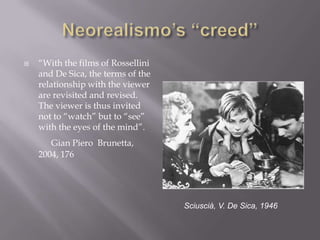
The “fathers” of Neorealismo	Roberto Rossellini (1906-1977):1945 Roma, città aperta (Rome, open city)1946 Paisà 1948 Germania Anno Zero (Germany Year Zero)Vittorio de Sica (1901-1974):1946 Sciuscià (Shoeshine)
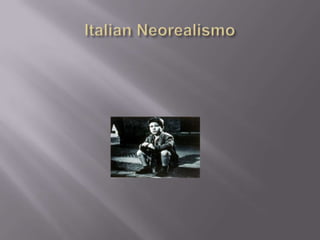
1948 Ladri di biclette (Bicycle Thieves)
1951 Miracolo a Milano (Miracle in Milan)Luchino Visconti (1906 -1976):1948 La terra trema (Earth Trembles)

Neo realismo

  • 1.
  • 2.
    A few facts11945 – end of war, Italy is finally liberated. A referendum abolishes monarchy. First republican government.Against all expectations, the Christian Democrats get an overwhelming majority of votes. The Communist Party, which played a significant role in the “Resistenza” against the Fascists, loses popularity but informs the work of eminent intellectuals.The country slowly re-builds itself. Poverty is rife, even though there are considerable class differences.
  • 3.
    A few facts2Between 1948 and 1951 Antonio Gramsci’s “Quaderni dal Carcere” are published. Many intellectuals discover/adopt Marxist ideology.The vivid class contrasts between the few “new” rich people and the starving majority prompts dreams of wealth and success – criticized by the Marxist intellectuals. Little funding is available for the arts. Yet, Cinecittà remains fully operative.
  • 4.
    NeorealismoIn line withMarxist/Gramscian ideology, the Neorealismo movement strive to expose and comment upon the rather grim reality shared by many Italians in the aftermath of WWII.As far as cinema is concerned, Neo-realismo juxtaposes the artificiality of the “plush” atmospheres of the Fascist “white telephones” cinema [cinema dei telefoni bianchi] with an often harsh portrayal of the conditions endured by Italians within social and historical contexts such as the struggle against the Fascists and the Nazi oppression, the difficulties of post-war period, the rural conditions, the urbanization, the “Americanization”, the human condition, literacy etc.With Neorealismo viewers become both recipients and protagonists.In the aftermath of the Fascist era and in the process of re-building both a country and a national identity, Neorealismo is a truly “national” cultural phenomenon, which crosses, explores and portrays life through the whole of Italy, without cultural and/or geographical divisions.The fiction of the studio sets is thus replaced with real places.Anna Magnani
  • 5.
    From MondoNuovo, I,n.1, 19 March 1945, p. 24“To produce a movie in Italy today is like to build a house starting with the roof (…) Yet, studios are packed and people are shooting. And it is surprising that only now that there no more facilities, Italian cinema-making mirrors exactly what is today’s reality in Italy. Cinecittà, which was so grand, majestic and luxurious, has become a sort of refugee camp. Machines have been stolen, or taken up North. All that is left are the few cameras and spotlights that some intelligent men managed to hide. And what about light? Power is constantly cut, there is not enough film, costumes and make up are problematic. Yet, we keep shooting.”
  • 6.
    Neorealismo aesthetics1With Neorealismocinema starts again from scratch. The idea is to rediscover a way of looking at the world and its inhabitants as if it were the first time – or as if through the innocent eyes of a child’s first discovery. It is as if reality itself steered and guided the camera’s eye, and imposed its own truth. Gian Piero Brunetta, 2007, 56
  • 7.
    Neorealismo aesthetics 2GillesDeleuze observed that, at the end of WWII, Italy was the first country to (re)gain what he called “an intuitive conscience” of the need to experiment with new images and new narratives. And , by acquiring such “conscience” Italian cinema questioned and challenged the action/image model proposed by American cinema, setting the clock back to the very origins of cinema itself.
  • 8.
    The “fathers” ofNeorealismo Roberto Rossellini (1906-1977):1945 Roma, città aperta (Rome, open city)1946 Paisà 1948 Germania Anno Zero (Germany Year Zero)Vittorio de Sica (1901-1974):1946 Sciuscià (Shoeshine)
  • 9.
    1948 Ladri dibiclette (Bicycle Thieves)
  • 10.
    1951 Miracolo aMilano (Miracle in Milan)Luchino Visconti (1906 -1976):1948 La terra trema (Earth Trembles)