Introduction
• • Graphtraversal means visiting all the
vertices of a graph.
• • BFS and DFS are two primary methods.
• • Common in pathfinding, AI, web crawling.
3.
Graph Basics
• •Graph: Vertices (nodes) and Edges
(connections)
• • Types: Directed/Undirected,
Weighted/Unweighted
• • Represented by adjacency list or matrix.
4.
What is BFS?
•• Breadth-First Search (BFS) explores
neighbors level by level.
• • Uses a queue (FIFO).
• • Best for shortest paths in unweighted
graphs.
5.
What is DFS?
•• Depth-First Search (DFS) goes deep before
backtracking.
• • Uses a stack or recursion.
• • Useful for cycle detection, topological sort.
6.
BFS Algorithm Steps
•1. Choose a start node.
• 2. Mark it visited and enqueue.
• 3. While the queue is not empty:
• - Dequeue a node.
• - Visit all unvisited neighbors, mark and
enqueue them.
• (Pseudo-code shown here)
7.
DFS Algorithm Steps
•1. Choose a start node.
• 2. Mark it visited.
• 3. Visit each unvisited neighbor recursively.
• (Pseudo-code shown here)
8.
BFS Example 1
•Graph: A-B-C, A-D, B-E, D-E
• Start: A
• BFS Order: A, B, D, C, E
• Queue at each step: (visuals or table)
9.
DFS Example 1
•Same graph as BFS Example 1
• Start: A
• DFS Order: A, B, C, E, D
• Call stack or recursion flow
10.
BFS Example 2– Maze Solver
• • Grid maze
• • BFS explores level-by-level
• • Ensures shortest path is found
• • Visual: Maze/grid animation
11.
DFS Example 2– Puzzle Solver
• • Used in Sudoku, N-Queens, etc.
• • Explores deeply
• • Backtracks on failure
12.
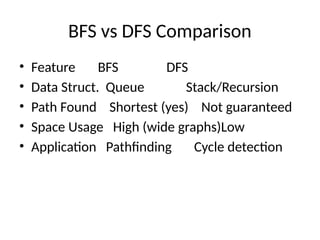
BFS vs DFSComparison
• Feature BFS DFS
• Data Struct. Queue Stack/Recursion
• Path Found Shortest (yes) Not guaranteed
• Space Usage High (wide graphs)Low
• Application Pathfinding Cycle detection
13.
BFS Applications
• •Finding shortest paths
• • Social networks (mutual friends)
• • GPS navigation
• • Web crawlers
BFS Example 3– Social Network
• • Nodes = People, Edges = Friendships
• • BFS helps find:
• - Friends of friends
• - Social distances
16.
DFS Example 3– File System
• • Folders = nodes, subfolders = edges
• • DFS explores folder hierarchy
• • Used in deep file search
17.
Conclusion & Q/A
•• BFS and DFS are fundamental algorithms
• • Know when to use each
• • Any questions?
18.
Real-World Analogies
• •BFS: Like waves spreading out in a pond –
reaches nearby nodes first.
• • DFS: Like exploring a cave – go deep,
backtrack on dead ends.
19.
Mini Use Case– BFS: Emergency
Evacuation
• In an office building, BFS helps find the
shortest route to the nearest exit.
• Simulates real-time emergency escape paths.
20.
Mini Use Case– DFS: Exploring a
Maze
• DFS is like someone trying every possible path
in a maze.
• Goes deep into one corridor until a dead end,
then backtracks.
21.
Advanced Variants
• •Bidirectional BFS – Efficient for huge graphs.
• • Iterative Deepening DFS – Combines DFS
space with BFS completeness.
• • BFS with Priority Queue – Leads into
Dijkstra’s Algorithm.
22.
Code Walkthrough –BFS (C++)
• // BFS Code Sample in C++
• queue<int> q;
• visited[start] = true;
• q.push(start);
• while (!q.empty()) {
• int node = q.front(); q.pop();
• for (int neighbor : adj[node]) {
• if (!visited[neighbor]) {
• visited[neighbor] = true;
23.
Memory Usage Comparison
•• Wide Graphs: BFS uses more memory
(queue grows large).
• • Deep Graphs: DFS is space-efficient (stack or
recursion depth).
24.
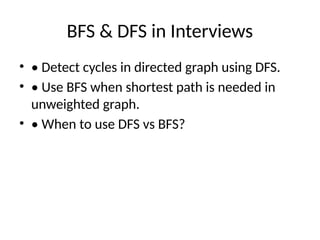
BFS & DFSin Interviews
• • Detect cycles in directed graph using DFS.
• • Use BFS when shortest path is needed in
unweighted graph.
• • When to use DFS vs BFS?
25.
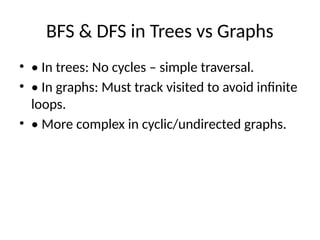
BFS & DFSin Trees vs Graphs
• • In trees: No cycles – simple traversal.
• • In graphs: Must track visited to avoid infinite
loops.
• • More complex in cyclic/undirected graphs.
26.
Bonus Example –Web Crawler
• • BFS starts from a URL, visits all directly
linked pages.
• • Great for level-based crawling like site map
generation.
27.
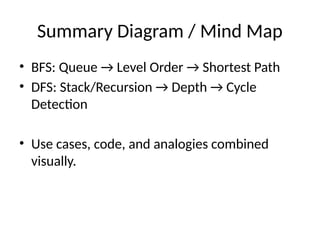
Summary Diagram /Mind Map
• BFS: Queue → Level Order → Shortest Path
• DFS: Stack/Recursion → Depth → Cycle
Detection
• Use cases, code, and analogies combined
visually.
![Graph Traversal Algorithms: BFS &
DFS
• Presented by: [Your Name]
• Course: Data Structures
• Instructor: [Instructor’s Name]](https://image.slidesharecdn.com/bfsdfsenhancedpresentation-250426135719-c30695ae/85/BFS_DFS_Enhanced_Presentation124567-pptx-1-320.jpg)





![Code Walkthrough – BFS (C++)
• // BFS Code Sample in C++
• queue<int> q;
• visited[start] = true;
• q.push(start);
• while (!q.empty()) {
• int node = q.front(); q.pop();
• for (int neighbor : adj[node]) {
• if (!visited[neighbor]) {
• visited[neighbor] = true;](https://image.slidesharecdn.com/bfsdfsenhancedpresentation-250426135719-c30695ae/85/BFS_DFS_Enhanced_Presentation124567-pptx-22-320.jpg)



![5G Explained! A High Level Overview [Introduction]](https://cdn.slidesharecdn.com/ss_thumbnails/5gexplainedahighleveloverview-260119165306-cc137a3e-thumbnail.jpg?width=640&height=640&fit=bounds)


