
DevSecOps:
The Open Source Way
Gordon Haff, Technology Evangelist, Red Hat
@ghaff
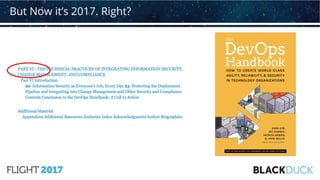
● DevOps “purists” point out that security was
always part of DevOps
● Did people just not read the book?
● Did people not understand the book?
● Are practitioners just skipping security
anyway?
WHY DevSecOps?
Source: IT Revolution, DevOps Enterprise abstract word cloud, 2014.
But Now it’s 2017. Right?
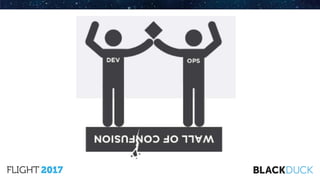
● A new silo
● Devs (often) don’t grok (even) traditional security
● Assembled applications and supply chains
● Security not integrated into pipeline
What’s the Problem?
SEC
OWASP Top 10
2007
Cross-site scripting (XSS)
Injection flaws
Malicious file execution
Insecure direct object reference
Cross-site request forgery (CSRF)
Information leakage & improper error handling
Broken authentication & session management
Insecure cryptographic storage
Insecure communications
Failure to restrict URL access
2017 RC2
Injection
Broken authentication
Sensitive data exposure
XML External Entities (XXE)
Broken access control
Security misconfiguration
Cross-site scripting (XSS)
Insecure deserialization
Using components with known vulnerabilities
Insufficient logging & monitoring
OWASP Top 10
2007
Cross-site scripting (XSS)
Injection flaws
Malicious file execution
Insecure direct object reference
Cross-site request forgery (CSRF)
Information leakage & improper error handling
Broken authentication & session management
Insecure cryptographic storage
Insecure communications
Failure to restrict URL access
2017 RC2
Injection
Broken authentication
Sensitive data exposure
XML External Entities (XXE)
Broken access control
Security misconfiguration
Cross-site scripting (XSS)
Insecure deserialization
Using components with known vulnerabilities
Insufficient logging & monitoring
OWASP Top 10
2007
Cross-site scripting (XSS)
Injection flaws
Malicious file execution
Insecure direct object reference
Cross-site request forgery (CSRF)
Information leakage & improper error handling
Broken authentication & session management
Insecure cryptographic storage
Insecure communications
Failure to restrict URL access
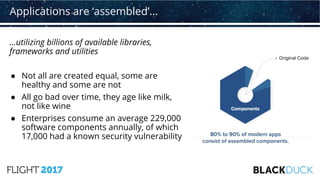
…utilizing billions of available libraries,
frameworks and utilities
● Not all are created equal, some are
healthy and some are not
● All go bad over time, they age like milk,
not like wine
● Enterprises consume an average 229,000
software components annually, of which
17,000 had a known security vulnerability
Applications are ‘assembled’...
A typical DevOps pipeline
How security integrates
● Better organizations
● Containers
● Secured supply chain
● Secured pipeline
● Secured operations
Opportunities!
}Managed approach to risk
Better Organizations
Kids programming: Esti Alvarez cc license
CULTURE
of collaboration
valuing openness
and transparency
Culture = f (l, o, i, t, …)
Where:
l = leadership
o = organization
i = incentives
t = trust
… = many other things
Open source offers guidance
Containers
What are containers?
● Sandboxed application processes
on a shared Linux OS kernel
● Simpler, lighter, and denser than
virtual machines
● Portable across different
environments
● Package my application and all of
its dependencies
● Deploy to any environment in
seconds and enable CI/CD
● Easily access and share
containerized components
Sys-Admins / Ops Developers
It Depends on Who You Ask
Containers technical timeline
LXC Initial
release
Aug ‘08
OpenShift
online
May
‘11
Docker Initial
release
Mar
‘13
OpenShift
Enterprise 3.0
Jun‘
15
Open
Container
Initiative
Initial release,
Buildah
Jun
‘17
Moby
Apr
‘17
Sep
‘17
CRI-O
Open source, leadership, and standards
● Docker/Moby
● Kubernetes/OpenShift
● OCI Specifications
● Cloud Native Technical Leadership
● Vendor/partner ecosystem
The community landscape
● Docker, Red Hat et al. June 2015
● Two Specifications
● Runtime
○ How to run a “filesystem bundle” that is unpacked on disk
● Image Format
○ How to create an OCI Image that contains sufficient information
to launch the application on the target platform
Open Container Initiative (OCI)
“Containers are an easy way to get a reasonable
percentage of security built in.”
John Willis
co-Author, DevOps Handbook
ServerlessConf 2017
Manage Risk
MANA
Reuse
AutomationMicroservices Immutability
Pervasive access
Speed
Rapid tech churn
Flexible deploys
Containers
Software-defined
MANAGED RISK
Dev Ops
Securing the assets
● Building code
○ Watching for changes in how things get built
○ Signing the builds
● Built assets
○ Scripts, binaries, packages (RPMs), containers
(OCI images), machine images (ISOs, etc.)
○ Registries (Service, Container, App)
○ Repositories (Local on host images assets)
Safe at Titan Missile Museum
https://upload.wikimedia.org/wikipedia/commons/5/59/Red_Safe%2C_Titan_Missile_Museum.jpg
Registries
● Do you require a private registry?
● What security meta-data is available
for your images?
● Are the images in the registry
updated regularly?
● Are there access controls on the
registry? How strong are they? Who
can push images to the registry?
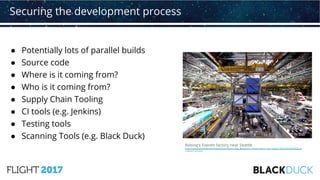
● Potentially lots of parallel builds
● Source code
● Where is it coming from?
● Who is it coming from?
● Supply Chain Tooling
● CI tools (e.g. Jenkins)
● Testing tools
● Scanning Tools (e.g. Black Duck)
Securing the development process
Boeing's Everett factory near Seattle
https://upload.wikimedia.org/wikipedia/commons/c/c8/At_Boeing%27s_Everett_factory_near_Seattle_%289130160595%29.jpg
Creative Commons
Ensure the application code is compliant
Ensure the pipeline is not compromised
Systematic, on-going, and automated
Securing the development process
Repo Scan
Image
Build
Scan
Dev
Deploy
Test
● How do ensure that all these
variations are working and
supported together?
● Containers and container
ecosystems help vendors to
continuously secure their
software
Track third-party development technologies
● Trusted registries and repos
● Signature authenticating and authorizing
● Image scanning
● Policies
● Ongoing assessment with automated
remediation
Securing the operations: Deployment
Mission Control - Apollo 13
https://c1.staticflickr.com/4/3717/9460197822_9f6ab3f30c_b.jpg
● Blue Green or A/B or Canary,
continuous deployments
● Monitoring deployments
● Possibly multiple environments
Securing the operations: Lifecycle
● Log (most) things
● Alarm few things
● Establish relevant metrics
● Root cause analysis (reactive)
● Detect patterns/trends (proactive)
● Context and distributions matter
● Incentives drive behavior
Securing the operations: Monitoring and metrics
“... we estimate that fewer than 20% of enterprise security architects
have engaged with their DevOps initiatives to actively and systematically
incorporate information security into their DevOps initiatives; and fewer still
have achieved the high degrees of security automation required to qualify as
DevSecOps.”
“By 2019, more than 70% of enterprise DevOps initiatives will have
incorporated automated security vulnerability and configuration
scanning for open source components and commercial packages, up from
less than 10% in 2016.”
How are we doing?
DevSecOps: How to Seemlessly Integrate Security Into DevOps, Gartner Inc. September 2016
Thank You!
Gordon Haff
Technology Evangelist, Red Hat
@ghaff
Cloudy Chat podcast
www.redhat.com
www.bitmasons.com

DevSecOps: The Open Source Way

  • 1.
    DevSecOps: The Open SourceWay Gordon Haff, Technology Evangelist, Red Hat @ghaff
  • 2.
    ● DevOps “purists”point out that security was always part of DevOps ● Did people just not read the book? ● Did people not understand the book? ● Are practitioners just skipping security anyway? WHY DevSecOps?
  • 3.
    Source: IT Revolution,DevOps Enterprise abstract word cloud, 2014.
  • 4.
    Source: IT Revolution,DevOps Enterprise abstract word cloud, 2014.
  • 5.
    But Now it’s2017. Right?
  • 7.
    ● A newsilo ● Devs (often) don’t grok (even) traditional security ● Assembled applications and supply chains ● Security not integrated into pipeline What’s the Problem?
  • 10.
  • 11.
    OWASP Top 10 2007 Cross-sitescripting (XSS) Injection flaws Malicious file execution Insecure direct object reference Cross-site request forgery (CSRF) Information leakage & improper error handling Broken authentication & session management Insecure cryptographic storage Insecure communications Failure to restrict URL access
  • 12.
    2017 RC2 Injection Broken authentication Sensitivedata exposure XML External Entities (XXE) Broken access control Security misconfiguration Cross-site scripting (XSS) Insecure deserialization Using components with known vulnerabilities Insufficient logging & monitoring OWASP Top 10 2007 Cross-site scripting (XSS) Injection flaws Malicious file execution Insecure direct object reference Cross-site request forgery (CSRF) Information leakage & improper error handling Broken authentication & session management Insecure cryptographic storage Insecure communications Failure to restrict URL access
  • 13.
    2017 RC2 Injection Broken authentication Sensitivedata exposure XML External Entities (XXE) Broken access control Security misconfiguration Cross-site scripting (XSS) Insecure deserialization Using components with known vulnerabilities Insufficient logging & monitoring OWASP Top 10 2007 Cross-site scripting (XSS) Injection flaws Malicious file execution Insecure direct object reference Cross-site request forgery (CSRF) Information leakage & improper error handling Broken authentication & session management Insecure cryptographic storage Insecure communications Failure to restrict URL access
  • 14.
    …utilizing billions ofavailable libraries, frameworks and utilities ● Not all are created equal, some are healthy and some are not ● All go bad over time, they age like milk, not like wine ● Enterprises consume an average 229,000 software components annually, of which 17,000 had a known security vulnerability Applications are ‘assembled’...
  • 15.
  • 16.
  • 17.
    ● Better organizations ●Containers ● Secured supply chain ● Secured pipeline ● Secured operations Opportunities! }Managed approach to risk
  • 18.
  • 19.
    Kids programming: EstiAlvarez cc license CULTURE of collaboration valuing openness and transparency
  • 20.
    Culture = f(l, o, i, t, …) Where: l = leadership o = organization i = incentives t = trust … = many other things Open source offers guidance
  • 21.
  • 22.
    What are containers? ●Sandboxed application processes on a shared Linux OS kernel ● Simpler, lighter, and denser than virtual machines ● Portable across different environments ● Package my application and all of its dependencies ● Deploy to any environment in seconds and enable CI/CD ● Easily access and share containerized components Sys-Admins / Ops Developers It Depends on Who You Ask
  • 23.
    Containers technical timeline LXCInitial release Aug ‘08 OpenShift online May ‘11 Docker Initial release Mar ‘13 OpenShift Enterprise 3.0 Jun‘ 15 Open Container Initiative Initial release, Buildah Jun ‘17 Moby Apr ‘17 Sep ‘17 CRI-O
  • 24.
    Open source, leadership,and standards ● Docker/Moby ● Kubernetes/OpenShift ● OCI Specifications ● Cloud Native Technical Leadership ● Vendor/partner ecosystem The community landscape
  • 25.
    ● Docker, RedHat et al. June 2015 ● Two Specifications ● Runtime ○ How to run a “filesystem bundle” that is unpacked on disk ● Image Format ○ How to create an OCI Image that contains sufficient information to launch the application on the target platform Open Container Initiative (OCI)
  • 26.
    “Containers are aneasy way to get a reasonable percentage of security built in.” John Willis co-Author, DevOps Handbook ServerlessConf 2017
  • 27.
  • 29.
    MANA Reuse AutomationMicroservices Immutability Pervasive access Speed Rapidtech churn Flexible deploys Containers Software-defined MANAGED RISK Dev Ops
  • 30.
    Securing the assets ●Building code ○ Watching for changes in how things get built ○ Signing the builds ● Built assets ○ Scripts, binaries, packages (RPMs), containers (OCI images), machine images (ISOs, etc.) ○ Registries (Service, Container, App) ○ Repositories (Local on host images assets) Safe at Titan Missile Museum https://upload.wikimedia.org/wikipedia/commons/5/59/Red_Safe%2C_Titan_Missile_Museum.jpg
  • 31.
    Registries ● Do yourequire a private registry? ● What security meta-data is available for your images? ● Are the images in the registry updated regularly? ● Are there access controls on the registry? How strong are they? Who can push images to the registry?
  • 32.
    ● Potentially lotsof parallel builds ● Source code ● Where is it coming from? ● Who is it coming from? ● Supply Chain Tooling ● CI tools (e.g. Jenkins) ● Testing tools ● Scanning Tools (e.g. Black Duck) Securing the development process Boeing's Everett factory near Seattle https://upload.wikimedia.org/wikipedia/commons/c/c8/At_Boeing%27s_Everett_factory_near_Seattle_%289130160595%29.jpg Creative Commons
  • 33.
    Ensure the applicationcode is compliant Ensure the pipeline is not compromised Systematic, on-going, and automated Securing the development process Repo Scan Image Build Scan Dev Deploy Test
  • 34.
    ● How doensure that all these variations are working and supported together? ● Containers and container ecosystems help vendors to continuously secure their software Track third-party development technologies
  • 35.
    ● Trusted registriesand repos ● Signature authenticating and authorizing ● Image scanning ● Policies ● Ongoing assessment with automated remediation Securing the operations: Deployment Mission Control - Apollo 13 https://c1.staticflickr.com/4/3717/9460197822_9f6ab3f30c_b.jpg
  • 36.
    ● Blue Greenor A/B or Canary, continuous deployments ● Monitoring deployments ● Possibly multiple environments Securing the operations: Lifecycle
  • 37.
    ● Log (most)things ● Alarm few things ● Establish relevant metrics ● Root cause analysis (reactive) ● Detect patterns/trends (proactive) ● Context and distributions matter ● Incentives drive behavior Securing the operations: Monitoring and metrics
  • 38.
    “... we estimatethat fewer than 20% of enterprise security architects have engaged with their DevOps initiatives to actively and systematically incorporate information security into their DevOps initiatives; and fewer still have achieved the high degrees of security automation required to qualify as DevSecOps.” “By 2019, more than 70% of enterprise DevOps initiatives will have incorporated automated security vulnerability and configuration scanning for open source components and commercial packages, up from less than 10% in 2016.” How are we doing? DevSecOps: How to Seemlessly Integrate Security Into DevOps, Gartner Inc. September 2016
  • 39.
    Thank You! Gordon Haff TechnologyEvangelist, Red Hat @ghaff Cloudy Chat podcast www.redhat.com www.bitmasons.com