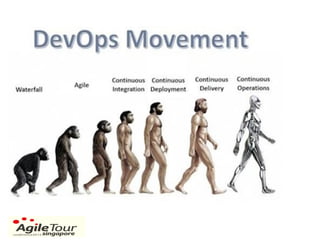
Devops
M MARIS PRABHAKARAN
Agile Coach, Singapore
Questions
• Development Team Operational Team
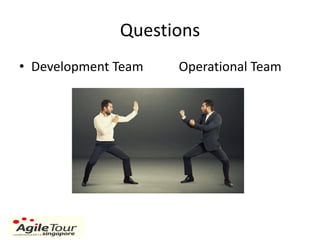
Questions
• Development Team Operational Team
It works fine for me...
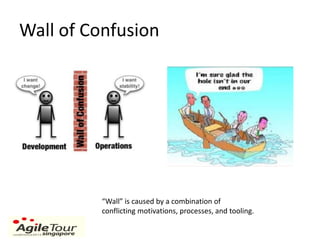
Wall of Confusion
“Wall” is caused by a combination of
conflicting motivations, processes, and tooling.
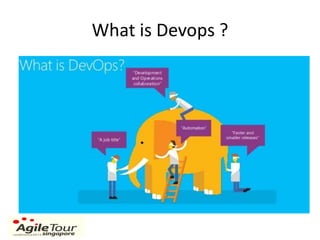
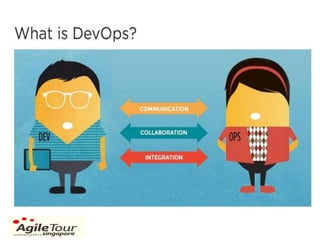
What is Devops ?
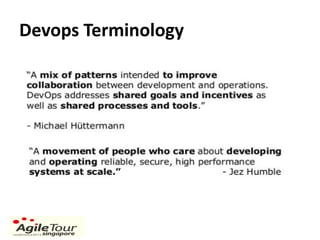
Devops Terminology
Devops Terminology
• Bridging the gap between projectsand operations
by using Agile techniques both in
development,project management
and system administration.
Patrick Debois
• Devops is banner for change
• Devops is a culture and Professional movement
Devops is CAMS
Culture
• People and process first. If you don’t have culture, all automation attempts will be fruitless.
Automation
• This is one of the places you start once you understand your culture. At this point, the tools can start
to stitch together an automation fabric for Devops. Tools for release management, provisioning,
configuration management, systems integration, monitoring and control, and orchestration become
important pieces in building a Devops fabric.
Measurement
• If you can’t measure, you can’t improve. A successful Devops implementation will measure everything
it can as often as it can… performance metrics, process metrics, and even people metrics.
Sharing
• Sharing is the loopback in the CAMS cycle. Creating a culture where people share ideas and problems
is critical.
John Willis
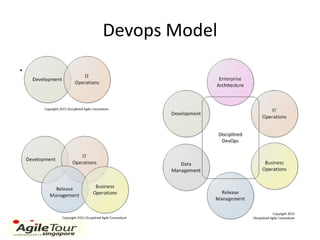
Disciplined DevOps
• Disciplined DevOps is the streamlining of IT
solution development and IT operations
activities, and supporting enterprise-IT
activities, to provide more effective outcomes
to an organization.
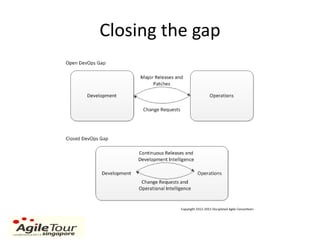
Closing the gap
Devops Model
.
Difficult to Come to a Common
Definition
• Specialized IT practitioners. Many IT professionals still tend to specialize – someone will choose to focus on being a programmer, an
operations engineer, an enterprise architect, a database administrator (DBA) and so on. As a result they tend to see the world through
the lens of their speciality. Programmers will focus on the software development aspects of DevOps, operations engineers the
operations aspects of DevOps, enterprise architects on the long-term planning and modelling aspects, and DBAs on the data
management aspects. Few people are looking at the overall “big picture”.
• Agilists are focused on continuous delivery. Right now agile and lean developers are investing a lot of effort to figure out continuous
delivery practices so as to streamline the regular deployment of value into production. Advanced teams are releasing daily if not
several times a day due to adoption of practices such as automated regression testing, continuous integration (CI), and continuous
delivery (CD). As a result most of the DevOps discussion in these communities focuses on these topics, sometimes straying into other
practices such as canary testing, feature toggles, and production monitoring frameworks. Clearly important techniques, but still not
covering the full potential range of DevOps. These practices and more are described later in this article.
• Operations professionals are often frustrated. Many operations groups are overwhelmed already with the rate of updates being
foisted upon them by development teams. This is often exacerbated by the inconsistent use of technologies – the impact of the lack of
enterprise awareness within undisciplined development teams is largely felt by the operations group who needs to support the
plethora of technology platforms used by the full range of development teams. Worse yet, the internal operations processes are often
based on heavy implementations of ITIL orITSM and have yet to be streamlined so that operations engineers are in a better position to
collaborate with development teams.
• Tool vendors have limited offerings. As a result of this the DevOps messaging from tool vendors will focus on just the aspects of
DevOps supported by their tools, narrowing the discussion to what they have on offer. Yes, tools are important, but they are only part
of the DevOps picture. Even if there was a vendor with a full range of tools, and if they actually interoperated smoothly (yes ALM
vendors, we’re referring to you), you would still need to understand how to use those tools effectively. To paraphrase an old saying – A
fool with a DevOps tool is still a fool.
• Service vendors have limited offerings. Similar to the issues surrounding tool vendors, service vendors are also making great claims
about their deep expertise in DevOps. Upon examination you will often find, like the tool vendors, their definition of DevOps will focus
on whatever they can currently support.
• Tool vendors treat DevOps as a marketing buzzword. To be blunt, many vendors have taken their existing products, and started
marketing them as DevOps products (regardless of how well those products actually support DevOps practices). Granted, these
products may have been very good at supporting traditional ways of working, but when it comes to supporting DevOps they prove to be
rather clunky even though they may have added a few new features.
• The DevOps=Cloud vision. There is a lot of rhetoric, particularly coming from Cloud vendors, about how cloud-based tooling and
deployment environments are critical to success in DevOps. Yes, having a cloud-based infrastructure clearly enables many DevOps
practices and given the choice we prefer to work in an environment which leverages cloud-based technologies whenever
appropriate. But, that doesn’t mean that the cloud is a prerequisite for doing DevOps.
Devops Strategies
• General Strategies(Collaborative work, Training, education, and mentoring, Continuous improvement)
• Teaming Strategies (Warranty period,Production support)
• Development Strategies (Canary tests, Split test)
• Operations Strategies
• Support (Help Desk) Strategies
• Release Management Strategies
• Data Management Strategies
• Enterprise Architecture Strategies
• https://disciplinedagiledelivery.wordpress.com/2015/02/08/devop
s-strategies-development/
Dev ops benefits
.
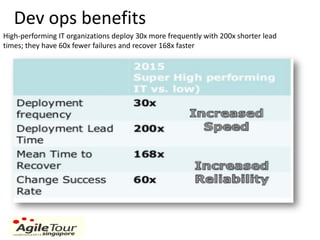
High-performing IT organizations deploy 30x more frequently with 200x shorter lead
times; they have 60x fewer failures and recover 168x faster
• Thank you
marisagility@gmail.com
https://www.linkedin.com/in/marisprabhu
#marisagility

Devops

  • 1.
  • 2.
  • 3.
  • 4.
    It works finefor me...
  • 5.
    Wall of Confusion “Wall”is caused by a combination of conflicting motivations, processes, and tooling.
  • 6.
  • 7.
  • 8.
    Devops Terminology • Bridgingthe gap between projectsand operations by using Agile techniques both in development,project management and system administration. Patrick Debois • Devops is banner for change • Devops is a culture and Professional movement
  • 10.
    Devops is CAMS Culture •People and process first. If you don’t have culture, all automation attempts will be fruitless. Automation • This is one of the places you start once you understand your culture. At this point, the tools can start to stitch together an automation fabric for Devops. Tools for release management, provisioning, configuration management, systems integration, monitoring and control, and orchestration become important pieces in building a Devops fabric. Measurement • If you can’t measure, you can’t improve. A successful Devops implementation will measure everything it can as often as it can… performance metrics, process metrics, and even people metrics. Sharing • Sharing is the loopback in the CAMS cycle. Creating a culture where people share ideas and problems is critical. John Willis
  • 12.
    Disciplined DevOps • DisciplinedDevOps is the streamlining of IT solution development and IT operations activities, and supporting enterprise-IT activities, to provide more effective outcomes to an organization.
  • 13.
  • 14.
  • 15.
    Difficult to Cometo a Common Definition • Specialized IT practitioners. Many IT professionals still tend to specialize – someone will choose to focus on being a programmer, an operations engineer, an enterprise architect, a database administrator (DBA) and so on. As a result they tend to see the world through the lens of their speciality. Programmers will focus on the software development aspects of DevOps, operations engineers the operations aspects of DevOps, enterprise architects on the long-term planning and modelling aspects, and DBAs on the data management aspects. Few people are looking at the overall “big picture”. • Agilists are focused on continuous delivery. Right now agile and lean developers are investing a lot of effort to figure out continuous delivery practices so as to streamline the regular deployment of value into production. Advanced teams are releasing daily if not several times a day due to adoption of practices such as automated regression testing, continuous integration (CI), and continuous delivery (CD). As a result most of the DevOps discussion in these communities focuses on these topics, sometimes straying into other practices such as canary testing, feature toggles, and production monitoring frameworks. Clearly important techniques, but still not covering the full potential range of DevOps. These practices and more are described later in this article. • Operations professionals are often frustrated. Many operations groups are overwhelmed already with the rate of updates being foisted upon them by development teams. This is often exacerbated by the inconsistent use of technologies – the impact of the lack of enterprise awareness within undisciplined development teams is largely felt by the operations group who needs to support the plethora of technology platforms used by the full range of development teams. Worse yet, the internal operations processes are often based on heavy implementations of ITIL orITSM and have yet to be streamlined so that operations engineers are in a better position to collaborate with development teams. • Tool vendors have limited offerings. As a result of this the DevOps messaging from tool vendors will focus on just the aspects of DevOps supported by their tools, narrowing the discussion to what they have on offer. Yes, tools are important, but they are only part of the DevOps picture. Even if there was a vendor with a full range of tools, and if they actually interoperated smoothly (yes ALM vendors, we’re referring to you), you would still need to understand how to use those tools effectively. To paraphrase an old saying – A fool with a DevOps tool is still a fool. • Service vendors have limited offerings. Similar to the issues surrounding tool vendors, service vendors are also making great claims about their deep expertise in DevOps. Upon examination you will often find, like the tool vendors, their definition of DevOps will focus on whatever they can currently support. • Tool vendors treat DevOps as a marketing buzzword. To be blunt, many vendors have taken their existing products, and started marketing them as DevOps products (regardless of how well those products actually support DevOps practices). Granted, these products may have been very good at supporting traditional ways of working, but when it comes to supporting DevOps they prove to be rather clunky even though they may have added a few new features. • The DevOps=Cloud vision. There is a lot of rhetoric, particularly coming from Cloud vendors, about how cloud-based tooling and deployment environments are critical to success in DevOps. Yes, having a cloud-based infrastructure clearly enables many DevOps practices and given the choice we prefer to work in an environment which leverages cloud-based technologies whenever appropriate. But, that doesn’t mean that the cloud is a prerequisite for doing DevOps.
  • 16.
    Devops Strategies • GeneralStrategies(Collaborative work, Training, education, and mentoring, Continuous improvement) • Teaming Strategies (Warranty period,Production support) • Development Strategies (Canary tests, Split test) • Operations Strategies • Support (Help Desk) Strategies • Release Management Strategies • Data Management Strategies • Enterprise Architecture Strategies • https://disciplinedagiledelivery.wordpress.com/2015/02/08/devop s-strategies-development/
  • 17.
    Dev ops benefits . High-performingIT organizations deploy 30x more frequently with 200x shorter lead times; they have 60x fewer failures and recover 168x faster
  • 18.