How to Run IT Support
the DevOps Way
John Custy
Managing Consultant
JPC Group
Sarah Khogyani
Product Marketing Manager
Atlassian
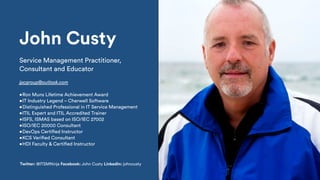
John Custy
Service Management Practitioner,
Consultant and Educator
jpcgroup@outlook.com
•Ron Muns Lifetime Achievement Award
•IT Industry Legend – Cherwell Software
•Distinguished Professional in IT Service Management
•ITIL Expert and ITIL Accredited Trainer
•ISFS, ISMAS based on ISO/IEC 27002
•ISO/IEC 20000 Consultant
•DevOps Certified Instructor
•KCS Verified Consultant
•HDI Faculty & Certified Instructor
Twitter: @ITSMNinja Facebook: John Custy LinkedIn: johncusty
DEVOPS OVERVIEW
TODAY
DEVOPS VALUES
DEVOPS FOR SUPPORT
Agenda
CRITICAL SUCCESS FACTORS
Today’s situation
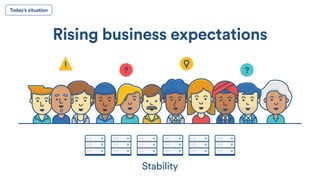
Rising business expectations
??
Stability
Today’s situation
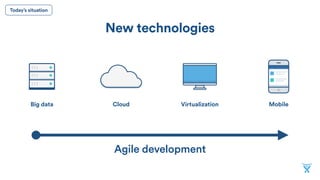
MobileCloudBig data
New technologies
Virtualization
Agile development
Today’s situation
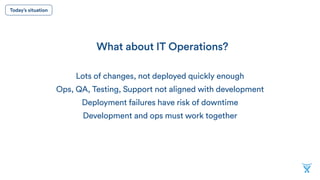
Lots of changes, not deployed quickly enough
Ops, QA, Testing, Support not aligned with development
Deployment failures have risk of downtime
Development and ops must work together
What about IT Operations?
Today’s situation
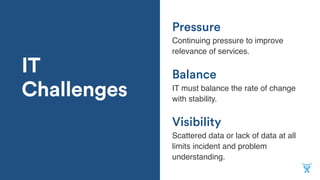
IT
Challenges
Visibility
Continuing pressure to improve
relevance of services.
Balance
IT must balance the rate of change
with stability.
Pressure
Scattered data or lack of data at all
limits incident and problem
understanding.
Support
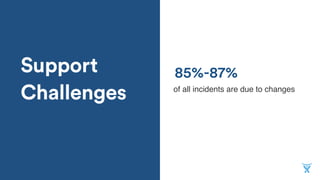
Challenges of all incidents are due to changes
85%-87%
Support
Challenges Support is often unaware of changes
being made to services they support.
What changes?
Support
Challenges Duplication of work happens in
support and across IT groups.
Rework
Support
Challenges Support is hidden from developers,
product owners and product
managers.
Silo’d
DevOps Overview
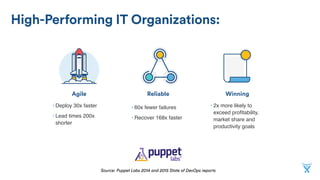
ReliableAgile
High-Performing IT Organizations:
Winning
• 60x fewer failures
• Recover 168x faster
• Deploy 30x faster
• Lead times 200x
shorter
• 2x more likely to
exceed profitability,
market share and
productivity goals
Source: Puppet Labs 2014 and 2015 State of DevOps reports
Reliability
What do customers care about?
New functionality
Enabling the business and their customers by providing more
reliable services. When there’s an interruption, they’re able to
recover faster and minimize impact to the business.
High-performing IT organizations are
Enabling the business
High-Performing IT Organizations:
What is
DevOps?
DevOps is a movement that
advocates a collaborative working
relationship between development
and IT operations.
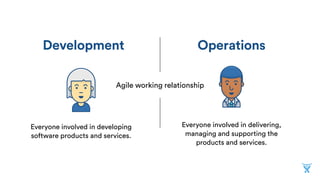
Development Operations
Everyone involved in developing
software products and services.
Everyone involved in delivering,
managing and supporting the
products and services.
Agile working relationship
Where did DevOps come from?
•Processes in place today aren’t meeting business needs.
•Response to bureaucratic processes
Notable DevOps practitioners:
DevOps Principles: The Three Ways
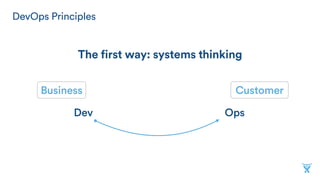
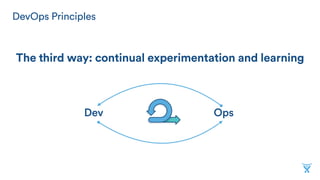
DevOps Principles
Dev Ops
Business Customer
The first way: systems thinking
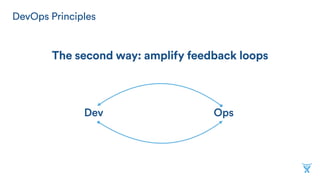
DevOps Principles
Dev Ops
The second way: amplify feedback loops
DevOps Principles
The third way: continual experimentation and learning
Dev Ops
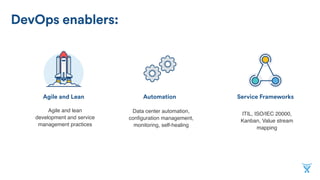
Agile and Lean
DevOps enablers:
Agile and lean
development and service
management practices
Automation Service Frameworks
Data center automation,
configuration management,
monitoring, self-healing
ITIL, ISO/IEC 20000,
Kanban, Value stream
mapping
DevOps Values
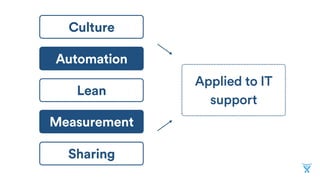
Keep C.A.L.M.S.
and DevOps On
Automation
Measurement
Lean
Sharing
Applied to IT
support
Culture
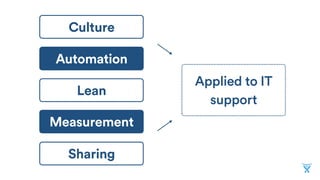
Automation
Measurement
Lean
Sharing
Applied to IT
support
Culture
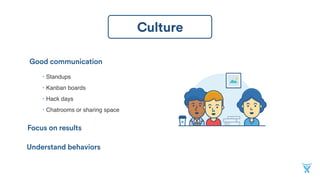
Culture
Focus on results
Understand behaviors
Good communication
• Standups
• Kanban boards
• Hack days
• Chatrooms or sharing space
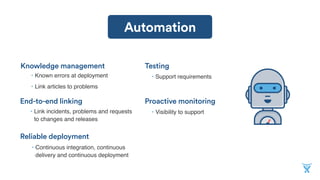
Knowledge management
• Known errors at deployment
• Link articles to problems
Automation
End-to-end linking
• Link incidents, problems and requests
to changes and releases
Reliable deployment
• Continuous integration, continuous
delivery and continuous deployment
Testing
• Support requirements
Proactive monitoring
• Visibility to support
Lean
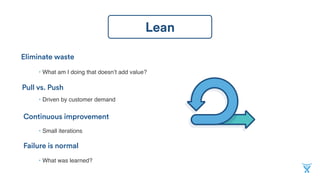
Eliminate waste
• What am I doing that doesn’t add value?
Pull vs. Push
• Driven by customer demand
Continuous improvement
• Small iterations
Failure is normal
• What was learned?
Waterlilies
& Lean
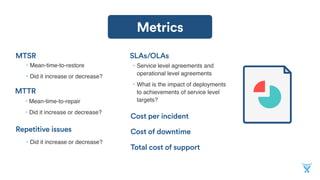
MTSR
• Mean-time-to-restore
• Did it increase or decrease?
Metrics
MTTR
• Mean-time-to-repair
• Did it increase or decrease?
Repetitive issues
• Did it increase or decrease?
SLAs/OLAs
• Service level agreements and
operational level agreements
• What is the impact of deployments
to achievements of service level
targets?
Cost per incident
Total cost of support
Cost of downtime
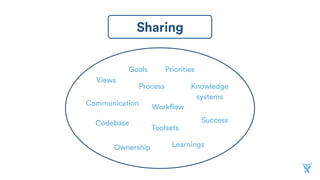
Sharing
Views
Goals Priorities
Process Knowledge
systems
Communication
Codebase
Toolsets
Ownership
Success
Workflow
Learnings
Outcomes Visions and goals must be linked to
business outcomes.
Innovation
Outcomes Ensure categorizations and tools
enable collaboration.
Sharing
Outcomes Incidents, problems and changes are
part the backlog.
Process
Outcomes Continually improve service design,
service transition and service
operations.
Improvement
What does success
look like?
Learning
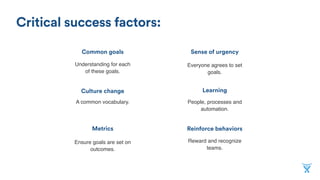
Sense of urgencyCommon goals
Critical success factors:
Culture change
Everyone agrees to set
goals.
Understanding for each
of these goals.
People, processes and
automation.
A common vocabulary.
Metrics Reinforce behaviors
Ensure goals are set on
outcomes.
Reward and recognize
teams.
Thanks for watching!

Run IT Support the DevOps Way