DevOps
NAJIB RADZUAN
Content
1 2
What is
DevOps?
3 4
DevOps v Agile
5
Azure DevOps
CI/CD Demo
6
Conclusion
DevOps Maturity
Model
Introduction/
Background
INTRO. & BACKGROUND
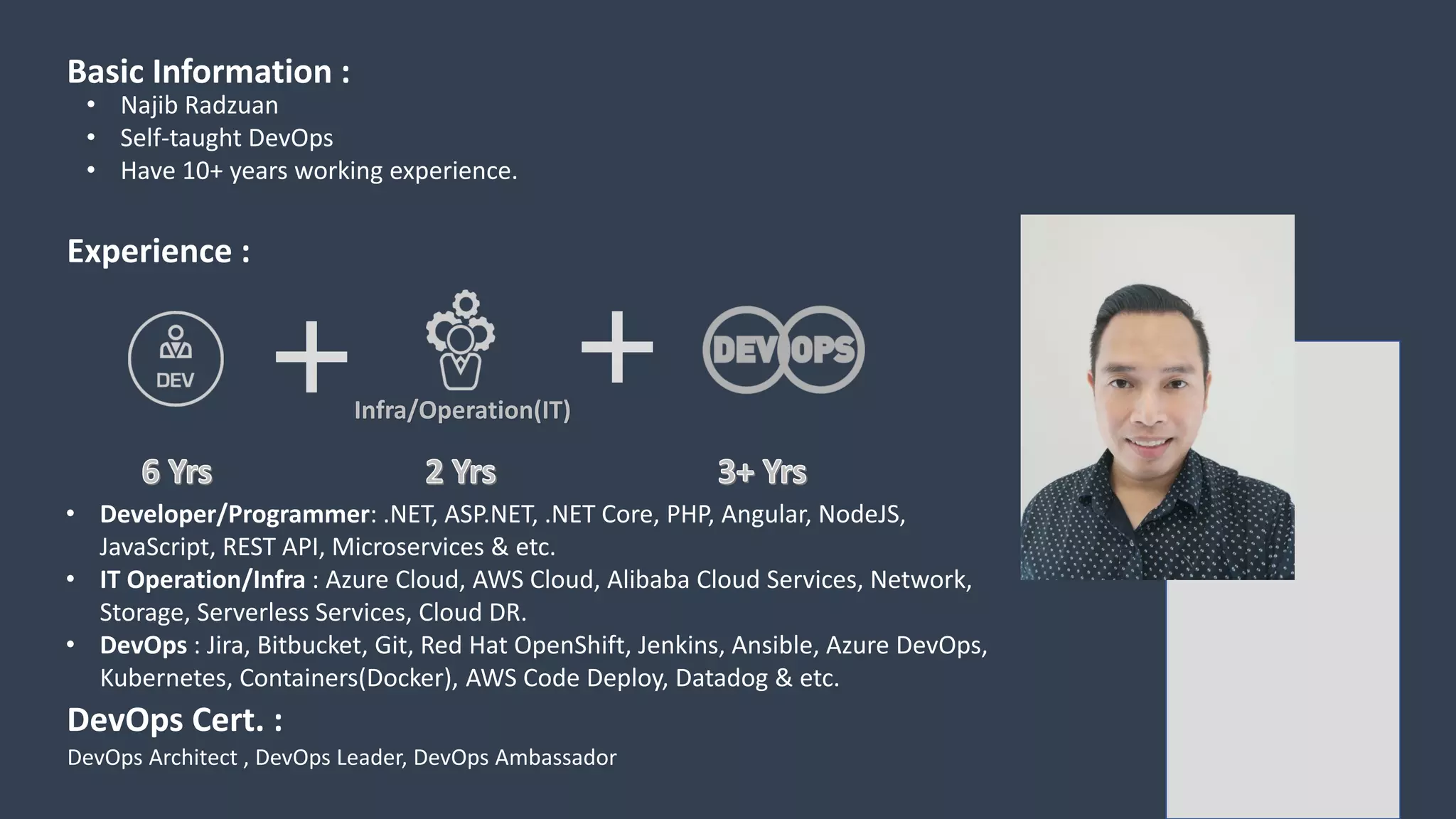
Basic Information :
Experience :
DevOps Cert. :
• Najib Radzuan
• Self-taught DevOps
• Have 10+ years working experience.
Infra/Operation(IT)
DevOps Architect , DevOps Leader, DevOps Ambassador
• Developer/Programmer: .NET, ASP.NET, .NET Core, PHP, Angular, NodeJS,
JavaScript, REST API, Microservices & etc.
• IT Operation/Infra : Azure Cloud, AWS Cloud, Alibaba Cloud Services, Network,
Storage, Serverless Services, Cloud DR.
• DevOps : Jira, Bitbucket, Git, Red Hat OpenShift, Jenkins, Ansible, Azure DevOps,
Kubernetes, Containers(Docker), AWS Code Deploy, Datadog & etc.
• Development Team have a long lead times to get software into
production make it difficult for companies to provide good services
and enhance the customer experience.
• Organization want to adopt the DevOps Culture(Process) and
methodology(Toolset).
• Hence, eliminates the barriers and exploits the dependencies
between development and operations.
BACKGROUND
WHAT IS DEVOPS
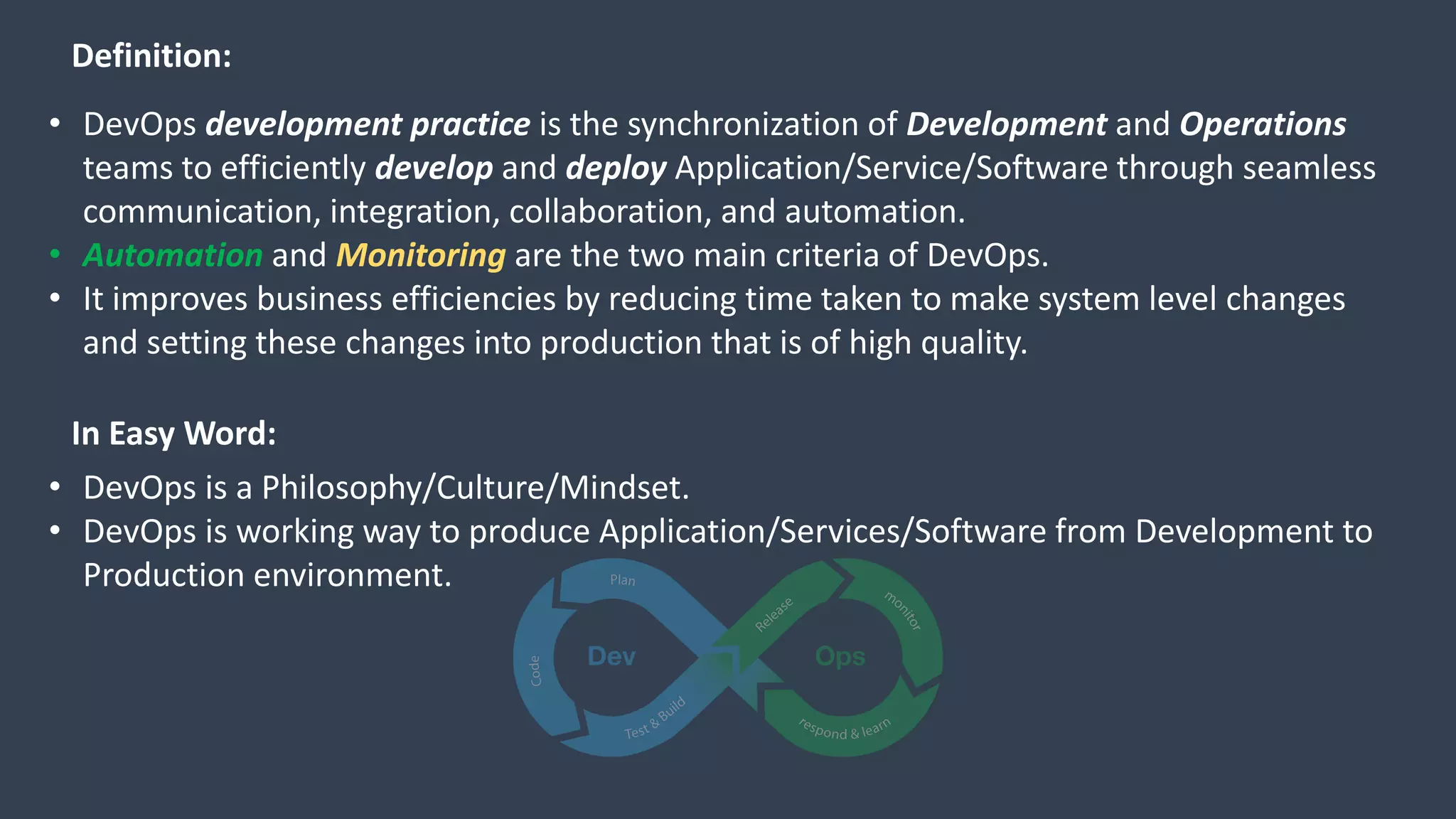
• DevOps development practice is the synchronization of Development and Operations
teams to efficiently develop and deploy Application/Service/Software through seamless
communication, integration, collaboration, and automation.
• Automation and Monitoring are the two main criteria of DevOps.
• It improves business efficiencies by reducing time taken to make system level changes
and setting these changes into production that is of high quality.
Definition:
In Easy Word:
• DevOps is a Philosophy/Culture/Mindset.
• DevOps is working way to produce Application/Services/Software from Development to
Production environment.
BENEFIT & WHY DO DEVOPS?
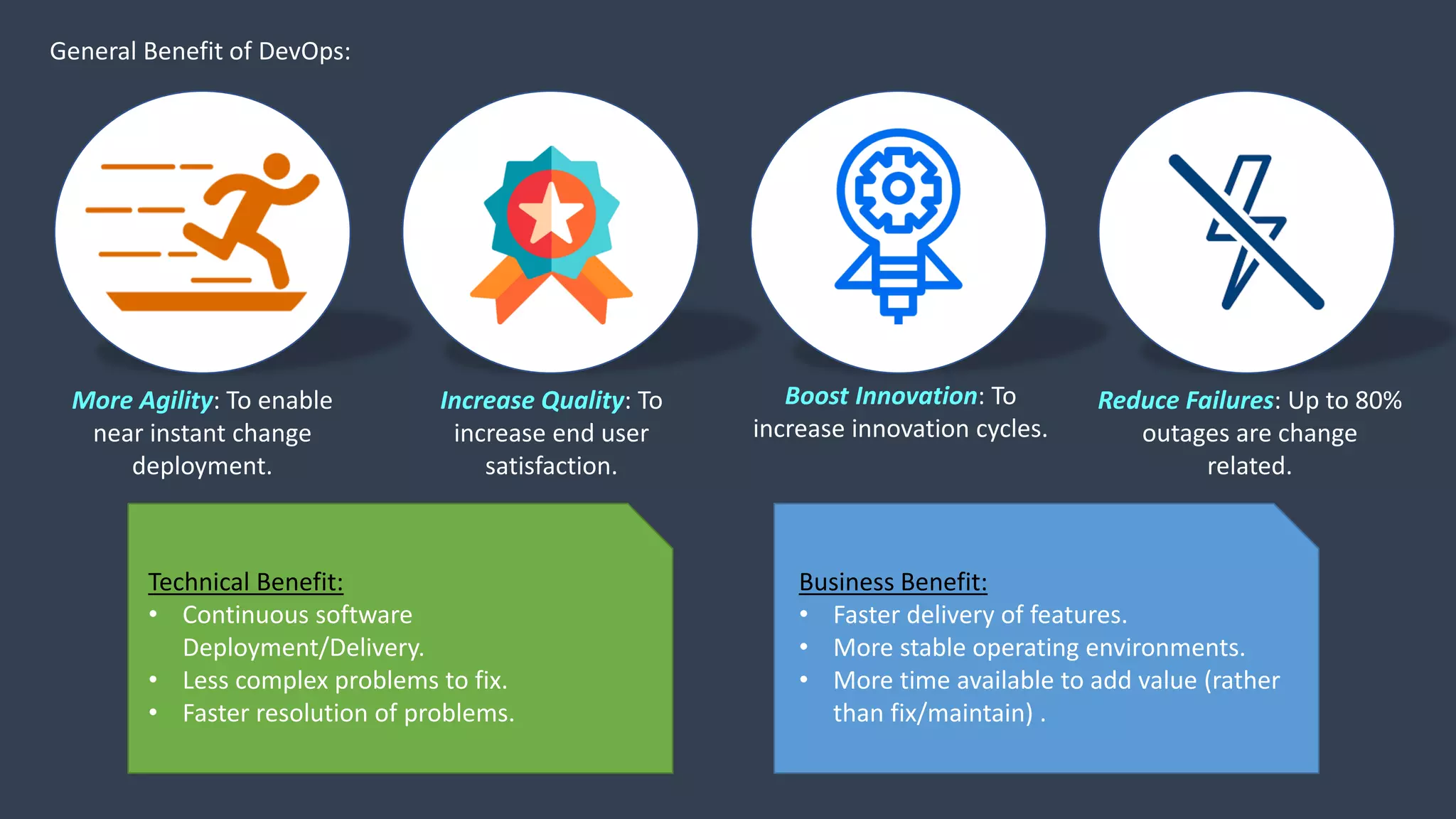
General Benefit of DevOps:
More Agility: To enable
near instant change
deployment.
Increase Quality: To
increase end user
satisfaction.
Boost Innovation: To
increase innovation cycles.
Reduce Failures: Up to 80%
outages are change
related.
Technical Benefit:
• Continuous software
Deployment/Delivery.
• Less complex problems to fix.
• Faster resolution of problems.
Business Benefit:
• Faster delivery of features.
• More stable operating environments.
• More time available to add value (rather
than fix/maintain) .
DEVOPS MATURITY MODEL
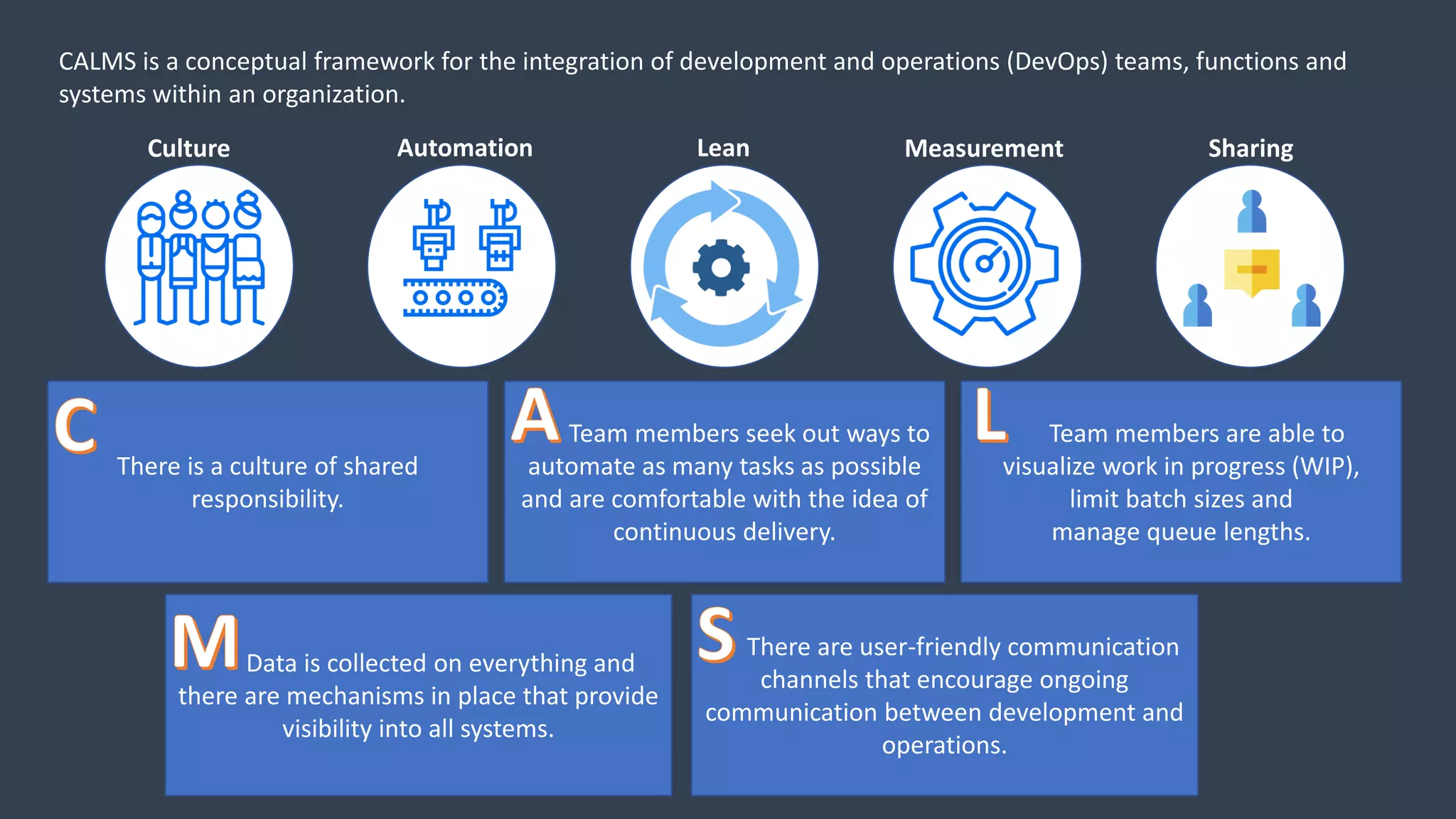
Culture Automation Lean Measurement Sharing
There is a culture of shared
responsibility.
Data is collected on everything and
there are mechanisms in place that provide
visibility into all systems.
There are user-friendly communication
channels that encourage ongoing
communication between development and
operations.
Team members seek out ways to
automate as many tasks as possible
and are comfortable with the idea of
continuous delivery.
Team members are able to
visualize work in progress (WIP),
limit batch sizes and
manage queue lengths.
CALMS is a conceptual framework for the integration of development and operations (DevOps) teams, functions and
systems within an organization.
MYTH IN DEVOPS
(WHAT NOT DEVOPS)
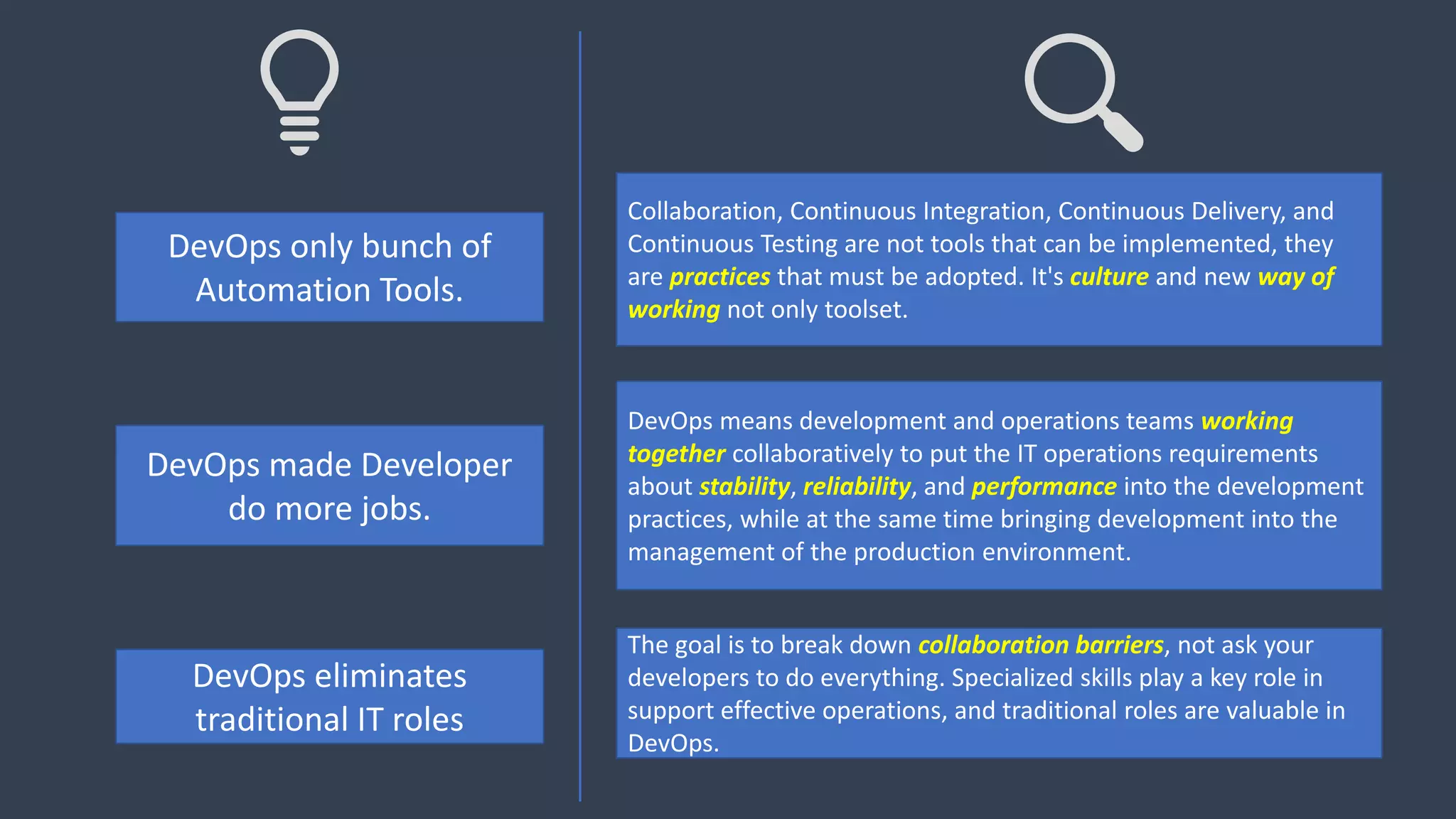
DevOps only bunch of
Automation Tools.
Collaboration, Continuous Integration, Continuous Delivery, and
Continuous Testing are not tools that can be implemented, they
are practices that must be adopted. It's culture and new way of
working not only toolset.
DevOps made Developer
do more jobs.
DevOps means development and operations teams working
together collaboratively to put the IT operations requirements
about stability, reliability, and performance into the development
practices, while at the same time bringing development into the
management of the production environment.
DevOps eliminates
traditional IT roles
The goal is to break down collaboration barriers, not ask your
developers to do everything. Specialized skills play a key role in
support effective operations, and traditional roles are valuable in
DevOps.
DEVOPS VS AGILE
Customer
+
Software Requirement
Software Developer
+
Tester/QA
IT Operation
+
IT Infrastructure
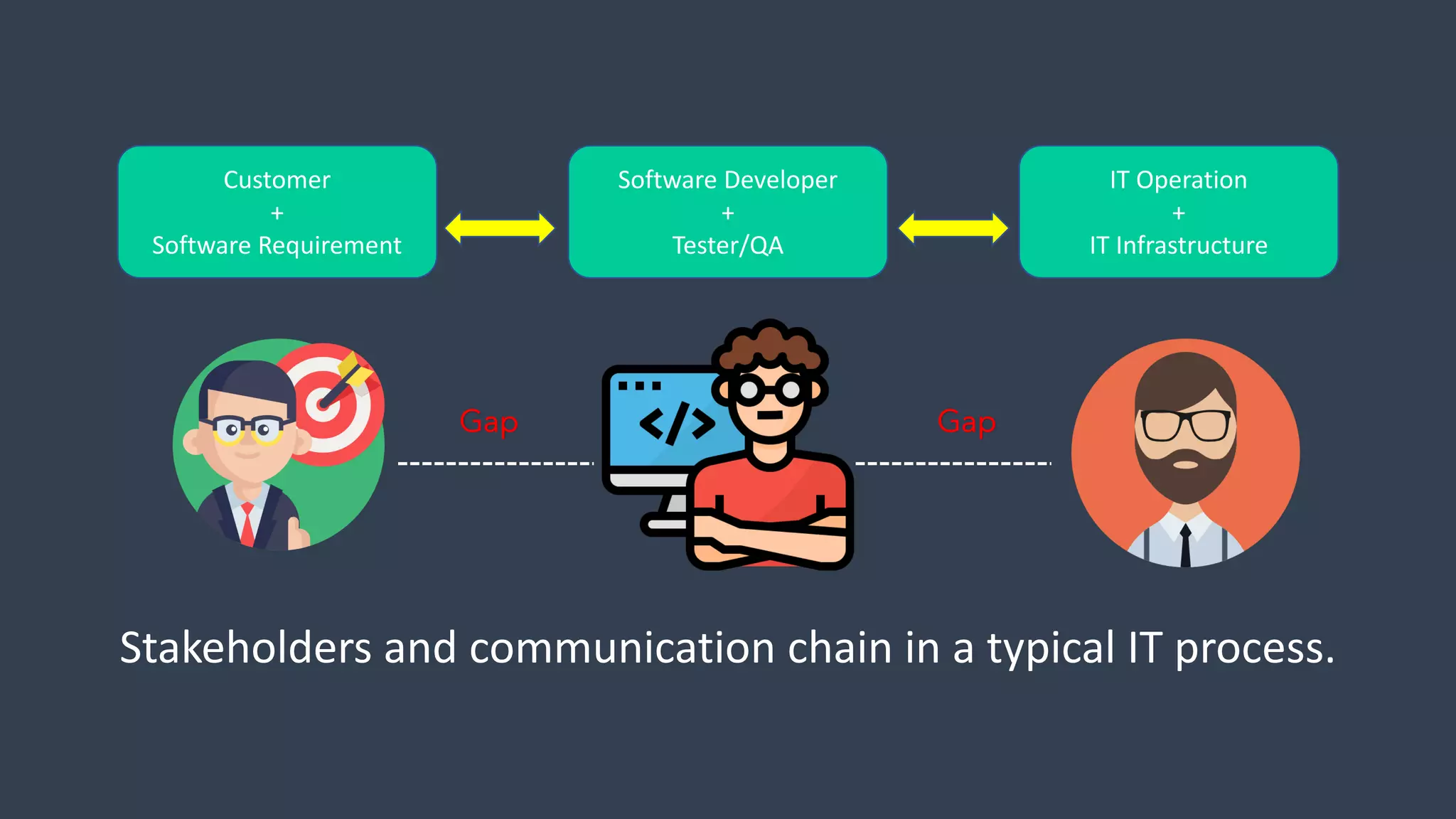
Stakeholders and communication chain in a typical IT process.
GapGap
Customer
+
Software Requirement
Software Developer
+
Tester/QA
IT Operation
+
IT Infrastructure
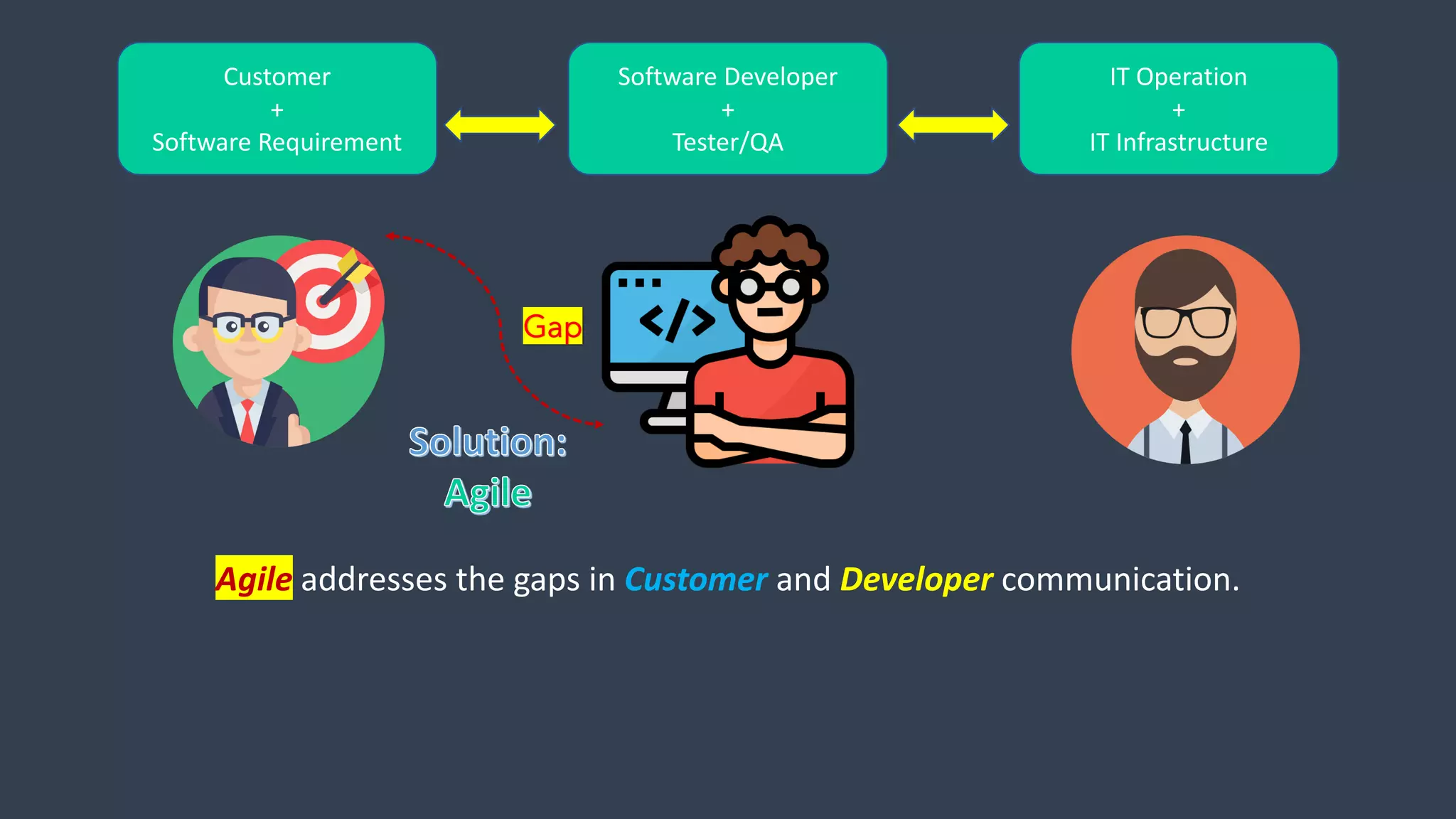
Agile addresses the gaps in Customer and Developer communication.
Gap
Customer
+
Software Requirement
Software Developer
+
Tester/QA
IT Operation
+
IT Infrastructure
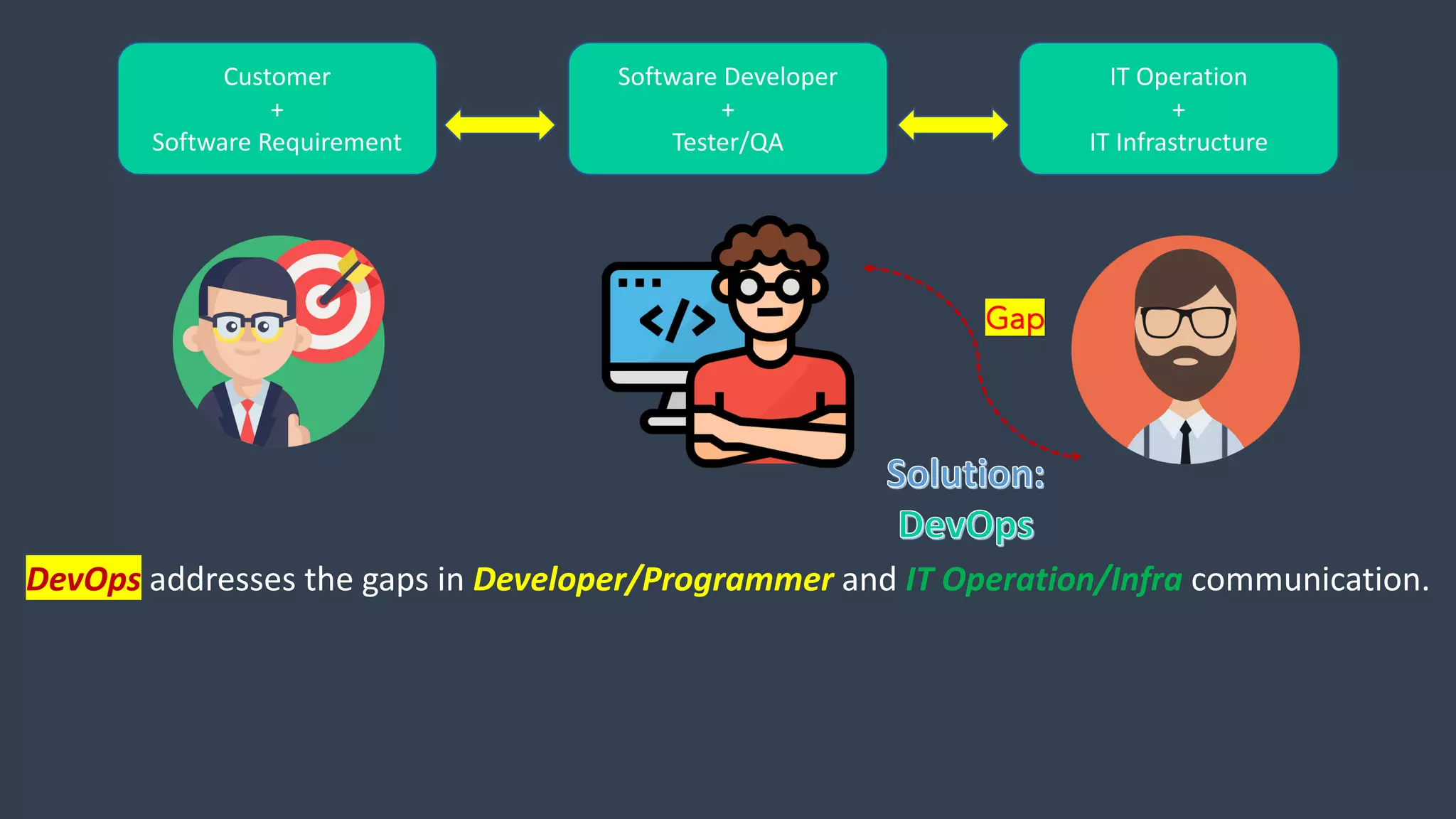
DevOps addresses the gaps in Developer/Programmer and IT Operation/Infra communication.
Gap
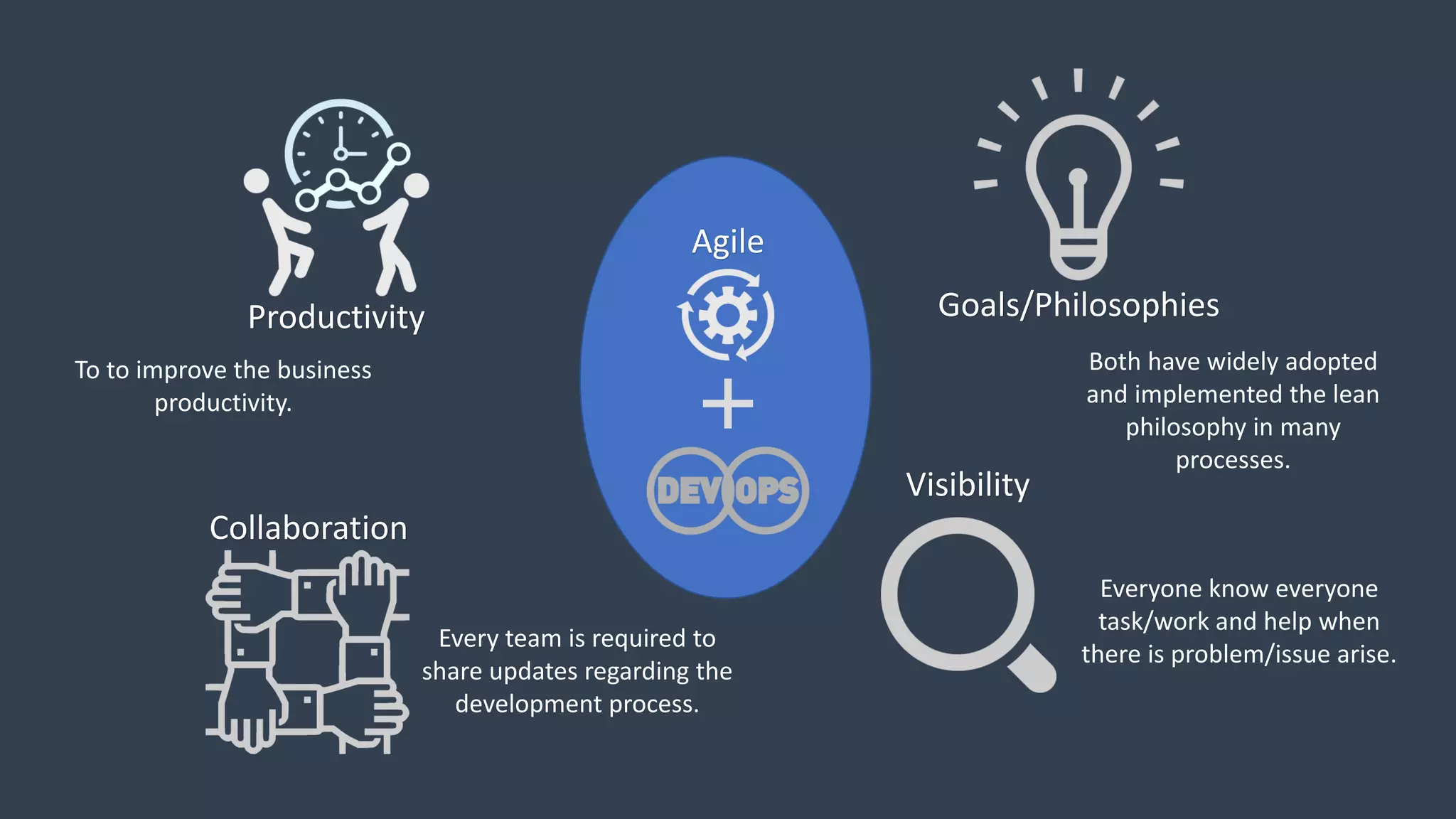
SIMILARITY OF DEVOPS & AGILE
Agile
Productivity Goals/Philosophies
Collaboration
Visibility
To to improve the business
productivity.
Both have widely adopted
and implemented the lean
philosophy in many
processes.
Every team is required to
share updates regarding the
development process.
Everyone know everyone
task/work and help when
there is problem/issue arise.
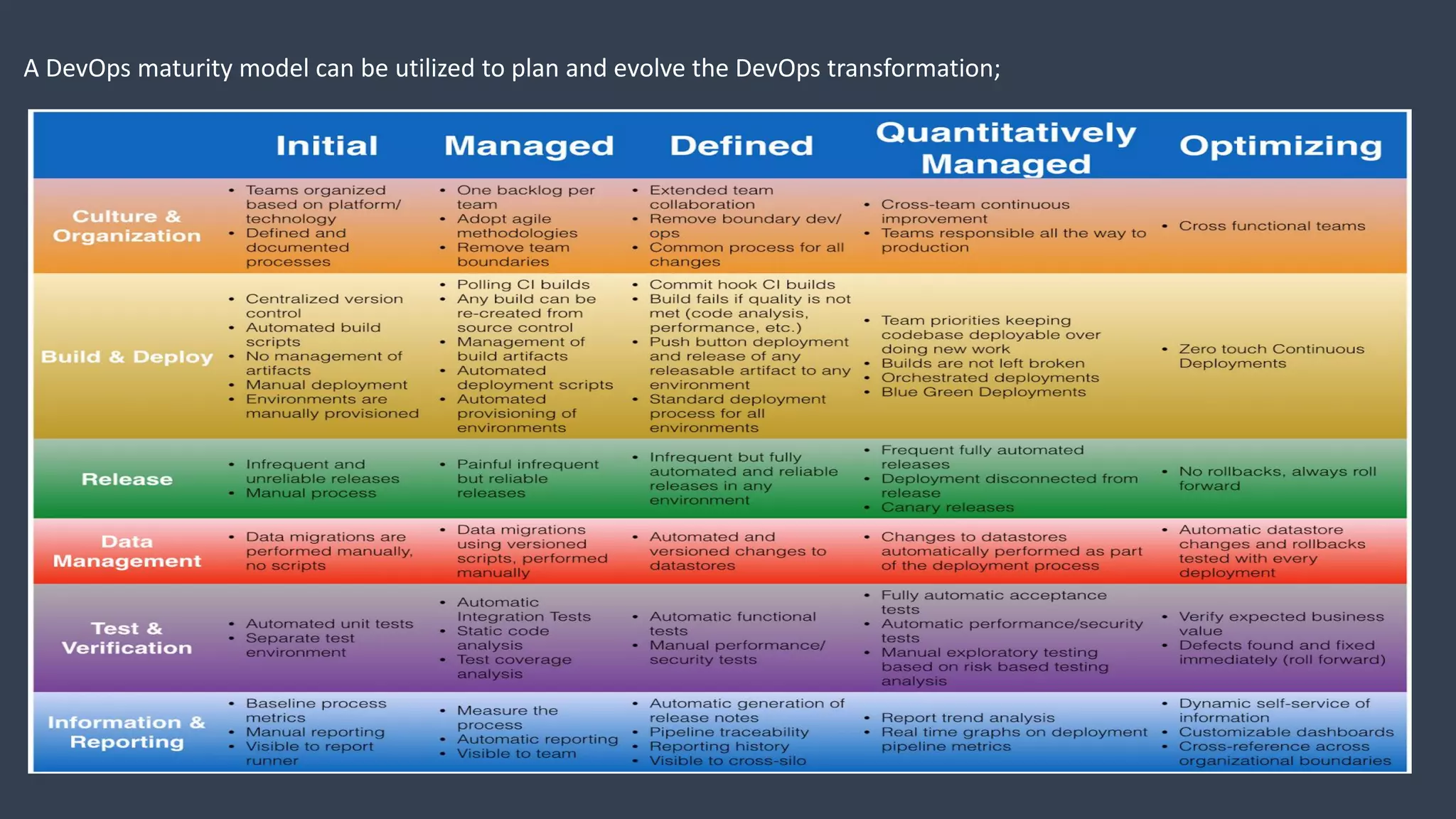
DEVOPS MATURITY MODEL
A DevOps maturity model can be utilized to plan and evolve the DevOps transformation;
AZURE DEVOPS DEMO
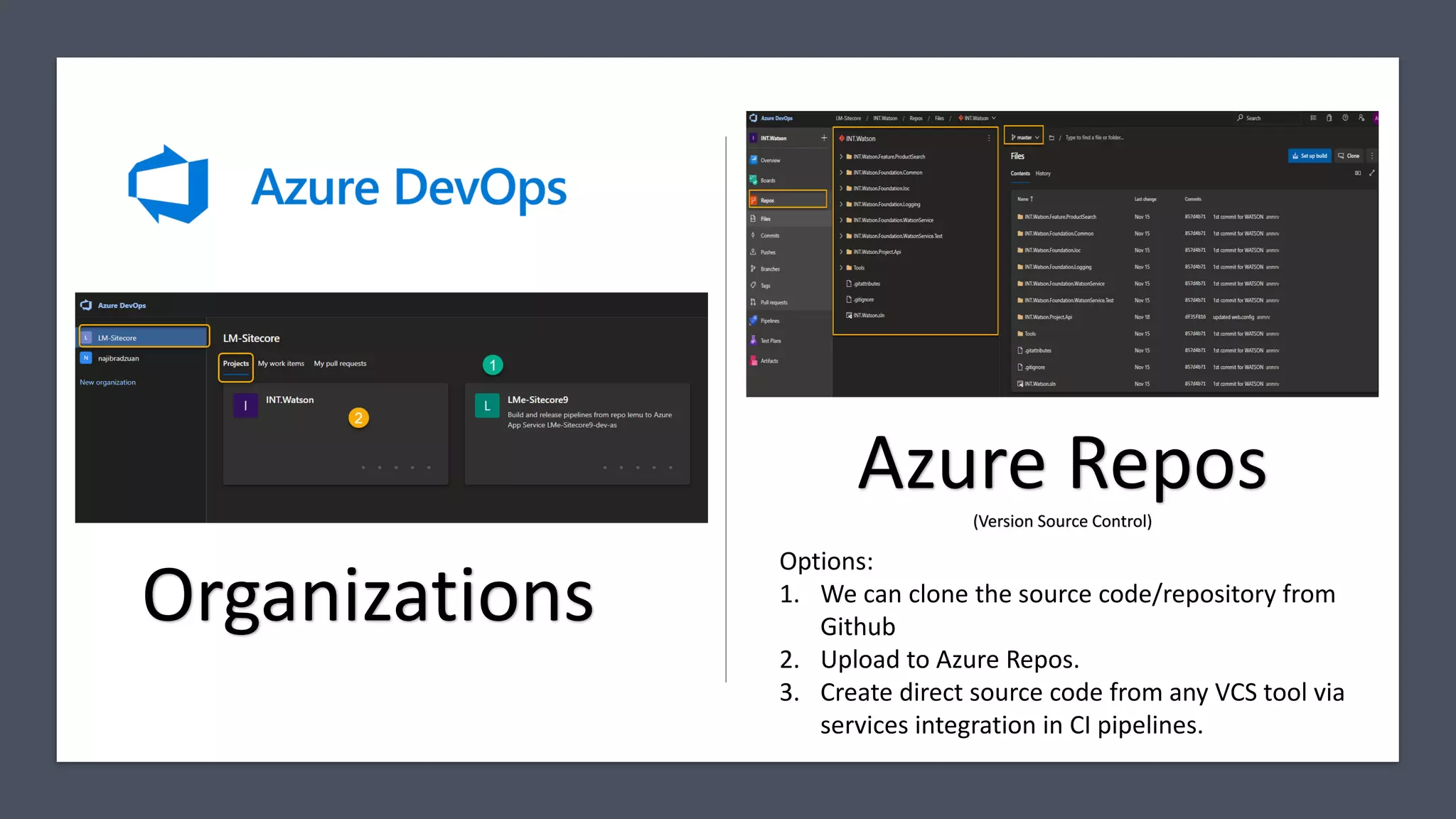
Organizations
Azure Repos(Version Source Control)
Options:
1. We can clone the source code/repository from
Github
2. Upload to Azure Repos.
3. Create direct source code from any VCS tool via
services integration in CI pipelines.
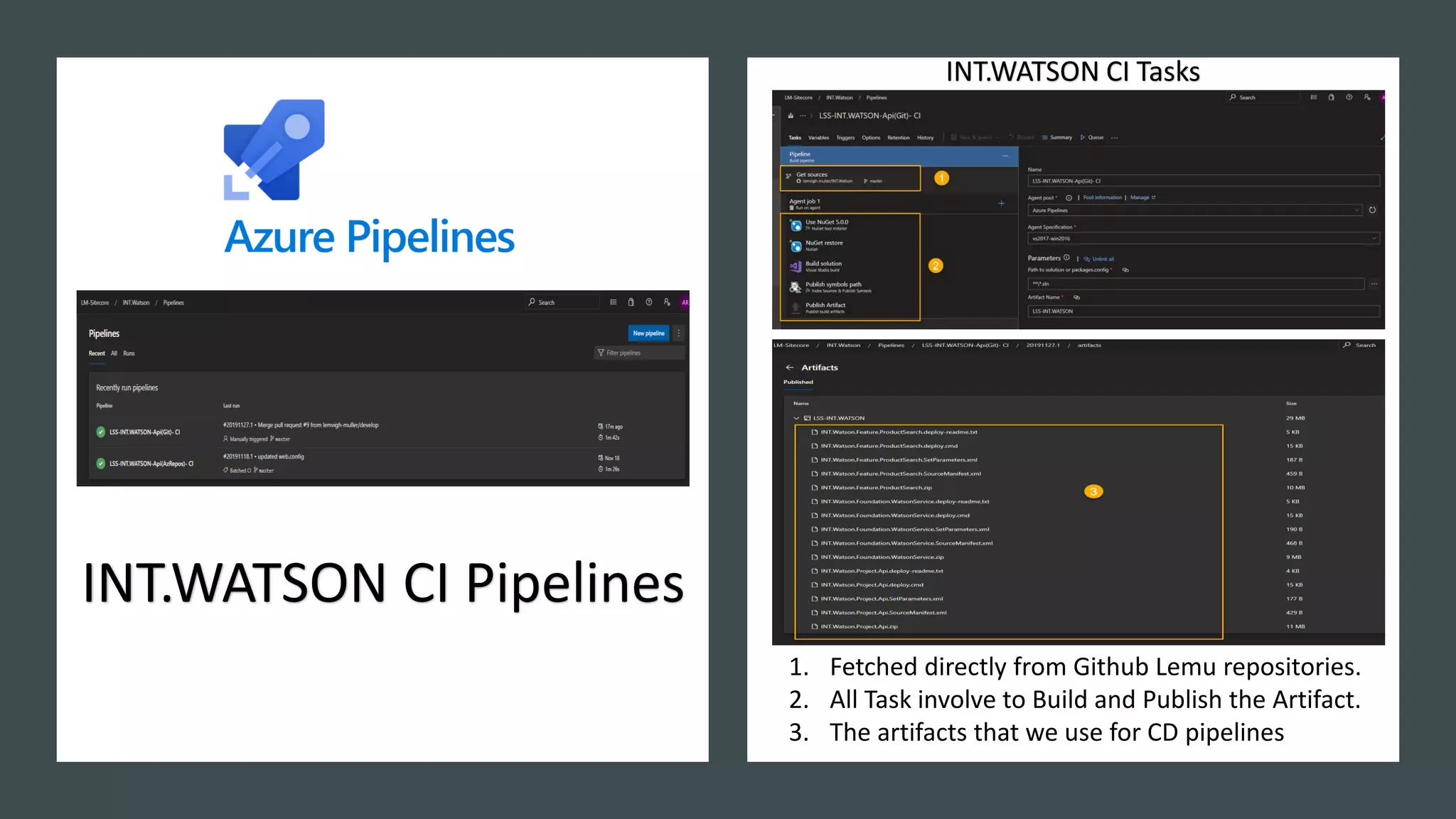
INT.WATSON CI Pipelines
INT.WATSON CI Tasks
1. Fetched directly from Github Lemu repositories.
2. All Task involve to Build and Publish the Artifact.
3. The artifacts that we use for CD pipelines
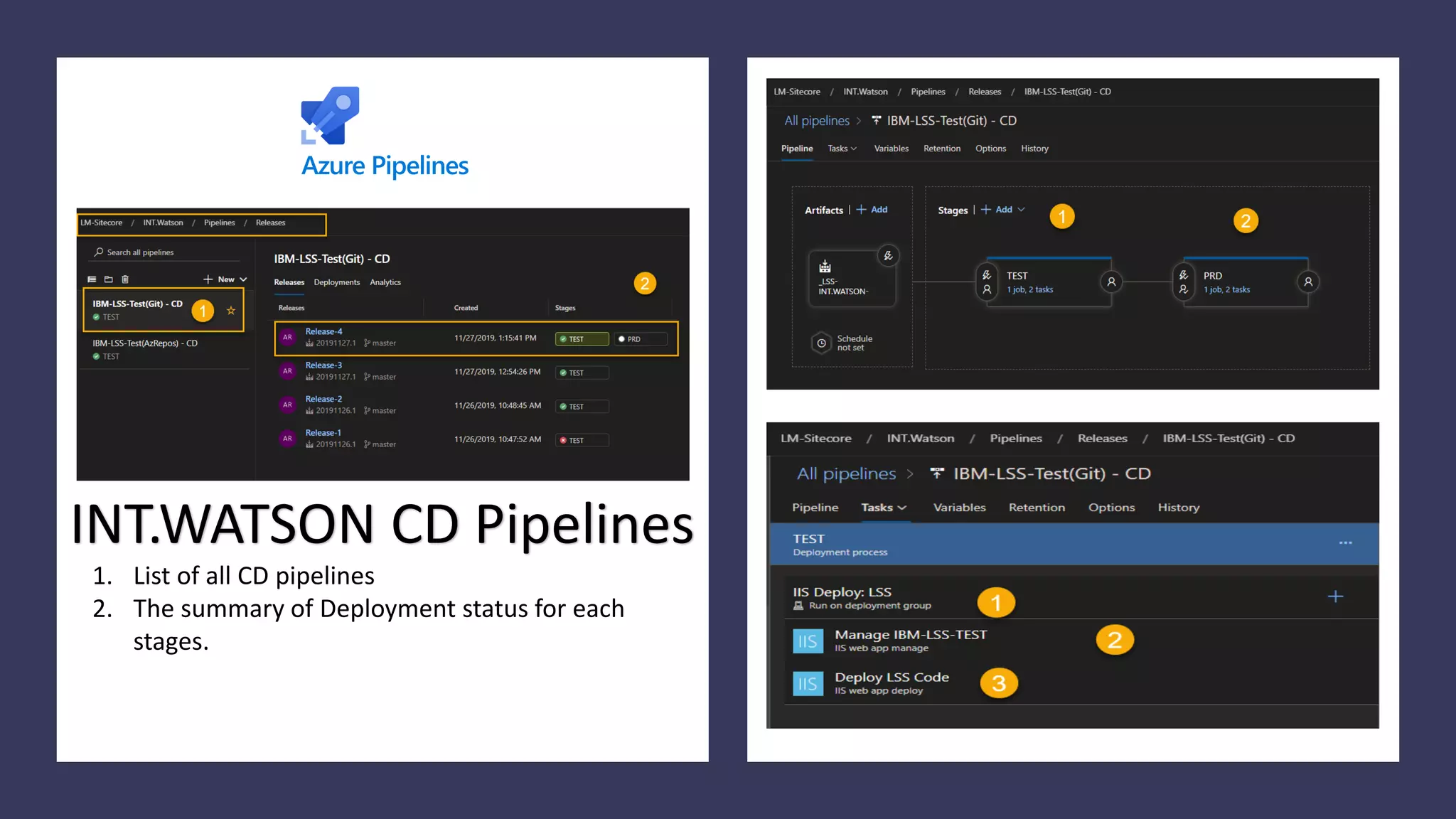
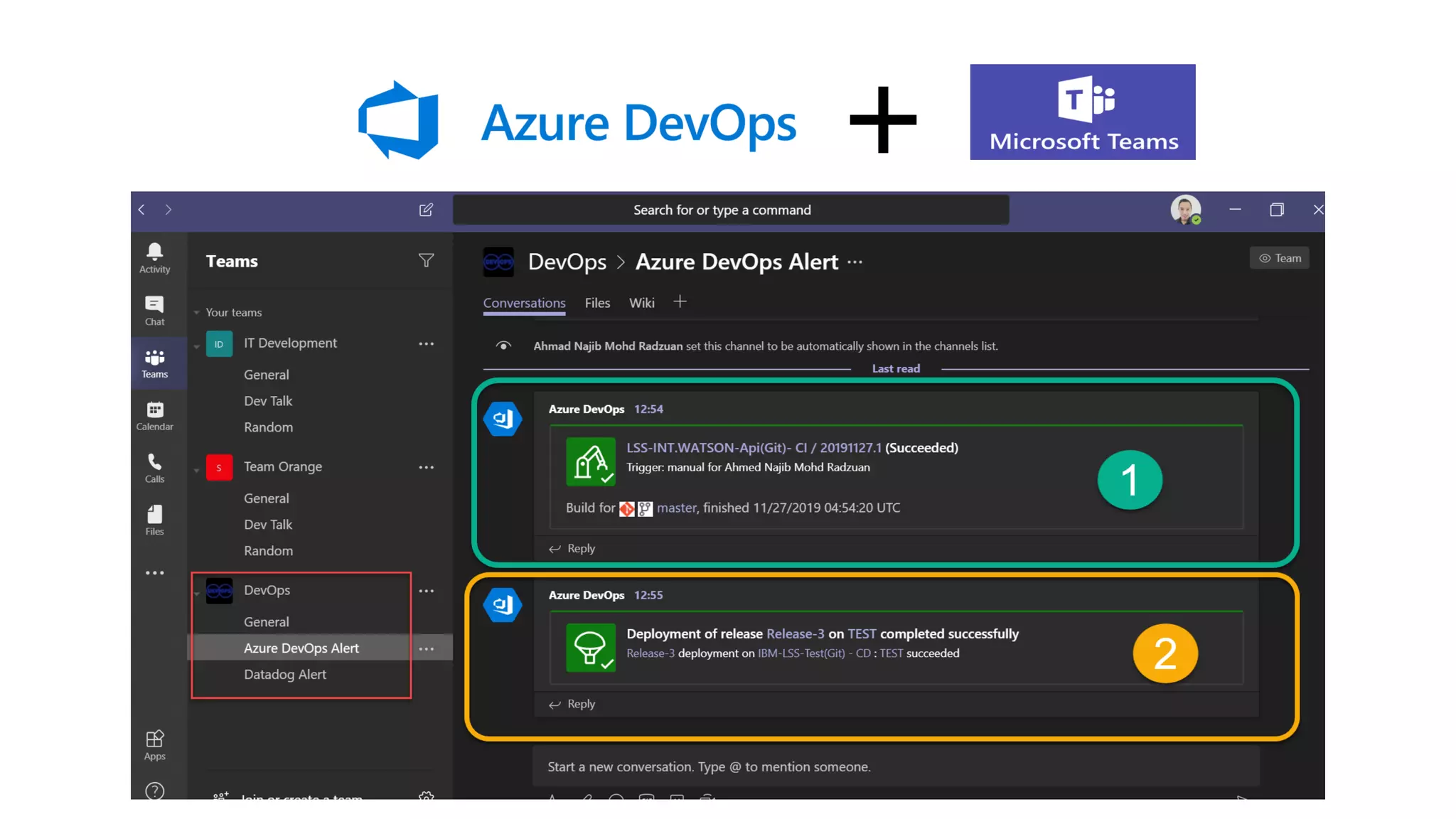
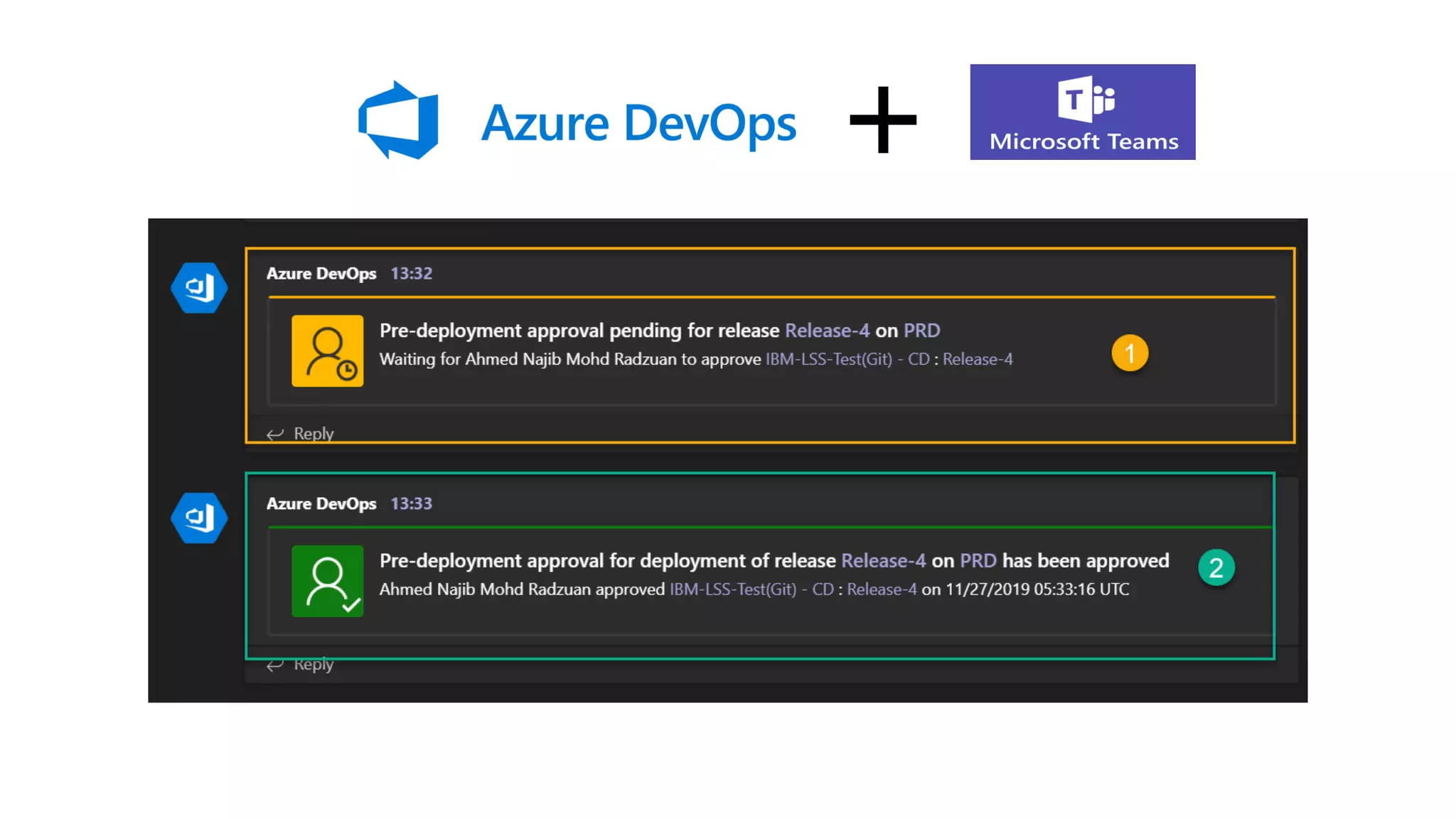
INT.WATSON CD Pipelines
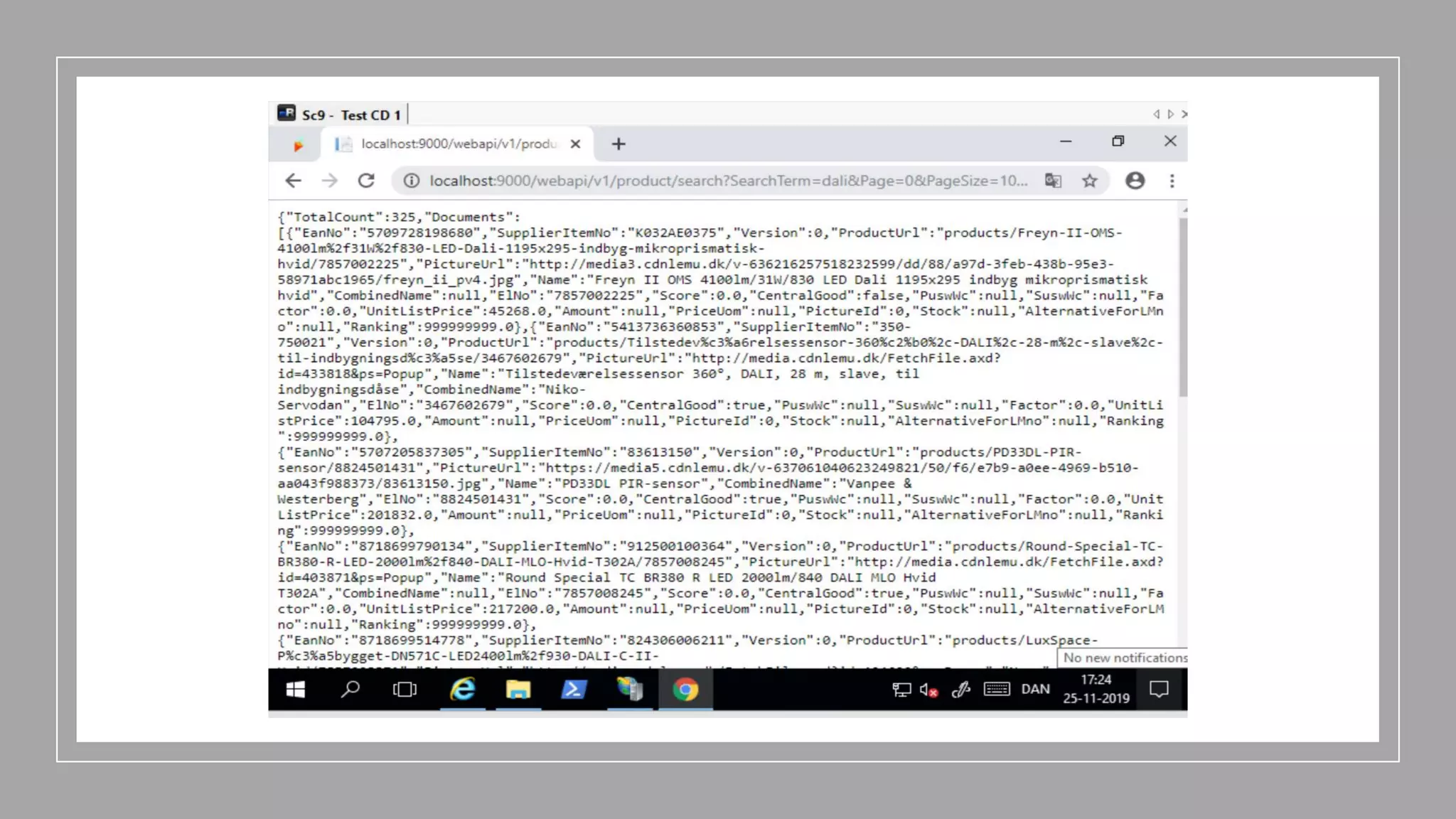
1. List of all CD pipelines
2. The summary of Deployment status for each
stages.
CONCLUSION
• With the change in the landscape of Application/Service
development and the introduction of Agile development,
developers were able to create functional code more faster. In the
end, DevOps can be thought of a practice/tools and Agile as a
process. Together, they help in continuously building, eliminating
waste, and optimizing work.
• What teams need to understand is that "at its core, DevOps isn't a
thing or toolset, it's a way of working". Therefore, people
management is key in aligning organisation's culture to a DevOps
culture and methodology.
ThankYou
Najib Radzuan
+60 176337416
anmrv@lemu.dk
https://devops4me.com/
REFERENCE
What is DevOps by Najib Radzuan
https://confluence.lm-gruppen.dk/x/nQbbAQ
Lemu Deploy & Release Procedure Report
https://confluence.lm-gruppen.dk/x/rgbbAQ
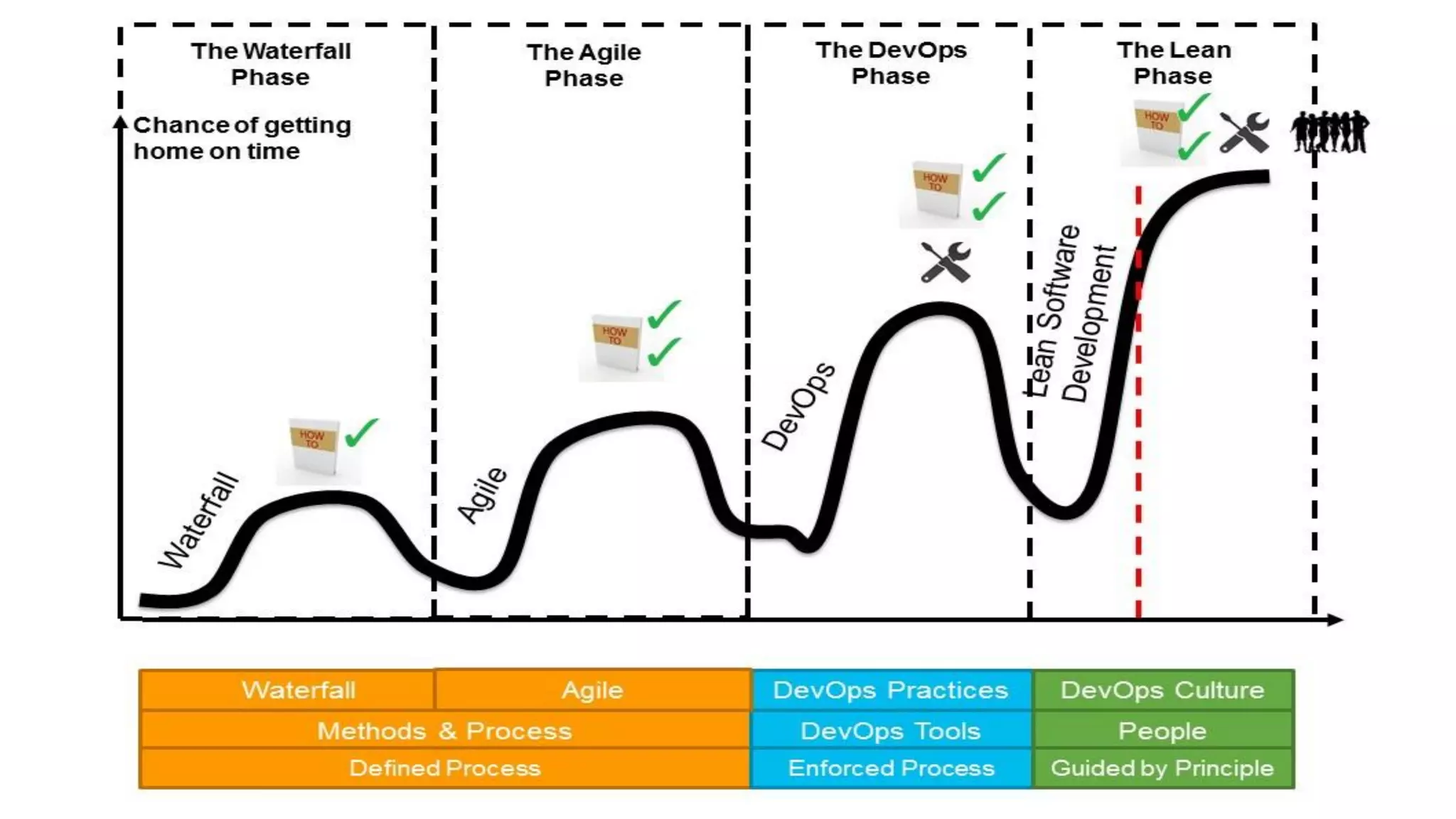
Is DevOps Agile? & Evolution of DevOps:
https://dzone.com/articles/is-devops-agile
Moving DevOps and Beyond:
https://www.ibm.com/developerworks/community/blogs/invisiblethread/entry/beyond_devops_distributedops_noops_and
_bizdevops?lang=en
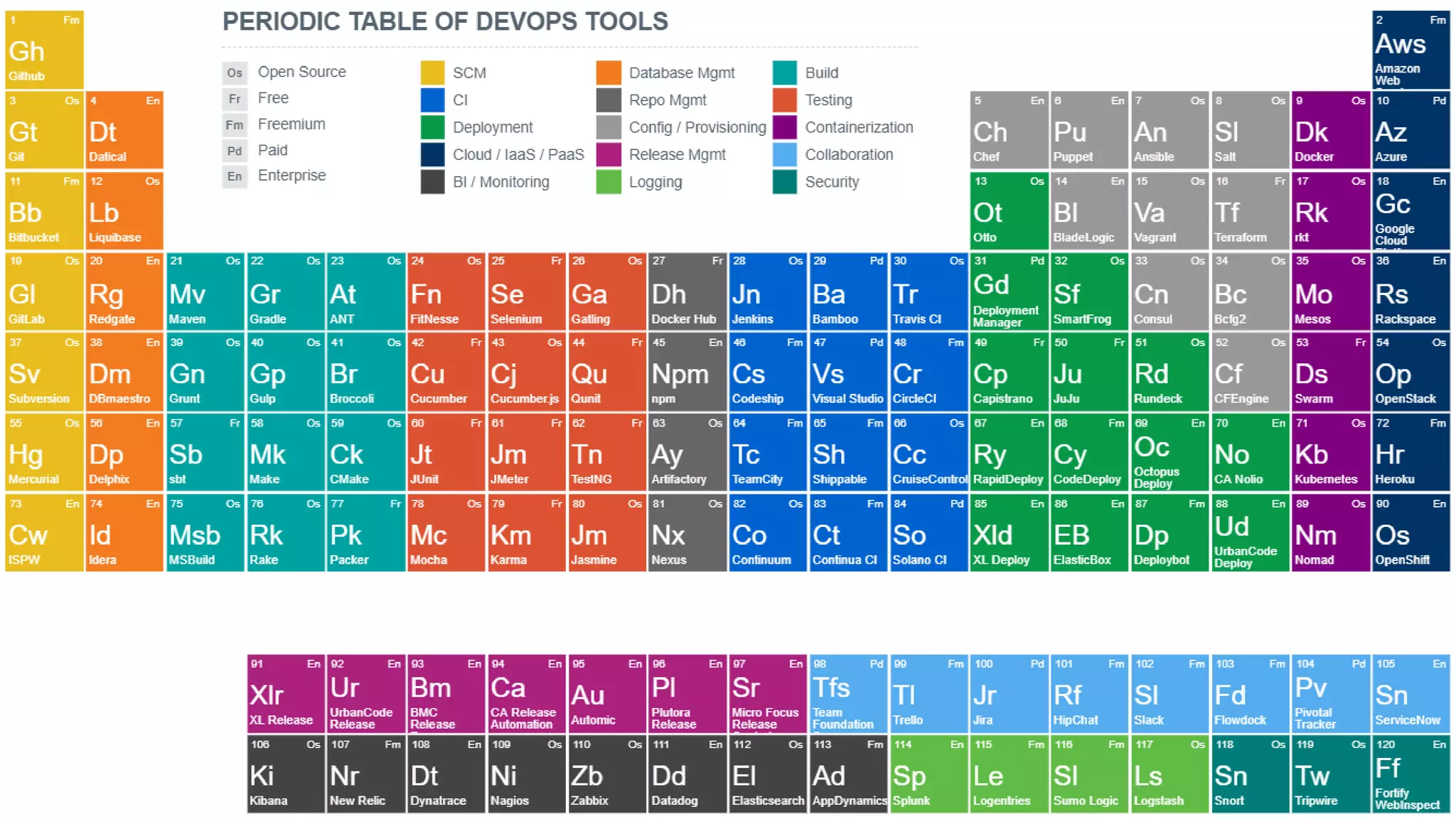
DevOps Tools:
https://xebialabs.com/periodic-table-of-devops-tools/
DevOps: Why People (Not Tools) Are Transforming Software Development:
https://www.business2community.com/tech-gadgets/devops-people-not-tools-transforming-software-development-
01477137#eKsigpBlHePsDxyX.97
An Introduction to DevOps:
http://www.xoomtrainings.com/blog/an-introduction-to-devops
Keep Calm and Embrace DevOps Culture:
https://blog.appdynamics.com/engineering/keep-calm-embrace-devops-culture/
APPENDICES
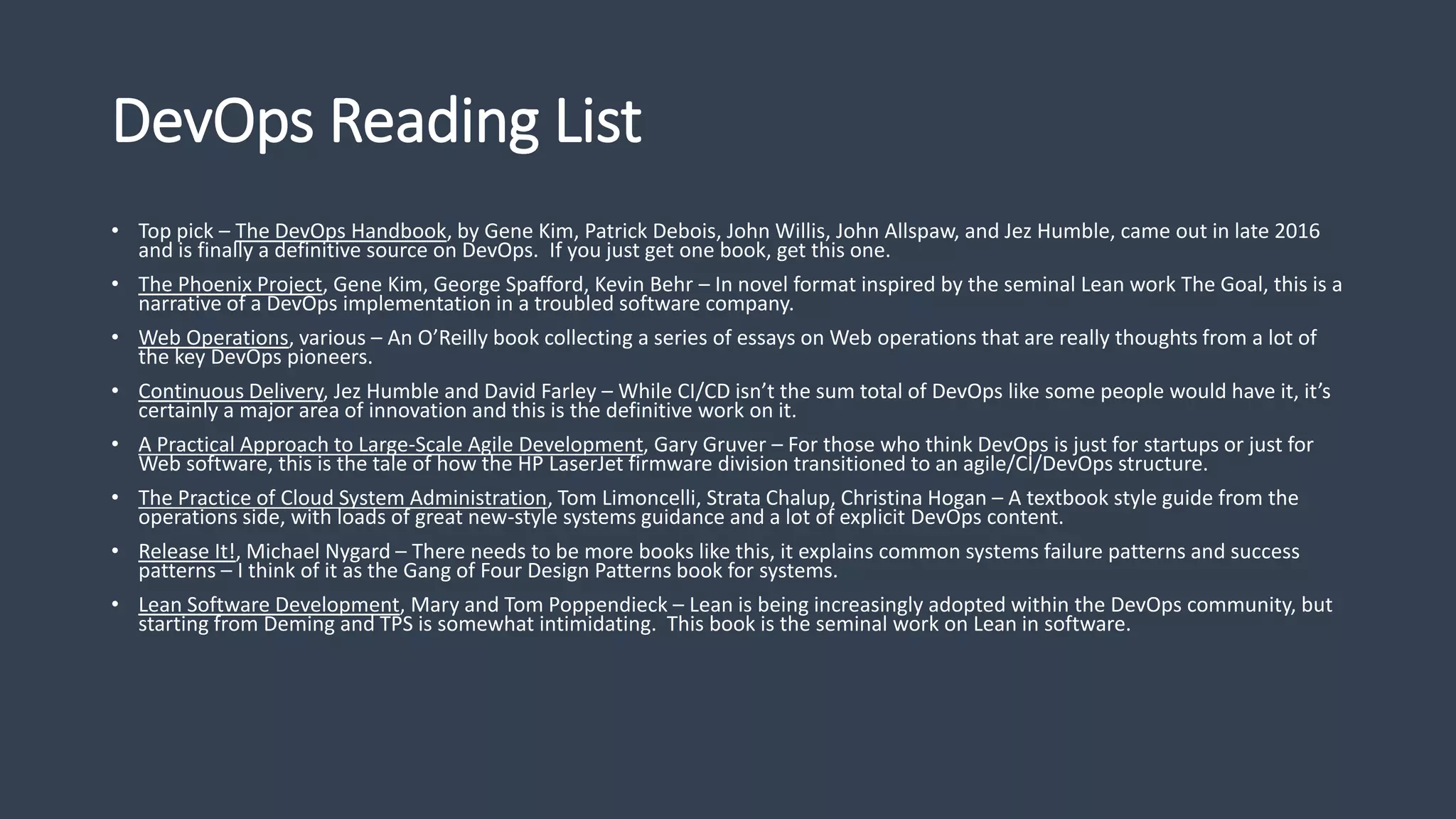
DevOps Reading List
• Top pick – The DevOps Handbook, by Gene Kim, Patrick Debois, John Willis, John Allspaw, and Jez Humble, came out in late 2016
and is finally a definitive source on DevOps. If you just get one book, get this one.
• The Phoenix Project, Gene Kim, George Spafford, Kevin Behr – In novel format inspired by the seminal Lean work The Goal, this is a
narrative of a DevOps implementation in a troubled software company.
• Web Operations, various – An O’Reilly book collecting a series of essays on Web operations that are really thoughts from a lot of
the key DevOps pioneers.
• Continuous Delivery, Jez Humble and David Farley – While CI/CD isn’t the sum total of DevOps like some people would have it, it’s
certainly a major area of innovation and this is the definitive work on it.
• A Practical Approach to Large-Scale Agile Development, Gary Gruver – For those who think DevOps is just for startups or just for
Web software, this is the tale of how the HP LaserJet firmware division transitioned to an agile/CI/DevOps structure.
• The Practice of Cloud System Administration, Tom Limoncelli, Strata Chalup, Christina Hogan – A textbook style guide from the
operations side, with loads of great new-style systems guidance and a lot of explicit DevOps content.
• Release It!, Michael Nygard – There needs to be more books like this, it explains common systems failure patterns and success
patterns – I think of it as the Gang of Four Design Patterns book for systems.
• Lean Software Development, Mary and Tom Poppendieck – Lean is being increasingly adopted within the DevOps community, but
starting from Deming and TPS is somewhat intimidating. This book is the seminal work on Lean in software.
DevOps Culture & Methodology Intro

DevOps Culture & Methodology Intro

  • 1.
  • 2.
    Content 1 2 What is DevOps? 34 DevOps v Agile 5 Azure DevOps CI/CD Demo 6 Conclusion DevOps Maturity Model Introduction/ Background
  • 3.
  • 4.
    Basic Information : Experience: DevOps Cert. : • Najib Radzuan • Self-taught DevOps • Have 10+ years working experience. Infra/Operation(IT) DevOps Architect , DevOps Leader, DevOps Ambassador • Developer/Programmer: .NET, ASP.NET, .NET Core, PHP, Angular, NodeJS, JavaScript, REST API, Microservices & etc. • IT Operation/Infra : Azure Cloud, AWS Cloud, Alibaba Cloud Services, Network, Storage, Serverless Services, Cloud DR. • DevOps : Jira, Bitbucket, Git, Red Hat OpenShift, Jenkins, Ansible, Azure DevOps, Kubernetes, Containers(Docker), AWS Code Deploy, Datadog & etc.
  • 5.
    • Development Teamhave a long lead times to get software into production make it difficult for companies to provide good services and enhance the customer experience. • Organization want to adopt the DevOps Culture(Process) and methodology(Toolset). • Hence, eliminates the barriers and exploits the dependencies between development and operations. BACKGROUND
  • 6.
  • 7.
    • DevOps developmentpractice is the synchronization of Development and Operations teams to efficiently develop and deploy Application/Service/Software through seamless communication, integration, collaboration, and automation. • Automation and Monitoring are the two main criteria of DevOps. • It improves business efficiencies by reducing time taken to make system level changes and setting these changes into production that is of high quality. Definition: In Easy Word: • DevOps is a Philosophy/Culture/Mindset. • DevOps is working way to produce Application/Services/Software from Development to Production environment.
  • 8.
    BENEFIT & WHYDO DEVOPS?
  • 9.
    General Benefit ofDevOps: More Agility: To enable near instant change deployment. Increase Quality: To increase end user satisfaction. Boost Innovation: To increase innovation cycles. Reduce Failures: Up to 80% outages are change related. Technical Benefit: • Continuous software Deployment/Delivery. • Less complex problems to fix. • Faster resolution of problems. Business Benefit: • Faster delivery of features. • More stable operating environments. • More time available to add value (rather than fix/maintain) .
  • 10.
  • 11.
    Culture Automation LeanMeasurement Sharing There is a culture of shared responsibility. Data is collected on everything and there are mechanisms in place that provide visibility into all systems. There are user-friendly communication channels that encourage ongoing communication between development and operations. Team members seek out ways to automate as many tasks as possible and are comfortable with the idea of continuous delivery. Team members are able to visualize work in progress (WIP), limit batch sizes and manage queue lengths. CALMS is a conceptual framework for the integration of development and operations (DevOps) teams, functions and systems within an organization.
  • 12.
  • 13.
    DevOps only bunchof Automation Tools. Collaboration, Continuous Integration, Continuous Delivery, and Continuous Testing are not tools that can be implemented, they are practices that must be adopted. It's culture and new way of working not only toolset. DevOps made Developer do more jobs. DevOps means development and operations teams working together collaboratively to put the IT operations requirements about stability, reliability, and performance into the development practices, while at the same time bringing development into the management of the production environment. DevOps eliminates traditional IT roles The goal is to break down collaboration barriers, not ask your developers to do everything. Specialized skills play a key role in support effective operations, and traditional roles are valuable in DevOps.
  • 14.
  • 15.
    Customer + Software Requirement Software Developer + Tester/QA ITOperation + IT Infrastructure Stakeholders and communication chain in a typical IT process. GapGap
  • 16.
    Customer + Software Requirement Software Developer + Tester/QA ITOperation + IT Infrastructure Agile addresses the gaps in Customer and Developer communication. Gap
  • 17.
    Customer + Software Requirement Software Developer + Tester/QA ITOperation + IT Infrastructure DevOps addresses the gaps in Developer/Programmer and IT Operation/Infra communication. Gap
  • 18.
  • 19.
    Agile Productivity Goals/Philosophies Collaboration Visibility To toimprove the business productivity. Both have widely adopted and implemented the lean philosophy in many processes. Every team is required to share updates regarding the development process. Everyone know everyone task/work and help when there is problem/issue arise.
  • 20.
  • 21.
    A DevOps maturitymodel can be utilized to plan and evolve the DevOps transformation;
  • 22.
  • 23.
    Organizations Azure Repos(Version SourceControl) Options: 1. We can clone the source code/repository from Github 2. Upload to Azure Repos. 3. Create direct source code from any VCS tool via services integration in CI pipelines.
  • 24.
    INT.WATSON CI Pipelines INT.WATSONCI Tasks 1. Fetched directly from Github Lemu repositories. 2. All Task involve to Build and Publish the Artifact. 3. The artifacts that we use for CD pipelines
  • 25.
    INT.WATSON CD Pipelines 1.List of all CD pipelines 2. The summary of Deployment status for each stages.
  • 30.
  • 31.
    • With thechange in the landscape of Application/Service development and the introduction of Agile development, developers were able to create functional code more faster. In the end, DevOps can be thought of a practice/tools and Agile as a process. Together, they help in continuously building, eliminating waste, and optimizing work. • What teams need to understand is that "at its core, DevOps isn't a thing or toolset, it's a way of working". Therefore, people management is key in aligning organisation's culture to a DevOps culture and methodology.
  • 32.
  • 33.
  • 34.
    What is DevOpsby Najib Radzuan https://confluence.lm-gruppen.dk/x/nQbbAQ Lemu Deploy & Release Procedure Report https://confluence.lm-gruppen.dk/x/rgbbAQ Is DevOps Agile? & Evolution of DevOps: https://dzone.com/articles/is-devops-agile Moving DevOps and Beyond: https://www.ibm.com/developerworks/community/blogs/invisiblethread/entry/beyond_devops_distributedops_noops_and _bizdevops?lang=en DevOps Tools: https://xebialabs.com/periodic-table-of-devops-tools/ DevOps: Why People (Not Tools) Are Transforming Software Development: https://www.business2community.com/tech-gadgets/devops-people-not-tools-transforming-software-development- 01477137#eKsigpBlHePsDxyX.97 An Introduction to DevOps: http://www.xoomtrainings.com/blog/an-introduction-to-devops Keep Calm and Embrace DevOps Culture: https://blog.appdynamics.com/engineering/keep-calm-embrace-devops-culture/
  • 35.
  • 36.
    DevOps Reading List •Top pick – The DevOps Handbook, by Gene Kim, Patrick Debois, John Willis, John Allspaw, and Jez Humble, came out in late 2016 and is finally a definitive source on DevOps. If you just get one book, get this one. • The Phoenix Project, Gene Kim, George Spafford, Kevin Behr – In novel format inspired by the seminal Lean work The Goal, this is a narrative of a DevOps implementation in a troubled software company. • Web Operations, various – An O’Reilly book collecting a series of essays on Web operations that are really thoughts from a lot of the key DevOps pioneers. • Continuous Delivery, Jez Humble and David Farley – While CI/CD isn’t the sum total of DevOps like some people would have it, it’s certainly a major area of innovation and this is the definitive work on it. • A Practical Approach to Large-Scale Agile Development, Gary Gruver – For those who think DevOps is just for startups or just for Web software, this is the tale of how the HP LaserJet firmware division transitioned to an agile/CI/DevOps structure. • The Practice of Cloud System Administration, Tom Limoncelli, Strata Chalup, Christina Hogan – A textbook style guide from the operations side, with loads of great new-style systems guidance and a lot of explicit DevOps content. • Release It!, Michael Nygard – There needs to be more books like this, it explains common systems failure patterns and success patterns – I think of it as the Gang of Four Design Patterns book for systems. • Lean Software Development, Mary and Tom Poppendieck – Lean is being increasingly adopted within the DevOps community, but starting from Deming and TPS is somewhat intimidating. This book is the seminal work on Lean in software.