‘DevOps unraveled’
Anko Tijman
1
Agenda
1. Introduction
2. What is DevOps anyway?
3. Stories from the trenches
4. Theories behind DevOps
5. Where is DevOps bringing us?
6. Accelerators and inhibitors of DevOps
7. DevOps unraveled
2
1. Introduction
About me…
 1997 Tester
 2001 My first Agile project
 2004 Joined Ordina
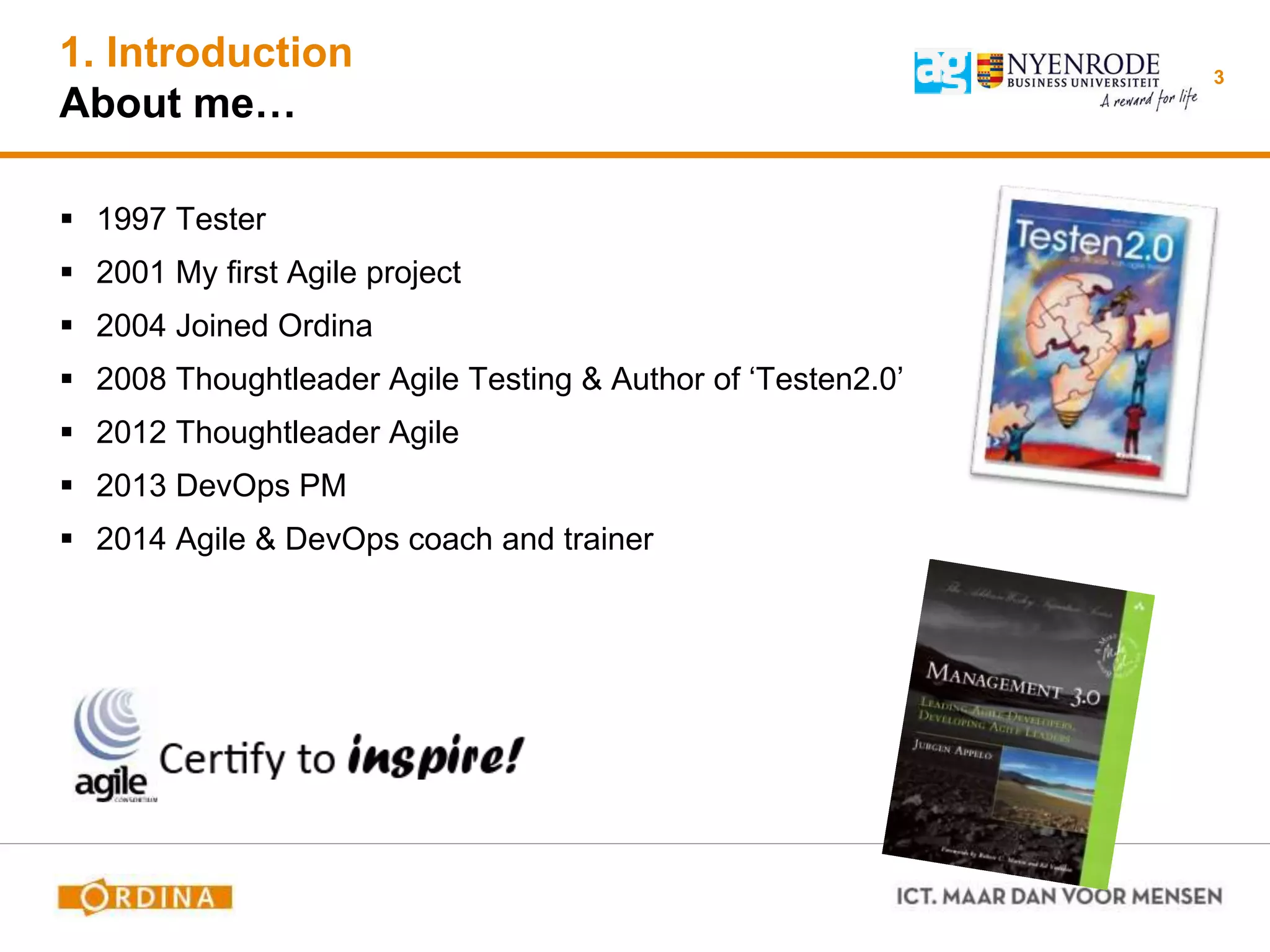
 2008 Thoughtleader Agile Testing & Author of ‘Testen2.0’
 2012 Thoughtleader Agile
 2013 DevOps PM
 2014 Agile & DevOps coach and trainer
3
1. Introduction
1. Introduction
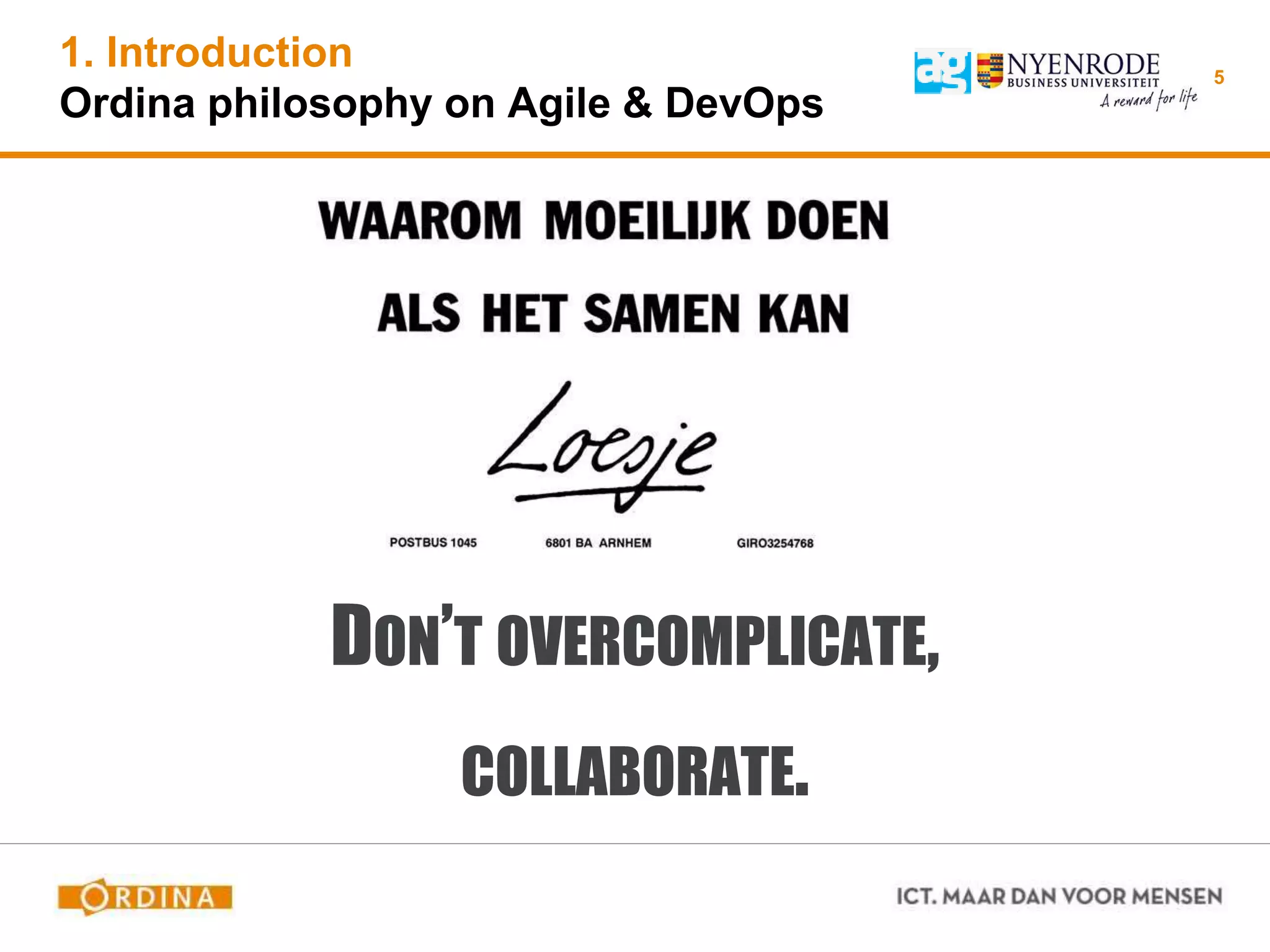
Ordina philosophy on Agile & DevOps
DON’T OVERCOMPLICATE,
COLLABORATE.
5
1. Introduction
Goals
6
 Uncovering what DevOps is
 Theories behind DevOps
 Why should an organization implement DevOps?
 Define what the impact of DevOps on organizations is
Note:
 DevOps is fairly new and under heavy construction
1. Introduction
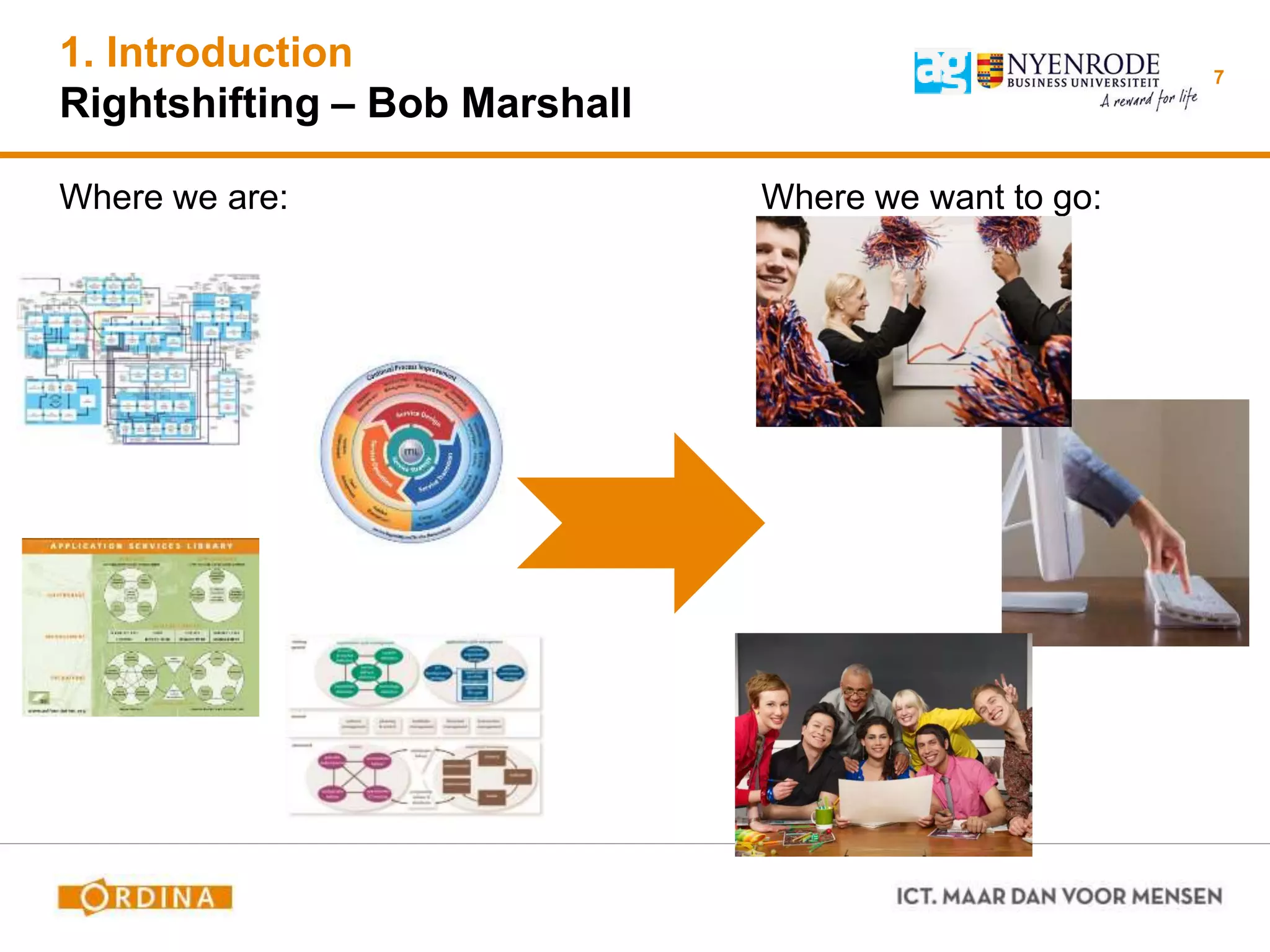
Rightshifting – Bob Marshall
Where we are:
7
Where we want to go:
1. Introduction
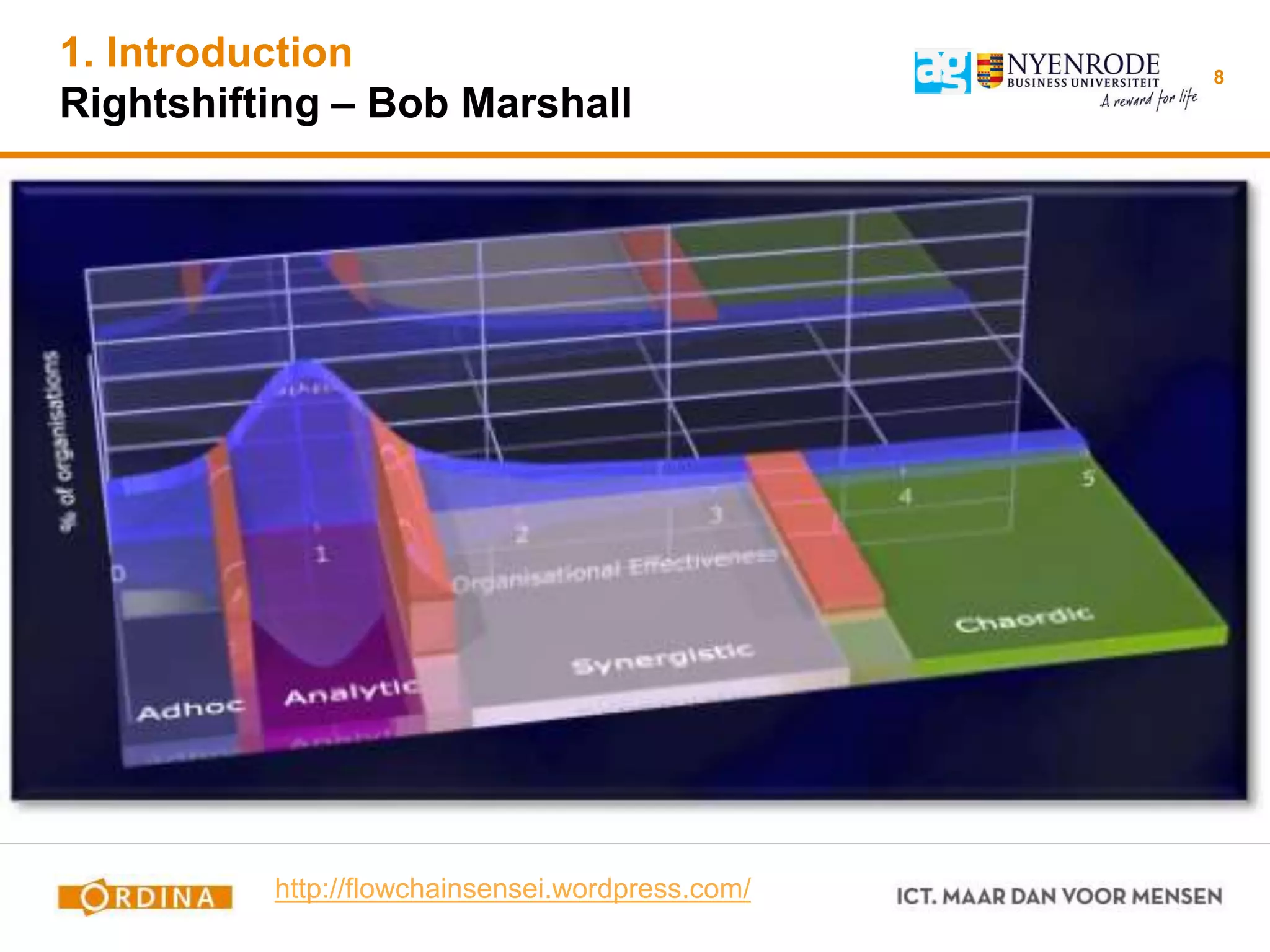
Rightshifting – Bob Marshall
8
http://flowchainsensei.wordpress.com/
1. Introduction
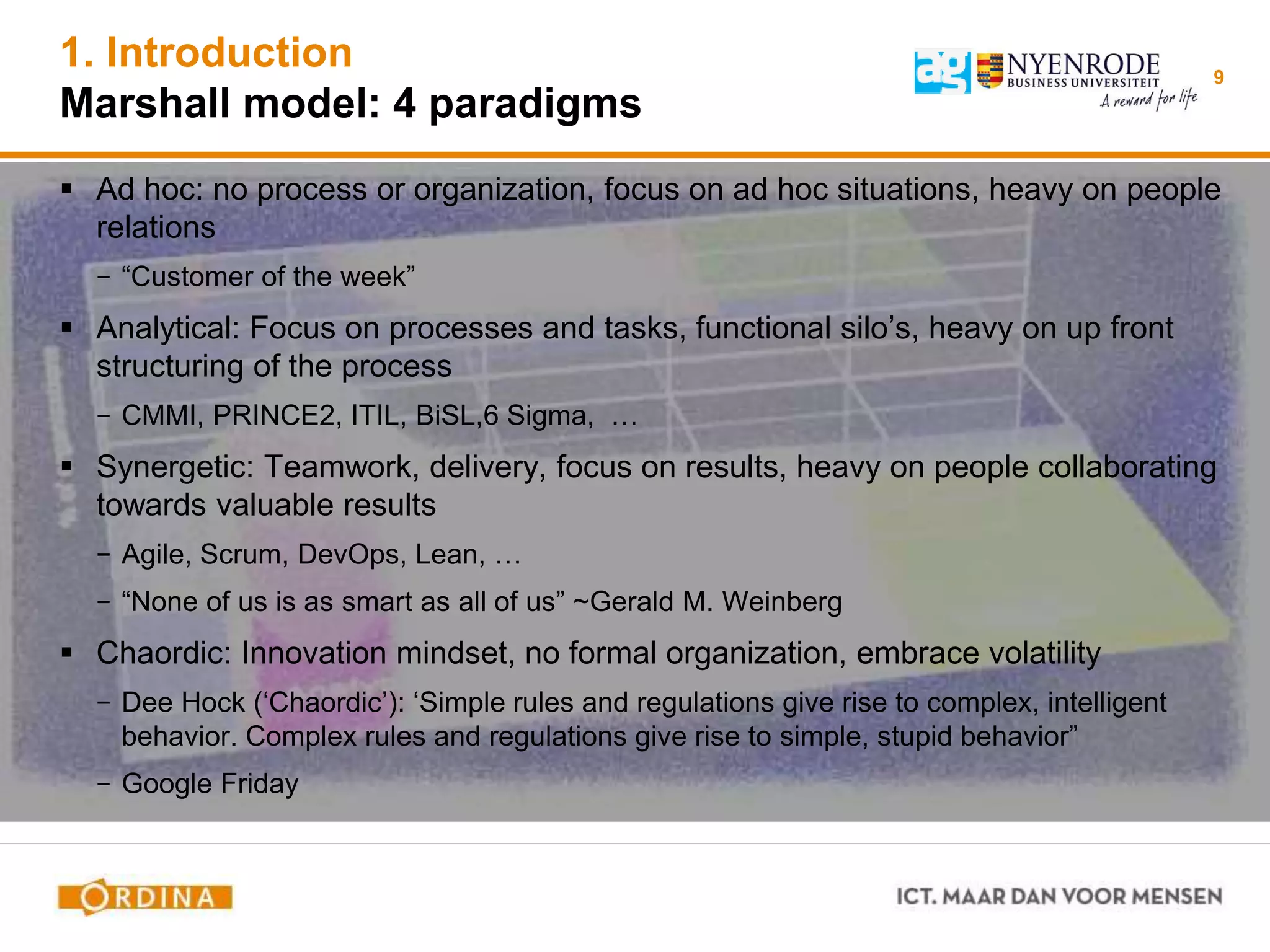
Marshall model: 4 paradigms
 Ad hoc: no process or organization, focus on ad hoc situations, heavy on people
relations
− “Customer of the week”
 Analytical: Focus on processes and tasks, functional silo’s, heavy on up front
structuring of the process
− CMMI, PRINCE2, ITIL, BiSL,6 Sigma, …
 Synergetic: Teamwork, delivery, focus on results, heavy on people collaborating
towards valuable results
− Agile, Scrum, DevOps, Lean, …
− “None of us is as smart as all of us” ~Gerald M. Weinberg
 Chaordic: Innovation mindset, no formal organization, embrace volatility
− Dee Hock (‘Chaordic’): ‘Simple rules and regulations give rise to complex, intelligent
behavior. Complex rules and regulations give rise to simple, stupid behavior”
− Google Friday
9
1. Introduction
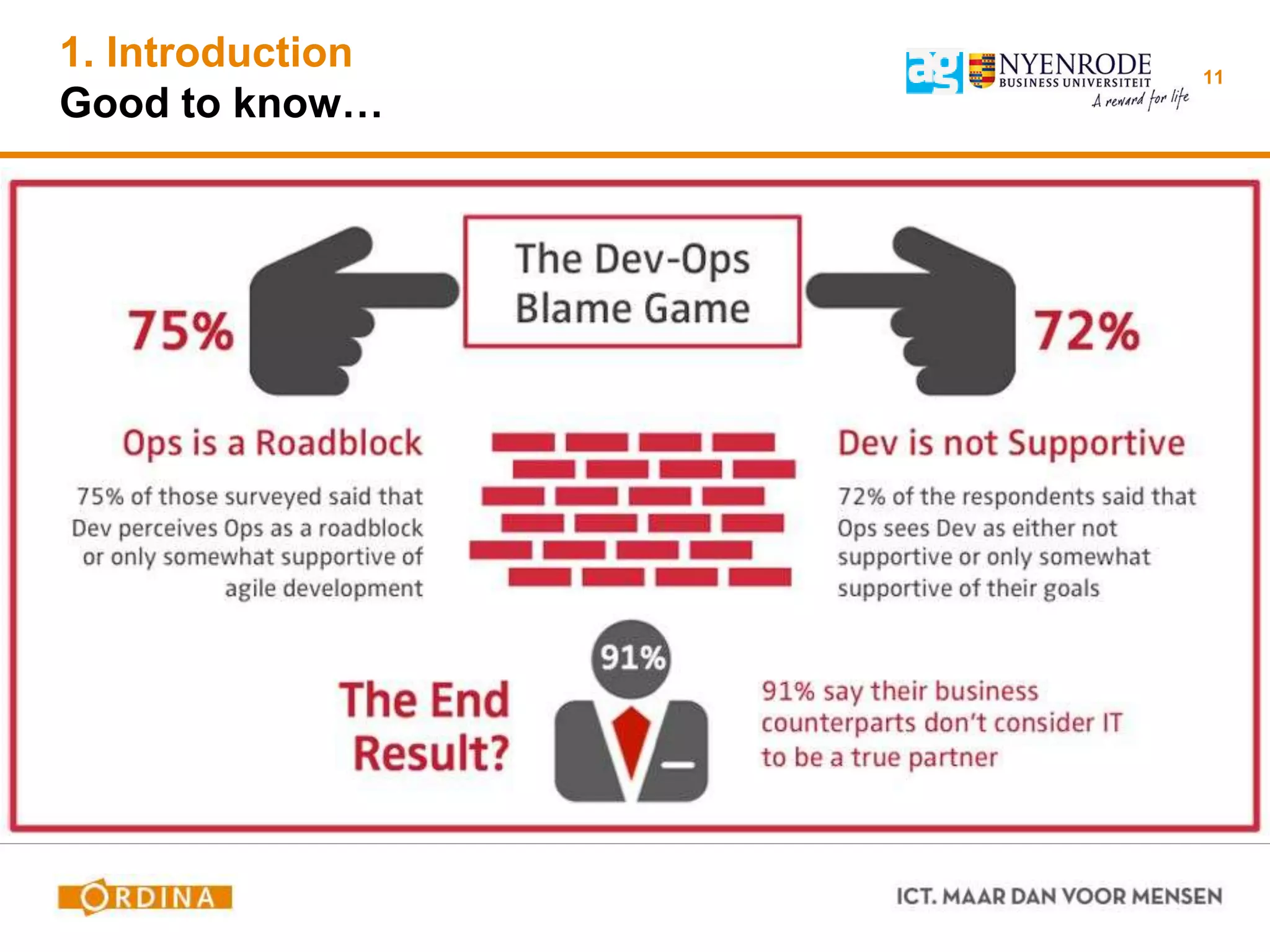
Good to know…
11
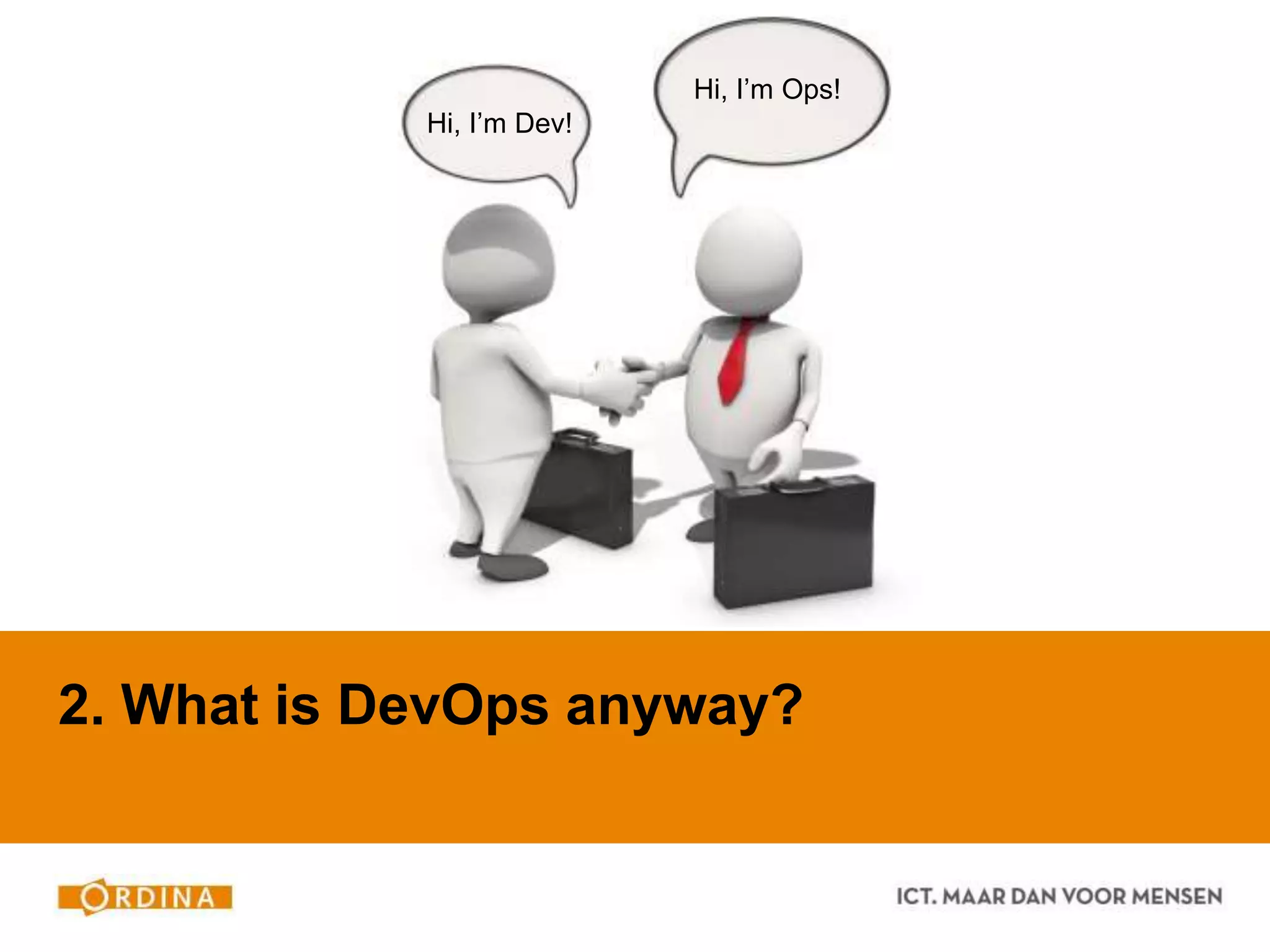
2. What is DevOps anyway?
Hi, I’m Dev!
Hi, I’m Ops!
What IS DevOps…?
13
2. What is DevOps anyway?
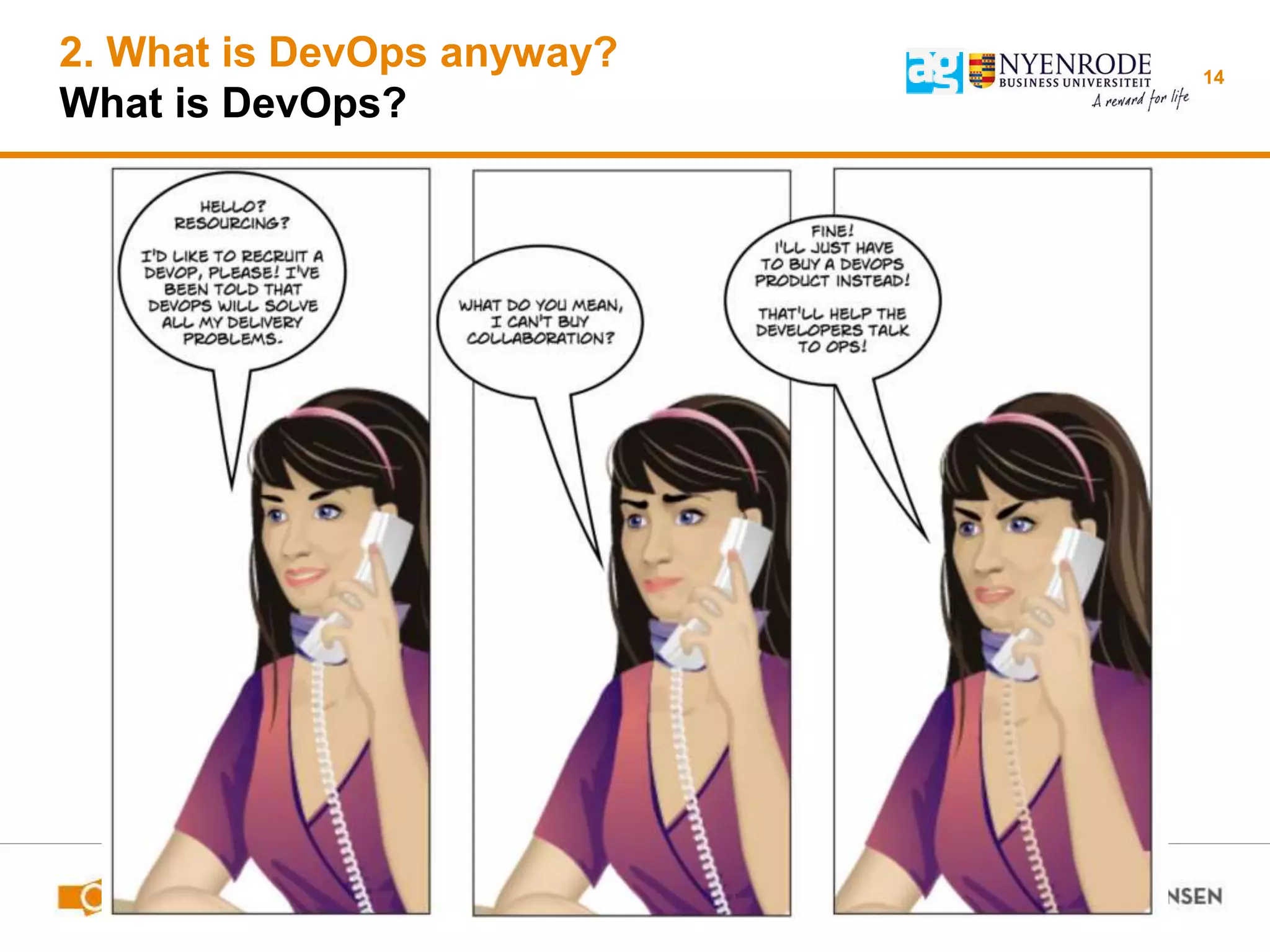
What is DevOps?
14
2. What is DevOps anyway?
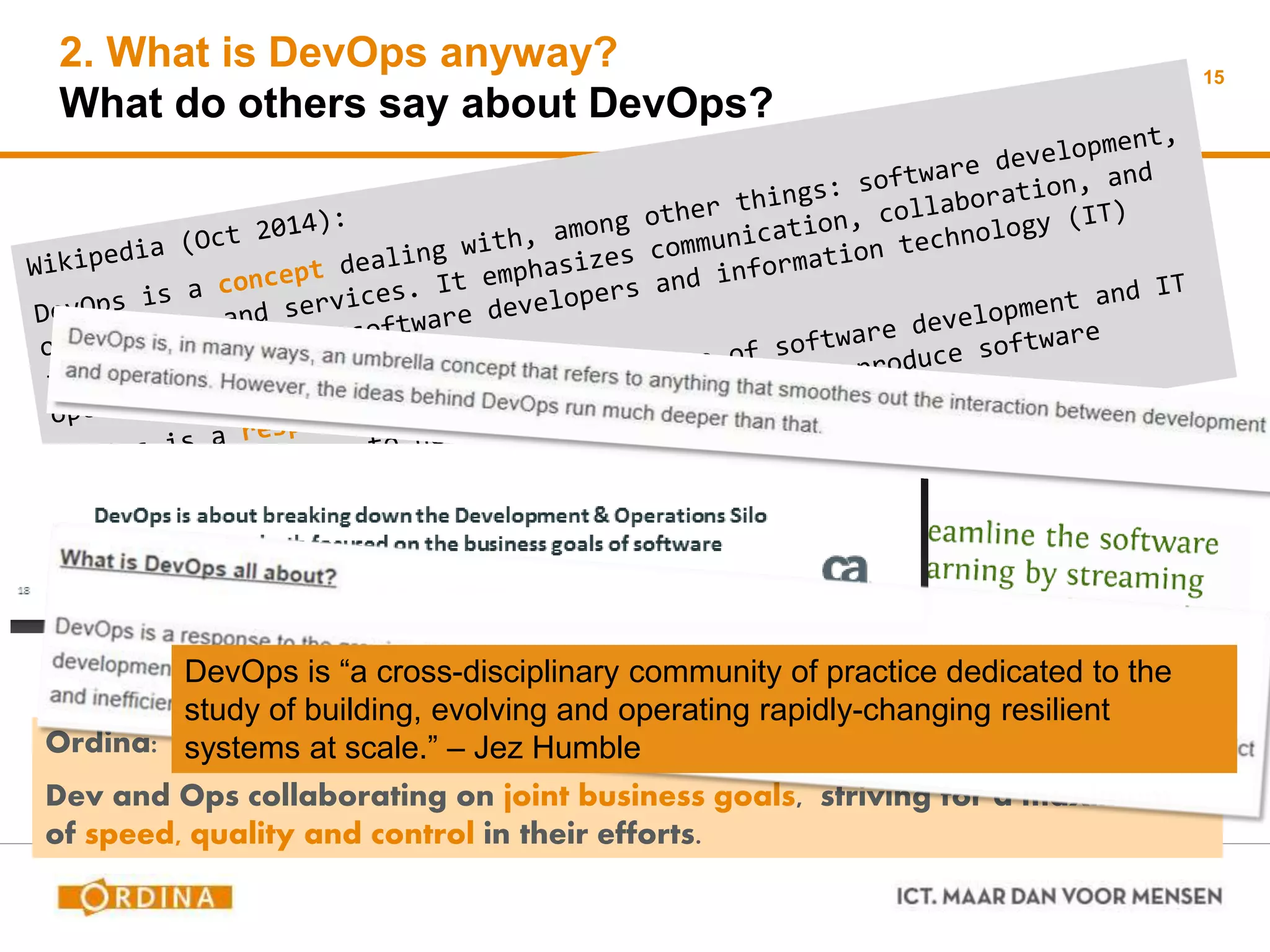
What do others say about DevOps?
15
Ordina:
Dev and Ops collaborating on joint business goals, striving for a maximum
of speed, quality and control in their efforts.
DevOps is “a cross-disciplinary community of practice dedicated to the
study of building, evolving and operating rapidly-changing resilient
systems at scale.” – Jez Humble
2. What is DevOps anyway?
Quotes
 Jez Humble:
− “In the era of continuous deployment, you need _tons_ of communication in order to
reduce the risk of frequent delivered releases.”
− “If it hurts, do it often.”
 Gene Kim
− “You get what you design for. Chester, your peer in Development, is spending all his
cycles on features, instead of stability, security, scalability, manageability, operability,
continuity, and all those other beautiful ’ilities.”
 Jeff Hodges
− "Knowing how the system’s behavior on day 20 is different from its behavior on day 15
is the difference between successful engineering and failed shamanism."
16
2. What is DevOps anyway?
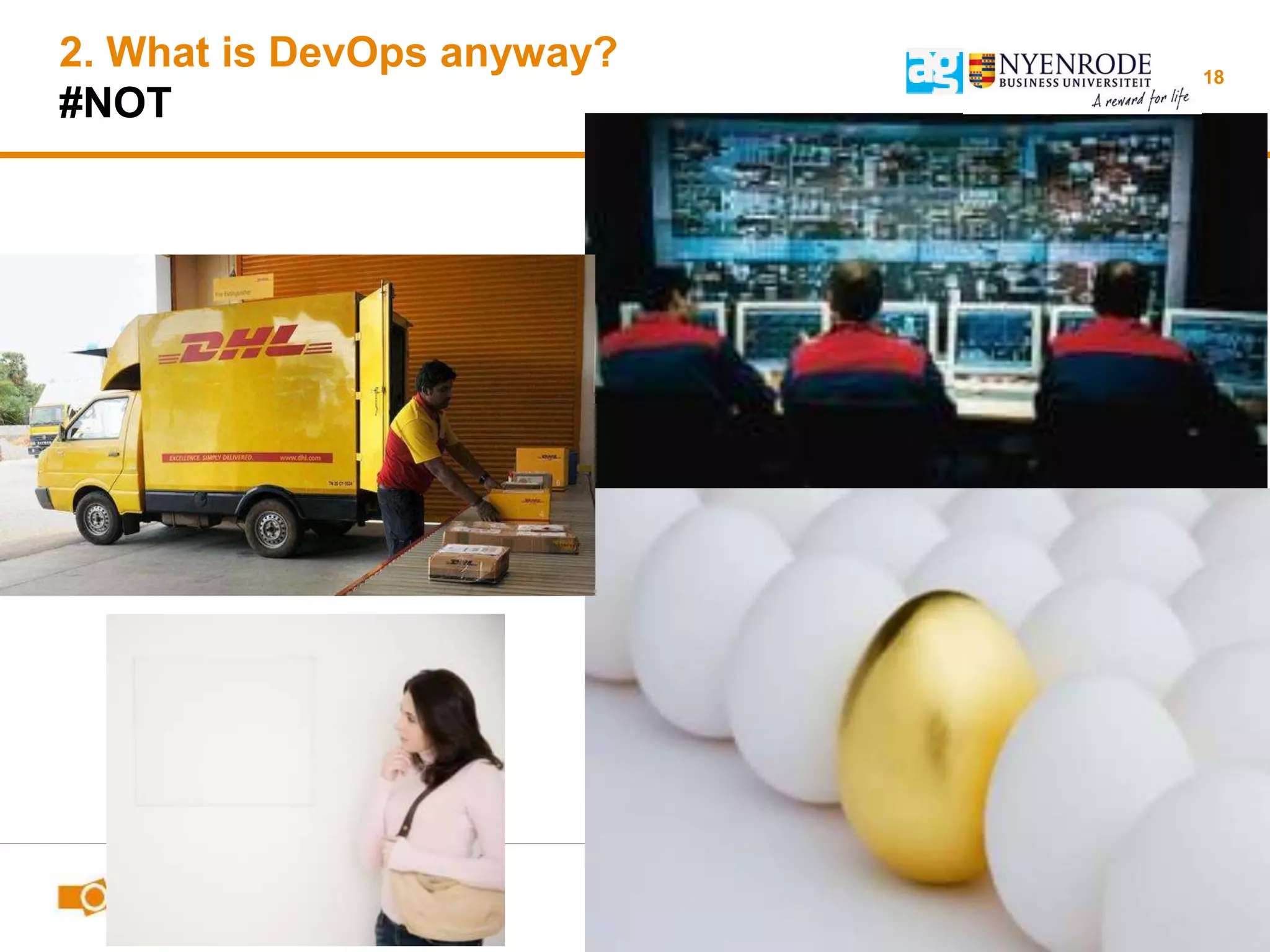
#NOT
18
2. What is DevOps anyway?
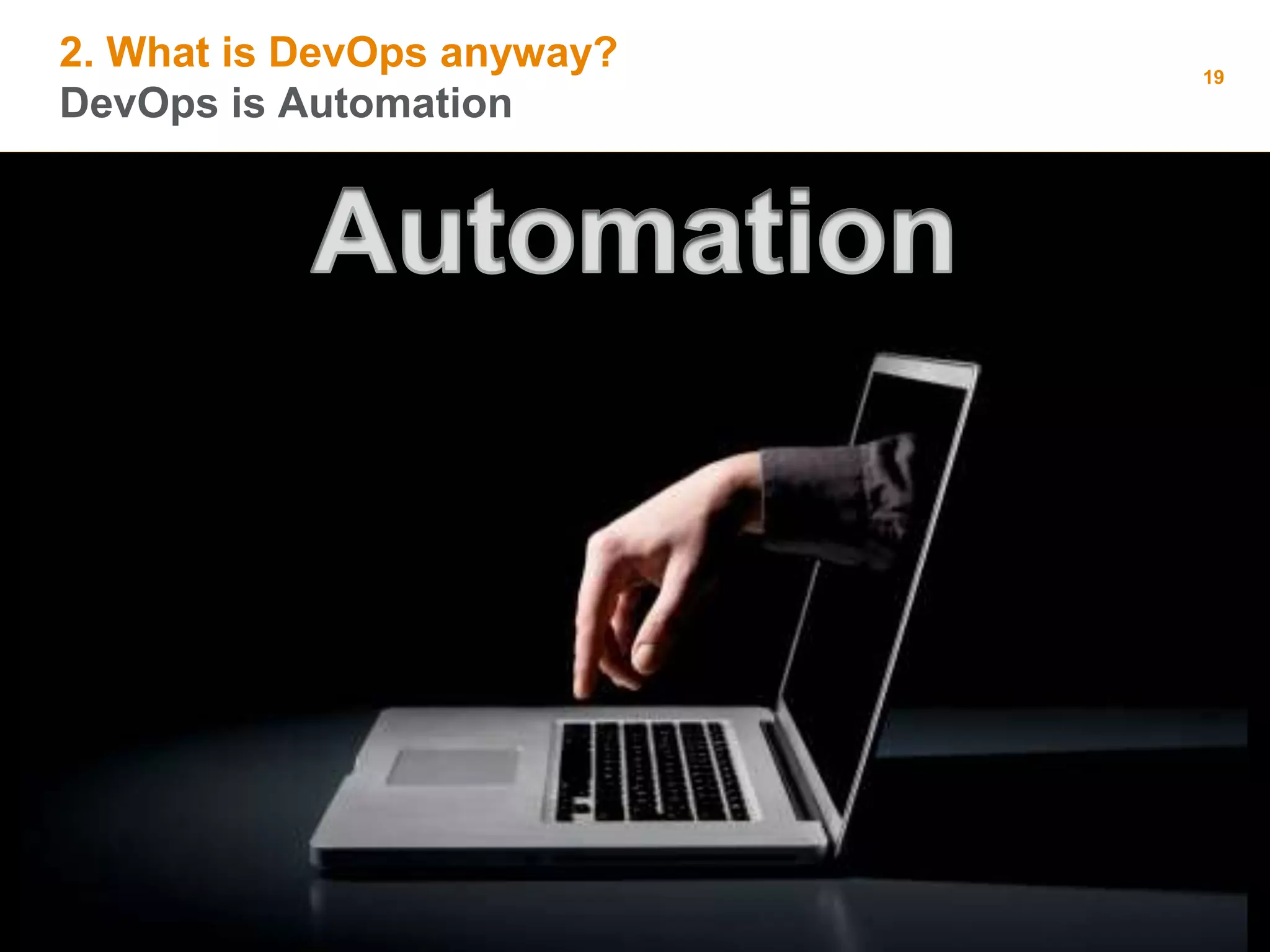
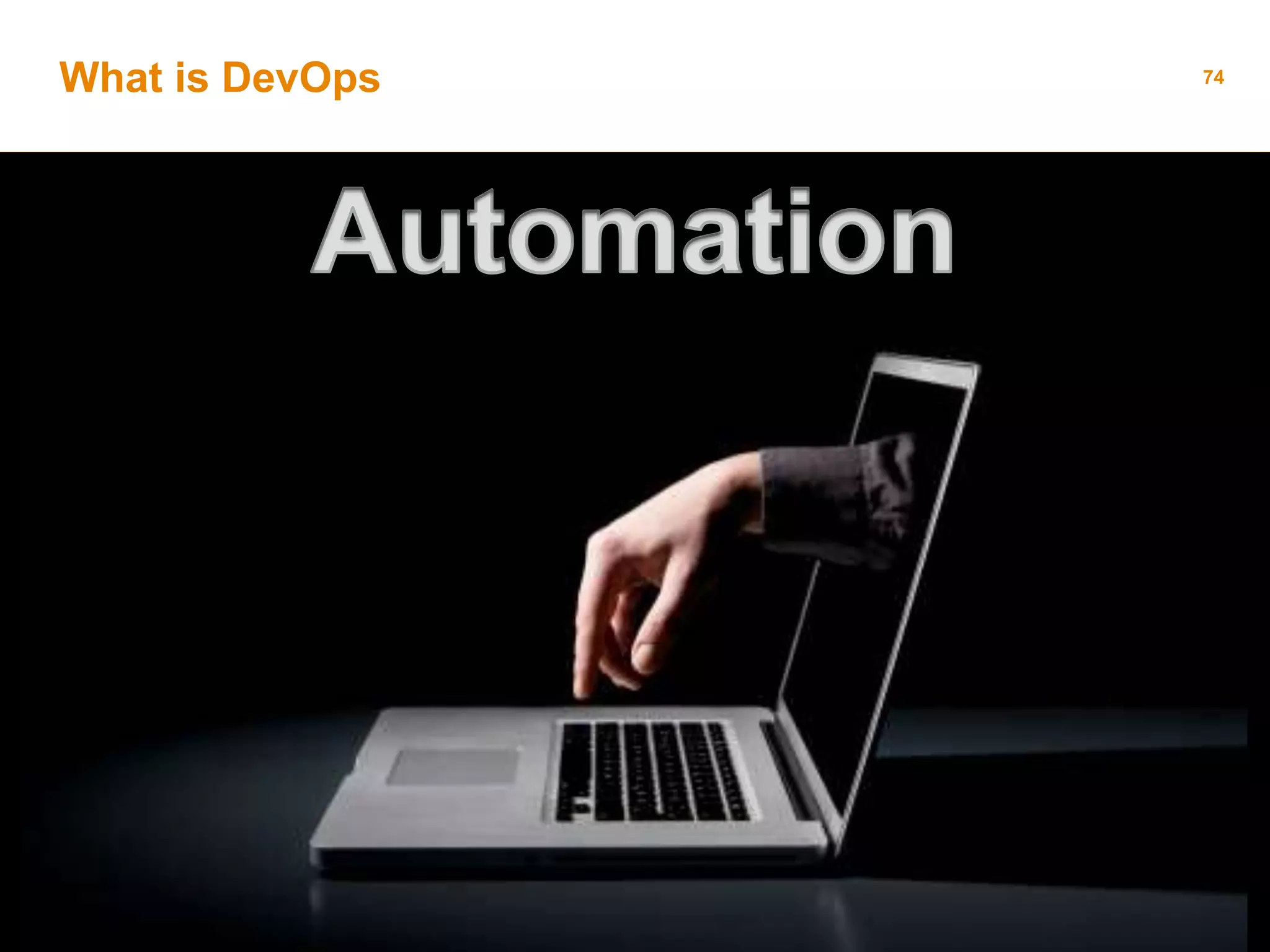
DevOps is Automation
19
2. What is DevOps anyway?
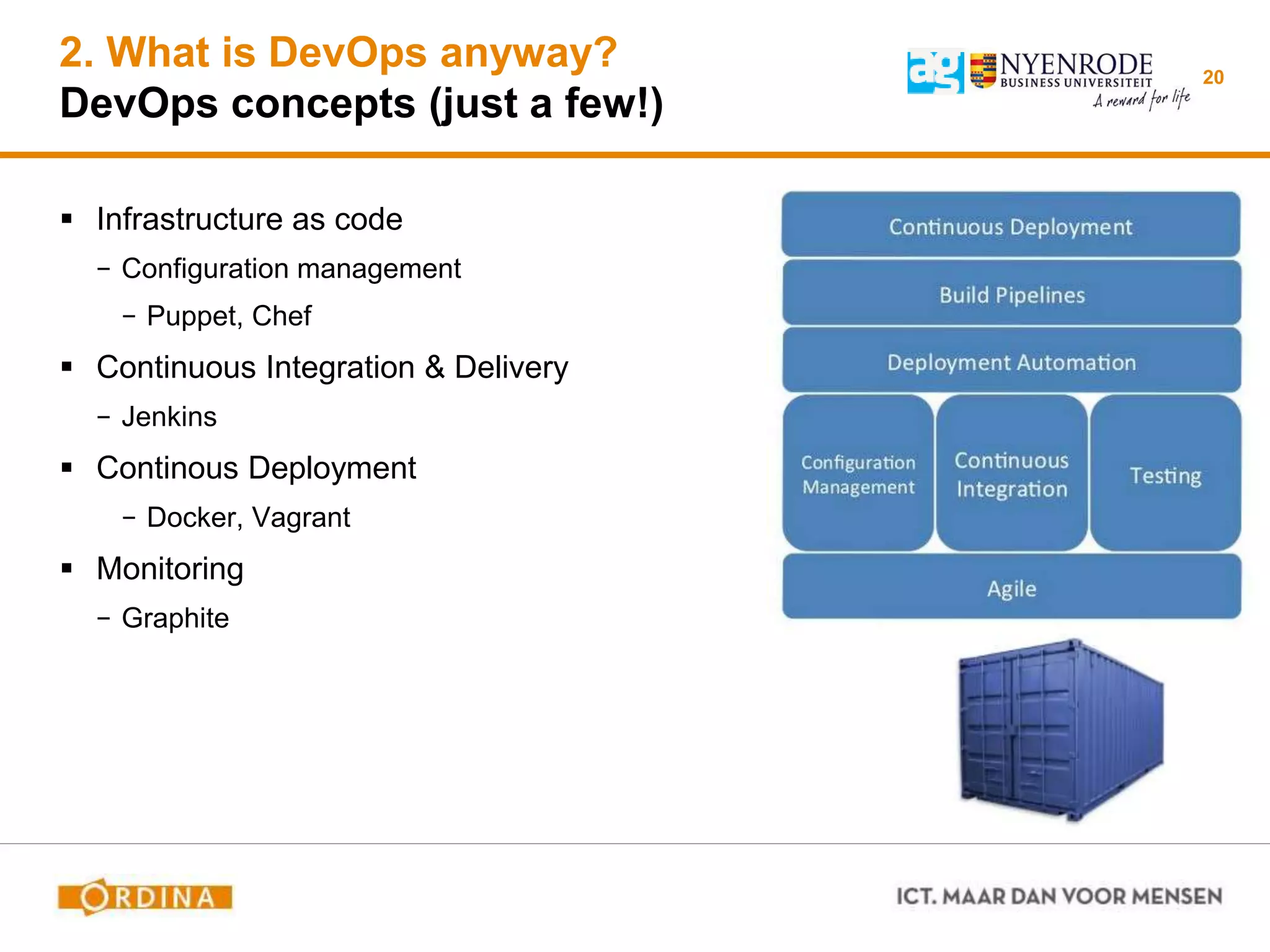
DevOps concepts (just a few!)
20
 Infrastructure as code
− Configuration management
− Puppet, Chef
 Continuous Integration & Delivery
− Jenkins
 Continous Deployment
− Docker, Vagrant
 Monitoring
− Graphite
2. What is DevOps anyway?
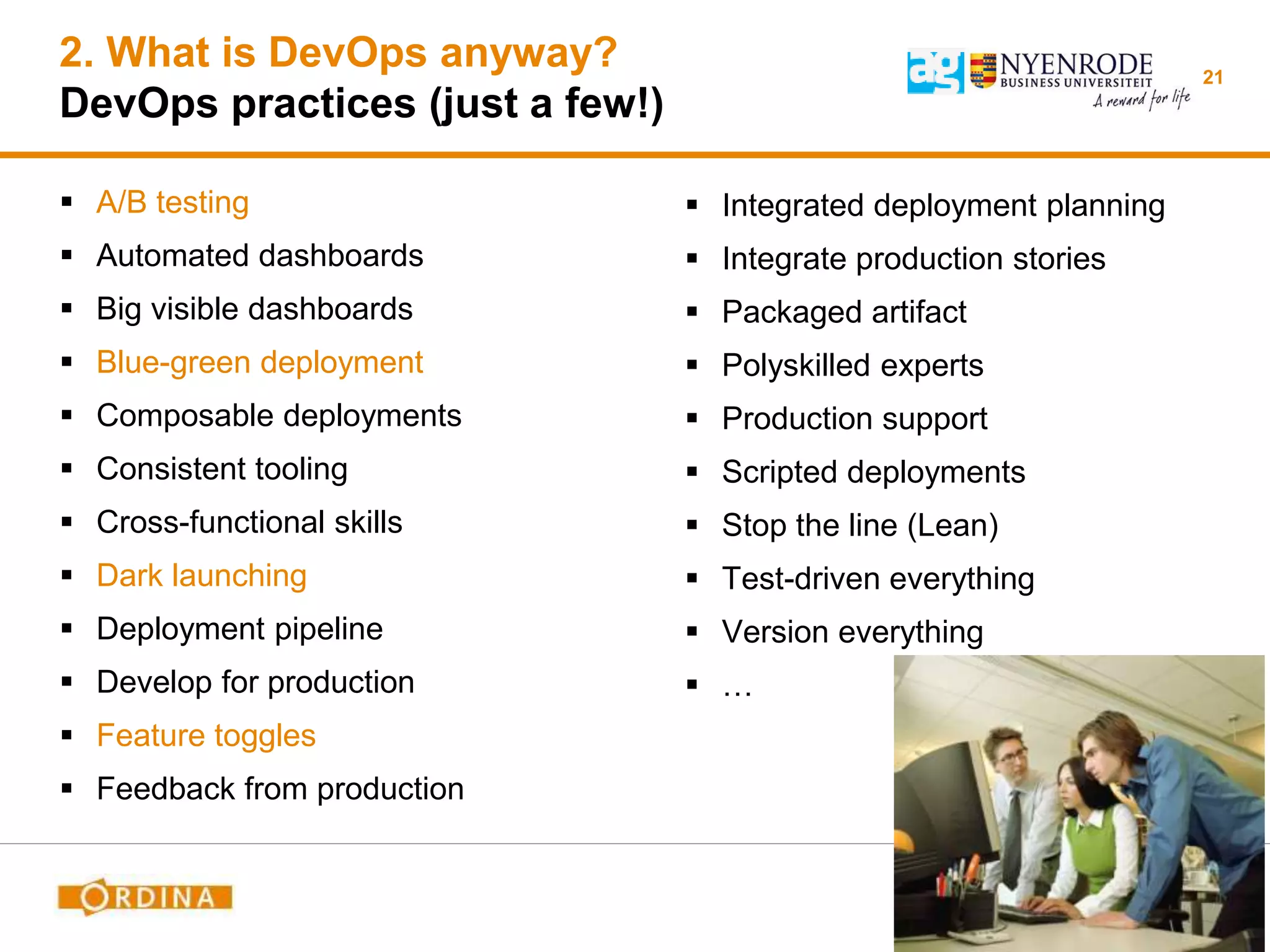
DevOps practices (just a few!)
 A/B testing
 Automated dashboards
 Big visible dashboards
 Blue-green deployment
 Composable deployments
 Consistent tooling
 Cross-functional skills
 Dark launching
 Deployment pipeline
 Develop for production
 Feature toggles
 Feedback from production
21
 Integrated deployment planning
 Integrate production stories
 Packaged artifact
 Polyskilled experts
 Production support
 Scripted deployments
 Stop the line (Lean)
 Test-driven everything
 Version everything
 …
2. What is DevOps anyway?
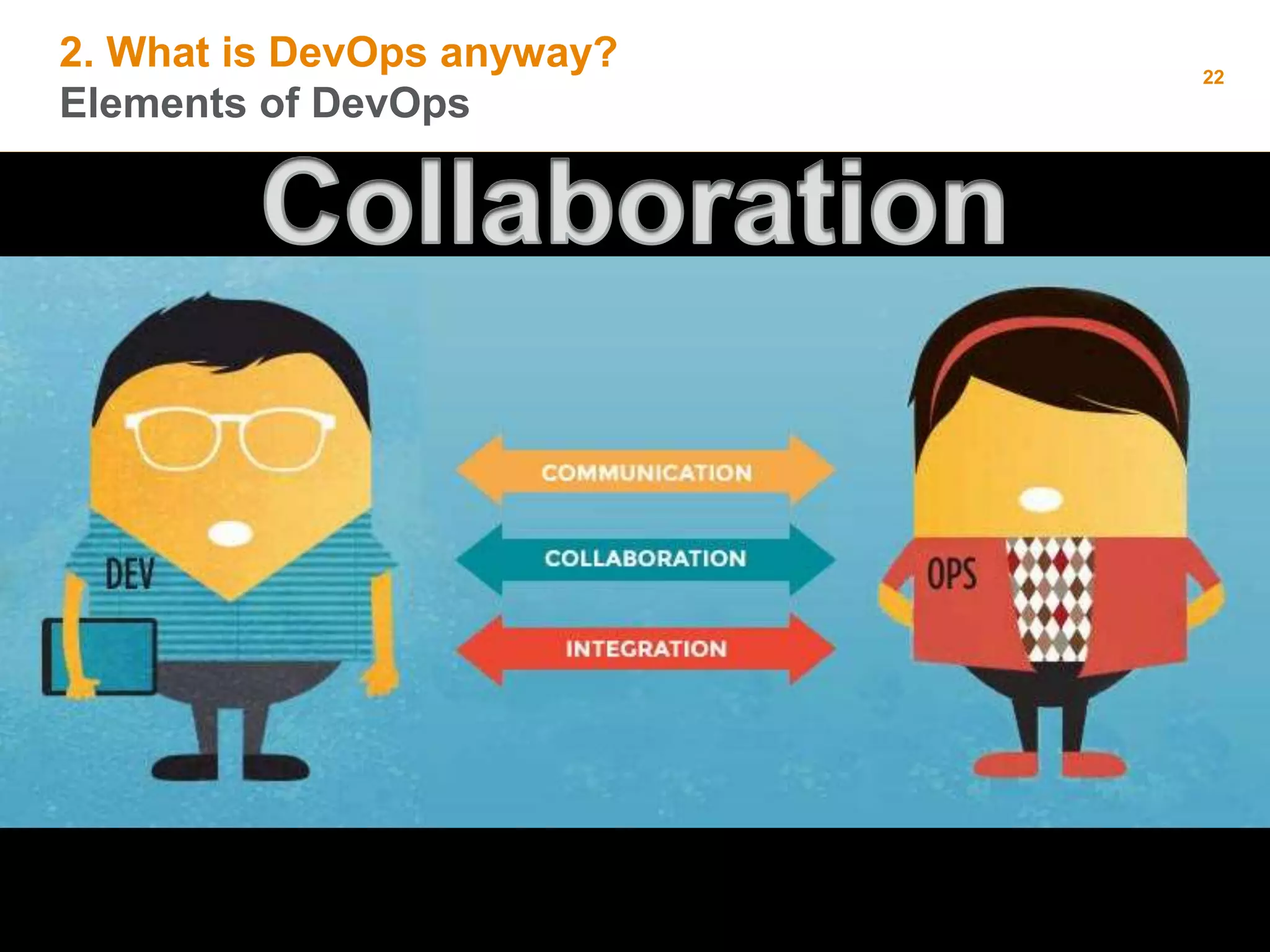
Elements of DevOps
22
 Collaboration
2. What is DevOps anyway?
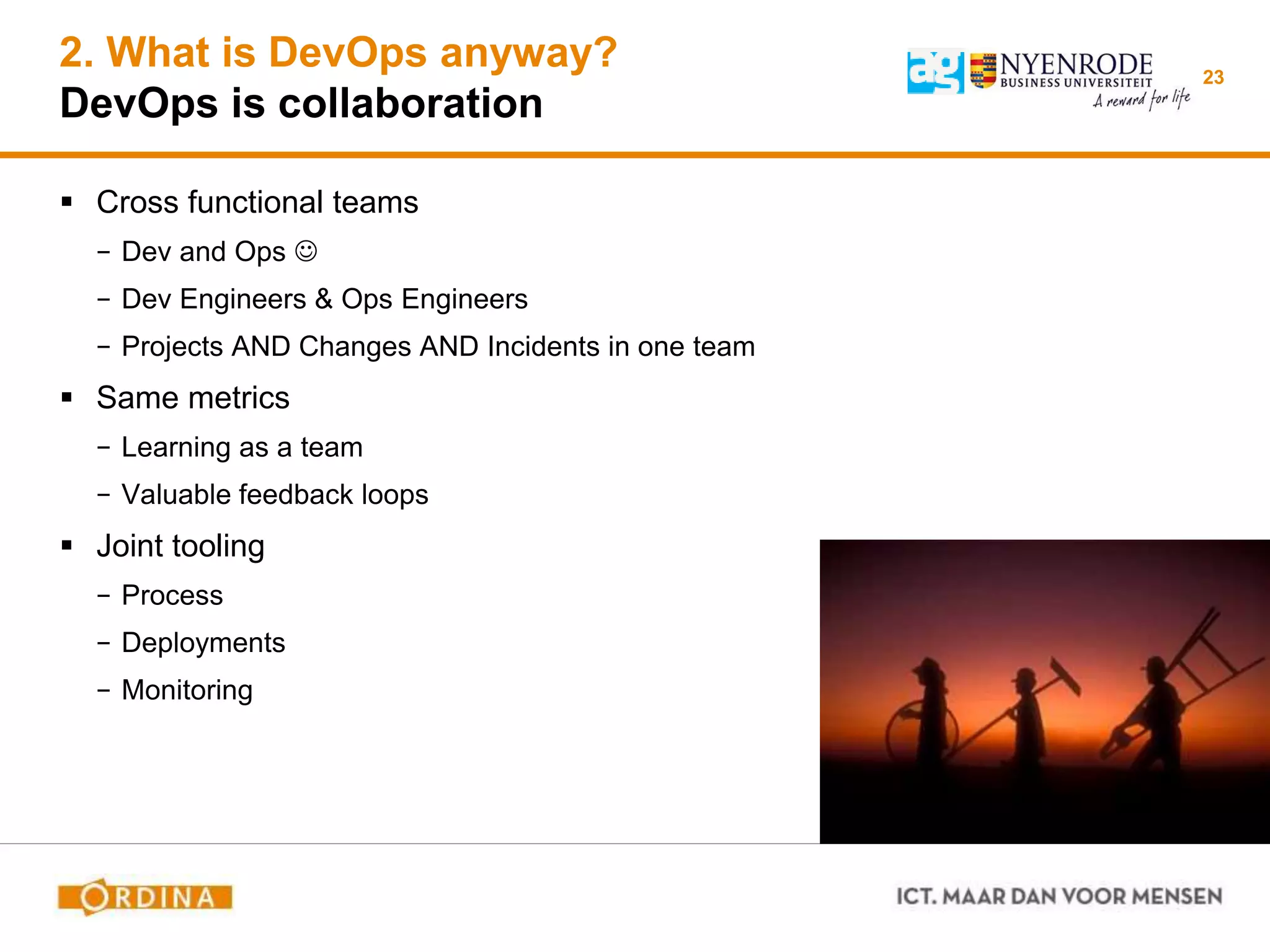
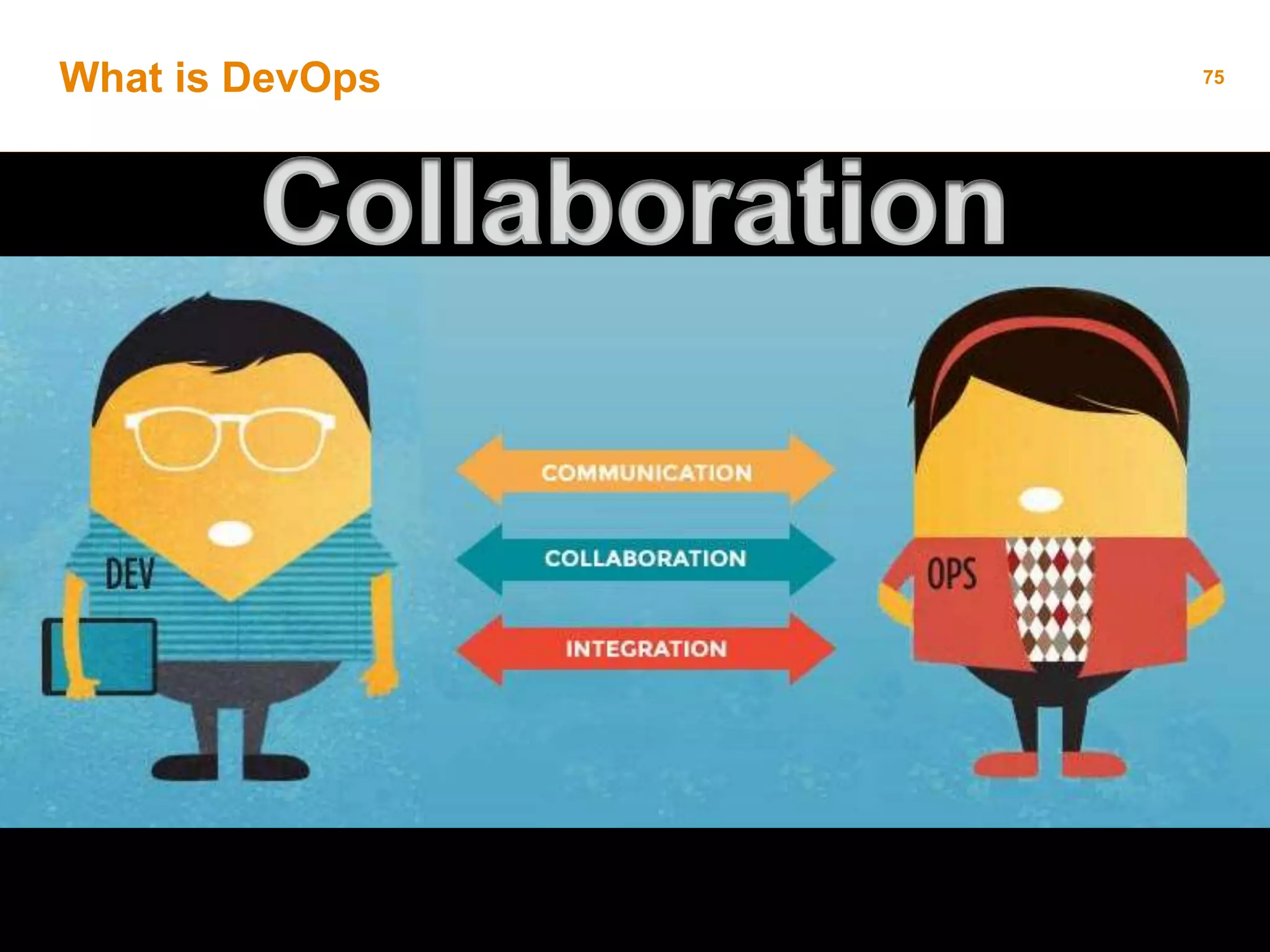
DevOps is collaboration
 Cross functional teams
− Dev and Ops 
− Dev Engineers & Ops Engineers
− Projects AND Changes AND Incidents in one team
 Same metrics
− Learning as a team
− Valuable feedback loops
 Joint tooling
− Process
− Deployments
− Monitoring
23
2. What is DevOps anyway?
Elements of DevOps
24
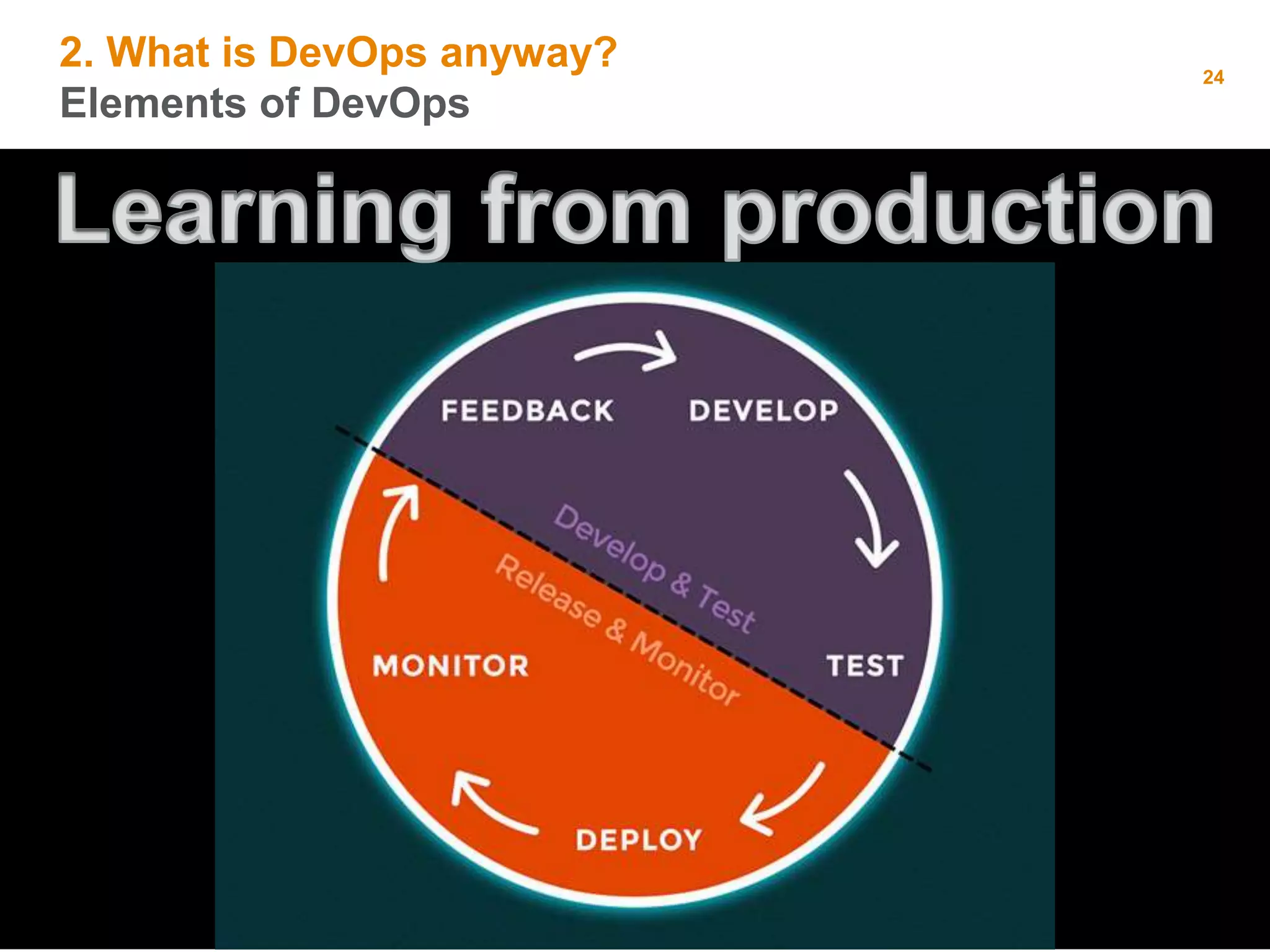
2. What is DevOps anyway?
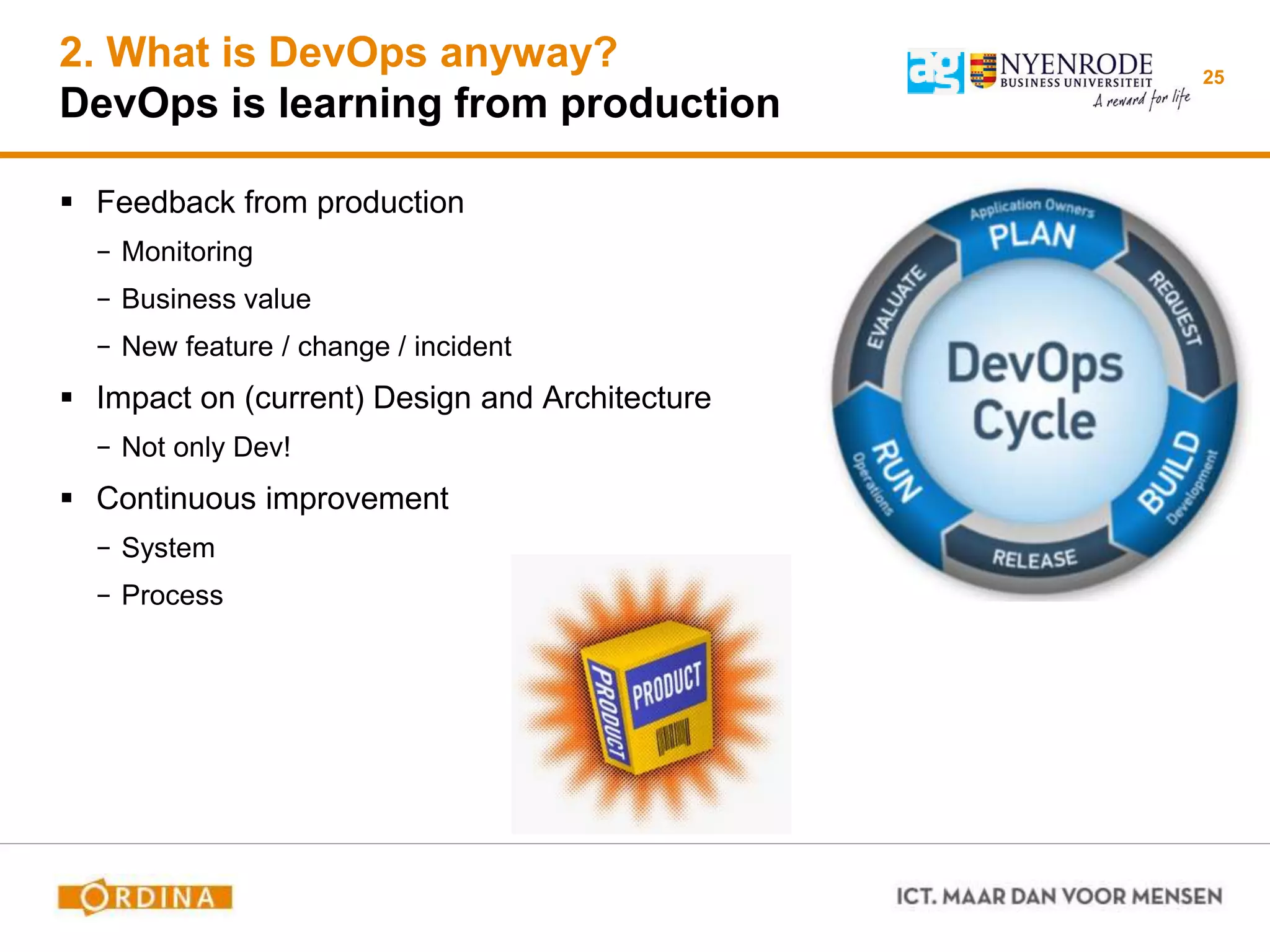
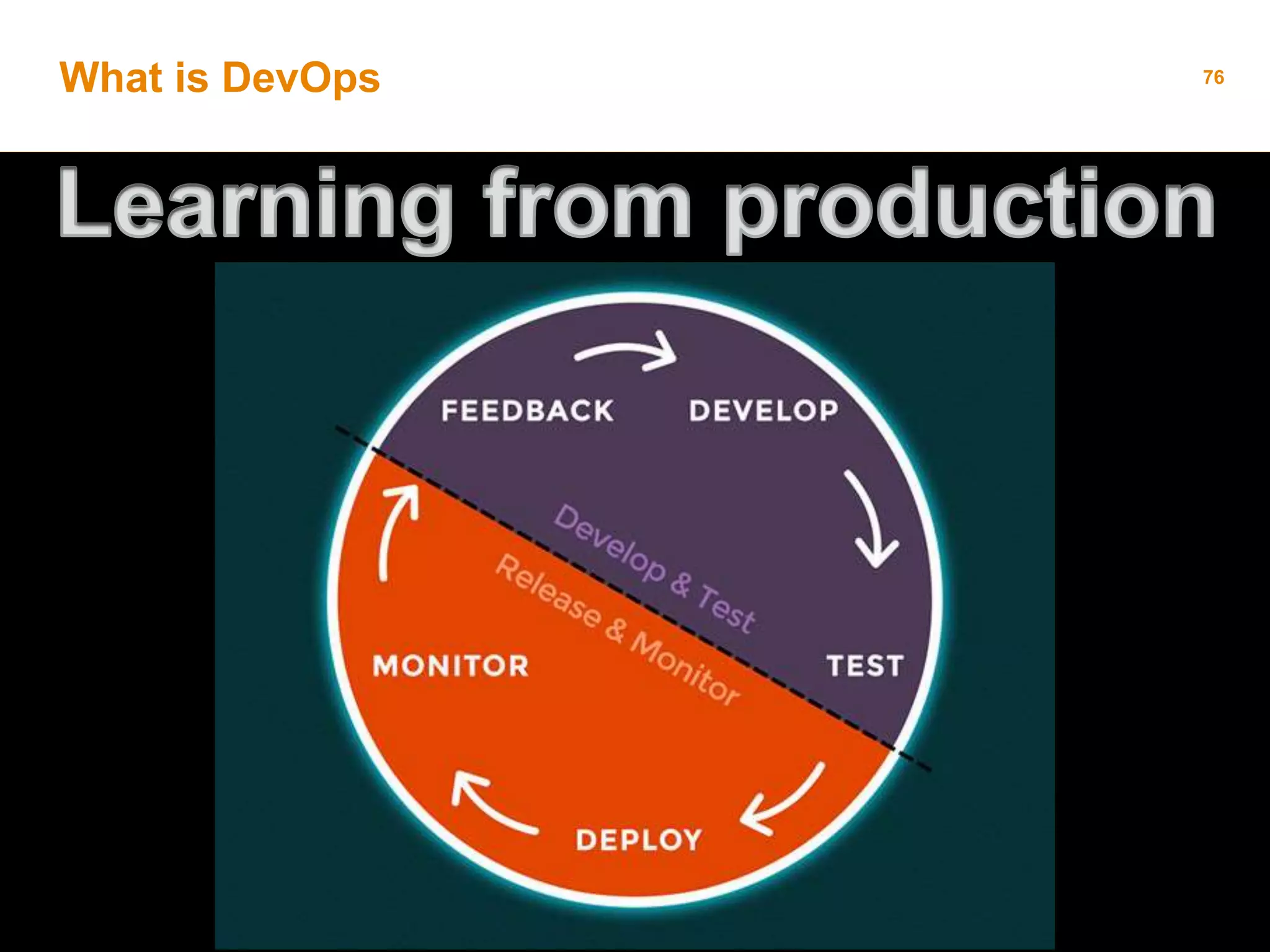
DevOps is learning from production
 Feedback from production
− Monitoring
− Business value
− New feature / change / incident
 Impact on (current) Design and Architecture
− Not only Dev!
 Continuous improvement
− System
− Process
25
2. What is DevOps anyway?
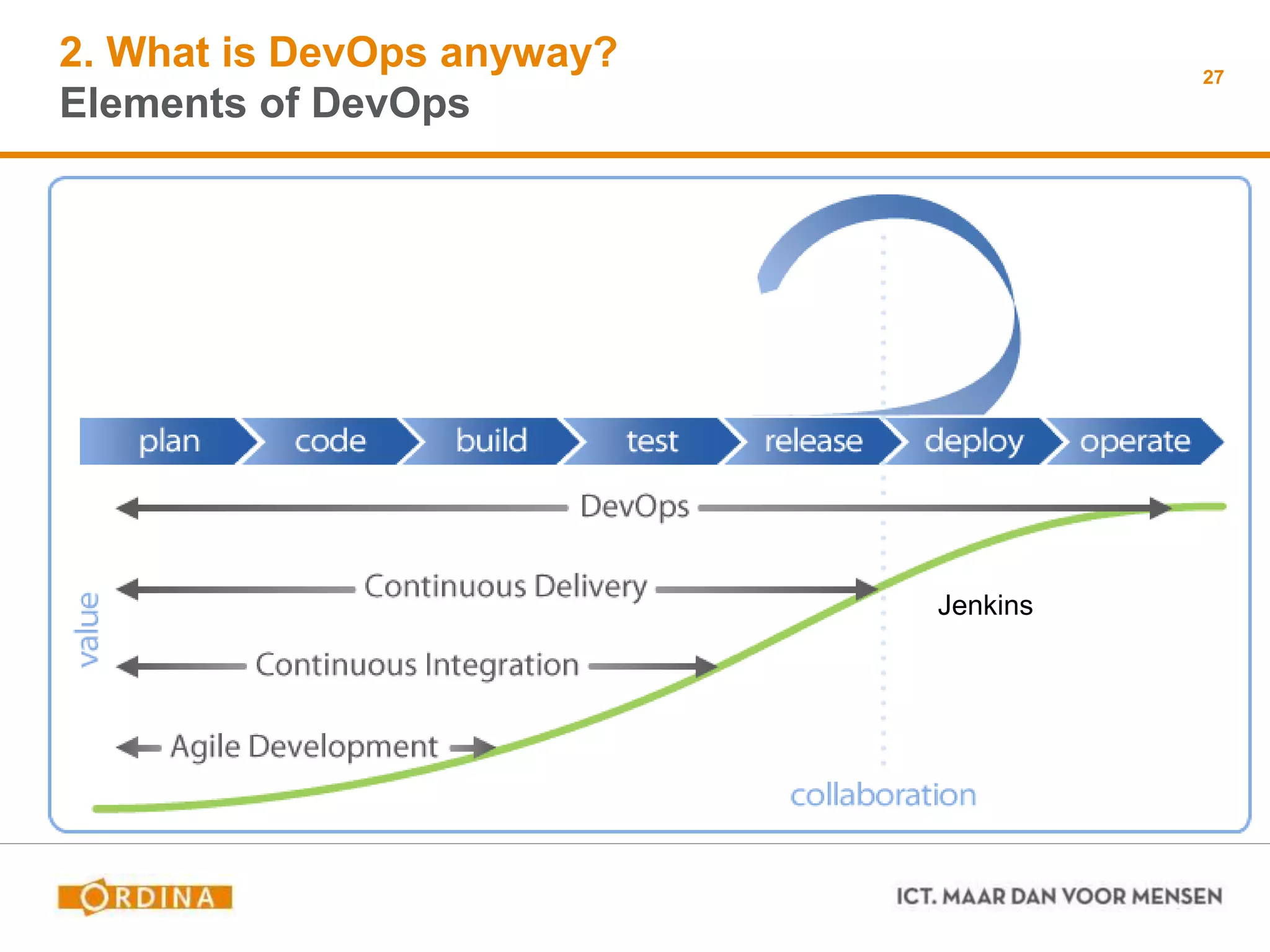
Elements of DevOps
27
Jenkins
2. What is DevOps anyway?
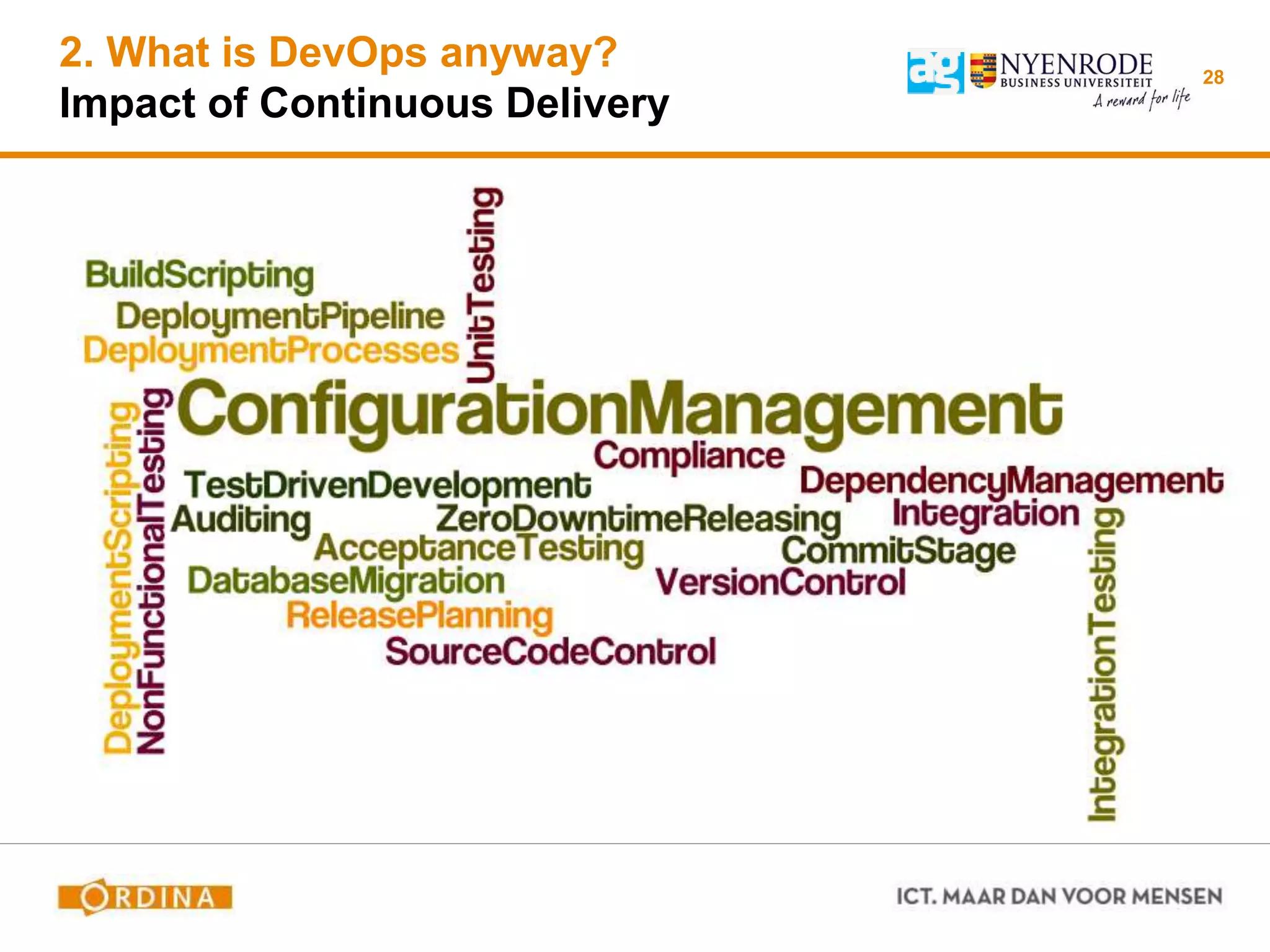
Impact of Continuous Delivery
28
2. What is DevOps anyway?
Quotes
29
30
www.ordina.nl
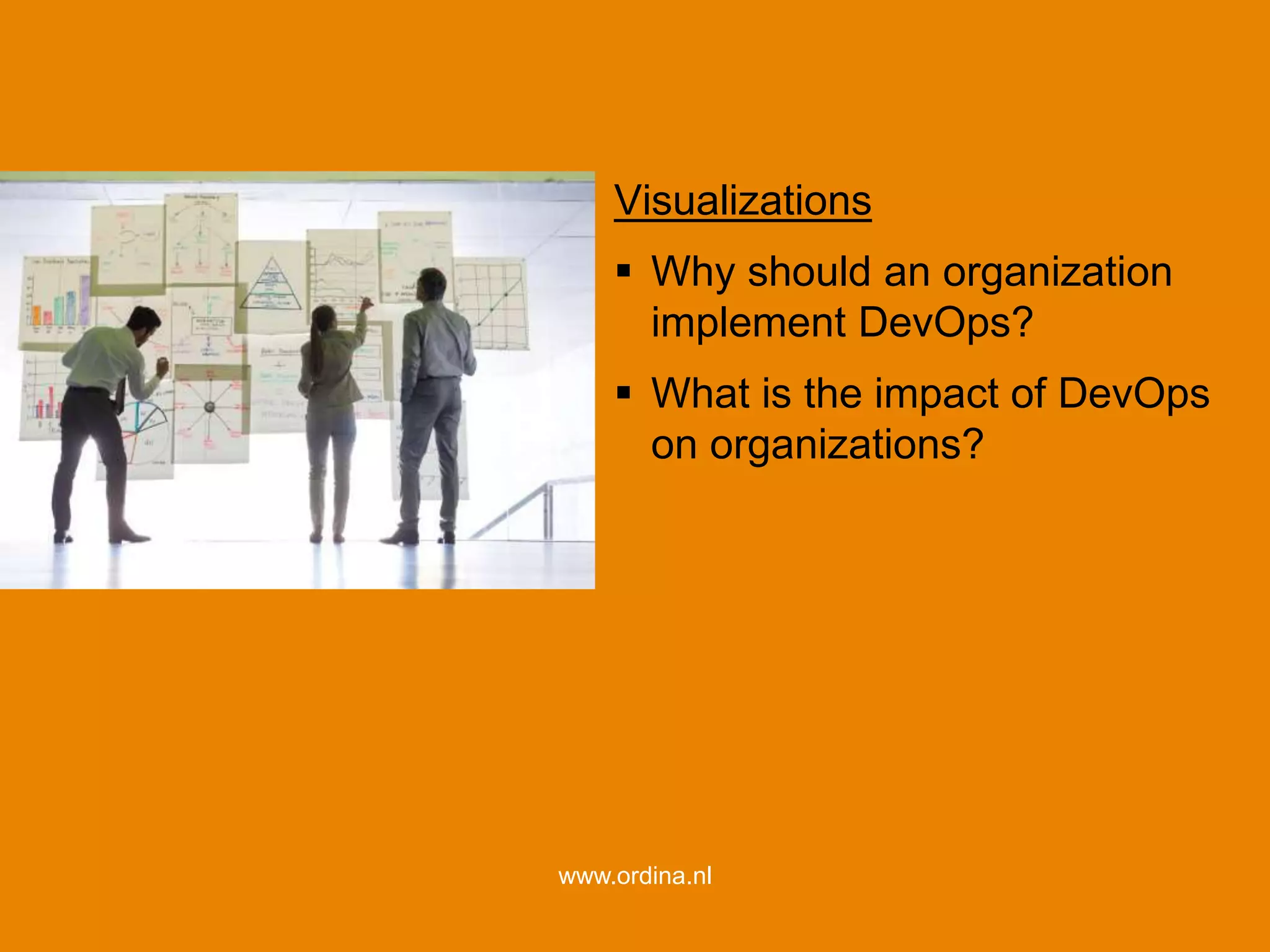
Visualizations
 Why should an organization
implement DevOps?
 What is the impact of DevOps
on organizations?
3. Stories from the trenches
ING, SchubergPhilis, Chamber of Commerce
3. Stories from the trenches
Speakers
 Evelijn van Leeuwen, ING
 Harm Boertien & Arthur van Schendel, SchubergPhilis
 Frank Verbruggen, Kamer van Koophandel (via Ordina)
32
4. Theories behind DevOps
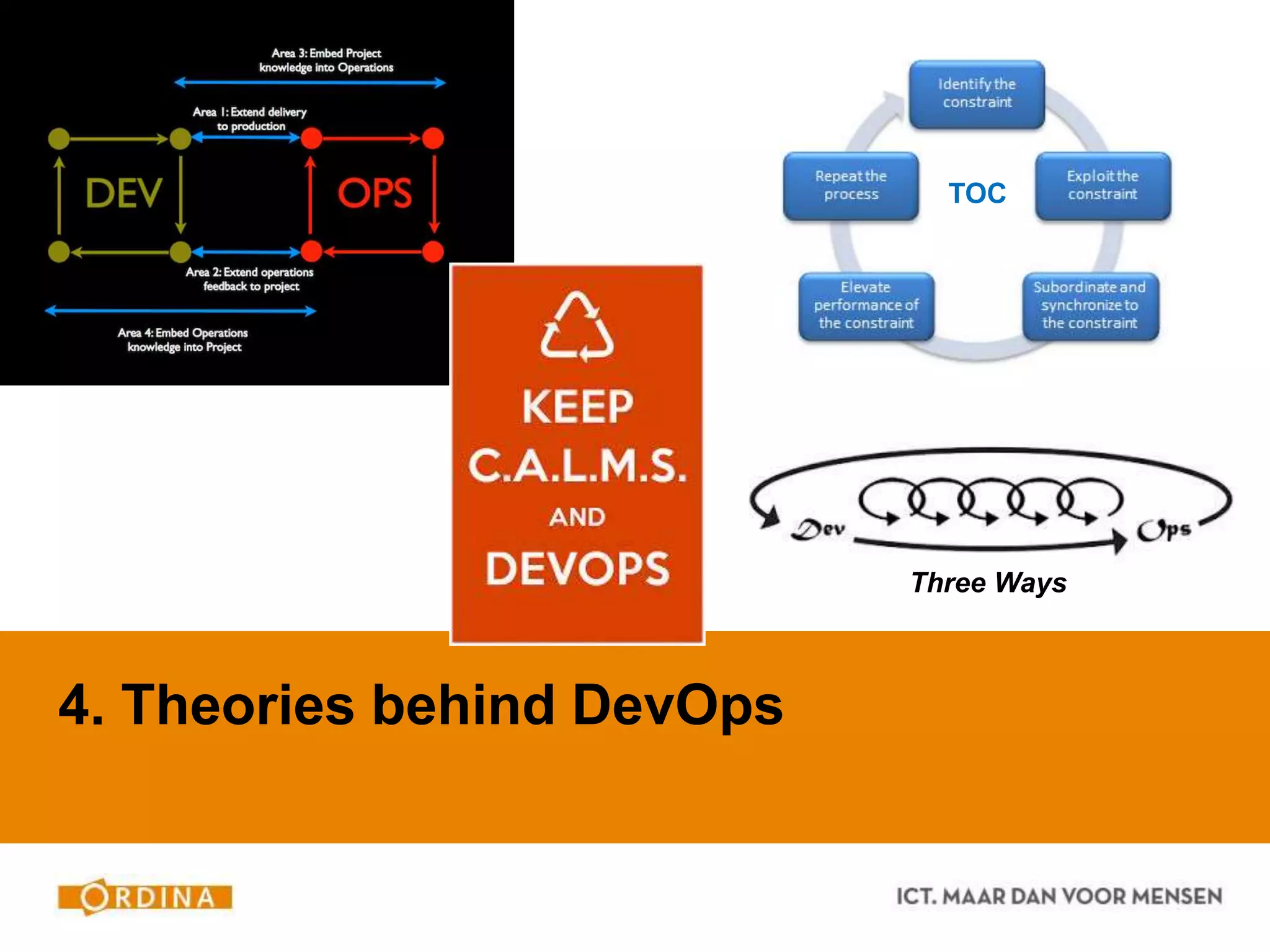
TOC
Three Ways
4. Theories behind DevOps
Thoughtleaders
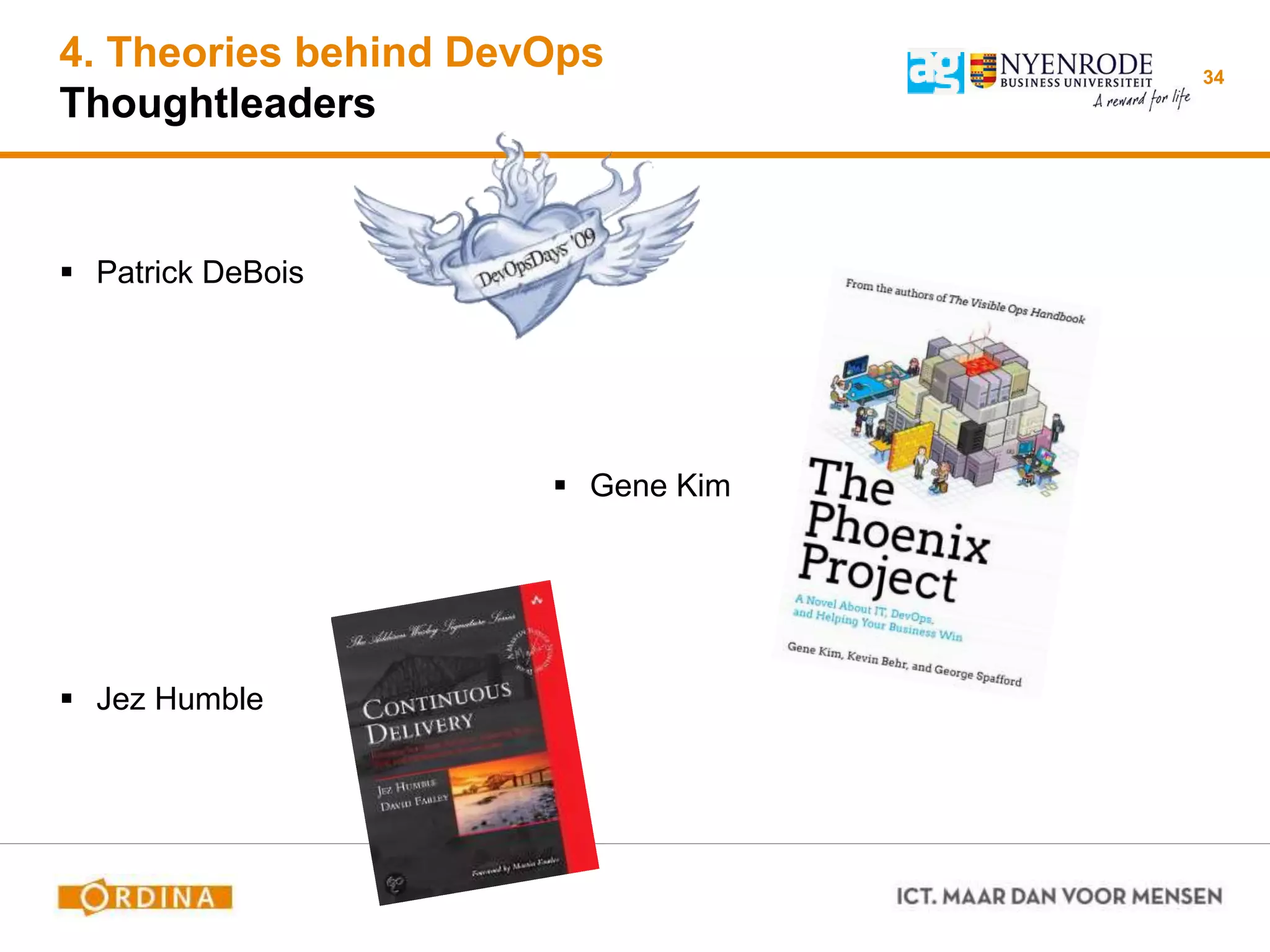
 Patrick DeBois
 Gene Kim
 Jez Humble
34
4. Theories behind DevOps
DeBois - ideas
35
 Founder of the DevOps movement
 DevOpsDays 2009, Ghent (B)
 Jedi.be
4. Theories behind DevOps
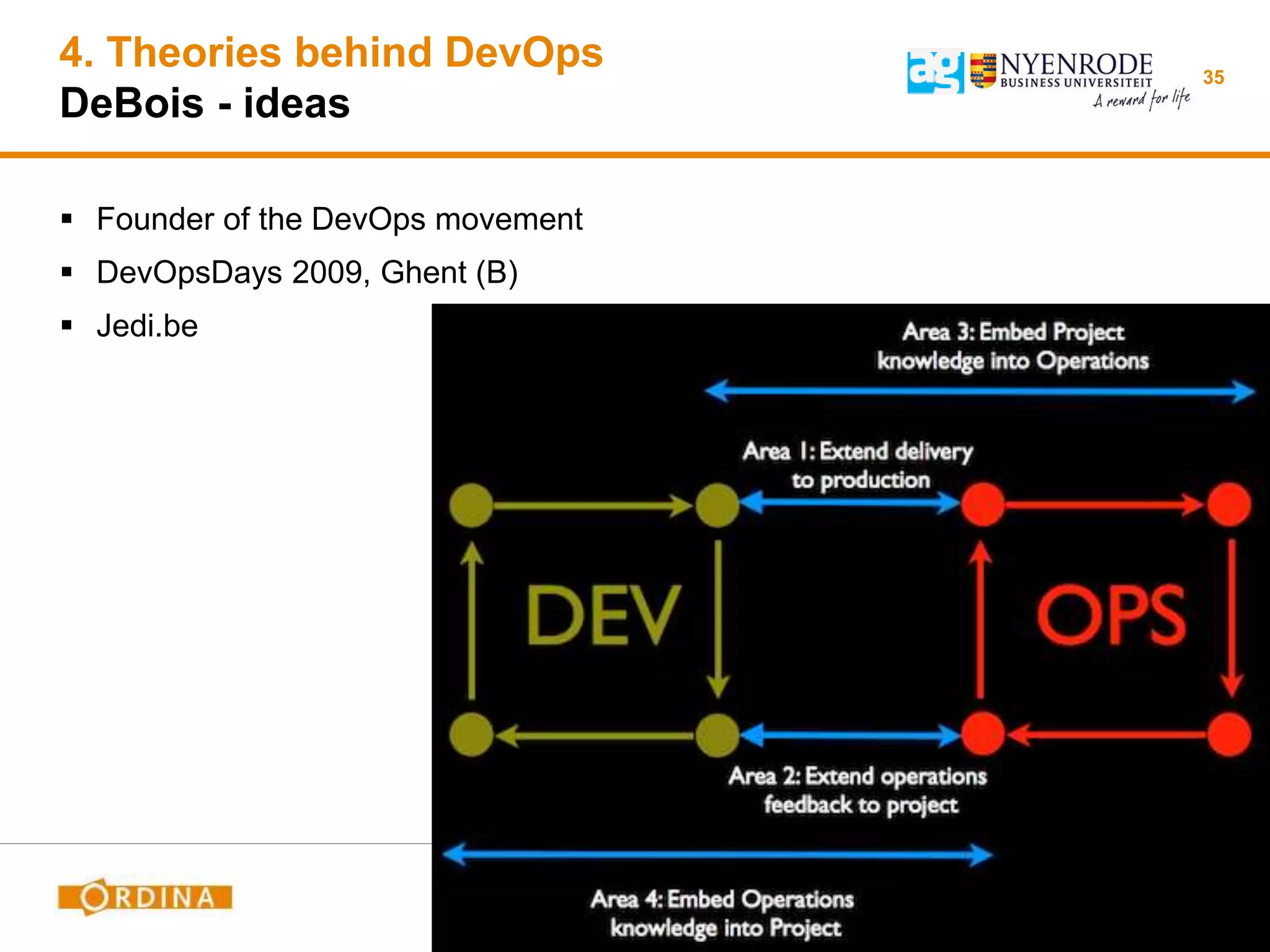
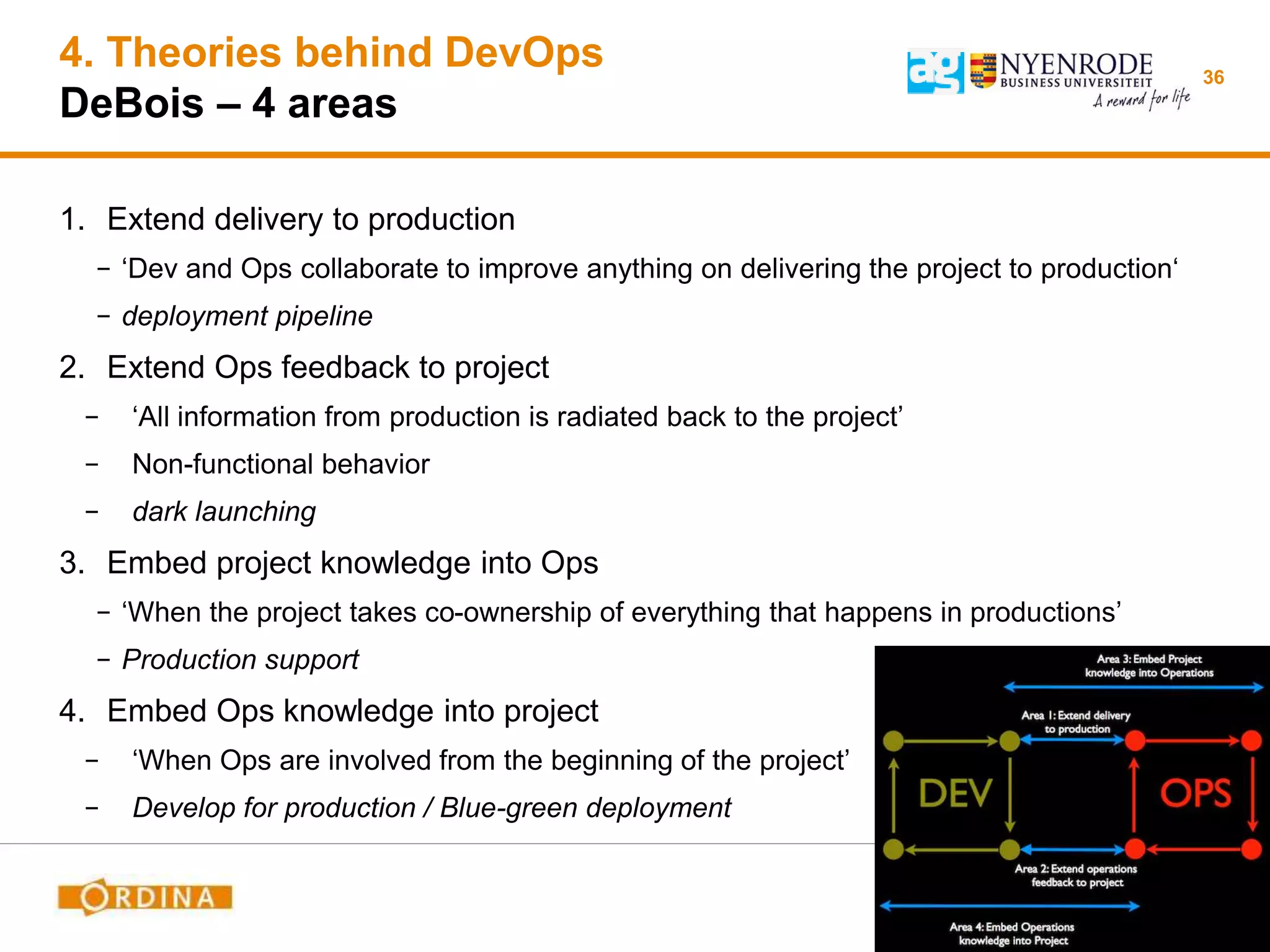
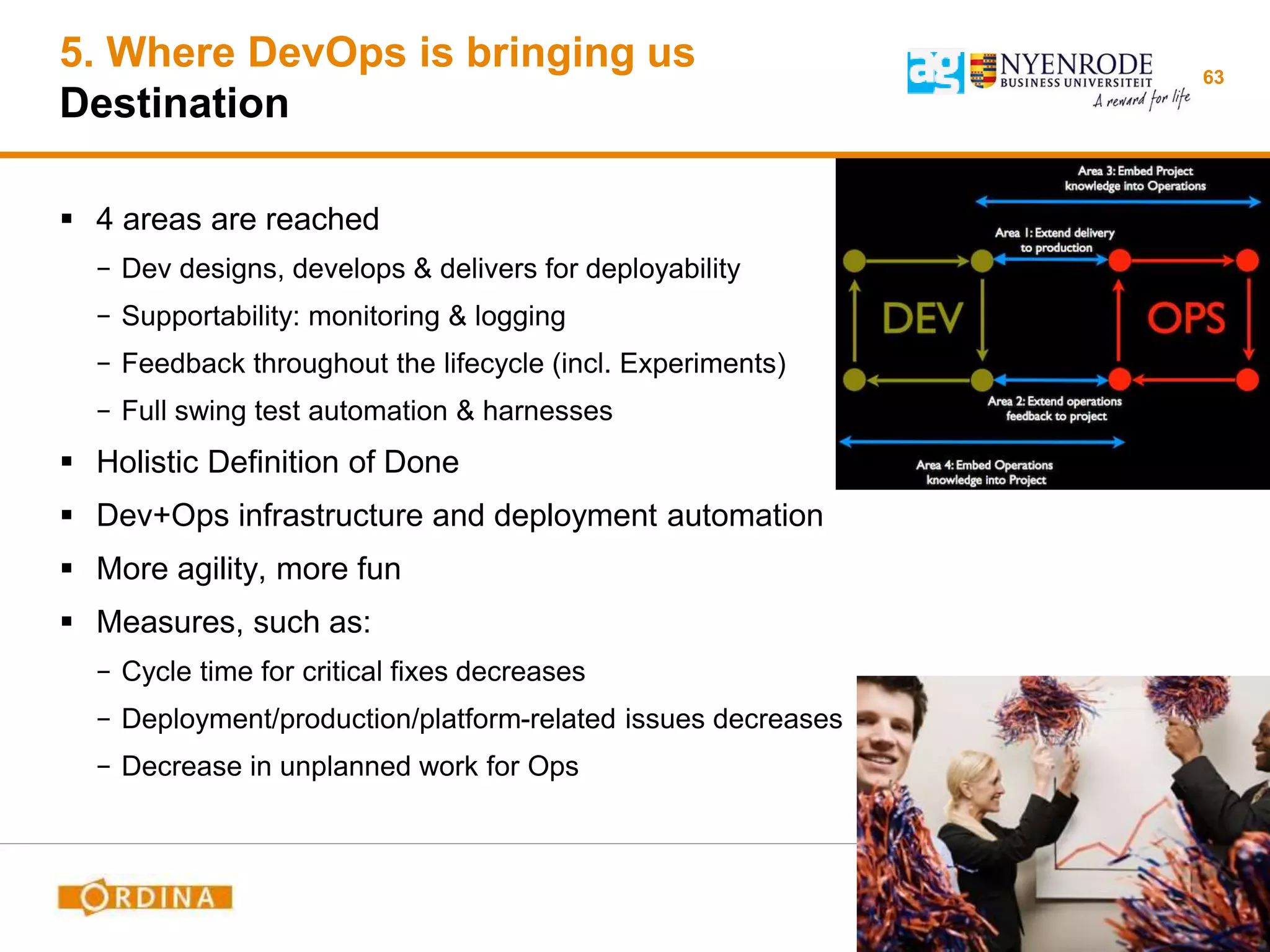
DeBois – 4 areas
36
1. Extend delivery to production
− ‘Dev and Ops collaborate to improve anything on delivering the project to production‘
− deployment pipeline
2. Extend Ops feedback to project
− ‘All information from production is radiated back to the project’
− Non-functional behavior
− dark launching
3. Embed project knowledge into Ops
− ‘When the project takes co-ownership of everything that happens in productions’
− Production support
4. Embed Ops knowledge into project
− ‘When Ops are involved from the beginning of the project’
− Develop for production / Blue-green deployment
4. Theories behind DevOps
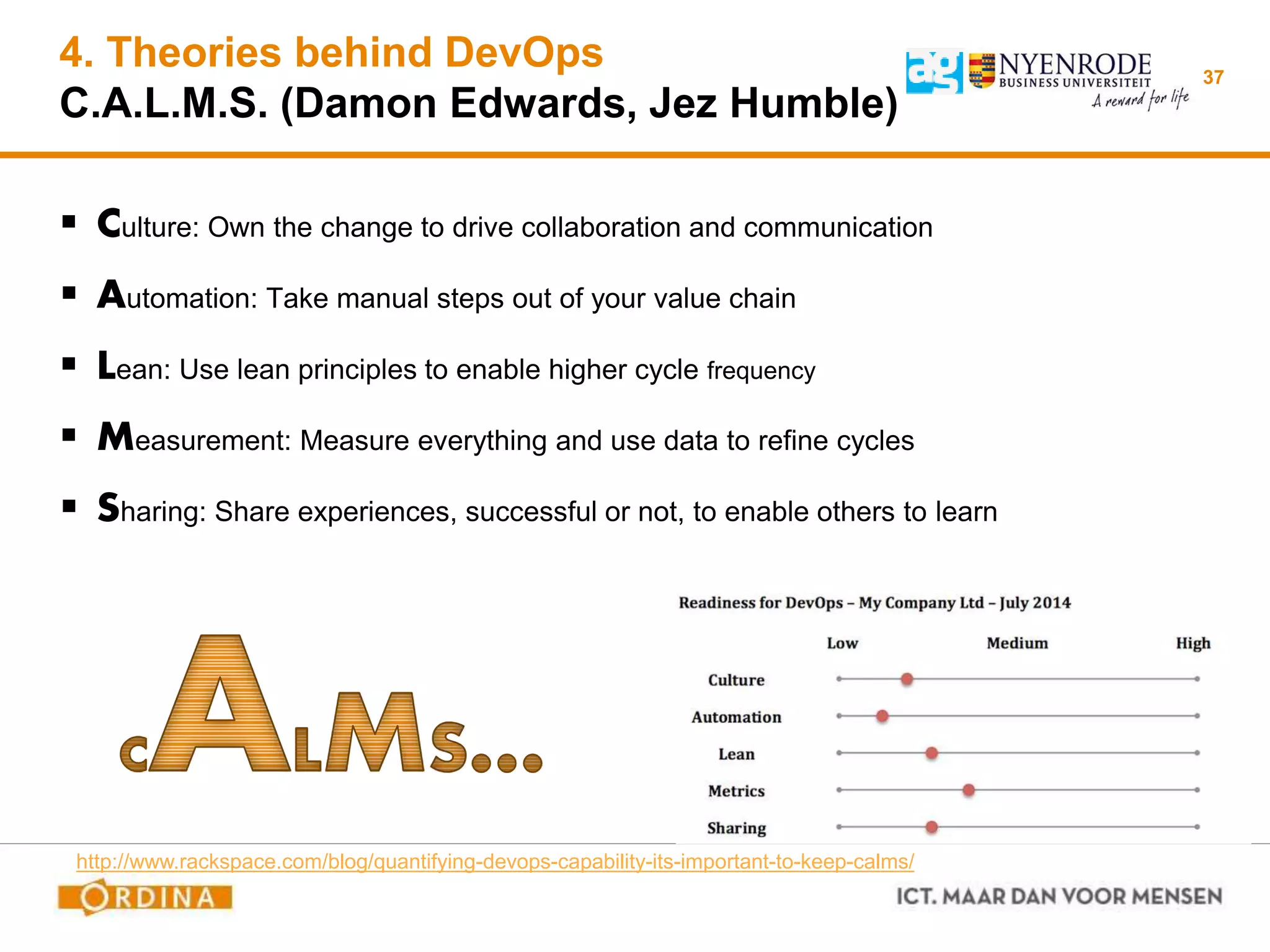
C.A.L.M.S. (Damon Edwards, Jez Humble)
 Culture: Own the change to drive collaboration and communication
 Automation: Take manual steps out of your value chain
 Lean: Use lean principles to enable higher cycle frequency
 Measurement: Measure everything and use data to refine cycles
 Sharing: Share experiences, successful or not, to enable others to learn
37
http://www.rackspace.com/blog/quantifying-devops-capability-its-important-to-keep-calms/
4. Theories behind DevOps
C.A.L.M.S. - Culture
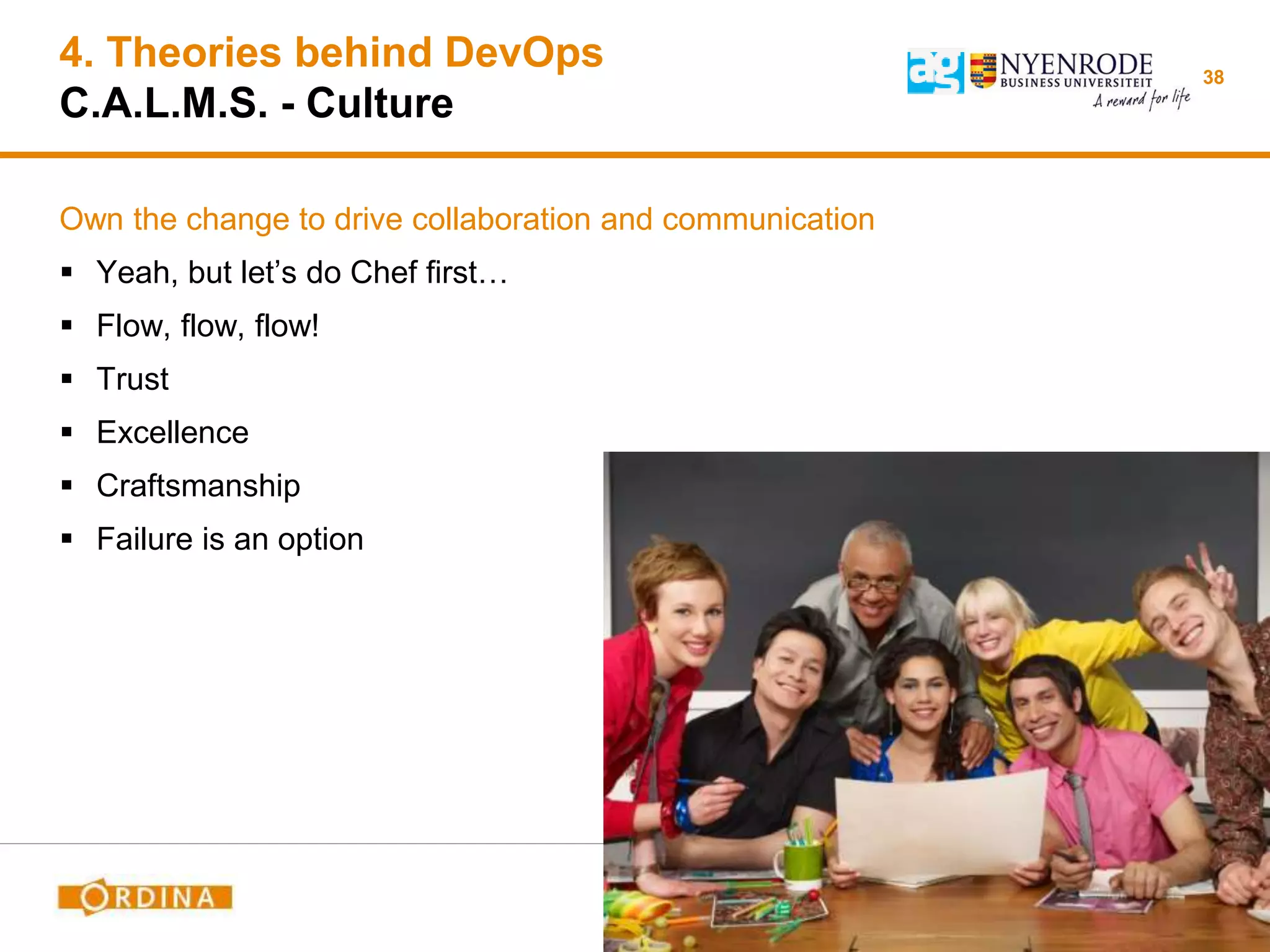
Own the change to drive collaboration and communication
 Yeah, but let’s do Chef first…
 Flow, flow, flow!
 Trust
 Excellence
 Craftsmanship
 Failure is an option
38
4. Theories behind DevOps
C.A.L.M.S. - Culture
39
4. Theories behind DevOps
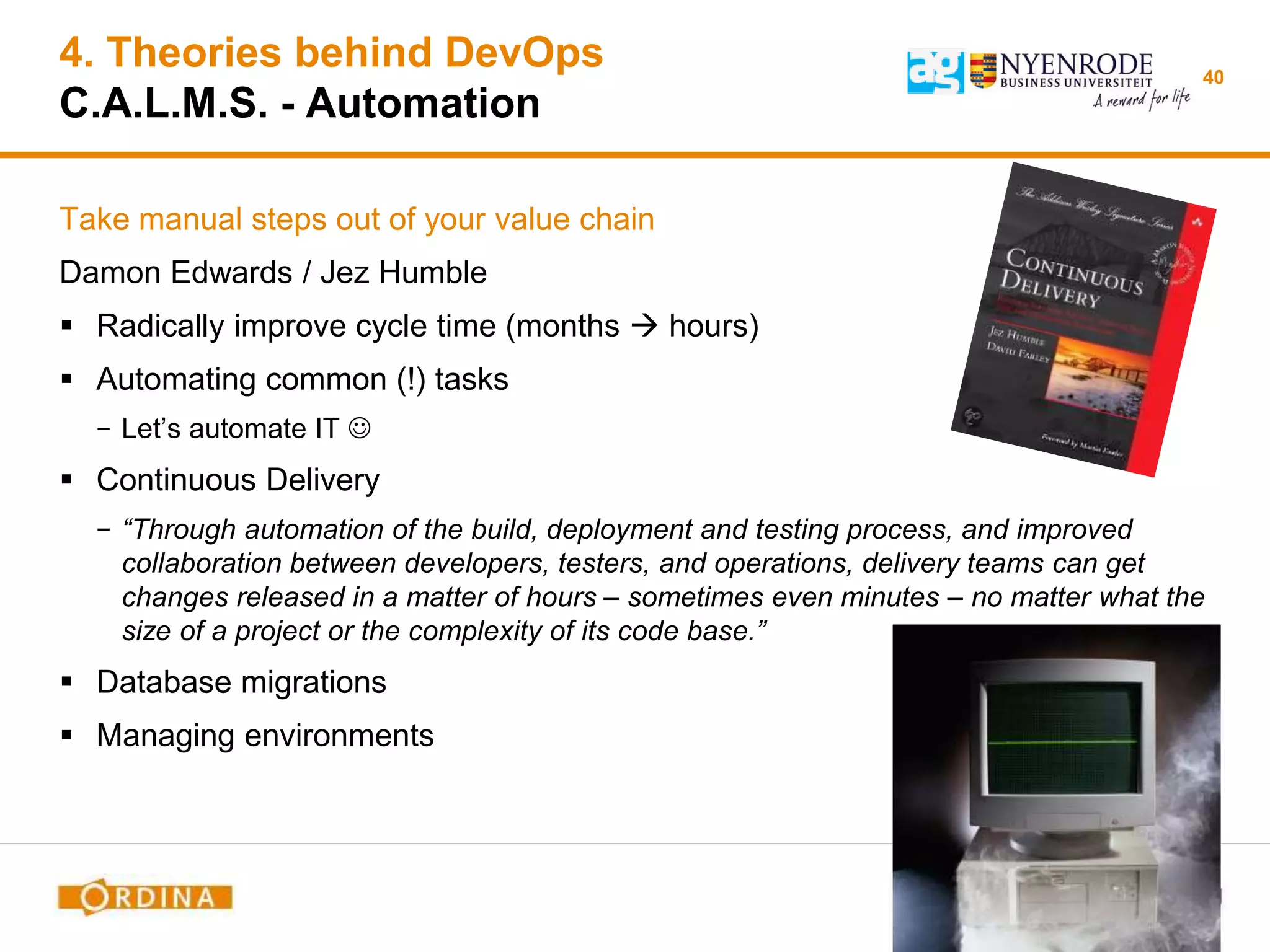
C.A.L.M.S. - Automation
Take manual steps out of your value chain
Damon Edwards / Jez Humble
 Radically improve cycle time (months  hours)
 Automating common (!) tasks
− Let’s automate IT 
 Continuous Delivery
− “Through automation of the build, deployment and testing process, and improved
collaboration between developers, testers, and operations, delivery teams can get
changes released in a matter of hours – sometimes even minutes – no matter what the
size of a project or the complexity of its code base.”
 Database migrations
 Managing environments
40
4. Theories behind DevOps
C.A.L.M.S. - Automation
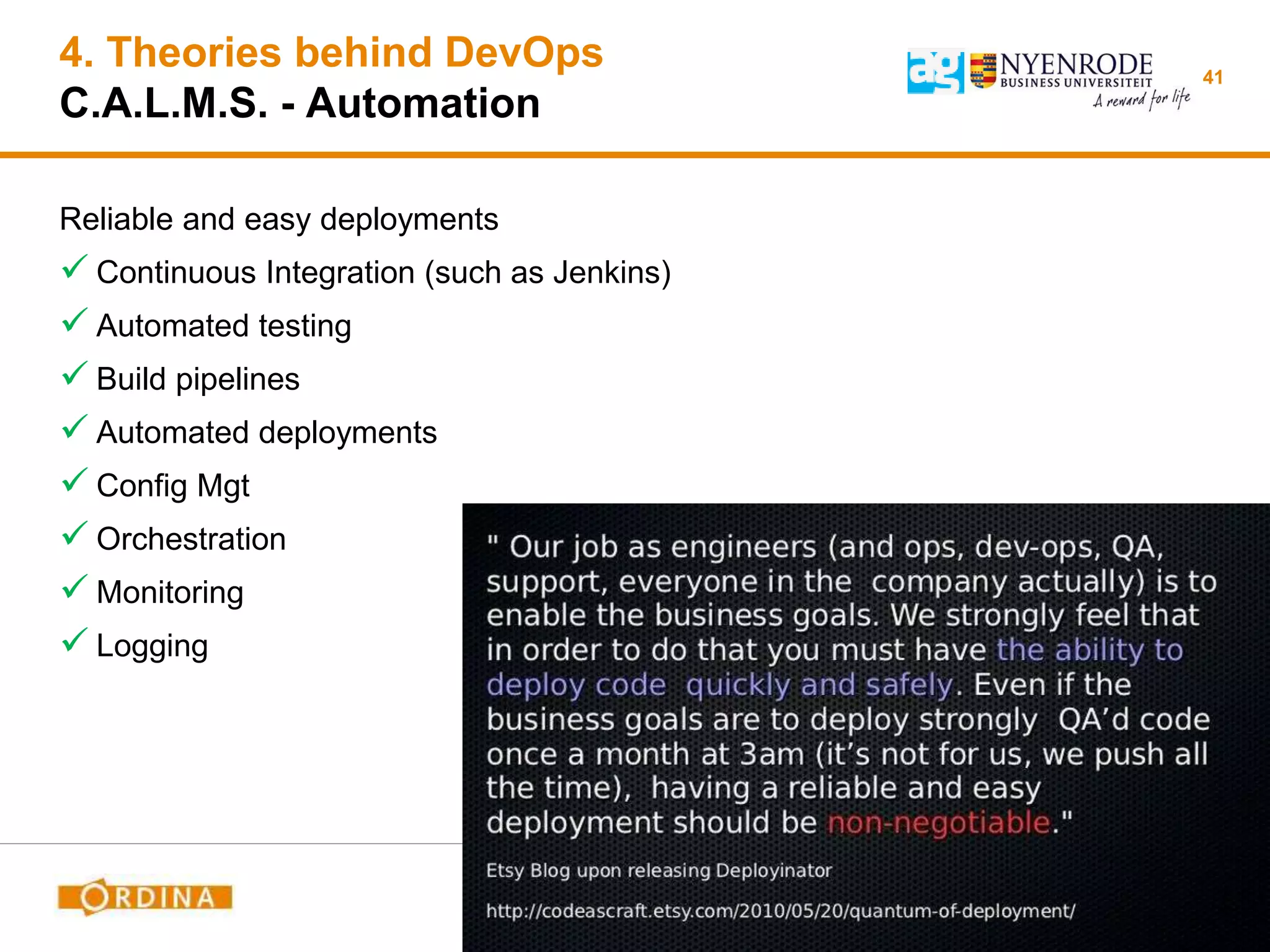
Reliable and easy deployments
 Continuous Integration (such as Jenkins)
 Automated testing
 Build pipelines
 Automated deployments
 Config Mgt
 Orchestration
 Monitoring
 Logging
41
4. Theories behind DevOps
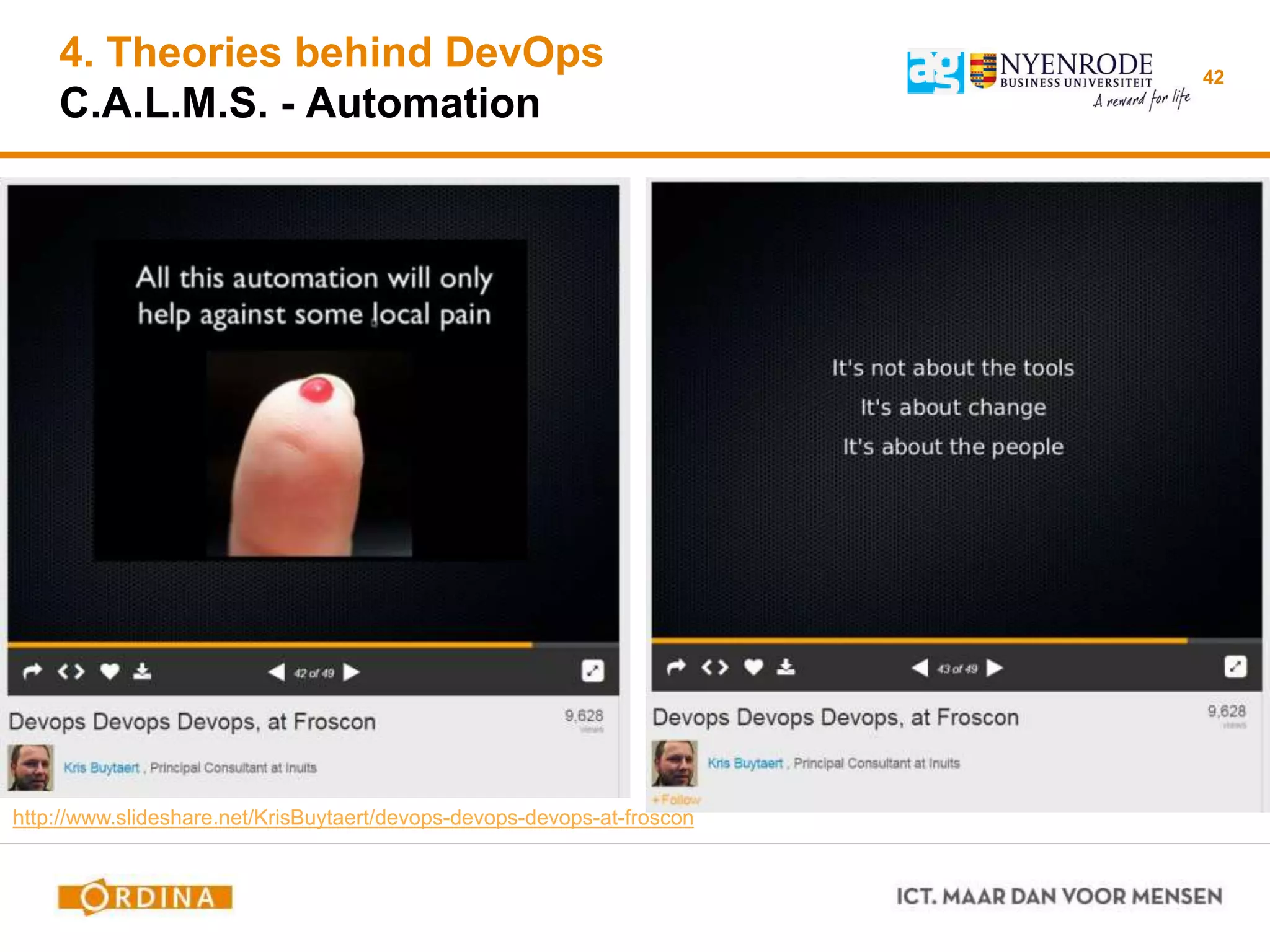
C.A.L.M.S. - Automation
42
http://www.slideshare.net/KrisBuytaert/devops-devops-devops-at-froscon
4. Theories behind DevOps
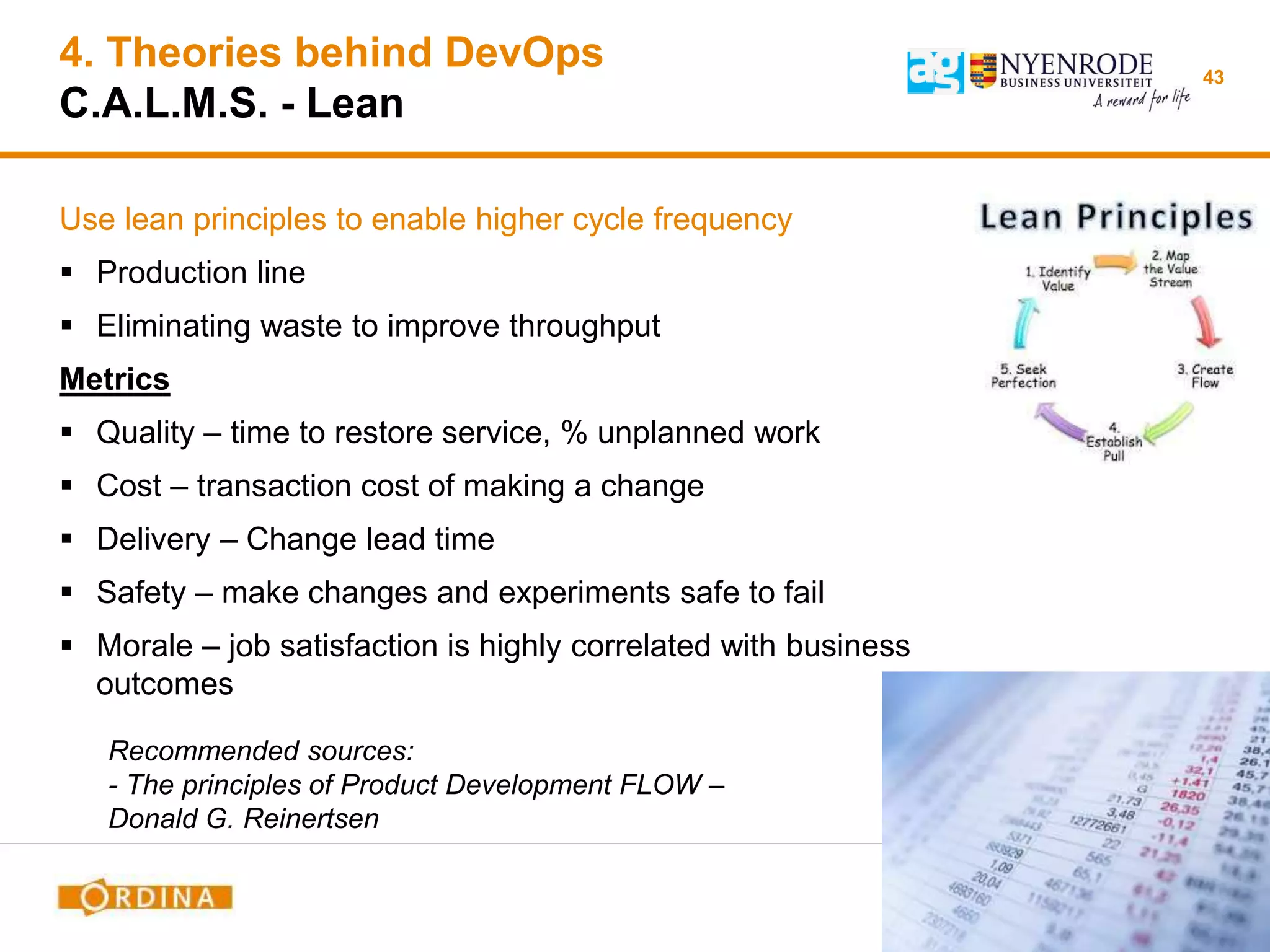
C.A.L.M.S. - Lean
Use lean principles to enable higher cycle frequency
 Production line
 Eliminating waste to improve throughput
Metrics
 Quality – time to restore service, % unplanned work
 Cost – transaction cost of making a change
 Delivery – Change lead time
 Safety – make changes and experiments safe to fail
 Morale – job satisfaction is highly correlated with business
outcomes
43
Recommended sources:
- The principles of Product Development FLOW –
Donald G. Reinertsen
4. Theories behind DevOps
C.A.L.M.S. - Measurement
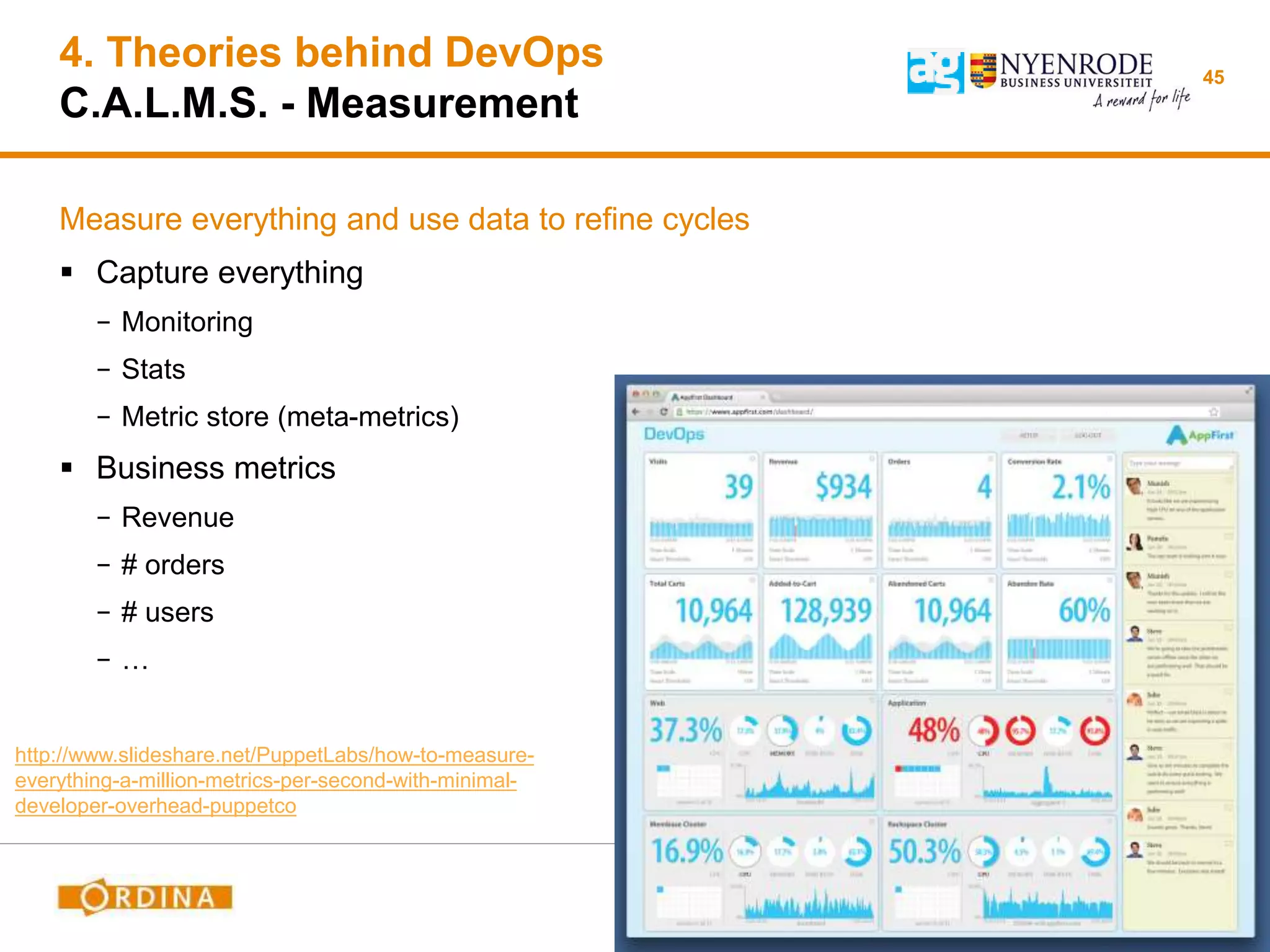
Measure everything and use data to refine cycles
 Capture everything
− Monitoring
− Stats
− Metric store (meta-metrics)
 Business metrics
− Revenue
− # orders
− # users
− …
45
http://www.slideshare.net/PuppetLabs/how-to-measure-
everything-a-million-metrics-per-second-with-minimal-
developer-overhead-puppetco
4. Theories behind DevOps
C.A.L.M.S. - Measurement
Measure everything and use data to refine cycles
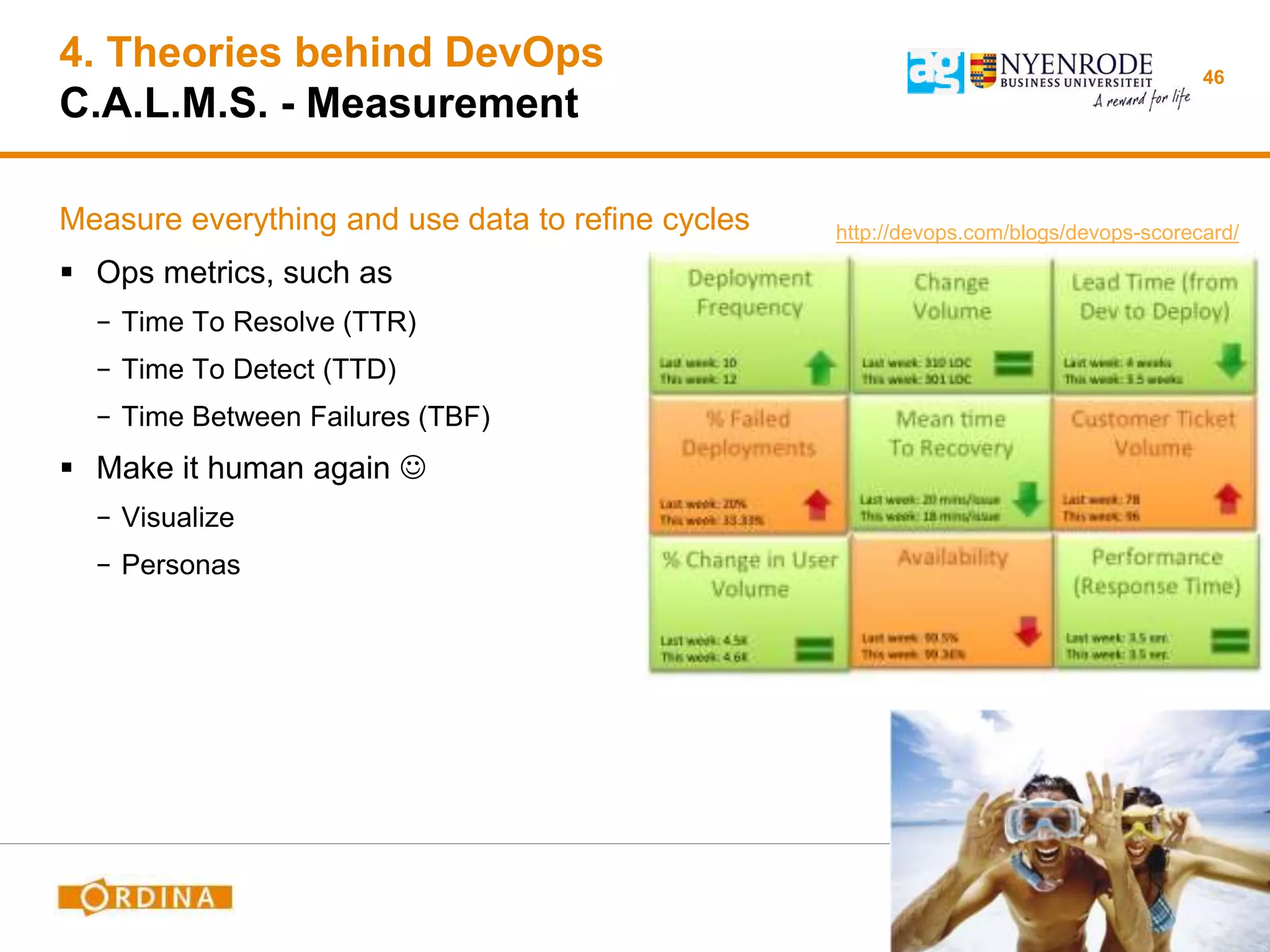
 Ops metrics, such as
− Time To Resolve (TTR)
− Time To Detect (TTD)
− Time Between Failures (TBF)
 Make it human again 
− Visualize
− Personas
46
http://devops.com/blogs/devops-scorecard/
4. Theories behind DevOps
C.A.L.M.S. - Sharing
Damon Edwards / John Willis / Jez Humble
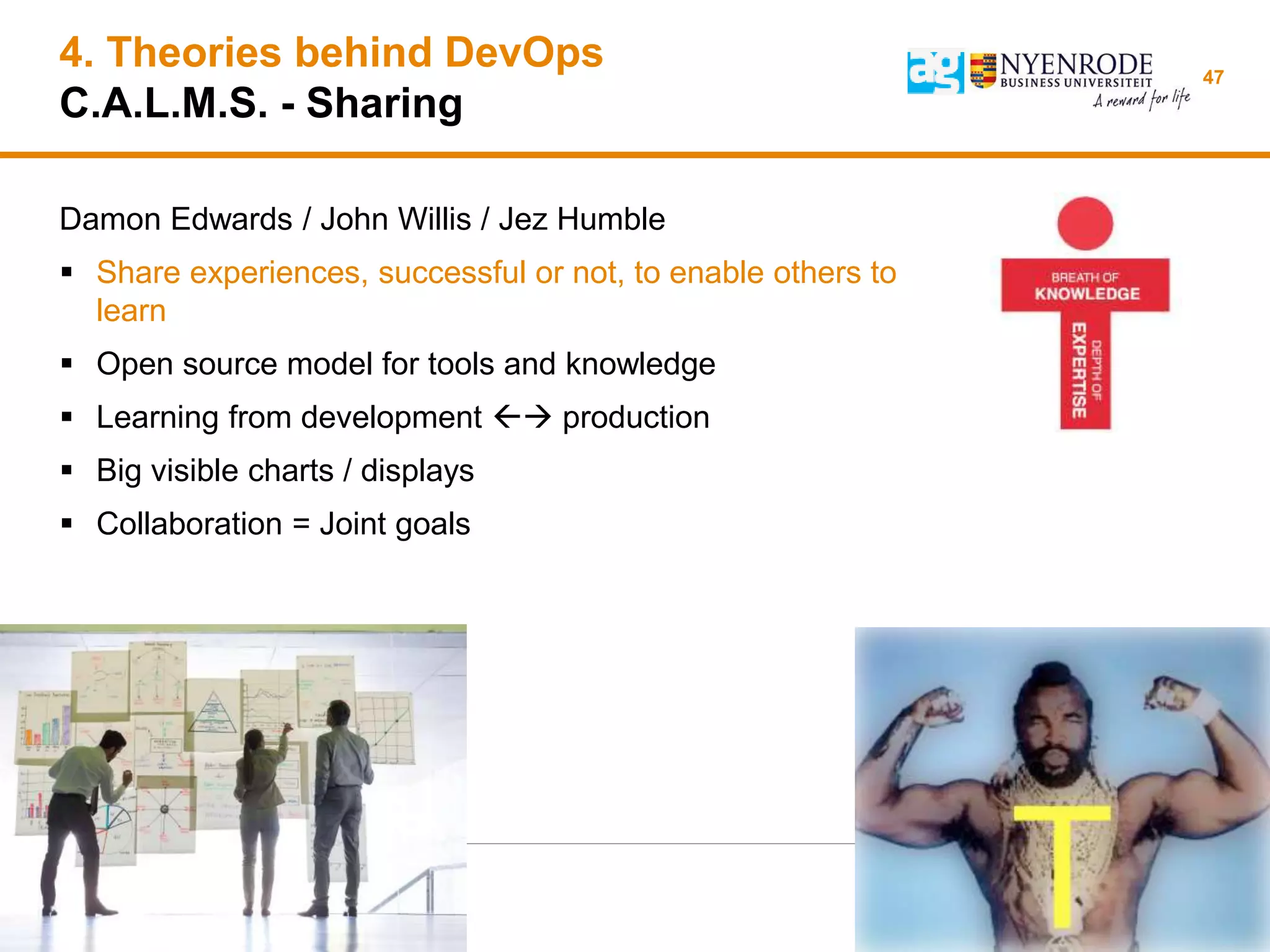
 Share experiences, successful or not, to enable others to
learn
 Open source model for tools and knowledge
 Learning from development  production
 Big visible charts / displays
 Collaboration = Joint goals
47
4. Theories behind DevOps
Three Ways
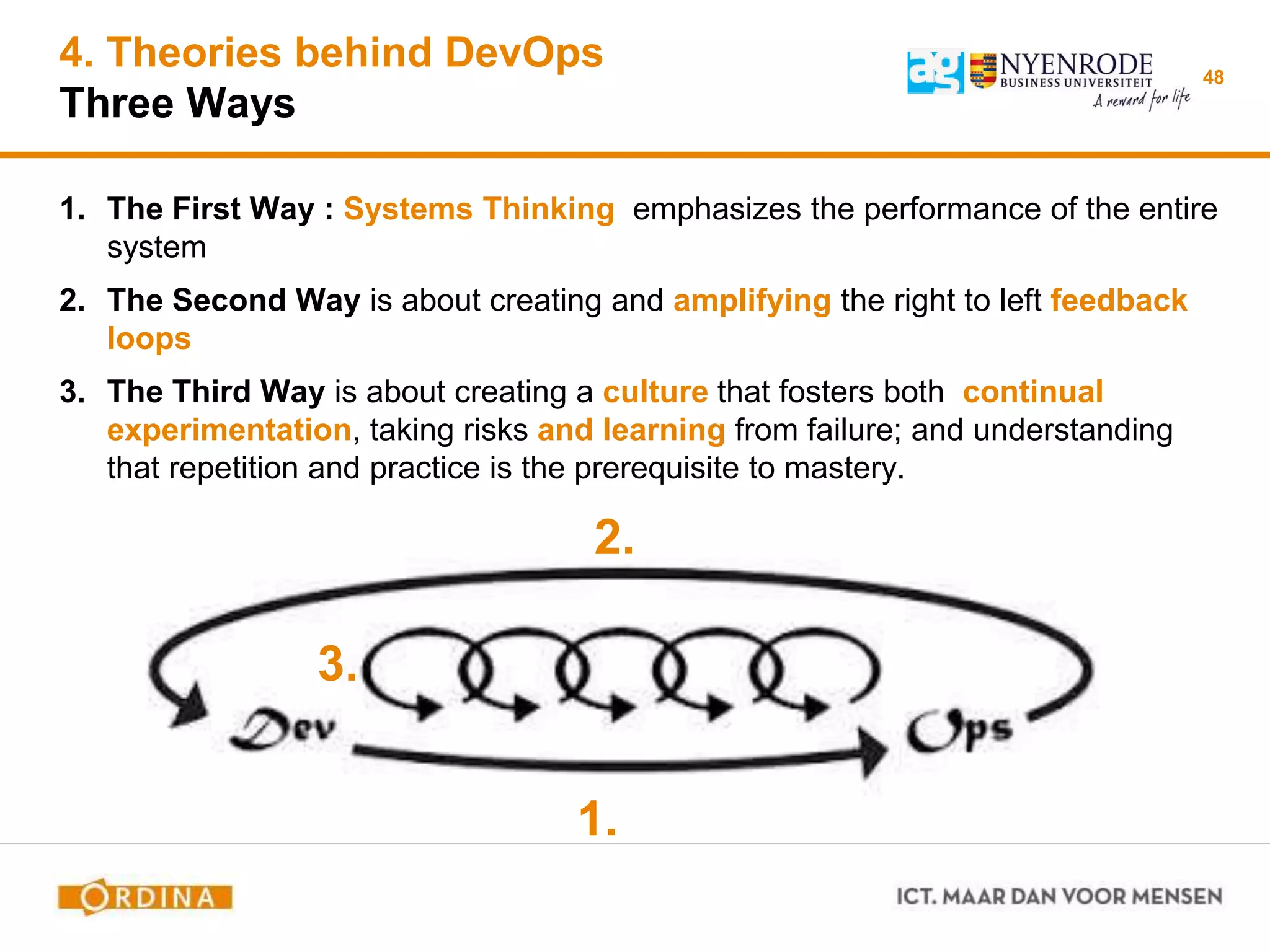
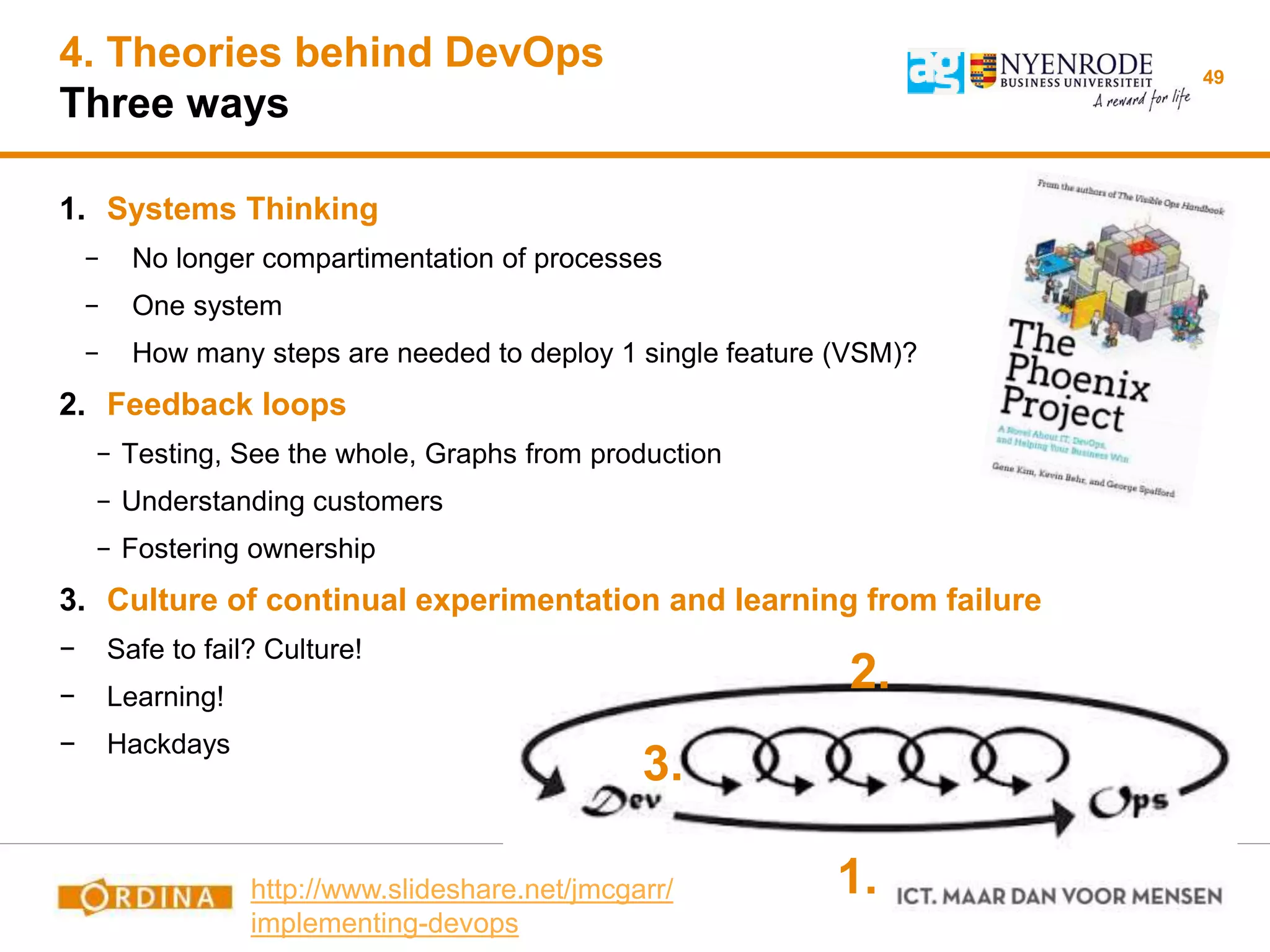
1. The First Way : Systems Thinking emphasizes the performance of the entire
system
2. The Second Way is about creating and amplifying the right to left feedback
loops
3. The Third Way is about creating a culture that fosters both continual
experimentation, taking risks and learning from failure; and understanding
that repetition and practice is the prerequisite to mastery.
48
1.
2.
3.
4. Theories behind DevOps
Three ways
49
1. Systems Thinking
− No longer compartimentation of processes
− One system
− How many steps are needed to deploy 1 single feature (VSM)?
2. Feedback loops
− Testing, See the whole, Graphs from production
− Understanding customers
− Fostering ownership
3. Culture of continual experimentation and learning from failure
− Safe to fail? Culture!
− Learning!
− Hackdays
1.
2.
3.
http://www.slideshare.net/jmcgarr/
implementing-devops
4. Theories behind DevOps
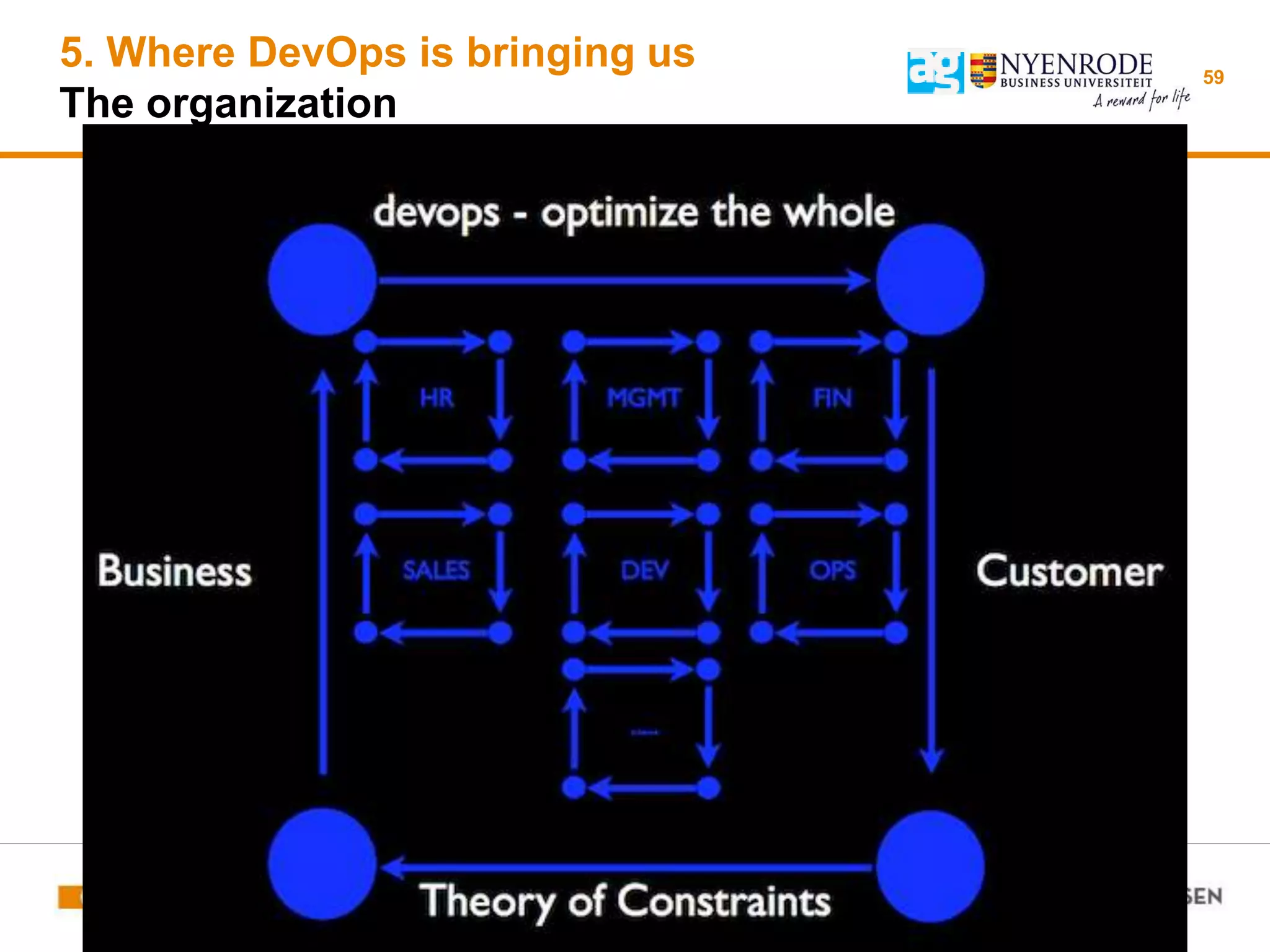
Theory of Constraints
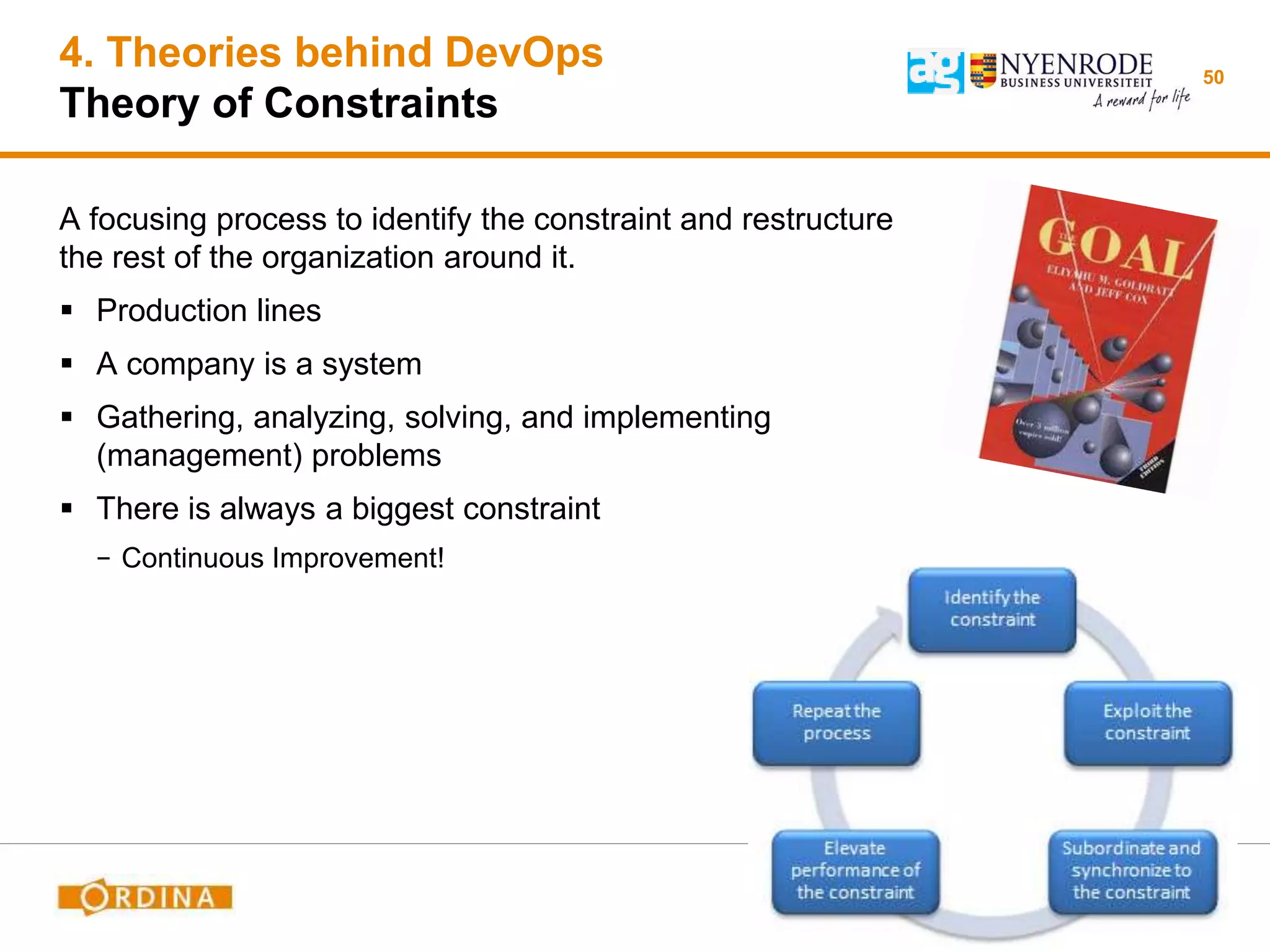
A focusing process to identify the constraint and restructure
the rest of the organization around it.
 Production lines
 A company is a system
 Gathering, analyzing, solving, and implementing
(management) problems
 There is always a biggest constraint
− Continuous Improvement!
50
4. Theories behind DevOps
Theory of Constraints
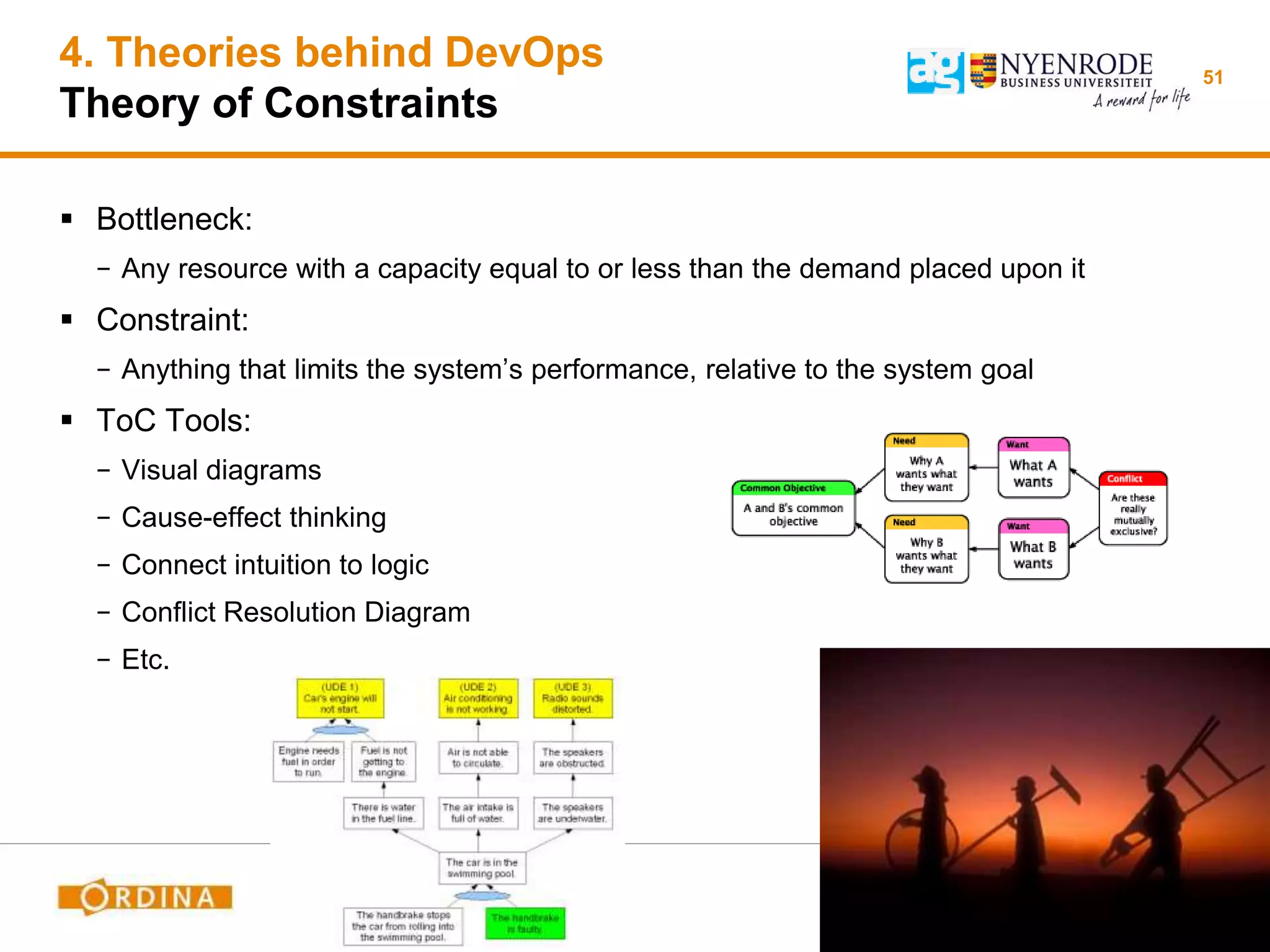
 Bottleneck:
− Any resource with a capacity equal to or less than the demand placed upon it
 Constraint:
− Anything that limits the system’s performance, relative to the system goal
 ToC Tools:
− Visual diagrams
− Cause-effect thinking
− Connect intuition to logic
− Conflict Resolution Diagram
− Etc.
51
4. Theories behind DevOps
Theory of Constraints & DevOps
 Why aren’t we deploying more often?
 Why do deployments take so long?
 Why is releasing our software such a hassle?
 …
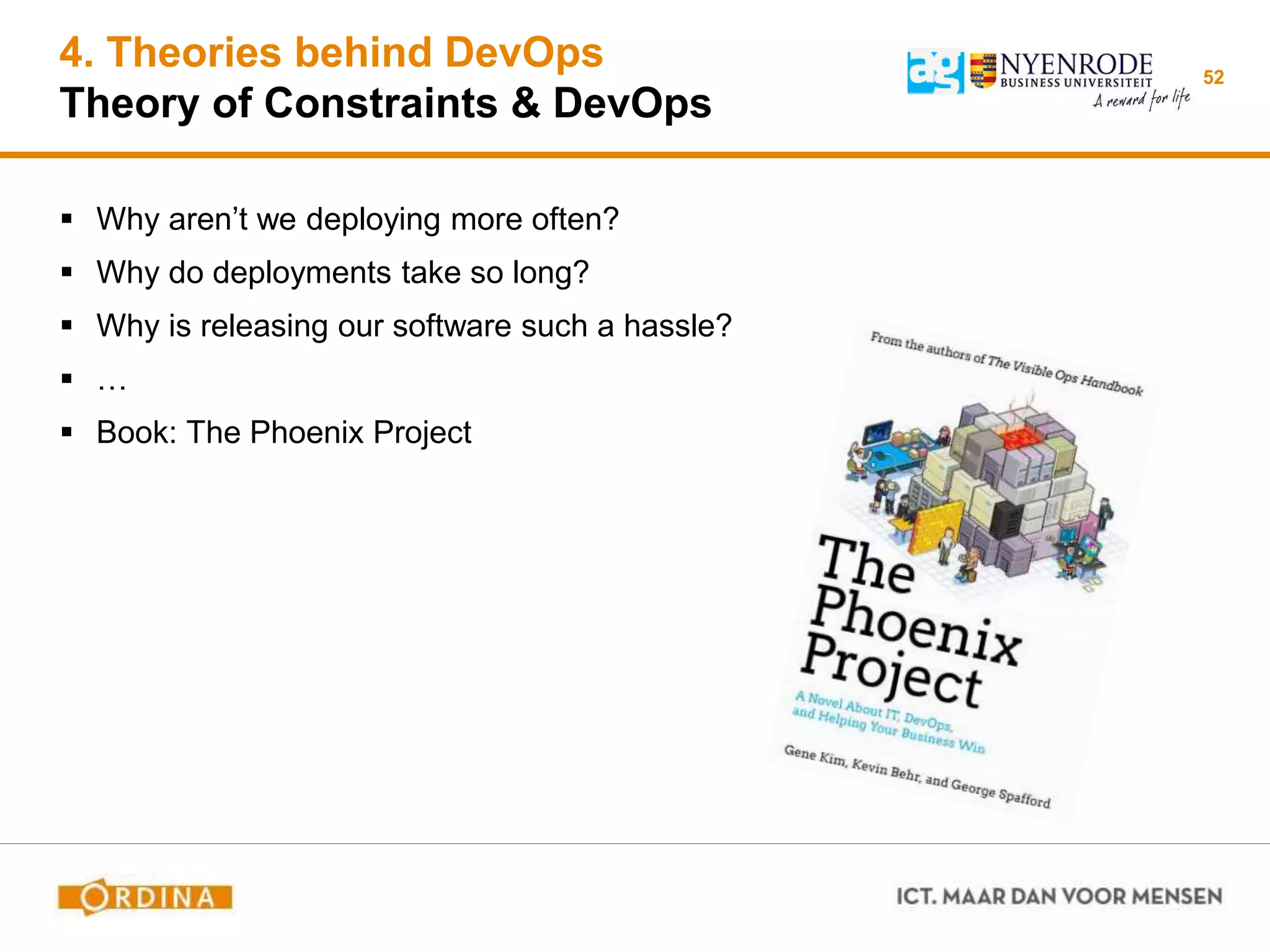
 Book: The Phoenix Project
52
53
www.ordina.nl
Visualizations
 Why should an organization
implement DevOps?
 What is the impact of DevOps
on organizations?
5. Where DevOps is bringing us
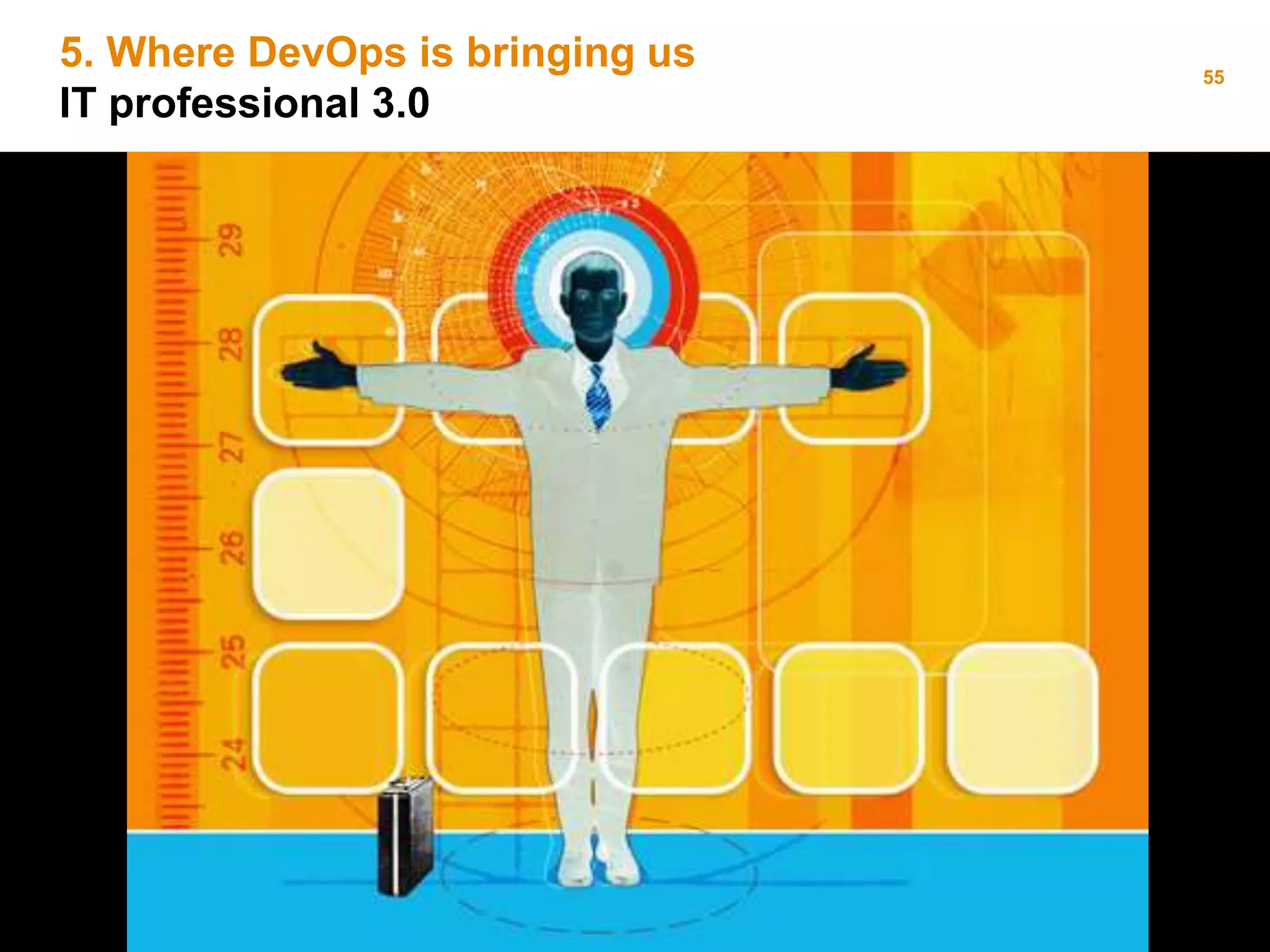
IT professional 3.0
55
5. Where DevOps is bringing us
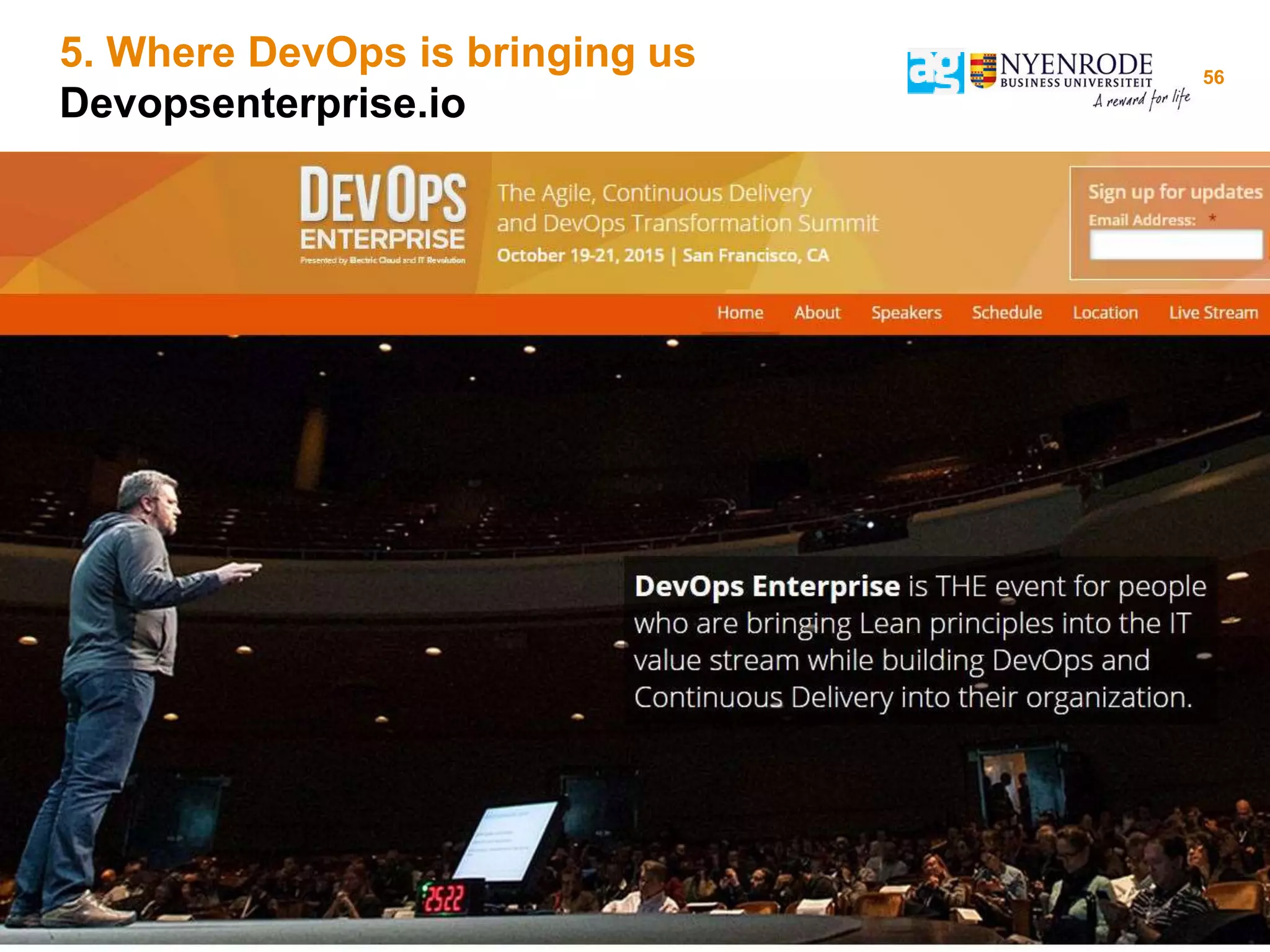
Devopsenterprise.io
56
5. Where DevOps is bringing us
Enterprise DevOps NL
 ‘DevOps Dialogues’
 ASL BiSL, itSMF, Agile Consortium
 End user organizations: Defense, Achmea, A.S.R.,
Rabobank, Belastingdienst, ING, TenneT, CJIB en
Philips
 Vendors: Ordina, CGI, Schuberg Philis, Sogeti, Quint
Wellington Redwood, The Lifecycle Company, Xebia en
Valori
 DevOps, wat heb je eraan?
- Cultuur en DevOps
- DevOps in the enterprise
57
5. Where DevOps is bringing us
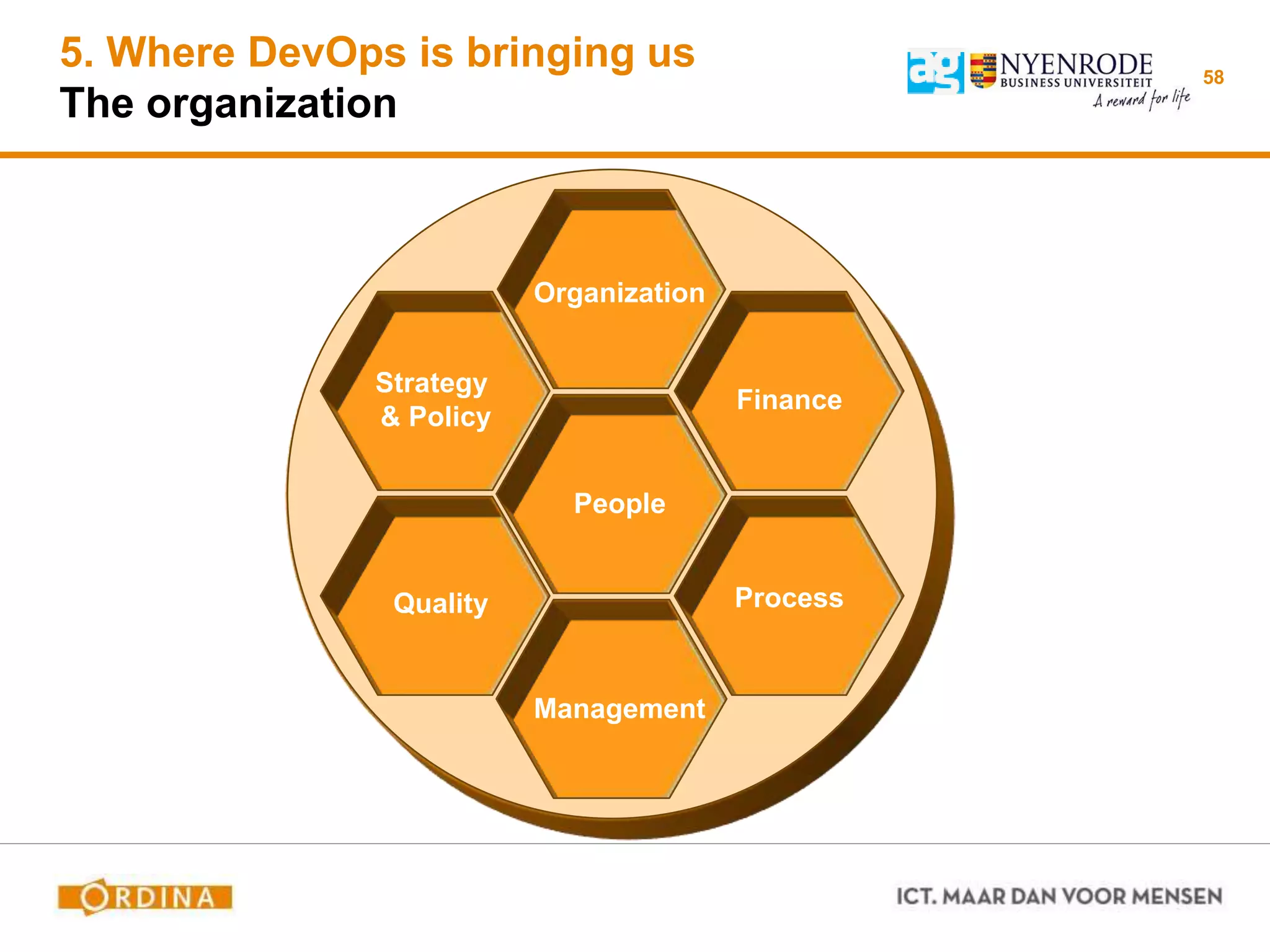
The organization
58
Organization
Strategy
& Policy
Finance
Quality Process
Management
People
5. Where DevOps is bringing us
The organization
59
60
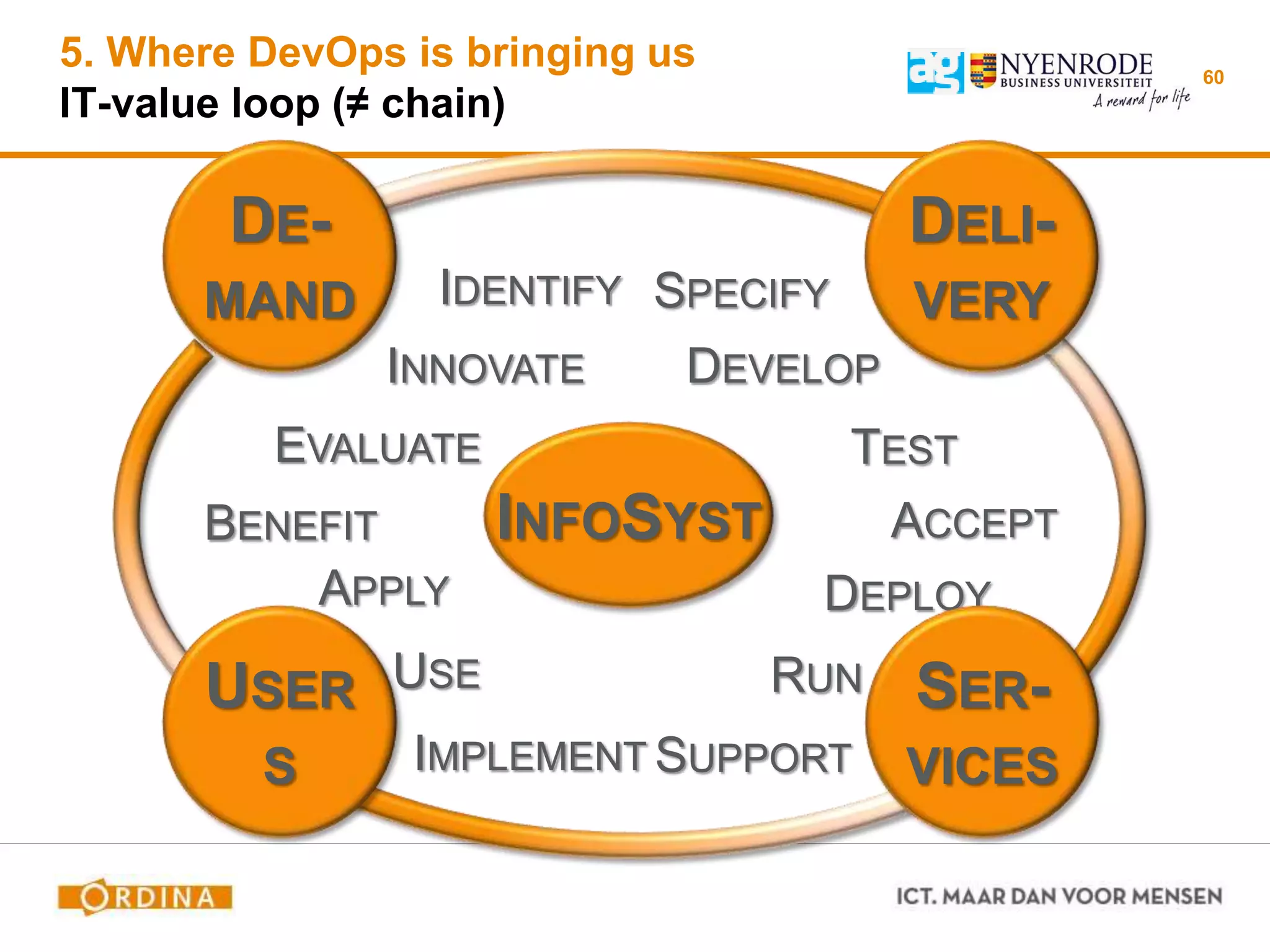
INFOSYST
TEST
ACCEPT
IMPLEMENT
SPECIFY
BENEFIT
RUN
EVALUATE
IDENTIFY
DEVELOP
DEPLOY
USE
SUPPORT
APPLY
INNOVATE
DE-
MAND
DELI-
VERY
SER-
VICES
USER
S
5. Where DevOps is bringing us
IT-value loop (≠ chain)
5. Where DevOps is bringing us
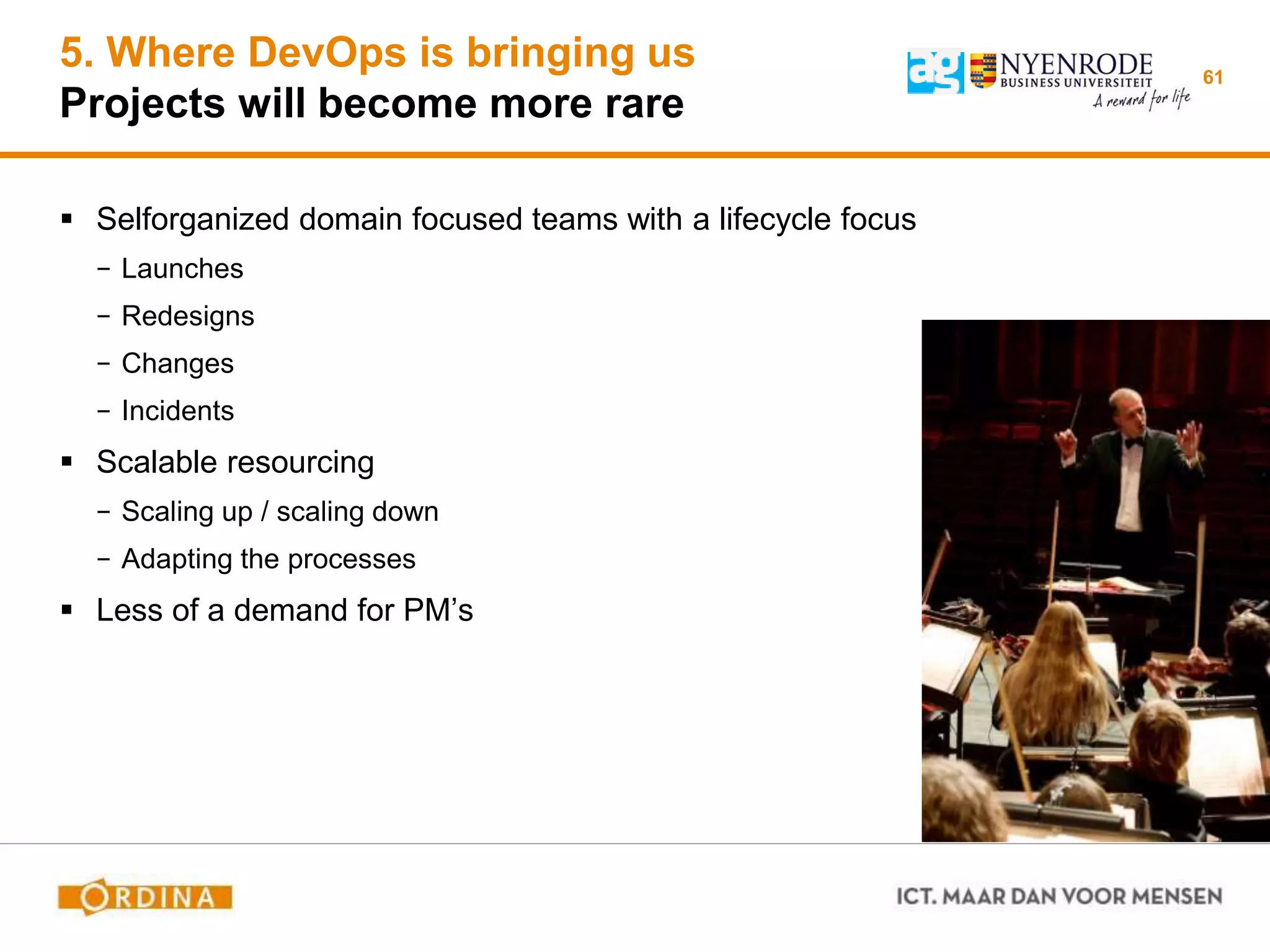
Projects will become more rare
 Selforganized domain focused teams with a lifecycle focus
− Launches
− Redesigns
− Changes
− Incidents
 Scalable resourcing
− Scaling up / scaling down
− Adapting the processes
 Less of a demand for PM’s
61
5. Where DevOps is bringing us
Destination
 4 areas are reached
− Dev designs, develops & delivers for deployability
− Supportability: monitoring & logging
− Feedback throughout the lifecycle (incl. Experiments)
− Full swing test automation & harnesses
 Holistic Definition of Done
 Dev+Ops infrastructure and deployment automation
 More agility, more fun
 Measures, such as:
− Cycle time for critical fixes decreases
− Deployment/production/platform-related issues decreases
− Decrease in unplanned work for Ops
63
65
www.ordina.nl
Visualizations
 Why should an organization
implement DevOps?
 What is the impact of DevOps on
organizations?
6. Accelerators and inhibitors
Accelerators
 Cloud
 Rhineland values
− Focus on professionals
− Weggeman
 Remote working (‘HNW’)
 Common goals!
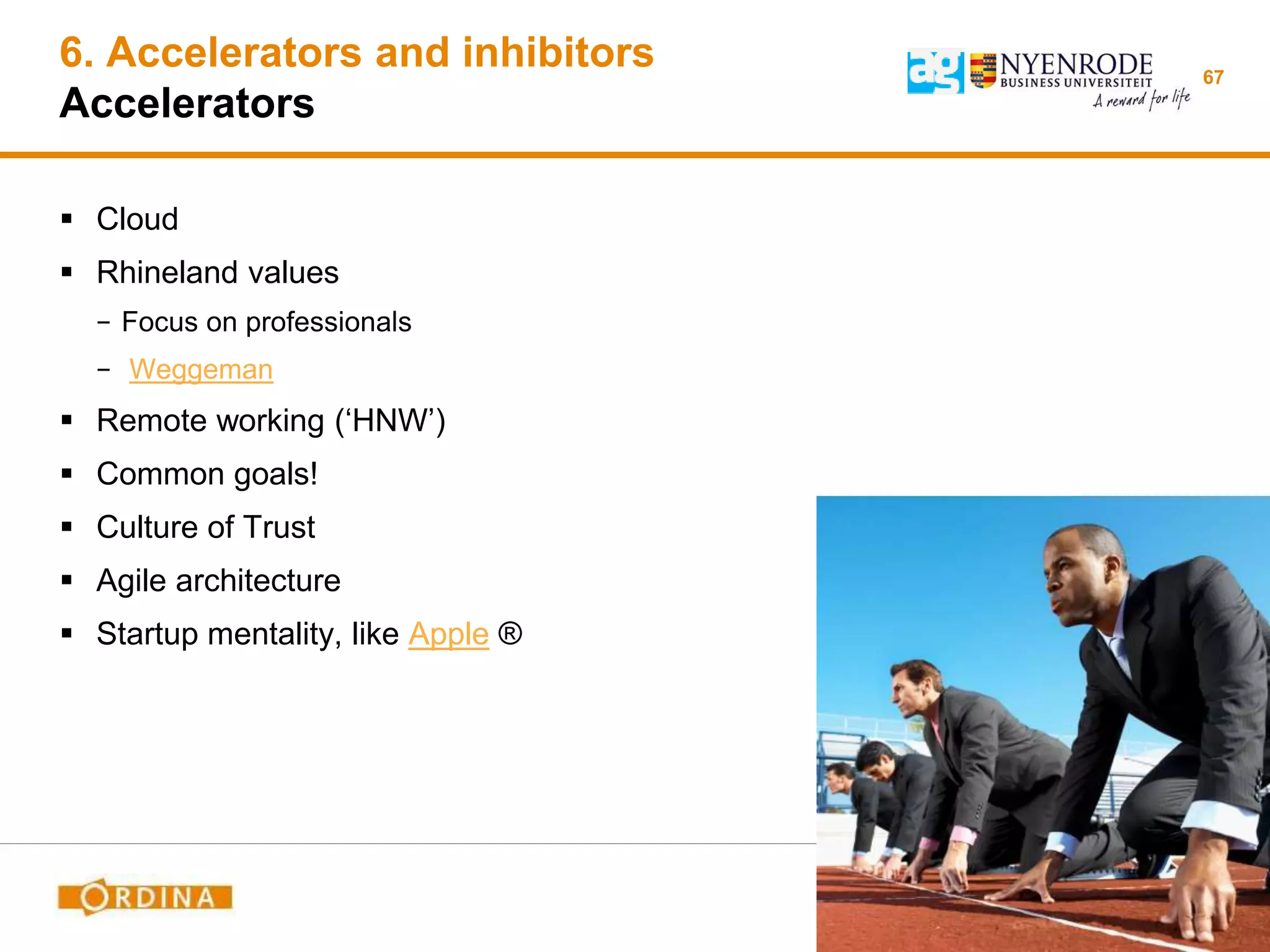
 Culture of Trust
 Agile architecture
 Startup mentality, like Apple ®
67
6. Accelerators and inhibitors
Inhibitors
 ‘Classic’ thinking
− Processes, detailed plans, big decisions up front etc.
 Functional silo’s
− Don’t create new ones!
 Remote working (…)
 Assurance
− From the classic paradigm
 Certification
− From the classic paradigm
68
69
www.ordina.nl
Visualizations
 Why should an organization
implement DevOps?
 What is the impact of DevOps on
organizations?
7. Promises of DevOps unraveled
71
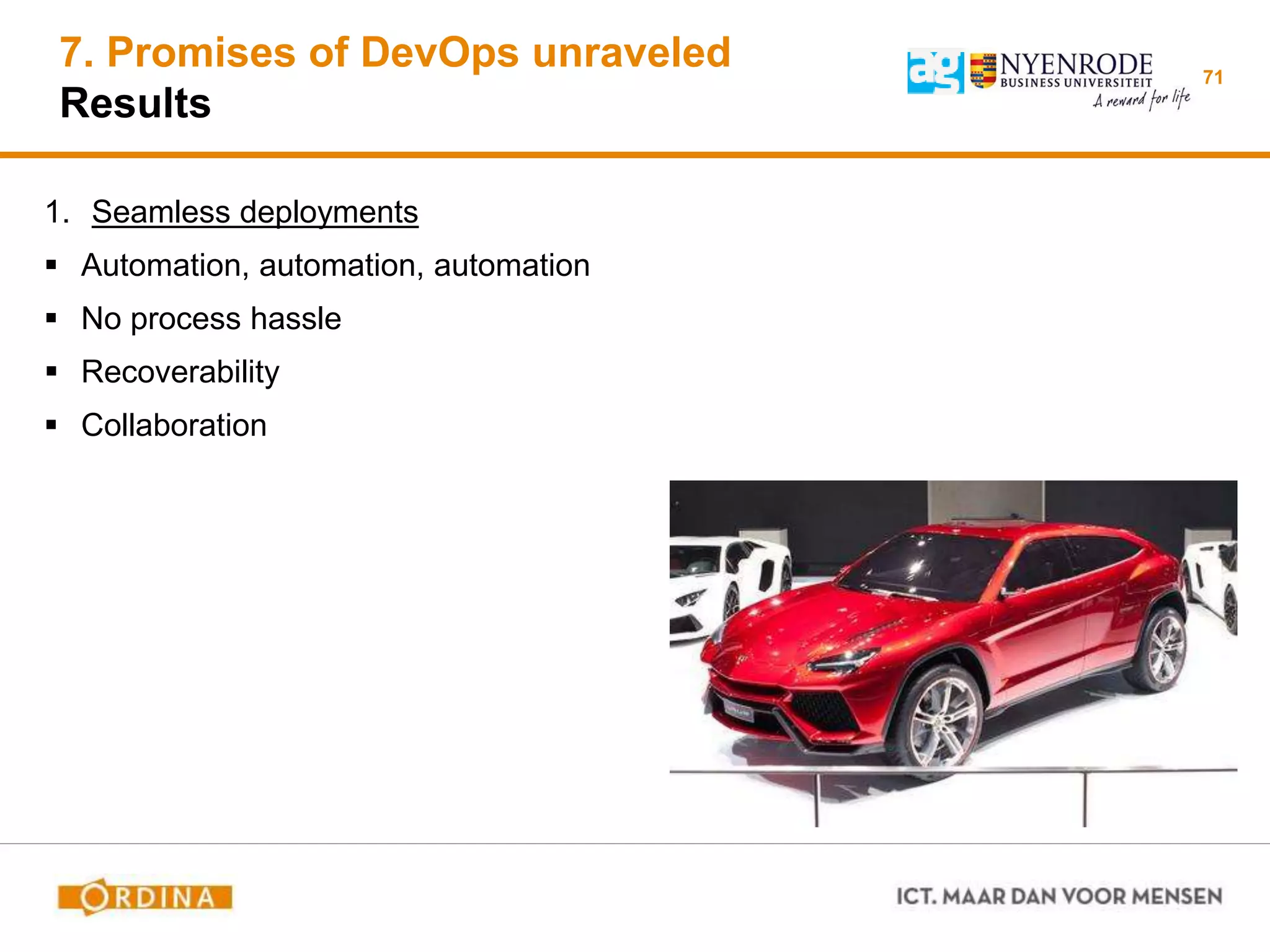
1. Seamless deployments
 Automation, automation, automation
 No process hassle
 Recoverability
 Collaboration
7. Promises of DevOps unraveled
Results
72
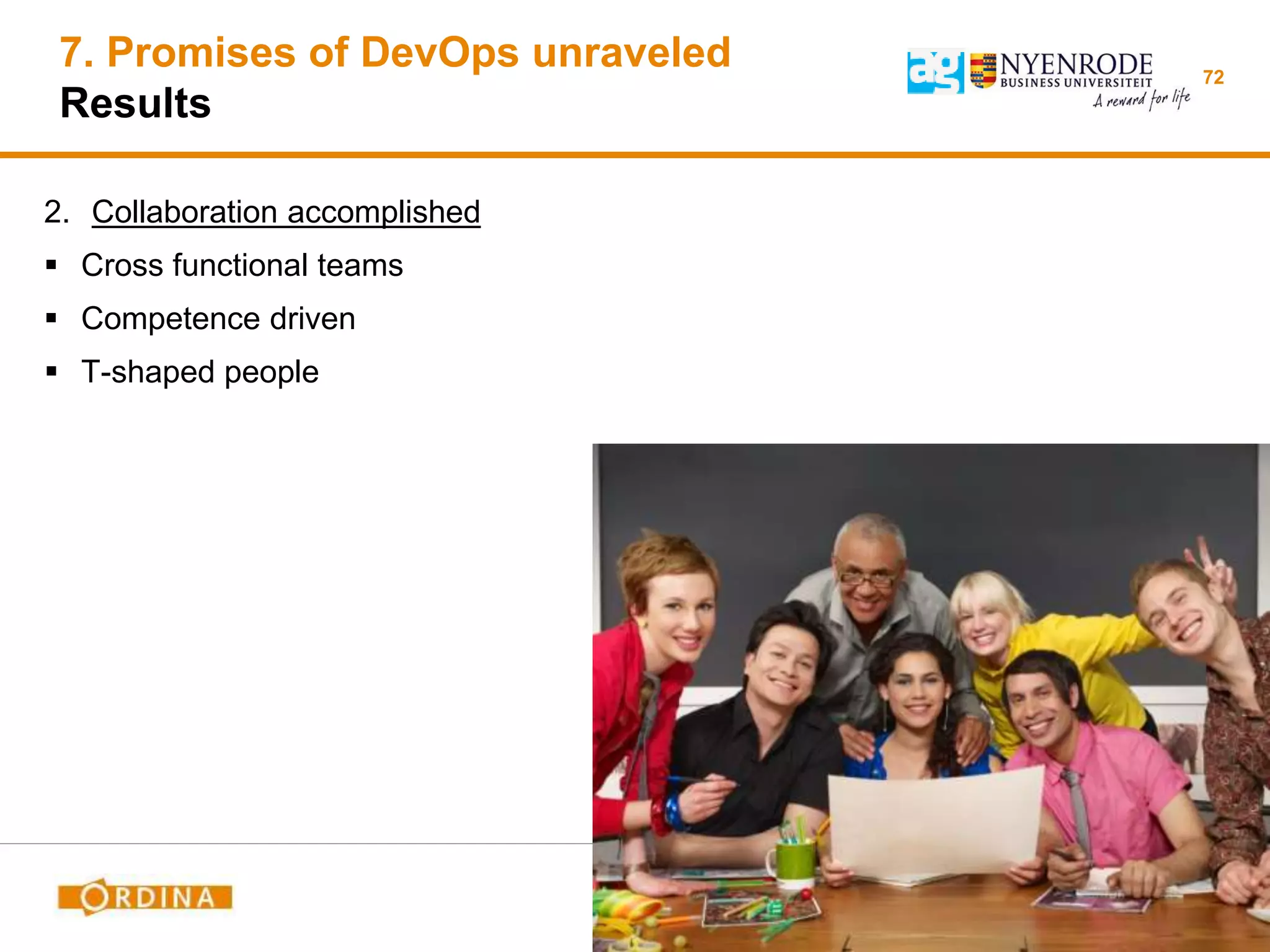
2. Collaboration accomplished
 Cross functional teams
 Competence driven
 T-shaped people
7. Promises of DevOps unraveled
Results
73
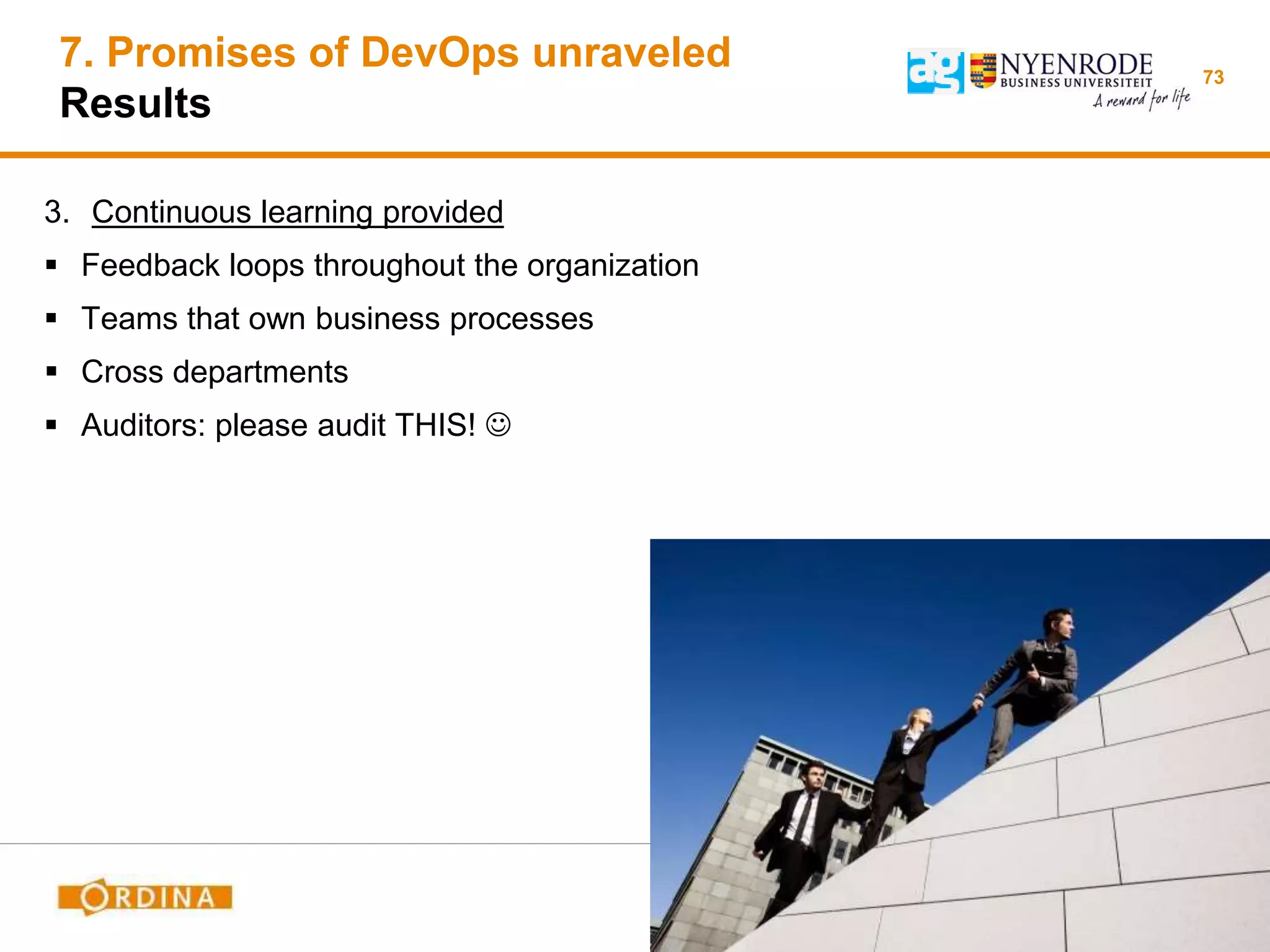
3. Continuous learning provided
 Feedback loops throughout the organization
 Teams that own business processes
 Cross departments
 Auditors: please audit THIS! 
7. Promises of DevOps unraveled
Results
What is DevOps 74
What is DevOps 75
 Collaboration
What is DevOps 76
 Collaboration
77
www.ordina.nl
Contact
Anko.Tijman@ordina.nl
@AnkoTijman

DevOps unraveled - Nyenrode masterclass on Agile Management

  • 1.
  • 2.
    Agenda 1. Introduction 2. Whatis DevOps anyway? 3. Stories from the trenches 4. Theories behind DevOps 5. Where is DevOps bringing us? 6. Accelerators and inhibitors of DevOps 7. DevOps unraveled 2
  • 3.
    1. Introduction About me… 1997 Tester  2001 My first Agile project  2004 Joined Ordina  2008 Thoughtleader Agile Testing & Author of ‘Testen2.0’  2012 Thoughtleader Agile  2013 DevOps PM  2014 Agile & DevOps coach and trainer 3
  • 4.
  • 5.
    1. Introduction Ordina philosophyon Agile & DevOps DON’T OVERCOMPLICATE, COLLABORATE. 5
  • 6.
    1. Introduction Goals 6  Uncoveringwhat DevOps is  Theories behind DevOps  Why should an organization implement DevOps?  Define what the impact of DevOps on organizations is Note:  DevOps is fairly new and under heavy construction
  • 7.
    1. Introduction Rightshifting –Bob Marshall Where we are: 7 Where we want to go:
  • 8.
    1. Introduction Rightshifting –Bob Marshall 8 http://flowchainsensei.wordpress.com/
  • 9.
    1. Introduction Marshall model:4 paradigms  Ad hoc: no process or organization, focus on ad hoc situations, heavy on people relations − “Customer of the week”  Analytical: Focus on processes and tasks, functional silo’s, heavy on up front structuring of the process − CMMI, PRINCE2, ITIL, BiSL,6 Sigma, …  Synergetic: Teamwork, delivery, focus on results, heavy on people collaborating towards valuable results − Agile, Scrum, DevOps, Lean, … − “None of us is as smart as all of us” ~Gerald M. Weinberg  Chaordic: Innovation mindset, no formal organization, embrace volatility − Dee Hock (‘Chaordic’): ‘Simple rules and regulations give rise to complex, intelligent behavior. Complex rules and regulations give rise to simple, stupid behavior” − Google Friday 9
  • 10.
  • 11.
    2. What isDevOps anyway? Hi, I’m Dev! Hi, I’m Ops!
  • 12.
  • 13.
    2. What isDevOps anyway? What is DevOps? 14
  • 14.
    2. What isDevOps anyway? What do others say about DevOps? 15 Ordina: Dev and Ops collaborating on joint business goals, striving for a maximum of speed, quality and control in their efforts. DevOps is “a cross-disciplinary community of practice dedicated to the study of building, evolving and operating rapidly-changing resilient systems at scale.” – Jez Humble
  • 15.
    2. What isDevOps anyway? Quotes  Jez Humble: − “In the era of continuous deployment, you need _tons_ of communication in order to reduce the risk of frequent delivered releases.” − “If it hurts, do it often.”  Gene Kim − “You get what you design for. Chester, your peer in Development, is spending all his cycles on features, instead of stability, security, scalability, manageability, operability, continuity, and all those other beautiful ’ilities.”  Jeff Hodges − "Knowing how the system’s behavior on day 20 is different from its behavior on day 15 is the difference between successful engineering and failed shamanism." 16
  • 16.
    2. What isDevOps anyway? #NOT 18
  • 17.
    2. What isDevOps anyway? DevOps is Automation 19
  • 18.
    2. What isDevOps anyway? DevOps concepts (just a few!) 20  Infrastructure as code − Configuration management − Puppet, Chef  Continuous Integration & Delivery − Jenkins  Continous Deployment − Docker, Vagrant  Monitoring − Graphite
  • 19.
    2. What isDevOps anyway? DevOps practices (just a few!)  A/B testing  Automated dashboards  Big visible dashboards  Blue-green deployment  Composable deployments  Consistent tooling  Cross-functional skills  Dark launching  Deployment pipeline  Develop for production  Feature toggles  Feedback from production 21  Integrated deployment planning  Integrate production stories  Packaged artifact  Polyskilled experts  Production support  Scripted deployments  Stop the line (Lean)  Test-driven everything  Version everything  …
  • 20.
    2. What isDevOps anyway? Elements of DevOps 22  Collaboration
  • 21.
    2. What isDevOps anyway? DevOps is collaboration  Cross functional teams − Dev and Ops  − Dev Engineers & Ops Engineers − Projects AND Changes AND Incidents in one team  Same metrics − Learning as a team − Valuable feedback loops  Joint tooling − Process − Deployments − Monitoring 23
  • 22.
    2. What isDevOps anyway? Elements of DevOps 24
  • 23.
    2. What isDevOps anyway? DevOps is learning from production  Feedback from production − Monitoring − Business value − New feature / change / incident  Impact on (current) Design and Architecture − Not only Dev!  Continuous improvement − System − Process 25
  • 24.
    2. What isDevOps anyway? Elements of DevOps 27 Jenkins
  • 25.
    2. What isDevOps anyway? Impact of Continuous Delivery 28
  • 26.
    2. What isDevOps anyway? Quotes 29
  • 27.
    30 www.ordina.nl Visualizations  Why shouldan organization implement DevOps?  What is the impact of DevOps on organizations?
  • 28.
    3. Stories fromthe trenches ING, SchubergPhilis, Chamber of Commerce
  • 29.
    3. Stories fromthe trenches Speakers  Evelijn van Leeuwen, ING  Harm Boertien & Arthur van Schendel, SchubergPhilis  Frank Verbruggen, Kamer van Koophandel (via Ordina) 32
  • 30.
    4. Theories behindDevOps TOC Three Ways
  • 31.
    4. Theories behindDevOps Thoughtleaders  Patrick DeBois  Gene Kim  Jez Humble 34
  • 32.
    4. Theories behindDevOps DeBois - ideas 35  Founder of the DevOps movement  DevOpsDays 2009, Ghent (B)  Jedi.be
  • 33.
    4. Theories behindDevOps DeBois – 4 areas 36 1. Extend delivery to production − ‘Dev and Ops collaborate to improve anything on delivering the project to production‘ − deployment pipeline 2. Extend Ops feedback to project − ‘All information from production is radiated back to the project’ − Non-functional behavior − dark launching 3. Embed project knowledge into Ops − ‘When the project takes co-ownership of everything that happens in productions’ − Production support 4. Embed Ops knowledge into project − ‘When Ops are involved from the beginning of the project’ − Develop for production / Blue-green deployment
  • 34.
    4. Theories behindDevOps C.A.L.M.S. (Damon Edwards, Jez Humble)  Culture: Own the change to drive collaboration and communication  Automation: Take manual steps out of your value chain  Lean: Use lean principles to enable higher cycle frequency  Measurement: Measure everything and use data to refine cycles  Sharing: Share experiences, successful or not, to enable others to learn 37 http://www.rackspace.com/blog/quantifying-devops-capability-its-important-to-keep-calms/
  • 35.
    4. Theories behindDevOps C.A.L.M.S. - Culture Own the change to drive collaboration and communication  Yeah, but let’s do Chef first…  Flow, flow, flow!  Trust  Excellence  Craftsmanship  Failure is an option 38
  • 36.
    4. Theories behindDevOps C.A.L.M.S. - Culture 39
  • 37.
    4. Theories behindDevOps C.A.L.M.S. - Automation Take manual steps out of your value chain Damon Edwards / Jez Humble  Radically improve cycle time (months  hours)  Automating common (!) tasks − Let’s automate IT   Continuous Delivery − “Through automation of the build, deployment and testing process, and improved collaboration between developers, testers, and operations, delivery teams can get changes released in a matter of hours – sometimes even minutes – no matter what the size of a project or the complexity of its code base.”  Database migrations  Managing environments 40
  • 38.
    4. Theories behindDevOps C.A.L.M.S. - Automation Reliable and easy deployments  Continuous Integration (such as Jenkins)  Automated testing  Build pipelines  Automated deployments  Config Mgt  Orchestration  Monitoring  Logging 41
  • 39.
    4. Theories behindDevOps C.A.L.M.S. - Automation 42 http://www.slideshare.net/KrisBuytaert/devops-devops-devops-at-froscon
  • 40.
    4. Theories behindDevOps C.A.L.M.S. - Lean Use lean principles to enable higher cycle frequency  Production line  Eliminating waste to improve throughput Metrics  Quality – time to restore service, % unplanned work  Cost – transaction cost of making a change  Delivery – Change lead time  Safety – make changes and experiments safe to fail  Morale – job satisfaction is highly correlated with business outcomes 43 Recommended sources: - The principles of Product Development FLOW – Donald G. Reinertsen
  • 41.
    4. Theories behindDevOps C.A.L.M.S. - Measurement Measure everything and use data to refine cycles  Capture everything − Monitoring − Stats − Metric store (meta-metrics)  Business metrics − Revenue − # orders − # users − … 45 http://www.slideshare.net/PuppetLabs/how-to-measure- everything-a-million-metrics-per-second-with-minimal- developer-overhead-puppetco
  • 42.
    4. Theories behindDevOps C.A.L.M.S. - Measurement Measure everything and use data to refine cycles  Ops metrics, such as − Time To Resolve (TTR) − Time To Detect (TTD) − Time Between Failures (TBF)  Make it human again  − Visualize − Personas 46 http://devops.com/blogs/devops-scorecard/
  • 43.
    4. Theories behindDevOps C.A.L.M.S. - Sharing Damon Edwards / John Willis / Jez Humble  Share experiences, successful or not, to enable others to learn  Open source model for tools and knowledge  Learning from development  production  Big visible charts / displays  Collaboration = Joint goals 47
  • 44.
    4. Theories behindDevOps Three Ways 1. The First Way : Systems Thinking emphasizes the performance of the entire system 2. The Second Way is about creating and amplifying the right to left feedback loops 3. The Third Way is about creating a culture that fosters both continual experimentation, taking risks and learning from failure; and understanding that repetition and practice is the prerequisite to mastery. 48 1. 2. 3.
  • 45.
    4. Theories behindDevOps Three ways 49 1. Systems Thinking − No longer compartimentation of processes − One system − How many steps are needed to deploy 1 single feature (VSM)? 2. Feedback loops − Testing, See the whole, Graphs from production − Understanding customers − Fostering ownership 3. Culture of continual experimentation and learning from failure − Safe to fail? Culture! − Learning! − Hackdays 1. 2. 3. http://www.slideshare.net/jmcgarr/ implementing-devops
  • 46.
    4. Theories behindDevOps Theory of Constraints A focusing process to identify the constraint and restructure the rest of the organization around it.  Production lines  A company is a system  Gathering, analyzing, solving, and implementing (management) problems  There is always a biggest constraint − Continuous Improvement! 50
  • 47.
    4. Theories behindDevOps Theory of Constraints  Bottleneck: − Any resource with a capacity equal to or less than the demand placed upon it  Constraint: − Anything that limits the system’s performance, relative to the system goal  ToC Tools: − Visual diagrams − Cause-effect thinking − Connect intuition to logic − Conflict Resolution Diagram − Etc. 51
  • 48.
    4. Theories behindDevOps Theory of Constraints & DevOps  Why aren’t we deploying more often?  Why do deployments take so long?  Why is releasing our software such a hassle?  …  Book: The Phoenix Project 52
  • 49.
    53 www.ordina.nl Visualizations  Why shouldan organization implement DevOps?  What is the impact of DevOps on organizations?
  • 50.
    5. Where DevOpsis bringing us
  • 51.
    5. Where DevOpsis bringing us IT professional 3.0 55
  • 52.
    5. Where DevOpsis bringing us Devopsenterprise.io 56
  • 53.
    5. Where DevOpsis bringing us Enterprise DevOps NL  ‘DevOps Dialogues’  ASL BiSL, itSMF, Agile Consortium  End user organizations: Defense, Achmea, A.S.R., Rabobank, Belastingdienst, ING, TenneT, CJIB en Philips  Vendors: Ordina, CGI, Schuberg Philis, Sogeti, Quint Wellington Redwood, The Lifecycle Company, Xebia en Valori  DevOps, wat heb je eraan? - Cultuur en DevOps - DevOps in the enterprise 57
  • 54.
    5. Where DevOpsis bringing us The organization 58 Organization Strategy & Policy Finance Quality Process Management People
  • 55.
    5. Where DevOpsis bringing us The organization 59
  • 56.
  • 57.
    5. Where DevOpsis bringing us Projects will become more rare  Selforganized domain focused teams with a lifecycle focus − Launches − Redesigns − Changes − Incidents  Scalable resourcing − Scaling up / scaling down − Adapting the processes  Less of a demand for PM’s 61
  • 58.
    5. Where DevOpsis bringing us Destination  4 areas are reached − Dev designs, develops & delivers for deployability − Supportability: monitoring & logging − Feedback throughout the lifecycle (incl. Experiments) − Full swing test automation & harnesses  Holistic Definition of Done  Dev+Ops infrastructure and deployment automation  More agility, more fun  Measures, such as: − Cycle time for critical fixes decreases − Deployment/production/platform-related issues decreases − Decrease in unplanned work for Ops 63
  • 59.
    65 www.ordina.nl Visualizations  Why shouldan organization implement DevOps?  What is the impact of DevOps on organizations?
  • 60.
  • 61.
    6. Accelerators andinhibitors Accelerators  Cloud  Rhineland values − Focus on professionals − Weggeman  Remote working (‘HNW’)  Common goals!  Culture of Trust  Agile architecture  Startup mentality, like Apple ® 67
  • 62.
    6. Accelerators andinhibitors Inhibitors  ‘Classic’ thinking − Processes, detailed plans, big decisions up front etc.  Functional silo’s − Don’t create new ones!  Remote working (…)  Assurance − From the classic paradigm  Certification − From the classic paradigm 68
  • 63.
    69 www.ordina.nl Visualizations  Why shouldan organization implement DevOps?  What is the impact of DevOps on organizations?
  • 64.
    7. Promises ofDevOps unraveled
  • 65.
    71 1. Seamless deployments Automation, automation, automation  No process hassle  Recoverability  Collaboration 7. Promises of DevOps unraveled Results
  • 66.
    72 2. Collaboration accomplished Cross functional teams  Competence driven  T-shaped people 7. Promises of DevOps unraveled Results
  • 67.
    73 3. Continuous learningprovided  Feedback loops throughout the organization  Teams that own business processes  Cross departments  Auditors: please audit THIS!  7. Promises of DevOps unraveled Results
  • 68.
  • 69.
    What is DevOps75  Collaboration
  • 70.
    What is DevOps76  Collaboration
  • 71.

Editor's Notes

  • #7 Not in try-out: What are current companies doing around DevOps?
  • #17 Shamanism: Sjamanisme is het manipuleren van bovennatuurlijke machten door een sjamaan die contact kan maken met geesten en de geestenwereld, veelal om op die manier door geesten verooorzaakte ziektes te genezen.
  • #18 Jenkins Github Corollary = gevolgtrekking
  • #19 Geen Continuous Delivery (DHL) Geen Lots of Automation (dashboard) Geen golden egg / silver bullet
  • #21 http://www.ibm.com/developerworks/library/a-devops9/ CI: dmv feature branches Docker open platform for developers and sysadmins to build, ship, and run distributed applications build any app in any language using any toolchain. “Dockerized” apps are completely portable and can run anywhere
  • #22 Composable deploy = Next: Continuous Delivery http://www.ibm.com/developerworks/library/a-devops9/
  • #24 Composable deploy = Next: Continuous Delivery http://www.ibm.com/developerworks/library/a-devops9/
  • #27 Composable deploy =
  • #30 Jenkins Github
  • #36 https://www.youtube.com/user/jedibvba 5 years of DevOps: https://www.youtube.com/watch?v=uRMV6tT_mu0
  • #38 These are the pillars of a successful DevOps implementation. Ignoring just one can compromise overall effectiveness. They also serve as an excellent benchmark to assess your current capability and highlight the areas you need to improve.
  • #39 https://www.youtube.com/watch?v=kbvMmNrz8Kk John Willis presenting on DevOps Culture at SV DevOps Meetup (4/18/13)
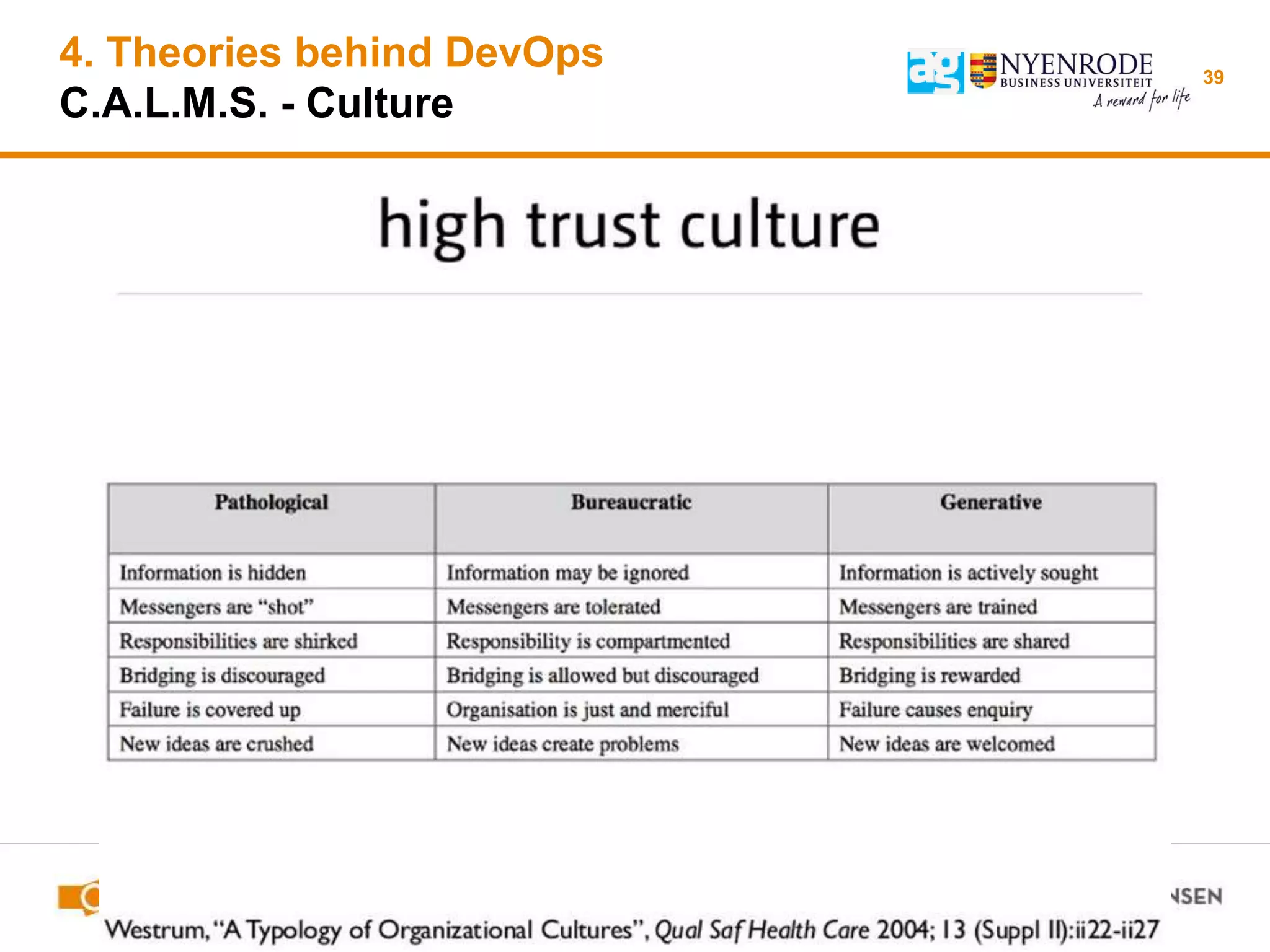
  • #40 Pathological = ziekelijk Generative = generatief = het vermogen tot groei en voortplanting in zich hebbend, voortbrengend  Shirked = ontweken (van ontwijken) Compartmented = gecompartimenteerd Enquiry = onderzoek
  • #42 Orchestration = managing 1000 nodes, tooling like Mcollective, Noah, Rundeck Monitoring: Graphite
  • #44 Scania Zwolle!
  • #45 Create constancy of purpose toward improvement of product and service, with the aim to become competitive, to stay in business and to provide jobs. Adopt the new philosophy. We are in a new economic age. Western management must awaken to the challenge, must learn their responsibilities, and take on leadership for change. Cease dependence on inspection to achieve quality. Build quality into the product in the first place. End the practice of awarding business on the basis of a price tag. Instead, minimize total cost. Move towards a single supplier for any one item, on a long-term relationship of loyalty and trust. Improve constantly and forever the system of production and service, to improve quality and productivity, and thus constantly decrease costs. Institute training on the job. Institute leadership. The aim of supervision should be to help people and machines and gadgets do a better job. Supervision of management is in need of overhaul, as well as supervision of production workers. Drive out fear, so that everyone may work effectively for the company. Break down barriers between departments. People in research, design, sales, and production must work as a team, in order to foresee problems of production and usage that may be encountered with the product or service. Eliminate slogans, exhortations, and targets for the work force asking for zero defects and new levels of productivity. Remove barriers that rob the hourly worker of his right to pride of workmanship. Remove barriers that rob people in management and in engineering of their right to pride of workmanship. Institute a vigorous program of education and self-improvement. Put everybody in the company to work to accomplish the transformation. The transformation is everybody's job.
  • #46 Metric store, such as Graphite Recommended: at least one graphite server per data center http://www.slideshare.net/jallspaw/ops-metametrics-the-currency-you-pay-for-change Persona’s: afbeelding, ieder zijn ding (each one doing their own thing)
  • #47 Metric store, such as Graphite Recommended: at least one graphite server per data center http://www.slideshare.net/jallspaw/ops-metametrics-the-currency-you-pay-for-change TTD = Time To Detect TTR = Time To Resolve TBF = Time Between Failures Deployment frequency: How often were we deploying code and getting new code in the hands of our customers? This metric should trend up or remain stable from week to week. Example: Twice a week, 50 times a day Change volume: For each deployment how many user stories and new lines of code were we shipping?  Example: 3 new features per day, Average 500 lines of new code per week. Another parameter to consider in addition to volume is complexity of change. Lead Time (from Dev to Deploy): How long does it take on an average to get the code from development complete through a cycle of A/B testing to 100% deploy and upgrade on production? Lead time should reduce as the team gets a better hold of the lifecycle. Percentage of failed deployments: What percentage of deployments failed causing an outage or a negative user reaction? This metric should decrease over time. Example: 9% deployments failed this month as opposed to 15% last month. This metric should be reviewed in combination with the change volume. If the change volume is low or remained the same but the percent of failed deployments increased, then there maybe a disfunction somewhere. Mean time to recovery: When we did fail, how long did it take us to recover? This is a true indicator of how good we are getting with handling change and this should ideally reduce over time.  You can expect some spikes in this number due to complex issues not encountered before. Example: On an average it took the team 15 minutes to resolve each last week, 14 minutes this week. Customer Ticket Volume: Number of alerts generated by customers to indicate issues in the service. This is a basic indicator of customer satisfaction. Example: 54 tickets were generated this week as opposed to 38 while the user volume remained steady is not a good thing % Change in User Volume: Number of new users signing up, interacting with my service and generating traffic. As new users sign up is my infrastructure able to handle the demand? Example: This week the number of customers spiked by 30% due to an external event causing volume of requests to go up Availability: What is the overall uptime for my service and did I violate any SLAs? Example: 99.9% uptime consistently for the last 3 months even with change in user volume Performance (Response Time): Is my service performing within my predetermined thresholds? This metric should remain stable irrespective of % change in user volume or any new deployment. Example: Sub 5 second response time from all geographies and devices
  • #49 The First Way emphasizes the performance of the entire system, as opposed to the performance of a specific silo of work or department — this as can be as large a division (e.g., Development or IT Operations) or as small as an individual contributor (e.g., a developer, system administrator). The focus is on all business value streams that are enabled by IT. In other words, it begins when requirements are identified (e.g., by the business or IT), are built in Development, and then transitioned into IT Operations, where the value is then delivered to the customer as a form of a service. The outcomes of putting the First Way into practice include never passing a known defect to downstream work centers, never allowing local optimization to create global degradation, always seeking to increase flow, and always seeking to achieve profound understanding of the system (as per Deming). The Second Way is about creating the right to left feedback loops. The goal of almost any process improvement initiative is to shorten and amplify feedback loops so necessary corrections can be continually made. The outcomes of the Second Way include understanding and responding to all customers, internal and external, shortening and amplifying all feedback loops, and embedding knowledge where we need it.
  • #51 NOT A DEVOPS THEORY, but an underlying and important theory Identify Exploit – utilize maximally Subordinate all other processes to the constraint Elevate the system’s constraint Start with Identification - but be aware of Inertia!
  • #56 Self organizing Business focus Lifecycle focus  Integrated quality Adapting processes T-shaped Result-oriented
  • #63 Security Privacy
  • #68 Weggeman Bohica: https://www.youtube.com/watch?v=hpEX6gGYkwo Weggeman Planning & Control: https://www.youtube.com/watch?v=32pqEbgNKbQ Trust: Trust begins to emerge when we have a sense that another person or organization is driven by things other than their own self-gain. – Simon Sinek
  • #69 There is nothing wrong with AGILE (synergetic!) Assurance or Certification programmes!
  • #80 What’s a little known fact about you?
  • #82 Jenkins Github
  • #83 Composable deploy =
  • #85 Jenkins Github
  • #92 http://www.lean4it.com/2013/05/a-devops-causal-loop-diagram.html Change Frequency has a positive impact on Change Capability. The more Changes, the better you are at handling Change. Note that "size" of change is not relevant to this relationship - it is a separate variable.  Change Frequency has a negative relationship to Change Size. The more often you change, the smaller the changes will be, everything else being equal.  Change Capability has a negative relationship to Change Risk. That is, if Change Capability improves, Change Risk decreases, and vice versa. Change Size increases Change Risk, and vice versa.  Finally, Change Risk has a negative effect on Stability.