
Testing in
DevOps World
Moataz Nabil
By Moataz Nabil
Agenda
• The Problem
• What is DevOps?
• Evolution of DevOps
• Why DevOps?
• DevOps and Test Automation
• Reinventing the tester's role in the face of
automation
• QA Responsibilities in DevOps
What is
DevOps?
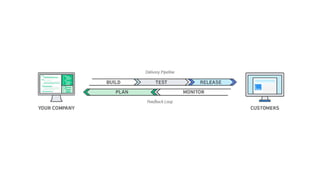
DevOps is a combination of mindset, practices,
and tools that help businesses deploy
applications and services faster and easier.
The development and improvement of
products succeeds in less time than companies
that rely on traditional processes for software
development and infrastructure management.
This speed advantage enables businesses to
better serve their customers and become
more effective in the marketplace.
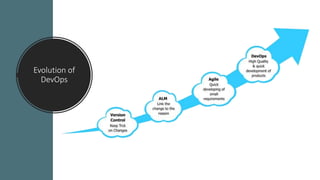
Evolution of
DevOps
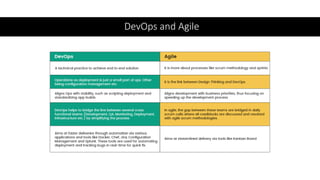
DevOps and Agile
This is how
DevOps works
• One of the key features of a DevOps model is that the development
and operations teams are no longer isolated from each other.
• Sometimes the two teams are brought together into a single team
where the engineers can manage the entire application lifecycle-
from development and testing to deployment and operations-to
develop capabilities that work flexibly, not just one Function are
limited.
• For some DevOps models, QA and security teams work more closely
with development and operations teams throughout the application
lifecycle. When security is the focus of everyone involved in a
DevOps team, it is sometimes referred to as DevSecOps.
• Practices to automate traditionally manual, time-consuming
processes are used. The technology stack used and the tools used
enable fast and reliable execution and development of
applications. These tools also enable engineers to do tasks on their
own (such as providing code or infrastructure) that they typically
rely on to support other teams. The result is also an increased
speed here.
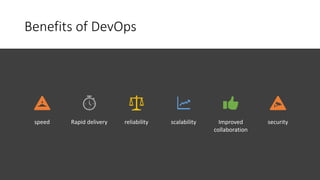
Benefits of DevOps
speed Rapid delivery reliability scalability Improved
collaboration
security
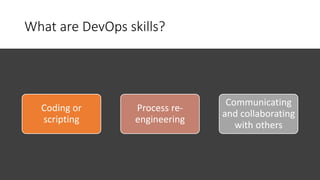
What are DevOps skills?
Coding or
scripting
Process re-
engineering
Communicating
and collaborating
with others
DevOps
Methods
Continuous integration
Continuous deployment
Microservices
Infrastructure as code
Monitoring and logging
Communication and cooperation
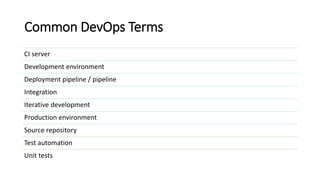
Common DevOps Terms
CI server
Development environment
Deployment pipeline / pipeline
Integration
Iterative development
Production environment
Source repository
Test automation
Unit tests
What is a DevOps engineer?
• There’s no formal career track for becoming a DevOps engineer.
• They are either developers who get interested in deployment and
network operations, or sysadmins who have a passion for scripting
and coding, and move into the development side where they can
improve the planning of test and deployment.
• Either way, these are people who have pushed beyond their defined
areas of competence and who have a more holistic view of their
technical environments.
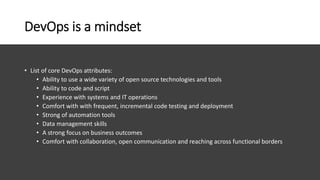
DevOps is a mindset
• List of core DevOps attributes:
• Ability to use a wide variety of open source technologies and tools
• Ability to code and script
• Experience with systems and IT operations
• Comfort with with frequent, incremental code testing and deployment
• Strong of automation tools
• Data management skills
• A strong focus on business outcomes
• Comfort with collaboration, open communication and reaching across functional borders
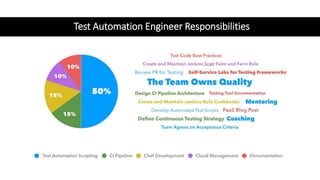
Test Automation Engineer Responsibilities

Testing in DevOps world

  • 1.
    Testing in DevOps World MoatazNabil By Moataz Nabil
  • 2.
    Agenda • The Problem •What is DevOps? • Evolution of DevOps • Why DevOps? • DevOps and Test Automation • Reinventing the tester's role in the face of automation • QA Responsibilities in DevOps
  • 3.
    What is DevOps? DevOps isa combination of mindset, practices, and tools that help businesses deploy applications and services faster and easier. The development and improvement of products succeeds in less time than companies that rely on traditional processes for software development and infrastructure management. This speed advantage enables businesses to better serve their customers and become more effective in the marketplace.
  • 4.
  • 5.
  • 7.
    This is how DevOpsworks • One of the key features of a DevOps model is that the development and operations teams are no longer isolated from each other. • Sometimes the two teams are brought together into a single team where the engineers can manage the entire application lifecycle- from development and testing to deployment and operations-to develop capabilities that work flexibly, not just one Function are limited. • For some DevOps models, QA and security teams work more closely with development and operations teams throughout the application lifecycle. When security is the focus of everyone involved in a DevOps team, it is sometimes referred to as DevSecOps. • Practices to automate traditionally manual, time-consuming processes are used. The technology stack used and the tools used enable fast and reliable execution and development of applications. These tools also enable engineers to do tasks on their own (such as providing code or infrastructure) that they typically rely on to support other teams. The result is also an increased speed here.
  • 8.
    Benefits of DevOps speedRapid delivery reliability scalability Improved collaboration security
  • 9.
    What are DevOpsskills? Coding or scripting Process re- engineering Communicating and collaborating with others
  • 10.
    DevOps Methods Continuous integration Continuous deployment Microservices Infrastructureas code Monitoring and logging Communication and cooperation
  • 11.
    Common DevOps Terms CIserver Development environment Deployment pipeline / pipeline Integration Iterative development Production environment Source repository Test automation Unit tests
  • 12.
    What is aDevOps engineer? • There’s no formal career track for becoming a DevOps engineer. • They are either developers who get interested in deployment and network operations, or sysadmins who have a passion for scripting and coding, and move into the development side where they can improve the planning of test and deployment. • Either way, these are people who have pushed beyond their defined areas of competence and who have a more holistic view of their technical environments.
  • 14.
    DevOps is amindset • List of core DevOps attributes: • Ability to use a wide variety of open source technologies and tools • Ability to code and script • Experience with systems and IT operations • Comfort with with frequent, incremental code testing and deployment • Strong of automation tools • Data management skills • A strong focus on business outcomes • Comfort with collaboration, open communication and reaching across functional borders
  • 15.
    Test Automation EngineerResponsibilities