Ph.D. Candidate Assistant Professor
Thassanee Rodmunkong
DICT @ KMUTNB
Division of Information and Communication for Education (DICT),
Faculty of Technical Education, King Mongkut’s University of Technology North Bangkok, Thailand
Development of Information Management Systems in accordance with the Thai
Qualifications Framework for Higher Education via Cloud Computing
Associate Professor
Panita Wannapiroon, Ph.D. Prachyanun Nilsook , Ph.D.
Contents
Introduction
Purpose
Methodology
Conclusion
Suggestions
Division of Information and Communication for Education (DICT),
Faculty of Technical Education, King Mongkut’s University of Technology North Bangkok, Thailand
DICT @ KMUTNB
Development of Information Management Systems in accordance with the Thai
Qualifications Framework for Higher Education via Cloud Computing
Results
Introduction
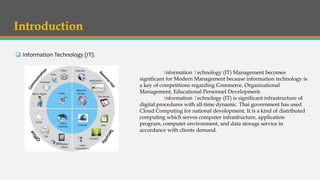
 Information Technology (IT).
Information Technology (IT) Management becomes
significant for Modern Management because information technology is
a key of competitions regarding Commerce, Organizational
Management, Educational Personnel Development.
Information Technology (IT) is significant infrastructure of
digital procedures with all-time dynamic. Thai government has used
Cloud Computing for national development. It is a kind of distributed
computing which serves computer infrastructure, application
program, computer environment, and data storage service in
accordance with clients demand.
Introduction
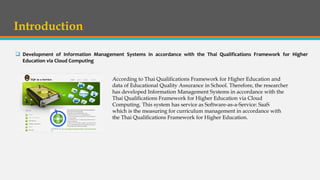
 Cloud Computing.
Cloud Computing service divides into 3 types (1) Software-
as-a-Service (SaaS) (2) Platform-as-a-Service (Paas) (3) Infrastructure-
as-a-service (IaaS) As mentioned recently called SPI Paradigm.
Information Technology (IT) is multilaterally operation
mechanism of organization in order to ingeniously correspond to
change of social situation and concretely get results. Development and
dynamic change of Information Technology (IT) and Academic
Education’s Management affects to college graduate quality. Moreover,
academic institute has to change and develop education management
in order to get high quality of graduate because of education
modernism. Ministry of Education then declared “Thai Qualifications
Framework for Higher Education, TQF : HEd”.
Cloud
Computing
Introduction
 National Education Act B.E.2542 (1999) and Amendments (Second National Education Act .B.E. 2545 (2002).
The Thai Qualifications Framework for Higher Education is a tool
applies National Education Act to concrete operation in Academic
Education which is quality assurance of graduates to raise academic
education standards. The National Education Act B.E. 2542 Amendments
(Second) National Education Act B.E. 2545 defined purposes and
instruction principle focuses on quality and standard divided into
“Internal Quality Assurance System” and “External Quality Assurance
System” used for quality maintenance in Academic Education.
Introduction
 Development of Information Management Systems in accordance with the Thai Qualifications Framework for Higher
Education via Cloud Computing
According to Thai Qualifications Framework for Higher Education and
data of Educational Quality Assurance in School. Therefore, the researcher
has developed Information Management Systems in accordance with the
Thai Qualifications Framework for Higher Education via Cloud
Computing. This system has service as Software-as-a-Service: SaaS
which is the measuring for curriculum management in accordance with
the Thai Qualifications Framework for Higher Education.
 To Develop the work procedures of Information Management Systems in accordance with
the Thai Qualifications Framework for Higher Education via Cloud Computing
 To Development of Information Management Systems in accordance with the Thai
Qualifications Framework for Higher Education via Cloud Computing
Purpose
Methodology
A. Develop the System
Research methods in accordance with System Analysis and Design, and Software Development
Life Cycle (SDLC) by using the Software Development Methodology via Cloud Computing in
accordance with ZHU Zemin and Xiaofei (2009 : 468) can divided into five stages as follows:
1. A detailed analysis to users’ requirement
2. The choice of service providers
3. Design and implementation of SaaS-based education information system
4. System running and maintenance
5. Propaganda for the information system
Methodology
B. Evaluate work procedures of the system Population and samples Divided into two groups:
Population were the experts in Information Management System, Cloud Computing and
TQF.
Sample were selected from the experts in the population using purposive sampling
technique. The three experts comprised of Information Management System, cloud computing and
TQF with experience in their field and Qualified doctoral.
1. Population and samples for evaluate Index of Item Objective Congruence
Population Professors, teachers and educators of Rajabhat Rajanagarindra University.
Sample Professors, teachers and educators of Rajabhat Rajanagarindra University who
were simply randomized. There are 13 professors, 29 teachers and 7 educators.
Methodology
B. Evaluate work procedures of the system Population and samples Divided into two groups:
2. Population and samples for assessing workflow system
C. The method of Information Management Systems Development in accordance with the Thai Qualifications Framework
for Higher Education via Cloud Computing consists 11 fields as following;
Results
1. Planning of Management Information Systems
2. Creating user of Management Information Systems
3. Determining eligibility of Management Information Systems usage
4. Preparing documents of Programme Specification (TQF2)
5. Preparing documents of Course Specification and Field Experience Specification (TQF3 and TQF4)
6. Preparing documents of Course Report and Field Experience Report (TQF5 and TQF6)
7. Preparing documents of Programme Report (TQF7)
8. Displaying document submission (TQF3-7) of Management Information Systems
9. Management Information Systems in work collaboration between professors and teacher
10. User of TQF2-7 via Management Information Systems
11. The channel to publish information of TQF2-7 via Management Information Systems
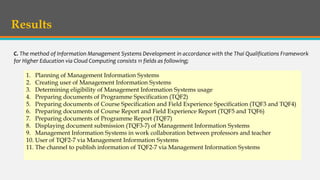
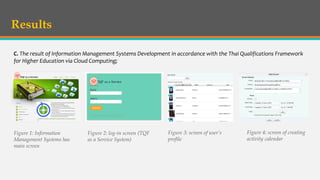
C. The result of Information Management Systems Development in accordance with the Thai Qualifications Framework
for Higher Education via Cloud Computing;
Results
Figure 1: Information
Management Systems has
main screen
Figure 2: log-in screen (TQF
as a Service System)
Figure 4: screen of creating
activity calendar
Figure 3: screen of user’s
profile
Conclusion
The evaluation process result of Information Management Systems in accordance with the Thai
Qualifications Framework for Higher Education via Cloud Computing
5.1 The preliminary data analysis regarding samples’ background
The analysis found that there were 22 male users (40.70%), 26 female users (41.10%) and 6 not-submit-
questionnaire-users (11.10%). When researcher considered based on position, the most of users are teachers,
29 persons, (53.70%), then 13 professors (13.00%), 7 educators (13.00%) and lastly, 5 not-submit-
questionnaire-persons (9.30%)
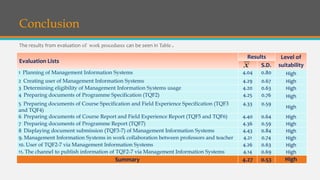
The results from evaluation of work procedures can be seen in Table .
Evaluation Lists
Results Level of
suitabilityS.D.
1 Planning of Management Information Systems 4.04 0.80 High
2 Creating user of Management Information Systems 4.29 0.67 High
3 Determining eligibility of Management Information Systems usage 4.20 0.63 High
4 Preparing documents of Programme Specification (TQF2) 4.25 0.76 High
5 Preparing documents of Course Specification and Field Experience Specification (TQF3
and TQF4)
4.33 0.59
High
6 Preparing documents of Course Report and Field Experience Report (TQF5 and TQF6) 4.40 0.64 High
7 Preparing documents of Programme Report (TQF7) 4.36 0.59 High
8 Displaying document submission (TQF3-7) of Management Information Systems 4.43 0.84 High
9. Management Information Systems in work collaboration between professors and teacher 4.21 0.74 High
10. User of TQF2-7 via Management Information Systems 4.26 0.63 High
11. The channel to publish information of TQF2-7 via Management Information Systems 4.14 0.69 High
Summary 4.27 0.53 High
x
Conclusion
Conclusion
The evaluation process result of Information Management Systems in accordance with the Thai
Qualifications Framework for Higher Education via Cloud Computing
5.2 The data analysis of statistical review from users of Information Management Systems in
accordance with the Thai Qualifications Framework for Higher Education via Cloud Computing
x
The analysis found that the overall of process of Management Information Systems, it is
appropriate at a high level ( = 4.27, S.D. = 0.53). When researcher considered the top three from the
highest to lowest, they found that the displaying document submission (TQF3-7) of Management
Information Systems has highest average ( = 4.43, S.D.= 0.84), then preparing documents of Course
Report and Field Experience Report (TQF5 and TQF6) ( = 4.40, S.D.= 0.64), and preparing
documents of Programme Report (TQF7) ( = 4.36, S.D.= 0.59) respectively.
x
x
x
x
1. More study and compare the differences between position and evaluation process result
of Management Information Systems.
2. More study the opinion of specialists about Management Information Systems.
3. Develop Management Information Systems in order to evaluate all sides of Learning
Outcomes.
Suggestions
Question?
Thank you
Miss Thassanee Rodmunkong
Division of Information and Communication Technology for Education.
Faculty of Technical Education, King Mongkut’s University of Technology
North Bangkok, Thailand.
e-Mail: Thassanee30@Gmail.com

Development of Information Management Systems

  • 1.
    Ph.D. Candidate AssistantProfessor Thassanee Rodmunkong DICT @ KMUTNB Division of Information and Communication for Education (DICT), Faculty of Technical Education, King Mongkut’s University of Technology North Bangkok, Thailand Development of Information Management Systems in accordance with the Thai Qualifications Framework for Higher Education via Cloud Computing Associate Professor Panita Wannapiroon, Ph.D. Prachyanun Nilsook , Ph.D.
  • 2.
    Contents Introduction Purpose Methodology Conclusion Suggestions Division of Informationand Communication for Education (DICT), Faculty of Technical Education, King Mongkut’s University of Technology North Bangkok, Thailand DICT @ KMUTNB Development of Information Management Systems in accordance with the Thai Qualifications Framework for Higher Education via Cloud Computing Results
  • 3.
    Introduction  Information Technology(IT). Information Technology (IT) Management becomes significant for Modern Management because information technology is a key of competitions regarding Commerce, Organizational Management, Educational Personnel Development. Information Technology (IT) is significant infrastructure of digital procedures with all-time dynamic. Thai government has used Cloud Computing for national development. It is a kind of distributed computing which serves computer infrastructure, application program, computer environment, and data storage service in accordance with clients demand.
  • 4.
    Introduction  Cloud Computing. CloudComputing service divides into 3 types (1) Software- as-a-Service (SaaS) (2) Platform-as-a-Service (Paas) (3) Infrastructure- as-a-service (IaaS) As mentioned recently called SPI Paradigm. Information Technology (IT) is multilaterally operation mechanism of organization in order to ingeniously correspond to change of social situation and concretely get results. Development and dynamic change of Information Technology (IT) and Academic Education’s Management affects to college graduate quality. Moreover, academic institute has to change and develop education management in order to get high quality of graduate because of education modernism. Ministry of Education then declared “Thai Qualifications Framework for Higher Education, TQF : HEd”. Cloud Computing
  • 5.
    Introduction  National EducationAct B.E.2542 (1999) and Amendments (Second National Education Act .B.E. 2545 (2002). The Thai Qualifications Framework for Higher Education is a tool applies National Education Act to concrete operation in Academic Education which is quality assurance of graduates to raise academic education standards. The National Education Act B.E. 2542 Amendments (Second) National Education Act B.E. 2545 defined purposes and instruction principle focuses on quality and standard divided into “Internal Quality Assurance System” and “External Quality Assurance System” used for quality maintenance in Academic Education.
  • 6.
    Introduction  Development ofInformation Management Systems in accordance with the Thai Qualifications Framework for Higher Education via Cloud Computing According to Thai Qualifications Framework for Higher Education and data of Educational Quality Assurance in School. Therefore, the researcher has developed Information Management Systems in accordance with the Thai Qualifications Framework for Higher Education via Cloud Computing. This system has service as Software-as-a-Service: SaaS which is the measuring for curriculum management in accordance with the Thai Qualifications Framework for Higher Education.
  • 7.
     To Developthe work procedures of Information Management Systems in accordance with the Thai Qualifications Framework for Higher Education via Cloud Computing  To Development of Information Management Systems in accordance with the Thai Qualifications Framework for Higher Education via Cloud Computing Purpose
  • 8.
    Methodology A. Develop theSystem Research methods in accordance with System Analysis and Design, and Software Development Life Cycle (SDLC) by using the Software Development Methodology via Cloud Computing in accordance with ZHU Zemin and Xiaofei (2009 : 468) can divided into five stages as follows: 1. A detailed analysis to users’ requirement 2. The choice of service providers 3. Design and implementation of SaaS-based education information system 4. System running and maintenance 5. Propaganda for the information system
  • 9.
    Methodology B. Evaluate workprocedures of the system Population and samples Divided into two groups: Population were the experts in Information Management System, Cloud Computing and TQF. Sample were selected from the experts in the population using purposive sampling technique. The three experts comprised of Information Management System, cloud computing and TQF with experience in their field and Qualified doctoral. 1. Population and samples for evaluate Index of Item Objective Congruence
  • 10.
    Population Professors, teachersand educators of Rajabhat Rajanagarindra University. Sample Professors, teachers and educators of Rajabhat Rajanagarindra University who were simply randomized. There are 13 professors, 29 teachers and 7 educators. Methodology B. Evaluate work procedures of the system Population and samples Divided into two groups: 2. Population and samples for assessing workflow system
  • 11.
    C. The methodof Information Management Systems Development in accordance with the Thai Qualifications Framework for Higher Education via Cloud Computing consists 11 fields as following; Results 1. Planning of Management Information Systems 2. Creating user of Management Information Systems 3. Determining eligibility of Management Information Systems usage 4. Preparing documents of Programme Specification (TQF2) 5. Preparing documents of Course Specification and Field Experience Specification (TQF3 and TQF4) 6. Preparing documents of Course Report and Field Experience Report (TQF5 and TQF6) 7. Preparing documents of Programme Report (TQF7) 8. Displaying document submission (TQF3-7) of Management Information Systems 9. Management Information Systems in work collaboration between professors and teacher 10. User of TQF2-7 via Management Information Systems 11. The channel to publish information of TQF2-7 via Management Information Systems
  • 12.
    C. The resultof Information Management Systems Development in accordance with the Thai Qualifications Framework for Higher Education via Cloud Computing; Results Figure 1: Information Management Systems has main screen Figure 2: log-in screen (TQF as a Service System) Figure 4: screen of creating activity calendar Figure 3: screen of user’s profile
  • 13.
    Conclusion The evaluation processresult of Information Management Systems in accordance with the Thai Qualifications Framework for Higher Education via Cloud Computing 5.1 The preliminary data analysis regarding samples’ background The analysis found that there were 22 male users (40.70%), 26 female users (41.10%) and 6 not-submit- questionnaire-users (11.10%). When researcher considered based on position, the most of users are teachers, 29 persons, (53.70%), then 13 professors (13.00%), 7 educators (13.00%) and lastly, 5 not-submit- questionnaire-persons (9.30%)
  • 14.
    The results fromevaluation of work procedures can be seen in Table . Evaluation Lists Results Level of suitabilityS.D. 1 Planning of Management Information Systems 4.04 0.80 High 2 Creating user of Management Information Systems 4.29 0.67 High 3 Determining eligibility of Management Information Systems usage 4.20 0.63 High 4 Preparing documents of Programme Specification (TQF2) 4.25 0.76 High 5 Preparing documents of Course Specification and Field Experience Specification (TQF3 and TQF4) 4.33 0.59 High 6 Preparing documents of Course Report and Field Experience Report (TQF5 and TQF6) 4.40 0.64 High 7 Preparing documents of Programme Report (TQF7) 4.36 0.59 High 8 Displaying document submission (TQF3-7) of Management Information Systems 4.43 0.84 High 9. Management Information Systems in work collaboration between professors and teacher 4.21 0.74 High 10. User of TQF2-7 via Management Information Systems 4.26 0.63 High 11. The channel to publish information of TQF2-7 via Management Information Systems 4.14 0.69 High Summary 4.27 0.53 High x Conclusion
  • 15.
    Conclusion The evaluation processresult of Information Management Systems in accordance with the Thai Qualifications Framework for Higher Education via Cloud Computing 5.2 The data analysis of statistical review from users of Information Management Systems in accordance with the Thai Qualifications Framework for Higher Education via Cloud Computing x The analysis found that the overall of process of Management Information Systems, it is appropriate at a high level ( = 4.27, S.D. = 0.53). When researcher considered the top three from the highest to lowest, they found that the displaying document submission (TQF3-7) of Management Information Systems has highest average ( = 4.43, S.D.= 0.84), then preparing documents of Course Report and Field Experience Report (TQF5 and TQF6) ( = 4.40, S.D.= 0.64), and preparing documents of Programme Report (TQF7) ( = 4.36, S.D.= 0.59) respectively. x x x x
  • 16.
    1. More studyand compare the differences between position and evaluation process result of Management Information Systems. 2. More study the opinion of specialists about Management Information Systems. 3. Develop Management Information Systems in order to evaluate all sides of Learning Outcomes. Suggestions
  • 17.
  • 18.
    Thank you Miss ThassaneeRodmunkong Division of Information and Communication Technology for Education. Faculty of Technical Education, King Mongkut’s University of Technology North Bangkok, Thailand. e-Mail: Thassanee30@Gmail.com