
DEVELOPMENT OF
DENTITION AND
OCCLUSION

www.indiandentalacademy.com
INDIAN DENTAL ACADEMY
Leader in continuing dental education
www.indiandentalacademy.com

www.indiandentalacademy.com
DEVELOPMENT OF DENTITION
INTRODUCTION
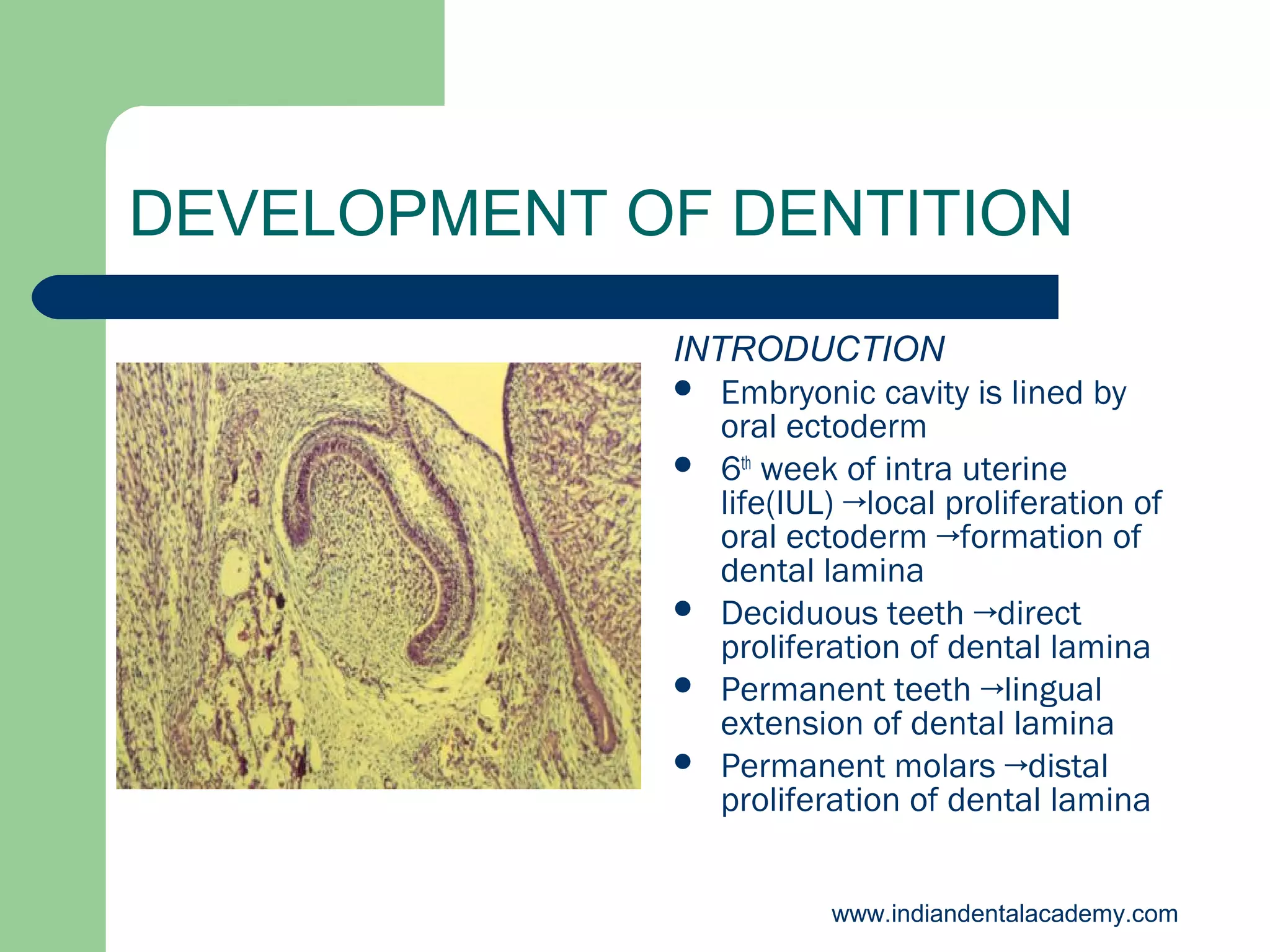
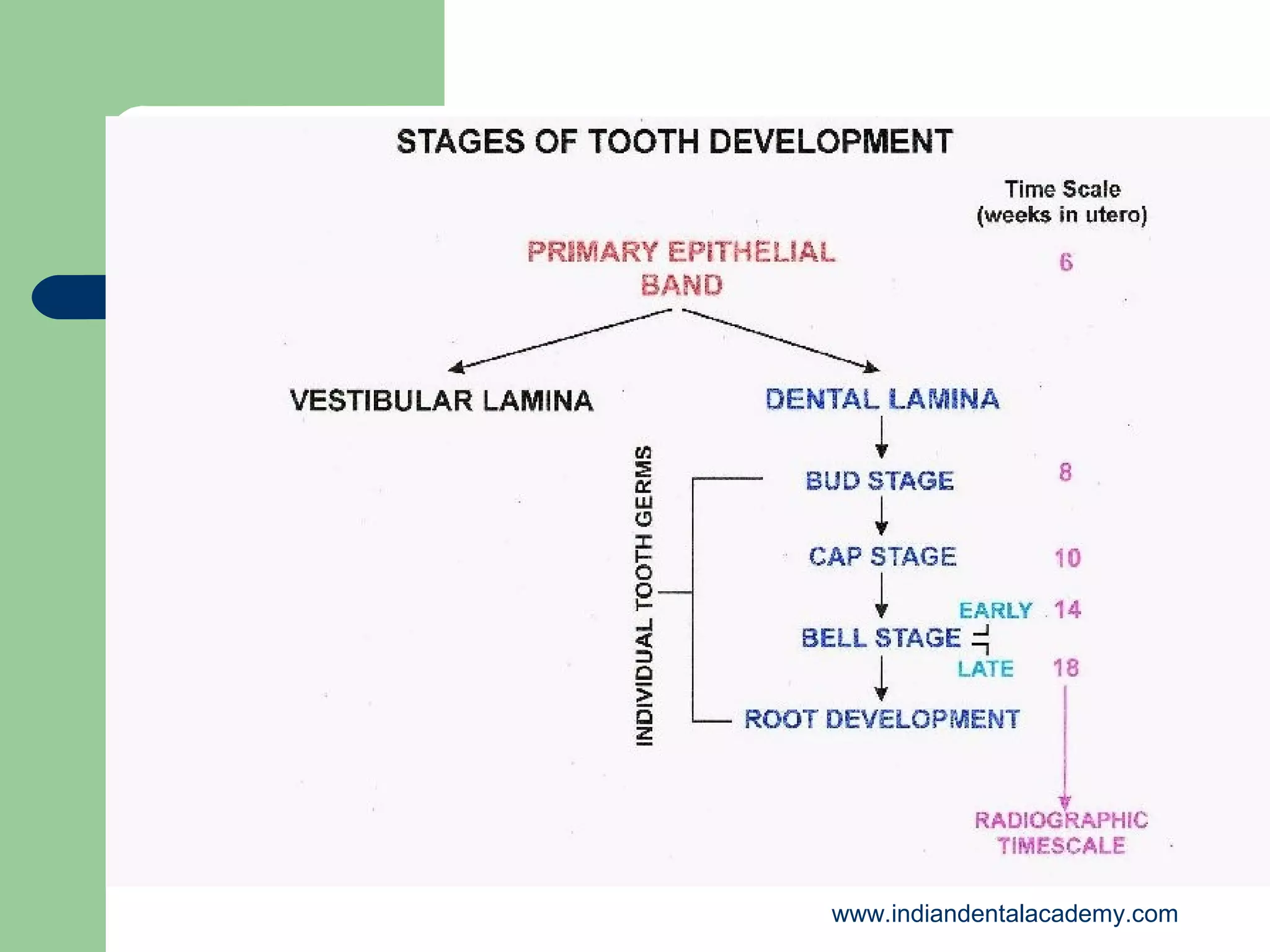
 Embryonic cavity is lined by
oral ectoderm
 6th week of intra uterine
life(IUL) →local proliferation of
oral ectoderm →formation of
dental lamina
 Deciduous teeth →direct
proliferation of dental lamina
 Permanent teeth →lingual
extension of dental lamina
 Permanent molars →distal
proliferation of dental lamina
www.indiandentalacademy.com
DEVELOPMENT OF TEETH
Bud

stage
Cap stage
Bell stage
Root formation

www.indiandentalacademy.com
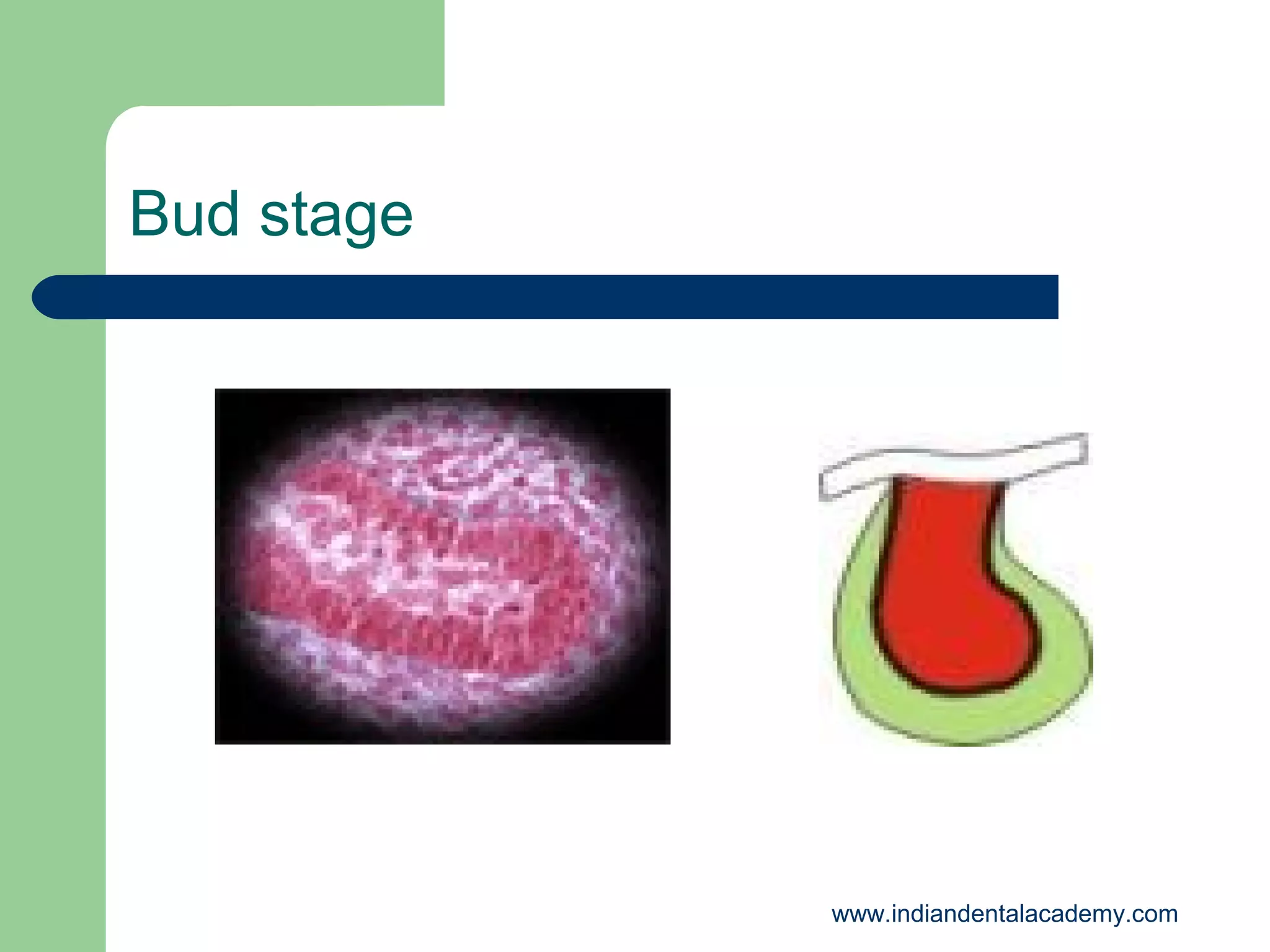
Bud stage

www.indiandentalacademy.com
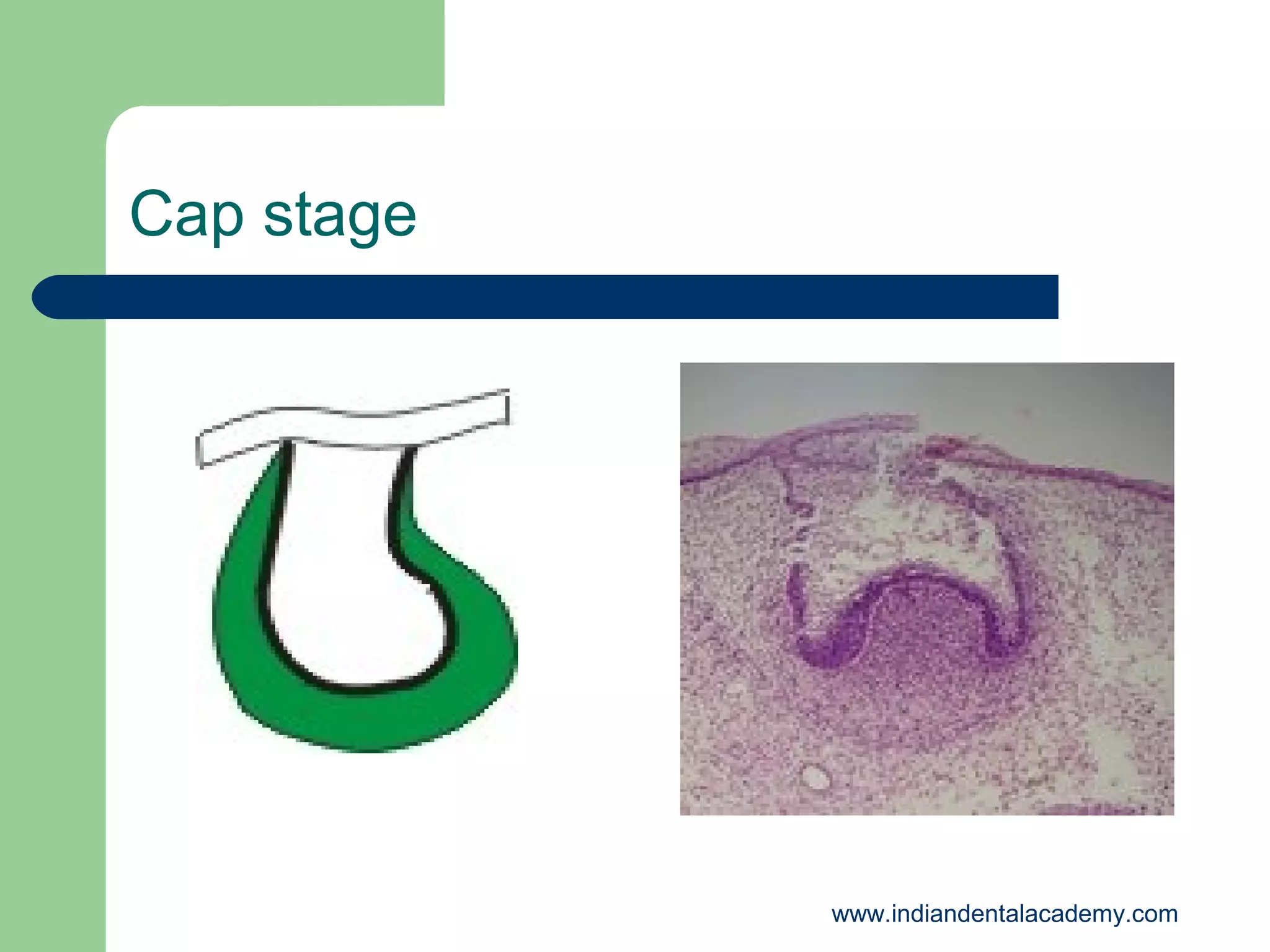
Cap stage

www.indiandentalacademy.com
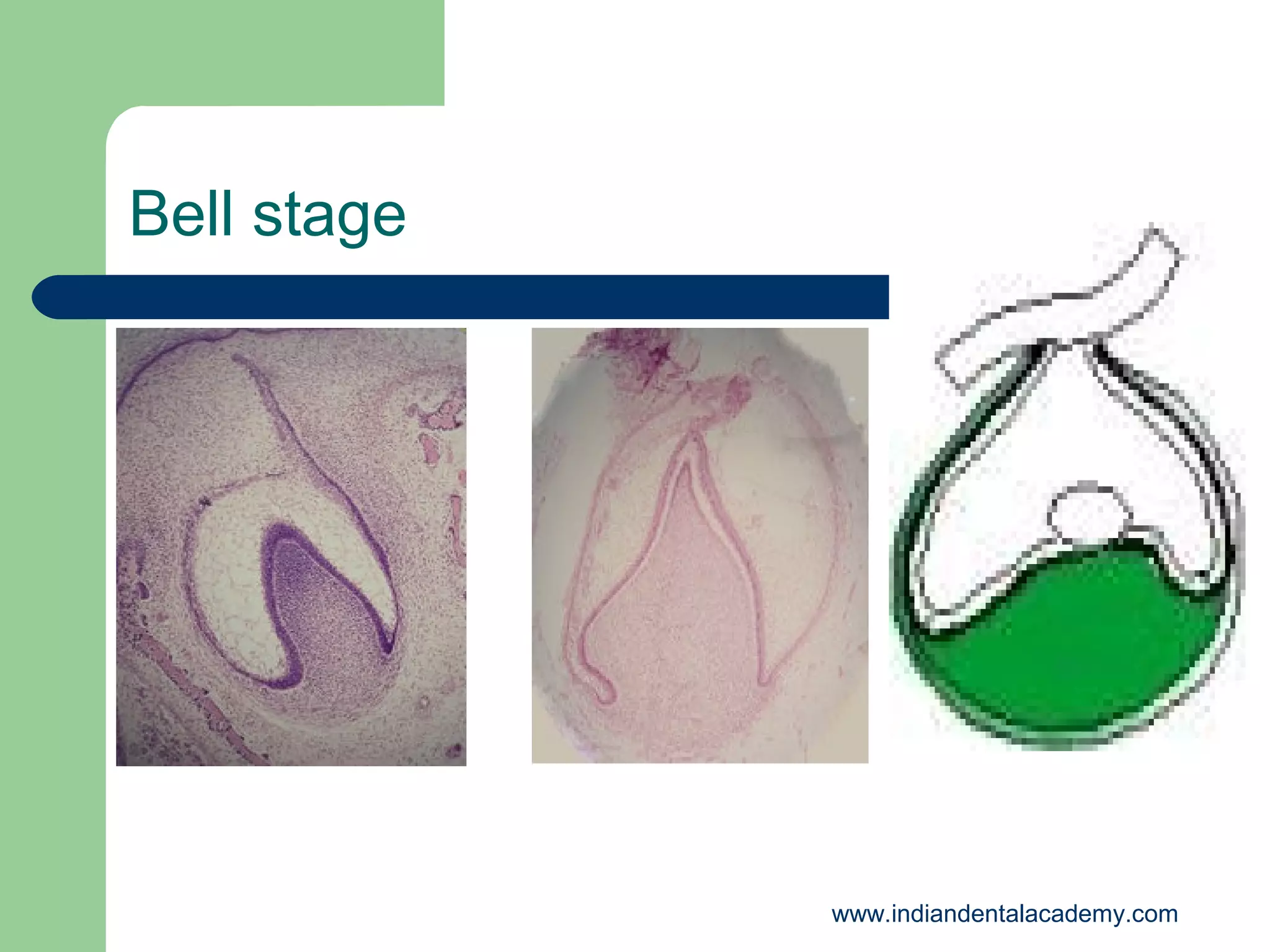
Bell stage

www.indiandentalacademy.com
PERIODS OF OCCLUSAL DEVELOPMENT

1.
2.
3.
4.

Pre-dental period
Deciduous dentition period
Mixed dentition
Permanent dentition period

www.indiandentalacademy.com
PRE-DENTAL PERIOD
 Period

after birth during which neonate does not
have teeth
 Lasts 6 months after birth

www.indiandentalacademy.com
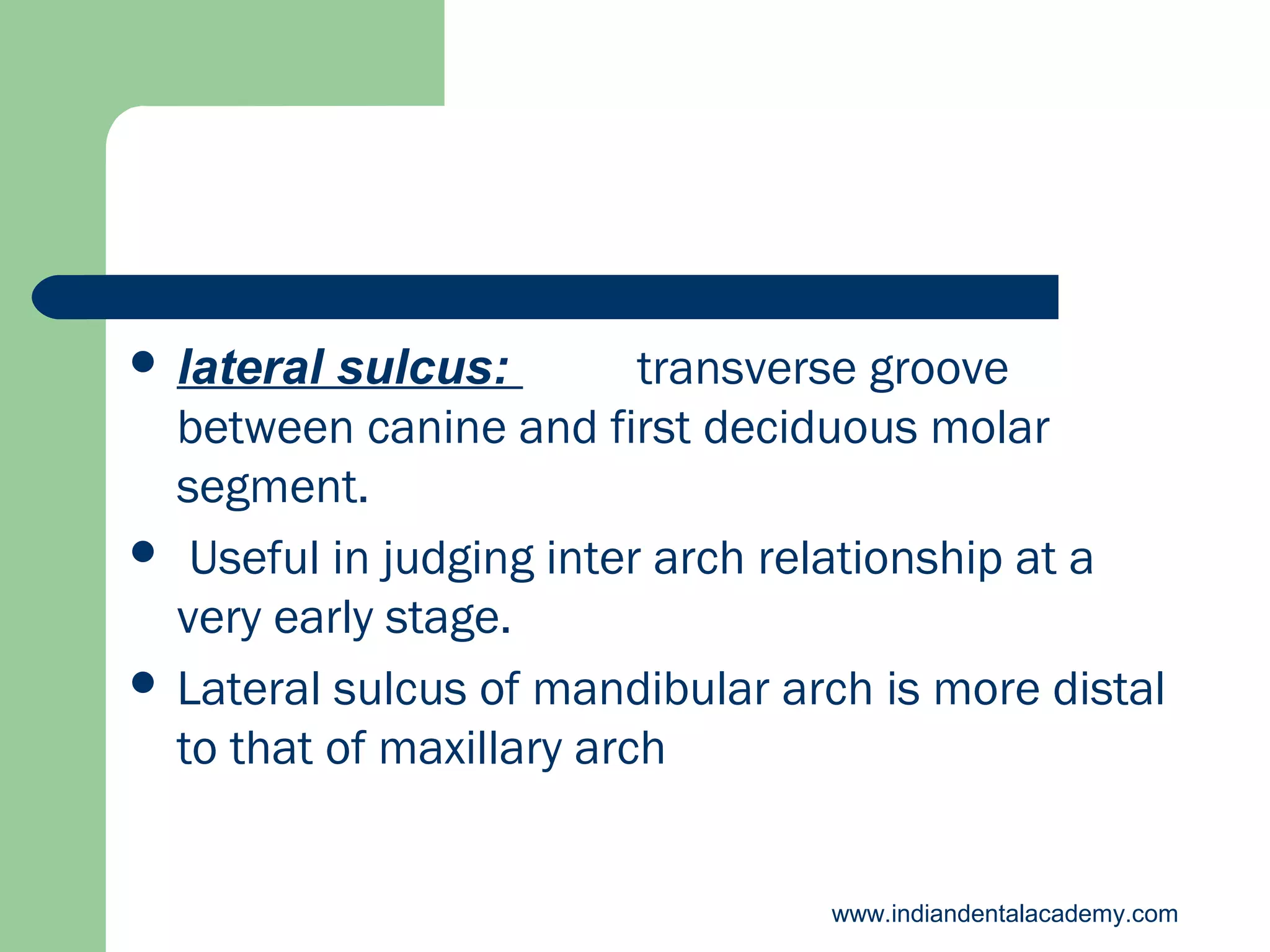
Gum pads



1.
2.




Alveolar processes at the time of birth
Firm,pink,horse shoe shaped,covered by
fibrous periosteum
Develops in two parts
Labiobuccal portion
Lingual portion
Both portions separated by dental
groove
Gum pads are divided into 10 segments
by transverse grooves
Each segment has one developing
deciduous tooth sac
www.indiandentalacademy.com
 lateral

sulcus:
transverse groove
between canine and first deciduous molar
segment.
 Useful in judging inter arch relationship at a
very early stage.
 Lateral sulcus of mandibular arch is more distal
to that of maxillary arch
www.indiandentalacademy.com


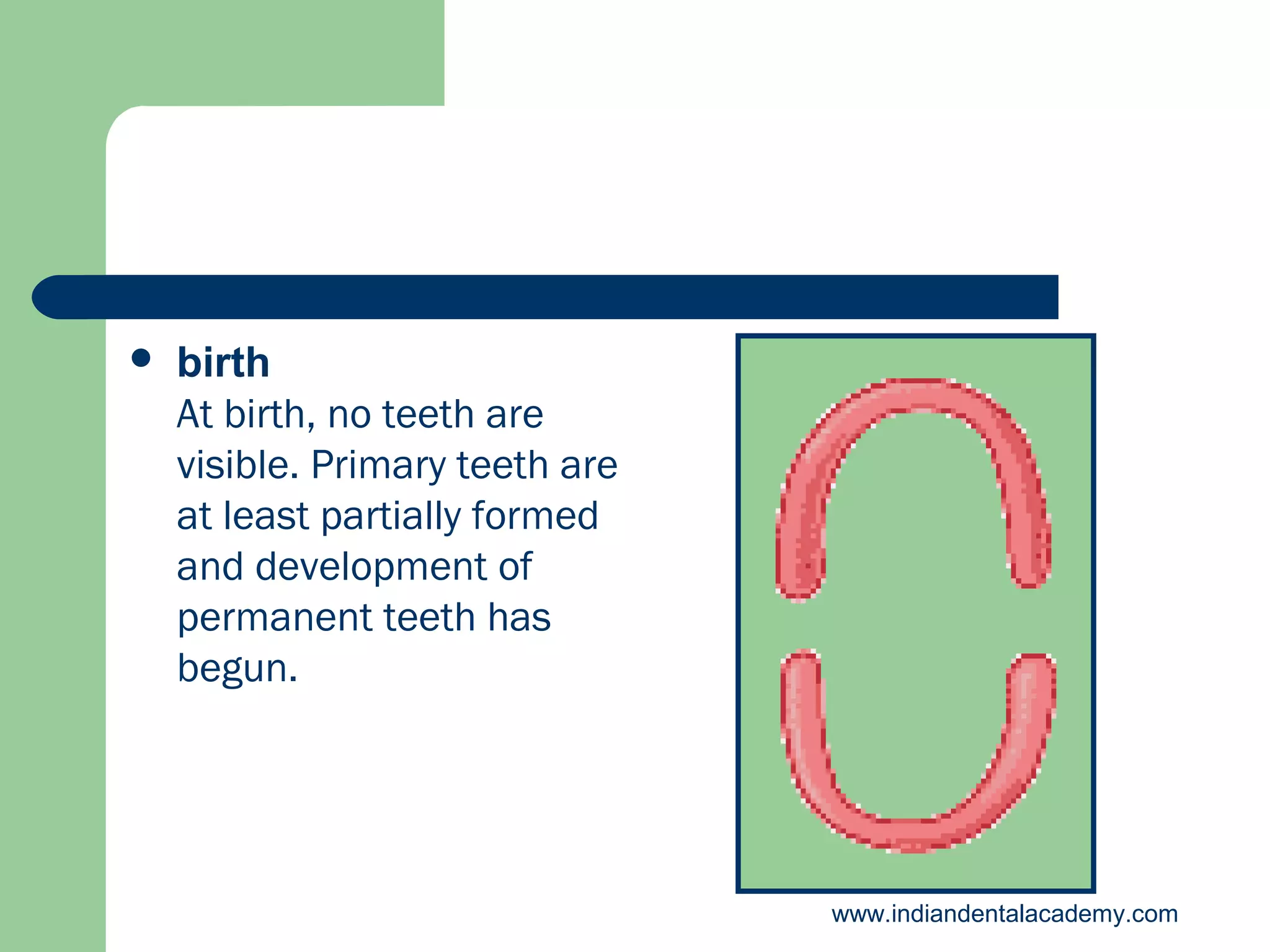
birth
At birth, no teeth are
visible. Primary teeth are
at least partially formed
and development of
permanent teeth has
begun.

www.indiandentalacademy.com
Infantile open bite






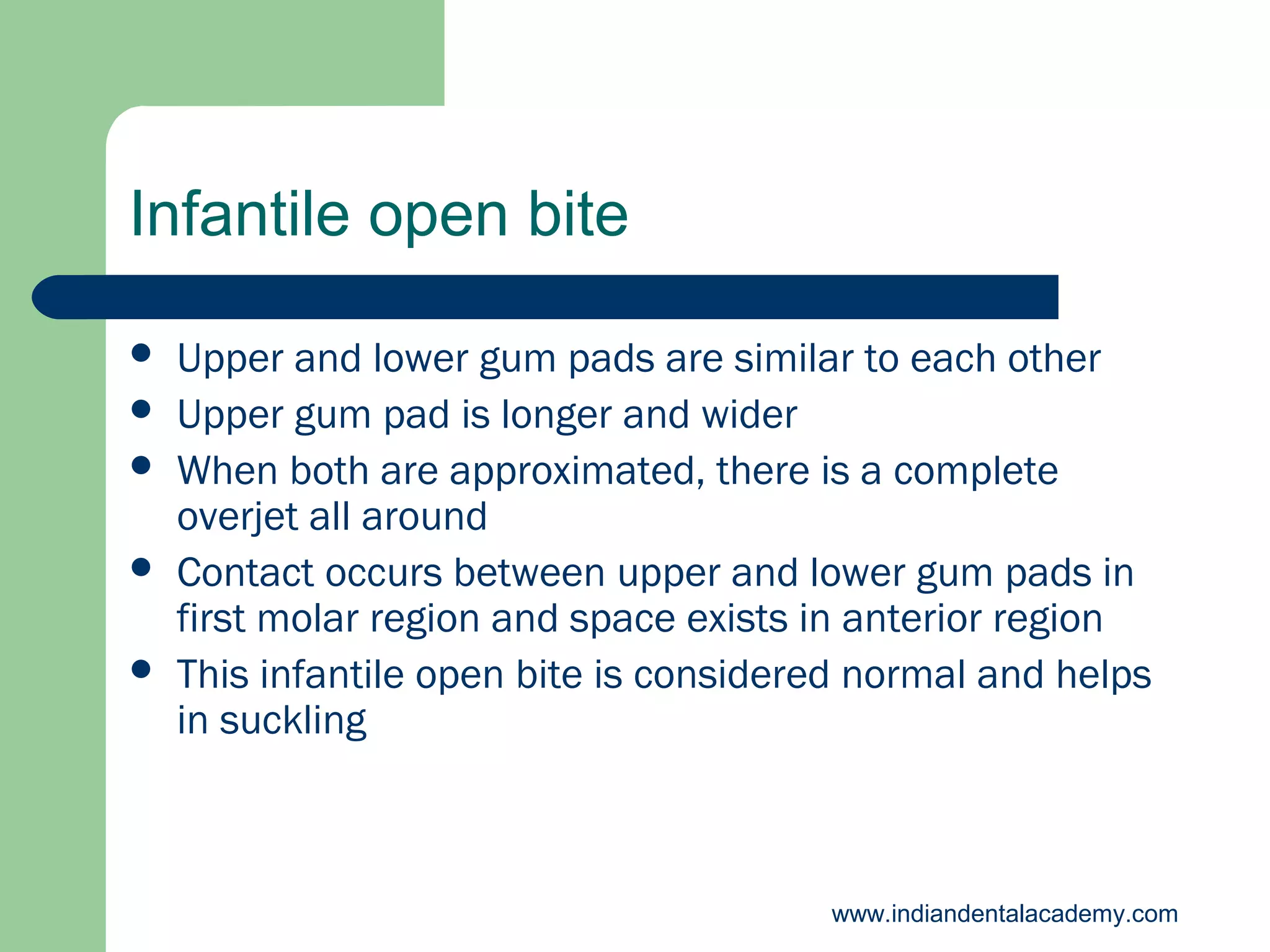
Upper and lower gum pads are similar to each other
Upper gum pad is longer and wider
When both are approximated, there is a complete
overjet all around
Contact occurs between upper and lower gum pads in
first molar region and space exists in anterior region
This infantile open bite is considered normal and helps
in suckling

www.indiandentalacademy.com
STATUS OF DENTITION
 Neonate

is without teeth for 6 months of life.
 Gum pads insufficient to accommodate
developing incisors that are crowded in crypts
 1st yr of life →gum pads grow rapidly permitting
incisors to erupt in good alignment.

www.indiandentalacademy.com
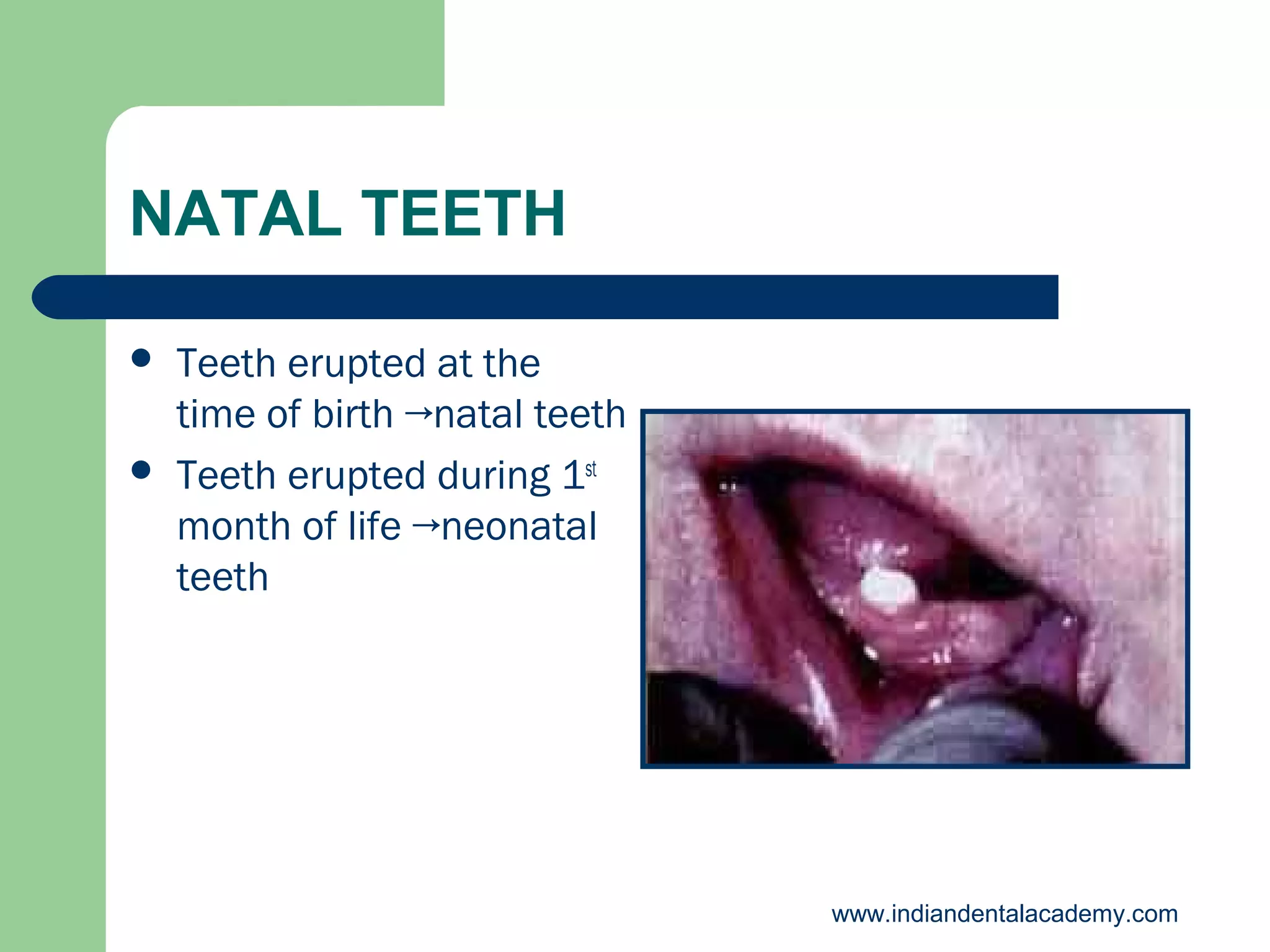
NATAL TEETH




Teeth erupted at the
time of birth →natal teeth
Teeth erupted during 1st
month of life →neonatal
teeth

www.indiandentalacademy.com


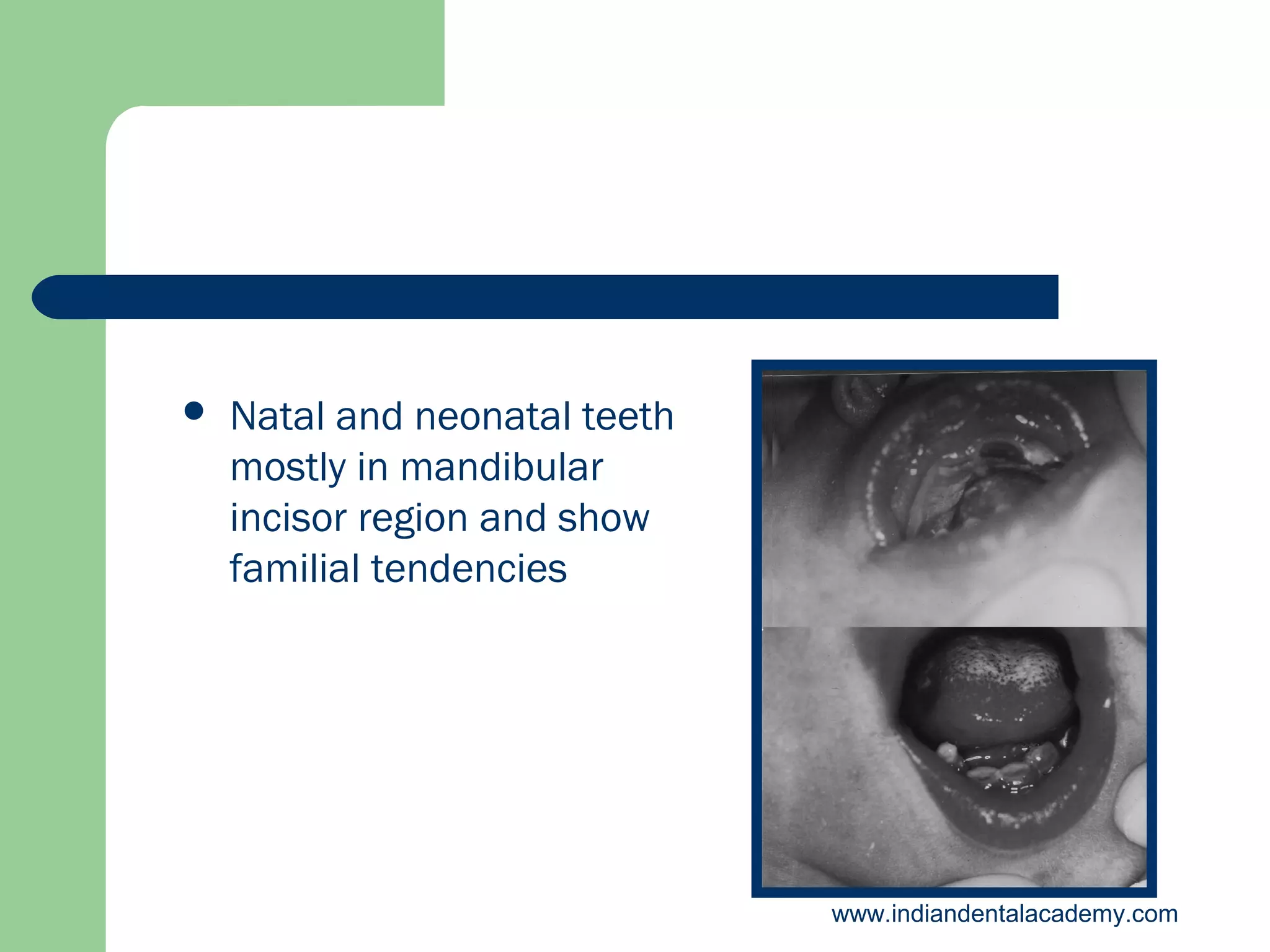
Natal and neonatal teeth
mostly in mandibular
incisor region and show
familial tendencies

www.indiandentalacademy.com
DECIDUOUS DENTITION PERIOD
 1st

6 weeks of IUL →initiation of tooth buds
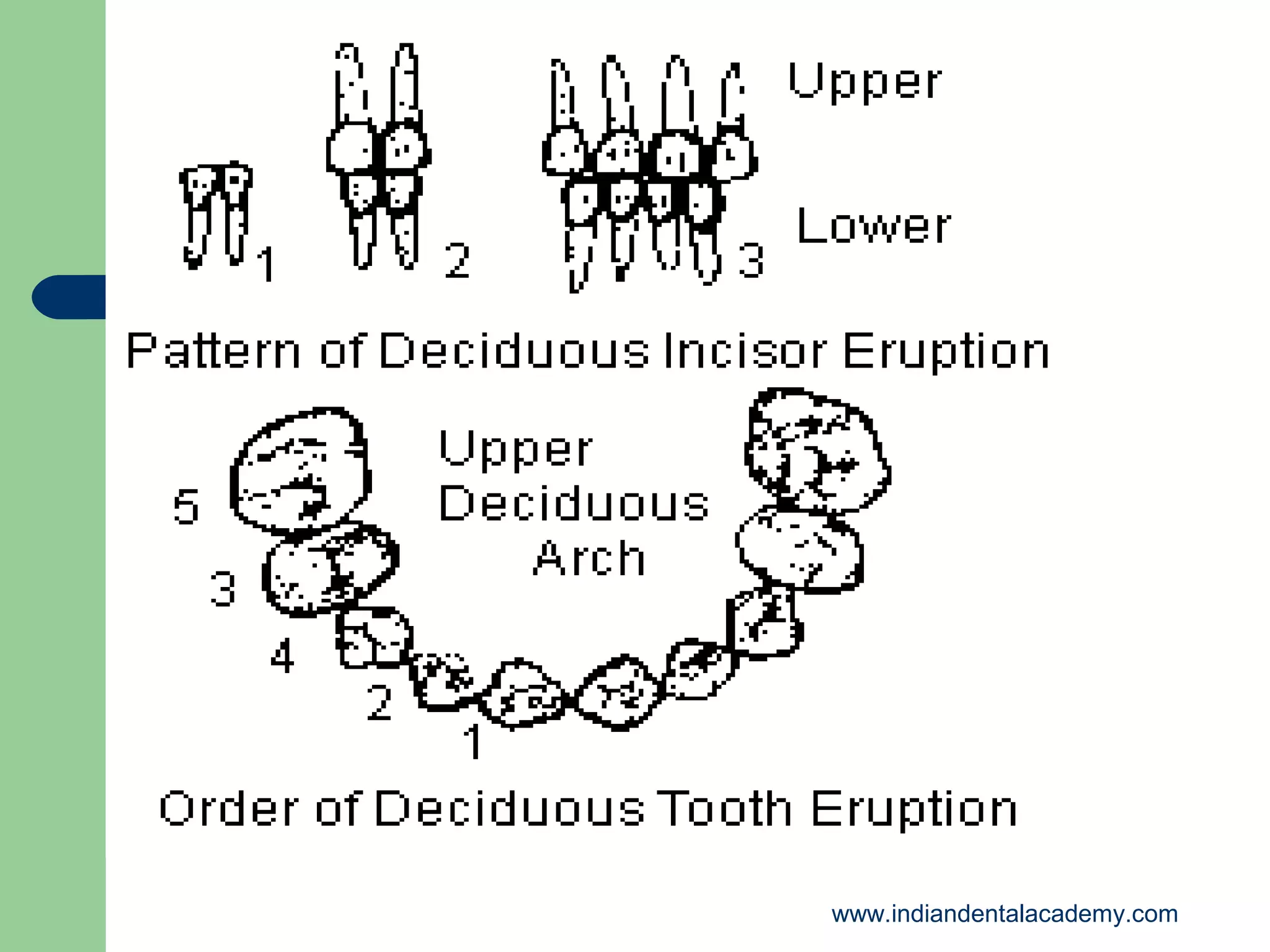
 Primary teeth erupt at about 6 months
 Eruption completed by 2 ½-3 ½ yrs
 Sequence of eruption →A-B-D-C-E

www.indiandentalacademy.com


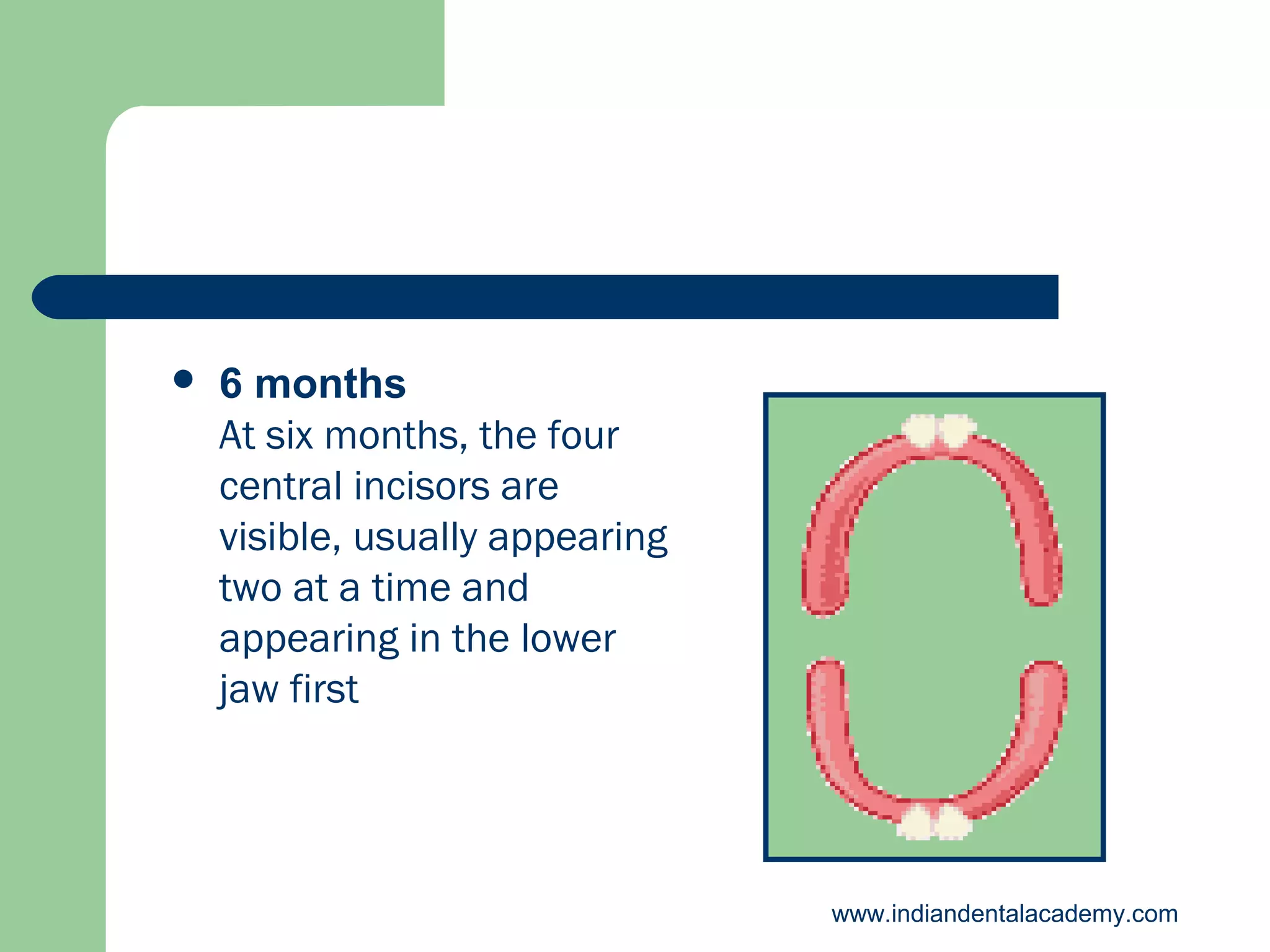
6 months
At six months, the four
central incisors are
visible, usually appearing
two at a time and
appearing in the lower
jaw first

www.indiandentalacademy.com
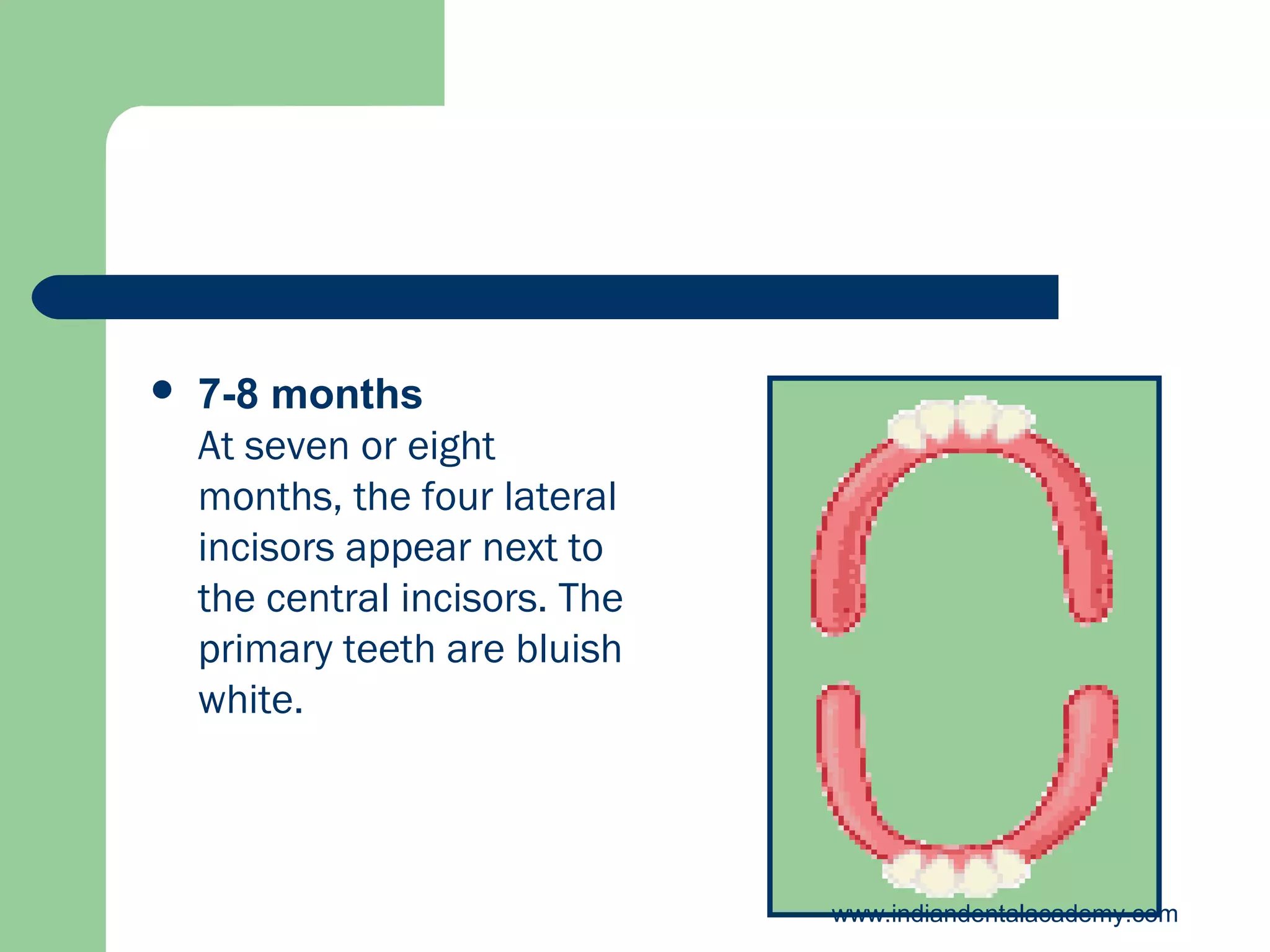


7-8 months
At seven or eight
months, the four lateral
incisors appear next to
the central incisors. The
primary teeth are bluish
white.

www.indiandentalacademy.com
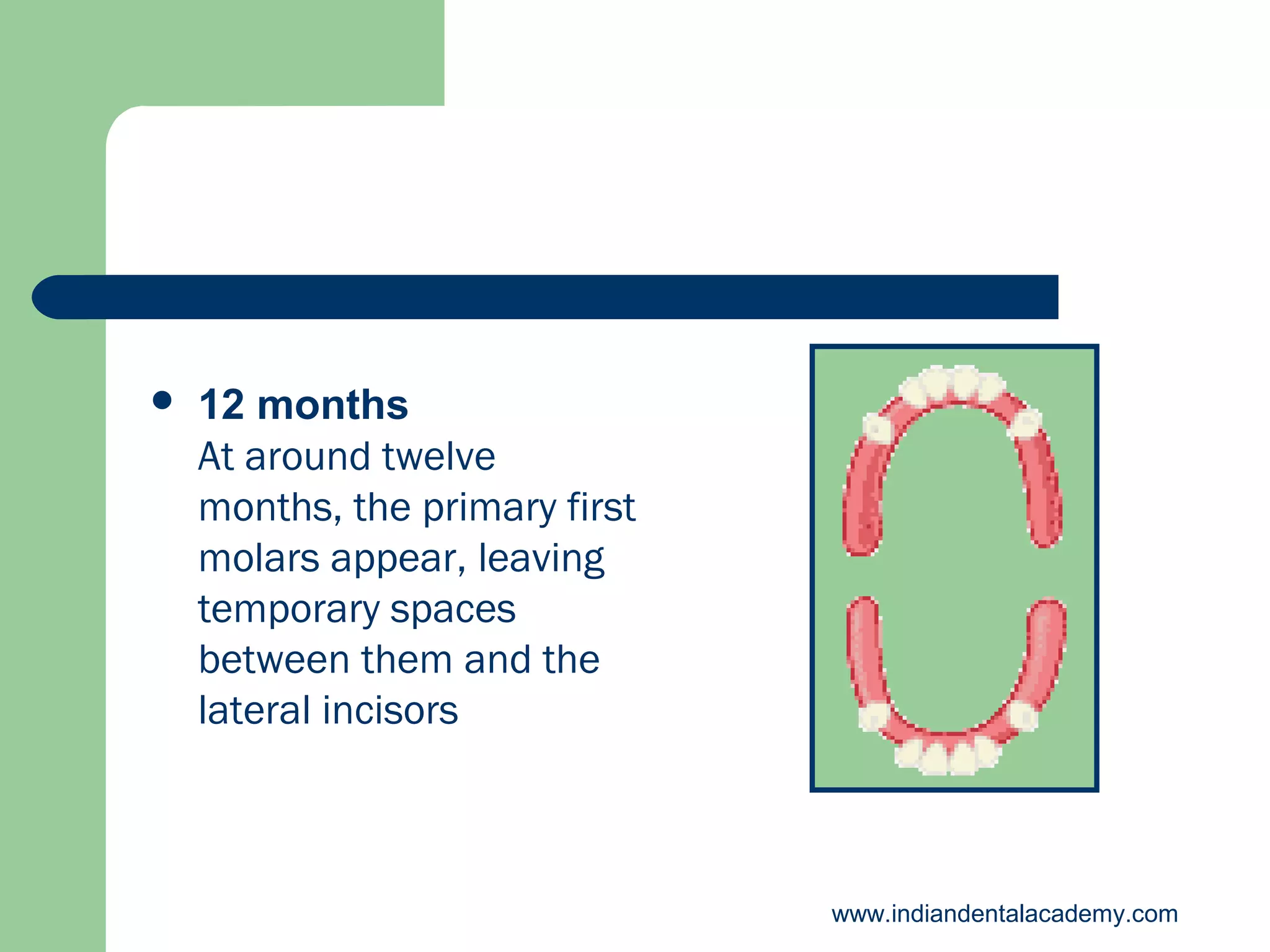


12 months
At around twelve
months, the primary first
molars appear, leaving
temporary spaces
between them and the
lateral incisors

www.indiandentalacademy.com
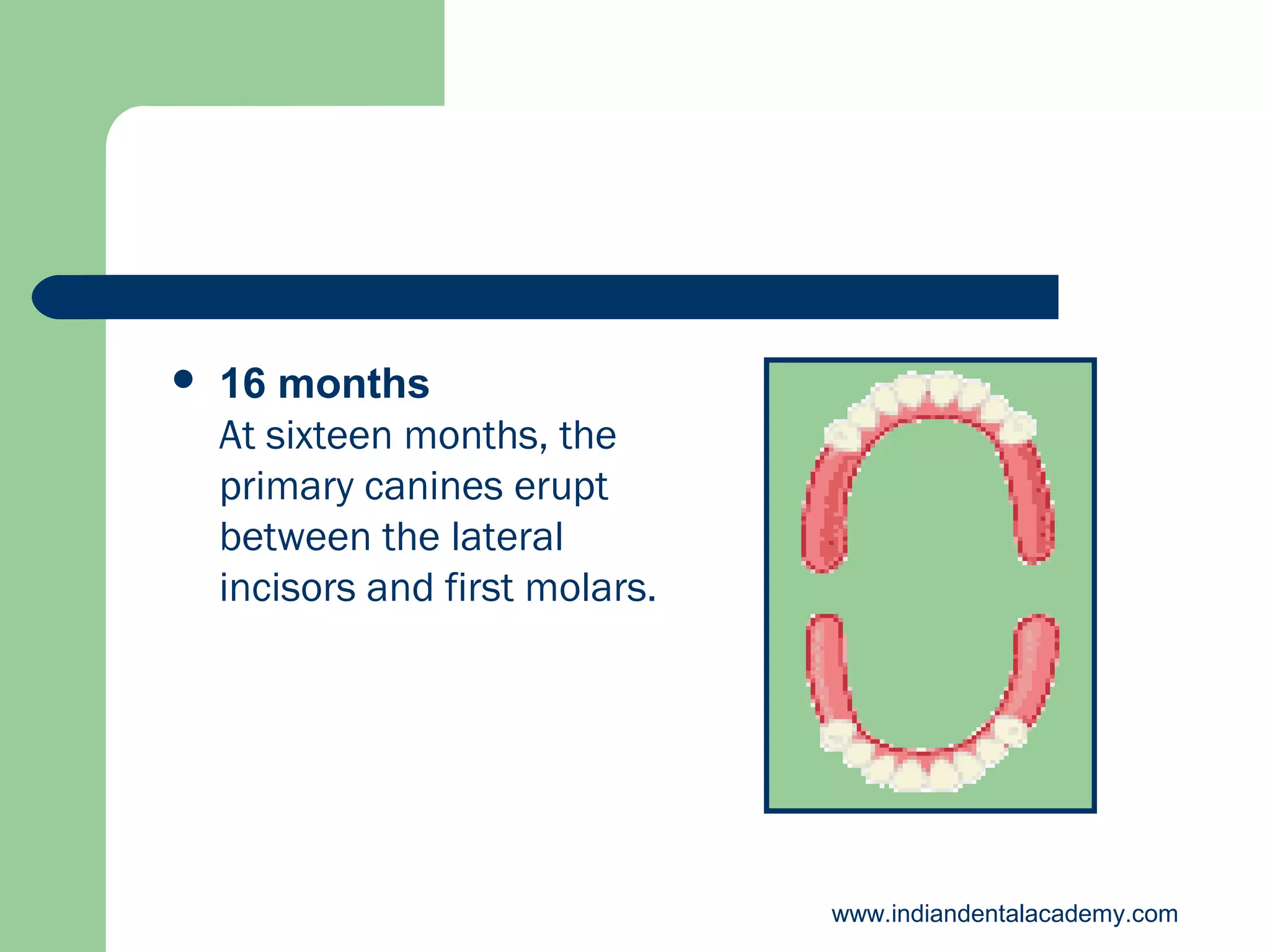


16 months
At sixteen months, the
primary canines erupt
between the lateral
incisors and first molars.

www.indiandentalacademy.com
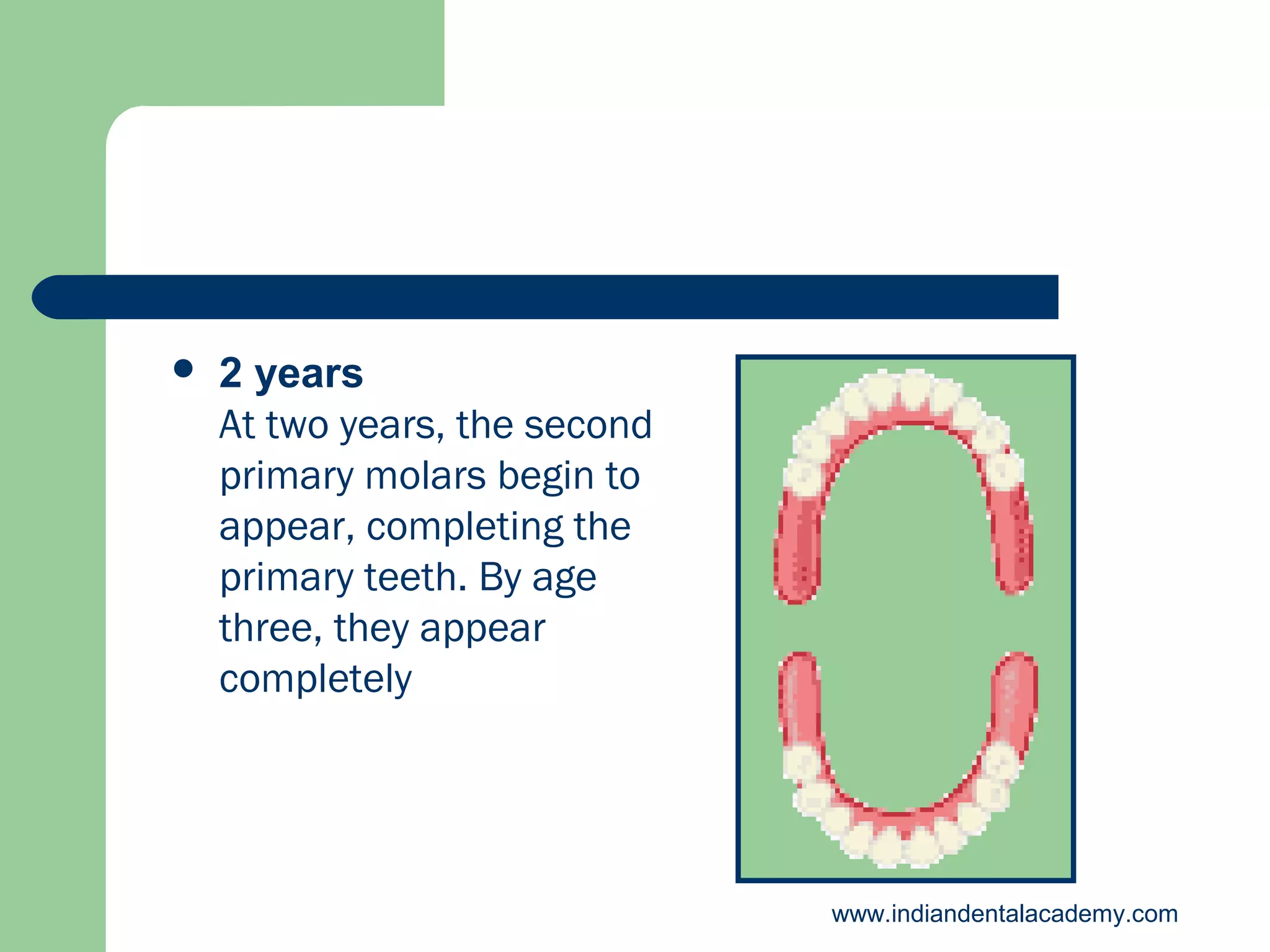


2 years
At two years, the second
primary molars begin to
appear, completing the
primary teeth. By age
three, they appear
completely

www.indiandentalacademy.com
SPACING IN DECIDUOUS DENTITION
 Spaces

usually exist between deciduous teeth
→physiological or developmental spaces
 Important for normal development of
2°dentition
 Absence of spaces is an indication that
crowding of teeth may occur in 2°dentition

www.indiandentalacademy.com
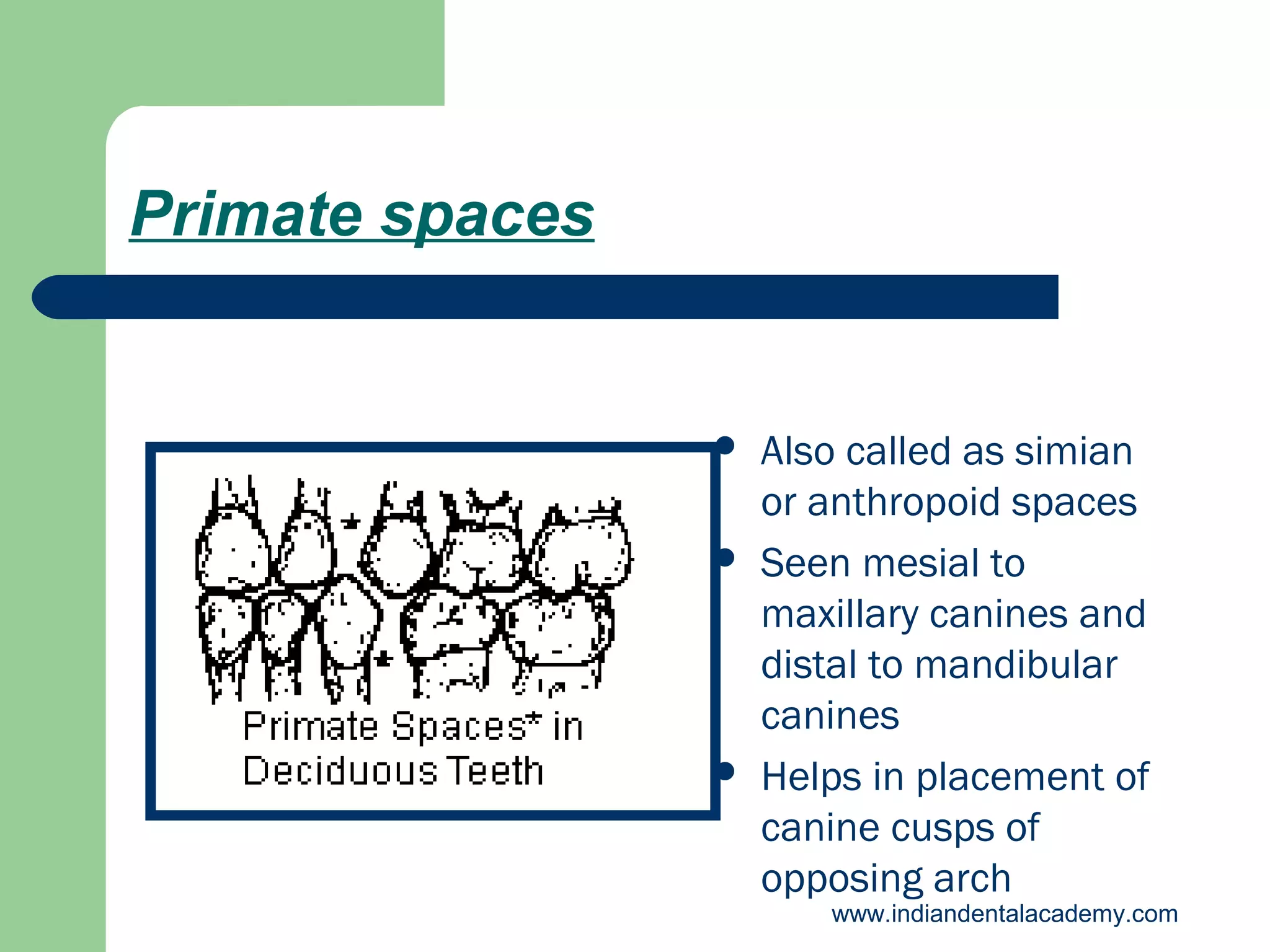
Primate spaces







Also called as simian
or anthropoid spaces
Seen mesial to
maxillary canines and
distal to mandibular
canines
Helps in placement of
canine cusps of
opposing arch

www.indiandentalacademy.com
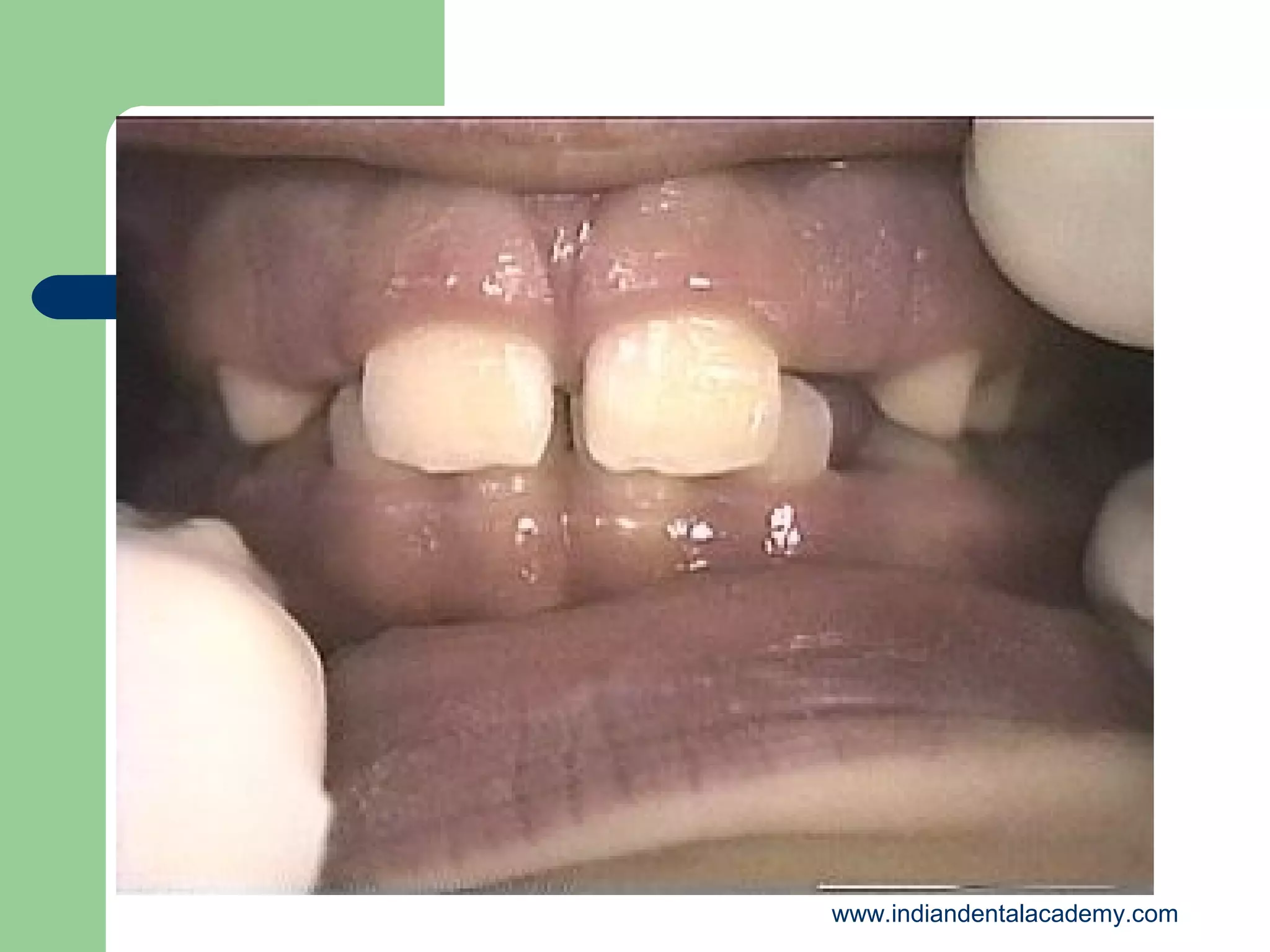
Deep bite





May occur in initial developing stages
Accentuated by the fact that deciduous incisors are
more upright
Lower incisal edges often contact cingulum area of
maxillary incisors
Later reduced by
1. Eruption of deciduous molars
2. Attrition of incisors
3. Forward growth of mandible
www.indiandentalacademy.com
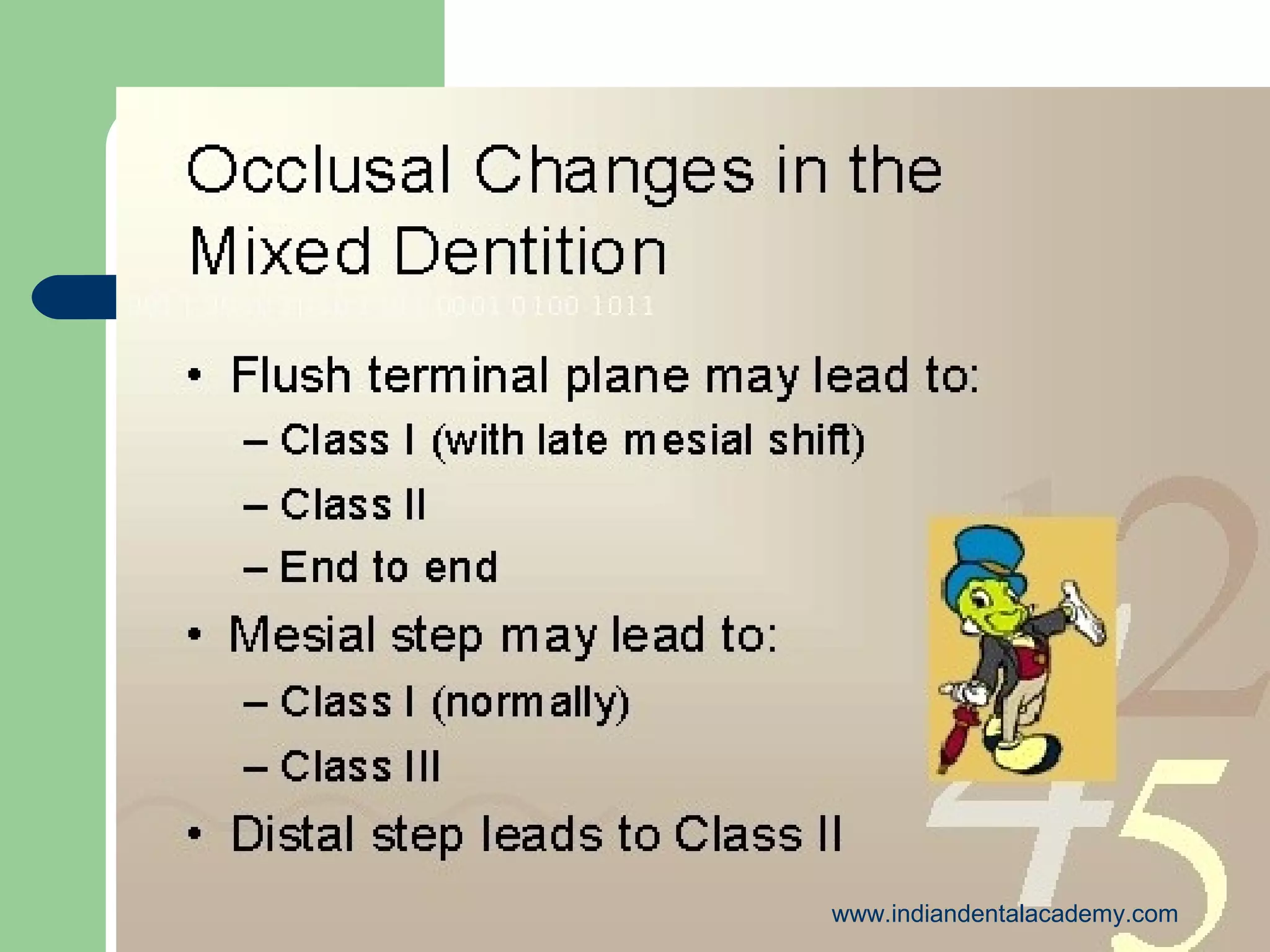
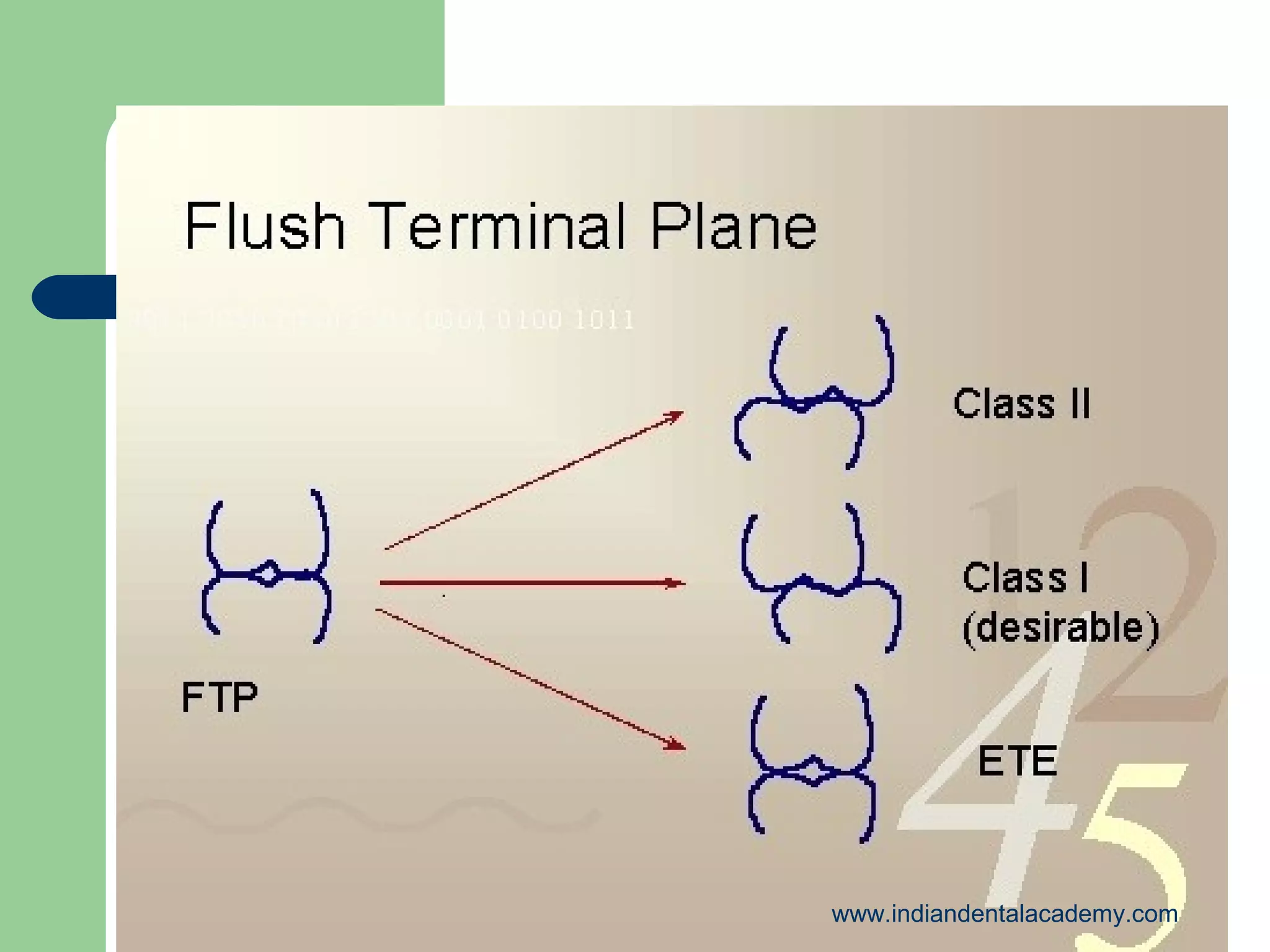
Flush terminal plane
 Mesiodistal

relation between distal surfaces of
upper and lower 2nd deciduous molars is called
as flush terminal plane
 Normal feature of deciduous dentition where
second deciduous molars are in same vertical
plane

www.indiandentalacademy.com
MIXED DENTITION PERIOD

1.
2.
3.

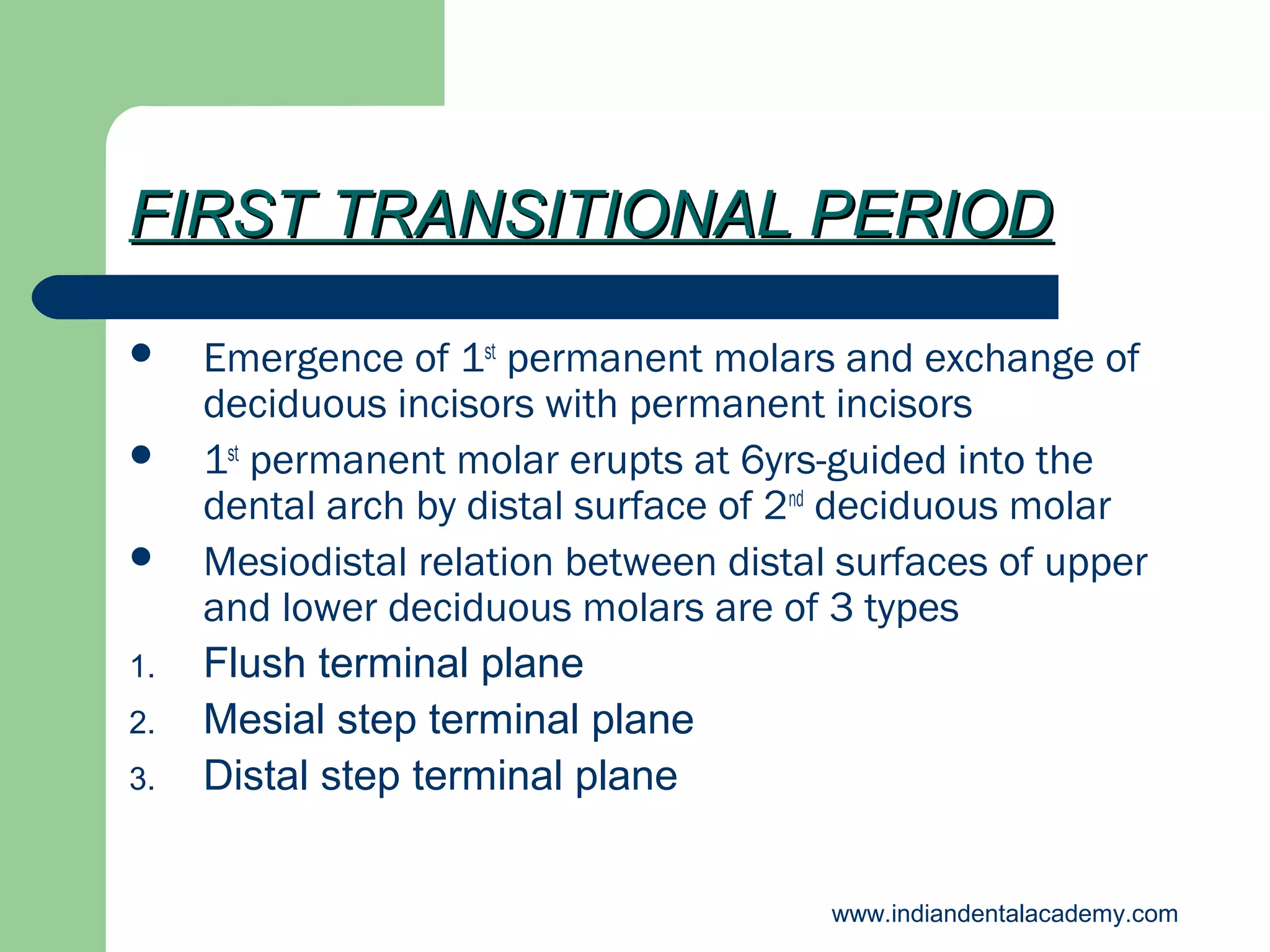
Begins at approximately 6yrs.Classified into:
1st transitional period
Inter transitional period
2nd transitional period

www.indiandentalacademy.com
FIRST TRANSITIONAL PERIOD



1.
2.
3.

Emergence of 1st permanent molars and exchange of
deciduous incisors with permanent incisors
1st permanent molar erupts at 6yrs-guided into the
dental arch by distal surface of 2nd deciduous molar
Mesiodistal relation between distal surfaces of upper
and lower deciduous molars are of 3 types
Flush terminal plane
Mesial step terminal plane
Distal step terminal plane
www.indiandentalacademy.com
FLUSH TERMINAL PLANE
 Mesiodistal

relation between distal surfaces of
upper and lower 2nd deciduous molars is called
as flush terminal plane.
 Normal feature of deciduous dentition where
second deciduous molars are in same vertical
plane.

www.indiandentalacademy.com
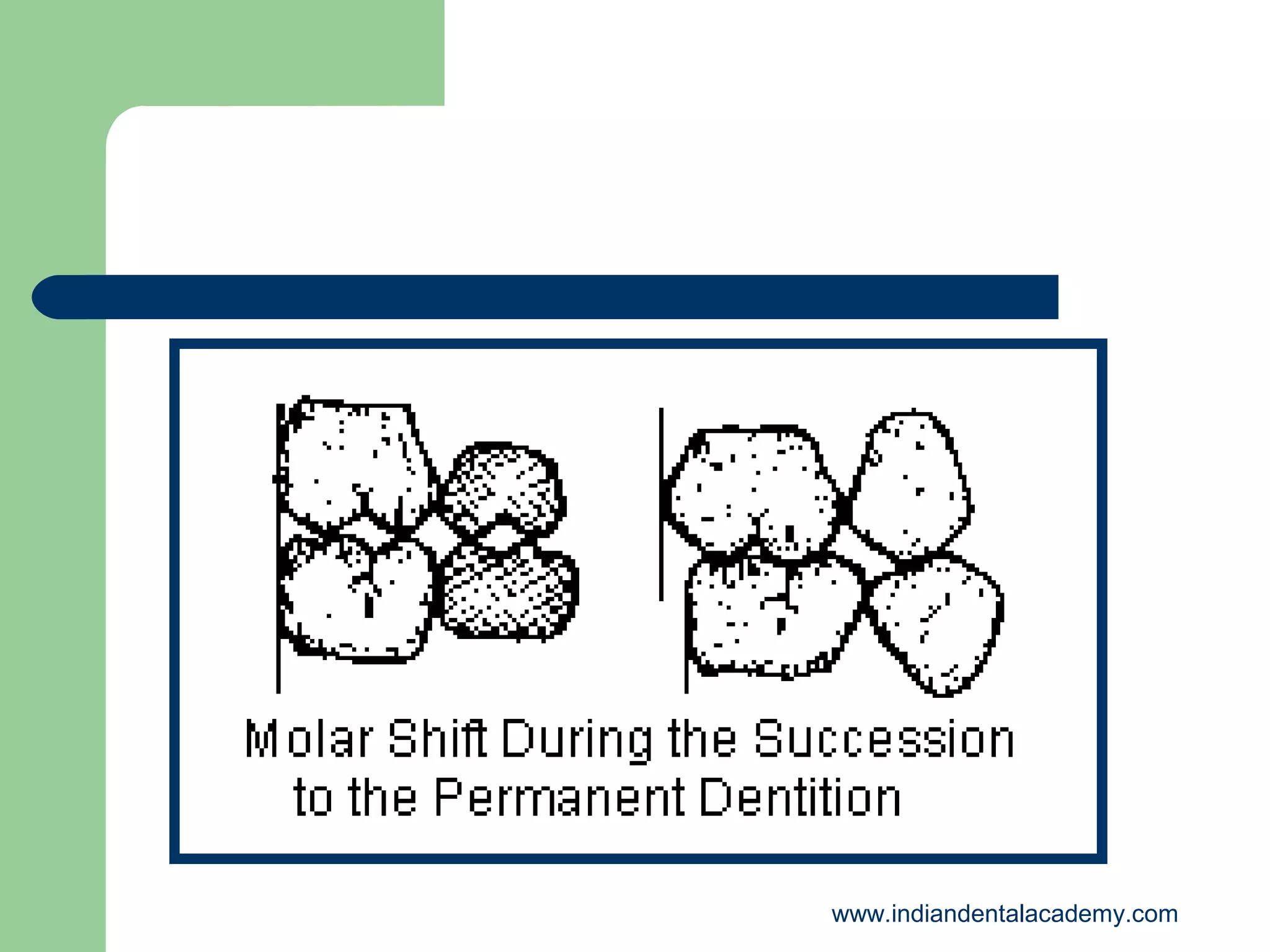
 Erupting

first molars may be in a flush or end
on relation
 For transition of such an end on molar to a
Class I molar relation, lower molar has to move
forward by about 3-5mm relative to upper
molar
 This can occur in 2 ways. By early shift or late
shift
www.indiandentalacademy.com
EARLY SHIFT
 Occurs during early
mixed dentition period
 Eruptive force of
permanent molar pushes
deciduous 1st and 2nd
molars in the arch to
close primate space and
establishing Class I

LATE SHIFT
 Occurs during late mixed
dentition period
 In children who lack
primate space, when the
deciduous molars
exfoliate the permanent
1st molars drift mesialy
utilizing leeway space.

www.indiandentalacademy.com
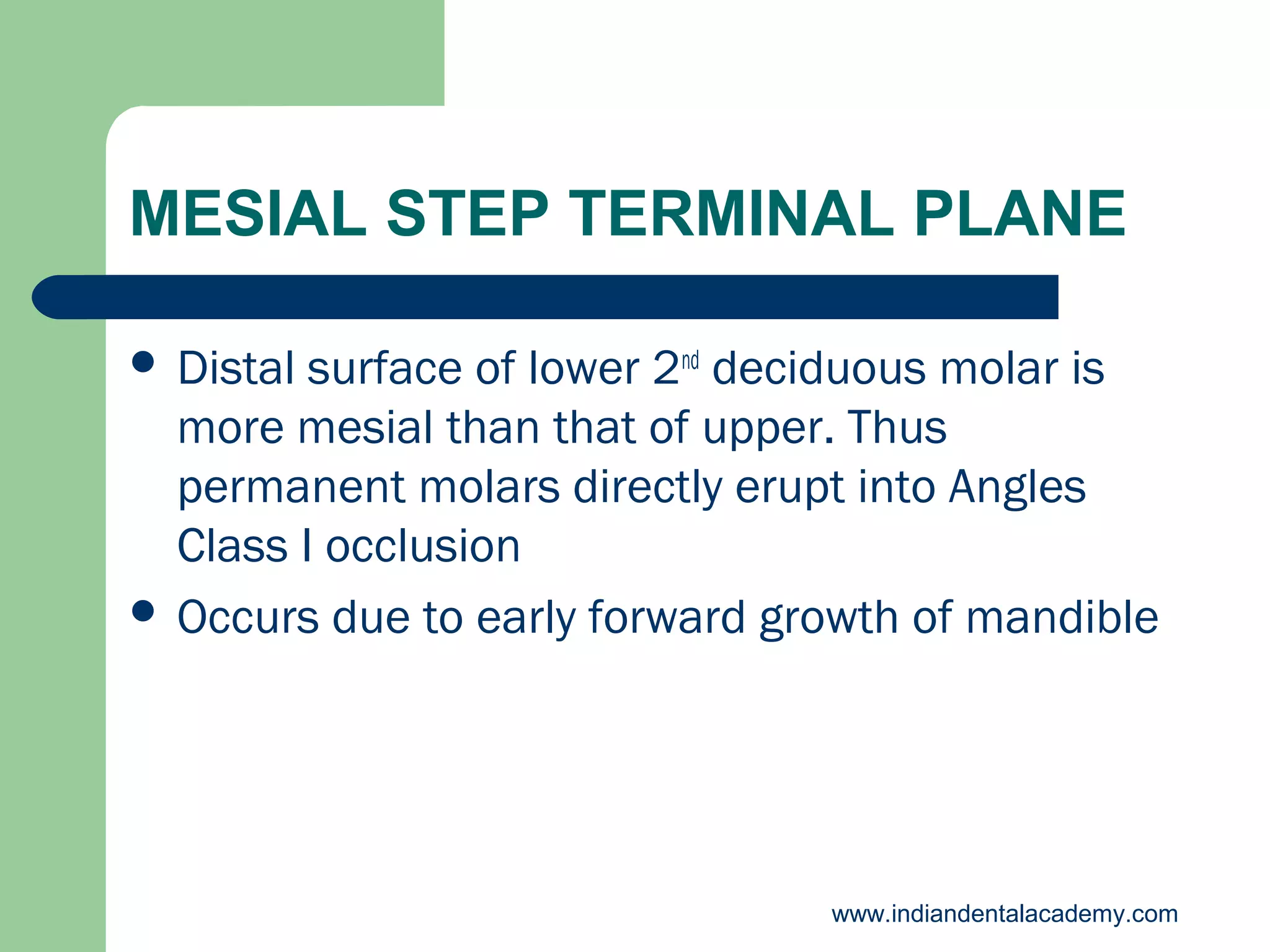
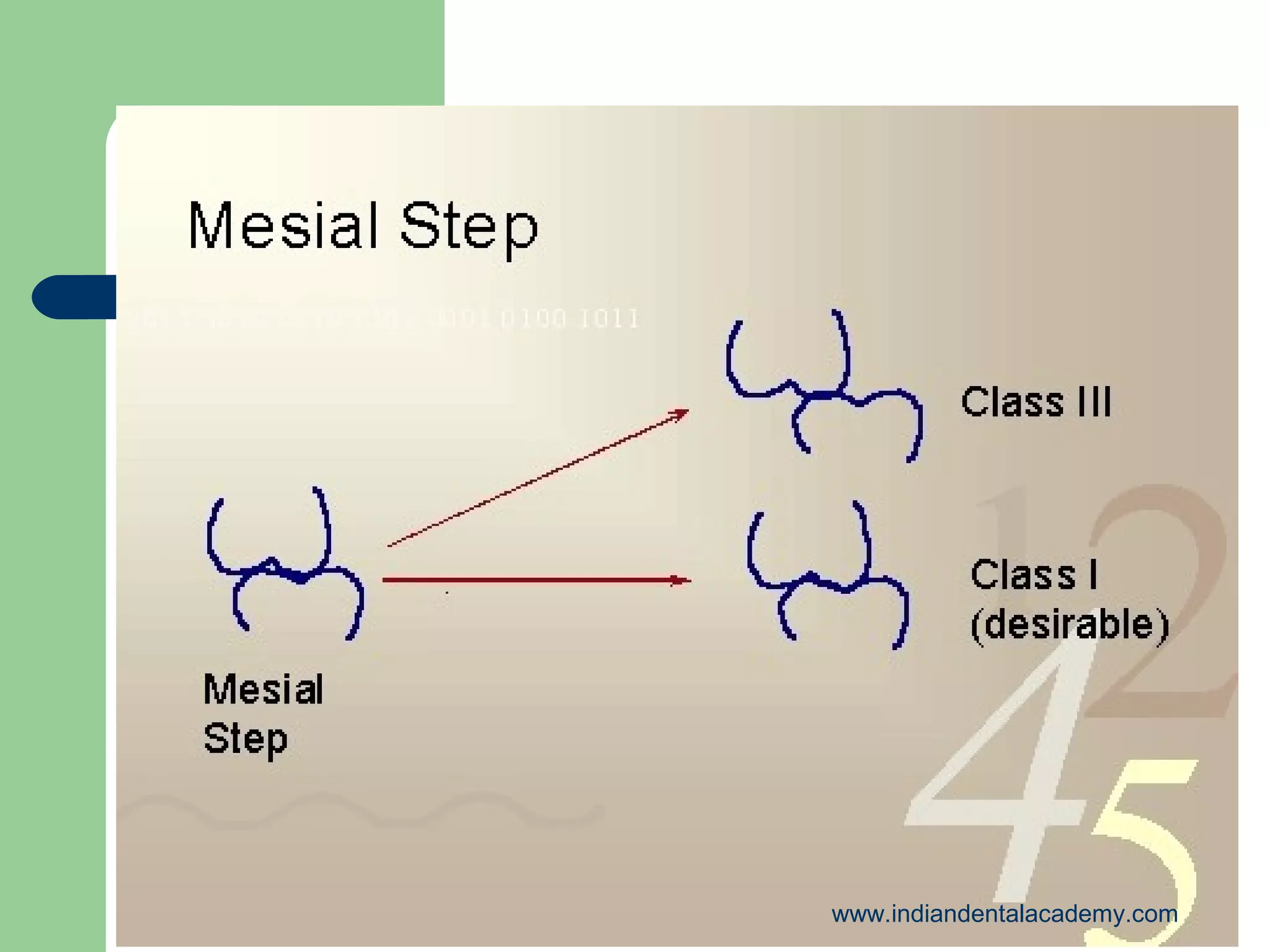
MESIAL STEP TERMINAL PLANE
 Distal

surface of lower 2nd deciduous molar is
more mesial than that of upper. Thus
permanent molars directly erupt into Angles
Class I occlusion
 Occurs due to early forward growth of mandible

www.indiandentalacademy.com
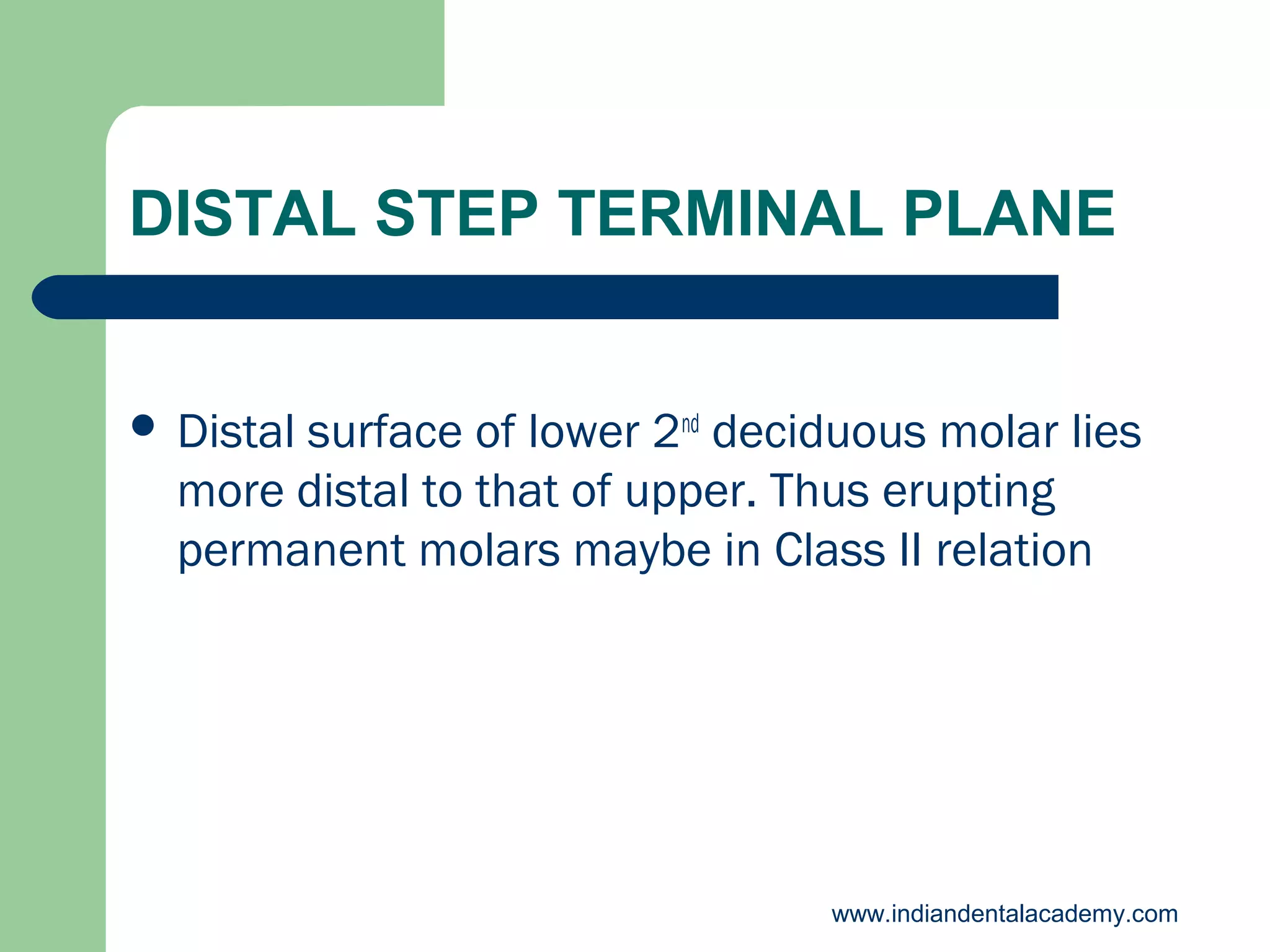
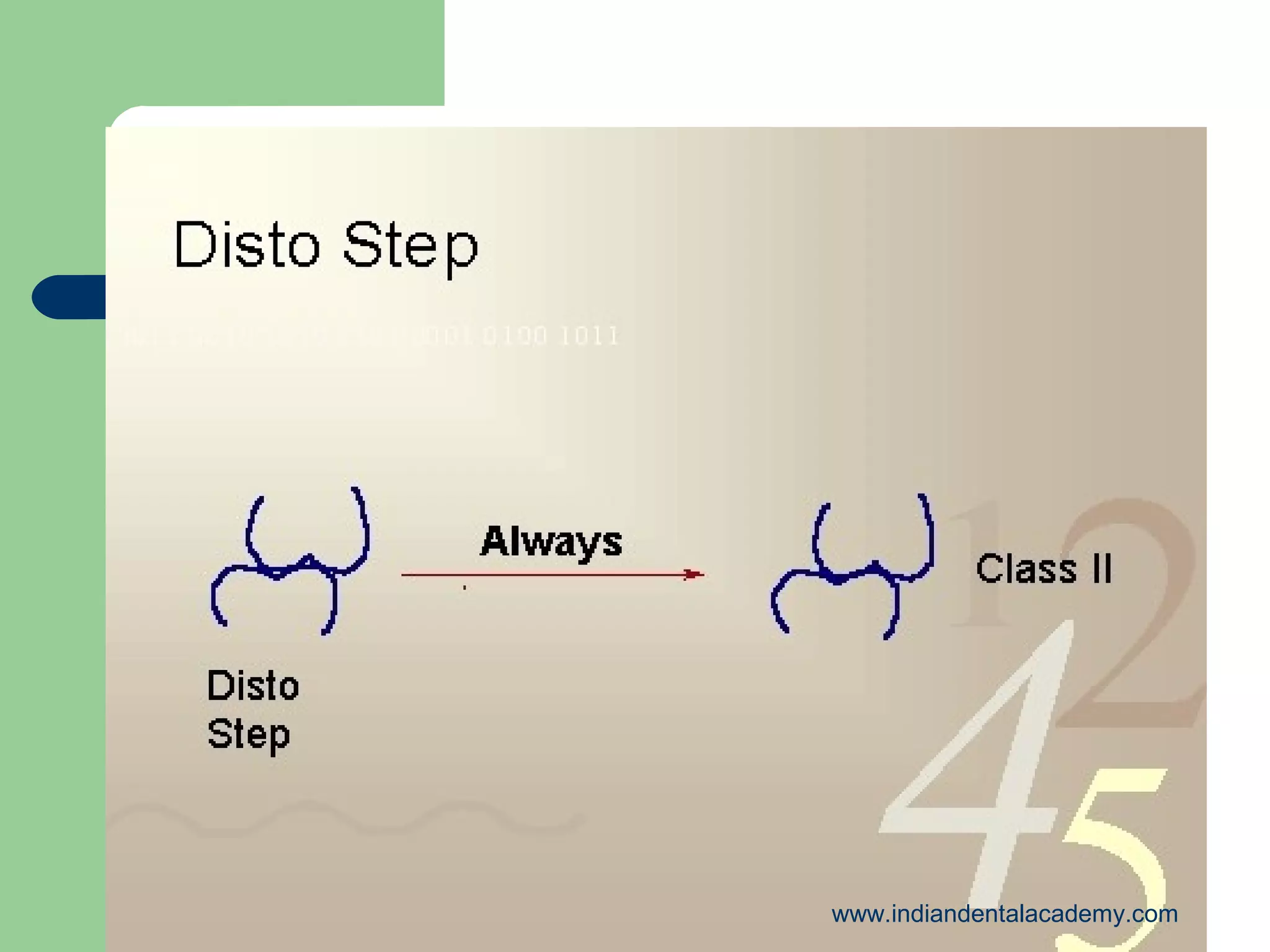
DISTAL STEP TERMINAL PLANE
 Distal

surface of lower 2nd deciduous molar lies
more distal to that of upper. Thus erupting
permanent molars maybe in Class II relation

www.indiandentalacademy.com
INCISAL LIABILITY
 The

exchange of lower incisors take place. The
difference between the amount of space
needed for the accomodation of incisors and
the space available for this →incisal liability
 It is roughly 7mm in upper arch and 5 mm in
lower arch

www.indiandentalacademy.com
Incisal liability
Overcome by the following factors:
1. Utilization of interdental spaces seen in
primary dentition
2. Increase in inter- canine width
3. Change in incisor inclination

www.indiandentalacademy.com
INTER TRANSITIONAL PERIOD
 Maxillary

and mandibular arches consists of
sets of deciduous and permanent teeth
 Between permanent incisors and permanent
1st molars are deciduous canines and molars
 This phase during mixed dentition stage is
relatively stable and no change occurs

www.indiandentalacademy.com
SECOND TRANSITIONAL PERIOD
 Replacement

of deciduous molars and
canines by premolars and permanent
cuspids respectively

www.indiandentalacademy.com
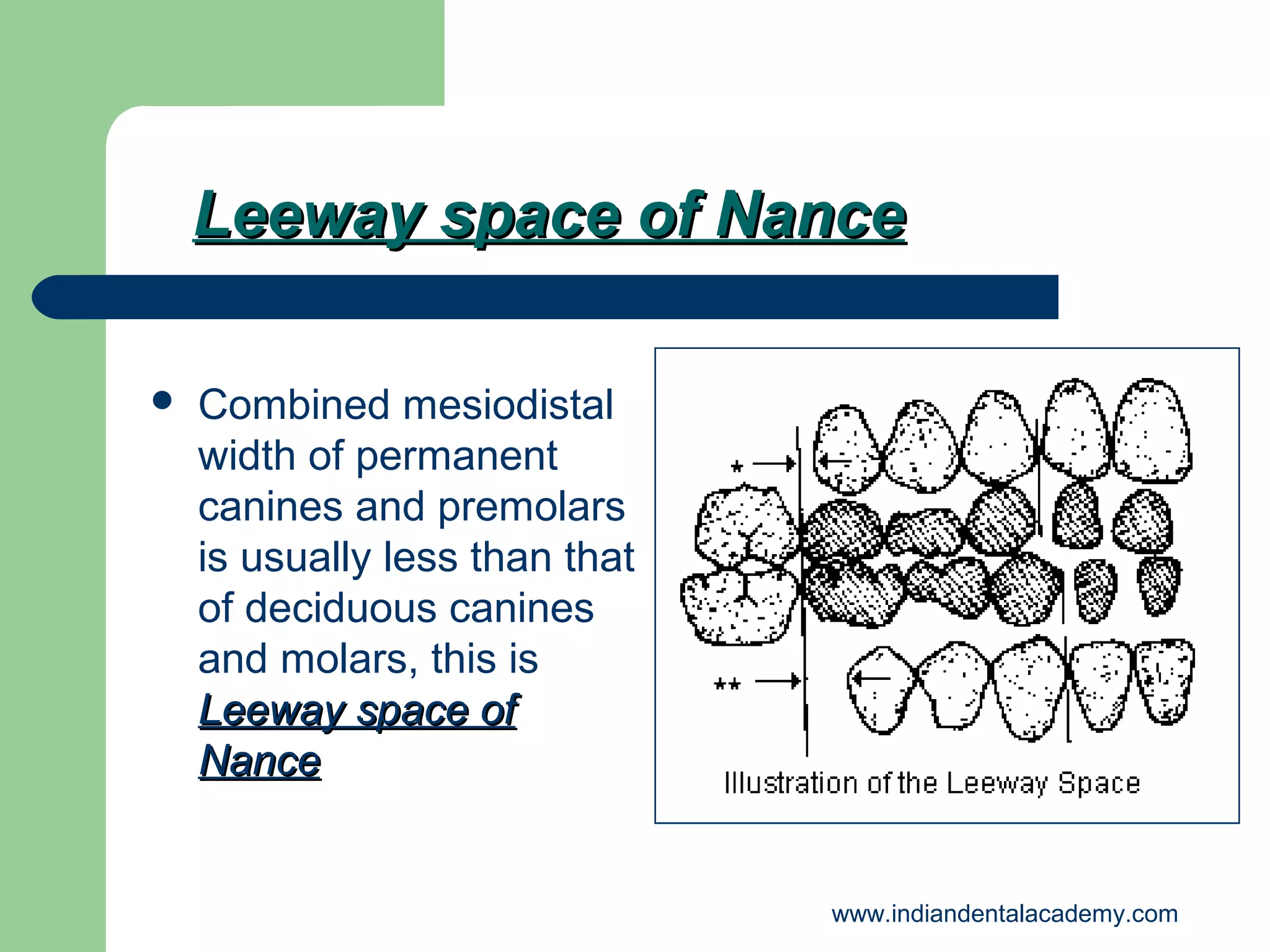
Leeway space of Nance


Combined mesiodistal
width of permanent
canines and premolars
is usually less than that
of deciduous canines
and molars, this is
Leeway space of
Nance

www.indiandentalacademy.com
Leeway space of Nance




Greater in mandibular
arch [3.4mm] than in
maxillary arch [1.8mm]
This excess space is
utilized for mesial drift
of mandibular molars to
establish Class I molar
relation

www.indiandentalacademy.com
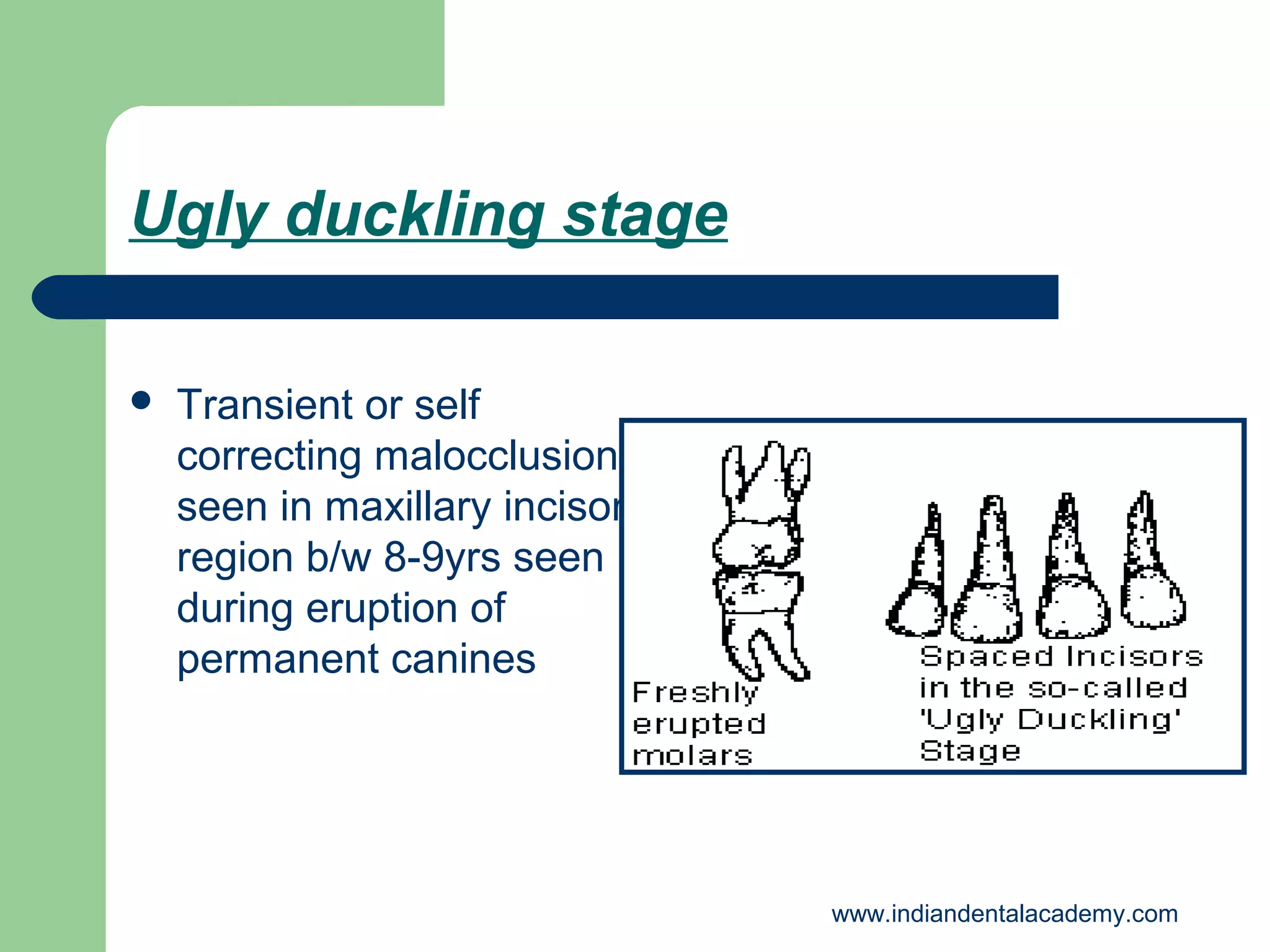
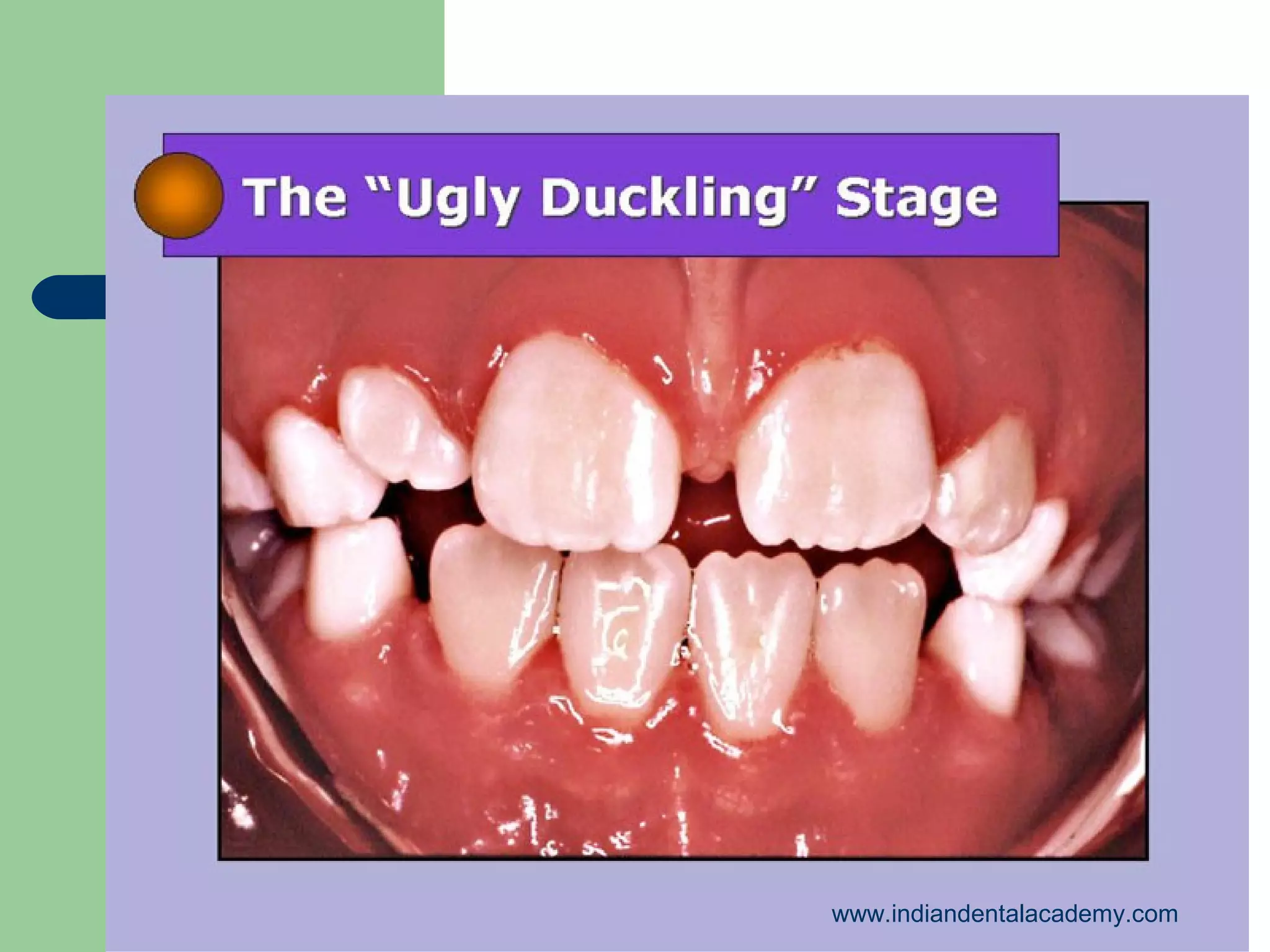
Ugly duckling stage


Transient or self
correcting malocclusion
seen in maxillary incisor
region b/w 8-9yrs seen
during eruption of
permanent canines

www.indiandentalacademy.com


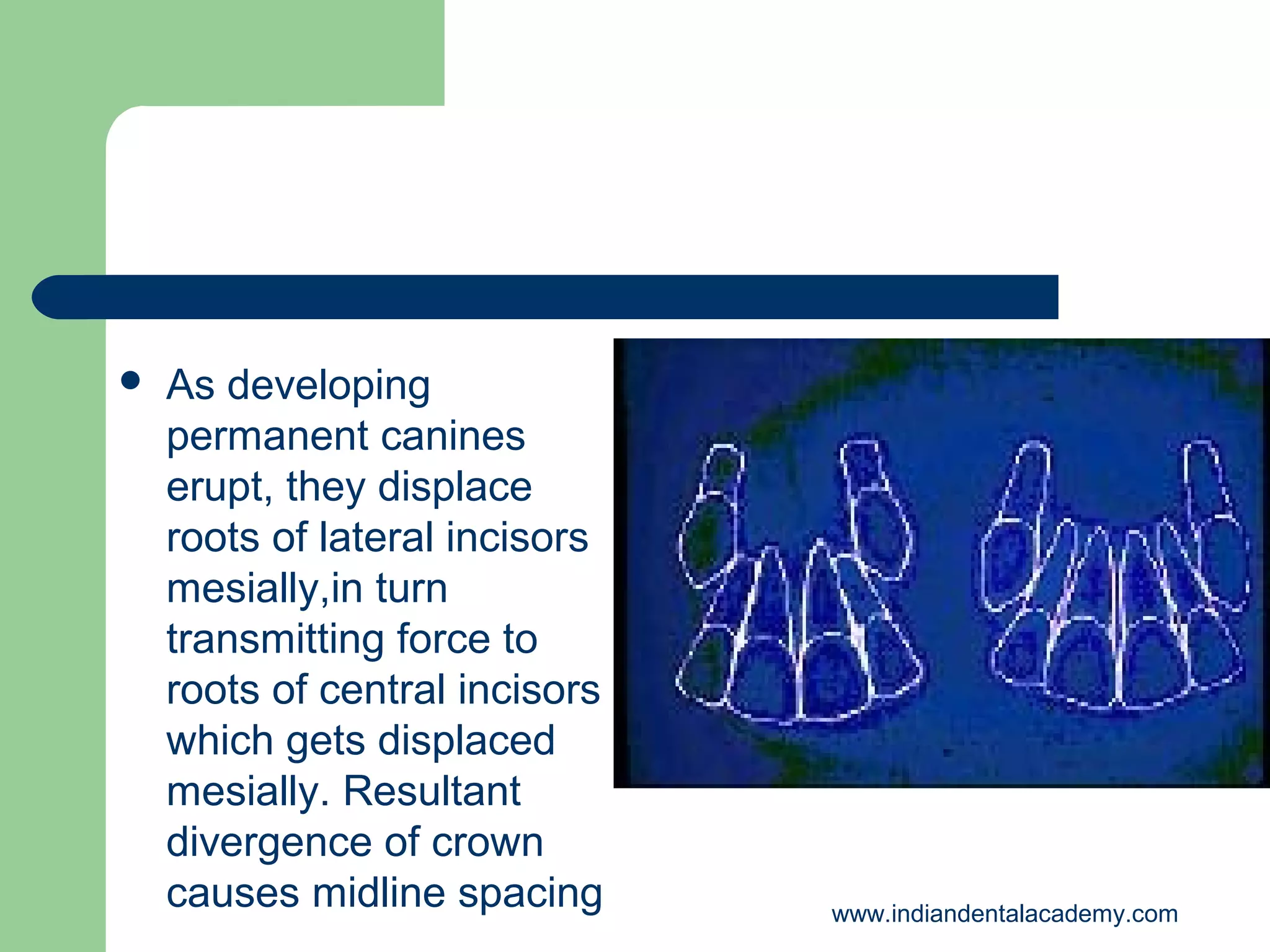
As developing
permanent canines
erupt, they displace
roots of lateral incisors
mesially,in turn
transmitting force to
roots of central incisors
which gets displaced
mesially. Resultant
divergence of crown
causes midline spacing

www.indiandentalacademy.com


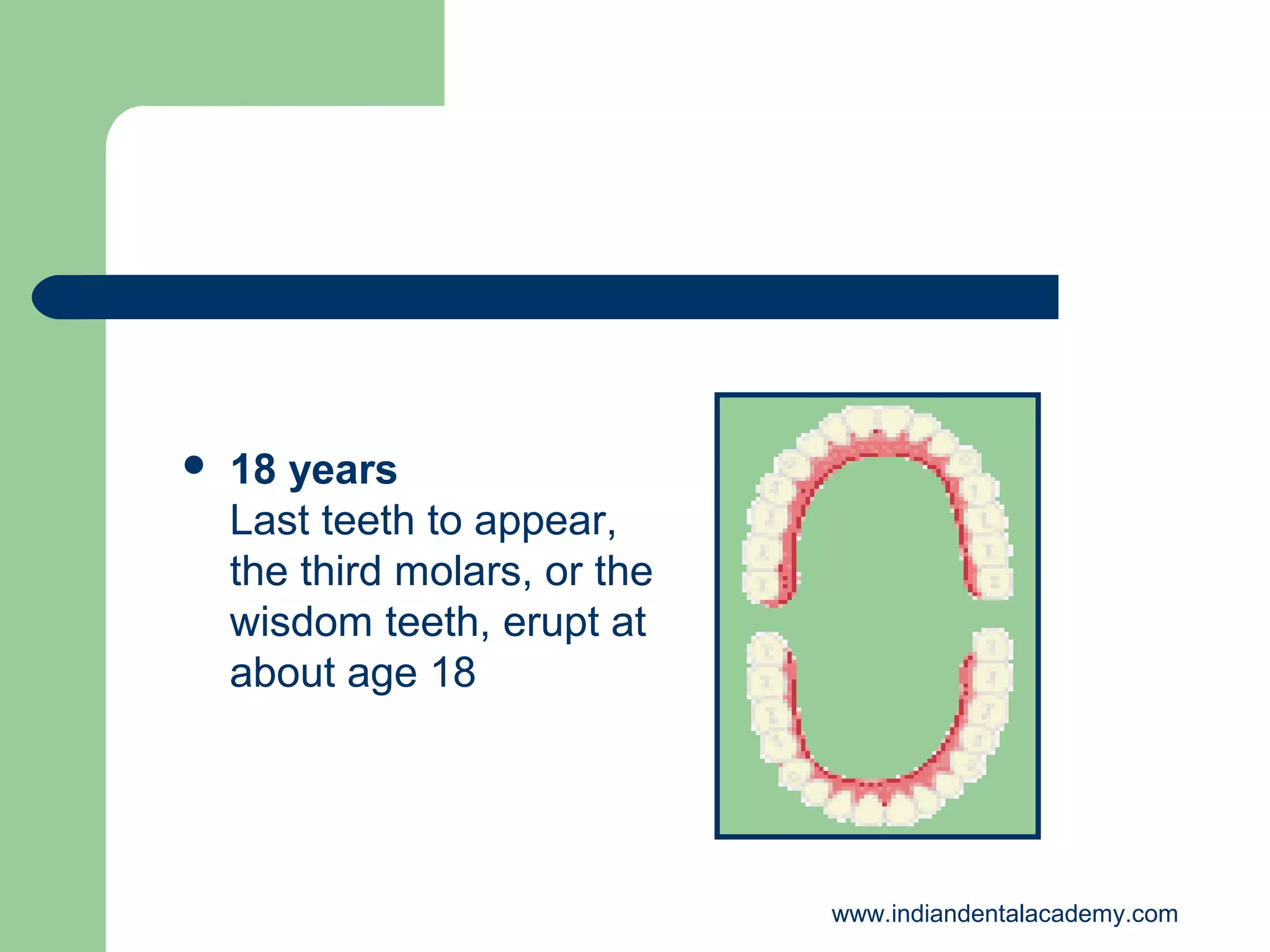
18 years
Last teeth to appear,
the third molars, or the
wisdom teeth, erupt at
about age 18

www.indiandentalacademy.com
THANK YOU
www.indiandentalacademy.com
Leader in continuing dental education

www.indiandentalacademy.com

Development of dentition & occlusion /certified fixed orthodontic courses by Indian dental academy

  • 1.
  • 2.
    INDIAN DENTAL ACADEMY Leaderin continuing dental education www.indiandentalacademy.com www.indiandentalacademy.com
  • 3.
    DEVELOPMENT OF DENTITION INTRODUCTION Embryonic cavity is lined by oral ectoderm  6th week of intra uterine life(IUL) →local proliferation of oral ectoderm →formation of dental lamina  Deciduous teeth →direct proliferation of dental lamina  Permanent teeth →lingual extension of dental lamina  Permanent molars →distal proliferation of dental lamina www.indiandentalacademy.com
  • 4.
    DEVELOPMENT OF TEETH Bud stage Capstage Bell stage Root formation www.indiandentalacademy.com
  • 5.
  • 6.
  • 7.
  • 8.
  • 9.
    PERIODS OF OCCLUSALDEVELOPMENT 1. 2. 3. 4. Pre-dental period Deciduous dentition period Mixed dentition Permanent dentition period www.indiandentalacademy.com
  • 10.
    PRE-DENTAL PERIOD  Period afterbirth during which neonate does not have teeth  Lasts 6 months after birth www.indiandentalacademy.com
  • 11.
    Gum pads    1. 2.    Alveolar processesat the time of birth Firm,pink,horse shoe shaped,covered by fibrous periosteum Develops in two parts Labiobuccal portion Lingual portion Both portions separated by dental groove Gum pads are divided into 10 segments by transverse grooves Each segment has one developing deciduous tooth sac www.indiandentalacademy.com
  • 12.
     lateral sulcus: transverse groove betweencanine and first deciduous molar segment.  Useful in judging inter arch relationship at a very early stage.  Lateral sulcus of mandibular arch is more distal to that of maxillary arch www.indiandentalacademy.com
  • 13.
     birth At birth, noteeth are visible. Primary teeth are at least partially formed and development of permanent teeth has begun. www.indiandentalacademy.com
  • 14.
    Infantile open bite      Upperand lower gum pads are similar to each other Upper gum pad is longer and wider When both are approximated, there is a complete overjet all around Contact occurs between upper and lower gum pads in first molar region and space exists in anterior region This infantile open bite is considered normal and helps in suckling www.indiandentalacademy.com
  • 15.
    STATUS OF DENTITION Neonate is without teeth for 6 months of life.  Gum pads insufficient to accommodate developing incisors that are crowded in crypts  1st yr of life →gum pads grow rapidly permitting incisors to erupt in good alignment. www.indiandentalacademy.com
  • 16.
  • 17.
    NATAL TEETH   Teeth eruptedat the time of birth →natal teeth Teeth erupted during 1st month of life →neonatal teeth www.indiandentalacademy.com
  • 18.
     Natal and neonatalteeth mostly in mandibular incisor region and show familial tendencies www.indiandentalacademy.com
  • 19.
    DECIDUOUS DENTITION PERIOD 1st 6 weeks of IUL →initiation of tooth buds  Primary teeth erupt at about 6 months  Eruption completed by 2 ½-3 ½ yrs  Sequence of eruption →A-B-D-C-E www.indiandentalacademy.com
  • 20.
     6 months At sixmonths, the four central incisors are visible, usually appearing two at a time and appearing in the lower jaw first www.indiandentalacademy.com
  • 21.
     7-8 months At sevenor eight months, the four lateral incisors appear next to the central incisors. The primary teeth are bluish white. www.indiandentalacademy.com
  • 22.
     12 months At aroundtwelve months, the primary first molars appear, leaving temporary spaces between them and the lateral incisors www.indiandentalacademy.com
  • 23.
     16 months At sixteenmonths, the primary canines erupt between the lateral incisors and first molars. www.indiandentalacademy.com
  • 24.
     2 years At twoyears, the second primary molars begin to appear, completing the primary teeth. By age three, they appear completely www.indiandentalacademy.com
  • 25.
    SPACING IN DECIDUOUSDENTITION  Spaces usually exist between deciduous teeth →physiological or developmental spaces  Important for normal development of 2°dentition  Absence of spaces is an indication that crowding of teeth may occur in 2°dentition www.indiandentalacademy.com
  • 26.
    Primate spaces    Also calledas simian or anthropoid spaces Seen mesial to maxillary canines and distal to mandibular canines Helps in placement of canine cusps of opposing arch www.indiandentalacademy.com
  • 27.
    Deep bite     May occurin initial developing stages Accentuated by the fact that deciduous incisors are more upright Lower incisal edges often contact cingulum area of maxillary incisors Later reduced by 1. Eruption of deciduous molars 2. Attrition of incisors 3. Forward growth of mandible www.indiandentalacademy.com
  • 28.
  • 29.
    Flush terminal plane Mesiodistal relation between distal surfaces of upper and lower 2nd deciduous molars is called as flush terminal plane  Normal feature of deciduous dentition where second deciduous molars are in same vertical plane www.indiandentalacademy.com
  • 30.
    MIXED DENTITION PERIOD  1. 2. 3. Beginsat approximately 6yrs.Classified into: 1st transitional period Inter transitional period 2nd transitional period www.indiandentalacademy.com
  • 31.
    FIRST TRANSITIONAL PERIOD    1. 2. 3. Emergenceof 1st permanent molars and exchange of deciduous incisors with permanent incisors 1st permanent molar erupts at 6yrs-guided into the dental arch by distal surface of 2nd deciduous molar Mesiodistal relation between distal surfaces of upper and lower deciduous molars are of 3 types Flush terminal plane Mesial step terminal plane Distal step terminal plane www.indiandentalacademy.com
  • 32.
  • 33.
  • 34.
    FLUSH TERMINAL PLANE Mesiodistal relation between distal surfaces of upper and lower 2nd deciduous molars is called as flush terminal plane.  Normal feature of deciduous dentition where second deciduous molars are in same vertical plane. www.indiandentalacademy.com
  • 35.
  • 36.
     Erupting first molarsmay be in a flush or end on relation  For transition of such an end on molar to a Class I molar relation, lower molar has to move forward by about 3-5mm relative to upper molar  This can occur in 2 ways. By early shift or late shift www.indiandentalacademy.com
  • 37.
    EARLY SHIFT  Occursduring early mixed dentition period  Eruptive force of permanent molar pushes deciduous 1st and 2nd molars in the arch to close primate space and establishing Class I LATE SHIFT  Occurs during late mixed dentition period  In children who lack primate space, when the deciduous molars exfoliate the permanent 1st molars drift mesialy utilizing leeway space. www.indiandentalacademy.com
  • 38.
    MESIAL STEP TERMINALPLANE  Distal surface of lower 2nd deciduous molar is more mesial than that of upper. Thus permanent molars directly erupt into Angles Class I occlusion  Occurs due to early forward growth of mandible www.indiandentalacademy.com
  • 39.
  • 40.
    DISTAL STEP TERMINALPLANE  Distal surface of lower 2nd deciduous molar lies more distal to that of upper. Thus erupting permanent molars maybe in Class II relation www.indiandentalacademy.com
  • 41.
  • 42.
    INCISAL LIABILITY  The exchangeof lower incisors take place. The difference between the amount of space needed for the accomodation of incisors and the space available for this →incisal liability  It is roughly 7mm in upper arch and 5 mm in lower arch www.indiandentalacademy.com
  • 43.
    Incisal liability Overcome bythe following factors: 1. Utilization of interdental spaces seen in primary dentition 2. Increase in inter- canine width 3. Change in incisor inclination www.indiandentalacademy.com
  • 44.
    INTER TRANSITIONAL PERIOD Maxillary and mandibular arches consists of sets of deciduous and permanent teeth  Between permanent incisors and permanent 1st molars are deciduous canines and molars  This phase during mixed dentition stage is relatively stable and no change occurs www.indiandentalacademy.com
  • 45.
    SECOND TRANSITIONAL PERIOD Replacement of deciduous molars and canines by premolars and permanent cuspids respectively www.indiandentalacademy.com
  • 46.
    Leeway space ofNance  Combined mesiodistal width of permanent canines and premolars is usually less than that of deciduous canines and molars, this is Leeway space of Nance www.indiandentalacademy.com
  • 47.
    Leeway space ofNance   Greater in mandibular arch [3.4mm] than in maxillary arch [1.8mm] This excess space is utilized for mesial drift of mandibular molars to establish Class I molar relation www.indiandentalacademy.com
  • 48.
    Ugly duckling stage  Transientor self correcting malocclusion seen in maxillary incisor region b/w 8-9yrs seen during eruption of permanent canines www.indiandentalacademy.com
  • 49.
     As developing permanent canines erupt,they displace roots of lateral incisors mesially,in turn transmitting force to roots of central incisors which gets displaced mesially. Resultant divergence of crown causes midline spacing www.indiandentalacademy.com
  • 50.
  • 51.
  • 52.
     18 years Last teethto appear, the third molars, or the wisdom teeth, erupt at about age 18 www.indiandentalacademy.com
  • 53.
    THANK YOU www.indiandentalacademy.com Leader incontinuing dental education www.indiandentalacademy.com