MIXED DENTITION
NAILA SUNBAL
PGR ORTHODONTIC DEPARTMENT
PESHAWAR DENTAL COLLEGE
CONTENT
 Introduction to mixed dentition
 Primary dentition
 Permanent dentition
 Phases of mixed dentition.
Mixed Dentition
 The period in which both primary and permanent teeth are present
in the oral cavity.
 Usually present between age 6 to 12 years.
 when some of the primary teeth are being replaced by permanent
teeth,
starts with the eruption of the first permanent tooth.
Eruption Sequence of primary teeth
 First primary teeth erupt approximately at 6 months of age,
up to 6 months of acceleration or delay is within normal range.
 Mandibular centrals erupt first followed by other incisors.
 After 3 to 4 month interval the mandibular and maxillary first
molars erupt.
 Followed in another 3 to 4 months interval canine erupt.
 Primary dentition usually completed at the age of 24th to 30th
month as the mandibular then maxillary 2nd molars erupt.
Features of primary dentition
Duration 6th month to 12 1/2 years.
Generalize spacing proper alignment of permanent
teeth.
Primate spaces.
20 in numbers (2 incisors ,1 canine ,2 molars).
Shorter crown sizes in relation to pulp chamber.
No mamelons.
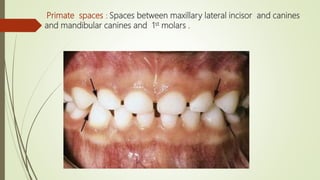
Primate spaces : Spaces between maxillary lateral incisor and canines
and mandibular canines and 1st molars .
 Primary dentition may be type I dentition (spaced
dentition) or
 Type II dentition (closed dentition) also called as
Hollywood smile normally leads to future crowding
 Shallow overjet & overbite
 Flush terminal plane is a normal feature.
 Ovoid arch forms.
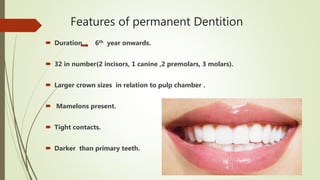
Features of permanent Dentition
 Duration 6th year onwards.
 32 in number(2 incisors, 1 canine ,2 premolars, 3 molars).
 Larger crown sizes in relation to pulp chamber .
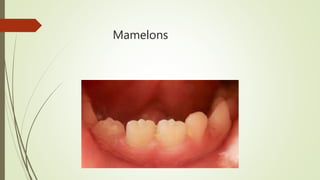
 Mamelons present.
 Tight contacts.
 Darker than primary teeth.
Mamelons
Eruption sequence of permanent teeth
 Teeth erupt in groups, mandibular first followed by maxillary.
 A tooth usually emerges when about three-fourth of its root has been completed.
 It takes 2 to 3 years for root to be completed after a tooth has been erupted into
occlusion .
 Most common sequence is mandibular central incisors at age 6¼
 Closely followed by permanent mandibular first molar and maxillary first molar.
 The beginning of eruption of this group of teeth characterizes dental age 6.
Eruption sequence of permanent teeth
 Dental Age 7 maxillary central incisors and mandibular lateral incisors.
 Dental Age 8 maxillary lateral incisors after this there is delay of 2 to 3
years.
 At dental age 9 primary canines, 1st and 2nd molars are present in
mouth.
 At dental Age 11 eruption of mandibular canines ,mandibular first
premolars and maxillary first premolars.
 At dental age 12 maxillary canines and maxillary and mandibular 2nd
premolars.
 A few months later maxillary and mandibular 2nd molars.
Normal variation in eruption sequence
 Eruption of 2nd molars ahead of premolars in mandibular
arch.
 Eruption of canines ahead of premolars in maxillary arch.
 Unusually large asymmetries in eruption between right
and left side.
Phases of mixed Dentition
 First transitional period
 Inter transitional period
 Second transitional period
1st Transitional period
 6 to 8 years .
 Eruption of 1st permanent molars and the exchange of the deciduous
incisors with the permanent incisors.
 The 1st permanent molars are guided into the arch by distal surface 2nd
deciduous molars.
 The mesiodistal relationship between the distal surfaces of upper and
lower 2nd deciduous molars are of three types.
1: Flush terminal plane
2: Mesial step
3: Distal step
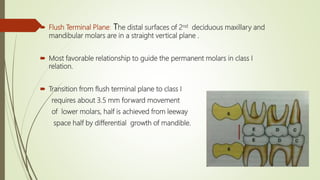
 Flush Terminal Plane: The distal surfaces of 2nd deciduous maxillary and
mandibular molars are in a straight vertical plane .
 Most favorable relationship to guide the permanent molars in class I
relation.
 Transition from flush terminal plane to class I
requires about 3.5 mm forward movement
of lower molars, half is achieved from leeway
space half by differential growth of mandible.
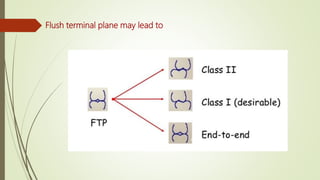
Flush terminal plane may lead to
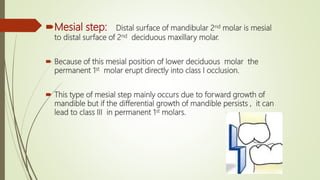
Mesial step: Distal surface of mandibular 2nd molar is mesial
to distal surface of 2nd deciduous maxillary molar.
 Because of this mesial position of lower deciduous molar the
permanent 1st molar erupt directly into class I occlusion.
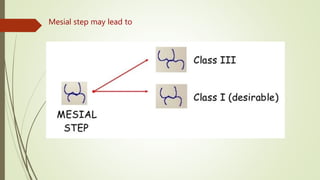
 This type of mesial step mainly occurs due to forward growth of
mandible but if the differential growth of mandible persists , it can
lead to class III in permanent 1st molars.
Mesial step may lead to
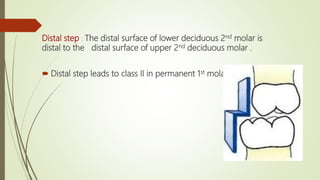
Distal step : The distal surface of lower deciduous 2nd molar is
distal to the distal surface of upper 2nd deciduous molar .
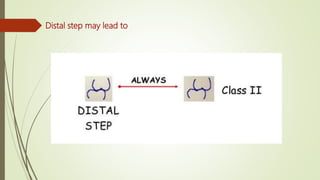
 Distal step leads to class II in permanent 1st molars .
Distal step may lead to
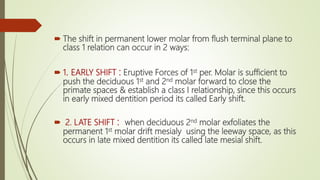
 The shift in permanent lower molar from flush terminal plane to
class 1 relation can occur in 2 ways:
 1. EARLY SHIFT : Eruptive Forces of 1st per. Molar is sufficient to
push the deciduous 1st and 2nd molar forward to close the
primate spaces & establish a class I relationship, since this occurs
in early mixed dentition period its called Early shift.
 2. LATE SHIFT : when deciduous 2nd molar exfoliates the
permanent 1st molar drift mesialy using the leeway space, as this
occurs in late mixed dentition its called late mesial shift.
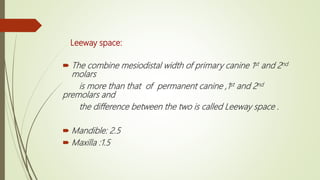
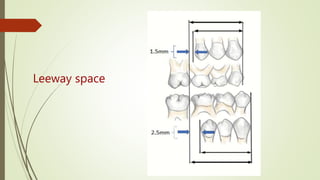
Leeway space:
 The combine mesiodistal width of primary canine 1st and 2nd
molars
is more than that of permanent canine ,1st and 2nd
premolars and
the difference between the two is called Leeway space .
 Mandible: 2.5
 Maxilla :1.5
Leeway space
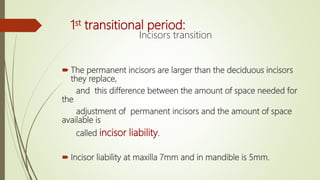
1st transitional period:
Incisors transition
 The permanent incisors are larger than the deciduous incisors
they replace,
and this difference between the amount of space needed for
the
adjustment of permanent incisors and the amount of space
available is
called incisor liability.
 Incisor liability at maxilla 7mm and in mandible is 5mm.
 Incisal liability is overcome by
1: Utilization of primate spaces present in primary
dentition.
2: Increase in dental arch width across the canine adds 1
to 2mm.
3: Labial position and inclined permanent incisors adds
up to 2mm
Inter-transitional phase
 8 to 10 years.
 This is stable phase during the mixed dentition stage and
no change occurs during inter-transitional phase.
 Teeth present are permanent incisors 1st molars and
deciduous canines 1st and 2nd molars.
 Last about 1.5 to 2 years.
2nd Transitional stage :
 10 to 12 years.
 Replacement of deciduous molars and canines by the premolars and
permanent canines
 2nd permanent molars erupt.
 Eruption of all permanent teeth occur except 3rd molars.
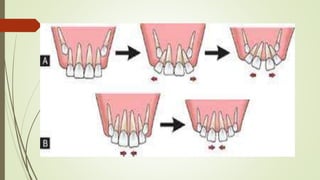
Ugly duckling stage
 Also called physiological diastema or Broadbents’ phenomena
 Occurs at 8 to 11 years
 This stage occurs before eruption of permanent canine.
 When cuspids are erupting they displaced the roots of lateral incisors mesial
transmitting force on the central incisors distally creating a midline diastema .
 Corrects by itself when canines erupt.
 Upto 2mm of diastema is self correcting ,further than that requires mx.
 Describes by Broadbents as ugly duckling as child looks ugly during this phase.
Thank you

Mixed dention ppt

  • 2.
    MIXED DENTITION NAILA SUNBAL PGRORTHODONTIC DEPARTMENT PESHAWAR DENTAL COLLEGE
  • 3.
    CONTENT  Introduction tomixed dentition  Primary dentition  Permanent dentition  Phases of mixed dentition.
  • 4.
    Mixed Dentition  Theperiod in which both primary and permanent teeth are present in the oral cavity.  Usually present between age 6 to 12 years.  when some of the primary teeth are being replaced by permanent teeth, starts with the eruption of the first permanent tooth.
  • 5.
    Eruption Sequence ofprimary teeth  First primary teeth erupt approximately at 6 months of age, up to 6 months of acceleration or delay is within normal range.  Mandibular centrals erupt first followed by other incisors.  After 3 to 4 month interval the mandibular and maxillary first molars erupt.  Followed in another 3 to 4 months interval canine erupt.  Primary dentition usually completed at the age of 24th to 30th month as the mandibular then maxillary 2nd molars erupt.
  • 6.
    Features of primarydentition Duration 6th month to 12 1/2 years. Generalize spacing proper alignment of permanent teeth. Primate spaces. 20 in numbers (2 incisors ,1 canine ,2 molars). Shorter crown sizes in relation to pulp chamber. No mamelons.
  • 7.
    Primate spaces :Spaces between maxillary lateral incisor and canines and mandibular canines and 1st molars .
  • 8.
     Primary dentitionmay be type I dentition (spaced dentition) or  Type II dentition (closed dentition) also called as Hollywood smile normally leads to future crowding  Shallow overjet & overbite  Flush terminal plane is a normal feature.  Ovoid arch forms.
  • 9.
    Features of permanentDentition  Duration 6th year onwards.  32 in number(2 incisors, 1 canine ,2 premolars, 3 molars).  Larger crown sizes in relation to pulp chamber .  Mamelons present.  Tight contacts.  Darker than primary teeth.
  • 10.
  • 11.
    Eruption sequence ofpermanent teeth  Teeth erupt in groups, mandibular first followed by maxillary.  A tooth usually emerges when about three-fourth of its root has been completed.  It takes 2 to 3 years for root to be completed after a tooth has been erupted into occlusion .  Most common sequence is mandibular central incisors at age 6¼  Closely followed by permanent mandibular first molar and maxillary first molar.  The beginning of eruption of this group of teeth characterizes dental age 6.
  • 12.
    Eruption sequence ofpermanent teeth  Dental Age 7 maxillary central incisors and mandibular lateral incisors.  Dental Age 8 maxillary lateral incisors after this there is delay of 2 to 3 years.  At dental age 9 primary canines, 1st and 2nd molars are present in mouth.  At dental Age 11 eruption of mandibular canines ,mandibular first premolars and maxillary first premolars.  At dental age 12 maxillary canines and maxillary and mandibular 2nd premolars.  A few months later maxillary and mandibular 2nd molars.
  • 13.
    Normal variation ineruption sequence  Eruption of 2nd molars ahead of premolars in mandibular arch.  Eruption of canines ahead of premolars in maxillary arch.  Unusually large asymmetries in eruption between right and left side.
  • 14.
    Phases of mixedDentition  First transitional period  Inter transitional period  Second transitional period
  • 15.
    1st Transitional period 6 to 8 years .  Eruption of 1st permanent molars and the exchange of the deciduous incisors with the permanent incisors.  The 1st permanent molars are guided into the arch by distal surface 2nd deciduous molars.  The mesiodistal relationship between the distal surfaces of upper and lower 2nd deciduous molars are of three types. 1: Flush terminal plane 2: Mesial step 3: Distal step
  • 16.
     Flush TerminalPlane: The distal surfaces of 2nd deciduous maxillary and mandibular molars are in a straight vertical plane .  Most favorable relationship to guide the permanent molars in class I relation.  Transition from flush terminal plane to class I requires about 3.5 mm forward movement of lower molars, half is achieved from leeway space half by differential growth of mandible.
  • 17.
  • 18.
    Mesial step: Distalsurface of mandibular 2nd molar is mesial to distal surface of 2nd deciduous maxillary molar.  Because of this mesial position of lower deciduous molar the permanent 1st molar erupt directly into class I occlusion.  This type of mesial step mainly occurs due to forward growth of mandible but if the differential growth of mandible persists , it can lead to class III in permanent 1st molars.
  • 19.
  • 20.
    Distal step :The distal surface of lower deciduous 2nd molar is distal to the distal surface of upper 2nd deciduous molar .  Distal step leads to class II in permanent 1st molars .
  • 21.
  • 22.
     The shiftin permanent lower molar from flush terminal plane to class 1 relation can occur in 2 ways:  1. EARLY SHIFT : Eruptive Forces of 1st per. Molar is sufficient to push the deciduous 1st and 2nd molar forward to close the primate spaces & establish a class I relationship, since this occurs in early mixed dentition period its called Early shift.  2. LATE SHIFT : when deciduous 2nd molar exfoliates the permanent 1st molar drift mesialy using the leeway space, as this occurs in late mixed dentition its called late mesial shift.
  • 23.
    Leeway space:  Thecombine mesiodistal width of primary canine 1st and 2nd molars is more than that of permanent canine ,1st and 2nd premolars and the difference between the two is called Leeway space .  Mandible: 2.5  Maxilla :1.5
  • 24.
  • 25.
    1st transitional period: Incisorstransition  The permanent incisors are larger than the deciduous incisors they replace, and this difference between the amount of space needed for the adjustment of permanent incisors and the amount of space available is called incisor liability.  Incisor liability at maxilla 7mm and in mandible is 5mm.
  • 26.
     Incisal liabilityis overcome by 1: Utilization of primate spaces present in primary dentition. 2: Increase in dental arch width across the canine adds 1 to 2mm. 3: Labial position and inclined permanent incisors adds up to 2mm
  • 27.
    Inter-transitional phase  8to 10 years.  This is stable phase during the mixed dentition stage and no change occurs during inter-transitional phase.  Teeth present are permanent incisors 1st molars and deciduous canines 1st and 2nd molars.  Last about 1.5 to 2 years.
  • 28.
    2nd Transitional stage:  10 to 12 years.  Replacement of deciduous molars and canines by the premolars and permanent canines  2nd permanent molars erupt.  Eruption of all permanent teeth occur except 3rd molars.
  • 29.
    Ugly duckling stage Also called physiological diastema or Broadbents’ phenomena  Occurs at 8 to 11 years  This stage occurs before eruption of permanent canine.  When cuspids are erupting they displaced the roots of lateral incisors mesial transmitting force on the central incisors distally creating a midline diastema .  Corrects by itself when canines erupt.  Upto 2mm of diastema is self correcting ,further than that requires mx.  Describes by Broadbents as ugly duckling as child looks ugly during this phase.
  • 31.