

DESIGN
LEADERSHIP
FRAMEWORK
Going Beyond the Tip of the Iceberg
DESIGNACADEMY
When teams fail to develop products that customers
love, it’s typically not due to the usual suspects:
time, tools, or resources. The real problem is often
a lack of alignment. Creating that alignment starts
with building strong culture.
It’s a story we hear all too often. A company hires
great designers, then sits back and waits for the
magic to happen. But then it doesn’t.
Instead of solving problems, the new design team
and company leadership don’t seem to speak the
same language, projects stall while design and other
functions struggle to work together, and what
was supposed to be a step forward becomes an
unwelcome disruption that hurts morale.
But isn’t hiring a design team supposed
to make products better, not make
building them harder?
Isn’t there a way for companies to hire
designers and integrate them into
company culture without blowing
everything up?
Our Design Leadership
Framework can help.
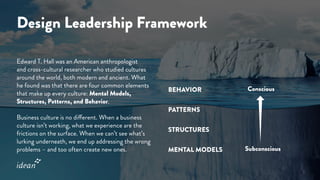
Design Leadership Framework
Conscious
Subconscious
BEHAVIOR
PATTERNS
STRUCTURES
MENTAL MODELS
Edward T. Hall was an American anthropologist
and cross-cultural researcher who studied cultures
around the world, both modern and ancient. What
he found was that there are four common elements
that make up every culture: Mental Models,
Structures, Patterns, and Behavior.
Business culture is no different. When a business
culture isn’t working, what we experience are the
frictions on the surface. When we can’t see what’s
lurking underneath, we end up addressing the wrong
problems – and too often create new ones.
When companies bring in a design
function or start integrating design across
departments, it will disrupt the company’s
cultural norms. If leaders don’t have a plan
for how to address that, the result is often
a lot of pain for the team.
For example, an engineering-driven
culture will have one set of mental
models, structures, and patterns in place.
A sales-driven culture will have another.
Depending on which culture is prevalent,
teams will have a different way of
thinking about things like how people are
incentivized and how they work together.
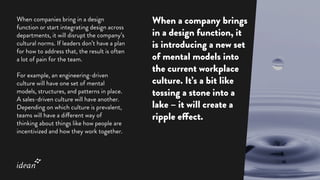
When a company brings
in a design function, it
is introducing a new set
of mental models into
the current workplace
culture. It’s a bit like
tossing a stone into a
lake – it will create a
ripple effect.
Right now there is a lot of talk in the design community about building design-driven or
design-led cultures. The problem with this is that switching from an engineering-driven
or sales-driven culture over to a design-driven culture won’t solve the problem.
Whatever changes happen, they need to be inclusive.
At Idean, the teams we’ve worked with that have successfully integrated design into their
existing culture do this well.
This kind of successful culture building is no accident. Leaders who do it well, do it
consciously. Our framework will help you think about how to make the ripple effect
positive.
BEHAVIOR
PATTERNS
STRUCTURES
MENTAL MODELS
PEOPLE
PLACES
PRACTICES
PRINCIPLES
PURPOSE
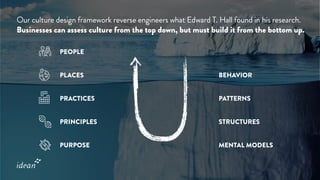
Our culture design framework reverse engineers what Edward T. Hall found in his research.
Businesses can assess culture from the top down, but must build it from the bottom up.
Our Leadership Intensive course at the Design Academy teaches executives and
leadership teams tools we use for the entire framework, but the first step of the
process is something anyone can start on their own: develop a shared group purpose.
Creating a shared purpose
Too many teams understand what they’re making
but not why they’re making it.
At a recent Idean Design Leadership workshop,
we asked 21 attendees to describe their teams’
purpose.
Only three attendees from
the for-profit sector could
name them.
That’s a problem.
Lack of alignment around purpose creates a
host of problems for teams. Everything from
debates over priorities, political battles between
stakeholders, inefficient production cycles, and
lackluster designs can mean products that fall
short of expectations.
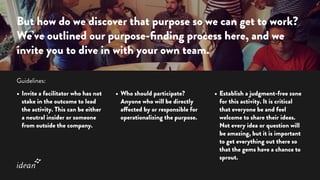
•	Invite a facilitator who has not
stake in the outcome to lead
the activity. This can be either
a neutral insider or someone
from outside the company.
•	Who should participate?
Anyone who will be directly
affected by or responsible for
operationalizing the purpose.
•	Establish a judgment-free zone
for this activity. It is critical
that everyone be and feel
welcome to share their ideas.
Not every idea or question will
be amazing, but it is important
to get everything out there so
that the gems have a chance to
sprout.
But how do we discover that purpose so we can get to work?
We’ve outlined our purpose-finding process here, and we
invite you to dive in with your own team.
Guidelines:
Build a Challenge Map
© Basadur Applied Creativity
A challenge map is a powerful experiential
tool that opens the floor for everyone to get
their thoughts out on the table. Through
building the map, teams identify what they
want to achieve, why they want to achieve it,
and what stands in their way.
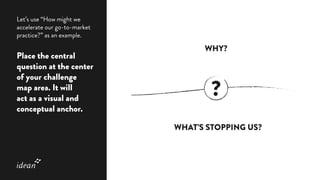
Let’s use “How might we
accelerate our go-to-market
practice?” as an example.
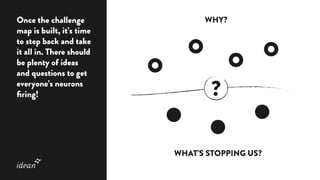
Place the central
question at the center
of your challenge
map area. It will
act as a visual and
conceptual anchor.
WHY?
WHAT’S STOPPING US?
?
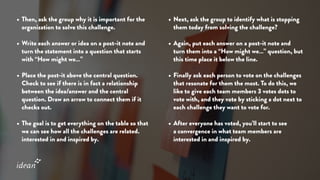
•	Then, ask the group why it is important for the
organization to solve this challenge.
•	Write each answer or idea on a post-it note and
turn the statement into a question that starts
with “How might we…”
•	Place the post-it above the central question.
Check to see if there is in fact a relationship
between the idea/answer and the central
question. Draw an arrow to connect them if it
checks out.
•	The goal is to get everything on the table so that
we can see how all the challenges are related.
interested in and inspired by.
•	Next, ask the group to identify what is stopping
them today from solving the challenge?
•	Again, put each answer on a post-it note and
turn them into a “How might we…” question, but
this time place it below the line.
•	Finally ask each person to vote on the challenges
that resonate for them the most. To do this, we
like to give each team members 3 votes dots to
vote with, and they vote by sticking a dot next to
each challenge they want to vote for.
•	After everyone has voted, you’ll start to see
a convergence in what team members are
interested in and inspired by.
?
Once the challenge
map is built, it’s time
to step back and take
it all in. There should
be plenty of ideas
and questions to get
everyone’s neurons
firing!
WHY?
WHAT’S STOPPING US?
Write individual
purpose statements.
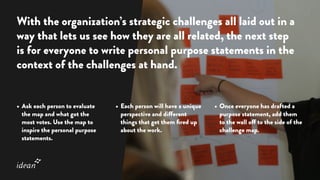
With the organization’s strategic challenges all laid out in a
way that lets us see how they are all related, the next step
is for everyone to write personal purpose statements in the
context of the challenges at hand.
•	Ask each person to evaluate
the map and what got the
most votes. Use the map to
inspire the personal purpose
statements.
•	Each person will have a unique
perspective and different
things that get them fired up
about the work.
•	Once everyone has drafted a
purpose statement, add them
to the wall off to the side of the
challenge map.
Share Personal
Purpose Statements
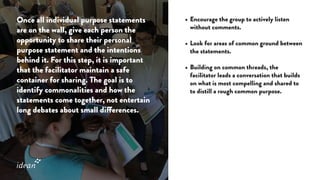
Once all individual purpose statements
are on the wall, give each person the
opportunity to share their personal
purpose statement and the intentions
behind it. For this step, it is important
that the facilitator maintain a safe
container for sharing. The goal is to
identify commonalities and how the
statements come together, not entertain
long debates about small differences.
•	Encourage the group to actively listen
without comments.
•	Look for areas of common ground between
the statements.
•	Building on common threads, the
facilitator leads a conversation that builds
on what is most compelling and shared to
to distill a rough common purpose.
Craft a Short, Memorable
Group Purpose Statement
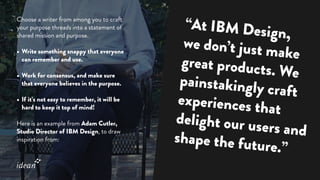
Choose a writer from among you to craft
your purpose threads into a statement of
shared mission and purpose.
•	Write something snappy that everyone
can remember and use.
•	Work for consensus, and make sure
that everyone believes in the purpose.
•	If it’s not easy to remember, it will be
hard to keep it top of mind!
Here is an example from Adam Cutler,
Studio Director of IBM Design, to draw
inspiration from:
“At IBM Design,
we don’t just make
great products. We
painstakingly craft
experiences that
delight our users andshape the future.”
Develop a Ritual
Rituals turn good ideas into habits and ways of doing great
work. What ritual you use isn’t as important as making sure that
you have a ritual you can stick to. The goal here is to incorporate
the purpose you just developed into how you frame your work on
a daily basis. Some examples of rituals could include:
•	Engage new employees to
do a personal challenge map
as part of their onboarding
experience. Revisit the shared
purpose statement and adjust
as necessary.
•	Tie your team’s use of purpose
into their professional
development plans.
•	Find a way for folks to get
creative and express the new
purpose through videos,
posters, visual stories on a
regular basis.
Defining your purpose is just the first step towards designing
a culture that sets your design team up for greater success.
Join us at the next Design Academy training to learn how
to work through the rest of our framework and get more
ready-to-use tools and frameworks to activate a stronger
design culture in your organization.
We love this stuff, and we love to collaborate and make it
better. If you want to chat with us, please reach out!
academy@idean.com
DESIGNACADEMY

Idean-Design-Leadership-Framework

  • 1.
    DESIGN LEADERSHIP FRAMEWORK Going Beyond theTip of the Iceberg DESIGNACADEMY
  • 2.
    When teams failto develop products that customers love, it’s typically not due to the usual suspects: time, tools, or resources. The real problem is often a lack of alignment. Creating that alignment starts with building strong culture. It’s a story we hear all too often. A company hires great designers, then sits back and waits for the magic to happen. But then it doesn’t. Instead of solving problems, the new design team and company leadership don’t seem to speak the same language, projects stall while design and other functions struggle to work together, and what was supposed to be a step forward becomes an unwelcome disruption that hurts morale. But isn’t hiring a design team supposed to make products better, not make building them harder? Isn’t there a way for companies to hire designers and integrate them into company culture without blowing everything up? Our Design Leadership Framework can help.
  • 3.
    Design Leadership Framework Conscious Subconscious BEHAVIOR PATTERNS STRUCTURES MENTALMODELS Edward T. Hall was an American anthropologist and cross-cultural researcher who studied cultures around the world, both modern and ancient. What he found was that there are four common elements that make up every culture: Mental Models, Structures, Patterns, and Behavior. Business culture is no different. When a business culture isn’t working, what we experience are the frictions on the surface. When we can’t see what’s lurking underneath, we end up addressing the wrong problems – and too often create new ones.
  • 4.
    When companies bringin a design function or start integrating design across departments, it will disrupt the company’s cultural norms. If leaders don’t have a plan for how to address that, the result is often a lot of pain for the team. For example, an engineering-driven culture will have one set of mental models, structures, and patterns in place. A sales-driven culture will have another. Depending on which culture is prevalent, teams will have a different way of thinking about things like how people are incentivized and how they work together. When a company brings in a design function, it is introducing a new set of mental models into the current workplace culture. It’s a bit like tossing a stone into a lake – it will create a ripple effect.
  • 5.
    Right now thereis a lot of talk in the design community about building design-driven or design-led cultures. The problem with this is that switching from an engineering-driven or sales-driven culture over to a design-driven culture won’t solve the problem. Whatever changes happen, they need to be inclusive. At Idean, the teams we’ve worked with that have successfully integrated design into their existing culture do this well. This kind of successful culture building is no accident. Leaders who do it well, do it consciously. Our framework will help you think about how to make the ripple effect positive.
  • 6.
    BEHAVIOR PATTERNS STRUCTURES MENTAL MODELS PEOPLE PLACES PRACTICES PRINCIPLES PURPOSE Our culturedesign framework reverse engineers what Edward T. Hall found in his research. Businesses can assess culture from the top down, but must build it from the bottom up.
  • 7.
    Our Leadership Intensivecourse at the Design Academy teaches executives and leadership teams tools we use for the entire framework, but the first step of the process is something anyone can start on their own: develop a shared group purpose.
  • 8.
  • 9.
    Too many teamsunderstand what they’re making but not why they’re making it. At a recent Idean Design Leadership workshop, we asked 21 attendees to describe their teams’ purpose. Only three attendees from the for-profit sector could name them. That’s a problem.
  • 10.
    Lack of alignmentaround purpose creates a host of problems for teams. Everything from debates over priorities, political battles between stakeholders, inefficient production cycles, and lackluster designs can mean products that fall short of expectations.
  • 11.
    • Invite a facilitatorwho has not stake in the outcome to lead the activity. This can be either a neutral insider or someone from outside the company. • Who should participate? Anyone who will be directly affected by or responsible for operationalizing the purpose. • Establish a judgment-free zone for this activity. It is critical that everyone be and feel welcome to share their ideas. Not every idea or question will be amazing, but it is important to get everything out there so that the gems have a chance to sprout. But how do we discover that purpose so we can get to work? We’ve outlined our purpose-finding process here, and we invite you to dive in with your own team. Guidelines:
  • 12.
    Build a ChallengeMap © Basadur Applied Creativity
  • 13.
    A challenge mapis a powerful experiential tool that opens the floor for everyone to get their thoughts out on the table. Through building the map, teams identify what they want to achieve, why they want to achieve it, and what stands in their way.
  • 14.
    Let’s use “Howmight we accelerate our go-to-market practice?” as an example. Place the central question at the center of your challenge map area. It will act as a visual and conceptual anchor. WHY? WHAT’S STOPPING US? ?
  • 15.
    • Then, ask thegroup why it is important for the organization to solve this challenge. • Write each answer or idea on a post-it note and turn the statement into a question that starts with “How might we…” • Place the post-it above the central question. Check to see if there is in fact a relationship between the idea/answer and the central question. Draw an arrow to connect them if it checks out. • The goal is to get everything on the table so that we can see how all the challenges are related. interested in and inspired by. • Next, ask the group to identify what is stopping them today from solving the challenge? • Again, put each answer on a post-it note and turn them into a “How might we…” question, but this time place it below the line. • Finally ask each person to vote on the challenges that resonate for them the most. To do this, we like to give each team members 3 votes dots to vote with, and they vote by sticking a dot next to each challenge they want to vote for. • After everyone has voted, you’ll start to see a convergence in what team members are interested in and inspired by.
  • 16.
    ? Once the challenge mapis built, it’s time to step back and take it all in. There should be plenty of ideas and questions to get everyone’s neurons firing! WHY? WHAT’S STOPPING US?
  • 17.
  • 18.
    With the organization’sstrategic challenges all laid out in a way that lets us see how they are all related, the next step is for everyone to write personal purpose statements in the context of the challenges at hand. • Ask each person to evaluate the map and what got the most votes. Use the map to inspire the personal purpose statements. • Each person will have a unique perspective and different things that get them fired up about the work. • Once everyone has drafted a purpose statement, add them to the wall off to the side of the challenge map.
  • 19.
  • 20.
    Once all individualpurpose statements are on the wall, give each person the opportunity to share their personal purpose statement and the intentions behind it. For this step, it is important that the facilitator maintain a safe container for sharing. The goal is to identify commonalities and how the statements come together, not entertain long debates about small differences. • Encourage the group to actively listen without comments. • Look for areas of common ground between the statements. • Building on common threads, the facilitator leads a conversation that builds on what is most compelling and shared to to distill a rough common purpose.
  • 21.
    Craft a Short,Memorable Group Purpose Statement
  • 22.
    Choose a writerfrom among you to craft your purpose threads into a statement of shared mission and purpose. • Write something snappy that everyone can remember and use. • Work for consensus, and make sure that everyone believes in the purpose. • If it’s not easy to remember, it will be hard to keep it top of mind! Here is an example from Adam Cutler, Studio Director of IBM Design, to draw inspiration from: “At IBM Design, we don’t just make great products. We painstakingly craft experiences that delight our users andshape the future.”
  • 23.
  • 24.
    Rituals turn goodideas into habits and ways of doing great work. What ritual you use isn’t as important as making sure that you have a ritual you can stick to. The goal here is to incorporate the purpose you just developed into how you frame your work on a daily basis. Some examples of rituals could include: • Engage new employees to do a personal challenge map as part of their onboarding experience. Revisit the shared purpose statement and adjust as necessary. • Tie your team’s use of purpose into their professional development plans. • Find a way for folks to get creative and express the new purpose through videos, posters, visual stories on a regular basis.
  • 25.
    Defining your purposeis just the first step towards designing a culture that sets your design team up for greater success. Join us at the next Design Academy training to learn how to work through the rest of our framework and get more ready-to-use tools and frameworks to activate a stronger design culture in your organization. We love this stuff, and we love to collaborate and make it better. If you want to chat with us, please reach out! academy@idean.com DESIGNACADEMY