Gender through HistoryShow
HIV and AIDS: Women in Africa and other countries
HIV and AIDS through the Years
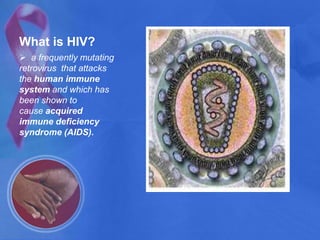
What is HIV?  a frequently mutating retrovirus  that attacks the human immune system and which has been shown to cause acquired immune deficiency syndrome (AIDS).What is HIV? infects the CD4+ T cells which are a subset of  white blood cells that coordinates the immune response to infection.
 can be spread through bodily fluids:
Breastfeeding
Unsafe sex
Blood transfusionOrigin of HIVoriginated in non-human primates in Sub-Saharan Africa and was transferred to humans during the late 19th or early 20th century.
Through zoonosis
a viral transfer from animals to humansTypes of HIV HIV- 1-  three times as infective as HIV-2- identified with the  Simian Immunodeficiency Virus from the chimpanzees
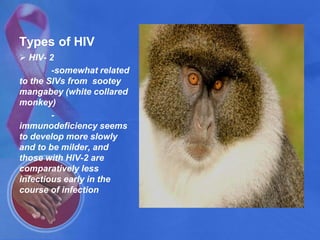
Types of HIV HIV- 2-somewhat related to the SIVs from  sooteymangabey (white collared monkey)- immunodeficiency seems to develop more slowly and to be milder, and those with HIV-2 are comparatively less infectious early in the course of infection
How is HIV spread?Unprotected sexHaving multiple sex partners or the presence of other sexually transmitted diseases (STDs) can increase the risk of infection during sex. Unprotected oral sex can also be a risk for HIV transmission, but it is a much lower risk than anal or vaginal sex.Sharing needles, syringes, rinse water, or other equipment used to prepare illicit drugs for injection.Being born to an infected mother—HIV can be passed from mother to child during pregnancy, birth, or breast-feeding
HIV is not spread through:HIV cannot reproduce outside the human body. It is not spread by:Air or water.Insects, including mosquitoes. Studies conducted by CDC researchers and others have shown no evidence of HIV transmission from insects.Saliva, tears, or sweat.  There is no documented case of HIV being transmitted by spitting.Casual contact like shaking hands or sharing dishes.Closed-mouth or “social” kissing.
Signs and SymptomsFever
Fatigue
Rash
Swollen lymph nodesAIDSAcquired Immunodeficiency Syndrome
later stage of HIV infection, when a person’s immune system is severely damaged and has difficulty fighting diseases and certain cancers.
Ultimate clinical consequence of HIV
Another signs and symptoms:
HIV infection and AIDS in AfricaEffects in Women and Children
Overall HIV TrendsIn 2007, UNAIDS reported that 22.5 million people in sub-Saharan Africa were living with HIV/AIDS.Represents 68% of the total 33.2 million of AIDS/HIV cases worldwide. Nearly 61 percent of HIV infections in this region occur in women, a higher percentage than any part of the world.
Overall HIV TrendsHIV prevalence rate rose a bit in Eastern Europe and Central Asia. Five countries in this region (Armenia, Georgia, Kazakhstan, Kyrgyzstan and Tajikistan)In 2009, over two-thirds of AIDS death were in this region.In Mozambique, there are 500,000 AIDS orphans.
Overall HIV Trends In 2010, the number of children orphaned by AIDS almost doubled worldwide to 25 million, if trends continue, according to a 2002 report from agencies including UNICEF, an estimated 20 million of them will be in hardest-hit Africa.Southern Africa has the highest HIV prevalence rates in the worldNigeria has the second largest HIV disease burden in theworld due to its large population.
HIV and AIDS Indicators in Selected World Regions
Women and Children in Africa and other countries as VICTIMS
HIV and AIDS EffectsCause the  destruction of labor force in different countries.Destruction of households and familiesA common source of stigma and discrimination in Africa and Southeast Asian Countries like Thailand.
ThailandDenial is part of a slowly crumbling wall of fear and discrimination as AIDS becomes more and more prevalent in Thai society.In 1997 up to the present, Thai people are frightened and often reject people with AIDS and HIV.
Discrimination and Stigma in Thai’s Societyearly emphasis on "risk groups" -- marginalized people such as homosexuals, prostitutes and drug users -- rather than risk behavior, coupled with a belief that casual contact could cause transmission of the disease, further stigmatized AIDS patients Physicians and nurses have been known to refuse to treat infected people, and those infected have lost their jobs
Discrimination and Stigma in Thai’s and Other SocietiesChildren whose parents have HIV or AIDS have been expelled from schoolAbandonment by family relatives and by the government even after death In many countries women are less likely to be able to negotiate condom use and are more likely to be subjected to non-consensual sex
Discrimination and Stigma in Thai’s and Other SocietiesIn Carribean, there is the so called “commercial sex”In Africa, the men are allowed to have polygamous relationships.
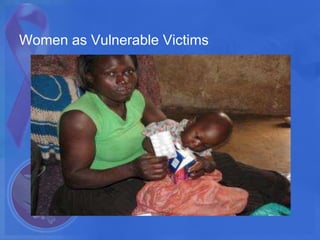
Women as Vulnerable Victims
Inequality within the FamilyIn some societies, women have few rights within sexual relationships and the family. Often men make the majority of decisions, such as whom they will marry and whether they will have more than one sexual partner. This power imbalance means that it can be more difficult for women to protect themselves from getting infected with HIV. For example, a woman may not be able to insist on the use of a condom if her husband is the one who makes the decisions.Marriage does not always protect a woman from becoming infected with HIV. Many new infections occur within marriage or long-term relationships as a result of unfaithful partners. In a number of societies, a man having more than one sexual partner is seen as the norm.
Violence against WomenWomen who are victims of sexual violence are at a higher risk of being exposed to HIV, and the lack of condom use and forced nature of rape means that women are immediately more vulnerable to HIV infection. A South African study concluded that women who were beaten or dominated by their partners were much more likely to become infected with HIV than women who were not.34 Another study of 20,425 couples in India found not only that HIV transmission was much greater in abusive relationships, but also that abusive husbands were more likely to be infected with HIV than non-abusive husbands.

Gender through history

  • 1.
  • 2.
    HIV and AIDS:Women in Africa and other countries
  • 3.
    HIV and AIDSthrough the Years
  • 4.
    What is HIV? a frequently mutating retrovirus  that attacks the human immune system and which has been shown to cause acquired immune deficiency syndrome (AIDS).What is HIV? infects the CD4+ T cells which are a subset of white blood cells that coordinates the immune response to infection.
  • 5.
    can bespread through bodily fluids:
  • 6.
  • 7.
  • 8.
    Blood transfusionOrigin ofHIVoriginated in non-human primates in Sub-Saharan Africa and was transferred to humans during the late 19th or early 20th century.
  • 9.
  • 10.
    a viral transferfrom animals to humansTypes of HIV HIV- 1- three times as infective as HIV-2- identified with the Simian Immunodeficiency Virus from the chimpanzees
  • 11.
    Types of HIVHIV- 2-somewhat related to the SIVs from sooteymangabey (white collared monkey)- immunodeficiency seems to develop more slowly and to be milder, and those with HIV-2 are comparatively less infectious early in the course of infection
  • 12.
    How is HIVspread?Unprotected sexHaving multiple sex partners or the presence of other sexually transmitted diseases (STDs) can increase the risk of infection during sex. Unprotected oral sex can also be a risk for HIV transmission, but it is a much lower risk than anal or vaginal sex.Sharing needles, syringes, rinse water, or other equipment used to prepare illicit drugs for injection.Being born to an infected mother—HIV can be passed from mother to child during pregnancy, birth, or breast-feeding
  • 13.
    HIV is notspread through:HIV cannot reproduce outside the human body. It is not spread by:Air or water.Insects, including mosquitoes. Studies conducted by CDC researchers and others have shown no evidence of HIV transmission from insects.Saliva, tears, or sweat.  There is no documented case of HIV being transmitted by spitting.Casual contact like shaking hands or sharing dishes.Closed-mouth or “social” kissing.
  • 14.
  • 15.
  • 16.
  • 17.
    Swollen lymph nodesAIDSAcquiredImmunodeficiency Syndrome
  • 18.
    later stage ofHIV infection, when a person’s immune system is severely damaged and has difficulty fighting diseases and certain cancers.
  • 19.
  • 20.
  • 21.
    HIV infection andAIDS in AfricaEffects in Women and Children
  • 22.
    Overall HIV TrendsIn2007, UNAIDS reported that 22.5 million people in sub-Saharan Africa were living with HIV/AIDS.Represents 68% of the total 33.2 million of AIDS/HIV cases worldwide. Nearly 61 percent of HIV infections in this region occur in women, a higher percentage than any part of the world.
  • 23.
    Overall HIV TrendsHIVprevalence rate rose a bit in Eastern Europe and Central Asia. Five countries in this region (Armenia, Georgia, Kazakhstan, Kyrgyzstan and Tajikistan)In 2009, over two-thirds of AIDS death were in this region.In Mozambique, there are 500,000 AIDS orphans.
  • 24.
    Overall HIV Trends In2010, the number of children orphaned by AIDS almost doubled worldwide to 25 million, if trends continue, according to a 2002 report from agencies including UNICEF, an estimated 20 million of them will be in hardest-hit Africa.Southern Africa has the highest HIV prevalence rates in the worldNigeria has the second largest HIV disease burden in theworld due to its large population.
  • 25.
    HIV and AIDSIndicators in Selected World Regions
  • 26.
    Women and Childrenin Africa and other countries as VICTIMS
  • 27.
    HIV and AIDSEffectsCause the destruction of labor force in different countries.Destruction of households and familiesA common source of stigma and discrimination in Africa and Southeast Asian Countries like Thailand.
  • 28.
    ThailandDenial is partof a slowly crumbling wall of fear and discrimination as AIDS becomes more and more prevalent in Thai society.In 1997 up to the present, Thai people are frightened and often reject people with AIDS and HIV.
  • 29.
    Discrimination and Stigmain Thai’s Societyearly emphasis on "risk groups" -- marginalized people such as homosexuals, prostitutes and drug users -- rather than risk behavior, coupled with a belief that casual contact could cause transmission of the disease, further stigmatized AIDS patients Physicians and nurses have been known to refuse to treat infected people, and those infected have lost their jobs
  • 30.
    Discrimination and Stigmain Thai’s and Other SocietiesChildren whose parents have HIV or AIDS have been expelled from schoolAbandonment by family relatives and by the government even after death In many countries women are less likely to be able to negotiate condom use and are more likely to be subjected to non-consensual sex
  • 31.
    Discrimination and Stigmain Thai’s and Other SocietiesIn Carribean, there is the so called “commercial sex”In Africa, the men are allowed to have polygamous relationships.
  • 32.
  • 33.
    Inequality within theFamilyIn some societies, women have few rights within sexual relationships and the family. Often men make the majority of decisions, such as whom they will marry and whether they will have more than one sexual partner. This power imbalance means that it can be more difficult for women to protect themselves from getting infected with HIV. For example, a woman may not be able to insist on the use of a condom if her husband is the one who makes the decisions.Marriage does not always protect a woman from becoming infected with HIV. Many new infections occur within marriage or long-term relationships as a result of unfaithful partners. In a number of societies, a man having more than one sexual partner is seen as the norm.
  • 34.
    Violence against WomenWomenwho are victims of sexual violence are at a higher risk of being exposed to HIV, and the lack of condom use and forced nature of rape means that women are immediately more vulnerable to HIV infection. A South African study concluded that women who were beaten or dominated by their partners were much more likely to become infected with HIV than women who were not.34 Another study of 20,425 couples in India found not only that HIV transmission was much greater in abusive relationships, but also that abusive husbands were more likely to be infected with HIV than non-abusive husbands.