1
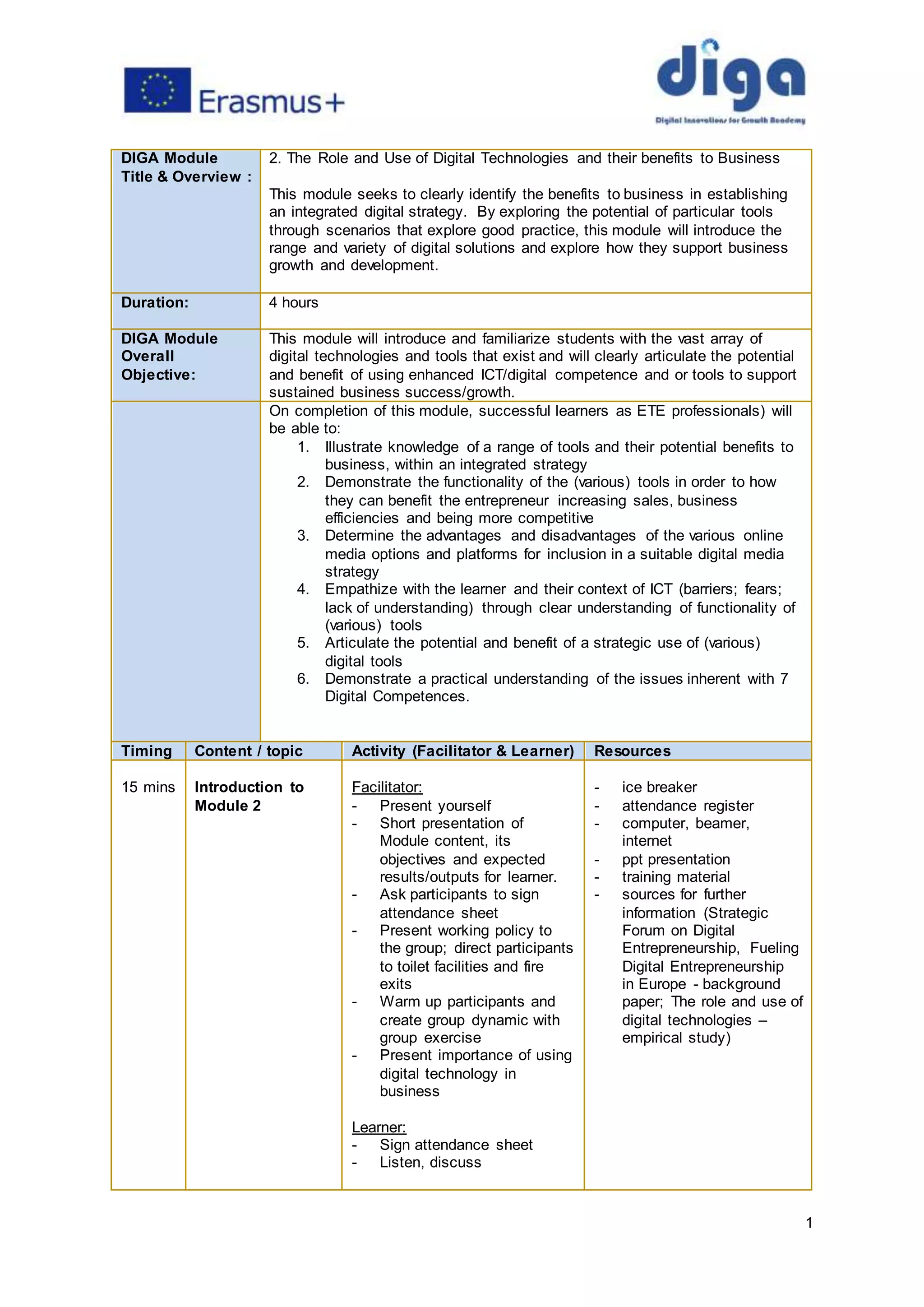
DIGA Module
Title & Overview :
2. The Role and Use of Digital Technologies and their benefits to Business
This module seeks to clearly identify the benefits to business in establishing
an integrated digital strategy. By exploring the potential of particular tools
through scenarios that explore good practice, this module will introduce the
range and variety of digital solutions and explore how they support business
growth and development.
Duration: 4 hours
DIGA Module
Overall
Objective:
This module will introduce and familiarize students with the vast array of
digital technologies and tools that exist and will clearly articulate the potential
and benefit of using enhanced ICT/digital competence and or tools to support
sustained business success/growth.
On completion of this module, successful learners as ETE professionals) will
be able to:
1. Illustrate knowledge of a range of tools and their potential benefits to
business, within an integrated strategy
2. Demonstrate the functionality of the (various) tools in order to how
they can benefit the entrepreneur increasing sales, business
efficiencies and being more competitive
3. Determine the advantages and disadvantages of the various online
media options and platforms for inclusion in a suitable digital media
strategy
4. Empathize with the learner and their context of ICT (barriers; fears;
lack of understanding) through clear understanding of functionality of
(various) tools
5. Articulate the potential and benefit of a strategic use of (various)
digital tools
6. Demonstrate a practical understanding of the issues inherent with 7
Digital Competences.
Timing Content / topic Activity (Facilitator & Learner) Resources
15 mins Introduction to
Module 2
Facilitator:
- Present yourself
- Short presentation of
Module content, its
objectives and expected
results/outputs for learner.
- Ask participants to sign
attendance sheet
- Present working policy to
the group; direct participants
to toilet facilities and fire
exits
- Warm up participants and
create group dynamic with
group exercise
- Present importance of using
digital technology in
business
Learner:
- Sign attendance sheet
- Listen, discuss
- ice breaker
- attendance register
- computer, beamer,
internet
- ppt presentation
- training material
- sources for further
information (Strategic
Forum on Digital
Entrepreneurship, Fueling
Digital Entrepreneurship
in Europe - background
paper; The role and use of
digital technologies –
empirical study)
2
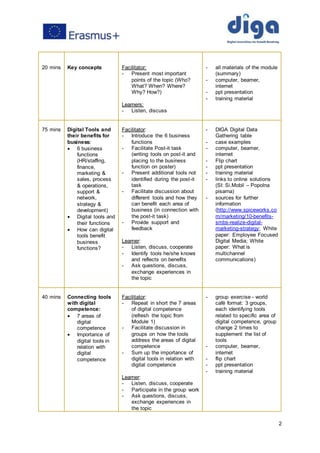
20 mins Key concepts Facilitator:
- Present most important
points of the topic (Who?
What? When? Where?
Why? How?)
Learners:
- Listen, discuss
- all materials of the module
(summary)
- computer, beamer,
internet
- ppt presentation
- training material
75 mins Digital Tools and
their benefits for
business:
 6 business
functions
(HR/staffing,
finance,
marketing &
sales, process
& operations,
support &
network,
strategy &
development)
 Digital tools and
their functions
 How can digital
tools benefit
business
functions?
Facilitator:
- Introduce the 6 business
functions
- Facilitate Post-it task
(writing tools on post-it and
placing to the business
function on poster)
- Present additional tools not
identified during the post-it
task
- Facilitate discussion about
different tools and how they
can benefit each area of
business (in connection with
the post-it task)
- Provide support and
feedback
Learner:
- Listen, discuss, cooperate
- Identify tools he/she knows
and reflects on benefits
- Ask questions, discuss,
exchange experiences in
the topic
- DIGA Digital Data
Gathering table
- case examples
- computer, beamer,
internet
- Flip chart
- ppt presentation
- training material
- links to online solutions
(SI: Si.Mobil – Popolna
pisarna)
- sources for further
information
(http://www.spiceworks.co
m/marketing/10-benefits-
smbs-realize-digital-
marketing-strategy; White
paper: Employee Focused
Digital Media; White
paper: What is
multichannel
communications)
40 mins Connecting tools
with digital
competence:
 7 areas of
digital
competence
 Importance of
digital tools in
relation with
digital
competence
Facilitator:
- Repeat in short the 7 areas
of digital competence
(refresh the topic from
Module 1)
- Facilitate discussion in
groups on how the tools
address the areas of digital
competence
- Sum up the importance of
digital tools in relation with
digital competence
Learner:
- Listen, discuss, cooperate
- Participate in the group work
- Ask questions, discuss,
exchange experiences in
the topic
- group exercise - world
café format: 3 groups,
each identifying tools
related to specific area of
digital competence, group
change 2 times to
supplement the list of
tools
- computer, beamer,
internet
- flip chart
- ppt presentation
- training material
3
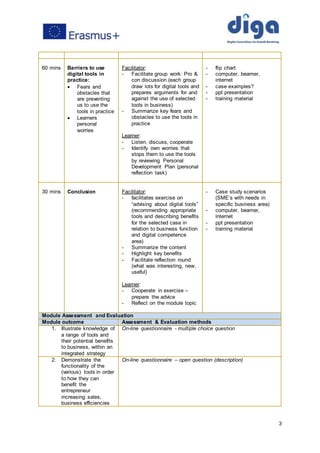
60 mins Barriers to use
digital tools in
practice:
 Fears and
obstacles that
are preventing
us to use the
tools in practice
 Learners
personal
worries
Facilitator:
- Facilitate group work: Pro &
con discussion (each group
draw lots for digital tools and
prepares arguments for and
against the use of selected
tools in business)
- Summarize key fears and
obstacles to use the tools in
practice
Learner:
- Listen, discuss, cooperate
- Identify own worries that
stops them to use the tools
by reviewing Personal
Development Plan (personal
reflection task)
- flip chart
- computer, beamer,
internet
- case examples?
- ppt presentation
- training material
30 mins Conclusion Facilitator:
- facilitates exercise on
“advising about digital tools”
(recommending appropriate
tools and describing benefits
for the selected case in
relation to business function
and digital competence
area)
- Summarize the content
- Highlight key benefits
- Facilitate reflection round
(what was interesting, new,
useful)
Learner:
- Cooperate in exercise –
prepare the advice
- Reflect on the module topic
- Case study scenarios
(SME’s with needs in
specific business area)
- computer, beamer,
internet
- ppt presentation
- training material
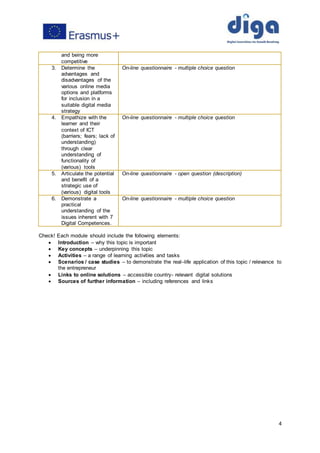
Module Assessment and Evaluation
Module outcome Assessment & Evaluation methods
1. Illustrate knowledge of
a range of tools and
their potential benefits
to business, within an
integrated strategy
On-line questionnaire - multiple choice question
2. Demonstrate the
functionality of the
(various) tools in order
to how they can
benefit the
entrepreneur
increasing sales,
business efficiencies
On-line questionnaire – open question (description)
4
and being more
competitive
3. Determine the
advantages and
disadvantages of the
various online media
options and platforms
for inclusion in a
suitable digital media
strategy
On-line questionnaire - multiple choice question
4. Empathize with the
learner and their
context of ICT
(barriers; fears; lack of
understanding)
through clear
understanding of
functionality of
(various) tools
On-line questionnaire - multiple choice question
5. Articulate the potential
and benefit of a
strategic use of
(various) digital tools
On-line questionnaire - open question (description)
6. Demonstrate a
practical
understanding of the
issues inherent with 7
Digital Competences.
On-line questionnaire - multiple choice question
Check! Each module should include the following elements:
 Introduction – why this topic is important
 Key concepts – underpinning this topic
 Activities – a range of learning activities and tasks
 Scenarios / case studies – to demonstrate the real–life application of this topic / relevance to
the entrepreneur
 Links to online solutions – accessible country- relevant digital solutions
 Sources of further information – including references and links

Diga draft session plan module 2

  • 1.
    1 DIGA Module Title &Overview : 2. The Role and Use of Digital Technologies and their benefits to Business This module seeks to clearly identify the benefits to business in establishing an integrated digital strategy. By exploring the potential of particular tools through scenarios that explore good practice, this module will introduce the range and variety of digital solutions and explore how they support business growth and development. Duration: 4 hours DIGA Module Overall Objective: This module will introduce and familiarize students with the vast array of digital technologies and tools that exist and will clearly articulate the potential and benefit of using enhanced ICT/digital competence and or tools to support sustained business success/growth. On completion of this module, successful learners as ETE professionals) will be able to: 1. Illustrate knowledge of a range of tools and their potential benefits to business, within an integrated strategy 2. Demonstrate the functionality of the (various) tools in order to how they can benefit the entrepreneur increasing sales, business efficiencies and being more competitive 3. Determine the advantages and disadvantages of the various online media options and platforms for inclusion in a suitable digital media strategy 4. Empathize with the learner and their context of ICT (barriers; fears; lack of understanding) through clear understanding of functionality of (various) tools 5. Articulate the potential and benefit of a strategic use of (various) digital tools 6. Demonstrate a practical understanding of the issues inherent with 7 Digital Competences. Timing Content / topic Activity (Facilitator & Learner) Resources 15 mins Introduction to Module 2 Facilitator: - Present yourself - Short presentation of Module content, its objectives and expected results/outputs for learner. - Ask participants to sign attendance sheet - Present working policy to the group; direct participants to toilet facilities and fire exits - Warm up participants and create group dynamic with group exercise - Present importance of using digital technology in business Learner: - Sign attendance sheet - Listen, discuss - ice breaker - attendance register - computer, beamer, internet - ppt presentation - training material - sources for further information (Strategic Forum on Digital Entrepreneurship, Fueling Digital Entrepreneurship in Europe - background paper; The role and use of digital technologies – empirical study)
  • 2.
    2 20 mins Keyconcepts Facilitator: - Present most important points of the topic (Who? What? When? Where? Why? How?) Learners: - Listen, discuss - all materials of the module (summary) - computer, beamer, internet - ppt presentation - training material 75 mins Digital Tools and their benefits for business:  6 business functions (HR/staffing, finance, marketing & sales, process & operations, support & network, strategy & development)  Digital tools and their functions  How can digital tools benefit business functions? Facilitator: - Introduce the 6 business functions - Facilitate Post-it task (writing tools on post-it and placing to the business function on poster) - Present additional tools not identified during the post-it task - Facilitate discussion about different tools and how they can benefit each area of business (in connection with the post-it task) - Provide support and feedback Learner: - Listen, discuss, cooperate - Identify tools he/she knows and reflects on benefits - Ask questions, discuss, exchange experiences in the topic - DIGA Digital Data Gathering table - case examples - computer, beamer, internet - Flip chart - ppt presentation - training material - links to online solutions (SI: Si.Mobil – Popolna pisarna) - sources for further information (http://www.spiceworks.co m/marketing/10-benefits- smbs-realize-digital- marketing-strategy; White paper: Employee Focused Digital Media; White paper: What is multichannel communications) 40 mins Connecting tools with digital competence:  7 areas of digital competence  Importance of digital tools in relation with digital competence Facilitator: - Repeat in short the 7 areas of digital competence (refresh the topic from Module 1) - Facilitate discussion in groups on how the tools address the areas of digital competence - Sum up the importance of digital tools in relation with digital competence Learner: - Listen, discuss, cooperate - Participate in the group work - Ask questions, discuss, exchange experiences in the topic - group exercise - world café format: 3 groups, each identifying tools related to specific area of digital competence, group change 2 times to supplement the list of tools - computer, beamer, internet - flip chart - ppt presentation - training material
  • 3.
    3 60 mins Barriersto use digital tools in practice:  Fears and obstacles that are preventing us to use the tools in practice  Learners personal worries Facilitator: - Facilitate group work: Pro & con discussion (each group draw lots for digital tools and prepares arguments for and against the use of selected tools in business) - Summarize key fears and obstacles to use the tools in practice Learner: - Listen, discuss, cooperate - Identify own worries that stops them to use the tools by reviewing Personal Development Plan (personal reflection task) - flip chart - computer, beamer, internet - case examples? - ppt presentation - training material 30 mins Conclusion Facilitator: - facilitates exercise on “advising about digital tools” (recommending appropriate tools and describing benefits for the selected case in relation to business function and digital competence area) - Summarize the content - Highlight key benefits - Facilitate reflection round (what was interesting, new, useful) Learner: - Cooperate in exercise – prepare the advice - Reflect on the module topic - Case study scenarios (SME’s with needs in specific business area) - computer, beamer, internet - ppt presentation - training material Module Assessment and Evaluation Module outcome Assessment & Evaluation methods 1. Illustrate knowledge of a range of tools and their potential benefits to business, within an integrated strategy On-line questionnaire - multiple choice question 2. Demonstrate the functionality of the (various) tools in order to how they can benefit the entrepreneur increasing sales, business efficiencies On-line questionnaire – open question (description)
  • 4.
    4 and being more competitive 3.Determine the advantages and disadvantages of the various online media options and platforms for inclusion in a suitable digital media strategy On-line questionnaire - multiple choice question 4. Empathize with the learner and their context of ICT (barriers; fears; lack of understanding) through clear understanding of functionality of (various) tools On-line questionnaire - multiple choice question 5. Articulate the potential and benefit of a strategic use of (various) digital tools On-line questionnaire - open question (description) 6. Demonstrate a practical understanding of the issues inherent with 7 Digital Competences. On-line questionnaire - multiple choice question Check! Each module should include the following elements:  Introduction – why this topic is important  Key concepts – underpinning this topic  Activities – a range of learning activities and tasks  Scenarios / case studies – to demonstrate the real–life application of this topic / relevance to the entrepreneur  Links to online solutions – accessible country- relevant digital solutions  Sources of further information – including references and links