International Journal of Excellence Innovation and Development
||Volume 2, Issue 1, Jan. 2019||Page No. 056-061||
www.ijeid.com {IJEID © 2019} All Rights Reserved Page | 56
Development and Experimentation of a
Mobile Mini Ice-tube Making Machine
O. O. Caleb1
, B. Kareem2
1
Department of Mechanical Engineering, Federal University of Technology Akure, Nigeria
2
Department of Industrial and Production Engineering, Federal University of Technology Akure, Nigeria
Abstract––This project entails the design and fabrication
of mini ice-tube making machine, this machine made use
of food flask (cooler) as the cooling compartment which
was installed inside a lagged stand made of galvanized
iron, and two trays of ice-tube which was arranged
vertically inside the cooling compartment after the
installtion of all refrigeration components. The mobile
machine is designed to produce 50 pieces of ice-tube
which is 25 pieces per tray, and the mass of water to
produce this quantity of ice-tube was 2.5135 kg of water
in 5 hours 51 minutes. The results revealed that the
machine is sustainable in terms of material availability,
lightweight, mobility, cost economy and performance.
Keywords––Ice-tube making machine, experimental,
mobility, lightweight, effectiveness
INTRODUCTION
Refrigeration may be defined as lowering the temperature
of an enclosed space by removing heat from the space
transferring it elsewhere (Ajeet and Salem, 2016). When
food items are stored inside a refrigerator at temperatures
below the freezing point, the process of growth of micro-
organisms is greatly impaired. According to Abubakar et.
al. (2012) in developing tropical countries like Nigeria
domestic use of refrigeration is the most prevalent due to
very high temperatures. Akinola et. al. (2015) stated that
the non-availability or epileptic supply of electricity is
not making the use of refrigerators effective. Poor supply
of electricity and the warm climate in Nigeria today are
responsible for the large demand for ice because of the
need to locally refrigerate drinks and perishable food
items. The development of a mini ice-tube making
machine arrangement was borne out of this need. Golob
et al. (2002) discovered that ice has been used to cool
down the crops after harvest and to maintain the
temperature low during shipping since ancient time. Ice is
added crushed inside the produce container. This crushed
ice takes out the heat from the commodity, causing it to
melt while ensuring high relative humidity surrounding
the produce (Sargent et al., 1988). This method is suitable
for produce that can tolerate the contact with ice and
water. Liquid ice or slurry of ice (ice and water) can
enhance produce cooling by filling all of the void volume
of the container. Ice cooling is considered as a fairly
quick and simple method since it can be done directly in
the field and within few minutes (Kader, 2002).
Ice is water in the solid state which may be any one of
the 15 known crystalline phases of water. Its solid
phases include snowflakes, hail, icicles, glaciers, pack
ice and entire polar ice caps (Lemboye et. al., 2015). Ice
is produced mechanically for domestic, leisure (for
sports and recreation activities), commercial and
industrial purposes (ASHRAE, 2006).
Ice tube as the name implies is in a shape of a tube,
which is of different tube sizes depending on the desire
of the production, the tube is always produced in the
refrigeration with a plate that is designed in a way that
each port of it can produce the shape of tube. The size,
and number of tubes to produce per plate of the ice tube
depend on the already design size, and number of tube
port per plate.
Dickson et. al, (1984) designed an ice making machine
comprising of a plurality of ice forming moulds, a
rotatable water spray bar for communicating make-up
water from a water sump toward the moulds during a
freezing cycle, a refrigerating system which includes a
compressor, condenser and an evaporator for freezing
water sprayed into the moulds; a water holding tank or
plate for retaining water in heat transfer relationship to
the ice moulds to aid the release of the ice formed during
the harvest cycle. He achieved the reduction in cycle
time due to the fact that the temperature of the
refrigerator was minimized during the harvest cycle,
hence, reducing the freezing cycle time.
Hara (1991) designed an automatic ice making machine
having an ice making section equipped with an
evaporator connected to a freezing system, a system for
feeding the water to be frozen to the ice making section,
an ice formation detector, and an ice releasing unit
which releases ice cakes formed in the ice making
section upon receipt of ice formation signal from the ice
formation detector. The ice making machine further
comprises an alarm unit which gives an alarm after a
predetermined time counted from the starting point of
ice making operation.
Meier (1992) developed totally automatic machine for
making the harvest blocks of ice. The machine has an ice
chamber having four sidewalls and a bottom wall, the
sidewalls has flange extending outward from the bottom
edge, refrigerant lines were arranged in serpentine
design on the sidewalls for providing refrigerant to the
sidewalls and flange to increase the freezing rate,
thereby giving rise to an energy cost effective machine.
Schlosser et. al. (1996) made improvements in the ice
making machine in their invention by greatly curtailing
Development and experimentation of a mobile mini ice-tube making machine Caleb and Kareem
www.ijeid.com {IJEID © 2019} All Rights Reserved Page | 57
the necessity for downtime, cleaning and sterilization of
the machine, thereby enchanting the continuity and
efficiency of operation of ice making machine. These
were achieved by designing an automatic self-cleaning
ice making machine having a freeze cycle and a harvest
cycle.
Schlosser et. al. (2004) designed an ice making machine
which comprises of a refrigeration system, water system
having a fresh water inlet, water circulation mechanisms,
an ice-forming device in thermal contact with the
evaporator and interconnecting water lines. Further work
was done by adding a control system which has a
temperature sensing device in thermal contact with the
outlet of the condenser, a microprocessor programmed to
use input from the temperature sensing device either at a
predetermined time after initiation of freeze cycle to
determine the desired duration of the freeze cycle or at a
predetermined time prior to the end of the freeze cycle to
determine the desired duration of harvest cycle.
The above ice making machines are expensive and not
readily available for local use. Hence, this work aims to
design and fabricate a mini ice-tube making machine
using locally available materials. The specific objectives
are to design a portable mobile ice-tube making
machine; fabricate the portable mobile ice-tube making
machine using locally available materials; and evaluate
the performance of the ice-tube making machine.
RESEARCH ELABORATION
The proposed ice-tube making machine is designed
based on the vapour compression refrigerating system,
using a plastic vacuum flask (cooler) as the refrigerating
compartment and the tube plate that will accommodate
the ice-tubes will be installed inside the cooler
compartment. Due to the fact that cooler is to be used as
the cooling medium, for the cooler to get to the freezing
point of water it was investigated that heat will be gained
by the cooler body due to temperature difference,
therefore to overcome this challenge and to increase the
freezing efficiency, the cooling medium will be installed
inside a lagging compartment making the lagging for the
whole system to be sufficient.
Tube Calculation
where (r) is the radius of the tubecylinder base circle, (h) is
the height of the tubecylinder
Surface area of tube= Area of top and bottom circle +
area of the side
The height (h) of the tube to be produced in this project
will be cm and the diameter as 4cm
Volume of water to be freeze to produce 50 ice-tubes
Volume of water to produce 50 ice-tubes
= 2513.5 = 0.0025135m3
From the calculation above
2.5135 litters of water will be used to produce 50 ice-
tubes of radius 2.5cm and tube height of 4cm.
Mass = density x volume (1)
Density of water = 1000 kg/
Mass (m) = 2.5135 kg
Design Calculation
For any product to be frozen and stored at some
temperature below its freezing temperature, the heat
involved is calculated in three parts, (Dossat, 2010).
i. The quantity of heat given off by the product in
cooling from the entering temperature to its freezing
temperature.
ii. The quantity of heat given off by the product during
freezing.
iii. The quantity of heat given off by the product in
cooling from its freezing temperature to the final
temperature.
The size and number of the ice-tube to be produced per
cycle of refrigeration is used to determine the size of the
cooler compartment to be used, the capacity of the
compressor to be used, and the hours required for
complete freezing of the water. The number of ice-tubes
to be produced is 50 tubes, having 25 ice-tubes in one
tube plate, which will be loaded vertically.
The space heat gain from the product is given by
equation (1)
Q1 = mcѲ (Rajput 2016) (2)
Where Q is quantity (kJ/kg); c is specific heat capacity
of the product (4.187kJ/kgK); Ѳ
(k) (27 to -10 o
C) and m is the mass of the product.
Volume of water to produce 50 ice-tubes
= 0.0025135m3
= 2.5135 litters
Mass = 2.5135 kg
Therefore, the amount of energy needed to cool this
water from 27o
c to 00
c
Q1 = 284.15 kJ
The amount of energy needed to change the water to ice
at 0o
C
Q2 = ml (3)
Q2 = 842.0225 KJ
The amount of energy needed to cool the ice from 00
C to
-100
C
Q3 = 105.240 KJ
The total heat QT to be removed in the freezer is
Qt = Q1 + Q2 + Q3 = 1231.4125 KJ
Total compartment area = 5766 cm2
Components installation compartment height = 28 cm
Total cooler area = 2400 cm2
Thickness before re-lagging = 15 mm
The cooler will be installed on the already fabricated
stand, and the space available between the stand and the
cooler is the area to be lagged.
Cooler installation area on stand = 5766 cm2
Lagging area = compartment area on stand – cooler area
Lagging area = (5766 – 2400) cm2
= 3366 cm2
Heat flow equation through the walls by conduction is
given in equation 7.
QA = Thf – Tcf = Q
LDA KD + 1A hcf
(4)
International Journal of Excellence Innovation and Development
||Volume 2, Issue 1, Jan. 2019||Page No. 056-061||
www.ijeid.com {IJEID © 2019} All Rights Reserved Page | 58
QA = 54.6816 W
For 6hrs of operation,
Qtotal = Qproduct + Qconduction (5)
Qtotal = 2412.54 KJ
Assuming infiltration load is 10% of Qtotal
Infiltration load = 241.254 KJ
Hence,
Qfinal = Qtotal + infiltration load (6)
Qfinal = 2653.80 KJ
Compressor Design
This is the capacity of the compressor required to
produce the required refrigeration for the system and to
remove the required amount of heat
From Converting Qfinal of (2653.80 KJ) to kilowatts, we
have; (7)
Cooling load = 0.12286 kW
Since 1 hp = 0.746 kW
While a (0.167) hp compressor was selected.
Compressor power = 0.1647 hp.
The compressor capacity required to produce the
refrigeration load of (0.1647 KW) in working for 6 hours
per day is (0.167) hp.
Mass flow rate of the refrigerant
Mass flow rate (m) = (8)
M = 0.0007914 Kg/s
Fabrication of freezer compartment
The following processes were carried out in the
fabrication of the freezer compartment. The material
used in the fabrication of the freezer compartment is
galvanized iron sheet for the freezer body and angle iron
for the stands. The galvanized iron sheet is measured and
marked out with the measurement specification required
for the body. The angle iron is measured and marked
out. All materials been marked out are cut out with
electric cutting machine. The angle irons for the stand
are arranged and welded together using electric welding
machine. The galvanized iron sheets for the body are
welded to the stand configuration.
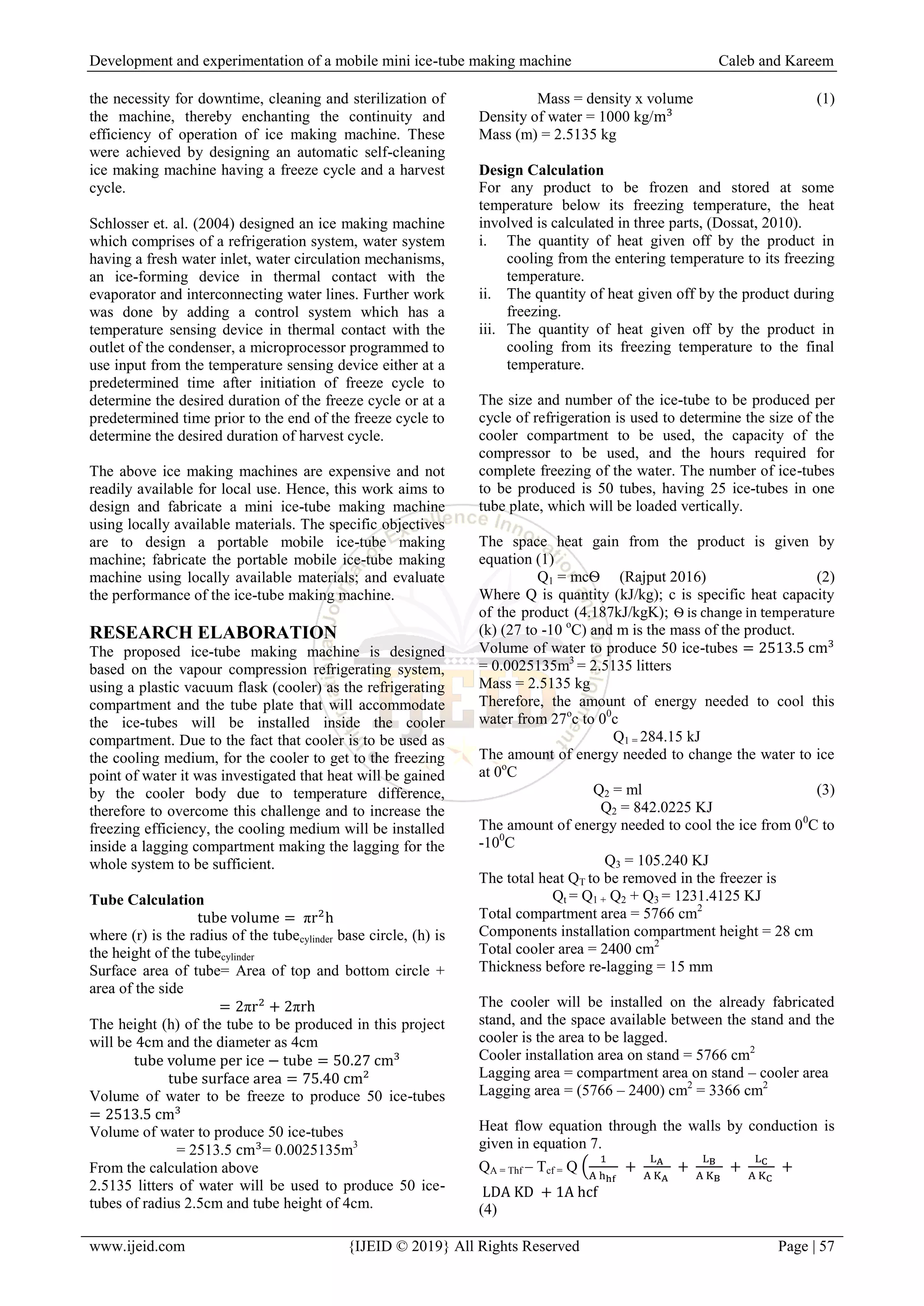
After the fabrication of the freezer compartment, the
cooler that is to be used for the inner compartment of the
freezer is inserted into the fabricated body, the cooler is
lagged with the freezing compartment using fibre glass
as lagging material. A hole for copper tube passage
between the compartment and the cooler is drilled out.
The opened area of the compartment after lagging is
covered with galvanized sheet. The freezer compartment
is sprayed with silver paint to prevent future corrosion.
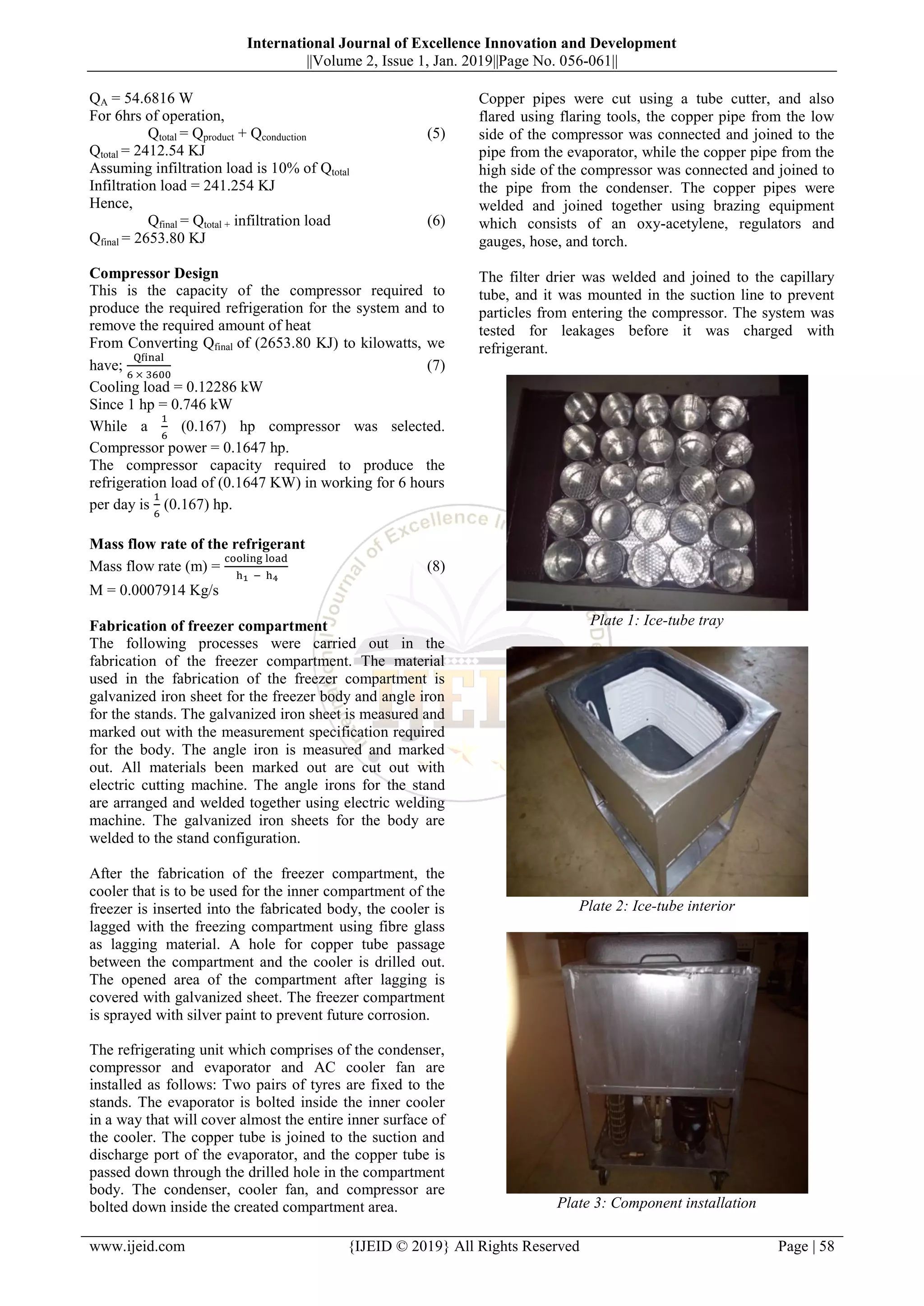
The refrigerating unit which comprises of the condenser,
compressor and evaporator and AC cooler fan are
installed as follows: Two pairs of tyres are fixed to the
stands. The evaporator is bolted inside the inner cooler
in a way that will cover almost the entire inner surface of
the cooler. The copper tube is joined to the suction and
discharge port of the evaporator, and the copper tube is
passed down through the drilled hole in the compartment
body. The condenser, cooler fan, and compressor are
bolted down inside the created compartment area.
Copper pipes were cut using a tube cutter, and also
flared using flaring tools, the copper pipe from the low
side of the compressor was connected and joined to the
pipe from the evaporator, while the copper pipe from the
high side of the compressor was connected and joined to
the pipe from the condenser. The copper pipes were
welded and joined together using brazing equipment
which consists of an oxy-acetylene, regulators and
gauges, hose, and torch.
The filter drier was welded and joined to the capillary
tube, and it was mounted in the suction line to prevent
particles from entering the compressor. The system was
tested for leakages before it was charged with
refrigerant.
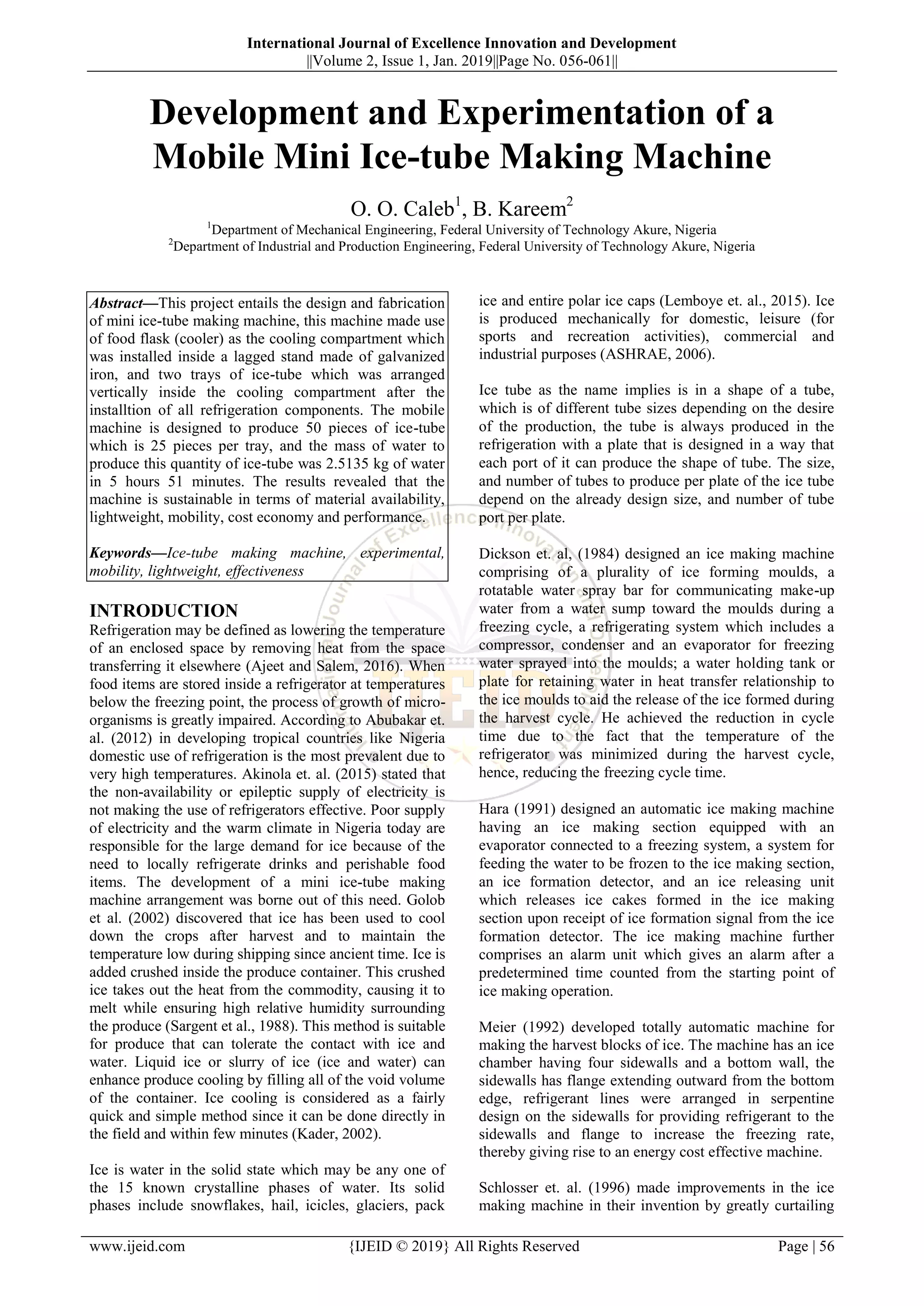
Plate 1: Ice-tube tray
Plate 2: Ice-tube interior
Plate 3: Component installation
Development and experimentation of a mobile mini ice-tube making machine Caleb and Kareem
www.ijeid.com {IJEID © 2019} All Rights Reserved Page | 59
RESULTS AND DISCUSSIONS
The mini ice-tube making machine was designed to
make use of water which was introduced into the tube
tray to be loaded into the freezing compartment of the
ice-tube making machine. The temperature was taken
with thermometer at three stages with interval of 30
minutes and the readings were recorded.
The tube tray consist of 25 pieces of cylindrical cups per
tray which each can be removed separately and it is
arranged inside the tube tray, the tube was loaded by
pouring water into the cup after the water has been
weighed with weighing balance to know the weight of
the water to be used, for the purpose of the design
2.5135kg of water were loaded into the two trays of the
ice-tube to produce the required number of ice-tube
which was weighed by weighing balance.
The initial temperature of the water to be frozen was
taken by the use of thermometer before it was loaded
into the evaporator compartment and temperatures were
recorded at every 30 minutes during the working cycle
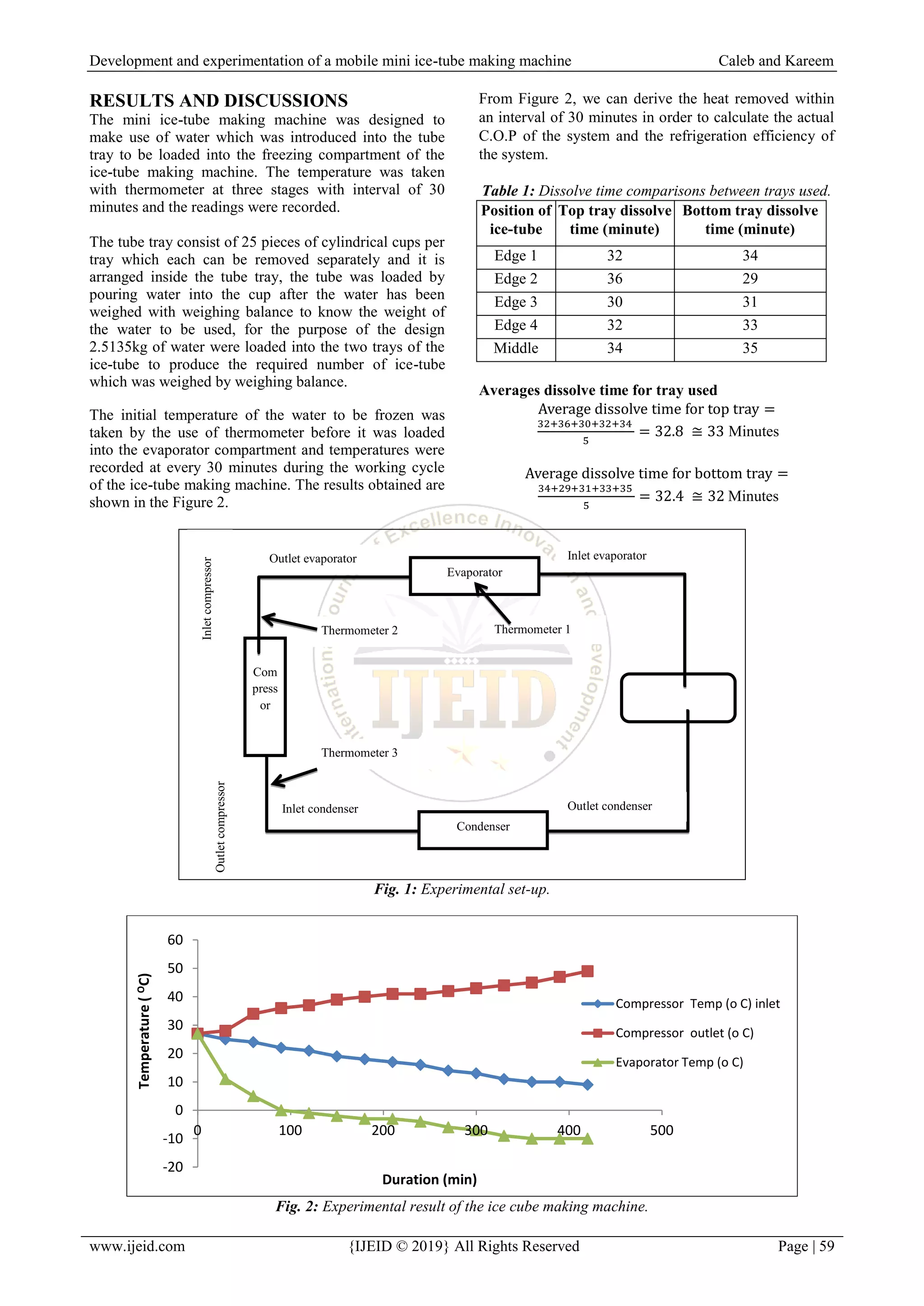
of the ice-tube making machine. The results obtained are
shown in the Figure 2.
From Figure 2, we can derive the heat removed within
an interval of 30 minutes in order to calculate the actual
C.O.P of the system and the refrigeration efficiency of
the system.
Table 1: Dissolve time comparisons between trays used.
Position of
ice-tube
Top tray dissolve
time (minute)
Bottom tray dissolve
time (minute)
Edge 1 32 34
Edge 2 36 29
Edge 3 30 31
Edge 4 32 33
Middle 34 35
Averages dissolve time for tray used
Minutes
Minutes
Fig. 1: Experimental set-up.
Fig. 2: Experimental result of the ice cube making machine.
-20
-10
0
10
20
30
40
50
60
0 100 200 300 400 500
Temperature(OC)
Duration (min)
Compressor Temp (o C) inlet
Compressor outlet (o C)
Evaporator Temp (o C)
Evaporator
Com
press
or
Condenser
Expansion valve
Outlet evaporator
Inletcompressor
Inlet condenser Outlet condenser
Inlet evaporator
Outletcompressor
Thermometer 2 Thermometer 1
Thermometer 3
International Journal of Excellence Innovation and Development
||Volume 2, Issue 1, Jan. 2019||Page No. 056-061||
www.ijeid.com {IJEID © 2019} All Rights Reserved Page | 60
Results discussion
From Table 1 comparing the average dissolve time for
both trays, it is seen from the above calculation that the
top tray has the highest dissolve time of 33 minutes and
the bottom tray of 32 minutes, the difference in time of
dissolve is due to the time of unloading each tray from
the system since the time difference is some seconds
interval.
From Figure 2 at 90 minutes of continuous system
running, the water reached temperature of 0 0
C and after
90 minutes the temperature of the system reduced by 1
0
C interval for each minutes, this is as a reason that the
system is doing much work to transform the water to ice
at those temperatures. The temperature remains constant
at -3 0
C from 180 to 210 minutes; this might be as a
result that the ice formed is trying to harden changing
from ice slurries to ice-tube.
After 360 minutes of continuous operation of the system
it was noticed that the inside temperature of the system
did not change from -10 0
C, from this observation, it can
be said that the system has reach its constant enthalpy,
therefore the system can continue to run for various
hours with constant temperature of -10 0
C.
Coefficient of performance (C.O.P)
The coefficient of performance is the ratio of the cooling
load to the compressor power; the COP is mainly
affected by the change in evaporating and condensing
temperature.
Compressor power = 0.1647 hp
Ambient temperature = 27 0
C, Temperature after 30
minutes = 11 0
C
Heat removed per 30 minute (q) =
–
Heat removed per 30 minute (q) = 0.01867 kW
Actual C.O.P = (Rajput 2016) (9)
From (equation 18) Actual C.O.P =
COP theoretical =
COP theoretical = 7.108
Refrigerating efficiency =
Time taken to freeze 1kg of water = 2.15 hours
Time taken to produce ice-tube of 2.5135kg of water (50
ice-tubes) = 5.51 hours
Plate 4: Ice-Tube Produced
CONCLUSION
A portable/mobile ice-tube making machine was
developed and evaluated. The machine ran for 5 hours
51 minutes to produce 50 pieces of ice-tube with 2.5135
kg of water using two ice-tube tray 25 pieces per tray,
and all part used for fabrication were selected to reduce
weight of the machine, reduce cost of production and
also increase the efficiency of the machine.
REFERENCES
[1] Abubakar, M., Andrew E. E., Akinola A. A.,
Abdulkadir B. H. (2012). Development and
Evaluation of a Prototype Refrigerated Cooling
Table for Conference Services. International
Journal of Engineering and Technology (IJET). 4
(2), 97 – 108.
[2] Ajeet, K. R. and Salem A. M. (2016). Study of
Performance Evaluation of Domestic Refrigerator
Working With Mixture of Propane, Butane and
Isobutene Refrigerant (Lpg). International Journal
of Mechanical Engineering and Technology
(IJMET). 7(3).
http://www.iaeme.com/IJMET/issues.asp?JType=I
JMET&VType=7&IType=
[3] Akinola, A. O.; Mogaji, T. S. and Adewole, K. A.
(2015). Development of a Solar-Powered Mobile
Refrigerator. International Journal of Emerging
Technology and Advanced Engineering
www.ijetae.com 5(9).
[4] ASHRAE, (2006). “Ice Manufacture,” ASHRAE
Handbook: Refrigeration. Inch-Pound Edition, pp.
34-41,
[5] Dickson, G and Westergaard, R.K (1984), Ice
Making Machine United States Patent 3791163
www.freepatentonline.com
[6] Dossat R.J, (2010) Principles of Refrigeration, 4th
edition Mohinder Singh Segwal for Wiley Eastern
Limited London, pp 206-213, 340-430
[7] Goldstein, V, (1991) Ice Making Machine
European Patent Application EP0316966.
www.freepatentonline.com
[8] Golob, P., Farrell, G. and Orchard, J. E. (2002).
Postharvest science and technology, principles and
practices. Blackwell Science. 554p.
[9] Kader, A. A. (2002a). Postharvest Technology of
Horticultural Crops. University of California,
Division of Agriculture and Natural Resources.
2nd Edition, Publication 3311, Berkeley, CA,
USA.
[10] Lemboye, K. T.; Layeni, A. T.; Oduntan, K.;
Akintunde, M. A. and Dahunsi, O. A. (2015).
Developing a Two Stage Cascade Compressor
Arrangement for Ice Block Production. Journal of
Machinery Manufacturing and Automation. 4 (2),
PP. 10-16.
[11] Meier, Gary B. (1992) Automatic ice block
machine, United States Patent
5167132.www.freepatentonline.com
[12] Rajput, R.K (2016) heat and mass transfer S.
Chand & Co. Ltd, New Delhi, pp150
Development and experimentation of a mobile mini ice-tube making machine Caleb and Kareem
www.ijeid.com {IJEID © 2019} All Rights Reserved Page | 61
[13] Sargent, S. A., Talbot, M. T. and Brecht, J. K.,
(1988). Evaluating Precooling Methods for
Vegetable Packinghouse Operations. Florida
Cooperative extension Service. Proc. Fla. State
Hort. Soc. Vol. 101, pp 175-182.
[14] Schlosser, C.E, Mueller, L.G and McDougal, G.
(1996). Ice making machine United States Patent
5586439. www.freepatentonline.com
[15] Schlosser, C.E, Pierskalla, C.J and Krcma, G.F
(2004) ice making machine and control method
therefor, European Patent EP0869321.
www.freepatentonline.com
Biography of Author(s)
CALEB, O. O. (B. Eng. Mechanical Engineering, M.
Eng. Building Services Engineering) is a lecturer at the
Department of Mechanical Engineering Federal
University of Technology Akure, Ondo State, Nigeria.
KAREEM, B. (B. Eng. Mechanical Engineering, M.
Eng. Production Engineering, PhD in Industrial
Engineering,) is Professor at the Department of
Industrial and Production Engineering Federal
University of Technology Akure, Ondo State, Nigeria.

Development and Experimentation of a Mobile Mini Ice-tube Making Machine

  • 1.
    International Journal ofExcellence Innovation and Development ||Volume 2, Issue 1, Jan. 2019||Page No. 056-061|| www.ijeid.com {IJEID © 2019} All Rights Reserved Page | 56 Development and Experimentation of a Mobile Mini Ice-tube Making Machine O. O. Caleb1 , B. Kareem2 1 Department of Mechanical Engineering, Federal University of Technology Akure, Nigeria 2 Department of Industrial and Production Engineering, Federal University of Technology Akure, Nigeria Abstract––This project entails the design and fabrication of mini ice-tube making machine, this machine made use of food flask (cooler) as the cooling compartment which was installed inside a lagged stand made of galvanized iron, and two trays of ice-tube which was arranged vertically inside the cooling compartment after the installtion of all refrigeration components. The mobile machine is designed to produce 50 pieces of ice-tube which is 25 pieces per tray, and the mass of water to produce this quantity of ice-tube was 2.5135 kg of water in 5 hours 51 minutes. The results revealed that the machine is sustainable in terms of material availability, lightweight, mobility, cost economy and performance. Keywords––Ice-tube making machine, experimental, mobility, lightweight, effectiveness INTRODUCTION Refrigeration may be defined as lowering the temperature of an enclosed space by removing heat from the space transferring it elsewhere (Ajeet and Salem, 2016). When food items are stored inside a refrigerator at temperatures below the freezing point, the process of growth of micro- organisms is greatly impaired. According to Abubakar et. al. (2012) in developing tropical countries like Nigeria domestic use of refrigeration is the most prevalent due to very high temperatures. Akinola et. al. (2015) stated that the non-availability or epileptic supply of electricity is not making the use of refrigerators effective. Poor supply of electricity and the warm climate in Nigeria today are responsible for the large demand for ice because of the need to locally refrigerate drinks and perishable food items. The development of a mini ice-tube making machine arrangement was borne out of this need. Golob et al. (2002) discovered that ice has been used to cool down the crops after harvest and to maintain the temperature low during shipping since ancient time. Ice is added crushed inside the produce container. This crushed ice takes out the heat from the commodity, causing it to melt while ensuring high relative humidity surrounding the produce (Sargent et al., 1988). This method is suitable for produce that can tolerate the contact with ice and water. Liquid ice or slurry of ice (ice and water) can enhance produce cooling by filling all of the void volume of the container. Ice cooling is considered as a fairly quick and simple method since it can be done directly in the field and within few minutes (Kader, 2002). Ice is water in the solid state which may be any one of the 15 known crystalline phases of water. Its solid phases include snowflakes, hail, icicles, glaciers, pack ice and entire polar ice caps (Lemboye et. al., 2015). Ice is produced mechanically for domestic, leisure (for sports and recreation activities), commercial and industrial purposes (ASHRAE, 2006). Ice tube as the name implies is in a shape of a tube, which is of different tube sizes depending on the desire of the production, the tube is always produced in the refrigeration with a plate that is designed in a way that each port of it can produce the shape of tube. The size, and number of tubes to produce per plate of the ice tube depend on the already design size, and number of tube port per plate. Dickson et. al, (1984) designed an ice making machine comprising of a plurality of ice forming moulds, a rotatable water spray bar for communicating make-up water from a water sump toward the moulds during a freezing cycle, a refrigerating system which includes a compressor, condenser and an evaporator for freezing water sprayed into the moulds; a water holding tank or plate for retaining water in heat transfer relationship to the ice moulds to aid the release of the ice formed during the harvest cycle. He achieved the reduction in cycle time due to the fact that the temperature of the refrigerator was minimized during the harvest cycle, hence, reducing the freezing cycle time. Hara (1991) designed an automatic ice making machine having an ice making section equipped with an evaporator connected to a freezing system, a system for feeding the water to be frozen to the ice making section, an ice formation detector, and an ice releasing unit which releases ice cakes formed in the ice making section upon receipt of ice formation signal from the ice formation detector. The ice making machine further comprises an alarm unit which gives an alarm after a predetermined time counted from the starting point of ice making operation. Meier (1992) developed totally automatic machine for making the harvest blocks of ice. The machine has an ice chamber having four sidewalls and a bottom wall, the sidewalls has flange extending outward from the bottom edge, refrigerant lines were arranged in serpentine design on the sidewalls for providing refrigerant to the sidewalls and flange to increase the freezing rate, thereby giving rise to an energy cost effective machine. Schlosser et. al. (1996) made improvements in the ice making machine in their invention by greatly curtailing
  • 2.
    Development and experimentationof a mobile mini ice-tube making machine Caleb and Kareem www.ijeid.com {IJEID © 2019} All Rights Reserved Page | 57 the necessity for downtime, cleaning and sterilization of the machine, thereby enchanting the continuity and efficiency of operation of ice making machine. These were achieved by designing an automatic self-cleaning ice making machine having a freeze cycle and a harvest cycle. Schlosser et. al. (2004) designed an ice making machine which comprises of a refrigeration system, water system having a fresh water inlet, water circulation mechanisms, an ice-forming device in thermal contact with the evaporator and interconnecting water lines. Further work was done by adding a control system which has a temperature sensing device in thermal contact with the outlet of the condenser, a microprocessor programmed to use input from the temperature sensing device either at a predetermined time after initiation of freeze cycle to determine the desired duration of the freeze cycle or at a predetermined time prior to the end of the freeze cycle to determine the desired duration of harvest cycle. The above ice making machines are expensive and not readily available for local use. Hence, this work aims to design and fabricate a mini ice-tube making machine using locally available materials. The specific objectives are to design a portable mobile ice-tube making machine; fabricate the portable mobile ice-tube making machine using locally available materials; and evaluate the performance of the ice-tube making machine. RESEARCH ELABORATION The proposed ice-tube making machine is designed based on the vapour compression refrigerating system, using a plastic vacuum flask (cooler) as the refrigerating compartment and the tube plate that will accommodate the ice-tubes will be installed inside the cooler compartment. Due to the fact that cooler is to be used as the cooling medium, for the cooler to get to the freezing point of water it was investigated that heat will be gained by the cooler body due to temperature difference, therefore to overcome this challenge and to increase the freezing efficiency, the cooling medium will be installed inside a lagging compartment making the lagging for the whole system to be sufficient. Tube Calculation where (r) is the radius of the tubecylinder base circle, (h) is the height of the tubecylinder Surface area of tube= Area of top and bottom circle + area of the side The height (h) of the tube to be produced in this project will be cm and the diameter as 4cm Volume of water to be freeze to produce 50 ice-tubes Volume of water to produce 50 ice-tubes = 2513.5 = 0.0025135m3 From the calculation above 2.5135 litters of water will be used to produce 50 ice- tubes of radius 2.5cm and tube height of 4cm. Mass = density x volume (1) Density of water = 1000 kg/ Mass (m) = 2.5135 kg Design Calculation For any product to be frozen and stored at some temperature below its freezing temperature, the heat involved is calculated in three parts, (Dossat, 2010). i. The quantity of heat given off by the product in cooling from the entering temperature to its freezing temperature. ii. The quantity of heat given off by the product during freezing. iii. The quantity of heat given off by the product in cooling from its freezing temperature to the final temperature. The size and number of the ice-tube to be produced per cycle of refrigeration is used to determine the size of the cooler compartment to be used, the capacity of the compressor to be used, and the hours required for complete freezing of the water. The number of ice-tubes to be produced is 50 tubes, having 25 ice-tubes in one tube plate, which will be loaded vertically. The space heat gain from the product is given by equation (1) Q1 = mcѲ (Rajput 2016) (2) Where Q is quantity (kJ/kg); c is specific heat capacity of the product (4.187kJ/kgK); Ѳ (k) (27 to -10 o C) and m is the mass of the product. Volume of water to produce 50 ice-tubes = 0.0025135m3 = 2.5135 litters Mass = 2.5135 kg Therefore, the amount of energy needed to cool this water from 27o c to 00 c Q1 = 284.15 kJ The amount of energy needed to change the water to ice at 0o C Q2 = ml (3) Q2 = 842.0225 KJ The amount of energy needed to cool the ice from 00 C to -100 C Q3 = 105.240 KJ The total heat QT to be removed in the freezer is Qt = Q1 + Q2 + Q3 = 1231.4125 KJ Total compartment area = 5766 cm2 Components installation compartment height = 28 cm Total cooler area = 2400 cm2 Thickness before re-lagging = 15 mm The cooler will be installed on the already fabricated stand, and the space available between the stand and the cooler is the area to be lagged. Cooler installation area on stand = 5766 cm2 Lagging area = compartment area on stand – cooler area Lagging area = (5766 – 2400) cm2 = 3366 cm2 Heat flow equation through the walls by conduction is given in equation 7. QA = Thf – Tcf = Q LDA KD + 1A hcf (4)
  • 3.
    International Journal ofExcellence Innovation and Development ||Volume 2, Issue 1, Jan. 2019||Page No. 056-061|| www.ijeid.com {IJEID © 2019} All Rights Reserved Page | 58 QA = 54.6816 W For 6hrs of operation, Qtotal = Qproduct + Qconduction (5) Qtotal = 2412.54 KJ Assuming infiltration load is 10% of Qtotal Infiltration load = 241.254 KJ Hence, Qfinal = Qtotal + infiltration load (6) Qfinal = 2653.80 KJ Compressor Design This is the capacity of the compressor required to produce the required refrigeration for the system and to remove the required amount of heat From Converting Qfinal of (2653.80 KJ) to kilowatts, we have; (7) Cooling load = 0.12286 kW Since 1 hp = 0.746 kW While a (0.167) hp compressor was selected. Compressor power = 0.1647 hp. The compressor capacity required to produce the refrigeration load of (0.1647 KW) in working for 6 hours per day is (0.167) hp. Mass flow rate of the refrigerant Mass flow rate (m) = (8) M = 0.0007914 Kg/s Fabrication of freezer compartment The following processes were carried out in the fabrication of the freezer compartment. The material used in the fabrication of the freezer compartment is galvanized iron sheet for the freezer body and angle iron for the stands. The galvanized iron sheet is measured and marked out with the measurement specification required for the body. The angle iron is measured and marked out. All materials been marked out are cut out with electric cutting machine. The angle irons for the stand are arranged and welded together using electric welding machine. The galvanized iron sheets for the body are welded to the stand configuration. After the fabrication of the freezer compartment, the cooler that is to be used for the inner compartment of the freezer is inserted into the fabricated body, the cooler is lagged with the freezing compartment using fibre glass as lagging material. A hole for copper tube passage between the compartment and the cooler is drilled out. The opened area of the compartment after lagging is covered with galvanized sheet. The freezer compartment is sprayed with silver paint to prevent future corrosion. The refrigerating unit which comprises of the condenser, compressor and evaporator and AC cooler fan are installed as follows: Two pairs of tyres are fixed to the stands. The evaporator is bolted inside the inner cooler in a way that will cover almost the entire inner surface of the cooler. The copper tube is joined to the suction and discharge port of the evaporator, and the copper tube is passed down through the drilled hole in the compartment body. The condenser, cooler fan, and compressor are bolted down inside the created compartment area. Copper pipes were cut using a tube cutter, and also flared using flaring tools, the copper pipe from the low side of the compressor was connected and joined to the pipe from the evaporator, while the copper pipe from the high side of the compressor was connected and joined to the pipe from the condenser. The copper pipes were welded and joined together using brazing equipment which consists of an oxy-acetylene, regulators and gauges, hose, and torch. The filter drier was welded and joined to the capillary tube, and it was mounted in the suction line to prevent particles from entering the compressor. The system was tested for leakages before it was charged with refrigerant. Plate 1: Ice-tube tray Plate 2: Ice-tube interior Plate 3: Component installation
  • 4.
    Development and experimentationof a mobile mini ice-tube making machine Caleb and Kareem www.ijeid.com {IJEID © 2019} All Rights Reserved Page | 59 RESULTS AND DISCUSSIONS The mini ice-tube making machine was designed to make use of water which was introduced into the tube tray to be loaded into the freezing compartment of the ice-tube making machine. The temperature was taken with thermometer at three stages with interval of 30 minutes and the readings were recorded. The tube tray consist of 25 pieces of cylindrical cups per tray which each can be removed separately and it is arranged inside the tube tray, the tube was loaded by pouring water into the cup after the water has been weighed with weighing balance to know the weight of the water to be used, for the purpose of the design 2.5135kg of water were loaded into the two trays of the ice-tube to produce the required number of ice-tube which was weighed by weighing balance. The initial temperature of the water to be frozen was taken by the use of thermometer before it was loaded into the evaporator compartment and temperatures were recorded at every 30 minutes during the working cycle of the ice-tube making machine. The results obtained are shown in the Figure 2. From Figure 2, we can derive the heat removed within an interval of 30 minutes in order to calculate the actual C.O.P of the system and the refrigeration efficiency of the system. Table 1: Dissolve time comparisons between trays used. Position of ice-tube Top tray dissolve time (minute) Bottom tray dissolve time (minute) Edge 1 32 34 Edge 2 36 29 Edge 3 30 31 Edge 4 32 33 Middle 34 35 Averages dissolve time for tray used Minutes Minutes Fig. 1: Experimental set-up. Fig. 2: Experimental result of the ice cube making machine. -20 -10 0 10 20 30 40 50 60 0 100 200 300 400 500 Temperature(OC) Duration (min) Compressor Temp (o C) inlet Compressor outlet (o C) Evaporator Temp (o C) Evaporator Com press or Condenser Expansion valve Outlet evaporator Inletcompressor Inlet condenser Outlet condenser Inlet evaporator Outletcompressor Thermometer 2 Thermometer 1 Thermometer 3
  • 5.
    International Journal ofExcellence Innovation and Development ||Volume 2, Issue 1, Jan. 2019||Page No. 056-061|| www.ijeid.com {IJEID © 2019} All Rights Reserved Page | 60 Results discussion From Table 1 comparing the average dissolve time for both trays, it is seen from the above calculation that the top tray has the highest dissolve time of 33 minutes and the bottom tray of 32 minutes, the difference in time of dissolve is due to the time of unloading each tray from the system since the time difference is some seconds interval. From Figure 2 at 90 minutes of continuous system running, the water reached temperature of 0 0 C and after 90 minutes the temperature of the system reduced by 1 0 C interval for each minutes, this is as a reason that the system is doing much work to transform the water to ice at those temperatures. The temperature remains constant at -3 0 C from 180 to 210 minutes; this might be as a result that the ice formed is trying to harden changing from ice slurries to ice-tube. After 360 minutes of continuous operation of the system it was noticed that the inside temperature of the system did not change from -10 0 C, from this observation, it can be said that the system has reach its constant enthalpy, therefore the system can continue to run for various hours with constant temperature of -10 0 C. Coefficient of performance (C.O.P) The coefficient of performance is the ratio of the cooling load to the compressor power; the COP is mainly affected by the change in evaporating and condensing temperature. Compressor power = 0.1647 hp Ambient temperature = 27 0 C, Temperature after 30 minutes = 11 0 C Heat removed per 30 minute (q) = – Heat removed per 30 minute (q) = 0.01867 kW Actual C.O.P = (Rajput 2016) (9) From (equation 18) Actual C.O.P = COP theoretical = COP theoretical = 7.108 Refrigerating efficiency = Time taken to freeze 1kg of water = 2.15 hours Time taken to produce ice-tube of 2.5135kg of water (50 ice-tubes) = 5.51 hours Plate 4: Ice-Tube Produced CONCLUSION A portable/mobile ice-tube making machine was developed and evaluated. The machine ran for 5 hours 51 minutes to produce 50 pieces of ice-tube with 2.5135 kg of water using two ice-tube tray 25 pieces per tray, and all part used for fabrication were selected to reduce weight of the machine, reduce cost of production and also increase the efficiency of the machine. REFERENCES [1] Abubakar, M., Andrew E. E., Akinola A. A., Abdulkadir B. H. (2012). Development and Evaluation of a Prototype Refrigerated Cooling Table for Conference Services. International Journal of Engineering and Technology (IJET). 4 (2), 97 – 108. [2] Ajeet, K. R. and Salem A. M. (2016). Study of Performance Evaluation of Domestic Refrigerator Working With Mixture of Propane, Butane and Isobutene Refrigerant (Lpg). International Journal of Mechanical Engineering and Technology (IJMET). 7(3). http://www.iaeme.com/IJMET/issues.asp?JType=I JMET&VType=7&IType= [3] Akinola, A. O.; Mogaji, T. S. and Adewole, K. A. (2015). Development of a Solar-Powered Mobile Refrigerator. International Journal of Emerging Technology and Advanced Engineering www.ijetae.com 5(9). [4] ASHRAE, (2006). “Ice Manufacture,” ASHRAE Handbook: Refrigeration. Inch-Pound Edition, pp. 34-41, [5] Dickson, G and Westergaard, R.K (1984), Ice Making Machine United States Patent 3791163 www.freepatentonline.com [6] Dossat R.J, (2010) Principles of Refrigeration, 4th edition Mohinder Singh Segwal for Wiley Eastern Limited London, pp 206-213, 340-430 [7] Goldstein, V, (1991) Ice Making Machine European Patent Application EP0316966. www.freepatentonline.com [8] Golob, P., Farrell, G. and Orchard, J. E. (2002). Postharvest science and technology, principles and practices. Blackwell Science. 554p. [9] Kader, A. A. (2002a). Postharvest Technology of Horticultural Crops. University of California, Division of Agriculture and Natural Resources. 2nd Edition, Publication 3311, Berkeley, CA, USA. [10] Lemboye, K. T.; Layeni, A. T.; Oduntan, K.; Akintunde, M. A. and Dahunsi, O. A. (2015). Developing a Two Stage Cascade Compressor Arrangement for Ice Block Production. Journal of Machinery Manufacturing and Automation. 4 (2), PP. 10-16. [11] Meier, Gary B. (1992) Automatic ice block machine, United States Patent 5167132.www.freepatentonline.com [12] Rajput, R.K (2016) heat and mass transfer S. Chand & Co. Ltd, New Delhi, pp150
  • 6.
    Development and experimentationof a mobile mini ice-tube making machine Caleb and Kareem www.ijeid.com {IJEID © 2019} All Rights Reserved Page | 61 [13] Sargent, S. A., Talbot, M. T. and Brecht, J. K., (1988). Evaluating Precooling Methods for Vegetable Packinghouse Operations. Florida Cooperative extension Service. Proc. Fla. State Hort. Soc. Vol. 101, pp 175-182. [14] Schlosser, C.E, Mueller, L.G and McDougal, G. (1996). Ice making machine United States Patent 5586439. www.freepatentonline.com [15] Schlosser, C.E, Pierskalla, C.J and Krcma, G.F (2004) ice making machine and control method therefor, European Patent EP0869321. www.freepatentonline.com Biography of Author(s) CALEB, O. O. (B. Eng. Mechanical Engineering, M. Eng. Building Services Engineering) is a lecturer at the Department of Mechanical Engineering Federal University of Technology Akure, Ondo State, Nigeria. KAREEM, B. (B. Eng. Mechanical Engineering, M. Eng. Production Engineering, PhD in Industrial Engineering,) is Professor at the Department of Industrial and Production Engineering Federal University of Technology Akure, Ondo State, Nigeria.