Enhancing Good Government
Through PRIVATIZATION and
E-GOVERNMENT
A Presentation by Group 5 (BPA 1-A)
MONTENEGRO | OBTIAR | NAVARRO | RODAVIA | PADILLA | RACELIS | RODRIGUEZ | PACHEO |
ORGANO
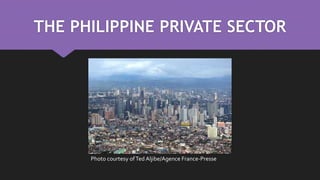
THE PHILIPPINE PRIVATE SECTOR
Photo courtesy ofTed Aljibe/Agence France-Presse
ROLE OF
PRIVATE
SECTOR
 The role of the private sector in economic
development cannot be overemphasized.
 The private sector is the engine of growth.
Successful businesses drive growth, create jobs
and pay the taxes that finance services and
investment.
 The Philippine government acknowledges the role
of the private sector as an important partner in
attaining the country’s development objectives of
inclusive growth.
Government ensures that the interests of both the
private sector and its citizens are balanced, where
policies and procedures are continually enhanced.
EXAMPLES OF PRIVATE COMPANIES
PRIVATIZATION
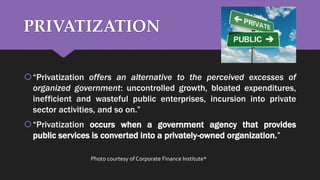
“Privatization offers an alternative to the perceived excesses of
organized government: uncontrolled growth, bloated expenditures,
inefficient and wasteful public enterprises, incursion into private
sector activities, and so on.”
“Privatization occurs when a government agency that provides
public services is converted into a privately-owned organization.”
Photo courtesy of Corporate Finance Institute*
MODES OF PRIVATIZATION
 1. Asset divesture – Disposition or sale of asset or stakes
 2. Contracting – The government pays a private firm to render public services
 3. Franchise – The government gives a private firm the privilege to act as a 'local
monopoly' in their area
 4. Public-Private Partnership – Shared responsibility in delivering public services
THRUST OF PRIVATIZATION
1. Debt crisis
 In an article from The Washington Post in December 25, 1983, it has been
reported that the Marcos administration had accumulated $24 billion in foreign
debt. The Philippines that time “is the first Asian nation with a serious difficulty in
repaying its debts.”
 From https://www.washingtonpost.com/archive/business/1983/12/25/philippines-faces-foreign-debt-
crisis/14d99c52-aa57-486d-8985-10d682d25c19
THRUST OF PRIVATIZATION
2. Multilateral stabilization loan.
The World Bank and the International Monetary Fund asked the
Philippine government under the Marcos administration to present
a privatization policy for their stabilization loan to be approved. A
stabilization loan means the government has to accomplish
economic reforms or changes before the loan gets approved.
THRUST OF PRIVATIZATION
3. Incursion in private sector
Government-owned and controlled corporations increased
significantly during the Marcos administration, which relatively
affected the performance and operation of private
companies/firms. The government attempted to privatize these
GOCCs so the private companies can freely contribute to the
economy.
MANDATE OF PRIVATIZATION
 a) Reduce the financial burden to the government due to “losing and inefficient
GOCCs”
 b) Reduce the government's intervention in economic activity
 c) Raise funds from the sale of GOCCs and assets to finance government
programs
 d) Promote greater efficiency in the operation of the government
ISSUES IN PHILIPPINE PRIVATIZATION
The labor sector was not consulted in formulating
the privatization policy.
 Section 27 of the Proclamation for privatization signed by then President Corazon
Aquino raised ‘much concern.’
 “None of such officers or employees shall retain any vested right to future employment
in the privatized or disposed corporation, and the owners or controlling interest thereof
shall have full and absolute discretion to retain or dismiss said officers and employees
and to hire the replacement or replacements of anyone or all of them as the pleasure
and confidence of such owners may dictate.”
SOURCES:
Briones, L. (January 1989). Issues onThe Privatization Policy in the Philippines
PROCLAMATION NO. 50. Privatization and Management Office
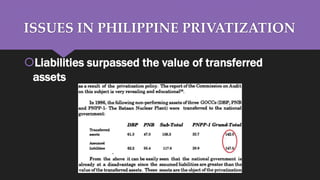
ISSUES IN PHILIPPINE PRIVATIZATION
Liabilities surpassed the value of transferred
assets
ISSUES IN PHILIPPINE PRIVATIZATION
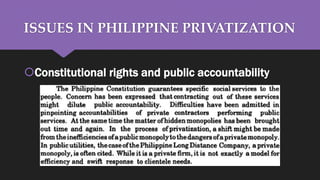
Constitutional rights and public accountability
EXAMPLES OF PRIVATIZATION IN
THE PHILIPPINES
Philippine Long Distance Telephone Company
• Was established on November 28, 1928
• In December 1967, Ramon Cojuangco Sr. took over the
company after buying its shares. This made PLDT a
“Filipino-controlled corporation.”
• In the 1970s, the Marcos administration nationalized the company.
By 1981, PLDT had monopolized the Philippines’ telecommunications industry.
• In 1986, the company had been ‘reprivatized’ as President Corazon Aquino
took over the country.
EXAMPLES OF PRIVATIZATION IN
THE PHILIPPINES
Petron Corporation
• Two oil companies from the United States merged in 1933 to form
Stanvac. When this merger ended, Stanvac became Esso Philippines.
• By 1973, President Ferdinand Marcos Sr. established the GOCC Philippine National Oil
Company (PNOC). Consequently, the PNOC acquired Esso Philippines and renamed it
Petron Corporation.
• In 1993, the PNOC sold 40 percent of Petron to the Arabian American Oil Company (Saudi
Aramco). Another 20 percent was sold to British company Ashmore Group.
• In 2010, Philippine conglomerate San Miguel Corporation acquired the majority of Petron
from the Ashmore Group.
GOVERNMENT-OWNED AND CONTROLLED
CORPORATION/S
MEANING
 “A stock or a non-stock corporation whether performing governmental or
proprietary functions, which is directly chartered by a special law or, if
organized under the general corporation law, is owned or controlled by
the government directly or indirectly through a parent corporation or a
subsidiary corporation.” (Presidential Decree No. 2029)
 “A corporation created by special law or incorporated and organized under
the Corporation Code and in which government, directly or indirectly, has
ownership of the majority of the capital stock.” (Executive Order No. 64 of
1993)
HISTORY OF GOCCs
From the 1950s to 1960s, GOCCs had “disastrous financial
performances.” In 1965, there were 37 GOCCs.
By 1975, or ten years later, the 37 GOCCs became 120 in number.
In 1984, the 120 GOCCs had swelled to 303.
Fast forward to 2010, the country had 604 GOCCs, in which 446 are
water districts.
The privatization of GOCCs through President Cory Aquino’s
proclamation brought down the number of GOCCs to 158 (today).
THRUST OF GOCCs
“Market failures do exist and government needs to intervene to
protect public interest.”
“The use of corporate vehicle recognized as efficient means to
mobilize government assets.”
MANDATE OF GOCCs
 To operate in cases where the private sector is ‘unwilling’ or ‘unable’ to provide goods
and services “vital to the society.” An example is the construction of infrastructure
projects.
 Situation: The participation of the Bases Conversion and Development Authority (BCDA)
in the government’s “Build Build Build” program.
 To “create bias” in favor of disadvantaged sectors of the society in a free market.
Examples are the rice and sugar industries.
 Situation: The creation of the National Food Authority (NFA) and the Sugar Regulatory
Administration (SRA).
 To protect the consuming public from natural monopolies.
 Situation: The function of the Metropolitan Waterworks and Sewerage System (MWSS).
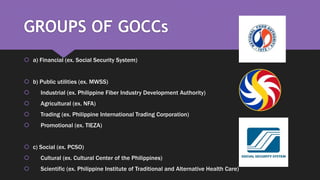
GROUPS OF GOCCs
 a) Financial (ex. Social Security System)
 b) Public utilities (ex. MWSS)
 Industrial (ex. Philippine Fiber Industry Development Authority)
 Agricultural (ex. NFA)
 Trading (ex. Philippine International Trading Corporation)
 Promotional (ex. TIEZA)
 c) Social (ex. PCSO)
 Cultural (ex. Cultural Center of the Philippines)
 Scientific (ex. Philippine Institute of Traditional and Alternative Health Care)
PUBLIC-PRIVATE PARTNERSHIP
A contractual agreement between the government and a private
firm targeted towards financing, designing, implementing, and
operating infrastructure facilities and services that were
traditionally provided by the public sector.
PPP: WHAT IT OFFERS?
 “It embodies “optimal risk allocation” between the parties – minimizing
cost while realizing project developmental objectives. Thus, the project is to
be structured in such a way that the private sector gets a reasonable rate
of return on its investment.”
WHAT CHANGE WILL PPP BRING?
 Allows the allocation of public funds for other “local priorities” as the limited
funding resource for local infrastructure is addressed
 Both the public and private sectors get to share any project risk
 Project implementation and service delivery become more efficient
 Value for Money (VFM), which means reduced costs, better risk allocation, faster
implementation, improved services, and possible additional revenue generation
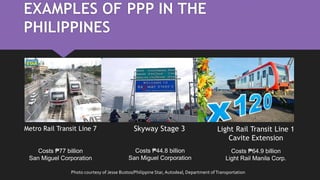
EXAMPLES OF PPP IN THE
PHILIPPINES
Metro Rail Transit Line 7 Skyway Stage 3 Light Rail Transit Line 1
Cavite Extension
Costs ₱77 billion
San Miguel Corporation
Costs ₱44.8 billion
San Miguel Corporation
Costs ₱64.9 billion
Light Rail Manila Corp.
Photo courtesy of Jesse Bustos/Philippine Star, Autodeal, Department ofTransportation
E-GOVERNMENT
 E-government has been employed to mean
everything from ‘online government services’’ to
‘exchange of information and services
electronically with citizens, businesses, and
other arms of government’
 It is the application of ICT in government
operations, achieving public ends by digital
means.
 Through innovation and e-government,
governments around the world can be more
efficient, provide better services, respond to the
demands of citizens for transparency and
accountability, be more inclusive and thus
restore the trust of citizens in their
governments.
REFERENCES
 Briones, L. M. (January 1989). Issues on The Privatization Policy in the Philippines
 Vilches, R. J. (2018, May 29). Privatization of Public Services in the Philippines. SlideShare.
https://www.slideshare.net/DomingoBrotamante/privatization-of-pubilc-services-in-the-philippines
 Lumanog, H. (2014, January 11). Government Owned and Controlled Corporation (GOCC) – Report.
SlideShare. https://www.slideshare.net/HermanLumanog/goverment-owned-and-contolled-
corporation-gocc-report
 What is PPP?. Public-Private Partnership (PPP) Center. https://ppp.gov.ph/ppp-program/what-is-ppp
 Cecilia, E. & DPM. (2020, September 17). The role of the private sector. The Manila Times.
https://www.manilatimes.net/2020/09/17/campus-press/the-role-of-the-private-sector/768834

Privatization and E-government in the Philippines

  • 1.
    Enhancing Good Government ThroughPRIVATIZATION and E-GOVERNMENT A Presentation by Group 5 (BPA 1-A) MONTENEGRO | OBTIAR | NAVARRO | RODAVIA | PADILLA | RACELIS | RODRIGUEZ | PACHEO | ORGANO
  • 2.
    THE PHILIPPINE PRIVATESECTOR Photo courtesy ofTed Aljibe/Agence France-Presse
  • 3.
    ROLE OF PRIVATE SECTOR  Therole of the private sector in economic development cannot be overemphasized.  The private sector is the engine of growth. Successful businesses drive growth, create jobs and pay the taxes that finance services and investment.  The Philippine government acknowledges the role of the private sector as an important partner in attaining the country’s development objectives of inclusive growth. Government ensures that the interests of both the private sector and its citizens are balanced, where policies and procedures are continually enhanced.
  • 4.
  • 5.
    PRIVATIZATION “Privatization offers analternative to the perceived excesses of organized government: uncontrolled growth, bloated expenditures, inefficient and wasteful public enterprises, incursion into private sector activities, and so on.” “Privatization occurs when a government agency that provides public services is converted into a privately-owned organization.” Photo courtesy of Corporate Finance Institute*
  • 6.
    MODES OF PRIVATIZATION 1. Asset divesture – Disposition or sale of asset or stakes  2. Contracting – The government pays a private firm to render public services  3. Franchise – The government gives a private firm the privilege to act as a 'local monopoly' in their area  4. Public-Private Partnership – Shared responsibility in delivering public services
  • 7.
    THRUST OF PRIVATIZATION 1.Debt crisis  In an article from The Washington Post in December 25, 1983, it has been reported that the Marcos administration had accumulated $24 billion in foreign debt. The Philippines that time “is the first Asian nation with a serious difficulty in repaying its debts.”  From https://www.washingtonpost.com/archive/business/1983/12/25/philippines-faces-foreign-debt- crisis/14d99c52-aa57-486d-8985-10d682d25c19
  • 8.
    THRUST OF PRIVATIZATION 2.Multilateral stabilization loan. The World Bank and the International Monetary Fund asked the Philippine government under the Marcos administration to present a privatization policy for their stabilization loan to be approved. A stabilization loan means the government has to accomplish economic reforms or changes before the loan gets approved.
  • 9.
    THRUST OF PRIVATIZATION 3.Incursion in private sector Government-owned and controlled corporations increased significantly during the Marcos administration, which relatively affected the performance and operation of private companies/firms. The government attempted to privatize these GOCCs so the private companies can freely contribute to the economy.
  • 10.
    MANDATE OF PRIVATIZATION a) Reduce the financial burden to the government due to “losing and inefficient GOCCs”  b) Reduce the government's intervention in economic activity  c) Raise funds from the sale of GOCCs and assets to finance government programs  d) Promote greater efficiency in the operation of the government
  • 11.
    ISSUES IN PHILIPPINEPRIVATIZATION The labor sector was not consulted in formulating the privatization policy.  Section 27 of the Proclamation for privatization signed by then President Corazon Aquino raised ‘much concern.’  “None of such officers or employees shall retain any vested right to future employment in the privatized or disposed corporation, and the owners or controlling interest thereof shall have full and absolute discretion to retain or dismiss said officers and employees and to hire the replacement or replacements of anyone or all of them as the pleasure and confidence of such owners may dictate.” SOURCES: Briones, L. (January 1989). Issues onThe Privatization Policy in the Philippines PROCLAMATION NO. 50. Privatization and Management Office
  • 12.
    ISSUES IN PHILIPPINEPRIVATIZATION Liabilities surpassed the value of transferred assets
  • 13.
    ISSUES IN PHILIPPINEPRIVATIZATION Constitutional rights and public accountability
  • 14.
    EXAMPLES OF PRIVATIZATIONIN THE PHILIPPINES Philippine Long Distance Telephone Company • Was established on November 28, 1928 • In December 1967, Ramon Cojuangco Sr. took over the company after buying its shares. This made PLDT a “Filipino-controlled corporation.” • In the 1970s, the Marcos administration nationalized the company. By 1981, PLDT had monopolized the Philippines’ telecommunications industry. • In 1986, the company had been ‘reprivatized’ as President Corazon Aquino took over the country.
  • 15.
    EXAMPLES OF PRIVATIZATIONIN THE PHILIPPINES Petron Corporation • Two oil companies from the United States merged in 1933 to form Stanvac. When this merger ended, Stanvac became Esso Philippines. • By 1973, President Ferdinand Marcos Sr. established the GOCC Philippine National Oil Company (PNOC). Consequently, the PNOC acquired Esso Philippines and renamed it Petron Corporation. • In 1993, the PNOC sold 40 percent of Petron to the Arabian American Oil Company (Saudi Aramco). Another 20 percent was sold to British company Ashmore Group. • In 2010, Philippine conglomerate San Miguel Corporation acquired the majority of Petron from the Ashmore Group.
  • 16.
    GOVERNMENT-OWNED AND CONTROLLED CORPORATION/S MEANING “A stock or a non-stock corporation whether performing governmental or proprietary functions, which is directly chartered by a special law or, if organized under the general corporation law, is owned or controlled by the government directly or indirectly through a parent corporation or a subsidiary corporation.” (Presidential Decree No. 2029)  “A corporation created by special law or incorporated and organized under the Corporation Code and in which government, directly or indirectly, has ownership of the majority of the capital stock.” (Executive Order No. 64 of 1993)
  • 17.
    HISTORY OF GOCCs Fromthe 1950s to 1960s, GOCCs had “disastrous financial performances.” In 1965, there were 37 GOCCs. By 1975, or ten years later, the 37 GOCCs became 120 in number. In 1984, the 120 GOCCs had swelled to 303. Fast forward to 2010, the country had 604 GOCCs, in which 446 are water districts. The privatization of GOCCs through President Cory Aquino’s proclamation brought down the number of GOCCs to 158 (today).
  • 18.
    THRUST OF GOCCs “Marketfailures do exist and government needs to intervene to protect public interest.” “The use of corporate vehicle recognized as efficient means to mobilize government assets.”
  • 19.
    MANDATE OF GOCCs To operate in cases where the private sector is ‘unwilling’ or ‘unable’ to provide goods and services “vital to the society.” An example is the construction of infrastructure projects.  Situation: The participation of the Bases Conversion and Development Authority (BCDA) in the government’s “Build Build Build” program.  To “create bias” in favor of disadvantaged sectors of the society in a free market. Examples are the rice and sugar industries.  Situation: The creation of the National Food Authority (NFA) and the Sugar Regulatory Administration (SRA).  To protect the consuming public from natural monopolies.  Situation: The function of the Metropolitan Waterworks and Sewerage System (MWSS).
  • 20.
    GROUPS OF GOCCs a) Financial (ex. Social Security System)  b) Public utilities (ex. MWSS)  Industrial (ex. Philippine Fiber Industry Development Authority)  Agricultural (ex. NFA)  Trading (ex. Philippine International Trading Corporation)  Promotional (ex. TIEZA)  c) Social (ex. PCSO)  Cultural (ex. Cultural Center of the Philippines)  Scientific (ex. Philippine Institute of Traditional and Alternative Health Care)
  • 21.
    PUBLIC-PRIVATE PARTNERSHIP A contractualagreement between the government and a private firm targeted towards financing, designing, implementing, and operating infrastructure facilities and services that were traditionally provided by the public sector.
  • 22.
    PPP: WHAT ITOFFERS?  “It embodies “optimal risk allocation” between the parties – minimizing cost while realizing project developmental objectives. Thus, the project is to be structured in such a way that the private sector gets a reasonable rate of return on its investment.”
  • 23.
    WHAT CHANGE WILLPPP BRING?  Allows the allocation of public funds for other “local priorities” as the limited funding resource for local infrastructure is addressed  Both the public and private sectors get to share any project risk  Project implementation and service delivery become more efficient  Value for Money (VFM), which means reduced costs, better risk allocation, faster implementation, improved services, and possible additional revenue generation
  • 24.
    EXAMPLES OF PPPIN THE PHILIPPINES Metro Rail Transit Line 7 Skyway Stage 3 Light Rail Transit Line 1 Cavite Extension Costs ₱77 billion San Miguel Corporation Costs ₱44.8 billion San Miguel Corporation Costs ₱64.9 billion Light Rail Manila Corp. Photo courtesy of Jesse Bustos/Philippine Star, Autodeal, Department ofTransportation
  • 25.
    E-GOVERNMENT  E-government hasbeen employed to mean everything from ‘online government services’’ to ‘exchange of information and services electronically with citizens, businesses, and other arms of government’  It is the application of ICT in government operations, achieving public ends by digital means.  Through innovation and e-government, governments around the world can be more efficient, provide better services, respond to the demands of citizens for transparency and accountability, be more inclusive and thus restore the trust of citizens in their governments.
  • 26.
    REFERENCES  Briones, L.M. (January 1989). Issues on The Privatization Policy in the Philippines  Vilches, R. J. (2018, May 29). Privatization of Public Services in the Philippines. SlideShare. https://www.slideshare.net/DomingoBrotamante/privatization-of-pubilc-services-in-the-philippines  Lumanog, H. (2014, January 11). Government Owned and Controlled Corporation (GOCC) – Report. SlideShare. https://www.slideshare.net/HermanLumanog/goverment-owned-and-contolled- corporation-gocc-report  What is PPP?. Public-Private Partnership (PPP) Center. https://ppp.gov.ph/ppp-program/what-is-ppp  Cecilia, E. & DPM. (2020, September 17). The role of the private sector. The Manila Times. https://www.manilatimes.net/2020/09/17/campus-press/the-role-of-the-private-sector/768834