(Problem Analysis, In Basket, and Group Discussion)
www.humanikaconsulting.com
Developing Tools of…
Seta A. Wicaksana, M.Psi., Psikolog
0811 19 53 43
seta.wicaksana@gmail.com
• Ahli Senior di Komite Kebijakan Pengelolaan Kinerja Organisasi dan SDM (KPKOS)
Dewan Pengawas BPJS Ketenagakerjaan
• Wakil Dekan II Fakultas Psikologi Universitas Pancasila
• Pembina Yayasan Humanika Edukasi Indonesia
• Pendiri dan Direktur Humanika Consulting
• Penulis Buku “SOBAT” Elexmedia Gramedia 2016
• Trainer, Psikolog, Konselor Karir dan Assessor di Humanika Consulting
• Pengembang Alat Tes minat bakat BRIGHT dan Sistem Tes Psikologi berbasis aplikasi
HITS dan HABIT
• Dosen Tetap Fakultas Psikologi Universitas Pancasila
• Sedang mengikuti tugas belajar Doktoral (S3) di Fakultas Ilmu Ekonomi dan Bisnis
Universitas Pancasila Bidang MSDM
• Lulusan Fakultas Psikologi S1 dan S2 Universitas Indonesia
• Lulusan sekolah ikatan dinas Akademi Sandi Negara
• Memahami konsep dan jenis-jenis Tes Situasional
• Memahami pelaksanaan Tes Situasional
• Memahami penyusunan Tes Situasional
• Terampil dalam membuat dan menyusun Tes
Situational.
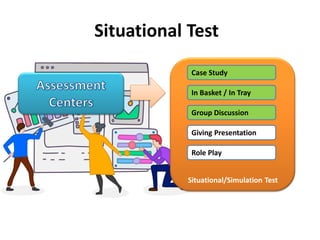
Situational Test
In Basket / In Tray
Group Discussion
Giving Presentation
Role Play
Situational/Simulation Test
Case Study
• Berupa berbagai problem
yang dapat menstimulasi
munculnya perilaku-
perilaku yang berkaitan
dengan kompetensi suatu
pekerjaan
• Kandidat ditempatkan pada
situasi yang serupa/sama
dengan pekerjaan/posisi
tertentu (se-natural
mungkin)
• Disebut juga Simulasi
• Penting dalam Assessment
Center dalam menggali
Knowledge and Skill
KASUS YANG DIUJIKAN DALAM TES SIMULASI
1. Krisis
kandidat harus memecahkan
problem dalam deadline ketat,
jika tindakan tidak tepat akan
memperparah problem (CS, IB,
PS, LGD, RP)
2. Eksploitasi
kandidat
mengembangkan/memperbaiki
suatu problem (CS, IB, PS, LGD,
RP)
3. Kreatif
kandidat mendesain,
merencanakan sesuatu yang
baru (CS, LGD, RP)
Case Study / Problem Analysis
CASE STUDY / PROBLEM ANALYSIS
• The case study exercise is a realistic simulation of the type of
business or strategic problem you are likely to encounter in your
new role (if you get the job!).
• a series of fictional documents such as company reports, a
consultant’s report, results from new product research etc. (i.e.
similar to the in-tray exercise except these documents will be
longer)
• be asked to make business decisions based on the information.
• can be done as an individual exercise, or more likely done in a group
discussion so that assessors can also score your team working
ability.
• Presenting proposal in the form of a brief report
or presentation.
• presenting your recommendations at an
interview with an assessor
• case study exercises are usually designed not to
have one ‘correct’ answer.
TYPICAL COMPETENCIES ASSESSED IN
THE CASE STUDY ARE:
1. Analytical Thinking
2. Assimilation of Information
3. Commercial
Awareness/keeping update
information
4. Innovation
5. Organizing
6. Decisiveness
7. Judgement
EXPLORING SKILLS
1. Interpreting lots of data in varying
formats and from various sources.
2. Analytical and strategic analysis of
problems
3. Formulating and committing to a
decision.
4. Commercial and entrepreneurial
insight into a problem.
5. Setting priority based on time
management
6. 6. Oral communication skills for
discussing your recommendations
SUITABLE THEMES FOR CASE OR PROJECT FILES
• A project is behind schedule and over budget.
• A complaint has been filed and an investigation is either
ongoing or has concluded.
• A decision denying an application has been appealed.
• An income assistance file needs to be reviewed and
critical decisions made.
• A labour relations case involving many interwoven and
underlying issues requires recommendations on action
or preparation for arbitration.
• A technical engineering project file needs to be audited
for adherence to regulations and standards.
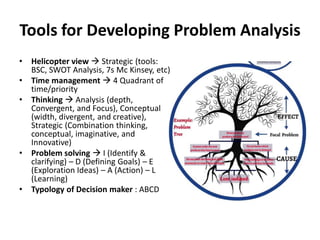
Tools for Developing Problem Analysis
• Helicopter view  Strategic (tools:
BSC, SWOT Analysis, 7s Mc Kinsey, etc)
• Time management  4 Quadrant of
time/priority
• Thinking  Analysis (depth,
Convergent, and Focus), Conceptual
(width, divergent, and creative),
Strategic (Combination thinking,
conceptual, imaginative, and
Innovative)
• Problem solving  I (Identify &
clarifying) – D (Defining Goals) – E
(Exploration Ideas) – A (Action) – L
(Learning)
• Typology of Decision maker : ABCD
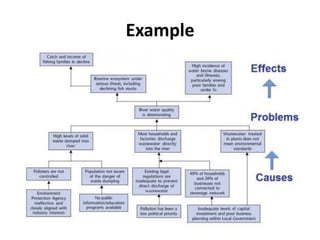
Example
Developing Case/Project study
• Purpose This
simulation will measure?
• Scenario
• Materials Provided
• Required Performance
• Time Limit
• Method of Rating
Strategic Tools - BSC
Mission
and
Vision
Strategic Tools – SWOT Analysis
Strategic Tools – 7s Mc Kinsey
Strategic Tools - Comparative
Time Management
THINKING (BLOOM’S REVISED TAXONOMY)
Creating
Generating new ideas, products, or ways of viewing things
Designing, constructing, planning, producing, inventing.
Evaluating
Justifying a decision or course of action
Checking, hypothesising, critiquing, experimenting, judging
Analyzing
Breaking information into parts to explore understandings and relationships
Comparing, organising, deconstructing, interrogating, finding
Applying
Using information in another familiar situation
Implementing, carrying out, using, executing
Understanding
Explaining ideas or concepts
Interpreting, summarising, paraphrasing, classifying, explaining
Remembering
Recalling information
Recognizing, listing, describing, retrieving, naming, finding
Problem Solving
Identifying
& Clarifying
Defining
Goals
Exploring
Ideas
Action
Learning
Problem
Solving
Typology of Decision Maker
Tips for Developing Effective Case /
Project File Tests
• Base tests on typical job samples from real
life  Choose a complex example that
happens on a fairly routine basis.
• Design rating scales in advance : can be used
to measure one skill or many skills
concurrently and
• Disguise real people and real fact.
• Provide all applicants with the same
knowledge base.
5 Tips For Creating a Case Study
1. Write About Someone Your Ideal Customer
Can Relate To
“If it’s someone in the education industry, then make your case studies about your
university customers”
The goal is to ensure that once your ideal customer has read your case studies, they
will feel:
• You are comfortable in their industry.
• You know their industry’s specific needs.
• You know how to give their industry targeted
results.
5 Tips For Creating a Case Study
2. Tell the Story from Start to Finish
People enjoy reading a story. A great case study will allow someone to really get to
know the customer in the case study including:
• Who is the sample customer and what do they
do?
• What were the customer’s goals?
• What were the customer’s needs?
• How did you satisfy those needs and help the
customer meet their goals?
5 Tips For Creating a Case Study
3. Provide Easy to Read Formatting
Be sure to use good content formatting elements like you would with articles,
blog posts, and copywriting on your website including:
• Headers
• Images
• Bulleted lists
• Bolded & italicized text
5 Tips For Creating a Case Study
4. Include Real Numbers
5 Tips For Creating a Case Study
5. Try Different Formats for Different Type of
Learners
• A podcast
• A YouTube video
• Or even an infographic
Kandidat diberikan 1 set berkas-berkas atau arsip yang
mencerminkan tugas-tugas pada posisi/job tertentu.
Kandidat diminta untuk membuat perencanaan,
pengambilan keputusan, dan komunikasi secara
tertulis berkaitan dengan problem yang ada.
Waktu: 1-2 jam (sesuai tingkat kesulitan In-Basket)
Kompetensi yang diukur: Problem Solving, Decision
Making, Analytical Thinking, Sensitivity, dll.
In Basket / In Tray
Work Efficiently
Identify key issues
Set Priorities
Anticipate Problems
Explore issues
Suggest Options
Make Recommendation
Give Reasons
Kelebihan
(+) Validitas lebih baik
(+) Praktis, dikerjakan sendiri
oleh kandidat
(+) Proses penyusunan yang
rumit dan panjang
Kelemahan
(-) Kejenuhan peserta
(-) Memerlukan waktu
lebih banyak untuk
mengerjakan tes (1-3
jam)
• Base on routine events on the job
• Design rating scales
• Pre-test
• Make the in-basket test an "open book" exam
• Avoid making success in one task contingent on
success in another
• Avoid bias towards applicants with "inside"
knowledge
Leaderless Group Discussion
Kandidat dilibatkan dalam kelompok 4-6 orang, diberikan
Case Study atau problem dan diminta untuk
mendiskusikan dan membuat kesimpulan berupa
rekomendasi/solusi atas problem tersebut.
Waktu: maksimal 45 menit
Assesor: 2 orang / kandidat (observasi silang)
Kompetensi yang dinilai: Communication, Influencing Others,
Persuasiveness, Developing & Maintaining Relationship,
Business Orientation, Negotiating, Leadership, dll.
Contribute Idea
Actively listening
Define Objective
Plan Solutions
Create discussion
Draw Conclusions
• Purpose This simulation will measure?
• Scenario
• Materials Provided
• Required Performance
• Time Limit
• Method of Rating
Kelebihan
(+) menonjolkan kemunculan kompetensi komunkasi, orientasi
team, interpersonal relationship, negosiasi, persuasif.
Kelemahan
(-) Kejenuhan peserta
(-) Memerlukan waktu lebih banyak untuk mengerjakan tes (1-3
jam)
Developing assessment center tools (case study)

Developing assessment center tools (case study)

  • 1.
    (Problem Analysis, InBasket, and Group Discussion) www.humanikaconsulting.com Developing Tools of…
  • 2.
    Seta A. Wicaksana,M.Psi., Psikolog 0811 19 53 43 seta.wicaksana@gmail.com • Ahli Senior di Komite Kebijakan Pengelolaan Kinerja Organisasi dan SDM (KPKOS) Dewan Pengawas BPJS Ketenagakerjaan • Wakil Dekan II Fakultas Psikologi Universitas Pancasila • Pembina Yayasan Humanika Edukasi Indonesia • Pendiri dan Direktur Humanika Consulting • Penulis Buku “SOBAT” Elexmedia Gramedia 2016 • Trainer, Psikolog, Konselor Karir dan Assessor di Humanika Consulting • Pengembang Alat Tes minat bakat BRIGHT dan Sistem Tes Psikologi berbasis aplikasi HITS dan HABIT • Dosen Tetap Fakultas Psikologi Universitas Pancasila • Sedang mengikuti tugas belajar Doktoral (S3) di Fakultas Ilmu Ekonomi dan Bisnis Universitas Pancasila Bidang MSDM • Lulusan Fakultas Psikologi S1 dan S2 Universitas Indonesia • Lulusan sekolah ikatan dinas Akademi Sandi Negara
  • 3.
    • Memahami konsepdan jenis-jenis Tes Situasional • Memahami pelaksanaan Tes Situasional • Memahami penyusunan Tes Situasional • Terampil dalam membuat dan menyusun Tes Situational.
  • 4.
    Situational Test In Basket/ In Tray Group Discussion Giving Presentation Role Play Situational/Simulation Test Case Study
  • 5.
    • Berupa berbagaiproblem yang dapat menstimulasi munculnya perilaku- perilaku yang berkaitan dengan kompetensi suatu pekerjaan • Kandidat ditempatkan pada situasi yang serupa/sama dengan pekerjaan/posisi tertentu (se-natural mungkin) • Disebut juga Simulasi • Penting dalam Assessment Center dalam menggali Knowledge and Skill
  • 6.
    KASUS YANG DIUJIKANDALAM TES SIMULASI 1. Krisis kandidat harus memecahkan problem dalam deadline ketat, jika tindakan tidak tepat akan memperparah problem (CS, IB, PS, LGD, RP) 2. Eksploitasi kandidat mengembangkan/memperbaiki suatu problem (CS, IB, PS, LGD, RP) 3. Kreatif kandidat mendesain, merencanakan sesuatu yang baru (CS, LGD, RP)
  • 7.
    Case Study /Problem Analysis
  • 8.
    CASE STUDY /PROBLEM ANALYSIS • The case study exercise is a realistic simulation of the type of business or strategic problem you are likely to encounter in your new role (if you get the job!). • a series of fictional documents such as company reports, a consultant’s report, results from new product research etc. (i.e. similar to the in-tray exercise except these documents will be longer) • be asked to make business decisions based on the information. • can be done as an individual exercise, or more likely done in a group discussion so that assessors can also score your team working ability.
  • 9.
    • Presenting proposalin the form of a brief report or presentation. • presenting your recommendations at an interview with an assessor • case study exercises are usually designed not to have one ‘correct’ answer.
  • 10.
    TYPICAL COMPETENCIES ASSESSEDIN THE CASE STUDY ARE: 1. Analytical Thinking 2. Assimilation of Information 3. Commercial Awareness/keeping update information 4. Innovation 5. Organizing 6. Decisiveness 7. Judgement
  • 11.
    EXPLORING SKILLS 1. Interpretinglots of data in varying formats and from various sources. 2. Analytical and strategic analysis of problems 3. Formulating and committing to a decision. 4. Commercial and entrepreneurial insight into a problem. 5. Setting priority based on time management 6. 6. Oral communication skills for discussing your recommendations
  • 12.
    SUITABLE THEMES FORCASE OR PROJECT FILES • A project is behind schedule and over budget. • A complaint has been filed and an investigation is either ongoing or has concluded. • A decision denying an application has been appealed. • An income assistance file needs to be reviewed and critical decisions made. • A labour relations case involving many interwoven and underlying issues requires recommendations on action or preparation for arbitration. • A technical engineering project file needs to be audited for adherence to regulations and standards.
  • 13.
    Tools for DevelopingProblem Analysis • Helicopter view  Strategic (tools: BSC, SWOT Analysis, 7s Mc Kinsey, etc) • Time management  4 Quadrant of time/priority • Thinking  Analysis (depth, Convergent, and Focus), Conceptual (width, divergent, and creative), Strategic (Combination thinking, conceptual, imaginative, and Innovative) • Problem solving  I (Identify & clarifying) – D (Defining Goals) – E (Exploration Ideas) – A (Action) – L (Learning) • Typology of Decision maker : ABCD
  • 14.
  • 15.
    Developing Case/Project study •Purpose This simulation will measure? • Scenario • Materials Provided • Required Performance • Time Limit • Method of Rating
  • 16.
    Strategic Tools -BSC Mission and Vision
  • 17.
    Strategic Tools –SWOT Analysis
  • 18.
    Strategic Tools –7s Mc Kinsey
  • 19.
    Strategic Tools -Comparative
  • 20.
  • 21.
    THINKING (BLOOM’S REVISEDTAXONOMY) Creating Generating new ideas, products, or ways of viewing things Designing, constructing, planning, producing, inventing. Evaluating Justifying a decision or course of action Checking, hypothesising, critiquing, experimenting, judging Analyzing Breaking information into parts to explore understandings and relationships Comparing, organising, deconstructing, interrogating, finding Applying Using information in another familiar situation Implementing, carrying out, using, executing Understanding Explaining ideas or concepts Interpreting, summarising, paraphrasing, classifying, explaining Remembering Recalling information Recognizing, listing, describing, retrieving, naming, finding
  • 22.
  • 23.
  • 25.
    Tips for DevelopingEffective Case / Project File Tests • Base tests on typical job samples from real life  Choose a complex example that happens on a fairly routine basis. • Design rating scales in advance : can be used to measure one skill or many skills concurrently and • Disguise real people and real fact. • Provide all applicants with the same knowledge base.
  • 26.
    5 Tips ForCreating a Case Study 1. Write About Someone Your Ideal Customer Can Relate To “If it’s someone in the education industry, then make your case studies about your university customers” The goal is to ensure that once your ideal customer has read your case studies, they will feel: • You are comfortable in their industry. • You know their industry’s specific needs. • You know how to give their industry targeted results.
  • 27.
    5 Tips ForCreating a Case Study 2. Tell the Story from Start to Finish People enjoy reading a story. A great case study will allow someone to really get to know the customer in the case study including: • Who is the sample customer and what do they do? • What were the customer’s goals? • What were the customer’s needs? • How did you satisfy those needs and help the customer meet their goals?
  • 28.
    5 Tips ForCreating a Case Study 3. Provide Easy to Read Formatting Be sure to use good content formatting elements like you would with articles, blog posts, and copywriting on your website including: • Headers • Images • Bulleted lists • Bolded & italicized text
  • 29.
    5 Tips ForCreating a Case Study 4. Include Real Numbers
  • 30.
    5 Tips ForCreating a Case Study 5. Try Different Formats for Different Type of Learners • A podcast • A YouTube video • Or even an infographic
  • 33.
    Kandidat diberikan 1set berkas-berkas atau arsip yang mencerminkan tugas-tugas pada posisi/job tertentu. Kandidat diminta untuk membuat perencanaan, pengambilan keputusan, dan komunikasi secara tertulis berkaitan dengan problem yang ada. Waktu: 1-2 jam (sesuai tingkat kesulitan In-Basket) Kompetensi yang diukur: Problem Solving, Decision Making, Analytical Thinking, Sensitivity, dll.
  • 34.
    In Basket /In Tray Work Efficiently Identify key issues Set Priorities Anticipate Problems Explore issues Suggest Options Make Recommendation Give Reasons
  • 35.
    Kelebihan (+) Validitas lebihbaik (+) Praktis, dikerjakan sendiri oleh kandidat (+) Proses penyusunan yang rumit dan panjang Kelemahan (-) Kejenuhan peserta (-) Memerlukan waktu lebih banyak untuk mengerjakan tes (1-3 jam)
  • 36.
    • Base onroutine events on the job • Design rating scales • Pre-test • Make the in-basket test an "open book" exam • Avoid making success in one task contingent on success in another • Avoid bias towards applicants with "inside" knowledge
  • 37.
  • 38.
    Kandidat dilibatkan dalamkelompok 4-6 orang, diberikan Case Study atau problem dan diminta untuk mendiskusikan dan membuat kesimpulan berupa rekomendasi/solusi atas problem tersebut. Waktu: maksimal 45 menit Assesor: 2 orang / kandidat (observasi silang) Kompetensi yang dinilai: Communication, Influencing Others, Persuasiveness, Developing & Maintaining Relationship, Business Orientation, Negotiating, Leadership, dll.
  • 39.
    Contribute Idea Actively listening DefineObjective Plan Solutions Create discussion Draw Conclusions
  • 40.
    • Purpose Thissimulation will measure? • Scenario • Materials Provided • Required Performance • Time Limit • Method of Rating
  • 41.
    Kelebihan (+) menonjolkan kemunculankompetensi komunkasi, orientasi team, interpersonal relationship, negosiasi, persuasif. Kelemahan (-) Kejenuhan peserta (-) Memerlukan waktu lebih banyak untuk mengerjakan tes (1-3 jam)