Developing a Gamified
Online Course on
Serious Games
OOFHEC2018:
Online, Open and Flexible Higher
Education Conference
Aarhus, Denmark
11 October 2018
Tanja Korhonen
Kajaani University of
Applied Sciences
Tanja.Korhonen@kamk.fi
Teija Lehto
Tampere University of Applied
Sciences, Finland
Teija.Lehto@tamk.fi
Introduction
2
• Tampere University of Applied Sciences (TAMK) and Kajaani
University of Applied Sciences (KAMK) were from 2016 till 2018
involved in a national, ESF funded project "SeGaBu - Serious
Games Platform for Business and Education" (http://segabu.fi)
• Gamification played an essential role in the content, as well as
the design of the courses.
Pilot courses
3
Gamification was applied in five
MOOC-type online courses (5 ects
each) on the DIGMA.FI platform.
Moodle-based LMS. Restrictions of
the Moodle platform to be
considered.
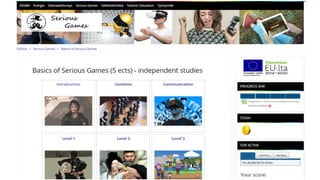
The course we mostly demonstrate
as an example of gamification is
"Basics of Serious Games”.
Five MOOC-type courses
• Basics of Serious Games
• Testing Methods for Serious
Games
• Serious Games and Business
• Game and Gamification
Design
• R&D Project in Serious Games
https://moodle.amk.fi/course/in
dex.php?categoryid=20
4
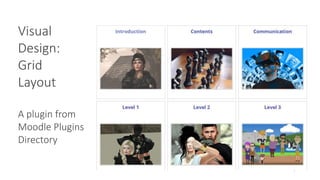
Visual
Design:
Grid
Layout
A plugin from
Moodle Plugins
Directory
5
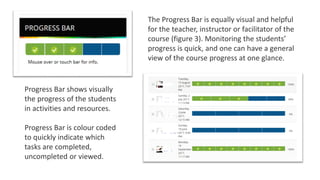
Progress Bar shows visually
the progress of the students
in activities and resources.
Progress Bar is colour coded
to quickly indicate which
tasks are completed,
uncompleted or viewed.
The Progress Bar is equally visual and helpful
for the teacher, instructor or facilitator of the
course (figure 3). Monitoring the students’
progress is quick, and one can have a general
view of the course progress at one glance.
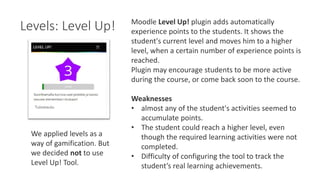
Levels: Level Up! Moodle Level Up! plugin adds automatically
experience points to the students. It shows the
student's current level and moves him to a higher
level, when a certain number of experience points is
reached.
Plugin may encourage students to be more active
during the course, or come back soon to the course.
Weaknesses
• almost any of the student's activities seemed to
accumulate points.
• The student could reach a higher level, even
though the required learning activities were not
completed.
• Difficulty of configuring the tool to track the
student’s real learning achievements.
We applied levels as a
way of gamification. But
we decided not to use
Level Up! Tool.
Levels
8
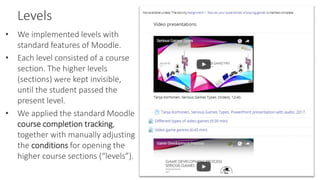
• We implemented levels with
standard features of Moodle.
• Each level consisted of a course
section. The higher levels
(sections) were kept invisible,
until the student passed the
present level.
• We applied the standard Moodle
course completion tracking,
together with manually adjusting
the conditions for opening the
higher course sections (“levels”).
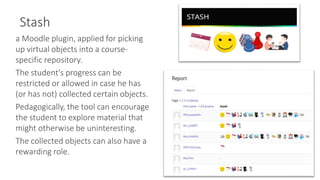
Stash
9
a Moodle plugin, applied for picking
up virtual objects into a course-
specific repository.
The student's progress can be
restricted or allowed in case he has
(or has not) collected certain objects.
Pedagogically, the tool can encourage
the student to explore material that
might otherwise be uninteresting.
The collected objects can also have a
rewarding role.
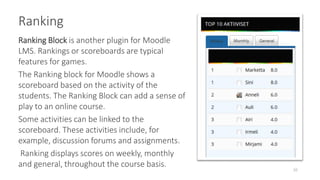
Ranking
10
Ranking Block is another plugin for Moodle
LMS. Rankings or scoreboards are typical
features for games.
The Ranking block for Moodle shows a
scoreboard based on the activity of the
students. The Ranking Block can add a sense of
play to an online course.
Some activities can be linked to the
scoreboard. These activities include, for
example, discussion forums and assignments.
Ranking displays scores on weekly, monthly
and general, throughout the course basis.
GAME plugin
11
• Builds on Moodle’s questions, quizzes and glossaries, creating a
new layout on them.
• Possible to create interactive games, such as Hangman,
Crossword, Cryptex, Snakes and ladders, Hidden picture,
Millionaire and Sudoku.
• Games are designed to be played independently.
• Visual layout is quite simple and sometimes even old-
fashioned. However, they are much better than no game layout
at all.
GAME plugin
12
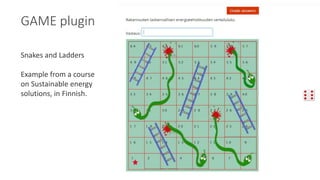
Snakes and Ladders
Example from a course
on Sustainable energy
solutions, in Finnish.
GAME plugin
13
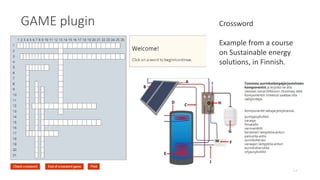
Crossword
Example from a course
on Sustainable energy
solutions, in Finnish.
GAME plugin
14
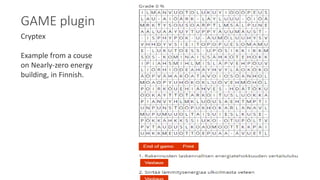
Cryptex
Example from a couse
on Nearly-zero energy
building, in Finnish.
Feedback and conclusions
15
• It was useful and fruitful to use gamification in an online course; it made
the course more interesting and engaging for the students, thus having a
positive influence on study motivation.
• Some technical problems came up, and help in these situations was
needed.
• The gamified tools did not always work the way they were intended: the
aim of the collectable coins (Stash) was unclear, the Level-up tool did not
serve our purposes, and the Progress bar did not always show the right
information, even though students considered them as good elements in
the course.
• The means and tools of gamification have to be carefully selected to suit
the course and its students.
OER
16
Material-only versions are freely
available on Digma.fi LMS, in
section “Serious Games”. No
need for login.
Unfortunately, activities,
discussions, tests, most
assignments – and mostly
gamification are missing in the
OER versions.
Open online materials for
• Basics of Serious Games
• Game Testing
• Serious Games and Business
• Game and Gamification
Design
• R&D Project in Serious Games
https://moodle.amk.fi/course/in
dex.php?categoryid=28

Developing a Gamified Online Course on Serious Games

  • 1.
    Developing a Gamified OnlineCourse on Serious Games OOFHEC2018: Online, Open and Flexible Higher Education Conference Aarhus, Denmark 11 October 2018 Tanja Korhonen Kajaani University of Applied Sciences Tanja.Korhonen@kamk.fi Teija Lehto Tampere University of Applied Sciences, Finland Teija.Lehto@tamk.fi
  • 2.
    Introduction 2 • Tampere Universityof Applied Sciences (TAMK) and Kajaani University of Applied Sciences (KAMK) were from 2016 till 2018 involved in a national, ESF funded project "SeGaBu - Serious Games Platform for Business and Education" (http://segabu.fi) • Gamification played an essential role in the content, as well as the design of the courses.
  • 3.
    Pilot courses 3 Gamification wasapplied in five MOOC-type online courses (5 ects each) on the DIGMA.FI platform. Moodle-based LMS. Restrictions of the Moodle platform to be considered. The course we mostly demonstrate as an example of gamification is "Basics of Serious Games”. Five MOOC-type courses • Basics of Serious Games • Testing Methods for Serious Games • Serious Games and Business • Game and Gamification Design • R&D Project in Serious Games https://moodle.amk.fi/course/in dex.php?categoryid=20
  • 4.
  • 5.
  • 6.
    Progress Bar showsvisually the progress of the students in activities and resources. Progress Bar is colour coded to quickly indicate which tasks are completed, uncompleted or viewed. The Progress Bar is equally visual and helpful for the teacher, instructor or facilitator of the course (figure 3). Monitoring the students’ progress is quick, and one can have a general view of the course progress at one glance.
  • 7.
    Levels: Level Up!Moodle Level Up! plugin adds automatically experience points to the students. It shows the student's current level and moves him to a higher level, when a certain number of experience points is reached. Plugin may encourage students to be more active during the course, or come back soon to the course. Weaknesses • almost any of the student's activities seemed to accumulate points. • The student could reach a higher level, even though the required learning activities were not completed. • Difficulty of configuring the tool to track the student’s real learning achievements. We applied levels as a way of gamification. But we decided not to use Level Up! Tool.
  • 8.
    Levels 8 • We implementedlevels with standard features of Moodle. • Each level consisted of a course section. The higher levels (sections) were kept invisible, until the student passed the present level. • We applied the standard Moodle course completion tracking, together with manually adjusting the conditions for opening the higher course sections (“levels”).
  • 9.
    Stash 9 a Moodle plugin,applied for picking up virtual objects into a course- specific repository. The student's progress can be restricted or allowed in case he has (or has not) collected certain objects. Pedagogically, the tool can encourage the student to explore material that might otherwise be uninteresting. The collected objects can also have a rewarding role.
  • 10.
    Ranking 10 Ranking Block isanother plugin for Moodle LMS. Rankings or scoreboards are typical features for games. The Ranking block for Moodle shows a scoreboard based on the activity of the students. The Ranking Block can add a sense of play to an online course. Some activities can be linked to the scoreboard. These activities include, for example, discussion forums and assignments. Ranking displays scores on weekly, monthly and general, throughout the course basis.
  • 11.
    GAME plugin 11 • Buildson Moodle’s questions, quizzes and glossaries, creating a new layout on them. • Possible to create interactive games, such as Hangman, Crossword, Cryptex, Snakes and ladders, Hidden picture, Millionaire and Sudoku. • Games are designed to be played independently. • Visual layout is quite simple and sometimes even old- fashioned. However, they are much better than no game layout at all.
  • 12.
    GAME plugin 12 Snakes andLadders Example from a course on Sustainable energy solutions, in Finnish.
  • 13.
    GAME plugin 13 Crossword Example froma course on Sustainable energy solutions, in Finnish.
  • 14.
    GAME plugin 14 Cryptex Example froma couse on Nearly-zero energy building, in Finnish.
  • 15.
    Feedback and conclusions 15 •It was useful and fruitful to use gamification in an online course; it made the course more interesting and engaging for the students, thus having a positive influence on study motivation. • Some technical problems came up, and help in these situations was needed. • The gamified tools did not always work the way they were intended: the aim of the collectable coins (Stash) was unclear, the Level-up tool did not serve our purposes, and the Progress bar did not always show the right information, even though students considered them as good elements in the course. • The means and tools of gamification have to be carefully selected to suit the course and its students.
  • 16.
    OER 16 Material-only versions arefreely available on Digma.fi LMS, in section “Serious Games”. No need for login. Unfortunately, activities, discussions, tests, most assignments – and mostly gamification are missing in the OER versions. Open online materials for • Basics of Serious Games • Game Testing • Serious Games and Business • Game and Gamification Design • R&D Project in Serious Games https://moodle.amk.fi/course/in dex.php?categoryid=28