Developing Effective Use
of the Blackboard
Mgter. Marina Falasca
Introduction
• Are you “lost without a blackboard”?
• Do you use the board as a “teaching
tool”? If so, how?
• Do you facilitate your students’ use of
the board? In what case/s?
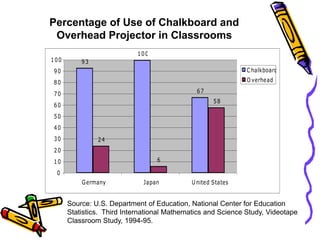
Percentage of Use of Chalkboard and
Overhead Projector in Classrooms
93
100
67
24
6
58
0
10
20
30
40
50
60
70
80
90
100
Germany Japan United States
C halkboard
O verhead
Source: U.S. Department of Education, National Center for Education
Statistics. Third International Mathematics and Science Study, Videotape
Classroom Study, 1994-95.
Typical Use of the Board in US
classrooms
• To focus students’ attention
• To display information in written or
graphic form
Source: Stigler & Hiebert (1999) The Teaching Gap
Typical Use of the Board in
Argentinian Classrooms
• Provide a record of the main topics that
are discussed during the lesson
• Other?
Source: Stigler & Hiebert (1999) The Teaching Gap
One Argentinian teacher described the
importance Argentinian teachers place
on using the blackboard:
“My senior teachers told me ‘you should
not erase what you write if you write on
the blackboard and you should not write
on the board if you are going to erase it.’”
Another Argentinian teacher described it
like this:
“I try to organize the blackboard in such a
way that my students and I can see and
understand how the lesson progressed
and what was talked about during the
lesson and at the end of the lesson.”
Using the Blackboard in Language
Teaching
• The blackboard is often used to introduce
new material
• It is also a tool used to connect parts of the
lesson coherently together in order to build
student understanding
• It may be used to show the flow of the lesson
process described in the lesson plan
• It can be used as a “get-reday-to-learn” tool
(e.g., provocative quotations)
Using the Blackboard in Language
Teaching
• The blackboard can be used to present and
“build up” new structures in collaboration with
the class (e.g., substitution tables)
• It can help students interpret language and
linguistic ideas in simple visual terms (e.g.,
simple line drawings, shapes and diagrams)
Use or Organization of the
Blackboard
• Considered an important teaching skill
• Considered one of the necessary tools for
child-centered discovery-oriented lessons
• Other?
Advantages of Using the Board
How can the board help our students learn?
 They get the information gradually, so that they have the time to
question anything they do not understand
 They get more opportunities to generate language
 They can interact with their classmates and with us
 They can measure themselves against their peers’ “public
writing”
 They can follow, remember or record important information
(e.g., homework assignments)
How Do EFL Teachers Use the
Blackboard?
1. Keep a Record of the Lesson
• Problem
• Questions
• Student voices, opinion, things noticed
• Student solutions
• Student discussions
• Important ideas or concepts
2. Help Students Remember What They Need
to Do and Think
• Problem
• Directions
• Tasks
• Questions
3. Help students see the connections of
different parts of the lesson and the
progression of the lesson
• Summary of the entire lesson
• Coherent flow of the lesson (how we reached the
conclusion)
• How student ideas were discussed and evolved in
order to reach the conclusion
4. A Place to Contrast and Discuss ideas
students presented
• Recording various ideas
• Discussing similarities and differences in ideas
• Discussing merits of certain methods
• Discovering/developing new ideas and questions
5. A Place to help organize student thinking
and discover new ideas
• Manipulating (sorting, lining up, categorizing,
moving directions, etc.) objects on the board and
thinking about or discovering ideas.
6. Fostering students’ organized note-
taking skills by modeling good
organization
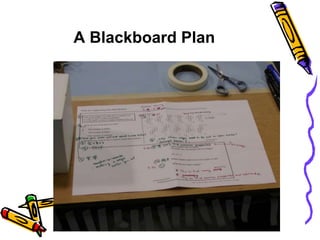
Planning Organization of the
Blackboard
• Logical and coherent organization
• Easy to understand the connections
• Clear goal and task
• Incorporate student ideas and strategies to build
understanding
A Blackboard Plan
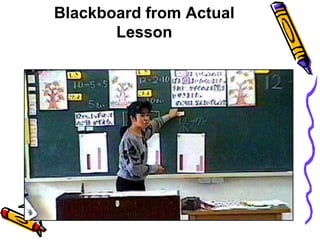
Blackboard from Actual
Lesson
How can we Learn to be Better
at Organizing the Board?
• Observing other teachers’ lessons
– Stealing good ideas
– Trying out what is learned and evaluating
the results
• Continuously thinking about making
connections and building up to the
lesson conclusion during the lesson.
Ideas of Board Activities
In pairs, decide what board activities you
could do in order to:
 determine students’ readiness for new
material
review new material
assess students’ success at mastering
this material

Developimg effective use of the blackboard

  • 1.
    Developing Effective Use ofthe Blackboard Mgter. Marina Falasca
  • 2.
    Introduction • Are you“lost without a blackboard”? • Do you use the board as a “teaching tool”? If so, how? • Do you facilitate your students’ use of the board? In what case/s?
  • 3.
    Percentage of Useof Chalkboard and Overhead Projector in Classrooms 93 100 67 24 6 58 0 10 20 30 40 50 60 70 80 90 100 Germany Japan United States C halkboard O verhead Source: U.S. Department of Education, National Center for Education Statistics. Third International Mathematics and Science Study, Videotape Classroom Study, 1994-95.
  • 4.
    Typical Use ofthe Board in US classrooms • To focus students’ attention • To display information in written or graphic form Source: Stigler & Hiebert (1999) The Teaching Gap
  • 5.
    Typical Use ofthe Board in Argentinian Classrooms • Provide a record of the main topics that are discussed during the lesson • Other? Source: Stigler & Hiebert (1999) The Teaching Gap
  • 6.
    One Argentinian teacherdescribed the importance Argentinian teachers place on using the blackboard: “My senior teachers told me ‘you should not erase what you write if you write on the blackboard and you should not write on the board if you are going to erase it.’”
  • 7.
    Another Argentinian teacherdescribed it like this: “I try to organize the blackboard in such a way that my students and I can see and understand how the lesson progressed and what was talked about during the lesson and at the end of the lesson.”
  • 8.
    Using the Blackboardin Language Teaching • The blackboard is often used to introduce new material • It is also a tool used to connect parts of the lesson coherently together in order to build student understanding • It may be used to show the flow of the lesson process described in the lesson plan • It can be used as a “get-reday-to-learn” tool (e.g., provocative quotations)
  • 9.
    Using the Blackboardin Language Teaching • The blackboard can be used to present and “build up” new structures in collaboration with the class (e.g., substitution tables) • It can help students interpret language and linguistic ideas in simple visual terms (e.g., simple line drawings, shapes and diagrams)
  • 10.
    Use or Organizationof the Blackboard • Considered an important teaching skill • Considered one of the necessary tools for child-centered discovery-oriented lessons • Other?
  • 11.
    Advantages of Usingthe Board How can the board help our students learn?  They get the information gradually, so that they have the time to question anything they do not understand  They get more opportunities to generate language  They can interact with their classmates and with us  They can measure themselves against their peers’ “public writing”  They can follow, remember or record important information (e.g., homework assignments)
  • 12.
    How Do EFLTeachers Use the Blackboard? 1. Keep a Record of the Lesson • Problem • Questions • Student voices, opinion, things noticed • Student solutions • Student discussions • Important ideas or concepts
  • 13.
    2. Help StudentsRemember What They Need to Do and Think • Problem • Directions • Tasks • Questions
  • 14.
    3. Help studentssee the connections of different parts of the lesson and the progression of the lesson • Summary of the entire lesson • Coherent flow of the lesson (how we reached the conclusion) • How student ideas were discussed and evolved in order to reach the conclusion
  • 15.
    4. A Placeto Contrast and Discuss ideas students presented • Recording various ideas • Discussing similarities and differences in ideas • Discussing merits of certain methods • Discovering/developing new ideas and questions
  • 16.
    5. A Placeto help organize student thinking and discover new ideas • Manipulating (sorting, lining up, categorizing, moving directions, etc.) objects on the board and thinking about or discovering ideas.
  • 17.
    6. Fostering students’organized note- taking skills by modeling good organization
  • 18.
    Planning Organization ofthe Blackboard • Logical and coherent organization • Easy to understand the connections • Clear goal and task • Incorporate student ideas and strategies to build understanding
  • 19.
  • 20.
  • 21.
    How can weLearn to be Better at Organizing the Board? • Observing other teachers’ lessons – Stealing good ideas – Trying out what is learned and evaluating the results • Continuously thinking about making connections and building up to the lesson conclusion during the lesson.
  • 22.
    Ideas of BoardActivities In pairs, decide what board activities you could do in order to:  determine students’ readiness for new material review new material assess students’ success at mastering this material