Retrofitting a Factory Automation
          System to Address Market Needs and
          Societal Changes
Date: July, 2012                      Conference: The IEEE10th International
Linked to: eSONIA (ARTEMIS Project)   Conference on Industrial Informatics

                                      Title of the paper: Retrofitting a Factory
                                      Automation System to Address Market
                                      Needs and Societal Changes

                                      Authors: Luis E. Gonzalez Moctezuma,
Contact information                   Jani Jokinen, Corina Postelnicu, Jose L.
                                      Martinez Lastra
Tampere University of Technology,
FAST Laboratory,
P.O. Box 600,
FIN-33101 Tampere,
                                      If you would like to receive a reprint of
Finland
                                      the original paper, please contact us
Email: fast@tut.fi
www.tut.fi/fast
2


Retrofitting a Factory Automation System to
   Address Market Needs and Societal
                  Changes
      Authors: Luis E. Gonzalez Moctezuma, Jani Jokinen,
          Corina Postelnicu, Jose L. Martinez Lastra

              Tampere University of Technology
     Factory Automations Systems and Technologies Lab.
                        www.tut.fi/fast

                  INDIN 2012, Beijing, China
                         25-27.7.2012
Outline


•   Motivation
•   Original system
•   Retrofitted system
•   Selected technology
•   Integration approach
•   Implementations
•   Achievements
•   Conclusions and future work
Motivation


• Current industrial automation systems are: rigid, islands of
  automation, hard-coded.

• Reuse industrial legacy equipment with the latest IT technologies
  to improve:

   •   Reconfigurability : Fast mass product customization
   •   Flexibility
   •   Energy-based decisions
   •   Open communications Interoperability
   •   Predictive maintenance Reduce failures
   •   Self-recovery Reduce downtime
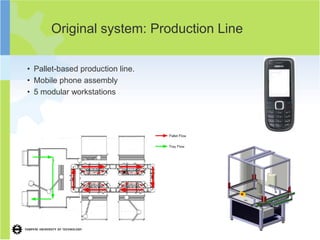
Original system: Production Line

• Pallet-based production line.
• Mobile phone assembly
• 5 modular workstations
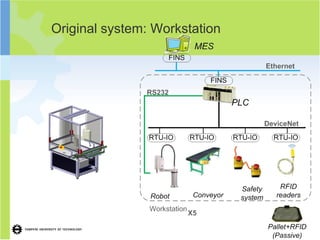
Original system: Workstation
7


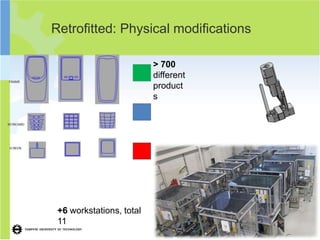
Retrofitted: Physical modifications

                          > 700
                          different
                          product
                          s


 +6 workstations, total
 11
Selected technology(1/2)

Web Services:
   •   Encapsulation
   •   Network addressable
   •   Platform independent
   •   XML-based
   •   Open
   •   Boost interoperability
   •   Foundation for Service Oriented Architecture (SOA)


Device Profile for Web Services (DPWS):
   •   Aligned with WSs
   •   Tuned for resource constrained devices
   •   Eventing
   •   Network discovery
Selected technology(2/2)
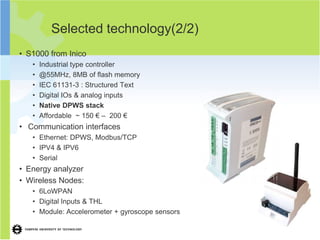
• S1000 from Inico
   •   Industrial type controller
   •   @55MHz, 8MB of flash memory
   •   IEC 61131-3 : Structured Text
   •   Digital IOs & analog inputs
   •   Native DPWS stack
   •   Affordable ~ 150 € – 200 €
• Communication interfaces
   • Ethernet: DPWS, Modbus/TCP
   • IPV4 & IPV6
   • Serial
• Energy analyzer
• Wireless Nodes:
   • 6LoWPAN
   • Digital Inputs & THL
   • Module: Accelerometer + gyroscope sensors
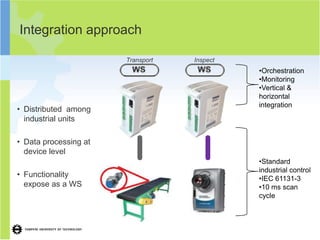
Integration approach

                       Transport   Inspect
                                             •Orchestration
                                             •Monitoring
                                             •Vertical &
                                             horizontal
                                             integration
• Distributed among
  industrial units

• Data processing at
  device level
                                             •Standard
                                             industrial control
• Functionality                              •IEC 61131-3
  expose as a WS                             •10 ms scan
                                             cycle
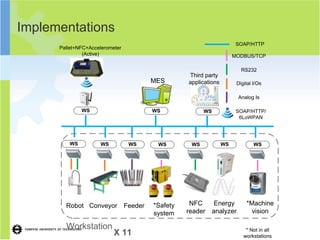
Implementations
                                                                     SOAP/HTTP
      Pallet+NFC+Accelerometer
               (Active)                                             MODBUS/TCP

                                                                       RS232
                                                Third party
                                      MES       applications         Digital I/Os

                                                                     Analog Is

               WS                     WS              WS             SOAP/HTTP/
                                                                      6LoWPAN


          WS          WS         WS    WS        WS            WS            WS


        Robot Conveyor Feeder         *Safety    NFC    Energy           *Machine
                                      system    reader analyzer            vision

        Workstation                                                      * Not in all
                           X 11                                         workstations
12


Achievements


•   Flexible and reconfigurable system
•   Loosely-coupled applications and devices
•   Event driven applications
•   Seamless horizontal and vertical integration
•   Platform independence
•   Data processing at device level Information
•   Boosted plug & play behaviour
•   Detailed energy-related information
•   Reutilization of IT technologies (eg. orchestration, management,
    event processing, cyber-security HW)
13


Conclusions and future work


Conclusions
• Legacy equipment can be reused with newest IT technologies

• Preserve low level control + powerful communication interface

Future work
• Energy-based control
• Predictive maintenance
• Asset awareness applications
• Multi objective control

Retrofitting a Factory Automation System to Address Market Needs and Societal Changes

  • 1.
    Retrofitting a FactoryAutomation System to Address Market Needs and Societal Changes Date: July, 2012 Conference: The IEEE10th International Linked to: eSONIA (ARTEMIS Project) Conference on Industrial Informatics Title of the paper: Retrofitting a Factory Automation System to Address Market Needs and Societal Changes Authors: Luis E. Gonzalez Moctezuma, Contact information Jani Jokinen, Corina Postelnicu, Jose L. Martinez Lastra Tampere University of Technology, FAST Laboratory, P.O. Box 600, FIN-33101 Tampere, If you would like to receive a reprint of Finland the original paper, please contact us Email: fast@tut.fi www.tut.fi/fast
  • 2.
    2 Retrofitting a FactoryAutomation System to Address Market Needs and Societal Changes Authors: Luis E. Gonzalez Moctezuma, Jani Jokinen, Corina Postelnicu, Jose L. Martinez Lastra Tampere University of Technology Factory Automations Systems and Technologies Lab. www.tut.fi/fast INDIN 2012, Beijing, China 25-27.7.2012
  • 3.
    Outline • Motivation • Original system • Retrofitted system • Selected technology • Integration approach • Implementations • Achievements • Conclusions and future work
  • 4.
    Motivation • Current industrialautomation systems are: rigid, islands of automation, hard-coded. • Reuse industrial legacy equipment with the latest IT technologies to improve: • Reconfigurability : Fast mass product customization • Flexibility • Energy-based decisions • Open communications Interoperability • Predictive maintenance Reduce failures • Self-recovery Reduce downtime
  • 5.
    Original system: ProductionLine • Pallet-based production line. • Mobile phone assembly • 5 modular workstations
  • 6.
  • 7.
    7 Retrofitted: Physical modifications > 700 different product s +6 workstations, total 11
  • 8.
    Selected technology(1/2) Web Services: • Encapsulation • Network addressable • Platform independent • XML-based • Open • Boost interoperability • Foundation for Service Oriented Architecture (SOA) Device Profile for Web Services (DPWS): • Aligned with WSs • Tuned for resource constrained devices • Eventing • Network discovery
  • 9.
    Selected technology(2/2) • S1000from Inico • Industrial type controller • @55MHz, 8MB of flash memory • IEC 61131-3 : Structured Text • Digital IOs & analog inputs • Native DPWS stack • Affordable ~ 150 € – 200 € • Communication interfaces • Ethernet: DPWS, Modbus/TCP • IPV4 & IPV6 • Serial • Energy analyzer • Wireless Nodes: • 6LoWPAN • Digital Inputs & THL • Module: Accelerometer + gyroscope sensors
  • 10.
    Integration approach Transport Inspect •Orchestration •Monitoring •Vertical & horizontal integration • Distributed among industrial units • Data processing at device level •Standard industrial control • Functionality •IEC 61131-3 expose as a WS •10 ms scan cycle
  • 11.
    Implementations SOAP/HTTP Pallet+NFC+Accelerometer (Active) MODBUS/TCP RS232 Third party MES applications Digital I/Os Analog Is WS WS WS SOAP/HTTP/ 6LoWPAN WS WS WS WS WS WS WS Robot Conveyor Feeder *Safety NFC Energy *Machine system reader analyzer vision Workstation * Not in all X 11 workstations
  • 12.
    12 Achievements • Flexible and reconfigurable system • Loosely-coupled applications and devices • Event driven applications • Seamless horizontal and vertical integration • Platform independence • Data processing at device level Information • Boosted plug & play behaviour • Detailed energy-related information • Reutilization of IT technologies (eg. orchestration, management, event processing, cyber-security HW)
  • 13.
    13 Conclusions and futurework Conclusions • Legacy equipment can be reused with newest IT technologies • Preserve low level control + powerful communication interface Future work • Energy-based control • Predictive maintenance • Asset awareness applications • Multi objective control

Editor's Notes

  • #6 More about productionImage of line, image of a workstation