Download to read offline
![International Journal of Innovative Research in Advanced Engineering ISSN: 2349-2163
Volume 1 Issue 4 (May 2014) http://ijirae.com
_________________________________________________________________________________________________
© 2014, IJIRAE- All Rights Reserved Page - 132
Detection of Spoofing attackers in wireless network
Raju M. Shingade Abhishek V. Mane (M.S)
IV Semester, M-Tech, Dept of Computer Assistant Professor, Dept of Computer
VJTI College Mumbai VJTI College Mumbai
rajshingade@gmail.com abhishekmane01@gmail.com
Abstract— Spoofing attacks effectively damage the networks performance and easy to launch by many tools available
in market. The previous security approach to address spoofing attacks is to apply cryptographic authentication.
However authentication method requires more infrastructures overhead. In this paper I propose the system of
detecting spoofing attackers in wireless network by using spatial information associated with each node hard to falsify
and not based on cryptography. This methodology can detect the attacks by spatial correlation received signal strength
(RSS), inherited from multiple wireless node. To determine multiple spoofing attackers cluster based mechanisms are
developed. I explore using the Support Vector Machines (SVM) method to further improve the accuracy of
determining the number of attackers. In addition, I developed an integrated detection and localization system that can
localize the positions of multiple attackers. The proposed methodology will obtain a reliable outcome that could be
helpful in identifying and eliminating certain attacks.
Keywords— Wireless network security, cryptography, spoofing attack, attack detection
I. INTRODUCTION
Due to openness wireless network becomes target of most of the attacks. Due to the open-nature of these platforms, it
will be particularly susceptible to spoofing attacks, where adversaries alter their network identifiers to those of legitimate
entities. Spoofing attacks can be easily launched. As because of its open and shared nature of the wireless medium, where
adversaries can perform passive monitoring of useful information of identity of user and then masquerade as another
device using the collected identity. Spoofing attacks can further facilitate a variety of traffic injection attacks [1], [2],
such as attacks on access control lists, rogue access point attacks, and eventually Denial-of-Service (DoS) attacks.
Therefore it is important to detect spoofing attacks and prevent them and to prevent the attacks we have to first find out
the attackers. Most previous approaches to find spoofing attacks required cryptographic methods. However the
application of cryptographic methods requires reliable key distribution, management and maintenance mechanisms. It is
not always desirable to apply these cryptographic methods because of the computational, distributional, infrastructural
and management overhead. Existing 802.11 security techniques including Wired Equivalent Privacy (WEP), WiFi
Protected Access (WPA), or 802.11i (WPA2), such methodology can only protect data frames an attacker can still spoof
management or control frames to cause significant impact on networks.
In this paper I propose a method for both detecting spoofing attacks, as well as locating the positions of adversaries
performing the attacks.
II. SPOOFING ATTACK
Spoofing means, pretending to be something you are not. In Internet terms it means pretending to be a different Internet
address from the one you really have in order to gain something. Spoofing attacks have different types like Email
spoofing, DNS spoofing, ARP spoofing, WEB spoofing and IP spoofing we mainly focus on IP Spoofing. IP spoofing
attack involves forging one's source address. It is the act of using one machine to impersonate another. Spoofing is an
active security attack in which one machine on the network masquerades as a different machine. As an active attack, it
disrupts the normal flow of data and may involve injecting data into the communications link between other machines.
III. EXISTING METHOD
The identity of a node can be verified through conventional security approaches are not always desirable. Adversaries
can easily purchase low-cost devices and use these commonly available platforms to launch a variety of attacks. Among
various types of attacks, identity-based spoofing attacks are especially easy to launch and can cause significant damage to
network performance. It is easy for an attacker to gather useful MAC address information during passive monitoring and
then modify its MAC address. It can further facilitate a variety of traffic injection attacks, such as attacks on access
control lists, rogue access point (AP) attacks, and eventually denial of service (DOS) attacks. The traditional approach to
address spoofing attacks is to apply cryptographic authentication. However, authentication requires additional
infrastructural overhead and computational power associated with distributing, and maintaining cryptographic keys. Due
to the limited power and resources available to the wireless devices and sensor nodes, it is not always possible to deploy
authentication. In addition, key management often incurs significant human management costs on the network.
IV.PROPOSED METHOD
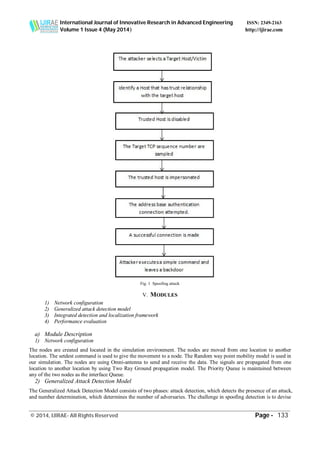
1) Detecting the presence of spoofing attacks
2) Determining the number of attackers when multiple adversaries masquerading as the same node identity
3) Localizing multiple adversaries and eliminate them](https://image.slidesharecdn.com/mycs10083-160222122909/85/Detection-of-Spoofing-attackers-in-wireless-network-1-320.jpg)
![International Journal of Innovative Research in Advanced Engineering ISSN: 2349-2163
Volume 1 Issue 4 (May 2014) http://ijirae.com
_________________________________________________________________________________________________
© 2014, IJIRAE- All Rights Reserved Page - 132
Detection of Spoofing attackers in wireless network
Raju M. Shingade Abhishek V. Mane (M.S)
IV Semester, M-Tech, Dept of Computer Assistant Professor, Dept of Computer
VJTI College Mumbai VJTI College Mumbai
rajshingade@gmail.com abhishekmane01@gmail.com
Abstract— Spoofing attacks effectively damage the networks performance and easy to launch by many tools available
in market. The previous security approach to address spoofing attacks is to apply cryptographic authentication.
However authentication method requires more infrastructures overhead. In this paper I propose the system of
detecting spoofing attackers in wireless network by using spatial information associated with each node hard to falsify
and not based on cryptography. This methodology can detect the attacks by spatial correlation received signal strength
(RSS), inherited from multiple wireless node. To determine multiple spoofing attackers cluster based mechanisms are
developed. I explore using the Support Vector Machines (SVM) method to further improve the accuracy of
determining the number of attackers. In addition, I developed an integrated detection and localization system that can
localize the positions of multiple attackers. The proposed methodology will obtain a reliable outcome that could be
helpful in identifying and eliminating certain attacks.
Keywords— Wireless network security, cryptography, spoofing attack, attack detection
I. INTRODUCTION
Due to openness wireless network becomes target of most of the attacks. Due to the open-nature of these platforms, it
will be particularly susceptible to spoofing attacks, where adversaries alter their network identifiers to those of legitimate
entities. Spoofing attacks can be easily launched. As because of its open and shared nature of the wireless medium, where
adversaries can perform passive monitoring of useful information of identity of user and then masquerade as another
device using the collected identity. Spoofing attacks can further facilitate a variety of traffic injection attacks [1], [2],
such as attacks on access control lists, rogue access point attacks, and eventually Denial-of-Service (DoS) attacks.
Therefore it is important to detect spoofing attacks and prevent them and to prevent the attacks we have to first find out
the attackers. Most previous approaches to find spoofing attacks required cryptographic methods. However the
application of cryptographic methods requires reliable key distribution, management and maintenance mechanisms. It is
not always desirable to apply these cryptographic methods because of the computational, distributional, infrastructural
and management overhead. Existing 802.11 security techniques including Wired Equivalent Privacy (WEP), WiFi
Protected Access (WPA), or 802.11i (WPA2), such methodology can only protect data frames an attacker can still spoof
management or control frames to cause significant impact on networks.
In this paper I propose a method for both detecting spoofing attacks, as well as locating the positions of adversaries
performing the attacks.
II. SPOOFING ATTACK
Spoofing means, pretending to be something you are not. In Internet terms it means pretending to be a different Internet
address from the one you really have in order to gain something. Spoofing attacks have different types like Email
spoofing, DNS spoofing, ARP spoofing, WEB spoofing and IP spoofing we mainly focus on IP Spoofing. IP spoofing
attack involves forging one's source address. It is the act of using one machine to impersonate another. Spoofing is an
active security attack in which one machine on the network masquerades as a different machine. As an active attack, it
disrupts the normal flow of data and may involve injecting data into the communications link between other machines.
III. EXISTING METHOD
The identity of a node can be verified through conventional security approaches are not always desirable. Adversaries
can easily purchase low-cost devices and use these commonly available platforms to launch a variety of attacks. Among
various types of attacks, identity-based spoofing attacks are especially easy to launch and can cause significant damage to
network performance. It is easy for an attacker to gather useful MAC address information during passive monitoring and
then modify its MAC address. It can further facilitate a variety of traffic injection attacks, such as attacks on access
control lists, rogue access point (AP) attacks, and eventually denial of service (DOS) attacks. The traditional approach to
address spoofing attacks is to apply cryptographic authentication. However, authentication requires additional
infrastructural overhead and computational power associated with distributing, and maintaining cryptographic keys. Due
to the limited power and resources available to the wireless devices and sensor nodes, it is not always possible to deploy
authentication. In addition, key management often incurs significant human management costs on the network.
IV.PROPOSED METHOD
1) Detecting the presence of spoofing attacks
2) Determining the number of attackers when multiple adversaries masquerading as the same node identity
3) Localizing multiple adversaries and eliminate them](https://image.slidesharecdn.com/mycs10083-160222122909/75/Detection-of-Spoofing-attackers-in-wireless-network-1-2048.jpg)
![International Journal of Innovative Research in Advanced Engineering ISSN: 2349-2163
Volume 1 Issue 4 (May 2014) http://ijirae.com
_________________________________________________________________________________________________
© 2014, IJIRAE- All Rights Reserved Page - 135
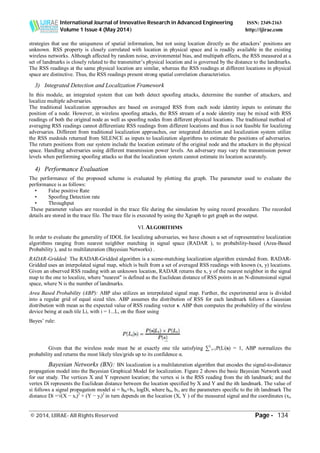
yi) of the ith landmark. The network models noise and outliers by modeling the si as a Gaussian distribution around the
above propagation model, with variance τi: si~N(b0i + b1i logDi, τi). Through Markov Chain Monte Carlo (MCMC)
simulation, BN returns the sampling distribution of the possible location of X and Y as the localization result.
Fig 2. Bayasian graphical model in our study
VII. CONCLUSIONS
In this work, we proposed to use received signal strength based spatial correlation, a physical property associated with
each wireless device that is hard to falsify and not reliant on cryptography as the basis for detecting spoofing attacks in
wireless networks. We provided theoretical analysis of using the spatial correlation of RSS inherited from wireless nodes
for attack detection. We derived the test statistic based on the cluster analysis of RSS readings. Our approach can both
detect the presence of attacks as well as determine the number of adversaries. Determining the number of adversaries is a
particularly challenging problem. We developed SILENCE, a mechanism that employs the minimum distance testing in
addition to cluster analysis to achieve better accuracy of determining the number of attackers than other methods under
study, such as Silhouette Plot and System Evolution that use cluster analysis alone. Additionally, when the training data
are available, we explored using Support Vector Machines-based mechanism to further improve the accuracy of
determining the number of attackers present in the system. Further, based on the number of attackers determined by our
mechanisms, our integrated detection and localization system can localize any number of adversaries even when
attackers using different transmission power levels. The performance of localizing adversaries achieves similar results as
those under normal conditions, thereby, providing strong evidence of the effectiveness of our approach in detecting
wireless spoofing attacks, determining the number of attackers and localizing adversaries
REFERENCES
[1] J. Bellardo and S. Savage, 802.11 Denial-of-Service Attacks: Real Vulnerabilities and Practical Solutions, Proc.
USENIX Security Symp., pp. 15-28, 2003.
[2] [2] F. Ferreri, M. Bernaschi, and L. Valcamonici, “Access Points Vulnerabilities to Dos Attacks in 802.11
Networks,” Proc. IEEE Wireless Comm. and Networking Conf., 2004.
[3] [3] D. Faria and D. Cheriton, “Detecting Identity-Based Attacks in Wireless Networks Using Signalprints,” Proc.
ACM Workshop Wireless Security (WiSe), Sept. 2006.
[4] [4] Q. Li and W. Trappe, “Relationship-Based Detection of Spoofing- Related Anomalous Traffic in Ad Hoc
Networks,” Proc. Ann. IEEE Comm. Soc. on IEEE and Sensor and Ad Hoc Comm. and Networks (SECON), 2006.
[5] [5] B. Wu, J. Wu, E. Fernandez, and S. Magliveras, “Secure and Efficient Key Management in Mobile Ad Hoc
Networks,” Proc. IEEE Int’l Parallel and Distributed Processing Symp. (IPDPS), 2005.
[6] [6] A. Wool, “Lightweight Key Management for IEEE 802.11 Wireless Lans With Key Refresh and Host
Revocation,” ACM/Springer Wireless Networks, vol. 11, no. 6, pp. 677-686, 2005.
[7] [7] Y. Sheng, K. Tan, G. Chen, D. Kotz, and A. Campbell, “Detecting 802.11 MAC Layer Spoofing Using
Received Signal Strength,” Proc. IEEE INFOCOM, Apr. 2008
[8] J. Yang, Y. Chen, and W. Trappe, “Detecting spoofing attacks in mobile wireless environments,” in Proc. IEEE
SECON, 2009.
[9] J. Wright, “Detecting wireless LAN MAC address spoofing,” 2003, technical document. [Online]. Available:
http://home.jwu.edu/jwright/papers/wlan-mac-spoof.pdf
[10] NS2 Tutorial http://www.isi.edu/nsnam/ns](https://image.slidesharecdn.com/mycs10083-160222122909/85/Detection-of-Spoofing-attackers-in-wireless-network-4-320.jpg)

This paper presents a novel method for detecting and localizing spoofing attackers in wireless networks by utilizing spatial information based on received signal strength (RSS) rather than relying on cryptographic techniques which can impose significant overhead. The proposed system employs support vector machines for enhanced accuracy in determining the number of attackers and integrates detection with localization capabilities. Overall, the methodology aims to improve network security against spoofing attacks by providing reliable outcomes for identifying and neutralizing threats.


![Cit877[1]](https://cdn.slidesharecdn.com/ss_thumbnails/cit8771-210422120827-thumbnail.jpg?width=640&height=640&fit=bounds)


![PM [B06] Complex Polar Coordinates](https://cdn.slidesharecdn.com/ss_thumbnails/pmb06complexpolarcoordinate-151011170738-lva1-app6891-thumbnail.jpg?width=640&height=640&fit=bounds)


