International Journal of Innovative Research in Advanced Engineering (IJIRAE) ISSN: 2349-2763
Issue 12, Volume 2 (December 2015) www.ijirae.com
____________________________________________________________________________________________________________
IJIRAE: Impact Factor Value - ISRAJIF: 1.857 | PIF: 2.469 | Jour Info: 4.085 | Index Copernicus 2014 = 6.57
© 2014- 15, IJIRAE- All Rights Reserved Page -18
A COMPARATIVE STUDY OF OMRF & SMRF
STRUCTURAL SYSTEM USING DIFFERENT SOFTWARES
Sheovinay Rai1,
Rajiv Banarjee2
, Tabish Izhar3
1
P.G. student of structural engineering, Department of Civil Engineering, Integral University, Lucknow
2
Associate Professor, Department of Civil Engineering Integral University, Lucknow
3
Assistant Professor, Department of Civil Engineering Integral University, Lucknow
Abstract-- This study is carried out to investigate the seismic behaviour of the structure having various structural configurations
like OMRF (Ordinary Moment Resisting Frames), SMRF (Special Moment Resisting Frames) using different softwares i.e.
Stadd.Pro & Etabs. A comparative study of all the types of frames will shed light on the best suited frame to be adopted for seismic
loads in Indian scenario. For this purpose, a G+6 storey R.C.C. regular building are analysed for OMRCF, SMRCF framing
configurations in Seismic Zone III & IV according to Indian codes. Linear static Analysis or Equivalent static Analysis are carried
out to evaluate their structural efficiencies in terms of storey drifts, average storey displacement, Time period. In OMRF structures
the design and detailing of reinforcement are executed as per the guide lines of I.S. 456-2000 which make the structure less tough
and ductile in comparison of SMRF structures. The basic approach of earthquake resistant design should be based on lateral
strength as well as deformability and ductility capacity of structure .In SMRF structures Beams, columns, and beam-column joints
are proportioned and detailed as per I.S. code 13920(2002) which give adequate toughness and ductility to resist severe earthquake
shock without collapse. Thus it has been observed that SMRF structures behave well in earthquake than OMRF structures.
Keywords:- Moment resisting frames, SMRF, OMRF, Equivalent static lateral force procedure, ductility, earthquake engineering,
response reduction factor, seismic weight, fundamental natural period, STADD.PRO.
1. INTRODUCTION
Some of the largest earthquakes of the world have occurred in India and the earthquake engineering developments in the country
started rather early. After the 1987 Assam earthquake a new earthquake resistant type of housing was developed which is still
prevalent in the north-east India. The Baluchistan earthquakes of 1030’s led to innovative earthquake resistant constructions and to the
development of first seismic zone map. The institutional development started in the late 1950’s and earthquake engineering concepts
have been applied to numerous major projects in high seismic regions in the country. Extensive damage during several moderate
earthquakes in recent years indicates that despite such early gains, earthquake risk in the country has been increasing alarmingly. Most
buildings even in high seismic regions of the country continue to be built without appropriate earthquake resistant features. At the
higher end of earthquake technology, the gap between state-of-the-practice of earthquake engineering and research in India, bench-
marked against the advanced countries, has been widening.
Indian earthquake problem cannot be overemphasized. More than about 60% of the land area is considered prone to shaking of
intensity VII and above (MMI scale). In fact, the entire Himalayan belt is considered prone to great earthquakes of magnitude
exceeding 8.0 and in ashort span of about 50 years, four such earthquakes have occurred; 1897 Assam (M8.7), 1905 Kangra
(M8.6),1934 Bihar-Nepal (M8.4),and 1950 Assam-Tibbet (M8.7). Despite an early start, the seismic risk in the country has been
increasing rapidly in the recent years. Five moderate earthquakes in the last eleven years(1988 Bihar-Nepal; M6.6,about 1004
dead;1991 Uttarkashi: M6.6, about 768 dead; 1993 Lathur : M6.4, about 8000 dead; 1997 Jabalpur: M6.0, about 38 dead; and 1999
Chamoli: M6.5, about 100 dead) have clearly underlined the inadequate preparedness of the country to face damaging earthquakes.
The selection of particular type of framing system depends upon two important parameters i.e. Seismic risk of the zone and the
budget. The lateral forces acting on any structure are distributed according to the flexural rigidity of individual components. Indian
Codes divide the entire country into four seismic zones (II, III, IV & V) depending on the seismic risks. OMRF is probably the most
commonly adopted type of frame in lower seismic zones. However with increase in the seismic risks, it becomes insufficient and
SMRF need to be adopted.
2. DESCRIPTION OF STRUCTURAL MODELS
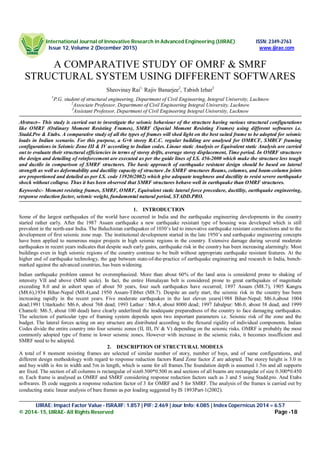
A total of 8 moment resisting frames are selected of similar number of story, number of bays, and of same configurations, and
different design methodology with regard to response reduction factors Rand Zone factor Z are adopted. The storey height is 3.0 m
and bay width is 4m in width and 5m in length, which is same for all frames.The foundation depth is assumed 1.5m and all supports
are fixed. The section of all columns is rectangular of size0.500*0.500 m and sections of all beams are rectangular of size 0.300*0.450
m. Each frame is analysed as OMRF and SMRF considering response reduction factors such as 3 and 5 using Stadd.pro. And Etabs
softwares. IS code suggests a response reduction factor of 3 for OMRF and 5 for SMRF. The analysis of the frames is carried out by
conducting static linear analysis of bare frames as per loading suggested by IS 1893Part-1(2002).
International Journal of Innovative Research in Advanced Engineering (IJIRAE) ISSN: 2349-2763
Issue 12, Volume 2 (December 2015) www.ijirae.com
____________________________________________________________________________________________________________
IJIRAE: Impact Factor Value - ISRAJIF: 1.857 | PIF: 2.469 | Jour Info: 4.085 | Index Copernicus 2014 = 6.57
© 2014- 15, IJIRAE- All Rights Reserved Page -19
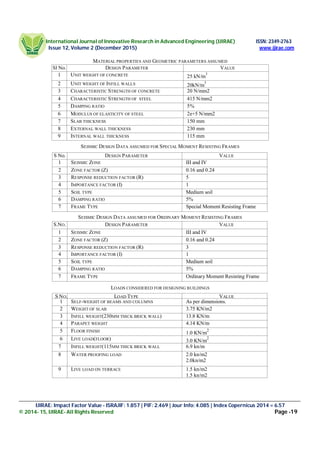
MATERIAL PROPERTIES AND GEOMETRIC PARAMETERS ASSUMED
Sl No. DESIGN PARAMETER VALUE
1 UNIT WEIGHT OF CONCRETE 25 kN/m
3
2 UNIT WEIGHT OF INFILL WALLS 20kN/m
3
3 CHARACTERISTIC STRENGTH OF CONCRETE 20 N/mm2
4 CHARACTERISTIC STRENGTH OF STEEL 415 N/mm2
5 DAMPING RATIO 5%
6 MODULUS OF ELASTICITY OF STEEL 2e+5 N/mm2
7 SLAB THICKNESS 150 mm
8 EXTERNAL WALL THICKNESS 230 mm
9 INTERNAL WALL THICKNESS 115 mm
SEISMIC DESIGN DATA ASSUMED FOR SPECIAL MOMENT RESISTING FRAMES
S No. DESIGN PARAMETER VALUE
1 SEISMIC ZONE III and IV
2 ZONE FACTOR (Z) 0.16 and 0.24
3 RESPONSE REDUCTION FACTOR (R) 5
4 IMPORTANCE FACTOR (I) 1
5 SOIL TYPE Medium soil
6 DAMPING RATIO 5%
7 FRAME TYPE Special Moment Resisting Frame
SEISMIC DESIGN DATA ASSUMED FOR ORDINARY MOMENT RESISTING FRAMES
S.NO. DESIGN PARAMETER VALUE
1 SEISMIC ZONE III and IV
2 ZONE FACTOR (Z) 0.16 and 0.24
3 RESPONSE REDUCTION FACTOR (R) 3
4 IMPORTANCE FACTOR (I) 1
5 SOIL TYPE Medium soil
6 DAMPING RATIO 5%
7 FRAME TYPE Ordinary Moment Resisting Frame
LOADS CONSIDERED FOR DESIGNING BUILDINGS
S NO. LOAD TYPE VALUE
1 SELF-WEIGHT OF BEAMS AND COLUMNS As per dimensions.
2 WEIGHT OF SLAB 3.75 KN/m2
3 INFILL WEIGHT(230MM THICK BRICK WALL) 13.8 KN/m
4 PARAPET WEIGHT 4.14 KN/m
5 FLOOR FINISH 1.0 KN/m
2
6 LIVE LOAD(FLOOR) 3.0 KN/m
2
7 INFILL WEIGHT(115MM THICK BRICK WALL 6.9 kn/m
8 WATER PROOFING LOAD 2.0 kn/m2
2.0kn/m2
9 LIVE LOAD ON TERRACE 1.5 kn/m2
1.5 kn/m2
International Journal of Innovative Research in Advanced Engineering (IJIRAE) ISSN: 2349-2763
Issue 12, Volume 2 (December 2015) www.ijirae.com
____________________________________________________________________________________________________________
IJIRAE: Impact Factor Value - ISRAJIF: 1.857 | PIF: 2.469 | Jour Info: 4.085 | Index Copernicus 2014 = 6.57
© 2014- 15, IJIRAE- All Rights Reserved Page -20
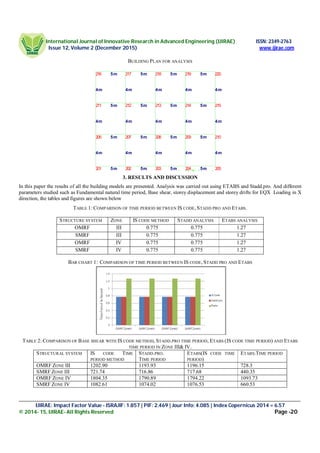
BUILDING PLAN FOR ANALYSIS
3. RESULTS AND DISCUSSION
In this paper the results of all the building models are presented. Analysis was carried out using ETABS and Stadd.pro. And different
parameters studied such as Fundamental natural time period, Base shear, storey displacement and storey drifts for EQX Loading in X
direction, the tables and figures are shown below
TABLE 1: COMPARISON OF TIME PERIOD BETWEEN IS CODE, STADD PRO AND ETABS.
BAR CHART 1: COMPARISON OF TIME PERIOD BETWEEN IS CODE, STADD PRO AND ETABS
TABLE 2: COMPARISON OF BASE SHEAR WITH IS CODE METHOD, STADD.PRO TIME PERIOD, ETABS (IS CODE TIME PERIOD) AND ETABS
TIME PERIOD IN ZONE III& IV.
STRUCTURAL SYSTEM IS CODE TIME
PERIOD METHOD
STADD.PRO.
TIME PERIOD
ETABS(IS CODE TIME
PERIOD)
ETABS.TIME PERIOD
OMRF ZONE III 1202.90 1193.93 1196.15 728.3
SMRF ZONE III 721.74 716.86 717.68 440.35
OMRF ZONE IV 1804.35 1790.89 1794.22 1093.73
SMRF ZONE IV 1082.61 1074.02 1076.53 660.53
5m
5m
4m
5m
4m
5m
4m
4m
5m
4m
4m 4m
5m
5m
4m
4m
5m
5m
4m
4m
5m
5m
5m
4m
4m
5m5m 5m
5m
4m
4m
205
209
204
212
208
211
219 220
201
215
216
207
213
206
217
202
210
203
214
218
DisplacementLoad1:
STRUCTURE SYSTEM ZONE IS CODE METHOD STADD ANALYSIS ETABS ANALYSIS
OMRF III 0.775 0.775 1.27
SMRF III 0.775 0.775 1.27
OMRF IV 0.775 0.775 1.27
SMRF IV 0.775 0.775 1.27
International Journal of Innovative Research in Advanced Engineering (IJIRAE) ISSN: 2349-2763
Issue 12, Volume 2 (December 2015) www.ijirae.com
____________________________________________________________________________________________________________
IJIRAE: Impact Factor Value - ISRAJIF: 1.857 | PIF: 2.469 | Jour Info: 4.085 | Index Copernicus 2014 = 6.57
© 2014- 15, IJIRAE- All Rights Reserved Page -21
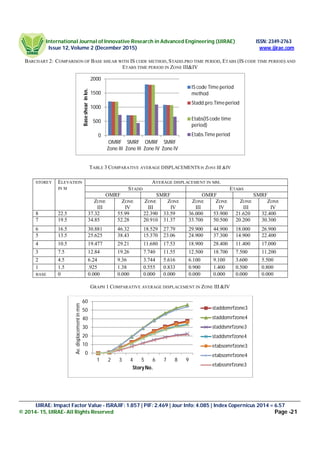
BARCHART 2: COMPARISON OF BASE SHEAR WITH IS CODE METHOD, STADD.PRO TIME PERIOD, ETABS (IS CODE TIME PERIOD) AND
ETABS TIME PERIOD IN ZONE III&IV
TABLE 3 COMPARATIVE AVERAGE DISPLACEMENTS IN ZONE III &IV
STOREY ELEVATION
IN M
AVERAGE DISPLACEMENT IN MM.
STADD ETABS
OMRF SMRF OMRF SMRF
ZONE
III
ZONE
IV
ZONE
III
ZONE
IV
ZONE
III
ZONE
IV
ZONE
III
ZONE
IV
8 22.5 37.32 55.99 22.390 33.59 36.000 53.900 21.620 32.400
7 19.5 34.85 52.28 20.910 31.37 33.700 50.500 20.200 30.300
6 16.5 30.881 46.32 18.529 27.79 29.900 44.900 18.000 26.900
5 13.5 25.625 38.43 15.370 23.06 24.900 37.300 14.900 22.400
4 10.5 19.477 29.21 11.680 17.53 18.900 28.400 11.400 17.000
3 7.5 12.84 19.26 7.740 11.55 12.500 18.700 7.500 11.200
2 4.5 6.24 9.36 3.744 5.616 6.100 9.100 3.600 5.500
1 1.5 .925 1.38 0.555 0.833 0.900 1.400 0.500 0.800
BASE 0 0.000 0.000 0.000 0.000 0.000 0.000 0.000 0.000
GRAPH 1 COMPARATIVE AVERAGE DISPLACEMENT IN ZONE III &IV
0
500
1000
1500
2000
OMRF
Zone III
SMRF
Zone III
OMRF
Zone IV
SMRF
Zone IV
Baseshearinkn. IS code Time period
method
Stadd.pro.Timeperiod
Etabs(IS code time
period)
Etabs.Time period
0
10
20
30
40
50
60
1 2 3 4 5 6 7 8 9
Av.displacementinmm
StoryNo.
staddomrfzone3
staddomrfzone4
staddsmrfzone3
staddsmrfzone4
etabsomrfzone3
etabsomrfzone4
etabssmrfzone3
International Journal of Innovative Research in Advanced Engineering (IJIRAE) ISSN: 2349-2763
Issue 12, Volume 2 (December 2015) www.ijirae.com
____________________________________________________________________________________________________________
IJIRAE: Impact Factor Value - ISRAJIF: 1.857 | PIF: 2.469 | Jour Info: 4.085 | Index Copernicus 2014 = 6.57
© 2014- 15, IJIRAE- All Rights Reserved Page -22
TABLE 4: COMPARATIVE STOREY DRIFT IN ZONE III &IV
STOREY ELEVATION
IN M
STOREY DRIFT IN MM.
STADD ETABS
OMRF SMRF OMRF SMRF
ZONE
III
ZONE
IV
ZONE
III
ZONE
IV
ZONE
III
ZONE
IV
ZONE
III
ZONE
IV
8 22.5 2.47 3.70 1.48 2.22 2.30 3.40 1.40 2.10
7 19.5 3.97 5.96 2.38 3.57 3.80 5.60 2.20 3.40
6 16.5 5.25 7.88 3.15 4.73 5.00 7.60 3.10 4.50
5 13.5 6.14 9.22 3.68 5.53 6.00 8.90 3.50 5.40
4 10.5 6.63 9.95 3.98 5.97 6.40 9.70 3.90 5.80
3 7.5 6.60 9.90 3.96 5.94 6.40 9.60 3.90 5.70
2 4.5 5.31 7.97 3.18 4.78 5.25 7.70 3.10 4.70
1 1.5 0.925 1.38 0.555 0.833 0.90 1.40 0.50 0.80
BASE 0 0.000 0.000 0.000 0.000 0.000 0.000 0.000 0.000
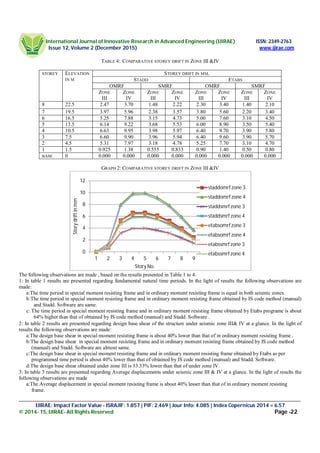
GRAPH 2: COMPARATIVE STOREY DRIFT IN ZONE III &IV
The following observations are made , based on the results presented in Table 1 to 4.
1: In table 1 results are presented regarding fundamental natural time periods. In the light of results the following observations are
made:
a:The time period in special moment resisting frame and in ordinary moment resisting frame is equal in both seismic zones.
b:The time period in special moment resisting frame and in ordinary moment resisting frame obtained by IS code method (manual)
and Stadd. Software are same.
c: The time period in special moment resisting frame and in ordinary moment resisting frame obtained by Etabs programe is about
64% higher than that of obtained by IS code method (manual) and Stadd. Software .
2: In table 2 results are presented regarding design base shear of the structure under seismic zone III& IV at a glance. In the light of
results the following observations are made:
a:The design base shear in special moment resisting frame is about 40% lower than that of in ordinary moment resisting frame .
b:The design base shear in special moment resisting frame and in ordinary moment resisting frame obtained by IS code method
(manual) and Stadd. Software are almost same.
c:The design base shear in special moment resisting frame and in ordinary moment resisting frame obtained by Etabs as per
programmed time period is about 40% lower than that of obtained by IS code method (manual) and Stadd. Software.
d:The design base shear obtained under zone III is 33.33% lower than that of under zone IV.
3: In table 3 results are presented regarding Average displacements under seismic zone III & IV at a glance. In the light of results the
following observations are made
a:The Average displacement in special moment resisting frame is about 40% lesser than that of in ordinary moment resisting
frame.
0
2
4
6
8
10
12
1 2 3 4 5 6 7 8 9
Storydriftinmm
Story No.
staddomrf zone 3
staddomrf zone 4
staddsmrf zone 3
staddsmrf zone 4
etabsomrf zone 3
etabsomrf zone 4
etabssmrf zone 3
etabssmrf zone 4
International Journal of Innovative Research in Advanced Engineering (IJIRAE) ISSN: 2349-2763
Issue 12, Volume 2 (December 2015) www.ijirae.com
____________________________________________________________________________________________________________
IJIRAE: Impact Factor Value - ISRAJIF: 1.857 | PIF: 2.469 | Jour Info: 4.085 | Index Copernicus 2014 = 6.57
© 2014- 15, IJIRAE- All Rights Reserved Page -23
b:The Average displacement in special moment resisting frame is about 40% lesser than that of in ordinary moment resisting frame
obtained by Etabs Software.
c: The Average displacement obtained by Etabs software is almost same that of obtained by Stadd.Pro. software.
d: The max. Average displacement occurred at top story of the building .
e: The min. Average displacement occurred at bottom story of the building.
f: The pattern of storey wise variation of average displacement is same in special moment resisting frame and ordinary moment
resisting frame.
g: The Average displacement under seismic zone III is 33.33% lower than that of under seismic zone IV.
4: In table 4 results are presented regarding story drift under zone III&IV at a glance. In the light of results the following observations
are made:
a:The Story drift in special moment resisting frame is 40% lesser than that of in ordinary moment resisting frame obtained by
Stadd. Pro. Software.
b: The Story drift in special moment resisting frame is 40% lesser than that of in ordinary moment resisting frame obtained by
Etabs Software.
c: The Story drift obtained by Etabs software is almost same that of obtained by Stadd.Pro. Software.
d: The max. Story drift occurred at mid story of the building.
e: The of variation of story drift is increasing in nature from bottom story to mid story and decreasing in nature from midstory to
top story of building.
f: The min. Story drift is at bottom floor.
g:The Storey drift under seismic zone III is 33.33% lower than that of under seismic zone IV.
4. CONCLUSION
In view of the results and observations obtained by the analysis of the considered building structures, following primary conclusions
on the prediction of the concern thesis topic could be made as under.
a:The SMRF structural system is more efficient than OMRF structural system in earthquake design because for a particular
seismic zone, design base shear , average displacement and story drift for SMRF is 40% lower than that of OMRF.
b:The design of buildings using Etabs software as per programmed calculated fundamental natural time period will be more
economical design than that of Stadd.Pro. software because design base shear obtained in first case is 40% lower than that of
second case.
5. SCOPE FOR FUTURE WORK
a:Another field of wide research could be the analysis and design of moment resisting frames considering the infill walls and
shear walls as a part of the structure.
b:The study of seismic behavior of structural system could be extended using one another software.
c:The study of seismic behavior of structural system could be extended considering more than two seismic zones
REFRENCES
[1]. ACI Committee 318, ACI, Structural Building Code and Commentary, American Concrete Institute, 2002.
[2]. Applied Technology Council, ATC 40, Seismic Evaluation and Retrofit of Concrete Buildings, Volume 1-2, California, 1996.
[3]. Army Corps of Engineers, Seismic Evaluation and Rehabilitation for Buildings, US. Washington, 1999.
[4]. Association of Bay Area Governments, ABAG Earthquake and Hazards Program-Mitigation Policy Review, 2005.
[5]. Athanassiadou C.J., Seismic Performance of RC Plane Frames Irregular in Elevation, Engineering Structures, doi:10.1016/
j.engstruct. 2007.07. 2015, 2007.
[6]. Attard T. and Fafitis A., Modeling of Higher-Mode Effects Using an OptimalMulti-Modal Pushover Analysis, Earthquake
Resistant Engineering Structures V, 2005.
[7]. Bayülke N., Kuran F., Dogan A., Kocaman C., Memis H. and Soyal L., Nonlinear Pushover Analysis of Reinforced Concrete
Structures and Comparison with Earthquake Damage, 5th National Conference on Earthquake Engineering, AT-108, Turkey,
2003.
[8]. Chang S. and Kim. S., Structural Behaviour of Soft Story Buildings, National Earthquake Engineering Congress, (449-459),
1994.
[9]. Chintanapakdee C. and Chopra A.K., Evaluation of Modal Pushover Analysis Using Generic Frames, Earthquake Engineering
and Structural Dynamics, Vol. 32, (417-442), 2003.
[10]. Chintanapakdee C. and Chopra A., Evaluation of The Modal Pushover Analysis Procedure Using Vertically Regular and
Irregular Generic Frames, A Report on Research Conducted under Grant No. CMS-9812531 from the National Science
Foundation, 2003.

A COMPARATIVE STUDY OF OMRF & SMRF STRUCTURAL SYSTEM USING DIFFERENT SOFTWARES

  • 1.
    International Journal ofInnovative Research in Advanced Engineering (IJIRAE) ISSN: 2349-2763 Issue 12, Volume 2 (December 2015) www.ijirae.com ____________________________________________________________________________________________________________ IJIRAE: Impact Factor Value - ISRAJIF: 1.857 | PIF: 2.469 | Jour Info: 4.085 | Index Copernicus 2014 = 6.57 © 2014- 15, IJIRAE- All Rights Reserved Page -18 A COMPARATIVE STUDY OF OMRF & SMRF STRUCTURAL SYSTEM USING DIFFERENT SOFTWARES Sheovinay Rai1, Rajiv Banarjee2 , Tabish Izhar3 1 P.G. student of structural engineering, Department of Civil Engineering, Integral University, Lucknow 2 Associate Professor, Department of Civil Engineering Integral University, Lucknow 3 Assistant Professor, Department of Civil Engineering Integral University, Lucknow Abstract-- This study is carried out to investigate the seismic behaviour of the structure having various structural configurations like OMRF (Ordinary Moment Resisting Frames), SMRF (Special Moment Resisting Frames) using different softwares i.e. Stadd.Pro & Etabs. A comparative study of all the types of frames will shed light on the best suited frame to be adopted for seismic loads in Indian scenario. For this purpose, a G+6 storey R.C.C. regular building are analysed for OMRCF, SMRCF framing configurations in Seismic Zone III & IV according to Indian codes. Linear static Analysis or Equivalent static Analysis are carried out to evaluate their structural efficiencies in terms of storey drifts, average storey displacement, Time period. In OMRF structures the design and detailing of reinforcement are executed as per the guide lines of I.S. 456-2000 which make the structure less tough and ductile in comparison of SMRF structures. The basic approach of earthquake resistant design should be based on lateral strength as well as deformability and ductility capacity of structure .In SMRF structures Beams, columns, and beam-column joints are proportioned and detailed as per I.S. code 13920(2002) which give adequate toughness and ductility to resist severe earthquake shock without collapse. Thus it has been observed that SMRF structures behave well in earthquake than OMRF structures. Keywords:- Moment resisting frames, SMRF, OMRF, Equivalent static lateral force procedure, ductility, earthquake engineering, response reduction factor, seismic weight, fundamental natural period, STADD.PRO. 1. INTRODUCTION Some of the largest earthquakes of the world have occurred in India and the earthquake engineering developments in the country started rather early. After the 1987 Assam earthquake a new earthquake resistant type of housing was developed which is still prevalent in the north-east India. The Baluchistan earthquakes of 1030’s led to innovative earthquake resistant constructions and to the development of first seismic zone map. The institutional development started in the late 1950’s and earthquake engineering concepts have been applied to numerous major projects in high seismic regions in the country. Extensive damage during several moderate earthquakes in recent years indicates that despite such early gains, earthquake risk in the country has been increasing alarmingly. Most buildings even in high seismic regions of the country continue to be built without appropriate earthquake resistant features. At the higher end of earthquake technology, the gap between state-of-the-practice of earthquake engineering and research in India, bench- marked against the advanced countries, has been widening. Indian earthquake problem cannot be overemphasized. More than about 60% of the land area is considered prone to shaking of intensity VII and above (MMI scale). In fact, the entire Himalayan belt is considered prone to great earthquakes of magnitude exceeding 8.0 and in ashort span of about 50 years, four such earthquakes have occurred; 1897 Assam (M8.7), 1905 Kangra (M8.6),1934 Bihar-Nepal (M8.4),and 1950 Assam-Tibbet (M8.7). Despite an early start, the seismic risk in the country has been increasing rapidly in the recent years. Five moderate earthquakes in the last eleven years(1988 Bihar-Nepal; M6.6,about 1004 dead;1991 Uttarkashi: M6.6, about 768 dead; 1993 Lathur : M6.4, about 8000 dead; 1997 Jabalpur: M6.0, about 38 dead; and 1999 Chamoli: M6.5, about 100 dead) have clearly underlined the inadequate preparedness of the country to face damaging earthquakes. The selection of particular type of framing system depends upon two important parameters i.e. Seismic risk of the zone and the budget. The lateral forces acting on any structure are distributed according to the flexural rigidity of individual components. Indian Codes divide the entire country into four seismic zones (II, III, IV & V) depending on the seismic risks. OMRF is probably the most commonly adopted type of frame in lower seismic zones. However with increase in the seismic risks, it becomes insufficient and SMRF need to be adopted. 2. DESCRIPTION OF STRUCTURAL MODELS A total of 8 moment resisting frames are selected of similar number of story, number of bays, and of same configurations, and different design methodology with regard to response reduction factors Rand Zone factor Z are adopted. The storey height is 3.0 m and bay width is 4m in width and 5m in length, which is same for all frames.The foundation depth is assumed 1.5m and all supports are fixed. The section of all columns is rectangular of size0.500*0.500 m and sections of all beams are rectangular of size 0.300*0.450 m. Each frame is analysed as OMRF and SMRF considering response reduction factors such as 3 and 5 using Stadd.pro. And Etabs softwares. IS code suggests a response reduction factor of 3 for OMRF and 5 for SMRF. The analysis of the frames is carried out by conducting static linear analysis of bare frames as per loading suggested by IS 1893Part-1(2002).
  • 2.
    International Journal ofInnovative Research in Advanced Engineering (IJIRAE) ISSN: 2349-2763 Issue 12, Volume 2 (December 2015) www.ijirae.com ____________________________________________________________________________________________________________ IJIRAE: Impact Factor Value - ISRAJIF: 1.857 | PIF: 2.469 | Jour Info: 4.085 | Index Copernicus 2014 = 6.57 © 2014- 15, IJIRAE- All Rights Reserved Page -19 MATERIAL PROPERTIES AND GEOMETRIC PARAMETERS ASSUMED Sl No. DESIGN PARAMETER VALUE 1 UNIT WEIGHT OF CONCRETE 25 kN/m 3 2 UNIT WEIGHT OF INFILL WALLS 20kN/m 3 3 CHARACTERISTIC STRENGTH OF CONCRETE 20 N/mm2 4 CHARACTERISTIC STRENGTH OF STEEL 415 N/mm2 5 DAMPING RATIO 5% 6 MODULUS OF ELASTICITY OF STEEL 2e+5 N/mm2 7 SLAB THICKNESS 150 mm 8 EXTERNAL WALL THICKNESS 230 mm 9 INTERNAL WALL THICKNESS 115 mm SEISMIC DESIGN DATA ASSUMED FOR SPECIAL MOMENT RESISTING FRAMES S No. DESIGN PARAMETER VALUE 1 SEISMIC ZONE III and IV 2 ZONE FACTOR (Z) 0.16 and 0.24 3 RESPONSE REDUCTION FACTOR (R) 5 4 IMPORTANCE FACTOR (I) 1 5 SOIL TYPE Medium soil 6 DAMPING RATIO 5% 7 FRAME TYPE Special Moment Resisting Frame SEISMIC DESIGN DATA ASSUMED FOR ORDINARY MOMENT RESISTING FRAMES S.NO. DESIGN PARAMETER VALUE 1 SEISMIC ZONE III and IV 2 ZONE FACTOR (Z) 0.16 and 0.24 3 RESPONSE REDUCTION FACTOR (R) 3 4 IMPORTANCE FACTOR (I) 1 5 SOIL TYPE Medium soil 6 DAMPING RATIO 5% 7 FRAME TYPE Ordinary Moment Resisting Frame LOADS CONSIDERED FOR DESIGNING BUILDINGS S NO. LOAD TYPE VALUE 1 SELF-WEIGHT OF BEAMS AND COLUMNS As per dimensions. 2 WEIGHT OF SLAB 3.75 KN/m2 3 INFILL WEIGHT(230MM THICK BRICK WALL) 13.8 KN/m 4 PARAPET WEIGHT 4.14 KN/m 5 FLOOR FINISH 1.0 KN/m 2 6 LIVE LOAD(FLOOR) 3.0 KN/m 2 7 INFILL WEIGHT(115MM THICK BRICK WALL 6.9 kn/m 8 WATER PROOFING LOAD 2.0 kn/m2 2.0kn/m2 9 LIVE LOAD ON TERRACE 1.5 kn/m2 1.5 kn/m2
  • 3.
    International Journal ofInnovative Research in Advanced Engineering (IJIRAE) ISSN: 2349-2763 Issue 12, Volume 2 (December 2015) www.ijirae.com ____________________________________________________________________________________________________________ IJIRAE: Impact Factor Value - ISRAJIF: 1.857 | PIF: 2.469 | Jour Info: 4.085 | Index Copernicus 2014 = 6.57 © 2014- 15, IJIRAE- All Rights Reserved Page -20 BUILDING PLAN FOR ANALYSIS 3. RESULTS AND DISCUSSION In this paper the results of all the building models are presented. Analysis was carried out using ETABS and Stadd.pro. And different parameters studied such as Fundamental natural time period, Base shear, storey displacement and storey drifts for EQX Loading in X direction, the tables and figures are shown below TABLE 1: COMPARISON OF TIME PERIOD BETWEEN IS CODE, STADD PRO AND ETABS. BAR CHART 1: COMPARISON OF TIME PERIOD BETWEEN IS CODE, STADD PRO AND ETABS TABLE 2: COMPARISON OF BASE SHEAR WITH IS CODE METHOD, STADD.PRO TIME PERIOD, ETABS (IS CODE TIME PERIOD) AND ETABS TIME PERIOD IN ZONE III& IV. STRUCTURAL SYSTEM IS CODE TIME PERIOD METHOD STADD.PRO. TIME PERIOD ETABS(IS CODE TIME PERIOD) ETABS.TIME PERIOD OMRF ZONE III 1202.90 1193.93 1196.15 728.3 SMRF ZONE III 721.74 716.86 717.68 440.35 OMRF ZONE IV 1804.35 1790.89 1794.22 1093.73 SMRF ZONE IV 1082.61 1074.02 1076.53 660.53 5m 5m 4m 5m 4m 5m 4m 4m 5m 4m 4m 4m 5m 5m 4m 4m 5m 5m 4m 4m 5m 5m 5m 4m 4m 5m5m 5m 5m 4m 4m 205 209 204 212 208 211 219 220 201 215 216 207 213 206 217 202 210 203 214 218 DisplacementLoad1: STRUCTURE SYSTEM ZONE IS CODE METHOD STADD ANALYSIS ETABS ANALYSIS OMRF III 0.775 0.775 1.27 SMRF III 0.775 0.775 1.27 OMRF IV 0.775 0.775 1.27 SMRF IV 0.775 0.775 1.27
  • 4.
    International Journal ofInnovative Research in Advanced Engineering (IJIRAE) ISSN: 2349-2763 Issue 12, Volume 2 (December 2015) www.ijirae.com ____________________________________________________________________________________________________________ IJIRAE: Impact Factor Value - ISRAJIF: 1.857 | PIF: 2.469 | Jour Info: 4.085 | Index Copernicus 2014 = 6.57 © 2014- 15, IJIRAE- All Rights Reserved Page -21 BARCHART 2: COMPARISON OF BASE SHEAR WITH IS CODE METHOD, STADD.PRO TIME PERIOD, ETABS (IS CODE TIME PERIOD) AND ETABS TIME PERIOD IN ZONE III&IV TABLE 3 COMPARATIVE AVERAGE DISPLACEMENTS IN ZONE III &IV STOREY ELEVATION IN M AVERAGE DISPLACEMENT IN MM. STADD ETABS OMRF SMRF OMRF SMRF ZONE III ZONE IV ZONE III ZONE IV ZONE III ZONE IV ZONE III ZONE IV 8 22.5 37.32 55.99 22.390 33.59 36.000 53.900 21.620 32.400 7 19.5 34.85 52.28 20.910 31.37 33.700 50.500 20.200 30.300 6 16.5 30.881 46.32 18.529 27.79 29.900 44.900 18.000 26.900 5 13.5 25.625 38.43 15.370 23.06 24.900 37.300 14.900 22.400 4 10.5 19.477 29.21 11.680 17.53 18.900 28.400 11.400 17.000 3 7.5 12.84 19.26 7.740 11.55 12.500 18.700 7.500 11.200 2 4.5 6.24 9.36 3.744 5.616 6.100 9.100 3.600 5.500 1 1.5 .925 1.38 0.555 0.833 0.900 1.400 0.500 0.800 BASE 0 0.000 0.000 0.000 0.000 0.000 0.000 0.000 0.000 GRAPH 1 COMPARATIVE AVERAGE DISPLACEMENT IN ZONE III &IV 0 500 1000 1500 2000 OMRF Zone III SMRF Zone III OMRF Zone IV SMRF Zone IV Baseshearinkn. IS code Time period method Stadd.pro.Timeperiod Etabs(IS code time period) Etabs.Time period 0 10 20 30 40 50 60 1 2 3 4 5 6 7 8 9 Av.displacementinmm StoryNo. staddomrfzone3 staddomrfzone4 staddsmrfzone3 staddsmrfzone4 etabsomrfzone3 etabsomrfzone4 etabssmrfzone3
  • 5.
    International Journal ofInnovative Research in Advanced Engineering (IJIRAE) ISSN: 2349-2763 Issue 12, Volume 2 (December 2015) www.ijirae.com ____________________________________________________________________________________________________________ IJIRAE: Impact Factor Value - ISRAJIF: 1.857 | PIF: 2.469 | Jour Info: 4.085 | Index Copernicus 2014 = 6.57 © 2014- 15, IJIRAE- All Rights Reserved Page -22 TABLE 4: COMPARATIVE STOREY DRIFT IN ZONE III &IV STOREY ELEVATION IN M STOREY DRIFT IN MM. STADD ETABS OMRF SMRF OMRF SMRF ZONE III ZONE IV ZONE III ZONE IV ZONE III ZONE IV ZONE III ZONE IV 8 22.5 2.47 3.70 1.48 2.22 2.30 3.40 1.40 2.10 7 19.5 3.97 5.96 2.38 3.57 3.80 5.60 2.20 3.40 6 16.5 5.25 7.88 3.15 4.73 5.00 7.60 3.10 4.50 5 13.5 6.14 9.22 3.68 5.53 6.00 8.90 3.50 5.40 4 10.5 6.63 9.95 3.98 5.97 6.40 9.70 3.90 5.80 3 7.5 6.60 9.90 3.96 5.94 6.40 9.60 3.90 5.70 2 4.5 5.31 7.97 3.18 4.78 5.25 7.70 3.10 4.70 1 1.5 0.925 1.38 0.555 0.833 0.90 1.40 0.50 0.80 BASE 0 0.000 0.000 0.000 0.000 0.000 0.000 0.000 0.000 GRAPH 2: COMPARATIVE STOREY DRIFT IN ZONE III &IV The following observations are made , based on the results presented in Table 1 to 4. 1: In table 1 results are presented regarding fundamental natural time periods. In the light of results the following observations are made: a:The time period in special moment resisting frame and in ordinary moment resisting frame is equal in both seismic zones. b:The time period in special moment resisting frame and in ordinary moment resisting frame obtained by IS code method (manual) and Stadd. Software are same. c: The time period in special moment resisting frame and in ordinary moment resisting frame obtained by Etabs programe is about 64% higher than that of obtained by IS code method (manual) and Stadd. Software . 2: In table 2 results are presented regarding design base shear of the structure under seismic zone III& IV at a glance. In the light of results the following observations are made: a:The design base shear in special moment resisting frame is about 40% lower than that of in ordinary moment resisting frame . b:The design base shear in special moment resisting frame and in ordinary moment resisting frame obtained by IS code method (manual) and Stadd. Software are almost same. c:The design base shear in special moment resisting frame and in ordinary moment resisting frame obtained by Etabs as per programmed time period is about 40% lower than that of obtained by IS code method (manual) and Stadd. Software. d:The design base shear obtained under zone III is 33.33% lower than that of under zone IV. 3: In table 3 results are presented regarding Average displacements under seismic zone III & IV at a glance. In the light of results the following observations are made a:The Average displacement in special moment resisting frame is about 40% lesser than that of in ordinary moment resisting frame. 0 2 4 6 8 10 12 1 2 3 4 5 6 7 8 9 Storydriftinmm Story No. staddomrf zone 3 staddomrf zone 4 staddsmrf zone 3 staddsmrf zone 4 etabsomrf zone 3 etabsomrf zone 4 etabssmrf zone 3 etabssmrf zone 4
  • 6.
    International Journal ofInnovative Research in Advanced Engineering (IJIRAE) ISSN: 2349-2763 Issue 12, Volume 2 (December 2015) www.ijirae.com ____________________________________________________________________________________________________________ IJIRAE: Impact Factor Value - ISRAJIF: 1.857 | PIF: 2.469 | Jour Info: 4.085 | Index Copernicus 2014 = 6.57 © 2014- 15, IJIRAE- All Rights Reserved Page -23 b:The Average displacement in special moment resisting frame is about 40% lesser than that of in ordinary moment resisting frame obtained by Etabs Software. c: The Average displacement obtained by Etabs software is almost same that of obtained by Stadd.Pro. software. d: The max. Average displacement occurred at top story of the building . e: The min. Average displacement occurred at bottom story of the building. f: The pattern of storey wise variation of average displacement is same in special moment resisting frame and ordinary moment resisting frame. g: The Average displacement under seismic zone III is 33.33% lower than that of under seismic zone IV. 4: In table 4 results are presented regarding story drift under zone III&IV at a glance. In the light of results the following observations are made: a:The Story drift in special moment resisting frame is 40% lesser than that of in ordinary moment resisting frame obtained by Stadd. Pro. Software. b: The Story drift in special moment resisting frame is 40% lesser than that of in ordinary moment resisting frame obtained by Etabs Software. c: The Story drift obtained by Etabs software is almost same that of obtained by Stadd.Pro. Software. d: The max. Story drift occurred at mid story of the building. e: The of variation of story drift is increasing in nature from bottom story to mid story and decreasing in nature from midstory to top story of building. f: The min. Story drift is at bottom floor. g:The Storey drift under seismic zone III is 33.33% lower than that of under seismic zone IV. 4. CONCLUSION In view of the results and observations obtained by the analysis of the considered building structures, following primary conclusions on the prediction of the concern thesis topic could be made as under. a:The SMRF structural system is more efficient than OMRF structural system in earthquake design because for a particular seismic zone, design base shear , average displacement and story drift for SMRF is 40% lower than that of OMRF. b:The design of buildings using Etabs software as per programmed calculated fundamental natural time period will be more economical design than that of Stadd.Pro. software because design base shear obtained in first case is 40% lower than that of second case. 5. SCOPE FOR FUTURE WORK a:Another field of wide research could be the analysis and design of moment resisting frames considering the infill walls and shear walls as a part of the structure. b:The study of seismic behavior of structural system could be extended using one another software. c:The study of seismic behavior of structural system could be extended considering more than two seismic zones REFRENCES [1]. ACI Committee 318, ACI, Structural Building Code and Commentary, American Concrete Institute, 2002. [2]. Applied Technology Council, ATC 40, Seismic Evaluation and Retrofit of Concrete Buildings, Volume 1-2, California, 1996. [3]. Army Corps of Engineers, Seismic Evaluation and Rehabilitation for Buildings, US. Washington, 1999. [4]. Association of Bay Area Governments, ABAG Earthquake and Hazards Program-Mitigation Policy Review, 2005. [5]. Athanassiadou C.J., Seismic Performance of RC Plane Frames Irregular in Elevation, Engineering Structures, doi:10.1016/ j.engstruct. 2007.07. 2015, 2007. [6]. Attard T. and Fafitis A., Modeling of Higher-Mode Effects Using an OptimalMulti-Modal Pushover Analysis, Earthquake Resistant Engineering Structures V, 2005. [7]. Bayülke N., Kuran F., Dogan A., Kocaman C., Memis H. and Soyal L., Nonlinear Pushover Analysis of Reinforced Concrete Structures and Comparison with Earthquake Damage, 5th National Conference on Earthquake Engineering, AT-108, Turkey, 2003. [8]. Chang S. and Kim. S., Structural Behaviour of Soft Story Buildings, National Earthquake Engineering Congress, (449-459), 1994. [9]. Chintanapakdee C. and Chopra A.K., Evaluation of Modal Pushover Analysis Using Generic Frames, Earthquake Engineering and Structural Dynamics, Vol. 32, (417-442), 2003. [10]. Chintanapakdee C. and Chopra A., Evaluation of The Modal Pushover Analysis Procedure Using Vertically Regular and Irregular Generic Frames, A Report on Research Conducted under Grant No. CMS-9812531 from the National Science Foundation, 2003.