Designing Meaningful
Performance-Based Assessment
Chapter 4. Assessment in Learning 2
Intended Learning Outcome
At the end of the chapter, you should be able to develop a
portfolio of performance-based assessment tools that measures
learners’ competencies of a given subject.
1. Defining the Purpose of Assessment
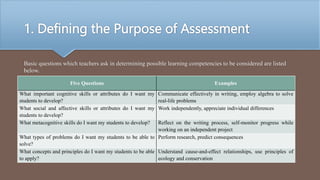
Basic questions which teachers ask in determining possible learning competencies to be considered are listed
below.
Five Questions Examples
What important cognitive skills or attributes do I want my
students to develop?
Communicate effectively in writing, employ algebra to solve
real-life problems
What social and affective skills or attributes do I want my
students to develop?
Work independently, appreciate individual differences
What metacognitive skills do I want my students to develop? Reflect on the writing process, self-monitor progress while
working on an independent project
What types of problems do I want my students to be able to
solve?
Perform research, predict consequences
What concepts and principles do I want my students to be able
to apply?
Understand cause-and-effect relationships, use principles of
ecology and conservation
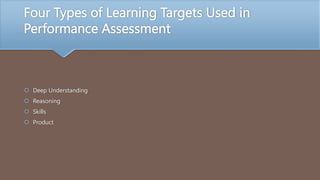
Four Types of Learning Targets Used in
Performance Assessment
 Deep Understanding
 Reasoning
 Skills
 Product
Process and Product-Oriented Performance-
Based Assessments
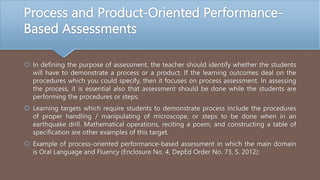
 In defining the purpose of assessment, the teacher should identify whether the students
will have to demonstrate a process or a product. If the learning outcomes deal on the
procedures which you could specify, then it focuses on process assessment. In assessing
the process, it is essential also that assessment should be done while the students are
performing the procedures or steps.
 Learning targets which require students to demonstrate process include the procedures
of proper handling / manipulating of microscope, or steps to be done when in an
earthquake drill. Mathematical operations, reciting a poem, and constructing a table of
specification are other examples of this target.
 Example of process-oriented performance-based assessment in which the main domain
is Oral Language and Fluency (Enclosure No. 4, DepEd Order No. 73, S. 2012):
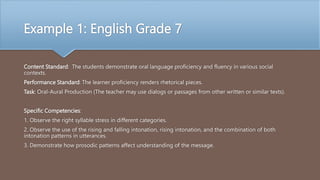
Example 1: English Grade 7
Content Standard: The students demonstrate oral language proficiency and fluency in various social
contexts.
Performance Standard: The learner proficiency renders rhetorical pieces.
Task: Oral-Aural Production (The teacher may use dialogs or passages from other written or similar texts).
Specific Competencies:
1. Observe the right syllable stress in different categories.
2. Observe the use of the rising and falling intonation, rising intonation, and the combination of both
intonation patterns in utterances.
3. Demonstrate how prosodic patterns affect understanding of the message.
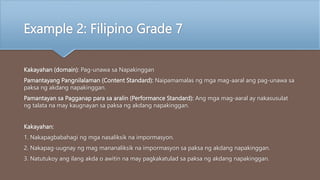
Example 2: Filipino Grade 7
Kakayahan (domain): Pag-unawa sa Napakinggan
Pamantayang Pangnilalaman (Content Standard): Naipamamalas ng mga mag-aaral ang pag-unawa sa
paksa ng akdang napakinggan.
Pamantayan sa Pagganap para sa aralin (Performance Standard): Ang mga mag-aaral ay nakasusulat
ng talata na may kaugnayan sa paksa ng akdang napakinggan.
Kakayahan:
1. Nakapagbabahagi ng mga nasaliksik na impormasyon.
2. Nakapag-uugnay ng mag mananaliksik na impormasyon sa paksa ng akdang napakinggan.
3. Natutukoy ang ilang akda o awitin na may pagkakatulad sa paksa ng akdang napakinggan.
Example 3: Creating a Book Cover Taken from
a Digital Camera
Performance Task: Creating A Book Cover
Competencies: The students should be able to:
1. Generate appropriate shots for book cover using digital camera;
2. Use a page lay-out software (MS Publisher) or presentation software (MS Powerpoint);
3. Create size estimation of image, shapes, and textbox in terms of importance, emphasis and visual
hierarchy; and
4. Demonstrate skills in information design principles such as cl arity, balance, relevance, contrast,
alignment, repetition and proximity.

Designing Meaningful Performance-Based Assessment.pptx

  • 1.
  • 2.
    Intended Learning Outcome Atthe end of the chapter, you should be able to develop a portfolio of performance-based assessment tools that measures learners’ competencies of a given subject.
  • 3.
    1. Defining thePurpose of Assessment Basic questions which teachers ask in determining possible learning competencies to be considered are listed below. Five Questions Examples What important cognitive skills or attributes do I want my students to develop? Communicate effectively in writing, employ algebra to solve real-life problems What social and affective skills or attributes do I want my students to develop? Work independently, appreciate individual differences What metacognitive skills do I want my students to develop? Reflect on the writing process, self-monitor progress while working on an independent project What types of problems do I want my students to be able to solve? Perform research, predict consequences What concepts and principles do I want my students to be able to apply? Understand cause-and-effect relationships, use principles of ecology and conservation
  • 4.
    Four Types ofLearning Targets Used in Performance Assessment  Deep Understanding  Reasoning  Skills  Product
  • 5.
    Process and Product-OrientedPerformance- Based Assessments  In defining the purpose of assessment, the teacher should identify whether the students will have to demonstrate a process or a product. If the learning outcomes deal on the procedures which you could specify, then it focuses on process assessment. In assessing the process, it is essential also that assessment should be done while the students are performing the procedures or steps.  Learning targets which require students to demonstrate process include the procedures of proper handling / manipulating of microscope, or steps to be done when in an earthquake drill. Mathematical operations, reciting a poem, and constructing a table of specification are other examples of this target.  Example of process-oriented performance-based assessment in which the main domain is Oral Language and Fluency (Enclosure No. 4, DepEd Order No. 73, S. 2012):
  • 6.
    Example 1: EnglishGrade 7 Content Standard: The students demonstrate oral language proficiency and fluency in various social contexts. Performance Standard: The learner proficiency renders rhetorical pieces. Task: Oral-Aural Production (The teacher may use dialogs or passages from other written or similar texts). Specific Competencies: 1. Observe the right syllable stress in different categories. 2. Observe the use of the rising and falling intonation, rising intonation, and the combination of both intonation patterns in utterances. 3. Demonstrate how prosodic patterns affect understanding of the message.
  • 7.
    Example 2: FilipinoGrade 7 Kakayahan (domain): Pag-unawa sa Napakinggan Pamantayang Pangnilalaman (Content Standard): Naipamamalas ng mga mag-aaral ang pag-unawa sa paksa ng akdang napakinggan. Pamantayan sa Pagganap para sa aralin (Performance Standard): Ang mga mag-aaral ay nakasusulat ng talata na may kaugnayan sa paksa ng akdang napakinggan. Kakayahan: 1. Nakapagbabahagi ng mga nasaliksik na impormasyon. 2. Nakapag-uugnay ng mag mananaliksik na impormasyon sa paksa ng akdang napakinggan. 3. Natutukoy ang ilang akda o awitin na may pagkakatulad sa paksa ng akdang napakinggan.
  • 8.
    Example 3: Creatinga Book Cover Taken from a Digital Camera Performance Task: Creating A Book Cover Competencies: The students should be able to: 1. Generate appropriate shots for book cover using digital camera; 2. Use a page lay-out software (MS Publisher) or presentation software (MS Powerpoint); 3. Create size estimation of image, shapes, and textbox in terms of importance, emphasis and visual hierarchy; and 4. Demonstrate skills in information design principles such as cl arity, balance, relevance, contrast, alignment, repetition and proximity.