EngD in Systems (Thinking)Richard Craig
OutlineWhat is an EngD?What is Systems Engineering?What is Systems Thinking and   why is Systems Thinking important?Research into Critical National Infrastructure (CNI)
What is an EngD?The Engineering Doctorate, or EngD, provides a more vocationally oriented doctorate in engineering than the traditional PhD and is better suited to the needs of industry. The degree was introduced nationally in 1992 and combines academic research in an industrial context with taught modules in a range of related subjects. The EngD is a 'professional' doctorate, equivalent to a PhD, but with the Research Engineer pursuing a research project while based within a company. The research itself is identified by the sponsoring company and confirmed as appropriate by the University.Within the company, an RE is treated as an employee, eg with company hours of work and holiday periods. The company commits to supporting the research project over the duration of the 4-year EngD programme, and to releasing REs to attend taught modules. All time spent on the EngD programme is fully recognised by Institutions towards CEng status.Association of Engineering Doctorates, http://www.aengd.org.uk
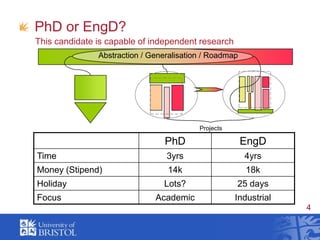
PhD or EngD?This candidate is capable of independent researchAbstraction / Generalisation / RoadmapProjects
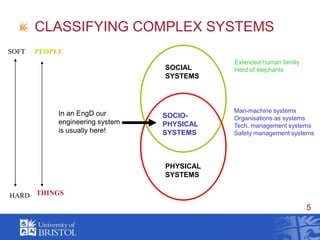
CLASSIFYING COMPLEX SYSTEMSSOFTPEOPLEExtended human family                Herd of elephantsSOCIAL SYSTEMSMan-machine systems        Organisations as systems             Tech. management systems                                    Safety management systems                 In an EngD our engineering system is usually here!SOCIO-  PHYSICAL SYSTEMSPHYSICAL SYSTEMSTHINGS HARD
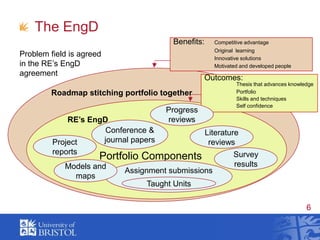
The EngDBenefits: 	Competitive advantage	Original  learning	Innovative solutions	Motivated and developed peopleProblem field is agreed in the RE’s EngD agreementRoadmap stitching portfolio togetherOutcomes:	                     	Thesis that advances knowledge	Portfolio	Skills and techniques	Self confidence RE’s EngDProgress reviewsConference & journal papersLiterature reviewsProject reportsPortfolio ComponentsSurvey resultsModels and mapsAssignment submissionsTaught Units
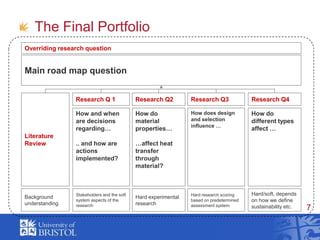
The Final PortfolioOverriding research questionMain road map questionResearch Q 1Research Q2Research Q3Research Q4Literature ReviewHow and when are decisions regarding….. and how are actions implemented? How do material properties……affect heat transfer through material?How does design and selection influence …How do different types affect …Stakeholders and the soft system aspects of the researchBackground understandingHard experimental researchHard research scoring based on predetermined assessment systemHard/soft, depends on how we define sustainability etc.
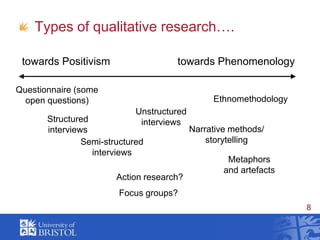
Types of qualitative research….towards Positivismtowards PhenomenologyQuestionnaire (some open questions)EthnomethodologyUnstructured interviewsStructured interviewsNarrative methods/ storytellingSemi-structured interviewsMetaphors and artefactsAction research?Focus groups?
What is Systems Engineering?
What is Systems Engineering?An interdisciplinary approach, focused on defining the needs and requirements (especially early in development cycle),Design synthesis and system validation whilst considering the whole problem, across the complete lifecycle.Systems Engineering considers both technical and business needs of all customers/stakeholders.This is the INCOSE definitionSystems Engineering is focused on understanding the full context for the solution being developed
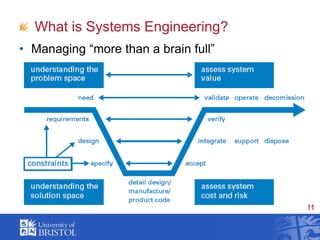
What is Systems Engineering?Managing “more than a brain full”
The need for the Systems ApproachEvery thing –even if it isn’t, can be considered as a systemUsing System properties is a means to understanding and managing the complexity of a system and preventing unwanted emergenceA key aspect of complex engineering systems is the fact that they frequently suffer late-observed emergent properties - which are expensive and difficult to solveThe problems faced by system creators are only getting more complex – or will have more complex interactions with existing systemsThe only known way of effectively reducing the problem is to apply Systems thinking systematically, rigorously as early in the problem life cycle as possible
The need for the Systems ApproachBig Picture thinking and the application of common sense to projectsA structured and auditable approach to identifying the requirements, managing interfaces and controlling risks through the project lifecycleMaking sure appropriate effort is put into understanding the purpose of system, and ensuring a top-down approach (rather than diving straight to detail solution)
What is Systems Thinking?
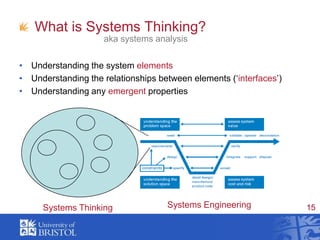
What is Systems Thinking?aka systems analysisUnderstanding the system elementsUnderstanding the relationships between elements (‘interfaces’)Understanding any emergent propertiesSystems EngineeringSystems Thinking
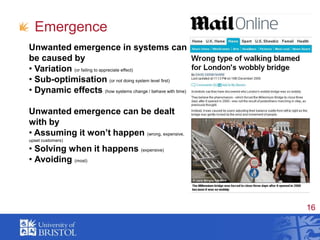
EmergenceUnwanted emergence in systems can be caused by Variation (or failing to appreciate effect)
 Sub-optimisation (or not doing system level first)
 Dynamic effects (how systems change / behave with time)Unwanted emergence can be dealt with by  Assuming it won’t happen (wrong, expensive, upset customers)
 Solving when it happens (expensive)
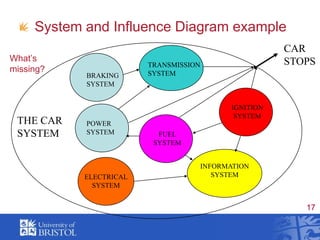
Avoiding (most) System and Influence Diagram exampleCAR STOPSWhat’s missing?TRANSMISSION SYSTEMBRAKING SYSTEMIGNITION SYSTEMTHE CAR SYSTEMPOWER SYSTEMFUEL SYSTEMINFORMATION SYSTEMELECTRICAL SYSTEM
My Research
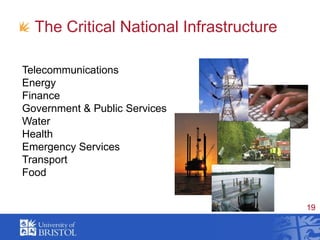
The Critical National InfrastructureTelecommunicationsEnergyFinanceGovernment & Public ServicesWater Health Emergency ServicesTransportFood

EngD in Systems (thinking)

  • 1.
    EngD in Systems(Thinking)Richard Craig
  • 2.
    OutlineWhat is anEngD?What is Systems Engineering?What is Systems Thinking and why is Systems Thinking important?Research into Critical National Infrastructure (CNI)
  • 3.
    What is anEngD?The Engineering Doctorate, or EngD, provides a more vocationally oriented doctorate in engineering than the traditional PhD and is better suited to the needs of industry. The degree was introduced nationally in 1992 and combines academic research in an industrial context with taught modules in a range of related subjects. The EngD is a 'professional' doctorate, equivalent to a PhD, but with the Research Engineer pursuing a research project while based within a company. The research itself is identified by the sponsoring company and confirmed as appropriate by the University.Within the company, an RE is treated as an employee, eg with company hours of work and holiday periods. The company commits to supporting the research project over the duration of the 4-year EngD programme, and to releasing REs to attend taught modules. All time spent on the EngD programme is fully recognised by Institutions towards CEng status.Association of Engineering Doctorates, http://www.aengd.org.uk
  • 4.
    PhD or EngD?Thiscandidate is capable of independent researchAbstraction / Generalisation / RoadmapProjects
  • 5.
    CLASSIFYING COMPLEX SYSTEMSSOFTPEOPLEExtendedhuman family Herd of elephantsSOCIAL SYSTEMSMan-machine systems Organisations as systems Tech. management systems Safety management systems In an EngD our engineering system is usually here!SOCIO- PHYSICAL SYSTEMSPHYSICAL SYSTEMSTHINGS HARD
  • 6.
    The EngDBenefits: Competitiveadvantage Original learning Innovative solutions Motivated and developed peopleProblem field is agreed in the RE’s EngD agreementRoadmap stitching portfolio togetherOutcomes: Thesis that advances knowledge Portfolio Skills and techniques Self confidence RE’s EngDProgress reviewsConference & journal papersLiterature reviewsProject reportsPortfolio ComponentsSurvey resultsModels and mapsAssignment submissionsTaught Units
  • 7.
    The Final PortfolioOverridingresearch questionMain road map questionResearch Q 1Research Q2Research Q3Research Q4Literature ReviewHow and when are decisions regarding….. and how are actions implemented? How do material properties……affect heat transfer through material?How does design and selection influence …How do different types affect …Stakeholders and the soft system aspects of the researchBackground understandingHard experimental researchHard research scoring based on predetermined assessment systemHard/soft, depends on how we define sustainability etc.
  • 8.
    Types of qualitativeresearch….towards Positivismtowards PhenomenologyQuestionnaire (some open questions)EthnomethodologyUnstructured interviewsStructured interviewsNarrative methods/ storytellingSemi-structured interviewsMetaphors and artefactsAction research?Focus groups?
  • 9.
    What is SystemsEngineering?
  • 10.
    What is SystemsEngineering?An interdisciplinary approach, focused on defining the needs and requirements (especially early in development cycle),Design synthesis and system validation whilst considering the whole problem, across the complete lifecycle.Systems Engineering considers both technical and business needs of all customers/stakeholders.This is the INCOSE definitionSystems Engineering is focused on understanding the full context for the solution being developed
  • 11.
    What is SystemsEngineering?Managing “more than a brain full”
  • 12.
    The need forthe Systems ApproachEvery thing –even if it isn’t, can be considered as a systemUsing System properties is a means to understanding and managing the complexity of a system and preventing unwanted emergenceA key aspect of complex engineering systems is the fact that they frequently suffer late-observed emergent properties - which are expensive and difficult to solveThe problems faced by system creators are only getting more complex – or will have more complex interactions with existing systemsThe only known way of effectively reducing the problem is to apply Systems thinking systematically, rigorously as early in the problem life cycle as possible
  • 13.
    The need forthe Systems ApproachBig Picture thinking and the application of common sense to projectsA structured and auditable approach to identifying the requirements, managing interfaces and controlling risks through the project lifecycleMaking sure appropriate effort is put into understanding the purpose of system, and ensuring a top-down approach (rather than diving straight to detail solution)
  • 14.
  • 15.
    What is SystemsThinking?aka systems analysisUnderstanding the system elementsUnderstanding the relationships between elements (‘interfaces’)Understanding any emergent propertiesSystems EngineeringSystems Thinking
  • 16.
    EmergenceUnwanted emergence insystems can be caused by Variation (or failing to appreciate effect)
  • 17.
    Sub-optimisation (ornot doing system level first)
  • 18.
    Dynamic effects(how systems change / behave with time)Unwanted emergence can be dealt with by Assuming it won’t happen (wrong, expensive, upset customers)
  • 19.
    Solving whenit happens (expensive)
  • 20.
    Avoiding (most) Systemand Influence Diagram exampleCAR STOPSWhat’s missing?TRANSMISSION SYSTEMBRAKING SYSTEMIGNITION SYSTEMTHE CAR SYSTEMPOWER SYSTEMFUEL SYSTEMINFORMATION SYSTEMELECTRICAL SYSTEM
  • 21.
  • 22.
    The Critical NationalInfrastructureTelecommunicationsEnergyFinanceGovernment & Public ServicesWater Health Emergency ServicesTransportFood
  • 23.
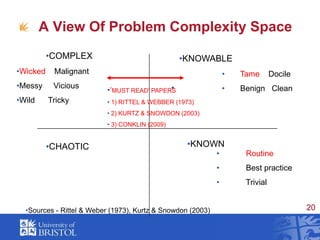
    A ViewOf Problem Complexity SpaceCOMPLEX
  • 24.
  • 25.
    Wicked Malignant
  • 26.
    Messy Vicious
  • 27.
    Wild Tricky
  • 28.
    Tame Docile
  • 29.
    Benign Clean
  • 30.
  • 31.
    1) RITTEL& WEBBER (1973)
  • 32.
    2) KURTZ& SNOWDON (2003)
  • 33.
  • 34.
  • 35.
  • 36.
    Routine
  • 37.
    Best practice
  • 38.
    Trivial
  • 39.
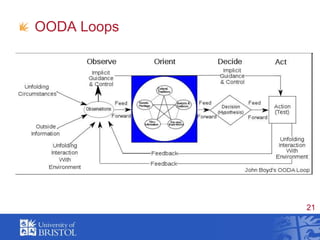
    Sources - Rittel& Weber (1973), Kurtz & Snowdon (2003) OODA Loops
  • 40.
    ContactRichard Craig (richard.craig@bristol.ac.uk)Realisingthe Potential of Systems Thinking by Professor Mike Jackson Tuesday 8th March 2011 Pugsley Lecture Theatre, Queens Building, University Walk,5.30pm Wine and Nibbles to follow. The talk will provide a brief account of the origins of systems thinking and its development over the past fifty years. It will review some of the successes and failures of the systems approach. Full abstract is available at http://www.bristol.ac.uk/eng-systems-centre/events/2011/m-jackson.htmlMike Jackson is Professor of Management Systems and Dean of the Hull University Business School. He has written 4 books on systems thinking and its applications and edited 6 others as well as publishing over 80 articles in refereed journals.

Editor's Notes

  • #4 By minimising the perceptual effort required to identify robot expressions we reduce the cognitive load and produce more efficient non verbal communication.Humans convey vast amounts of information through their gaze, posture, gesturesand facial expression. As technology aimed at improving our lives becomes furtherintegrated into our routines, these systems should adjust according to non verbalsocial cues to minimize effort during interactions. The aim of ’Affective computing’research is to detect and interpret human non-verbal of communication and modulatethese interactions through the application of human social characteristics [2]. Affectivesystems should not only provide improved performance when assisting humans,but also have a capacity to modulate human behaviour through the manipulation ofnon-verbal communication gained through an understand of human social cognition.Understanding innate human perception and response to robots will allow for efficientdesign of future social robots