Design Principles
Ways to combine visual elements to make a more powerful
design/composition
Pattern/Repetition
An element (color, shape,
form, etc.) that occurs over
and over in a design.
It is more visually
appealing to vary the
repetition to some degree.
Hats in the Garment District, New York (1930) Margaret Bourke-White
Contrast
Most often, people think of
contrast as pertaining to
value (the range of light
and dark) in a design.
However, contrast can also
be created using color,
shape, or any other
element that provides a
sense of visual discord.
Self-portrait (1976) Samuel Fosso
Proportion
Our perception of an
object’s size is related to
the size and position of
other objects within the
field of view.
North by Northwest (1959) Alfred Hitchcock
Alignment
Position objects that
belong together along a
common edge or implied
line.
Barnes & Noble Website: https://www.barnesandnoble.com/
Balance
Balance is a sense of visual
stability within a design.
Symmetrical - objects are
the same size, color,
and/or shape
Asymmetrical - achieved
with a combination of
objects of varying sizes,
shapes, and colors.
Festival de las flores (1925) Diego Rivera
Movement
Movement can be a literal
representation, or implied
through repetition of shape
(rhythm) or the alternation
of lights and darks.
Commuter on the New York New Haven line running to catch train pulling out of Grand Central Station (1961) Alfred Eisenstadt
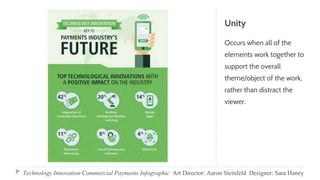
Unity
Occurs when all of the
elements work together to
support the overall
theme/object of the work,
rather than distract the
viewer.
Technology Innovation Commercial Payments Infographic Art Director: Aaron Steinfeld Designer: Sara Haney

Design Principles

  • 1.
    Design Principles Ways tocombine visual elements to make a more powerful design/composition
  • 2.
    Pattern/Repetition An element (color,shape, form, etc.) that occurs over and over in a design. It is more visually appealing to vary the repetition to some degree. Hats in the Garment District, New York (1930) Margaret Bourke-White
  • 3.
    Contrast Most often, peoplethink of contrast as pertaining to value (the range of light and dark) in a design. However, contrast can also be created using color, shape, or any other element that provides a sense of visual discord. Self-portrait (1976) Samuel Fosso
  • 4.
    Proportion Our perception ofan object’s size is related to the size and position of other objects within the field of view. North by Northwest (1959) Alfred Hitchcock
  • 5.
    Alignment Position objects that belongtogether along a common edge or implied line. Barnes & Noble Website: https://www.barnesandnoble.com/
  • 6.
    Balance Balance is asense of visual stability within a design. Symmetrical - objects are the same size, color, and/or shape Asymmetrical - achieved with a combination of objects of varying sizes, shapes, and colors. Festival de las flores (1925) Diego Rivera
  • 7.
    Movement Movement can bea literal representation, or implied through repetition of shape (rhythm) or the alternation of lights and darks. Commuter on the New York New Haven line running to catch train pulling out of Grand Central Station (1961) Alfred Eisenstadt
  • 8.
    Unity Occurs when allof the elements work together to support the overall theme/object of the work, rather than distract the viewer. Technology Innovation Commercial Payments Infographic Art Director: Aaron Steinfeld Designer: Sara Haney