Design Policy in Action—
Politecnico di Milano
The model of the Lux DAG
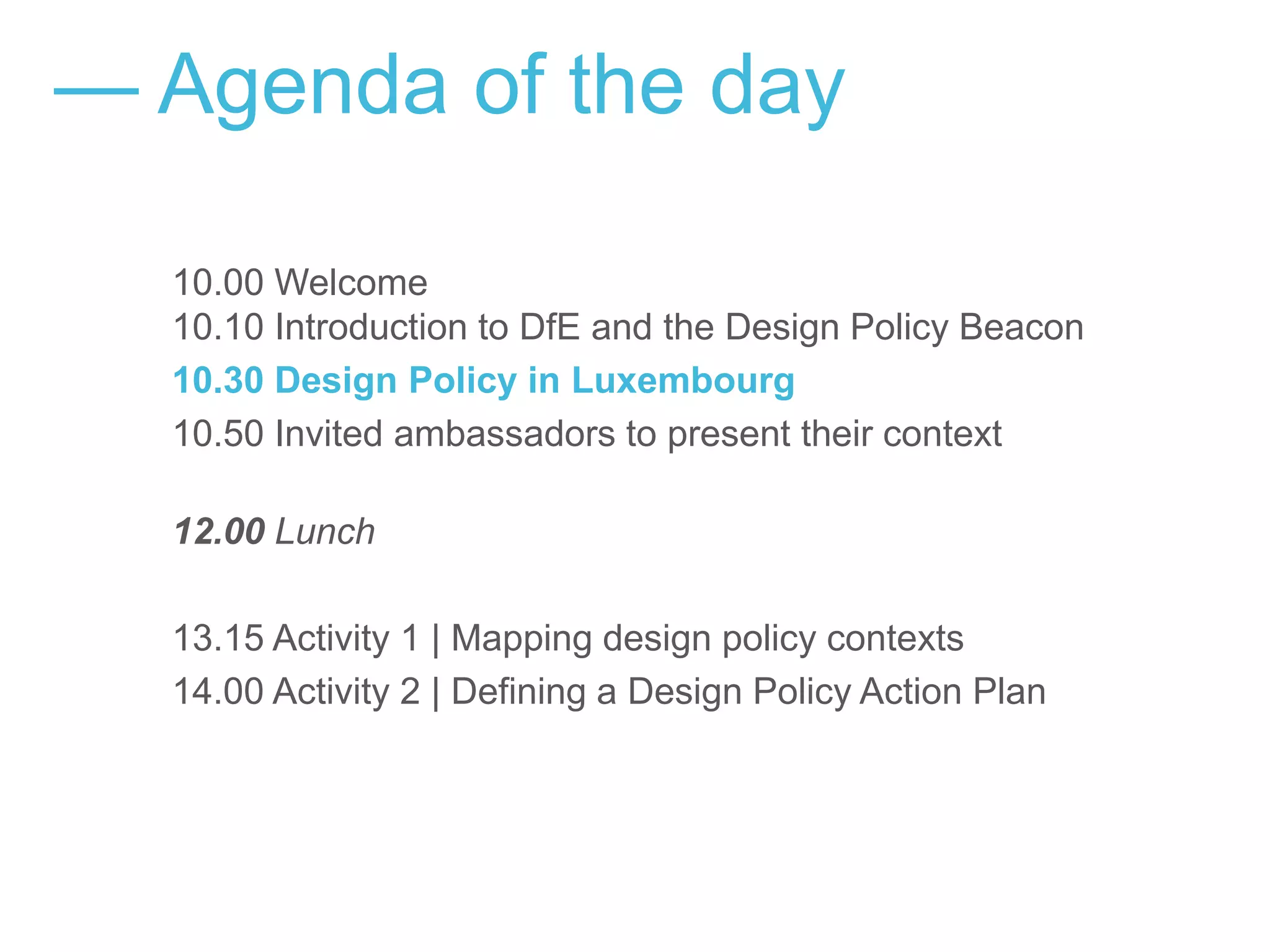
10.00 Welcome
10.10 Introduction to DfE and the Design Policy Beacon
10.30 Design Policy in Luxembourg
10.50 Invited ambassadors to present their context
12.00 Lunch
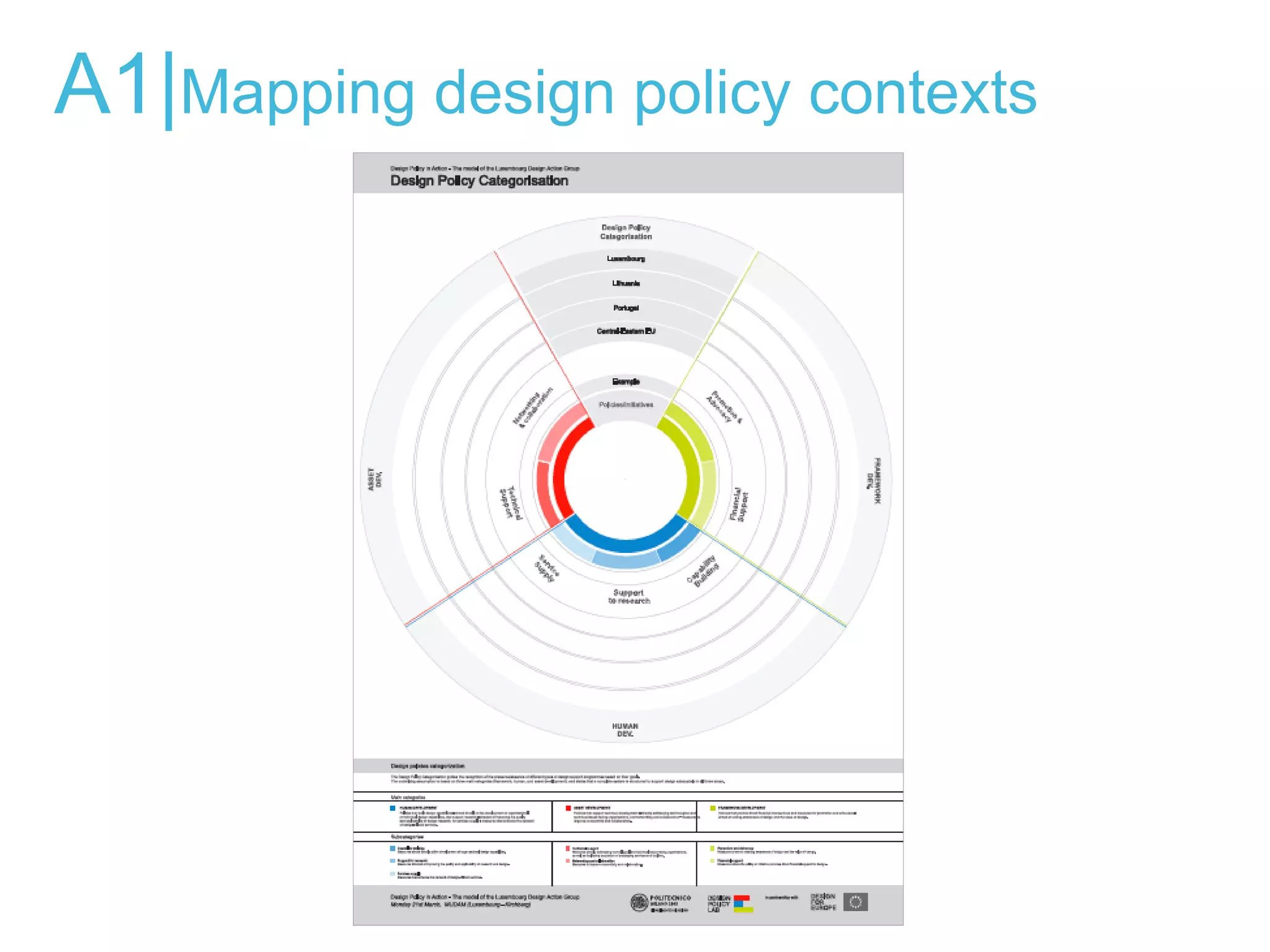
13.15 Activity 1 | Mapping design policy contexts
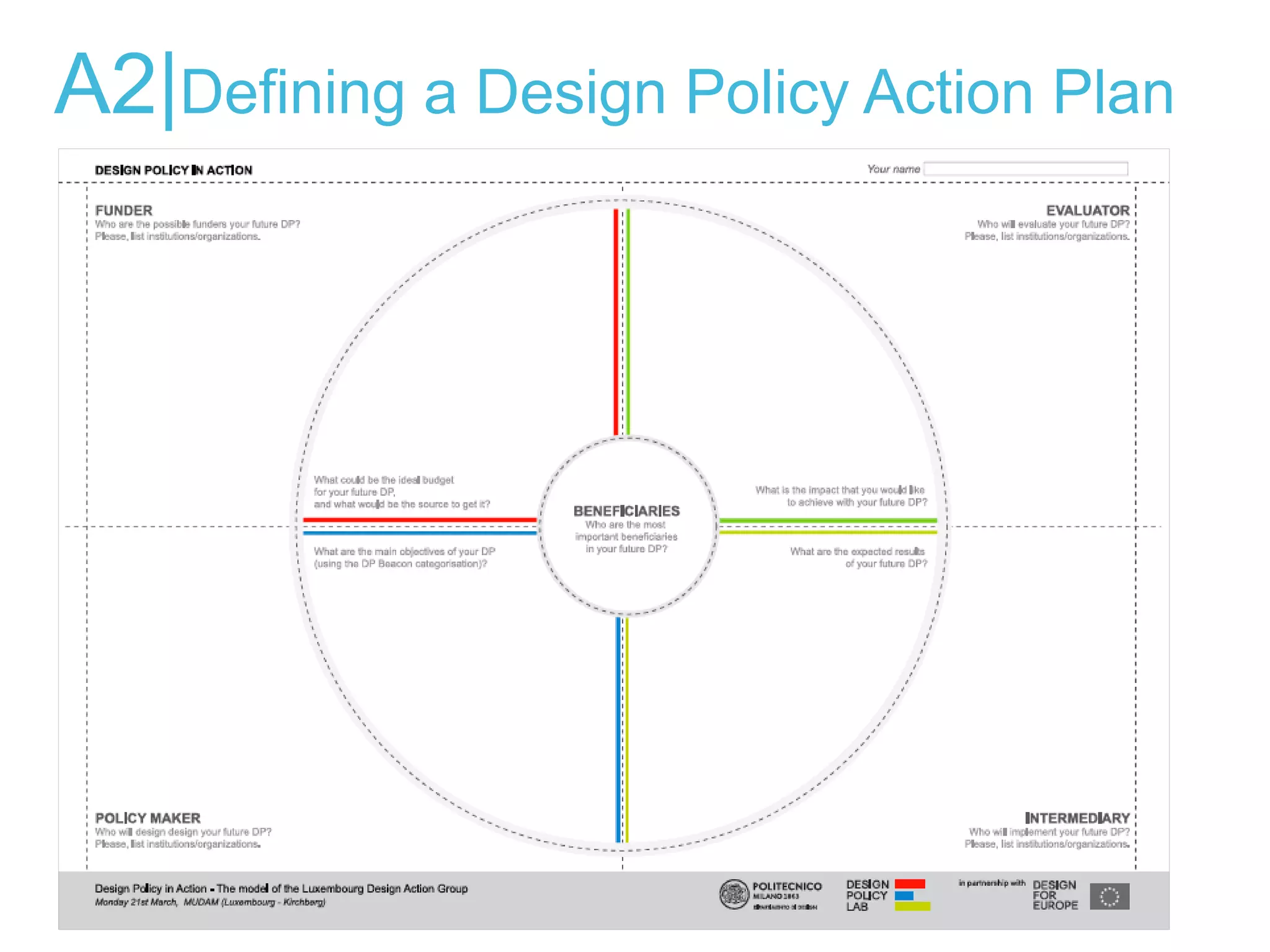
14.00 Activity 2 | Defining a Design Policy Action Plan
— Agenda of the day
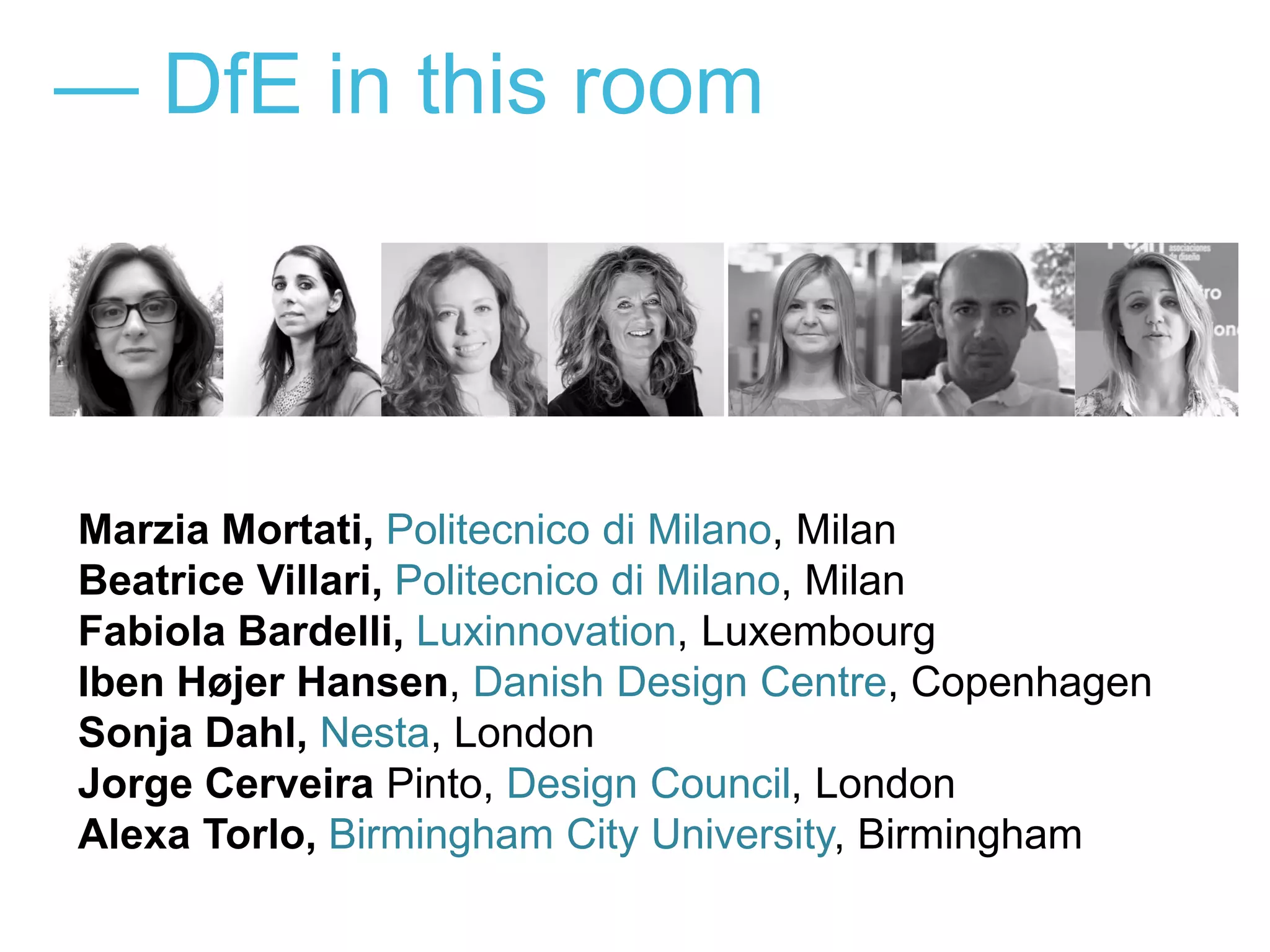
— DfE in this room
Marzia Mortati, Politecnico di Milano, Milan
Beatrice Villari, Politecnico di Milano, Milan
Fabiola Bardelli, Luxinnovation, Luxembourg
Iben Højer Hansen, Danish Design Centre, Copenhagen
Sonja Dahl, Nesta, London
Jorge Cerveira Pinto, Design Council, London
Alexa Torlo, Birmingham City University, Birmingham
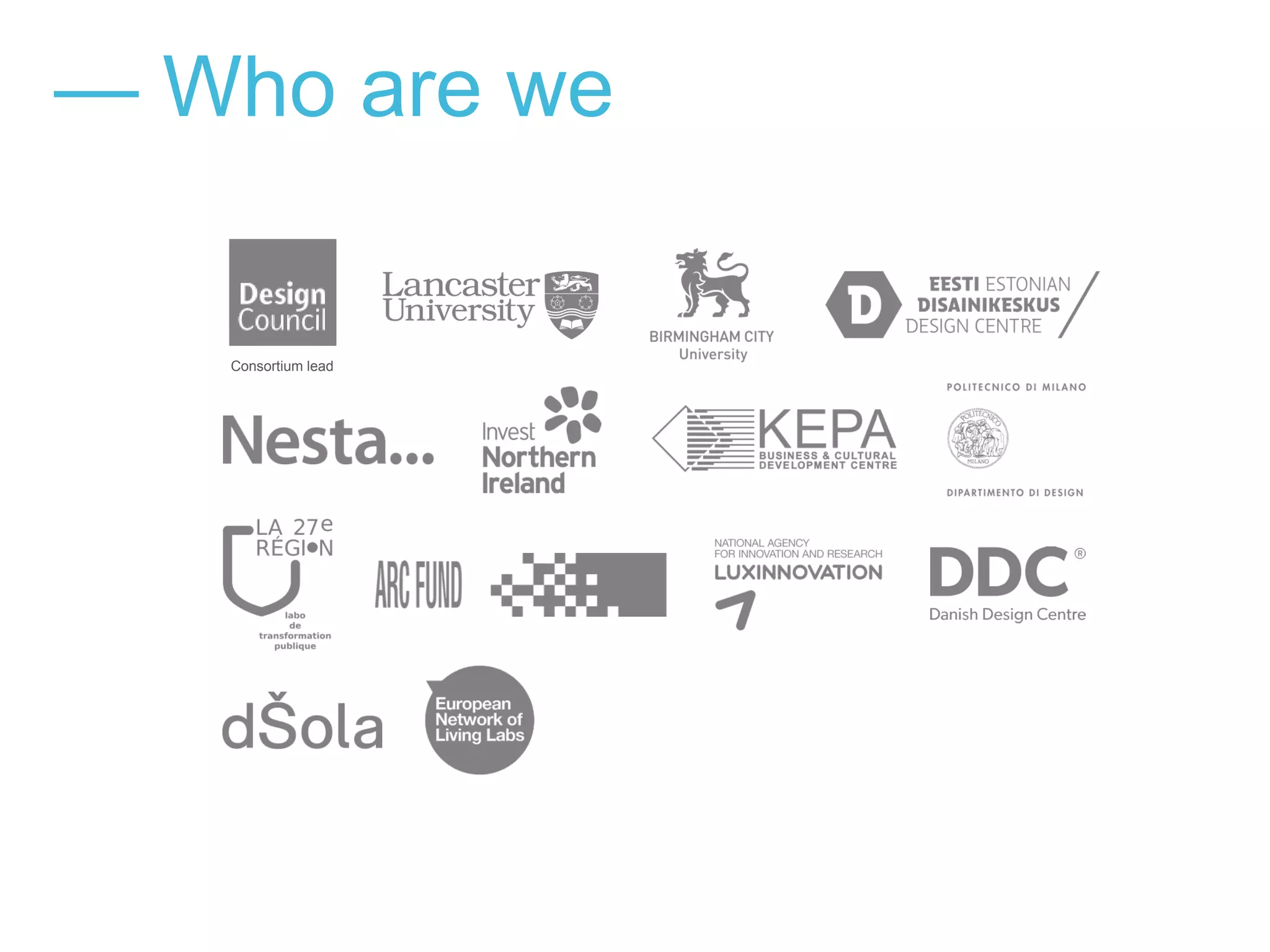
— Who are we
Consortium lead
Our vision—
To accelerate design-driven
innovation by raising awareness of
how design increases efficiency in
public services and drives business
growth across Europe.
—
— Design for Europe
— Design for Europe
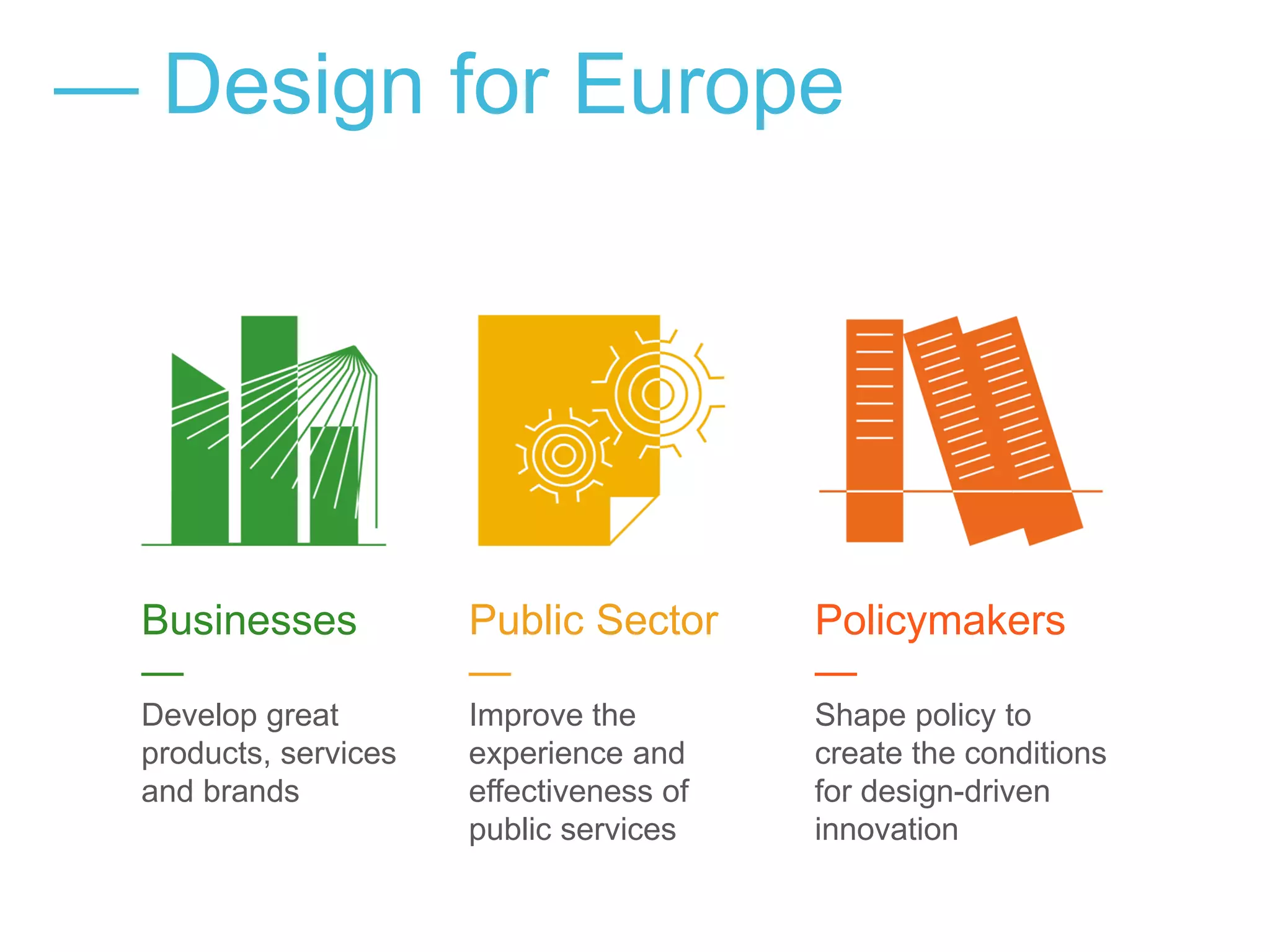
Businesses
—
Develop great
products, services
and brands
Public Sector
—
Improve the
experience and
effectiveness of
public services
Policymakers
—
Shape policy to
create the conditions
for design-driven
innovation
—
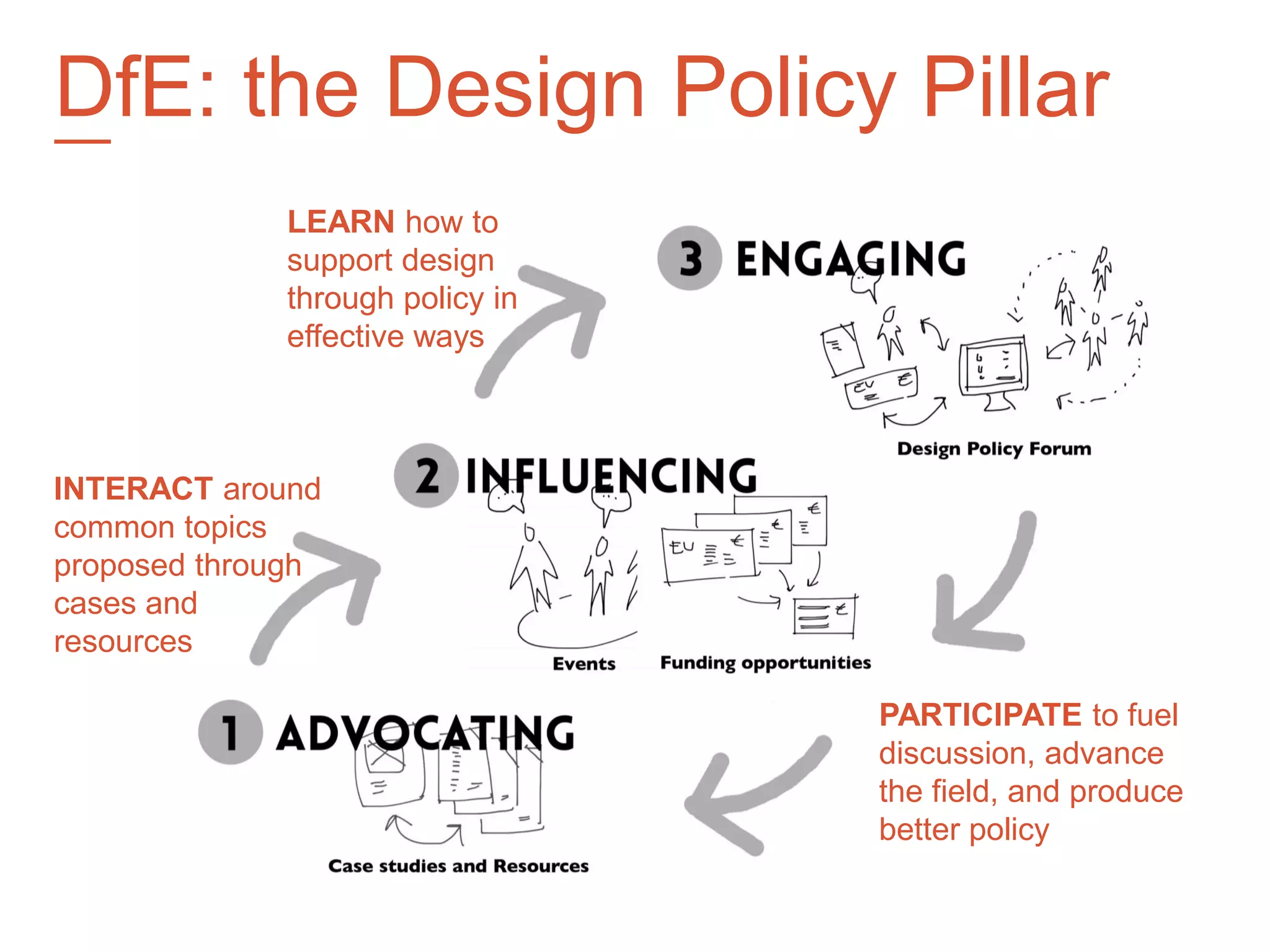
The Design Policy Pillar
To carry out a set of activities
targeted to European, national
and local policymakers to raise
awareness, exchange
knowledge and build capacity all
over Europe for accelerating the
take-up of design in innovation
policies.
—
DfE: the Design Policy Pillar
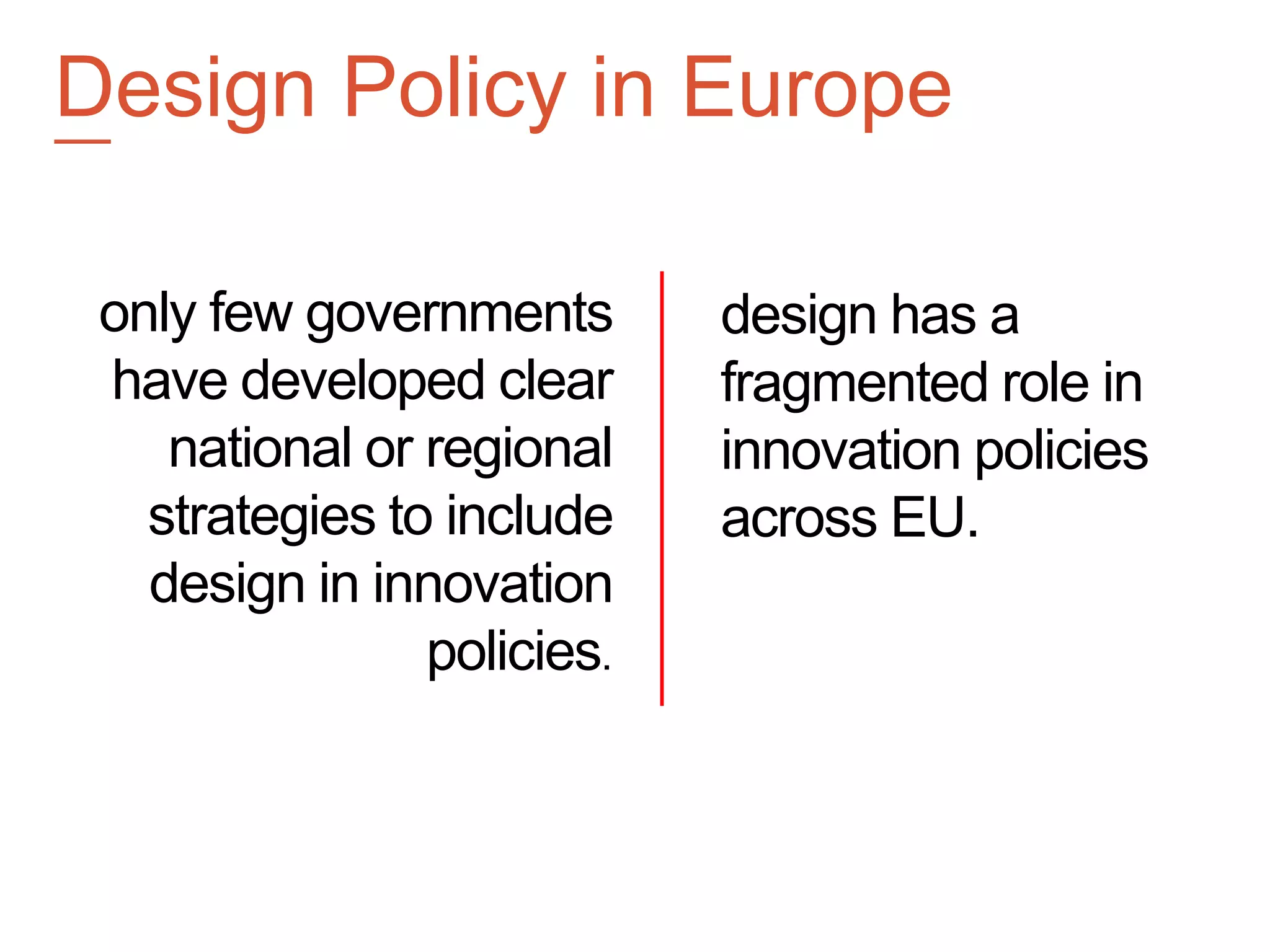
only few governments
have developed clear
national or regional
strategies to include
design in innovation
policies.
design has a
fragmented role in
innovation policies
across EU.
Design Policy in Europe—
—
DfE: the Design Policy Pillar
INTERACT around
common topics
proposed through
cases and
resources
LEARN how to
support design
through policy in
effective ways
PARTICIPATE to fuel
discussion, advance
the field, and produce
better policy
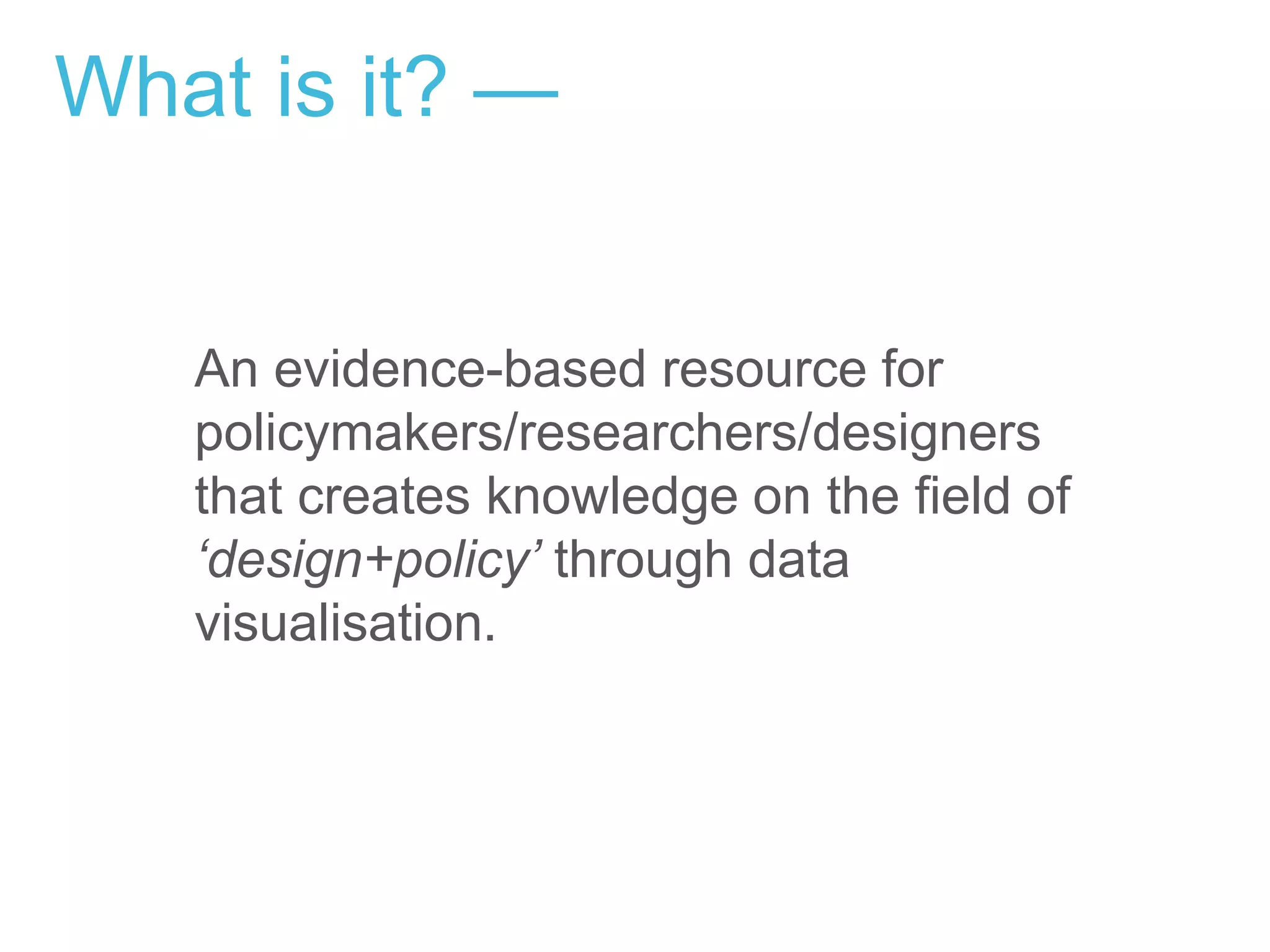
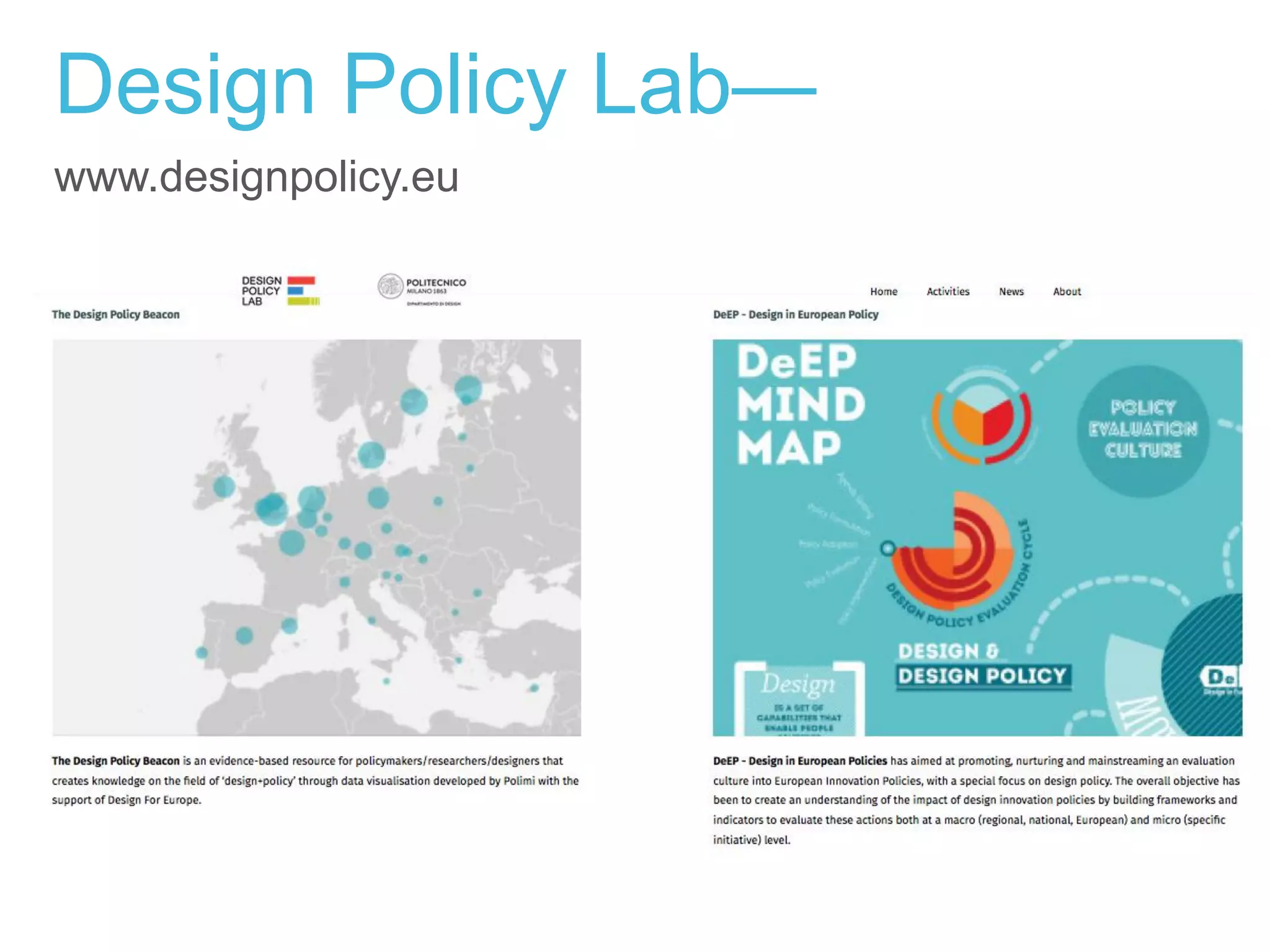
What is it? —
An evidence-based resource for
policymakers/researchers/designers
that creates knowledge on the field of
‘design+policy’ through data
visualisation.
http://designforeurope.eu/
•Policy makers and implementers
•Governmental institutions
•Design policy beneficiaries
•Designers
•Academics
…
Who is it for? —
What does it offer? —
Knowledge about the design policy
context in different EU regions,
interpreted through data visualisation
in order to make information easily
accessible and comparable.
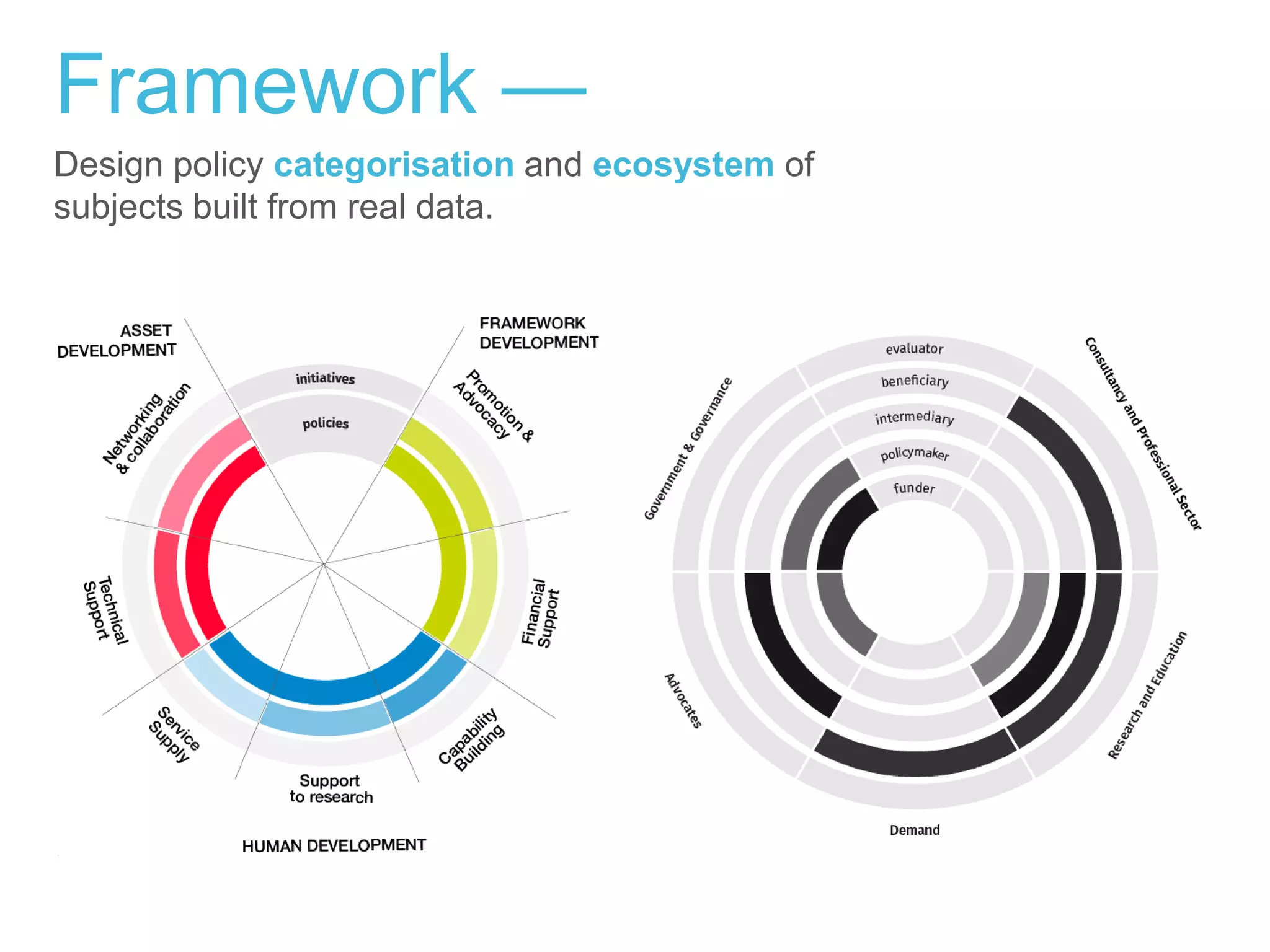
Framework —
Design policy categorisation and ecosystem of
subjects built from real data.
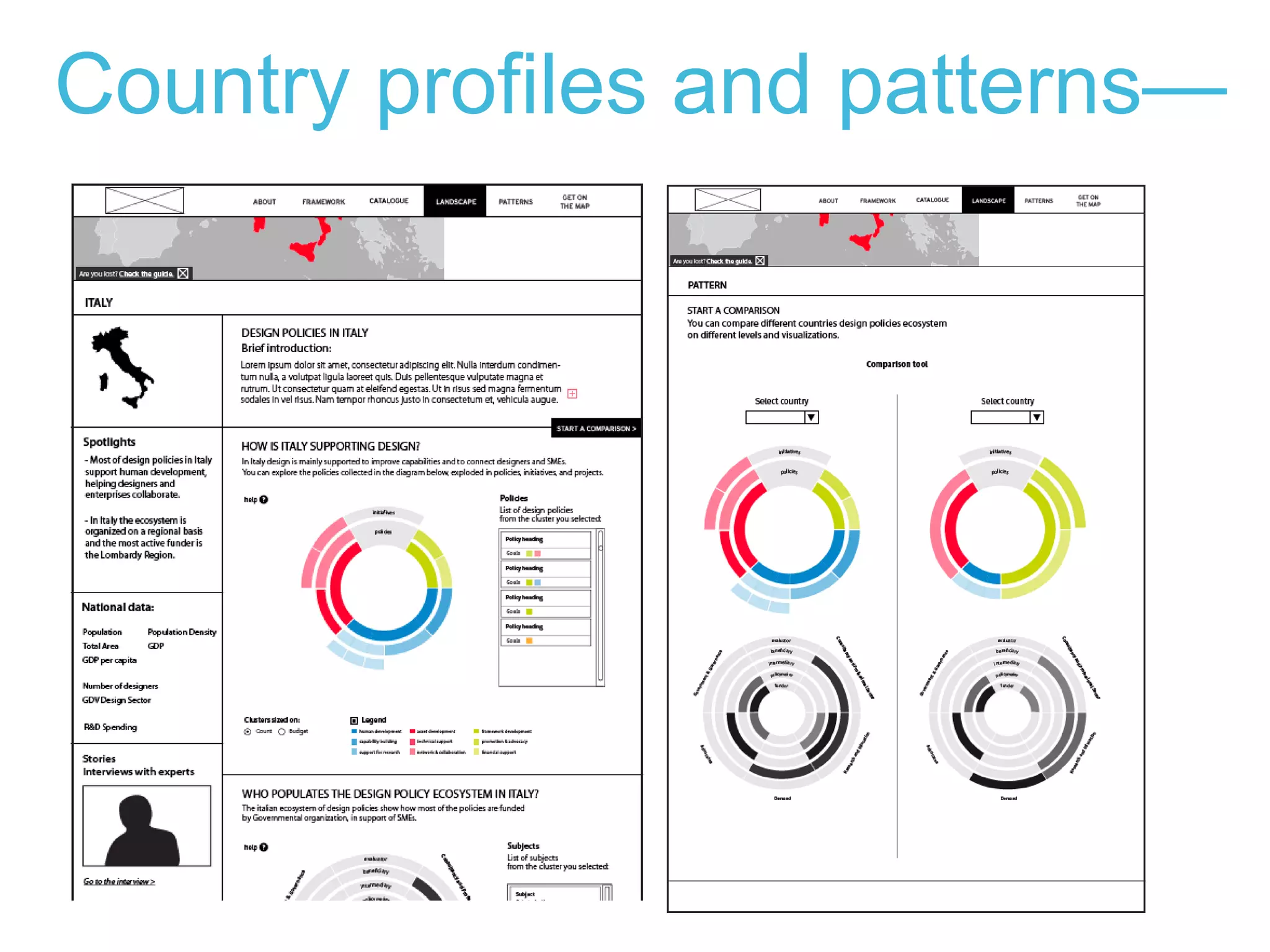
Country profiles and patterns—
Design Policy Lab—
www.designpolicy.eu
Why are we here today?—
How can you make design support
relevant and impactful in your region?
—
How to make your design innovation
context more robust?
—
How to invest strategically on design
for future growth?
—
How to learn from past investments
and experiments and from what other
have done?
—
There is no recipe —
HOW? —
A1|Mapping design policy contexts
A2|Defining a Design Policy Action Plan
10.00 Welcome
10.10 Introduction to DfE and the Design Policy Beacon
10.30 Design Policy in Luxembourg
10.50 Invited ambassadors to present their context
12.00 Lunch
13.15 Activity 1 | Mapping design policy contexts
14.00 Activity 2 | Defining a Design Policy Action Plan
— Agenda of the day
THANK YOU—

Design Policy in Action Workshop - Polimi introductory presentation

  • 1.
    Design Policy inAction— Politecnico di Milano The model of the Lux DAG
  • 2.
    10.00 Welcome 10.10 Introductionto DfE and the Design Policy Beacon 10.30 Design Policy in Luxembourg 10.50 Invited ambassadors to present their context 12.00 Lunch 13.15 Activity 1 | Mapping design policy contexts 14.00 Activity 2 | Defining a Design Policy Action Plan — Agenda of the day
  • 3.
    — DfE inthis room Marzia Mortati, Politecnico di Milano, Milan Beatrice Villari, Politecnico di Milano, Milan Fabiola Bardelli, Luxinnovation, Luxembourg Iben Højer Hansen, Danish Design Centre, Copenhagen Sonja Dahl, Nesta, London Jorge Cerveira Pinto, Design Council, London Alexa Torlo, Birmingham City University, Birmingham
  • 4.
    — Who arewe Consortium lead
  • 5.
    Our vision— To acceleratedesign-driven innovation by raising awareness of how design increases efficiency in public services and drives business growth across Europe. — — Design for Europe
  • 6.
    — Design forEurope Businesses — Develop great products, services and brands Public Sector — Improve the experience and effectiveness of public services Policymakers — Shape policy to create the conditions for design-driven innovation
  • 7.
  • 8.
    To carry outa set of activities targeted to European, national and local policymakers to raise awareness, exchange knowledge and build capacity all over Europe for accelerating the take-up of design in innovation policies. — DfE: the Design Policy Pillar
  • 9.
    only few governments havedeveloped clear national or regional strategies to include design in innovation policies. design has a fragmented role in innovation policies across EU. Design Policy in Europe—
  • 10.
    — DfE: the DesignPolicy Pillar INTERACT around common topics proposed through cases and resources LEARN how to support design through policy in effective ways PARTICIPATE to fuel discussion, advance the field, and produce better policy
  • 12.
    What is it?— An evidence-based resource for policymakers/researchers/designers that creates knowledge on the field of ‘design+policy’ through data visualisation.
  • 13.
    http://designforeurope.eu/ •Policy makers andimplementers •Governmental institutions •Design policy beneficiaries •Designers •Academics … Who is it for? —
  • 14.
    What does itoffer? — Knowledge about the design policy context in different EU regions, interpreted through data visualisation in order to make information easily accessible and comparable.
  • 15.
    Framework — Design policycategorisation and ecosystem of subjects built from real data.
  • 16.
  • 17.
  • 18.
    Why are wehere today?—
  • 19.
    How can youmake design support relevant and impactful in your region? —
  • 21.
    How to makeyour design innovation context more robust? —
  • 22.
    How to investstrategically on design for future growth? —
  • 23.
    How to learnfrom past investments and experiments and from what other have done? —
  • 24.
    There is norecipe —
  • 25.
  • 26.
  • 27.
    A2|Defining a DesignPolicy Action Plan
  • 28.
    10.00 Welcome 10.10 Introductionto DfE and the Design Policy Beacon 10.30 Design Policy in Luxembourg 10.50 Invited ambassadors to present their context 12.00 Lunch 13.15 Activity 1 | Mapping design policy contexts 14.00 Activity 2 | Defining a Design Policy Action Plan — Agenda of the day
  • 29.