Design Council
Angel Building
407 St John Street
London EC1V 4AB
United Kingdom
Tel +44(0)20 7420 5200
Fax +44(0)20 7420 5300
info@designcouncil.org.uk
www.designcouncil.org.uk
Registered charity number 272099
© Design Council, May 2013
Designfor
PublicGood
Supported by the European Commission
Design for Public Good
Author country profiles
Authorcountryprofiles
Denmark
Danish design rests on a long-standing
democratic and human-centred tradition that
addresses systems, processes and products
from the bottom up.
Design has the highest turnover growth
among Danish creative sector industries
(2003-2010). The government launched the
world’s first national design policy in 1997 and
recently launched a comprehensive growth
plan for creative industries and design. This
continues support for design as a key driver
of innovation.
The Danish Design Centre was established in
1978, and has from the beginning focused on
promoting design and the value of design for
Danish industry. It has played a key part in the
creation of design policy from 1997. In 2013, it
launched a radical new strategy of cooperation
with the design field, business, industry,
research and education.
Finland
The Finnish organisation for design
promotion is the Design Forum Finland.
Design has been on the national agenda since
SITRA, the Finnish Innovation Fund, was
founded 1967.
In 2008, design was written into the definition
of innovation in the National Innovation
Strategy and made an essential part of the
National Innovation System. The National
Innovation Policy will soon include user-
driven innovation.
Helsinki was World Design Capital for 2012
and ran Open Helsinki – Embedded Design in
Life. The National Innovation Policy action-
plan used this as an opportunity to pilot public
service design. The learning from the world
design capital experience was written into
the renewed national design policy “Design
Finland”. The new design policy specifies four
visions of wider-scale strategic design use
and learning, aiming to increase investment
in design capabilities and learning over the
period to 2020.
Wales
In2008,designrepresentedthelargest
proportionoftheWelshcreativeindustriesboth
inemploymentandgrossvalueadded.1
The
WelshGovernmenthasprovideddesignsupport
tocompaniesinWalesthroughtheDesign
AdvisoryServicesince1994.DesignWales,part
oftheNationalCentreforProductDesignand
DevelopmentResearchatCardiffMetropolitan
University,wasestablishedin1994.
In 2010, the “Design for Innovation in Wales”
manifesto was adopted unanimously by the
National Assembly for Wales. This resulted
in design forming part of Wales’s 2010
innovation policy and the 2013 Innovation
Strategy for Wales. Two new programmes
resulted: the Service Design Programme
(training designers in service design and
creating demand for it in manufacturing)
and SPIDER (piloting service design projects
in Cardiff City Council and training public
officials in service design methods).
UK
TheUKdesignindustryisthelargestinEurope
andoneofthestrongestglobally.NESTA
estimates£23bnisspentondesignintheUK
annually,whileImperialCollegeputthefigure
at£33.5bnfor2011.DesignCouncilresearch
showsthat,despitetherecession,theindustry
grewby29%between2005and2010.
TheDesignCouncilwasfoundedin1944,
thenunderthenametheCouncilofIndustrial
Design.Today,designplaysanimportantrole
inUKinnovationandcompetitiveness.In
2011theInnovationandResearchStrategyfor
Growth(2011),publishedbytheDepartmentfor
Business,InnovationandSkills,putinnovation
attheheartoftheUKgovernmentstrategyfor
economicgrowthandrebalancing,withdesign
givenacentralrole.Designisalsorecognisedin
theUKNationalPlanningPolicyFramework
(2011)asavitalpartofsustainabledevelopment
andtheIndependentReviewofCompetitiveness
(2012)isinformedbytheconsiderablepotential
fordesigntosupportbothgovernmentand
businessandbolsterUKcompetitiveness.
Atbothlocalandcentralgovernmentlevel
intheUK,designisplayinganincreasingly
importantroleinservicedevelopmentand
deliveryandthereisgrowinginterestinitsuse
forpolicymaking.
2/3
Foreword		 4
Executive summary	 6
Recommendations	10
Introduction and overview of design process	 14
Introduction	16	
Overview of design process	 18
A designer’s toolbox	 24
The Public Sector Design Ladder and case studies	 28
The Public Sector Design Ladder	 30
Recommendation 1: Developing the ladder	 31
	 Step 1
	 Case studies: Design for public services	 33
	 1. Young people’s use of the tax system	 34
	 2. The Good Kitchen	 36
	 Case studies: Humanising technology	 39
	 3. Designing Faces	 40
	 4. Big data	 42
	 Case studies: Systemic change	 43
	 5. Reducing violence and aggression in A&E	 44
	 6. Make it Work	 48
	 Step 2
	 Case studies: Embedding design process	 51
	 7. Lewisham Housing Options Service	 52
	 8. Government Digital Service	 56
	 Step 3
	 Case studies: Strategic design	 60
	 9. Helsinki Design Lab	 62
	 10. Mindlab	 64
	 11. Behavioural Insights Team	 68
	 12. Design thinking for the civil service	 72
Recommendation 2: Embedding design in government	 76
Build your own public sector design-led innovation industry	 78
Recommendation 3: Building a design sector	 79
Evaluation: Measuring the impact	 80
Evaluation overview	 81
Evaluation case studies	 82
Evaluation literature	 88
Recommendation 4: Building the evidence base	 89
Endnotes and credits	 90
Contents
4/5
We are moving into a global economy based not just on knowledge but
ingenuity. Increasingly success depends less on what material resources we
have and more on what we make of them. This is true even in the field of
mass-produced consumer goods, where the global harmonisation of labour
costs will come to impede emerging economies’ ability to compete on price.
Quality will be the great differentiator. As those concerned with innovation
now widely understand, design is key to this, not as an add-on,
but as a way of structuring development.
The UK government fully appreciates the role of design as a driver of
economic growth. Successive governments have supported design for over 60
years since the Government set up the Council for Industrial Design in 1944 to
aid post-war economic recovery. Design is a source of competitive advantage
and can help organisations transform their performance. That is why design
forms an integral part of the Government’s plans for innovation and growth.
Design and innovation play a particularly crucial role in services. With a
certain symmetry, as manufacturing moved to Asia, digital technology has
allowed principally European and American businesses to create value
through increasingly sophisticated service offerings. This has given rise to
vital new design disciplines focused not on objects but services and systems.
This is almost entirely about what we do, not what we have. It is about
reorganising what we do around an understanding of the needs of the end
user, ensuring that we do not waste time and money on anything extraneous.
This capability grew from the private sector, but provides vital cues for
the public sector. It is the capability to do more for citizens with less, or do
less with greater effect. It has the potential to meet the pressing needs of
the present, but also to help governments achieve wider long-term aims of
growth and quality of life for its citizens. With governments around the world
beginning to recognise it, it is a capability Europe cannot afford to ignore.
Foreword
Rt Hon David Willetts MP,
Minister for Universities
and Science, Department
for Business, Innovation
and Skills, UK
Annette Vilhelmsen,
Minister for Business
and Growth, Denmark
Design is a key source of innovation and therefore part of the solution to
the growth challenge Europe is facing. Every day we see start-up businesses
inspired by design and creative thinking, and leading global enterprises using
it as a means to boost business development and gain competitive advantage.
Worldwide there is also an increasing focus on how design and other creative
skills can contribute to a green transition. A major part of a product’s
environmental footprint is defined through the early design phase, so many
environmental issues can be solved by focusing on reducing environmental
impact early in the development process.
Rapid urbanisation is another example. The rise of megacities with millions
of inhabitants is increasing the need for design solutions both technical and
social that can meet the challenge of creating sustainable urban environments
on a huge scale.
Design and creativity also brings value to the public sector by contributing
to the development of more user-friendly services and humanising
technology. To promote design-driven innovation in the public sector,
the Danish Government supports MindLab, a cross-ministerial innovation
unit that involves citizens and businesses in creating new solutions for
society. Entrepreneurship, climate change, digital self-service, education,
employment services and workplace safety are some of the areas the
unit addresses.
Denmark is highly aware of the value of design and was one of the first
countries in the world to launch a national design policy. Recently the Danish
government has made design and creative industries a specific focus area in
the national policy for business and growth. Design thinking and creativity
can contribute to innovation and economic growth and has a lot to offer in
developing sustainable solutions for a better society.
Design for Public Good
Foreword
Design for Public Good
Executive summary
6/7
The right team for the right system
Starting with the user also gives designers a
direct insight into the system in which they are
tryingtoinnovate.Bymappingauser’sjourney
around a system’s touchpoints, designers
are able to see quickly which departments
and areas of expertise are relevant, how they
might be better joined up and who the relevant
personnel are. These individuals can then be
included in the design process.
Designersdonotseektosupplantother
areasofexpertise;rather,theirtechniques
facilitatemultidisciplinaryteamwork.Teams
mightincluderepresentativesfromdifferent
governmentdepartmentsoragencies,but
alsoexpertsinfieldssuchasbehavioural
economics.Designers’visualisationshelpthese
teamsunderstandproblemscollaboratively
andsynthesisetheirinsightsintoviable
solutions.Theygetoftendisconnected
individualsandteamsworkingtogether.
Designing out risk
Prototypes are a low-cost, efficient way to
ensure solutions work. One can start with
very simple models – an early prototype of a
hospital service, for example, might use chalk
lines on tarmac to indicate wards. As each
prototype reveals more about what works,
iterations can become more like a finished
product. By the time one arrives at final
prototype or pilot, unintended consequences
and risk of failure will usually have been
designed out.
This is the spine of the design-led innovation
process. It is, as one can see, a joined-up
process from analysis to problem solving
to implementation. It mitigates risk while
increasing the chances of success by using
end user needs as a touchstone.
Mapping the system
Application of design to services and policy
might seem a leap to some. In fact, part of
design’s value here is in making seemingly
intangible things tangible to the teams
working on them. A service or system,
for instance, is made up of a series of
“touchpoints” (anything from shop counters
to web pages to tax forms). A map of these can
be sketched, just as an object can.
Meeting the real need
User needs are a quick route to efficiency. By
designing a service or policy around them,
one can eliminate extraneous elements and
cut costs. Policymaking often begins with
cost savings and does not engage with the
user. This is skipping a step. A measure that
does not meet the needs of the people it is
intended to serve is no saving, however cheap
it appears upfront.
Designers’ observations are particularly
effective because they go beyond the
focus group or survey to observe real user
behaviour, often identifying needs and
behaviour people are not aware of themselves.
No longer just an add-on, design has
evolved into a fully joined-up innovation
methodology. There is increasing
understanding in the private sector of the
enormous value this adds, even in areas not
traditionally seen as the preserve of design
such as services. Likewise, and for similar
reasons, it is increasingly clear in the public
sector that design thinking is the way to
overcome common structural flaws in service
provision and policymaking:
–– 	Design-led innovation is a joined-
up process, with no inefficient
handover from analysis to solution to
implementation.
–– 	Rather than disjointedly patching
together incremental solutions to
problems as they arise, design thinking
looks at the entire system to redefine the
problem from the ground up.
–– 	Design thinking starts by understanding
user needs in order to ensure solutions
are appropriate, waste is avoided and end
users buy into them.
–– 	Rather than jumping straight to
expensive and risky pilots, design process
tests iteratively, starting with low-cost,
simple prototypes and designing out risk
as prototypes become more evolved.
–– 	Silo structures are a perennial problem
in government. While the structural
factors that cause this may be stubborn,
design methods offer uniquely effective
ways of understanding which teams,
departments, experts and specialists are
relevant to a problem and engaging them
in collaboration.
In this publication, members of SEE
(SharingExperienceEurope),anetwork
of11Europeanpartners,presentaseries
ofcasestudiesandtoolstoenhancethe
understandingofdesignforpublicsector
innovationandfacilitatetheintegrationofits
methodsintomainstreampractice.
Societies today face common challenges in
delivering the best possible quality of life
in a way that is economically sustainable.
Design thinking offers a highly effective
methodology for squaring this circle and
connecting with citizens – at all levels of the
public sector, and from services to policy.
Countries such as New Zealand, South
Korea, Australia and Singapore are adopting
design-led innovation, realising in common
with leading-edge companies such as Apple
that it is key to growth and competitiveness.
The European Union cannot afford to be
left behind and, with pioneering work from
several of its member states, has a chance to
lead the field.
Executivesummary
Visualise
solutions
Prototype
and improve
Research
user needs1 32
A brief and simplified description of design as a three-step process begins to show how
this works. Designers:
This report is a collaborative effort between the Design Council, Danish Design Centre,
Aalto University and Design Wales (SEE Platform lead partner).
Design for Public Good
Executive summary
Step 1: Design for discrete problems
At this step, design projects are one-offs
and design thinking is not embedded in
the commissioning organisations. Public
sector service design projects, of which there
are numerous good examples, fit into this
category. Projects can be very small or have
wide systemic implications. They can tackle
societal problems such as malnutrition
among the elderly, violence in hospitals and
worklessness, among many others. This
category also covers design’s application as a
way of making technology useful and usable
for people.
Step 2: Design as capability
Here,publicsectoremployeesnotonlywork
withdesigners,theyunderstandanduse
designthinkingthemselves.Manydesign
techniquesareeasilytransferabletonon-
designersandcancreatesignificantefficiencies
aspartofday-to-dayoperations.Staff:
–– 	use the new skills to solve numerous
problems too small to merit the hiring
of designers.
–– 	gain a shift in perspective in seeing
things from the point of view of the
citizens they serve.
–– 	become more adept at hiring design
teams when required.
Step 3: Design for policy
Here design thinking is used by policymakers,
often facilitated by designers. This is a
relatively new discipline and much of the work
on it so far has been experimental, but the logic
of design’s application here is strong given that
it meets some key policymaker needs:
–– 	A joined up process, from policymaking
to implementation
–– A low-cost way of mitigating risk
through prototyping
–– 	A way of getting an overview of a system
–– A way of cutting across departmental
silos and engaging people from outside
government too.
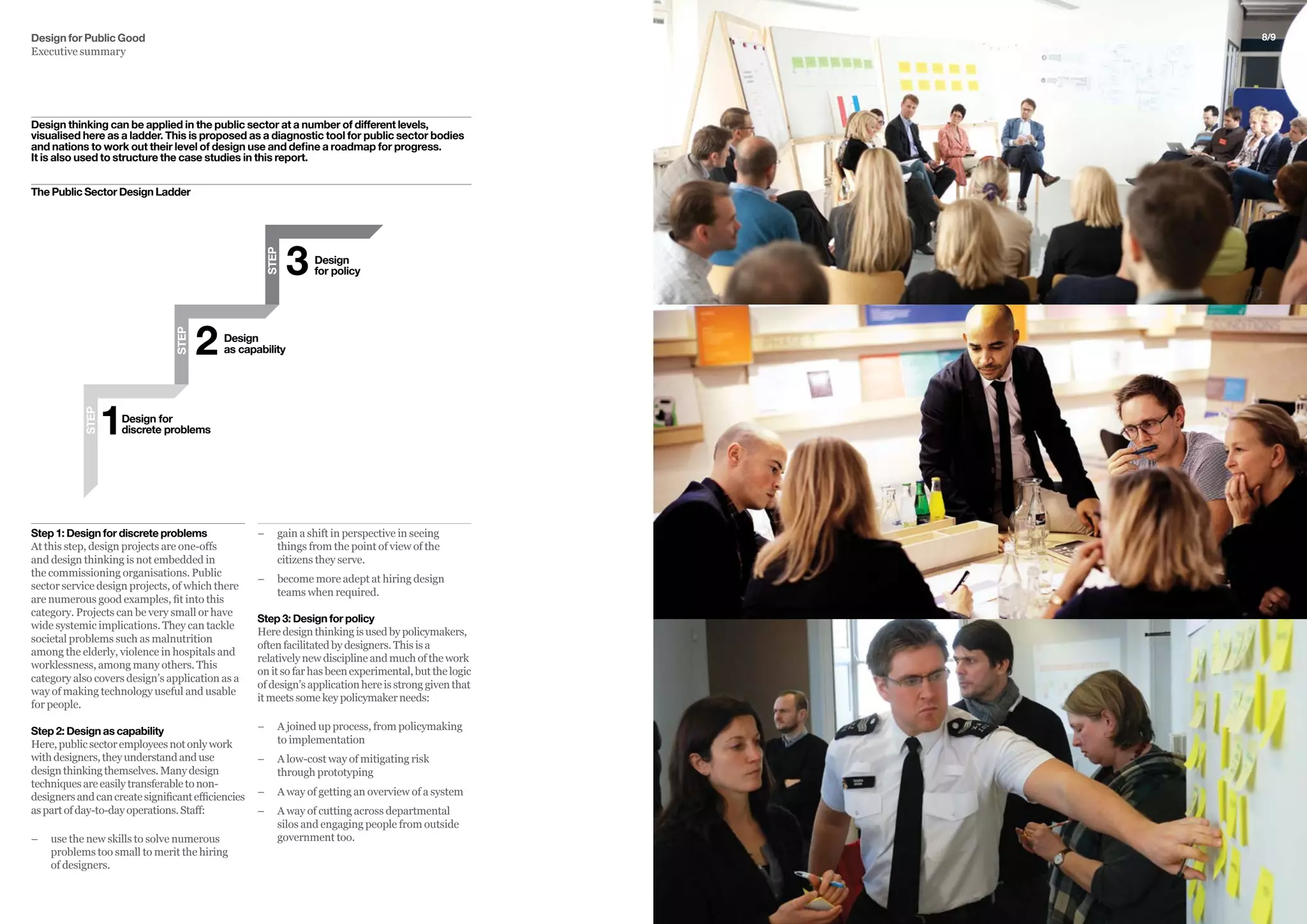
The Public Sector Design Ladder
STEP
Design
as capability2
Design
for policy3STEP
Design for
discrete problems1
STEP
8/9
Design thinking can be applied in the public sector at a number of different levels,
visualised here as a ladder. This is proposed as a diagnostic tool for public sector bodies
and nations to work out their level of design use and define a roadmap for progress.
It is also used to structure the case studies in this report.
Design for Public Good
Recommendations
10/11
CountriesmaywishtolearnfromtheDanish
orUKexperiencesofboostingdesignsector
capabilities,orcontacttheauthorsofthisreport
foradvice,traininganddirectassistance.
The design sector and design
organisations should build awareness of
and capability in supporting the public sector
as follows:
–– 	Design organisations should raise
awareness among designers of the public
sector as a potential market/client.
–– 	Designers should build knowledge of
service and strategic design approaches,
ideally through direct contact with those
who have pioneered them.
–– 	Given that strategic design is an emerging
field, designers engaging with it should
also seek to gain direct experience of the
policymaking landscape and contribute
to the development of the discipline.
3	 Recommendation 3:
	 Build a strong design sector that can
	 offer strategic and service design to the
	 public sector
The European Commission should
support this by:
–– 	facilitating the sharing of learning and
best practice – such as case studies
or evaluation reports – via online or
physical networks and events.
–– ensuring that design project case
studies follow a standard template and
are categorised according to the three
steps of the ladder so a picture of the
effectiveness of outcomes achieved at
these levels can be built.
–– 	ensuring design-led innovation
projects are eligible for European
funding streams focussed on innovation
and public sector renewal.
Member States and municipalities
wanting to build design capabilities should:
–– 	assess the strengths/weaknesses of
their design sector and set targets for
improvement (see the design ladder for a
framework for this).
–– 	learn from those with experience
in design-led public services and
policymaking.
–– 	build these skills into design education
from school level upwards.
Recommendations
2	 Recommendation 2: 	
	 Build design thinking into government
	 and public policy practice
In order for the European Commission
to promote design thinking in government, it
is logical that it embeds it in its own working
methods. This should not be a sudden or
expensively engineered change but start
small, with short designer-led workshops or
training sessions showing teams how to apply
design thinking to existing challenges.
Successful adoption of these processes will
be a direct benefit to European Commission
working practices, provide an evidence base
and should also help European Commission
staff advocate for these methods.
Member States and municipalities
should:
–– seek out design resource for policy-level
work, ideally in their own countries or,
if it is unavailable, from expert design
organisations and agencies abroad.
–– start small, with training, workshops
and small-scale service projects.
–– 	share information within the
Commission and with other countries
trying these design approaches.
Design organisations should actively
seek to grow the market by offering the
public sector small-scale training sessions,
workshops and project leadership in
partnership with the design sector.
1	 Recommendation 1:
	 Use the Public Sector Design Ladder
	 as a diagnostic tool and roadmap
	 for progression.
The Public Sector Design Ladder can be
used to assess one’s own position relative to
ambitions and needs, other organisations and
the big picture nationally and internationally.
–– Member states, municipalities and
government departments, and
agencies should use it to monitor their
own design use and determine how to
progress towards more wide-ranging
service and policy design-led innovations.
–– Design organisations should use it
to diagnose design sector capabilities
and the degree to which design thinking
is embedded in government and help
clients improve.
–– 	The design sector can use it to assess
the effectiveness of its own offerings.
The European Commission should
promote use of the ladder and fund work
on developing it as a diagnostic tool and
roadmap for progression. This could take
the form of a matrix, allowing specific
disciplines on one axis to be plotted against
steps of the ladder on the other. This will
help create a more detailed picture of the use
and effectiveness of design capabilities and
related disciplines at each step of the ladder.
The following recommendations occur throughout the report.
12/13
4	 Recommendation 4:
	 Build the evidence base and impact 		
	 measurements for design innovation in 	
	 the public sector
The European Commission should
support this by:
–– 	initiating a detailed study on
best-practice evaluation of service and
strategic design, so that it can deliver
clear guidelines on this as an integral
part of knowledge sharing.
–– 	making good evaluation integral
to funding applications for design
innovation projects.
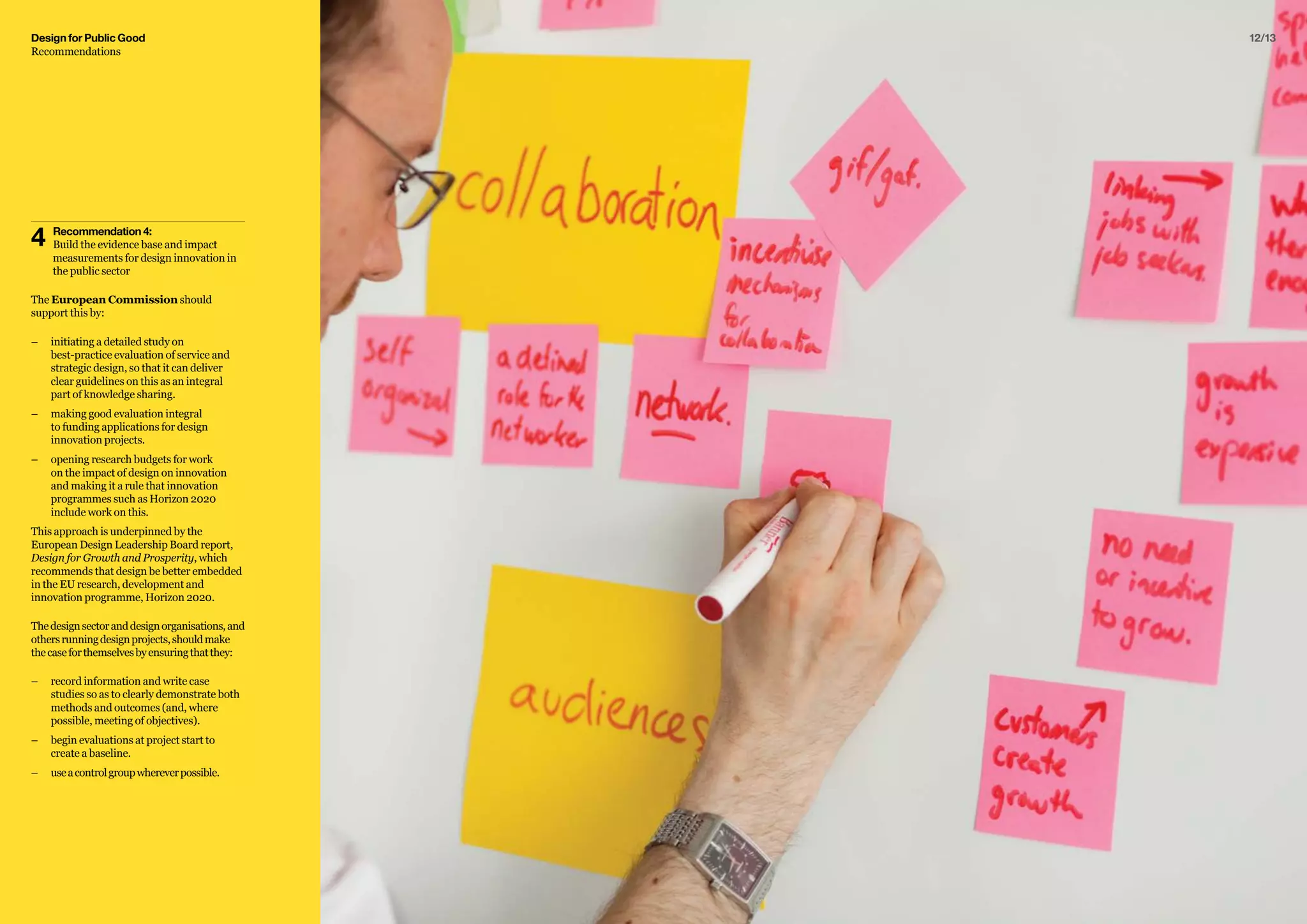
–– 	opening research budgets for work
on the impact of design on innovation
and making it a rule that innovation
programmes such as Horizon 2020
include work on this.
This approach is underpinned by the
European Design Leadership Board report,
Design for Growth and Prosperity, which
recommends that design be better embedded
in the EU research, development and
innovation programme, Horizon 2020.
Thedesignsectoranddesignorganisations,and
othersrunningdesignprojects,shouldmake
thecaseforthemselvesbyensuringthatthey:
–– 	record information and write case
studies so as to clearly demonstrate both
methods and outcomes (and, where
possible, meeting of objectives).
–– 	begin evaluations at project start to
create a baseline.
–– 	useacontrolgroupwhereverpossible.
Design for Public Good
Recommendations
14/15Design for Public Good
Introduction and overview of design process
Introduction
andoverviewof
designprocess
Wegenuinelybelievethatpublicsector
leadersneedtoacquiredesignskillsif
theyaretostandareasonablechanceof
reshapingandrefashioningtheservices
forwhichtheyareresponsible.Design
offersafreshapproachtorethinking
policy,redrawingprofessionalpractice
andreshapingservicedelivery.”
– Barry Quirk, Chief Executive of Lewisham Council, London 2
Ourchallengetodayliesinourabilityto
moveintounchartedterritory,ratherthan
improvetheexisting.Howelsewillour
ageingsocietybeabletomeetgrowing
serviceneedswithadiminishingtaxbase?
Howwillwemeetoursustainability
challengewithinanenergyandresource
dependenteconomy?Thesearenot
efficiencychallenges,butratherredesign
challenges.Wewillhavetoclarifyour
attitudetowardsrisk.Doingnewthings
hasanassociatedrisk,butdoingnothing
isarguablymuchriskier.”
– Marco Steinberg, Director of Internal Strategic Design, SITRA
“
“
Design for Public Good
Introduction and overview of design process
16/17
In the current straitened economic climate,
this is vital. However, design-led innovation
techniques are no mere emergency measures.
Rather, they are ways of working that
governments can and should use at any time.
Whether one has a lot of resource or a little,
what matters is that it be targeted effectively.
Design thinking fits solutions to problems
with precision. It is a way of being agile,
economical and intelligent in meeting both
the challenges that are pressing in the present
and the new ones that will continually appear
in the future. We strongly believe that it has
the potential to help societies not only sustain
themselves, but flourish.
Nevertheless, trial of these methods need not
be a blind – or wild-eyed – leap of faith. One
of design’s great capabilities is allowing one
to start small – both with design solutions
and design methodology itself. Organisations
new to these techniques can and should begin
with quick, low-cost projects and workshops,
proving the worth of design methods and
helping staff learn design thinking before
moving on to larger projects. This will also
be likely to deliver efficiency wins almost
immediately. Then, as innovations bear fruit
and design thinking becomes part of the
nervous system of public sector bodies, they
can begin to apply it to some of the bigger,
more challenging problems of our age and the
next one.
Soforinnovation-mindedpublicauthorities
lookingtodeliverarobust,rationalpublic
sector,design-ledinnovationisasetoftools
tailoredtoyourneeds,waitingtobetried.
Thereisnothingtoloseandagreatdealtogain.
Inthispublication,membersof SEE
(SharingExperienceEurope),anetwork
of11Europeanpartners,presentaseries
ofcasestudiesandtoolstoenhancethe
understandingofdesignforpublicsector
innovationandfacilitatetheintegrationofits
methodsintomainstreampractice.
Countries such as New Zealand, South
Korea, Australia and Singapore are all
adopting design-led innovation to solve
societal challenges. In common with leading
international companies such as Apple, they
know that these processes are key to growth
and competitiveness.
The EU is not lagging behind. With a strong
track-record of pioneering work in this area
from countries such as Denmark, the UK
and Finland, we have in fact been leading the
way for the past decade. To continue to do
this, however, we now need to increase use of
these practices and close the divide between
the advanced EU member states and those for
whom these methods are new.
Butthisisnotjustastoryofpressurefrom
globalisation.Itis,predominantly,astory
aboutpeopleandsociety.Governmentdesign
projectsconsistentlydeliverlowercosts,
greaterefficiency,fulfilledpublicsectorstaff
and,mostimportantly,citizenswhoare
bothmoresecureinthepresentandmore
empoweredandself-reliantlong-term.Inother
words,designhasshownitsabilitytosquare
thecirclebetweentwofirst-orderobjectives
oftenseenasmutuallyexclusive:cuttingstate
spendingandimprovingtheexperienceof
citizens.Itdoesthisbytailoringitssolutions
totheneedsoftheenduser,thecitizen,and
trimmingoffwhateverisextraneous.
Introduction
Design and the public sector
Ithinkinthepastthere’sbeenan
assumptionthatifit’sinthepublicsectorit
doesn’thavetobeasgoodasintheprivate
sector.Thatisridiculous.Asdesigners,
we’reworkingtomakepeople’slivesbetter;
we’reworkingtosavebillionsofpounds.
Theambitionshouldbeskyhigh.”
– Ben Terrett, Head of Design, UK Government Digital Service
“
“Adesigneraddressesdevelopmentby
lookingforaproblem–notasolution.
Thereisonlyoneproblem,butthereare
manysolutions.Becauseoftheamount
ofcompetitionandthepressureon
financesandresources,wedon’thave
timeformistakes.Itisbothefficientand
riskreducingtoidentifytheproblem
beforedevelopingthesolutions.”
– David Fellah, CEO main markets, Designit
Design for Public Good
Introduction and overview of design process
18/19
Overviewof
designprocess
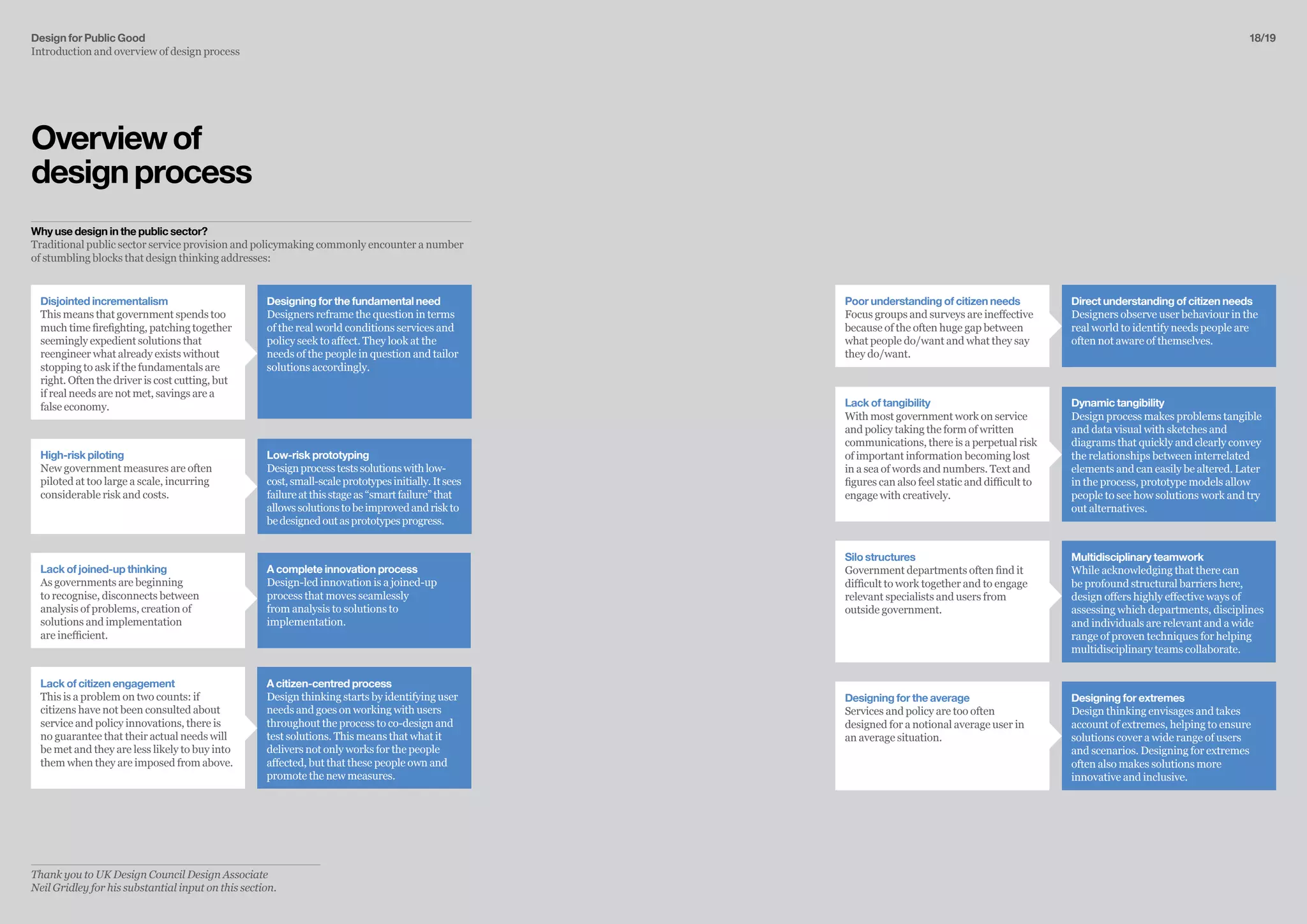
Why use design in the public sector?
Traditional public sector service provision and policymaking commonly encounter a number
of stumbling blocks that design thinking addresses:
Poor understanding of citizen needs
Focus groups and surveys are ineffective
because of the often huge gap between
what people do/want and what they say
they do/want.
Direct understanding of citizen needs
Designers observe user behaviour in the
real world to identify needs people are
often not aware of themselves.
Lack of tangibility
With most government work on service
and policy taking the form of written
communications, there is a perpetual risk
of important information becoming lost
in a sea of words and numbers. Text and
figures can also feel static and difficult to
engage with creatively.
Silo structures
Government departments often find it
difficult to work together and to engage
relevant specialists and users from
outside government.
Dynamic tangibility
Design process makes problems tangible
and data visual with sketches and
diagrams that quickly and clearly convey
the relationships between interrelated
elements and can easily be altered. Later
in the process, prototype models allow
people to see how solutions work and try
out alternatives.
Multidisciplinary teamwork
While acknowledging that there can
be profound structural barriers here,
design offers highly effective ways of
assessing which departments, disciplines
and individuals are relevant and a wide
range of proven techniques for helping
multidisciplinary teams collaborate.
Designing for the average
Services and policy are too often
designed for a notional average user in
an average situation.
Designing for extremes
Design thinking envisages and takes
account of extremes, helping to ensure
solutions cover a wide range of users
and scenarios. Designing for extremes
often also makes solutions more
innovative and inclusive.
Disjointed incrementalism
This means that government spends too
much time firefighting, patching together
seemingly expedient solutions that
reengineer what already exists without
stopping to ask if the fundamentals are
right. Often the driver is cost cutting, but
if real needs are not met, savings are a
false economy.
Designing for the fundamental need
Designers reframe the question in terms
of the real world conditions services and
policy seek to affect. They look at the
needs of the people in question and tailor
solutions accordingly.
High-risk piloting
New government measures are often
piloted at too large a scale, incurring
considerable risk and costs.
Low-risk prototyping
Designprocesstestssolutionswithlow-
cost,small-scaleprototypesinitially.Itsees
failureatthisstageas“smartfailure”that
allowssolutionstobeimprovedandriskto
bedesignedoutasprototypesprogress.
Lack of joined-up thinking
As governments are beginning
to recognise, disconnects between
analysis of problems, creation of
solutions and implementation
are inefficient.
A complete innovation process
Design-led innovation is a joined-up
process that moves seamlessly
from analysis to solutions to
implementation.
Lack of citizen engagement
This is a problem on two counts: if
citizens have not been consulted about
service and policy innovations, there is
no guarantee that their actual needs will
be met and they are less likely to buy into
them when they are imposed from above.
A citizen-centred process
Design thinking starts by identifying user
needs and goes on working with users
throughout the process to co-design and
test solutions. This means that what it
delivers not only works for the people
affected, but that these people own and
promote the new measures.
Thank you to UK Design Council Design Associate
Neil Gridley for his substantial input on this section.
Design for Public Good
Introduction and overview of design process
20/21
Creativityisthegenerationofnewideas.
Innovationisthesuccessfulexploitation
ofnewideas.Designiswhatlinkscreativity
andinnovation.Itshapesideastobecome
practicalandattractivepropositions
forusersorcustomers.”
– Sir George Cox, former UK Design Council Chairman
Design without objects
This report is primarily concerned with the
design not of discrete objects but of public
services and public policy. To many, this
notion of design will be unfamiliar and may be
difficult to imagine in practice. We therefore
begin by explaining some basic principles.
For example:
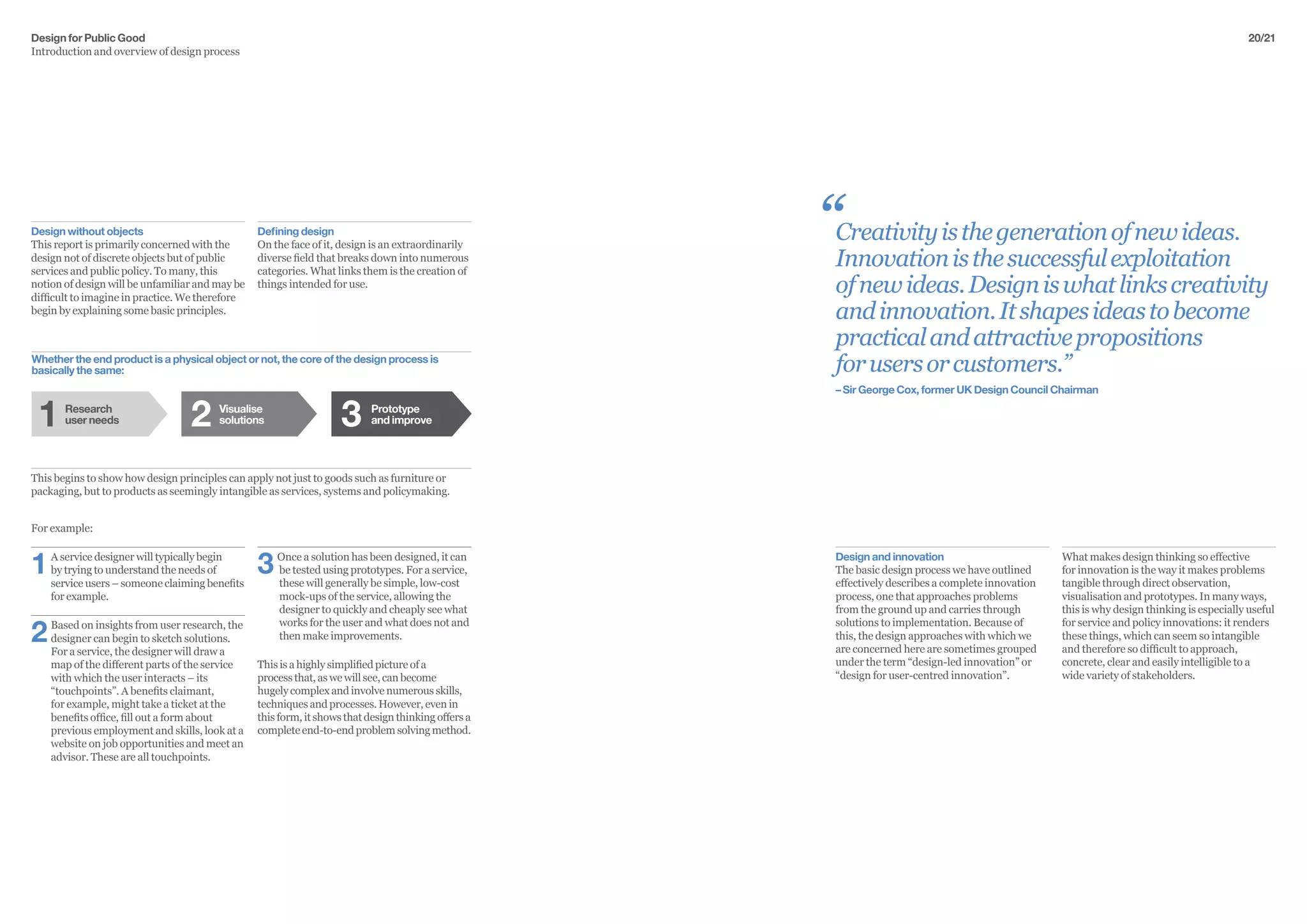
1	 A service designer will typically begin
by trying to understand the needs of
service users – someone claiming benefits
for example.
2	 Based on insights from user research, the
designer can begin to sketch solutions.
For a service, the designer will draw a
map of the different parts of the service
with which the user interacts – its
“touchpoints”. A benefits claimant,
for example, might take a ticket at the
benefits office, fill out a form about
previous employment and skills, look at a
website on job opportunities and meet an
advisor. These are all touchpoints.
Whether the end product is a physical object or not, the core of the design process is
basically the same:
Defining design
On the face of it, design is an extraordinarily
diverse field that breaks down into numerous
categories. What links them is the creation of
things intended for use.
3	 Once a solution has been designed, it can 	
	be tested using prototypes. For a service, 	
	these will generally be simple, low-cost 	
	mock-ups of the service, allowing the 		
	designer to quickly and cheaply see what 	
	works for the user and what does not and 	
	then make improvements.
This is a highly simplified picture of a
process that, as we will see, can become
hugely complex and involve numerous skills,
techniques and processes. However, even in
this form, it shows that design thinking offers a
complete end-to-end problem solving method.
“
This begins to show how design principles can apply not just to goods such as furniture or
packaging, but to products as seemingly intangible as services, systems and policymaking.
What makes design thinking so effective
for innovation is the way it makes problems
tangible through direct observation,
visualisation and prototypes. In many ways,
this is why design thinking is especially useful
for service and policy innovations: it renders
these things, which can seem so intangible
and therefore so difficult to approach,
concrete, clear and easily intelligible to a
wide variety of stakeholders.
Design and innovation
The basic design process we have outlined
effectively describes a complete innovation
process, one that approaches problems
from the ground up and carries through
solutions to implementation. Because of
this, the design approaches with which we
are concerned here are sometimes grouped
under the term “design-led innovation” or
“design for user-centred innovation”.
Visualise
solutions
Prototype
and improve
Research
user needs1 32
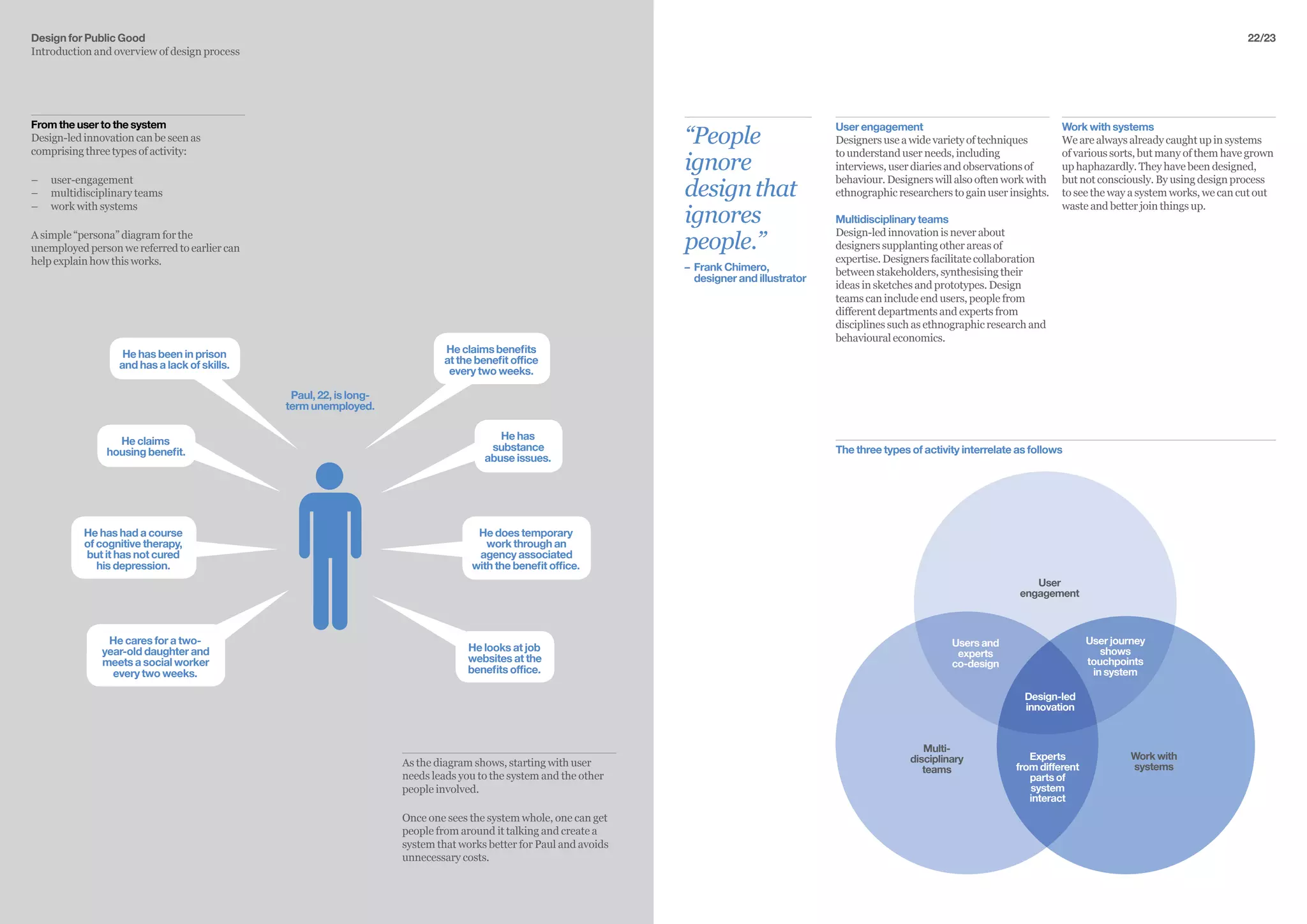
From the user to the system
Design-led innovation can be seen as
comprising three types of activity:
–– 	user-engagement
–– multidisciplinary teams
–– work with systems
A simple “persona” diagram for the
unemployed person we referred to earlier can
help explain how this works.
Design for Public Good
Introduction and overview of design process
Paul, 22, is long-
term unemployed.
Heclaimsbenefits
at the benefit office
every two weeks.
He has been in prison
and has a lack of skills.
He has
substance
abuse issues.
He looks at job
websites at the
benefits office.
He does temporary
work through an
agency associated
with the benefit office.
He has had a course
of cognitive therapy,
but it has not cured
his depression.
He cares for a two-
year-old daughter and
meets a social worker
every two weeks.
He claims
housing benefit.
As the diagram shows, starting with user
needs leads you to the system and the other
people involved.
Once one sees the system whole, one can get
people from around it talking and create a
system that works better for Paul and avoids
unnecessary costs.
22/23
“People
ignore
designthat
ignores
people.”
–	 Frank Chimero, 		
	 designer and illustrator
Work with systems
We are always already caught up in systems
of various sorts, but many of them have grown
up haphazardly. They have been designed,
but not consciously. By using design process
to see the way a system works, we can cut out
waste and better join things up.
User engagement
Designers use a wide variety of techniques
to understand user needs, including
interviews, user diaries and observations of
behaviour. Designers will also often work with
ethnographic researchers to gain user insights.
Multidisciplinary teams
Design-led innovation is never about
designers supplanting other areas of
expertise. Designers facilitate collaboration
between stakeholders, synthesising their
ideas in sketches and prototypes. Design
teams can include end users, people from
different departments and experts from
disciplines such as ethnographic research and
behavioural economics.
User journey
shows
touchpoints
in system
Experts
from different
parts of
system
interact
Users and
experts
co-design
User
engagement
Multi-
disciplinary
teams
Work with
systems
Design-led
innovation
The three types of activity interrelate as follows
24/25Design for Public Good
Introduction and overview of design process
Adesigner’stoolbox
The philosopher Isaiah Berlin, taking a cue from the
Greek poet Archilochus, famously divided people into
hedgehogs and foxes. The former know one big thing,
or think they do. The latter know lots of little things.
Design is a methodology for foxes – not one big method,
but an expandable set of little methods, each geared
towards helping those involved understand the material
circumstances they are trying to affect.
A few of the key techniques designers use will give an idea
of how this works.
For a more comprehensive survey of design tools, see:
www.designcouncil.org.uk/about-design/How-designers-work/Design-methods
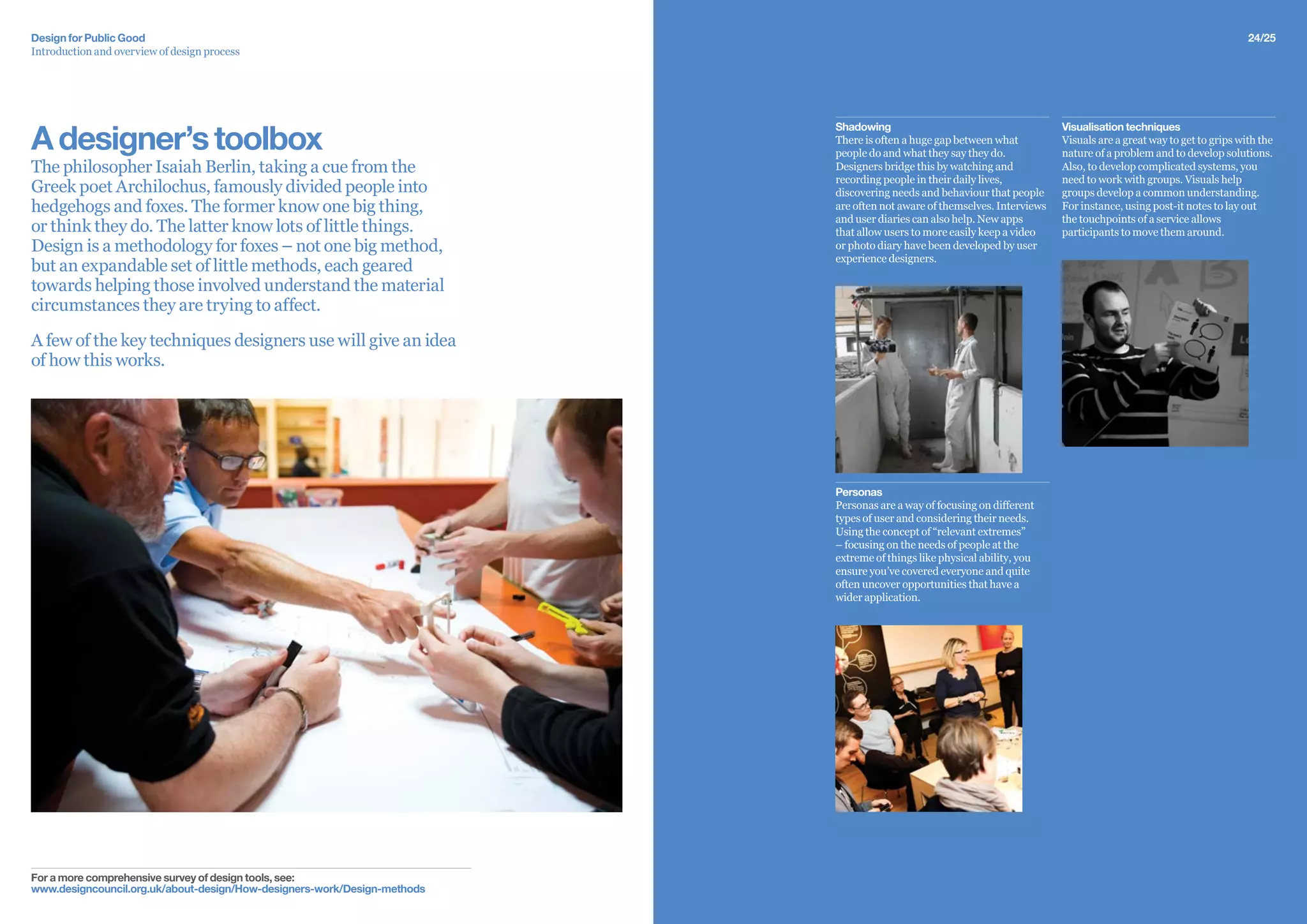
Visualisation techniques
Visuals are a great way to get to grips with the
nature of a problem and to develop solutions.
Also, to develop complicated systems, you
need to work with groups. Visuals help
groups develop a common understanding.
For instance, using post-it notes to lay out
the touchpoints of a service allows
participants to move them around.
Shadowing
There is often a huge gap between what
people do and what they say they do.
Designers bridge this by watching and
recording people in their daily lives,
discovering needs and behaviour that people
are often not aware of themselves. Interviews
and user diaries can also help. New apps
that allow users to more easily keep a video
or photo diary have been developed by user
experience designers.
Personas
Personas are a way of focusing on different
types of user and considering their needs.
Using the concept of “relevant extremes”
– focusing on the needs of people at the
extreme of things like physical ability, you
ensure you’ve covered everyone and quite
often uncover opportunities that have a
wider application.
User journeys
A detailed map of user behaviour over time
can be used to quickly identify the “pain
points” in a service or product. These can
inspire everything from small tweaks to
farreaching innovation projects.
Service Designers also use these to sketch
new services. These maps are called Service
Blueprints. These are effectively service
designers’ versions of product design
sketches. Instead of sketching an object, they
map the touchpoints that make up a service.
They also draw storyboards to show the
movement of users between touchpoints.
26/27Design for Public Good
Introduction and overview of design process
Prototyping
The aim here is always to design risk out,
so that by the time you reach a high level of
investment, the risk is low. By starting with
low or no-cost prototypes, one can learn a lot
about what works and what does not before
going on to more elaborate iterations and
uncover consequences that would otherwise
have been unforseen.
Prototyping can include everything from tiny,
cheap cardboard models to large, expensive
ones with working parts, but it also covers
activities like role-playing and live testing.
Services can be prototyped as a whole, but
you might also simply prototype individual
touchpoints, such as forms people have to fill
out, web pages etc.
Discover Define Develop Deliver
Scenarios
As part of prototyping, specific scenarios
about the future use of a design object can
be imagined. This is similar to “relevant
extremes”, described above. One might
conceive scenarios in which things go as
wrong as they possibly can vs. ideal scenarios.
Double Diamond
In practice, it can be helpful to think of – and
plan – the design process according to
what the Design Council describes as the
Double Diamond.
This basically describes a process of
beginning with many ideas – “divergent
thinking” – and then sifting down to the best
– “convergent thinking”. The reason there
are two diamonds is that the process happens
twice. In the first diamond you examine
numerous ways of looking at a problem
and then resolve them into a brief. In the
second, numerous solutions to the brief are
presented, only to be sifted out in the final
phase to arrive at the final design.
Designistheapplication
ofintent–theoppositeof
happenstance,andan
antidotetoaccident.”
– Robert L. Peters, designer, founder of Circle Design
“
skjbdkjbkkjbkjb
kjhbxksbkxjbkabk
bkbakbkjabskjb
kbkabkbkjbskjbk
bksjbkjbksjbk
jbskjbkjsbkjbsk
Design For Public Good
The Public Sector Design Ladder and case studies
ThePublicSector
DesignLadderand
casestudies
Design for Public Good
The Public Sector Design Ladder and case studies
28/29
30/31Design for Public Good
The Public Sector Design Ladder and case studies
barriers to design thinking’s adoption at
higher and higher levels incrementally. It is,
then, a roadmap for progression. It can also
be used as a diagnostic tool to think about
where one is at and where one would like to
get to – whether as an agency, department,
local authority or nation.
The ladder categories will provide orientation
as we go through the case studies.
Each step on the ladder is a good place to
be, but the higher up a public sector body
goes, the more value it can create. Crucially,
however, the barriers to use of design
also increase. One can see why this is by
thinking about how things work at Step 1:
organisations here can run discrete design
projects without changing their fundamental
working practices.
One of the reasons for presenting these
design applications as a ladder is to suggest
that, by going through the steps in order,
organisations may be able to decrease the
The Public Sector Design Ladder can be used to assess one’s own position
relative to ambitions and needs, other organisations and the big picture
nationally and internationally.
–– Member states, municipalities and government departments,
and agencies should use it to monitor their own design use and
determine how to progress towards more wide-ranging service and policy
design-led innovations.
–– Design organisations should use it to diagnose design sector
capabilities and the degree to which design thinking is embedded in
government and help clients improve.
–– 	The design sectorcanuseittoassesstheeffectivenessofitsownofferings.
The European Commission should promote use of the ladder and fund
work on developing it as a diagnostic tool and roadmap for progression. This
could take the form of a matrix, allowing specific disciplines on one axis to be
plotted against steps of the ladder on the other. This will help create a more
detailed picture of the use and effectiveness of design capabilities and related
disciplines at each step of the ladder.
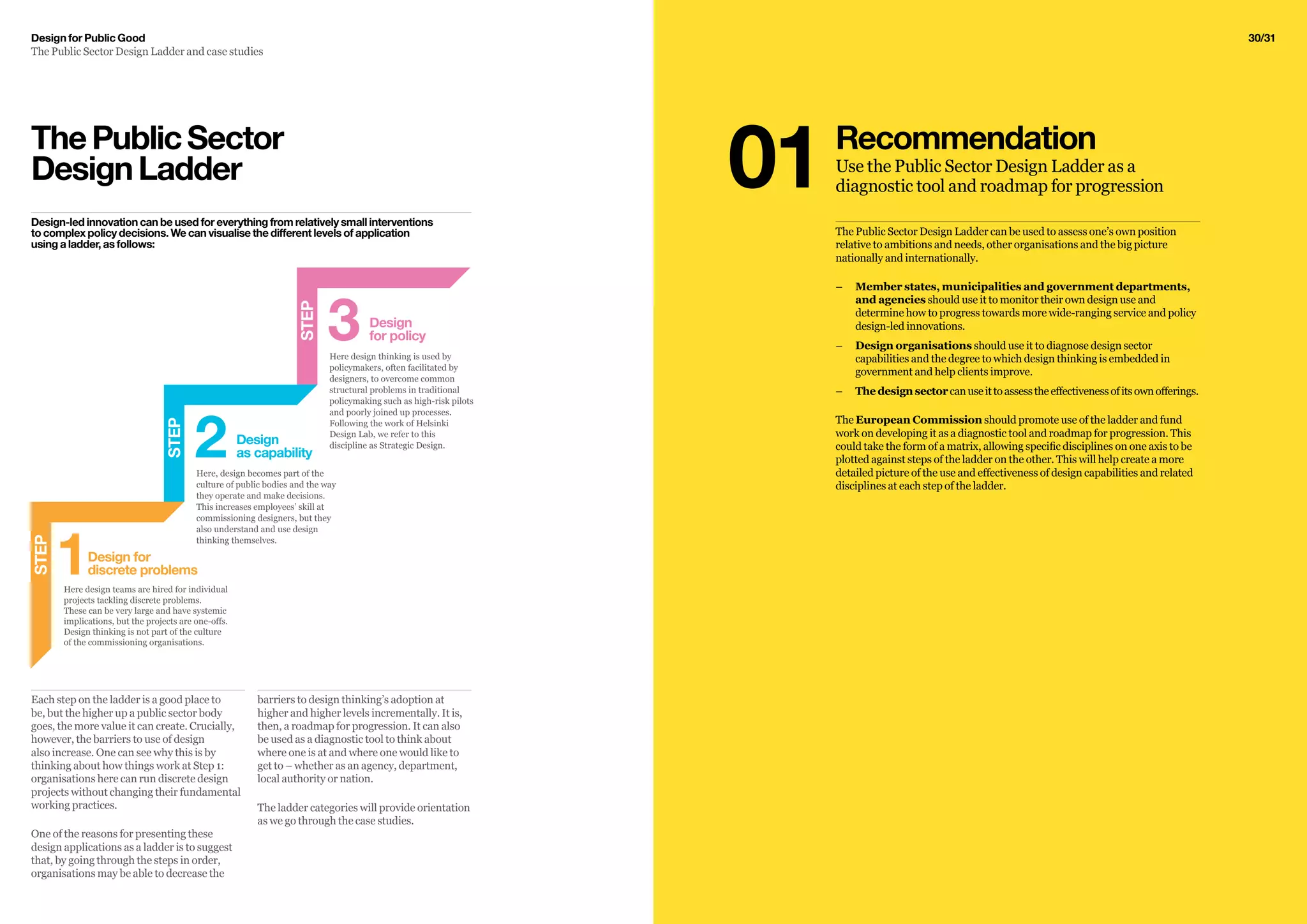
ThePublicSector
DesignLadder
Design-led innovation can be used for everything from relatively small interventions
to complex policy decisions. We can visualise the different levels of application
using a ladder, as follows:
STEP
Design
as capability2Here, design becomes part of the
culture of public bodies and the way
they operate and make decisions.
This increases employees’ skill at
commissioning designers, but they
also understand and use design
thinking themselves.
Design
for policy3Here design thinking is used by
policymakers, often facilitated by
designers, to overcome common
structural problems in traditional
policymaking such as high-risk pilots
and poorly joined up processes.
Following the work of Helsinki
Design Lab, we refer to this
discipline as Strategic Design.
STEP
Here design teams are hired for individual
projects tackling discrete problems.
These can be very large and have systemic
implications, but the projects are one-offs.
Design thinking is not part of the culture
of the commissioning organisations.
Design for
discrete problems1
STEP
Recommendation
Use the Public Sector Design Ladder as a
diagnostic tool and roadmap for progression01
Design for Public Good
The Public Sector Design Ladder and case studies
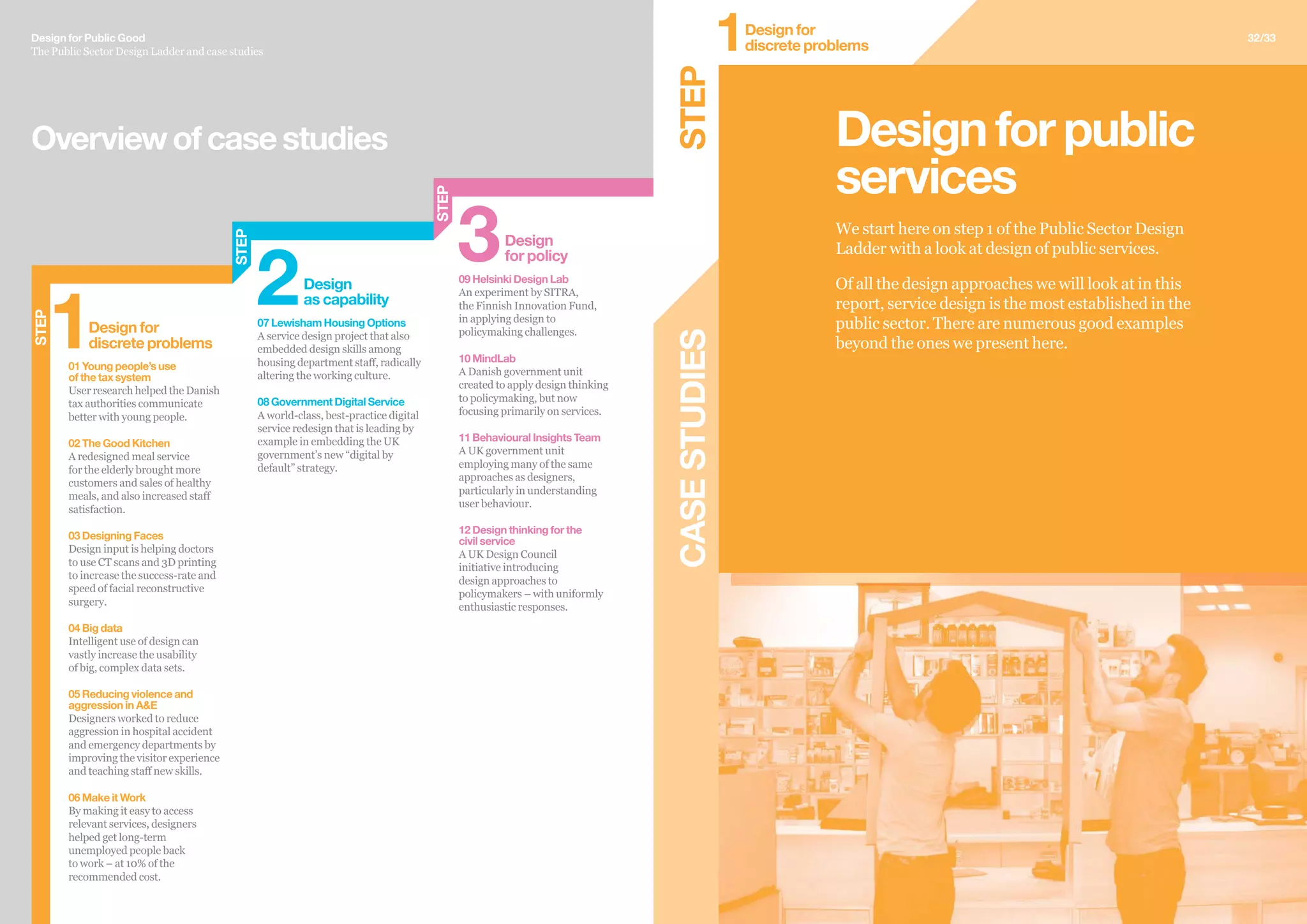
Overviewofcasestudies
09 Helsinki Design Lab
An experiment by SITRA,
the Finnish Innovation Fund,
in applying design to
policymaking challenges.
10 MindLab
A Danish government unit
created to apply design thinking
to policymaking, but now
focusing primarily on services.
11 Behavioural Insights Team
A UK government unit
employing many of the same
approaches as designers,
particularly in understanding
user behaviour.
12 Design thinking for the
civil service
A UK Design Council
initiative introducing
design approaches to
policymakers – with uniformly
enthusiastic responses.
3Design
for policy
01 Young people’s use
of the tax system
User research helped the Danish
tax authorities communicate
better with young people.
02 The Good Kitchen
A redesigned meal service
for the elderly brought more
customers and sales of healthy
meals, and also increased staff
satisfaction.
03 Designing Faces
Design input is helping doctors
to use CT scans and 3D printing
to increase the success-rate and
speed of facial reconstructive
surgery.
04 Big data
Intelligent use of design can
vastly increase the usability
of big, complex data sets.
05 Reducing violence and
aggression in A&E
Designers worked to reduce
aggression in hospital accident
and emergency departments by
improving the visitor experience
and teaching staff new skills.
06 Make it Work
By making it easy to access
relevant services, designers
helped get long-term
unemployed people back
to work – at 10% of the
recommended cost.
1Design for
discrete problems
STEP
07 Lewisham Housing Options
A service design project that also
embedded design skills among
housing department staff, radically
altering the working culture.
08 Government Digital Service
A world-class, best-practice digital
service redesign that is leading by
example in embedding the UK
government’s new “digital by
default” strategy.
2Design
as capability
STEP
STEP
32/33
CASESTUDIESSTEP
We start here on step 1 of the Public Sector Design
Ladder with a look at design of public services.
Of all the design approaches we will look at in this
report, service design is the most established in the
public sector. There are numerous good examples
beyond the ones we present here.
Designforpublic
services
Design for
discrete problems1
34/35
Youngpeople’suse
ofthetaxsystem
A relatively small, targeted user-research project helped
service providers communicate more effectively to users,
without the need for a major service redesign.
Find out more
mind-lab.dk/en/cases/away-with-the-red-tape-for-young-taxpayers
21-year-old Dennis, a car mechanic
apprentice from Falser, was typical. He
found it almost impossible to update his
preliminary tax statement via the SKAT
online system. His problem, in common
with most of the other interviewees, was that
he did not understand tax authority phrases
like “pre-printed”, “employer-administered
pension” and even “back taxes”.
What did they deliver?
MindLab made a series of audio recordings
of the young people’s reactions and played
them at workshops to SKAT employees. The
employees soon realised they had taken it for
granted that the users would understand or
figure out their language.
What was the result?
The project was a paradigmatic example of
how engagement with end users can help
service providers refine their offering both
for users and themselves.
SKAT saw that they needed to work with
young people both to help them understand
what support they could get and make it
easier to do things themselves. SKAT now
takes account of young people’s knowledge
in its communications and has made
improvements to the self-service site to make
it easier for them to use. Details from the study
were subsequently used for specific initiatives
in cooperation with SKAT staff, including a
cross-ministerial project on the improvement
of teaching materials for young taxpayers.
What was the problem/challenge?
In Denmark, taxpayers can take care of their
business with the IRS/Treasury digitally.
However, some citizens still contact the
authorities by phone or visiting the local
tax offices.
The Danish Tax and Customs Administration
(SKAT) had assumed that young people – the
digital generation – would only contact them
via the website. In fact, they were approached
by many young people who could not figure
out how to use it. SKAT therefore asked
MindLab for help.
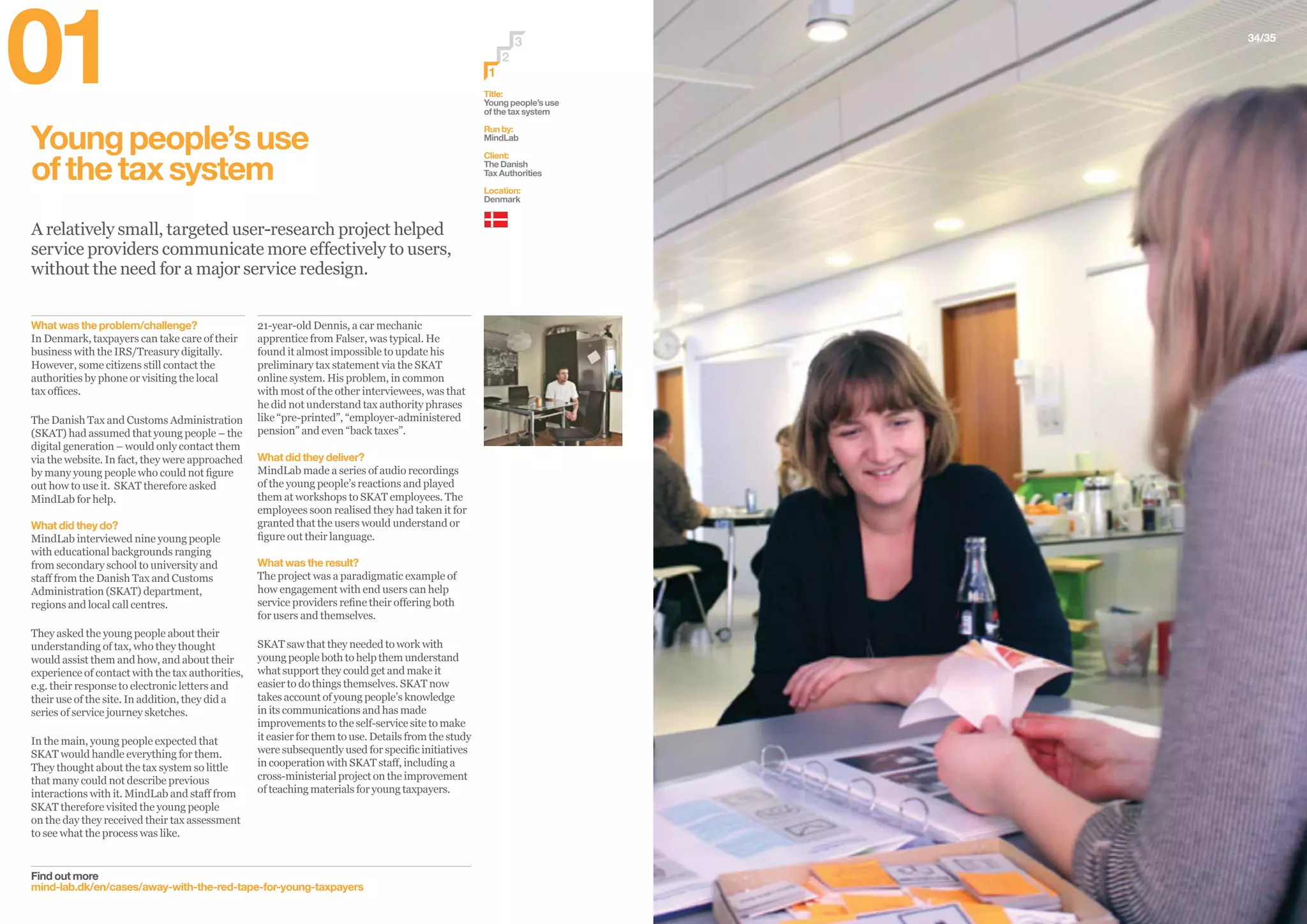
What did they do?
MindLab interviewed nine young people
with educational backgrounds ranging
from secondary school to university and
staff from the Danish Tax and Customs
Administration (SKAT) department,
regions and local call centres.
They asked the young people about their
understanding of tax, who they thought
would assist them and how, and about their
experience of contact with the tax authorities,
e.g. their response to electronic letters and
their use of the site. In addition, they did a
series of service journey sketches.
In the main, young people expected that
SKAT would handle everything for them.
They thought about the tax system so little
that many could not describe previous
interactions with it. MindLab and staff from
SKAT therefore visited the young people
on the day they received their tax assessment
to see what the process was like.
01 Title:
Young people’s use
of the tax system
Run by:
MindLab
Client:
The Danish
Tax Authorities
Location:
Denmark
2
3
1
36/37
The
GoodKitchen
The redesign of a food service for senior citizens bore
unexpected fruit for the municipality that commissioned it:
not just more customers and sales of healthy meals, but
increased staff pride and job satisfaction and a prestigious
design award.
Many interviewees, for instance, were
embarrassed at having a van marked in large
type “HOLSTEBRO MUNICIPAL MEAL
SERVICE” outside their homes.
Workshopswereconductedwithsenior
citizensandallotherrelevantparties,including
kitchenstaff,usingideadevelopmentmethods
suchas“radicalanalogies”.Thisinspiresnew
waysofthinkingbyreferencingsomething
thatisdifferentbutsimilar–inthiscasea
restaurantandamealserviceforafamilywith
children.Kitchenstaffwereaskedquestions
suchas,“Whatiftheseniorcitizenswere
payingguestsinarestaurant?”
The designers also invited a gourmet chef
to the kitchen to increase staff pride in food
preparation and provide tips on things like
styling, colour mix and portion sizes to
improve the food experience.
New designs arising out of this work were
developed through feedback studies in which
progressive prototype iterations were tested
with users.
The design process lasted around six months.
Design spend was limited because Hatch
& Bloom was hired on a consultancy basis,
so Holstebro Municipality invested a large
number of working hours from relevant staff.
What was the problem/challenge?
More than 125,000 senior citizens are
dependent on food services in Denmark today
and these numbers are set to soar in years to
come. Most senior citizens feel they lose their
dignity and become even less active when no
longer capable of cooking and shopping.
This often leads to a lower quality of life,
reduced appetite, and further deterioration
in health. Inadequate nutrition is a huge
problem among the elderly. 60% in assisted
living have poor nutrition and, of those,
20% are actually malnourished.3
Holstebro Municipality set out to better
meet the needs of its food service users and
improve their health and quality of life.
What did they do?
The innovation agency Hatch & Bloom
worked with Holstebro to develop a service
design solution covering all aspects of their
public food service system.
Hatch & Bloom’s “design anthropologists”
conducted ethnographic research into user
behaviour, looking for needs and wishes both
spoken and unspoken. By observing and
interviewing users, the agency learned that
food services relate to many issues beyond
the actual food, gaining insights concerning
packaging, colours, loneliness, meal sizes and
preferred dining environment.
The focus on the user, far from just being
a methodology for a redesign, has been
embedded as an active component of the
service. Users can now offer feedback and
suggestions at any time using a Good Kitchen
postcard. These cards are read aloud at staff
meetings and put up in the kitchens.
All of this comes wrapped in an appealing
new brand identity implemented on
everything from delivery vans to packaging,
menus and staff uniforms.
What did they deliver?
What had seemed like the relatively simple
goal of improving the food service delivered
results with far wider reach than anyone at
Holstebro initially imagined.
The food service was completely reinvented.
Now named The Good Kitchen, it works
through more efficient and transparent
cooperation between kitchen staff, home
carers and the municipality. There are more
daily food choices and users can now also
order extra meals for guests. Improved
menu descriptions give users a clearer sense
of how food will taste. (e.g. not just “Liver
with gravy, potatoes and vegetables” but
“Pan-fried calf’s liver with onions and gravy,
potatoes tossed in thyme, and butter-roasted
vegetables.”) The new menus take better
account of individual preferences, allowing
users to choose not just between overall
meals, but side-dishes, e.g. potatoes vs. rice.
They can also specify portion size and health
requirements relating to conditions such as
obesity, malnutrition and diabetes.
Title:
The Good Kitchen/Service
design for the public sector/Design
demonstration programme
Run by:
Danish Construction Authority/
Hatch & Bloom
Client:
Holstebro Municipality
Location:
Holstebro, North Jutland, Denmark
2
3
1
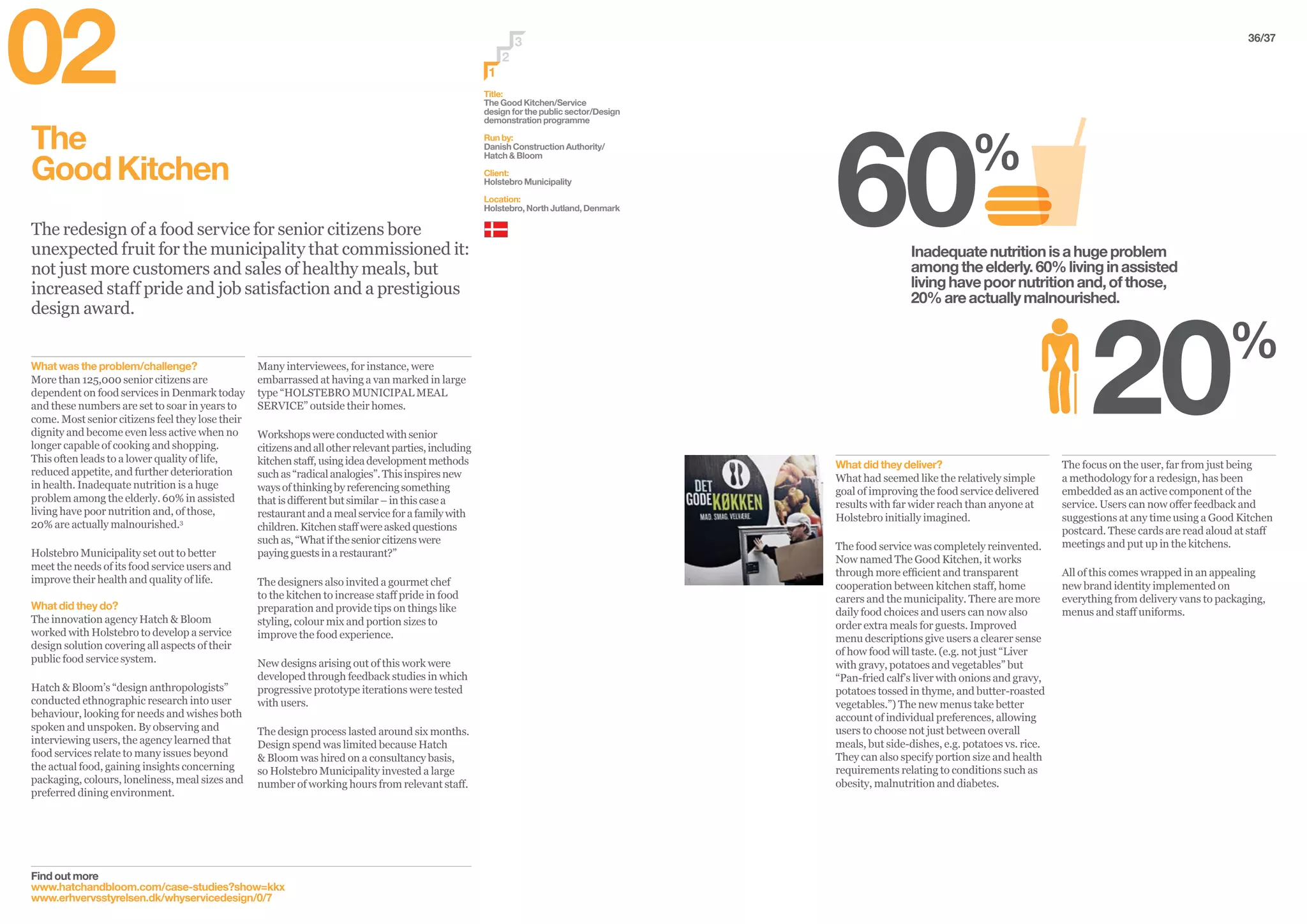
Inadequatenutritionisahugeproblem
amongtheelderly.60%livinginassisted
livinghavepoornutritionand,ofthose,
20%areactuallymalnourished.
Find out more
www.hatchandbloom.com/case-studies?show=kkx
www.erhvervsstyrelsen.dk/whyservicedesign/0/7
02
CASESTUDIES
38/39
Find out more
www.hatchandbloom.com/case-studies?show=kkx
www.erhvervsstyrelsen.dk/whyservicedesign/0/7
What difference did it make?
The Good Kitchen won the prestigious
Danish Design Award 2008/09 and has been
showcased in more than 30 countries around
the world. Tangible results include a 22%
increase in customers, improved customer
satisfaction, 78% increase in sales of healthy
dishes, and improved collaboration across
institutions involved in the food service.
Holstebro Municipality’s image has had a
boost both nationally and internationally
and its staff are happier. “We receive a large
number of unsolicited applications to the
kitchen, because of the widespread rumours
concerning the happiness and pride of the
kitchen staff. And we have experienced a drop
in sickness absence among existing kitchen
staff,” says section leader Anne Marie Nielsen
of Holstebro Municipality.
This is still step 1 of the ladder, but the focus is not on
specific services so much as capabilities that can be an
important part of the mix.
Humanising
technology
Far from advocating major public sector outlay on technology, we are saying that when
technology is used, design can significantly mitigate costs. Real user needs will be better
identified and met and solutions will be tested with low-cost prototypes to reduce wastage
on failed tech implementation.
Conversely, designers may at times actively and creatively seek out tech solutions in order
to increase the efficiency of public service delivery, improving user experiences and, again,
reducing costs.
User engagement
The title of this chapter
suggests how fundamental
this is. Design’s capacity
to engage with users,
discover their needs
and create solutions
accordingly is what
makes technology into
something people can
use. The internet is a
perfect example of this.
Technologists made it
happen, but it is web and
service designers who
create the websites that
allow us to use it.
Multidisciplinary teams
When new tech is applied,
it will often be in
specialised areas. In the
field of medicine,
for instance, design
methodology can be
the bridge between
technologists, doctors
and end users.
Systems
Already and for many
years now, technology
has provided key
touchpoints in systems
and services we use every
day. When these things
work well, people tend
to assimilate them easily,
quickly forgetting how
novel they are. The public
sector is currently lagging
even in exploiting existing
technology. How many
journeys to see doctors or
publicofficials,forinstance,
could be cut out using
web video telephony?
Technology is still the first thing that many people think of when they think of innovation.
Some companies, notably Apple, are increasingly aware that technologists often need
to work hand-in-hand with designers in order to deliver innovations that are usable and
engaging. Very often, when design thinking is applied to technology, people find that the
technology can do more than they first imagined.
Innovation wins in the public sector are not dependent on high level technological
innovation or major technological spend, but some of the same principles still apply.
And where the public sector does engage with technology, as it sometimes must,
design thinking can ensure it is used well and economically.
Design-led innovation’s three modes of working are a good way of understanding
the link between technology and design:
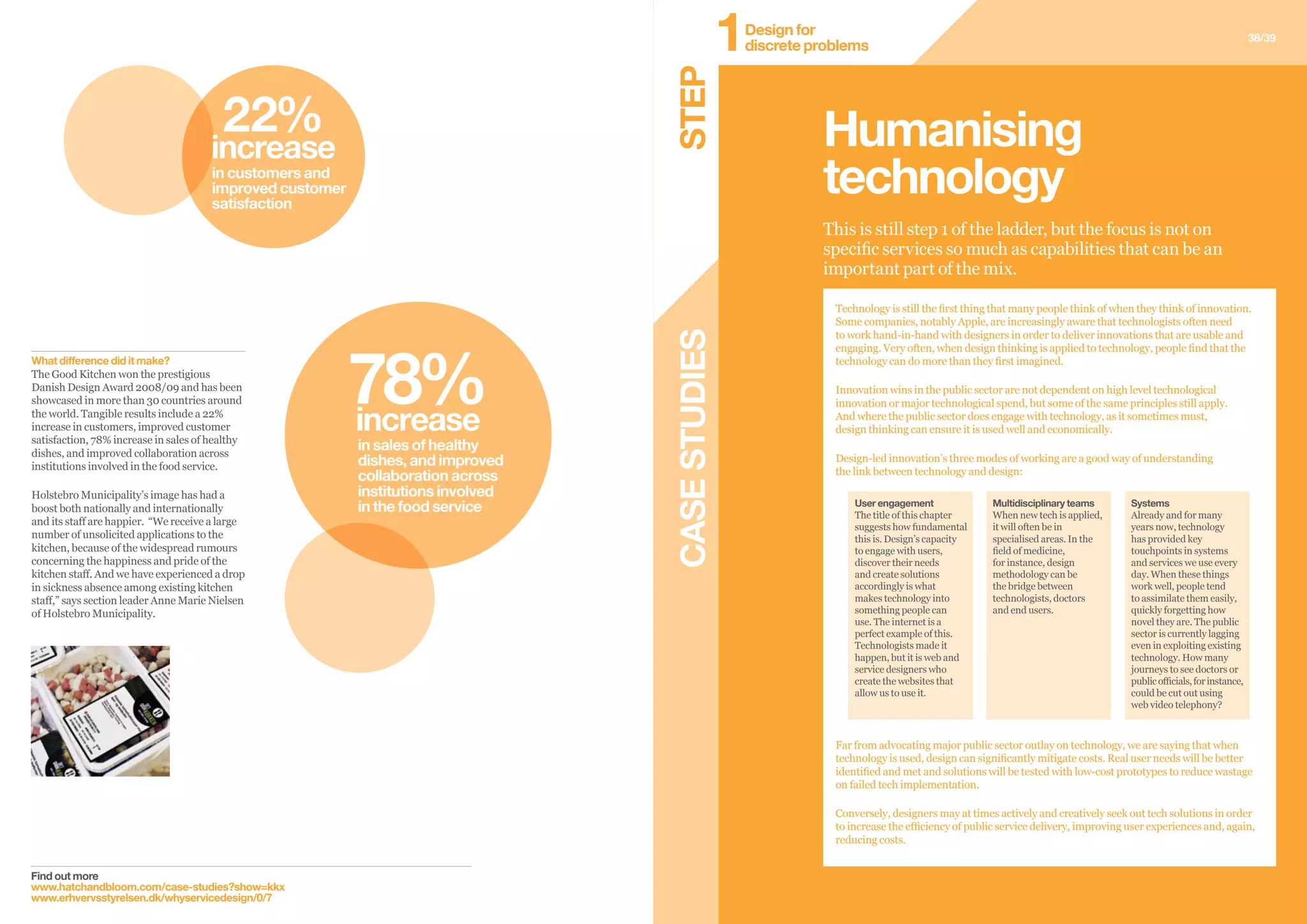
22%
increase
in customers and
improved customer
satisfaction
78%increase
in sales of healthy
dishes, and improved
collaboration across
institutions involved
in the food service
STEP
Design for
discrete problems1
Designing
Faces
Clever implementation of computerised tomography (CT)
scans and 3D printing by designers has revolutionised
facial reconstructive surgery, cutting the times
and increasing the success of operations.
Find out more
www.cartis.org
While product end users may be surgeons
or prosthetists, it is the patient who
must ultimately benefit. For this reason,
design processes are led by those who
understand the patient needs best. After
initial preparation, MAG typically engages
the prescribing clinician via the internet.
This collaborative approach is crucial to
ensure that the prosthetic device is viable
for use in surgery, ensure compliance with
medical device regulations and meet each
patient’s unique set of surgical, prosthetic,
rehabilitation and technical needs.
What did they deliver?
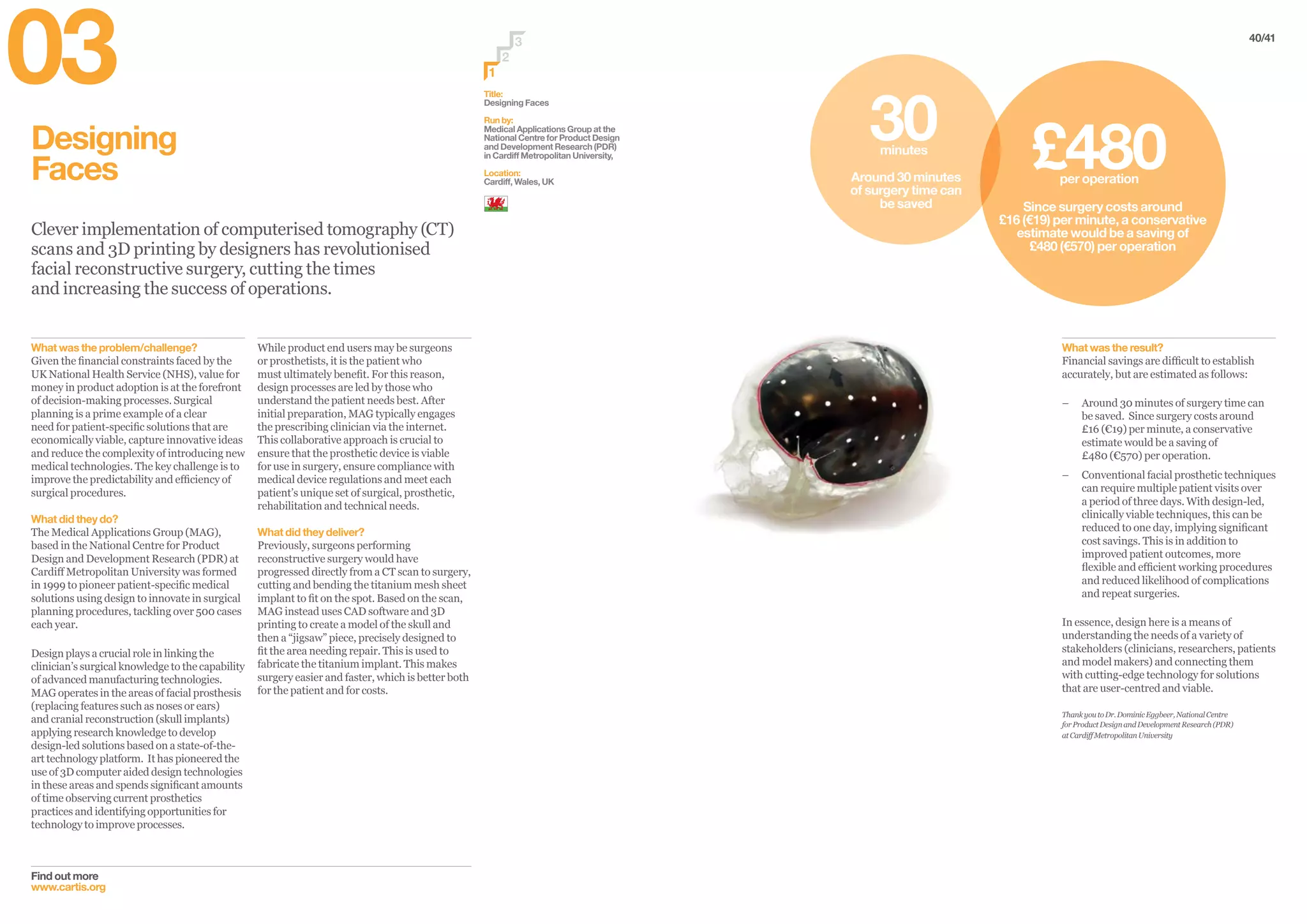
Previously, surgeons performing
reconstructive surgery would have
progressed directly from a CT scan to surgery,
cutting and bending the titanium mesh sheet
implant to fit on the spot. Based on the scan,
MAG instead uses CAD software and 3D
printing to create a model of the skull and
then a “jigsaw” piece, precisely designed to
fit the area needing repair. This is used to
fabricate the titanium implant. This makes
surgery easier and faster, which is better both
for the patient and for costs.
What was the problem/challenge?
Given the financial constraints faced by the
UK National Health Service (NHS), value for
money in product adoption is at the forefront
of decision-making processes. Surgical
planning is a prime example of a clear
need for patient-specific solutions that are
economically viable, capture innovative ideas
and reduce the complexity of introducing new
medical technologies. The key challenge is to
improve the predictability and efficiency of
surgical procedures.
What did they do?
The Medical Applications Group (MAG),
based in the National Centre for Product
Design and Development Research (PDR) at
Cardiff Metropolitan University was formed
in 1999 to pioneer patient-specific medical
solutions using design to innovate in surgical
planning procedures, tackling over 500 cases
each year.
Design plays a crucial role in linking the
clinician’s surgical knowledge to the capability
of advanced manufacturing technologies.
MAG operates in the areas of facial prosthesis
(replacing features such as noses or ears)
and cranial reconstruction (skull implants)
applying research knowledge to develop
design-led solutions based on a state-of-the-
art technology platform. It has pioneered the
use of 3D computer aided design technologies
in these areas and spends significant amounts
of time observing current prosthetics
practices and identifying opportunities for
technology to improve processes.
Title:
Designing Faces
Run by:
Medical Applications Group at the
National Centre for Product Design
and Development Research (PDR)
in Cardiff Metropolitan University,
Location:
Cardiff, Wales, UK
2
3
1
40/41
What was the result?
Financial savings are difficult to establish
accurately, but are estimated as follows:
–– Around 30 minutes of surgery time can
be saved. Since surgery costs around
£16 (€19) per minute, a conservative
estimate would be a saving of
£480 (€570) per operation.
–– Conventional facial prosthetic techniques
can require multiple patient visits over
a period of three days. With design-led,
clinically viable techniques, this can be
reduced to one day, implying significant
cost savings. This is in addition to
improved patient outcomes, more
flexible and efficient working procedures
and reduced likelihood of complications
and repeat surgeries.
In essence, design here is a means of
understanding the needs of a variety of
stakeholders (clinicians, researchers, patients
and model makers) and connecting them
with cutting-edge technology for solutions
that are user-centred and viable.
ThankyoutoDr.DominicEggbeer,NationalCentre
forProductDesignandDevelopmentResearch(PDR)
atCardiffMetropolitanUniversity
Around 30 minutes
of surgery time can
be saved Since surgery costs around
£16 (€19) per minute, a conservative
estimate would be a saving of
£480 (€570) per operation
£480per operation
30minutes
03
Big
data
The rise of digital technology has made it possible
to capture, store and review unprecedented amounts
of data, sometimes in entirely new ways.
Find out more
www.siliconangle.com/blog/2012/10/30/3d-big-data-visualization-helps-fighting-cancer-with-karios3d
www.wired.com/insights/2012/11/3d-visualization-big-data
www.infoworld.com/d/big-data/fighting-cancer-3d-big-data-visualization-205645
Title:
Mapping the Danish design sector
Run by:
Danish Design Centre, in
association with the Copenhagen
Institute for Interaction Design and
the Ministry of Business
Location:
Denmark
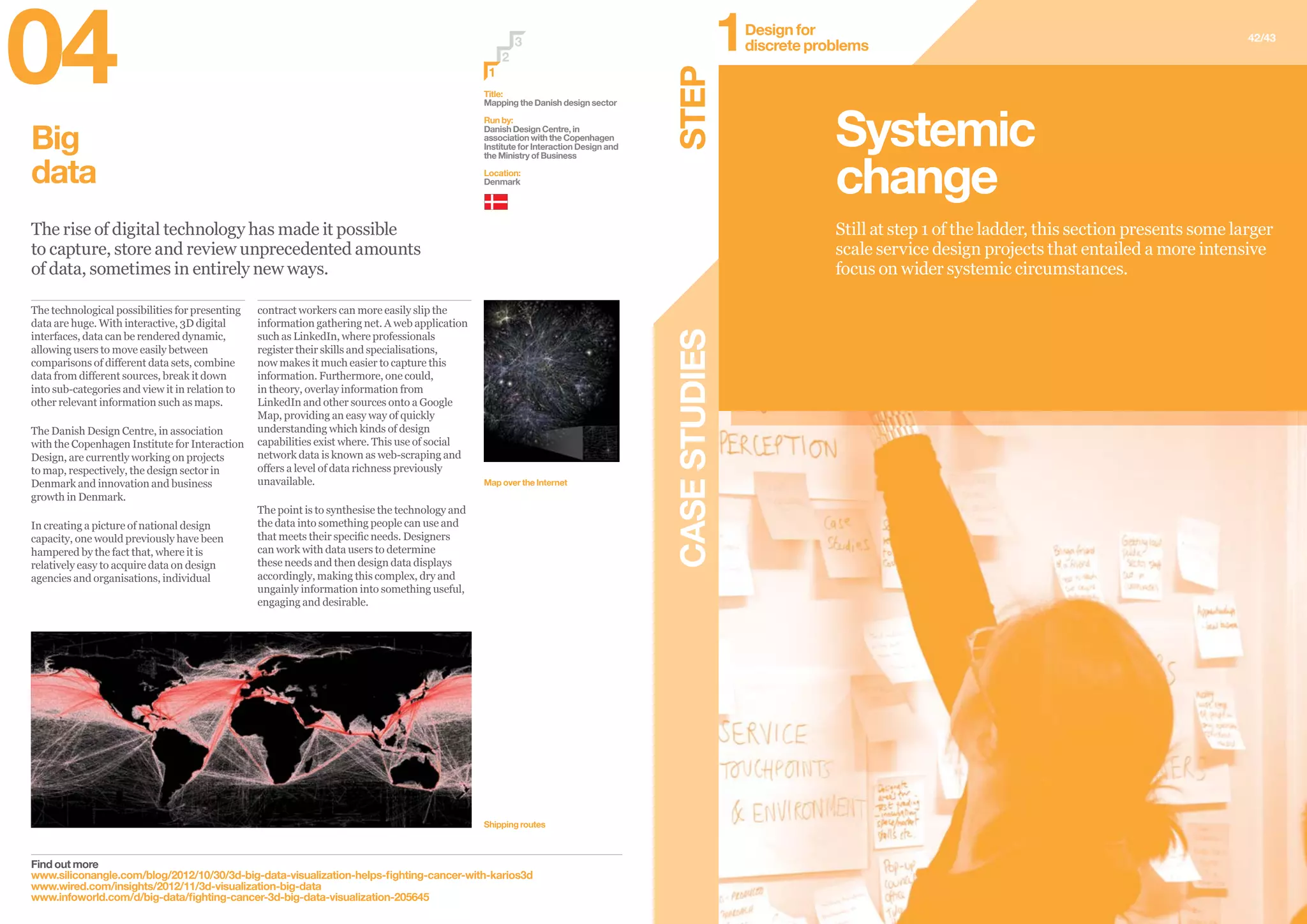
Shipping routes
Map over the Internet
2
3
1
contract workers can more easily slip the
information gathering net. A web application
such as LinkedIn, where professionals
register their skills and specialisations,
now makes it much easier to capture this
information. Furthermore, one could,
in theory, overlay information from
LinkedIn and other sources onto a Google
Map, providing an easy way of quickly
understanding which kinds of design
capabilities exist where. This use of social
network data is known as web-scraping and
offers a level of data richness previously
unavailable.
The point is to synthesise the technology and
the data into something people can use and
that meets their specific needs. Designers
can work with data users to determine
these needs and then design data displays
accordingly, making this complex, dry and
ungainly information into something useful,
engaging and desirable.
The technological possibilities for presenting
data are huge. With interactive, 3D digital
interfaces, data can be rendered dynamic,
allowing users to move easily between
comparisons of different data sets, combine
data from different sources, break it down
into sub-categories and view it in relation to
other relevant information such as maps.
The Danish Design Centre, in association
with the Copenhagen Institute for Interaction
Design, are currently working on projects
to map, respectively, the design sector in
Denmark and innovation and business
growth in Denmark.
In creating a picture of national design
capacity, one would previously have been
hampered by the fact that, where it is
relatively easy to acquire data on design
agencies and organisations, individual
CASESTUDIES
42/43
Still at step 1 of the ladder, this section presents some larger
scale service design projects that entailed a more intensive
focus on wider systemic circumstances.
Systemic
change
STEP
Design for
discrete problems1
04
44/45
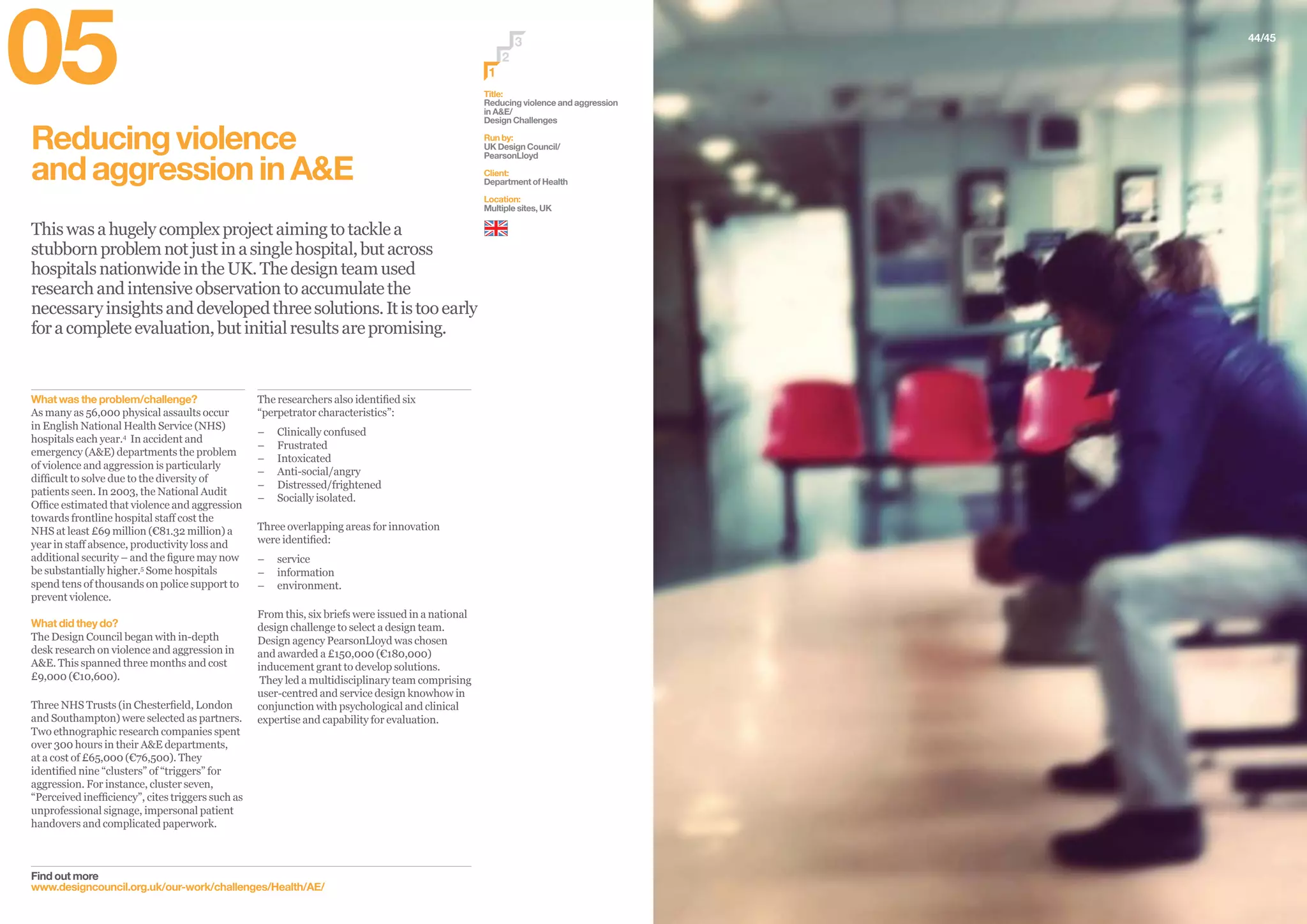
Reducingviolence
andaggressioninA&E
Thiswasahugelycomplexprojectaimingtotacklea
stubbornproblemnotjustinasinglehospital,butacross
hospitalsnationwideintheUK.Thedesignteamused
researchandintensiveobservationtoaccumulatethe
necessaryinsightsanddevelopedthreesolutions.Itistooearly
foracompleteevaluation,butinitialresultsarepromising.
Find out more
www.designcouncil.org.uk/our-work/challenges/Health/AE/
The researchers also identified six
“perpetrator characteristics”:
–– Clinically confused
–– Frustrated
–– Intoxicated
–– Anti-social/angry
–– Distressed/frightened
–– Socially isolated.
Three overlapping areas for innovation
were identified:
–– service
–– information
–– environment.
From this, six briefs were issued in a national
design challenge to select a design team.
Design agency PearsonLloyd was chosen
and awarded a £150,000 (€180,000)
inducement grant to develop solutions.
They led a multidisciplinary team comprising
user-centred and service design knowhow in
conjunction with psychological and clinical
expertise and capability for evaluation.
What was the problem/challenge?
As many as 56,000 physical assaults occur
in English National Health Service (NHS)
hospitals each year.4
In accident and
emergency (A&E) departments the problem
of violence and aggression is particularly
difficult to solve due to the diversity of
patients seen. In 2003, the National Audit
Office estimated that violence and aggression
towards frontline hospital staff cost the
NHS at least £69 million (€81.32 million) a
year in staff absence, productivity loss and
additional security – and the figure may now
be substantially higher.5
Some hospitals
spend tens of thousands on police support to
prevent violence.
What did they do?
The Design Council began with in-depth
desk research on violence and aggression in
A&E. This spanned three months and cost
£9,000 (€10,600).
Three NHS Trusts (in Chesterfield, London
and Southampton) were selected as partners.
Two ethnographic research companies spent
over 300 hours in their A&E departments,
at a cost of £65,000 (€76,500). They
identified nine “clusters” of “triggers” for
aggression. For instance, cluster seven,
“Perceived inefficiency”, cites triggers such as
unprofessional signage, impersonal patient
handovers and complicated paperwork.
Title:
Reducing violence and aggression
in A&E/
Design Challenges
Run by:
UK Design Council/
PearsonLloyd
Client:
Department of Health
Location:
Multiple sites, UK
2
3
1
05
46/47
Find out more
www.designcouncil.org.uk/our-work/challenges/Health/AE/
What did they deliver?
The four themes were distilled into three
outputs, which are still at prototype stage.
The designers felt it was vital that it be
possible to use their solutions in any
A&E throughout the country.
1	Guidance
	A modular signage system to give
patients information and reduce
anxiety. The central component is large
signs explaining where one is, used
everywhere from car parks to waiting
rooms to the ceilings of ambulance bays.
A “process map” leaflet explains the AE
journey. Live information, e.g. about
waiting times, appears on digital screens.
There is also potential for touchscreens
and smartphone apps.
2	People
	A new staff-centred reflective practice
using cognitive learning to support work
with patients, boost morale and help
recover from stress. A vertical cross-
section of staff are trained and then pass
on learning to colleagues. They acquire
new ways to greet patients, answer
questions and ensure everyone starts the
AE experience positively. In parallel,
they are encouraged to notice incident
levels, reflect on experiences, and feed
back to management.
3	Toolkit
	This is about disseminating the research
findings throughout the NHS, laying
out the causes of aggression and giving
advice on how to address them. It is
intended for existing AE staff, but also
for architects and designers working on
new builds.
The team went back to experience AE
firsthand. Following the Double Diamond
approach, they familiarised themselves with
environments and processes. They refined
the six national design challenge briefs into
four overarching themes:
— Arrival: creating positive first impressions
and managing expectations. This was
key because the start coloured the entire
experience and was often disorientating.
— Waiting: mitigating frustration. Research
showed that patients’ perception of AE
experience was almost entirely of waiting,
often without knowing why.
— Guidance: alleviating the stress of the
unknown. Frustration is considerably
worsened by a lack of information. Survey
respondents wanted information above all.
— People: building healthy relationships.
Research showed that current procedures
tended to instill a “me vs. the system”
mentality among AE visitors.
“This should be in all Emergency
Departments” – Patient
“We should have done this [install the
Guidance signage] a long time ago.”
– ED Matron
A detailed evaluation framework has
been established to assess both the
benefits and costs of the design changes.
Evaluation study results are expected
in Summer 2013.
ThankstoChrisHowroyd,UKDesignCouncil
What difference did it make?
To date, three NHS sites have adopted one or
more of the solutions: Newham University
Hospital, Southampton General and St
Georges, South London. There is feedback
from Newham, which is very encouraging:
“Since installing the Guidance signage
we’ve seen patients regulating each
other’s behaviour, which is saving staff’s
time. The other day, someone started
shouting about not knowing why he
was waiting. Another patient got up
and told him to read the signs.”
– Emergency Department Clinician
(Charge Nurse)
“The signs show that we know what we’re
doing, that we are organised and that
we have a plan for people’s care. This is
reassuring to our patients.”
– ED Clinician (Senior Sister)
“Patients are asking us fewer questions which
has freed up our time.”
– ED Receptionist
“Patients are
asking us fewer
questions which
has freed up
our time.”
– 	Emergency Department 	
	Receptionist
48/49
Make
itWork
Designers looked at existing support for workless people
and found that, while there was a great deal available,
it was disconnected and difficult to access. They made it
easy for services to communicate and service users to get
the help they needed – with impressive results.
Find out more
www.livework.co.uk/our-work/Sunderland-City-Council
www.designcouncil.org.uk/Case-studies/Northern-Way-worklessness-pilot/
Designers from live|work and public sector
managers set out to help “hard-to-reach”
people (those not attending job centres),
including those on Incapacity Benefit,
overcome the barriers to employment.
Over a three-month project, the design
team talked to and shadowed 12 long-term
unemployed people to build up a picture of
their needs and experiences. They also talked
to service staff, discovering the extensive
but sometimes confusing array of support
services available.
Creating a map of service users’ progress
from unemployment to work showed that,
while their journeys were similar, their needs
were diverse. Relevant support existed for
participants, but they all had a problem
accessing and combining the right services
for them. They needed personal support
(e.g. from voluntary sector organisations
such as addiction support groups) but
also access to opportunities controlled
by government agencies (training such as
could be got through the job centre). A more
coordinated approach was needed in which
all the potentially relevant organisations
worked together in coalition.
To develop this concept the team asked
250 representatives of public and voluntary
sectors organisations to make a proposal for
how they could contribute to the coalition.
The only requirements were that they
collaborate and share data.
What was the problem/challenge?
Six million people in the UK live in
households where no one works, costing
taxpayers an estimated £13 billion (€16
billion) a year in benefits. The long-term
unemployed face barriers to getting back to
work that tend to increase exponentially the
longer they are out of work. These include
health and social problems, lack of skills
and drug and alcohol dependency.
In the City of Sunderland, 26% of working-
age people were economically inactive,
with almost four times as many people
claiming Incapacity Benefit (benefits for ill
and disabled) as the ordinary Job Seekers
Allowance. There was no active attempt
to get Incapacity Benefit claimants back
into work. Council budgets were being
significantly stretched both by benefit payouts
and by solutions that had little to no impact.
What did they do?
One NorthEast, the Regional Development
Agency for the North East of England, asked
service design agency live|work to run a
pilot scheme with Sunderland City Council
to explore how the long-term unemployed
interact with employment services and
develop innovative ways to reach and
support individuals into work.
Title:
Make it Work
Run by:
live|work
Client:
Sunderland City Council
Location:
Sunderland, UK
2
3
1
06
CASESTUDIES
50/51
Find out more
www.livework.co.uk/our-work/Sunderland-City-Council
www.designcouncil.org.uk/Case-studies/Northern-Way-worklessness-pilot
What difference did it make?
The scheme has supported more than
1,000 people, of whom 275 found work.
The total cost of running the programme
was £180,000 (€211,000). The return,
calculated by an independent evaluation,
was that over £360,000 (€422,000)
was saved from the public purse through
reduction in welfare spend.
According to the Department of Work and
Pensions, it is economically rational to spend
£62,000 (€73,000) on getting the average
person on Incapacity Benefit back into work.
The average cost per person for Make it Work
is less than £5,000 (€6,000). This amounts
to a saving of 90%.
ThankstoBenReason,live|work
What did they deliver?
Over a nine-month pilot, a number of these
organisations worked together to offer
coordinated support around five of the
main barriers to work: drug and alcohol
dependency, mental health issues, long-term
caregiving, being over 55 and physical illness
or disability.
When a long-term unemployed person
registered with any organisation in the
programme, the data could be shared easily
with the others. Essentially, registering
with one meant registering with the
entire network. This cut out bottlenecks
in the system further down the line (no
re-registering each time users started a
relationship with another organisation)
and made it easier for organisations to
share information and spot users to
whom they could offer help.
One success was James who joined the
programme on leaving prison with substance
misuse issues. He was supported by a small
rehab and work experience organisation that,
through the network, were also able to access
training and job seeking services to build
James’s confidence and capabilities.
He trained as a forklift truck driver and
found work in the automobile industry.
We here move to step 2 of the Public Sector Design
Ladder, Design as capability. This is about public
sector bodies adopting design thinking not just for
discrete projects, but to change the way they operate
– in particular, the way they deliver for citizens.
A joined-up and agile problem-solving capability is
as useful for day-to-day issues as for larger design
projects. User needs are still the central concern and
they still relate to systems and multiple departments.
Techniques and tools such as the Double Diamond,
visualisation and prototyping can be used by
non-designers to quickly work towards solutions.
In addition, understanding of design process makes
staff more sophisticated about procuring design
services when required.
Embedding
designprocess
Thisamounts
toasavingof
90%
Theaveragecost
perpersonforMake
itWorkislessthan
£5,000
(€6,000)
DepartmentofWork
andPensionssaysit
iseconomically
rationaltospend
£62,000(€73,000)
ongettingtheaverage
IncapacityBenefit
claimantbacktowork
STEP
Design as
capability2
Lewisham
HousingOptions
This example was initially thought of by the client as a
service redesign (and actually delivered service outputs), but
its key output was a cultural change that embedded design
skills among staff. This arguably improved the service more
than the service design outputs because it made staff better
able to meet user needs long-term. It suggests that the ideal
way to embed design thinking in organisations is simply to
get staff involved in learning by doing.
Find out more
www.designcouncil.org.uk/case-studies/lewisham-council
Frontline staff were armed with tools and
techniques so they, rather than the designers,
could go out to find and fix problems. This
was key, says Miller: “In the current climate,
with councils having only limited funds, it
makes total sense to invest in training staff
to take on things themselves. Engaging them
through a design-led approach ensures better
buy-in and provides a framework that can be
repeated elsewhere.”
Lewisham commissioned a design agency
to train Housing Options staff in video
ethnographic research techniques, giving
them the capability to better record,
understand, share and get closer to the
barriers users were experiencing. Video
material was used in an ideas workshop to
prompt service improvement suggestions
from staff. This session alone generated
around a hundred different ideas.
What was the problem/challenge?
The London Borough of Lewisham’s Housing
Options Service provides information and
advice for people in need of emergency
housing. Like every public sector department,
it faces pressing challenges: increased
demand from service users, reduced budgets
for service provision and growing pressure to
move towards greater personalisation
of services.
The service’s Housing Options Centre was
often extremely busy and service users could
not always determine their entitlement to
support quickly or easily enough, causing
stress for both visitors and staff.
What did they do?
TheboroughturnedforsupporttotheDesign
Council’sDesignLeadershipforPublicServices
programme.Organisationsparticipatingin
theprogrammeareallocatedanexperienced
DesignAssociatetoguideastrategicservice
reviewandidentifyareasforimprovement.
Someofthesebecomecommissionedprojects
onwhichappropriatedesignagencies
collaboratewiththeorganisations.
Title:
Design Leadership for
Public Services
Run by:
UK Design Council /Design
Associate, Sean Miller/thinkpublic
Client:
The London Borough
of Lewisham
Location:
London, UK
3
1
2
52/53
What difference did it make?
The support Lewisham received from
Design Leadership for Public Services had
far-reaching benefits. Staff morale improved,
staff absences reduced, money was saved and
customers now enjoy a more efficient and
appealing Housing Options Service. Efficiency
savings of £368,000 (€433,250) have been
identified against the borough’s design project
investment of £7,000 (€8,250).
Work on the prototypes is ongoing, with
storyboards, in particular, delivering
promising results. However, the most
important change is cultural. Equipping
staff with research skills and involving them
in co-design fostered strong engagement
both with the project and the broader aim
of improving service. It helped staff
empathise with customers and reflect on the
part each played in service provision.
Lindsey Grant, Transformation and
Development Manager, says: “Things
like prototyping transform how we work. It’s
not just about jumping to a pilot phase. We
can redefine things to make sure it’s right
before we start investing. Design will be
integrated into our methodology as another
tool for transformation.”
What did they deliver?
Three of the ideas from the workshop were
prioritised on the basis of their suitability
for design projects. These were developed
into prototypes:
— Right First Time was about improving
first-time interactions between customer
and service. This involved “re-scripting”
what staff say when meeting a service
user. The aim was to reduce repeat
visits by improving questions asked and
information provided.
— What Next Doc? was an information
design idea to help customers understand
each stage of the Housing Options process.
A follow-up letter after each meeting
explains what happens next. New fact
sheets more clearly and accurately present
the housing options available.
— Storyboards was about using comic-strip
style illustrations to show customers what
to expect in various situations. These
appear on walls in reception and printed
materials. This visual approach would help
bridge cultural and literacy divides within
Lewisham’s diverse local community.
07
54/55
Lindsey Craig, Policy and Strategy Officer,
says about using video: “We found it’s a really
good way to get staff bought in. It’s much
more difficult to argue against than a report. It
also allows customers to tell the story in their
own words. People obviously feel comfortable
being filmed, and I didn’t expect that.”
Inparticular,astheborough’sownpresentation
ontheprojectshows,afocusonendusers,
whichitreferstoas“customerinsight”has
becomecentraltotheirworkprocess.6
The model for this success has proved
transferrable. Staff members who adopted
new methods are now training colleagues. The
borough’s Transformation and Development
team are using the new skills to look further at
issues of temporary accommodation.
Peter Gadsdon, Head of Strategy and
Performance for Lewisham, says: “In order to
improve you need to admit that you get things
wrong. So at a strategic level I think design
can be helpful to a council or the public sector
and at a practical level with staff it is also very
useful in empowering them to make changes
to the way they work.”
ThankstoPeterGadsdonandLindseyGrant,
LewishamCouncil
“Design may seem an
upfront cost, but if you
engage with it and work
with people who do it
well you develop lasting
skills to take forward into
other projects. Design
isn’t something to be
scared of. It’s just a new
way of looking at things.”
– 	Lindsey Grant, Transformation
	 and Development Manager at the
	 London Borough of Lewisham
Find out more
www.designcouncil.org.uk/case-studies/lewisham-council/
www.slideshare.net/localinsight/putting-customer-insight-into-practice-peter-gadsdon-
lewisham-council
www.dansic.org/category/design/
webarchive.nationalarchives.gov.uk/+/http://blogs.bis.gov.uk/publicsectorinnovation/
author/peter-gadsdon-head-of-strategy-and-performance-cus/
Efficiency
savingsof
£368,000
(€433,250)
Designproject
investmentof
£7,000
(€8,250)
Government
DigitalService
In most respects, the UK government’s redesign of its
digital services is a service design project – albeit a
particularly large, complex and impressive one. However,
as a best-practice example of government providing
services to citizens, it has the potential to spread design
knowhow far and wide throughout government.
Find out more
www.gov.uk
www.digital.cabinetoffice.gov.uk
What did they do?
Minister for the Cabinet Office, Francis
Maude, led the change. In direct response
to Lane Fox’s report, he set up a new
Cabinet Office team, the Government
Digital Service (GDS) with a core purpose of
ensuring government offers digital products
and services at least equal to the digital
experience delivered by the giants of the web.
However, as the team of leading designers
and developers soon discovered, this was
not just a matter of duplicating best-practice
commercial work.
As Ben Terrett, GDS Head of Design, says, the
site was built with “a relentless focus on the
user.” The team found that users engaging
with government services want simplicity
and speed. “It’s about looking for the bones of
the needs,” says developer Frances Berrima,
“Users aren’t on gov.uk for fun or to be
impressed with our web design skills. They
need to get something done and they want to
get it done as quickly as possible.”
For instance, user research showed that
people were often looking for what the team
has come to refer to as the “Quick Answer”.
Most people visiting the VAT page, for
instance, would be looking for the standard
rate: 20%. The team therefore placed it front
and centre. The usability of pages is measured
with “bounce rates”. The more
What was the problem/challenge?
UK online government support services –
Directgov and Business Link, plus hundreds
of other agency and department websites
– had become sprawling, inefficient and
often irrelevant. Since they were set up in
2004, the nature and potential of internet
usage had changed drastically. Most people
now have access to the internet and think of
it as the first place to look for information
and services. In parallel, technological
capabilities for harnessing complex data sets
have grown, meaning that user needs can be
better understood to create more responsive
digital experiences.
As a further incentive to change, the
economic downturn is driving government
to think about smarter solutions to problems
both old and emerging. Now more than ever,
public services need to increase efficiency and
convenience and be cheaper to run.
Internet entrepreneur Martha Lane Fox’s
2010 report, Revolution not Evolution,
advocated for a new era of government
services that would be “digital by default”.7
Lane Fox’s recommendations imply
high quality design: digital media offers
governments a uniquely effective method of
engaging with citizens, but only if delivered
through well designed channels.
Title:
Government Digital Service
Run by:
Cabinet Office, UK Government
Location:
United Kingdom
3
1
2
56/57
Underpinning all GDS’s work are their
ten design principles. In line with their
own tenth principle, these were issued
online and quickly went viral.
1.	 Start with needs
2.	 Do less
3.	 Design with data
4.	Do the hard work to
make it simple
5.	 Iterate. Then iterate again.
6.	 Build for inclusion
7.	 Understand context
8.	Build digital services,
not websites
9.	 Be consistent, not uniform
10.	Make things open: it makes things
better
You can read about these
in more detail at
www.gov.uk/designprinciples
people who leave a Quick Answer page
without visiting another, the more the design
team know users have found what they were
looking for. The bank holiday page has a
bounce rate of nearly 90%. 8
The new simplicity was also informed by
the principle of designing for extremes.
In working to provide a readability option
for dyslexic users, the team eventually
decided just to make the site simpler for
everyone. They were much helped in this
by consultation from Léonie Watson, chair
of the British Computer Association of the
Blind and a screen reader-user herself.
While asking themselves questions about
the cutting edge of digital services – “How
would Apple do car tax?” for example – the
design team also drew inspiration for their
stripped back look from the UK’s tradition of
great public sector design. Margaret Calvert,
famous for her work with Jock Kinneir on
UK road signage, was enlisted as an adviser.
Gov.uk uses a font, New Transport, based on
her road signage font, designed to be as clear
and readable as possible.
“Users aren’t
on gov.uk for
fun or to be
impressed
with our web
design skills.
They need to get
something done
and they want
to get it done
as quickly as
possible.”
– 	Frances Berrima,
	 developer for GDS
08
58/59
Find out more
www.gov.uk
www.digital.cabinetoffice.gov.uk
What did they deliver?
Lane Fox’s report recommended having
just one domain as the first step in making
it simpler, clearer and faster to access
government information and services.
Gov.uk enacts this consolidation.
Information architecture has been completely
rationalised. In the past, for instance, to get
a complete picture of government policy on
Afghanistan, one had to look in no less than
nine different places. It is now all together at
one location.
GDS also has a digital engagement team
working to improve the way citizens
interact with government online as well as
introducing digital tools into day-to-day
government operations.
Sitting within gov.uk, a new site area
called Inside Government will replace
over 350 government departments and
agency websites.
In line with GDS’s ten design principles,
the new site looks much simpler than
DirectGov, while the back end and the user
understanding are much more sophisticated.
Unlike most other government websites
around the world, gov.uk has very few
images, using them only when necessary.
User understanding did not just inform
the design, it is on-going with the design
team continually accumulating data on user
behaviour to refine the experience.
The site’s lessons are likely to spread by
osmosis, in particular, to the numerous
agencies and departments now on Inside
Government – and this is very much the
intention, with all code for the site made
available open source.
What difference did it make?
Overall, gov.uk provides an object lesson
in how in-depth design engagement with
diverse user requirements, complex data
sets and state-of-the-art interaction can
create a simple, streamlined service machine
that brilliantly answers the needs of both
users and government. The site won the
2013 Design Museum Design of the Year
Award. UK Prime Minister David Cameron
commented that it enhanced “the modern
relationship between the public and
government.”
In March 2013, in the UK House of
Commons, Francis Maude said the
government was, “committed to ensuring
that as we reform the delivery of public
services, they are designed around the needs
of the user, rather than, as has been far too
often the case in the past, designed to suit
the convenience of the government.”
Meanwhile, as a best-practice example, the
site is a trailblazer for government service
innovation internationally. In the US,
answers.honolulu.gov and utah.gov already
show the influence. Tim Brown of IDEO has
said, “The UK is leading the way in using
design to create a singular digital service for
its citizens.” Open-source guru Tim O’Reilly
has declared the work the most important
piece of user interface guidance since the
original Mac principles from the 1980s.10
Thanks to Ben Terrett, GDS
“Justafewdays
clearofitsbeta
mode,gov.uk
alreadylooks
tohavesetthe
barhighfor
digitalpublic
servicesacross
theworld.”
– 	Mark Sinclair,
	 Creative Review
Gov.ukwonthe
UKDesignMuseum
DesignoftheYear
Awardfor2013
Replacing DirectGov and
Business Link with the new
service has already saved
£55-70m
(€65-82million)
There are estimated annual
savings from a shift to digital
by default of roughly
£1.7bn
(€2billion)9
We now come to step 3 of the Public Sector
Design Ladder: Design of policy.
Strategicdesignin
government
1. User focus
Too often at policy level,
the first questions asked
are about cost savings and
not who an application,
service or policy is for. This
is a paradigmatic example
of a false economy.
Solutions that do not meet
real needs are wasted effort
and expenditure, no matter
how cheap. Moreover,
focusing on user needs
rarely increases costs and
often creates savings.
2. Visual thinking
and communication
Thinking around policies
tends to be done in words
and numbers, making it
difficult to communicate
them to stakeholders and
also rendering internal
communications around
them cumbersome. Design
mitigates this by showing
how ideas work simply and
quickly, facilitating quick
buy-in from and easier
collaboration among
diverse stakeholders.
3. A joined-up process
As noted by strategic
designer Bryan Boyer
policymaking is often shot
through with disconnects:
one group analyses,
another recommends,
another implements.
Recommendations may
be passed from hand to
hand with no definite
endpoint. Design-led
innovation, by contrast
is a joined-up, complete
innovation process.
4. Risk mitigation
through prototyping
Risk is a major
consideration for
policymakers and can be a
great inhibitor of new ideas.
Design overcomes risk
with prototyping. Distinct
from piloting, which tends
to be done on a large scale
(e.g. a whole town or area),
prototyping can be done at
tiny scale initially, working
up from, for instance,
a cardboard house to a
real house to a street to a
town. This assumes some
degree of initial failure, but
sees it as “smart failure”
from which learning can
be applied to the next
prototype, designing out
risk with each iteration.
5. Inter-departmental
working
Policymaking roles are
often clearly defined and
this tends to prevent
policymakers from working
across and beyond their
departments according to
need. Design disciplines
such as user journeys
quickly identify where
different departments need
to work together and visual
communication facilitates
this. To this we can add
that design’s capability
for multidisciplinary team
work is highly relevant to
policymaking, where such
a multitude of different
disciplines often informs
the process.
So the same principles that work in service design are
applicable here. In addition, policymaking is often not
quick enough to keep up with policy needs. Design
offers real potential for making it more agile.
Significant challenges remain for designers, however,
in understanding the challenges of the complex
policymaking landscape. This is not a simple matter of
transplanting service designers into a policy context.
It must also be admitted that relatively little practical
work has been done in this area, though what has has
born promising results. The problem is a vicious circle:
policymakers are reluctant to try new processes without
a strong evidence base and, without trying them, cannot
develop a strong evidence base.
We will look at some examples before further reflecting
on the challenges. Note that, while the examples are
mainly from central government, design thinking can
apply at either local or central government level.
CASESTUDIES 60/61
STEP Design
for policy3
Where design techniques are introduced to policymakers,
the response is enthusiastic. This is because these
techniques meet real needs:
Helsinki
DesignLab
Helsinki Design Lab was created by SITRA, The Finnish
Innovation Fund, in 2009 to advance strategic design
within government. The idea was that while strategic
design was an accepted discipline in business, it was
new territory in government and was going to entail
development of new ways of thinking and working.
Find out more
www.helsinkidesignlab.org
www.seeplatform.eu/docs/SEE%20Platform%20Bulletin%20Issue%208.pdf
“I don’t know that Finland needs a policy for
design so much as it needs policy by design.”
– Bryan Boyer, Strategic Design Lead, SITRA
The lab developed the Helsinki Design Lab
Studio Model – a structured engagement
between experts and designers aiming to
rapidly generate a “sketch” for a systemic
redesign. The lab completed three Studios,
one on dropouts from the education system,
one on sustainability and climate change and
one on the ageing population. Subject areas
were suggested by government ministries,
encouraged by the lab to give them problems
“they were fed-up of thinking about.”
For the studios, the lab put together
multidisciplinary teams small enough
to facilitate conversations, but with the
expertise to provide a rounded view. So, for
example, the Education Studio, which looked
at the problem of school dropouts, included
a policymaker and practicing physician
from the Ministry of Health, a principal
from a top secondary school in Sri Lanka,
a developmental psychologist, a professor
from the Harvard School of Education and
an educational software specialist. There
were two designers and their main role was to
coordinate and synthesise the conversations
and engagements.
Helsinki Design Lab was created by SITRA,
The Finnish Innovation Fund, in 2009 to
advance strategic design within government.
The idea was that while strategic design was
an accepted discipline in business, it was new
territory in government and was going to
entail development of new ways of thinking
and working.
The lab’s rationale had three parts:
–– Top-down government responses to
problems tend to be reactive, addressing
symptoms in isolation rather than
engaging with the often complex web
of factors that create a problem – what
the lab referred to as “the architecture
of the problem”.
–– Government can always find a supplier
when it knows what it needs, but has
fewer options sourcing support with
framing a problem.
–– What analysis is available to government,
e.g. from management consultants,
tends to be separate from execution.
This is inefficient.
All this is in line with fundamental service
design methodology. The aim now was to
apply this to government policy. Bryan Boyer,
Strategic Design Lead at SITRA, described
the lab’s purpose as being “designing
decision-making”.
2
3
1
62/63
“I don’t know
that Finland
needs a policy
for design so
much as it
needs policy
by design.”
– 	Bryan Boyer,
	 Strategic Design
	 Lead, SITRA
The team members immersed themselves
in the challenge over the course of a week.
On day one they received a series of lectures
from experts. On day two they visited a
school and spoke to as many people there
as possible, including the principal, teachers,
pupils and caretaker. In the afternoon they
got to know the wider context, visiting places
like family counselling centres and sports
clubs. They spent the next two and a half
days developing proposals for improvement
and the last half day presenting these to a
jury of policymakers.
These intensive studios were experiments and
not necessarily intended to produce tangible
effects. The real result was in understanding
how to approach policymakers and get the
multidisciplinary teams working together.
In addition to these investigations, the lab
piloted a number of more complex and long-
term projects. Of particular relevance here
are Design Exchange Programme (DEP)
and Brickstarter.
Design Exchange was a placement
programme, embedding strategic designers
as full-time employees for a year in ministries
and municipalities. Again, the objective
was a shift towards a more citizen-centred
approach to policymaking. The first
placement put a strategic designer in the
town of Lahti’s urban planning department.
Her role was to engage citizens in the design
of the town’s train station. The point was
to get citizens to help write the brief,
not just give them a series of design
submissions to evaluate.
In a similar vein, but at a more systemic
level, Brickstarter is about improving the
often cumbersome interface between
citizens and government institutions.
The idea is that, with the aid of social media
and mobile apps, the potential exists to
smooth this process and facilitate genuinely
participative governance. The core of the
project is a prototype web service through
which citizens can work towards building
ideas into proposals and projects. Included
in this is crowd funding capability adapted
from services like Kickstarter.com,
potentially creating a new source of
project capital.
ThankstoBrianBoyer
Title:
Helsinki Design Lab
Run by:
SITRA, the Finnish Innovation Fund
Location:
Finland
09
MindLab
MindLab was established in 2002 as a Danish government
unit to facilitate use of design methodology by policymakers.
Find out more
www.mind-lab.dk
with user needs, sometimes through
co-design with ordinary citizens. On the
other, through prototyping, they could
produce more workable solutions and
communicate them to decision-makers so as
to have a good chance of implementation.
MindLabwasplacedintheMinistryof
BusinessAffairsclosetotheMinisterandthe
Minister’sadvisers.TheMindLabmanagement
andteamdevelopedthelayoutofthelab
soastofacilitatedesignactivitiessuchas
multidisciplinaryteamworkandvisualisation.
Throughout most of the postwar period,
industrial and business policy has been
designed in close cooperation with business
organisations. In Denmark, as in many
other countries, there has traditionally been
an assumption that parliament would adopt
business organisations’ proposals largely
wholesale. This works reasonably well as
long as known policies are merely being
adjusted and there is no need for major policy
changes. Larger policy changes, however,
are often difficult to implement within
existing organisational frameworks. It has
been estimated that nearly three quarters
of all public projects in Denmark failed, and
that many development projects are never
presented for political decision-making and
subsequent implementation.
The transition from the industrial era to a
global knowledge economy made this issue
a matter of urgency, raising the need for
radical policy rethinks and, therefore, radical
new approaches to making policy. In the
old model, civil servants facilitated dialogue
between industrial organisations and supplied
legal and legislative expertise. They did not
themselves play a decisive policymaking
role. That changed during the early 2000s.
They continued to fulfill old roles, but also
presented new policy suggestions.
MindLab was established in 2002 to
augment this process, staffed with a team of
ethnographers, designers and public policy
specialists. It was not supposed to develop
policy, but use design methodologies to
coordinate project teams. On the one hand
they could help cut across disciplinary and
departmental silos and engage more directly
2
3
1
Title:
MindLab
Run by:
The Danish Government
Location:
Copenhagen, Denmark
64/65
10
Find out more
www.mind-lab.dk
The lab was established as an internal
consulting unit funded by the Ministry’s
existing budget. For the preparation of each
new policy proposal, a ministerial team was
established. It was up to each team whether
it used MindLab or external consultants.
MindLab got off to a flying start because it
offered services that were tailored to policy
development and, at least at the time, did
not exist elsewhere. Projects in which it
participated included educational reform and
cutting through red tape for new businesses.
It also, more self-reflexively, looked at how to
systematically prototype, test, and scale up
public sector policy and services.
It was originally intended that MindLab
should serve the Ministry of Business Affairs,
but other ministries approached to be
granted access to its services. Large private
companies also showed significant interest in
its work.
MindLab’s three main areas of activity:
1	Project assistance where MindLab
helped colleagues develop and test new
ideas with the citizen at the centre
2	Training where MindLab conducted
courses and provided methods to
colleagues so they could implement
user-centered projects.
3	Research where MindLab cooperated
with Danish and foreign universities on,
among other things, PhD projects where
the research takes place in MindLab.
MindLabhasastaffofaboutadozenemployees
andhandlesapproximately tendevelopment
projectsayear.
SteenØstergaardJensen,HeadofThe
DanishNationalBoardofIndustrialInjuries
commented,“Whenyoulistentothevictim’s
perspective,itsuddenlybecomesveryclearwhy
allactorsmustcooperate.Herethepartnership
withMindLabhasbeenveryrewarding,
becausetheycancontinuetoremindus
whyashiftinperspectiveisimportant.”
66/67
MindLabcarriesoutregularsurveysofits
partners’perceptionofitsservices.Itis
measuredonavarietyofcriteriaandpartners
assessMindLabonascalefrom1to5,with5
beingthehighestrating.
Thereisconsiderablesatisfactionwiththe
unit.Onthecrucialquestionofwhetherit
contributestointer-ministerialcooperationand
“Oursocietyingeneral,andourpublicsector
inparticularfacegrandchallenges.The
needforinnovationhasneverbeenmore
critical.Designers’capabilitytoholistically
understandproblems,userneedsandglobal
trends,needtobecomeafullyintegrated
methodofpublicsectorinnovation.”
– 	Lars Mikkelgaard-Jensen, Managing Director, IBM Denmark and Chairman of the Danish	
	 Design Centre
culturalchange,itachievedascoreof4ormore.
Onthequestionofwhetheritscontribution
overallisvaluable,thelatestscorewas4.50
against4.35inthepreviousevaluation.
In2007,MindLabcameundernew
management,andtheprimaryfocusshifted
frompolicytoservices.
TheBehavioural
InsightsTeam
The majority of government policies are dependent on – or
seek to affect – people’s judgments and decisions. A range
of interventions can be used to influence the population,
from regulations that restrict choice to tax incentives and
persuasive marketing campaigns. The problem is they are
often time-intensive, high-cost and built on an outdated
understanding of human behaviour. The result is a range
of programmes with a firm rationale but minimal impact.
Find out more
www.cabinetoffice.gov.uk/behavioural-insights-team
2
3
1
Title:
The Behavioural Insights Team
Run by:
Cabinet Office
Location:
London, United Kingdom
Their process follows four distinct steps.
1	Understand the system in question,
e.g. how Her Majesty’s Revenue and
Customs (HMRC) collect income tax,
to identify the outcomes of interest
and relevant behaviours.
2	Build your insights around why these
behaviours occur and ways to change
them, e.g. make a process easier or more
social.
3	Design the intervention.
4	Test and adapt the ideas using
randomised controlled trials where
possible.
The basic principles of this process can
be applied to many domains and system,
from tax collection to criminal justice.
The Behavioural Insights Team – commonly
known as the “nudge unit” – was set up by the
coalition government in July 2010 to “find
innovative way of encouraging, enabling and
supporting people to make better choices for
themselves.” A small team of psychologists
and economists apply insights and methods
from behavioural science to the design of
policies, demonstrating how small changes to
the context in which people choose can have
a dramatic effect on behaviour. The aim is to
find low – or no – cost interventions that can
have a rapid impact within the current term.
68/69
Outputs
The team has worked with almost every
government department from health to
energy. They have influenced policies
to increase the uptake of loft insulation,
encourage organ donation, prompt the
payment of court fines, reduce fraud and
increase the payment of tax debts.
For example, when HMRC made simple
changes to tax letters, explaining that most
people in the local area had already paid
their taxes, repayment rates were boosted
by around 15%. Similarly, personalising text
message reminders led to greater repayment
of court fines.
The outputs are often low-cost changes
to existing communications. On a larger
scale, the team most recently worked
with Jobcentre Plus on redesigning their
service at a centre in Essex. Three changes
that introduced commitment devices and
expressive writing were tested using a
randomised control trial over six months,
demonstrating a 15% increase in the number
of people leaving benefits within 13 weeks. It
is early days but a promising start to a wider
range of cross-country trials.
The results speak for themselves. Over
the past two years, the team has identified
public savings of at least £300 million (€353
million). Improving tax repayment rates has
already generated £30 million (€35 million)
of extra revenue annually, while the text
messages have reduced the number of bailiff
interventions by 150,000, saving a further
£30 million. This goes well beyond the goal of
achieving a ten-fold return on the cost of the
team and they are continuing to expand.
How embedded is design?
The Behavioural Insights Team have done
a great job of raising awareness of the use
of behavioural insights – with astounding
results – but more could be done to
incorporate design thinking.
Many of the team’s early projects were
constrained by a clear set of required
deliverables, leading to small alterations
of existing mechanisms. This is a smart
strategy for delivering noticeable impact
(pick the low-hanging fruit) but it may miss
the importance of design going forward if the
goal is to support people in changing their
own behaviour in order to alleviate pressure
on the state. In short, the team is still
operating within the traditional policymaking
paradigm of patching together expedient
solutions for cost savings. There is none of
design thinking’s reframing of problems by
looking at the wider systemic context.
Intervention
Control
Population is split into
two groups by random lot
Looking for work Found work
Outcomes for both
groups are measured
Illustrationofarandomised
controlledtrial(RCT)
totestanew‘backto
work’programme
11
The approaches to policy discussed so far
have been rightly cautious and experimental.
MindLab, in its policy phase, never sought
to take the lead in policymaking, but applied
design knowhow to coordinate civil servant
work. Helsinki Design Lab (HDL), working
more methodically to define a design
approach to policymaking, also saw designers
as facilitators – and learners. In their teams
of experts and policymakers, designers were
very much in the minority. No designer
hubris here.
One way of looking at this, with the benefit
of hindsight, might be that HDL and
MindLab skipped a step on our ladder: Step
2, in which design process becomes part of
the organisational culture. Without this,
could they realistically expect to get enough
institutional buy-in to get design thinking
accepted in high-level policymaking?
This in mind, we conclude this section with
a case study that, while it clearly has a logical
place in Step 2, has its eye on Step 3 and may
point a way forward.
Designandpolicy–from
theorytopractice
Find out more
www.cabinetoffice.gov.uk/behavioural-insights-team
interventions are feasible and viable,
focusing in on the strongest opportunity.
The most traditional design skills – simply
sketching concepts – are often a quick
and engaging route to doing this and to
engaging multidisciplinary teams for a
more systemic overhaul.
Academics and policymakers are often
accused of underestimating the importance
of creativity and overestimating the degree
to which, once the knowledge of the
problem is in place, the ideas will look after
themselves. This blindspot does not avoid
design but deploys it inexpertly. Policy is
always being designed one way or another.
If the Team continues to leave designers out
of the equation, they will not avoid design,
but rather devise their own haphazardly,
and, as a reinvention of the wheel, it will
be less effective.
ThankstoEdGardiner,WarwickBusinessSchool
The team is clearly practicing some principles
of design, however: the use of behavioural
insights ensures a people-centred approach,
they have begun using observation to
better understand the user experience; the
emphasis on randomised controlled trials
ensures they are testing, albeit at the end
rather than throughout. But although design
is an explicit step in the team’s process, there
is a question about whether its use is more
functional or strategic and embedded. There
are no designers on the team. Design can be
practiced without “designers” per se, but this
equates to saying that anyone who has read
the book “Nudge” has a good understanding
of behavioural science.
As the problems become more complex,
these issues will become more important.
Understanding the need is only half the
challenge. The less well defined the context
is, the more important it is to decide – using
divergent and convergent thinking – which
StrategicDesignisonlypossible
whendesignisintegratedintothe
DNAoforganisations,creatingnew
opportunitiesfordesignerswitha
strategicaptitudetomigratefrom
studiosandatelierstointegrated
positions,embeddedwithin
organisationsandgovernments.”
– Helsinki Design Lab13
“
70/71
Designthinkingfor
thecivilservice
Workshops for civil servants in design methodologies.
Find out more
www.designcouncil.org.uk/our-work/Insight/Policy/What-were-doing
www.civilservice.gov.uk/networks/policy-profession
2
3
1
Title:
Design thinking for the civil service
Run by:
UK Design Council
Supported by:
Department of Business,
Innovation and Skills
Client:
UK Government
Location:
United Kingdom
What did they do?
The Design Council has done extensive
work over the years to introduce design
methodologies to businesses and local
government. Through its Design Leadership
programme, it has begun to offer training in
these methodologies to civil servants from
across central government departments
and in the Policy Profession. The Policy
Profession is the community of professional
policymakers within the civil service, headed
by Chris Wormald Permanent Secretary
at the Department for Education. The
Profession’s priorities are:
–– 	ensuring everyone involved in
policymaking recognises that
what matters, ultimately, is change in
the real world
–– 	making better, more efficient,
innovative and joined-up policy
–– 	making and delivering policy in
better ways.
What was the problem/challenge?
There is increasing recognition in
government that policy needs to do things
differently. Objectives include better
understanding user needs, doing more
with less and breaking down silos. The UK
government’s Civil Service Reform Plan
calls for the Civil Service to be, “pacier, more
innovative, less hierarchical, focused on
outcomes, not process,” and policy that is
“linked to implementation,” leverages a “less
narrow range of views” and finds “new ways
of delivering services.” 14
Despite design thinking’s promise of
being able to meet these needs, barriers to
adoption include:
–– 	low awareness of the benefits of design
thinking methodologies and principles
among UK civil servants
–– 	thecomplexityandcostoftenderingfor
governmentcontracts,whichisprohibitive
formanysmalldesigncompanies
–– 	the limited scale and scope of design-led
policymaking so far, meaning there is
limited evidence for this kind of work
–– 	lack of networks between local
authorities and central government
departments for knowledge exchange on
successful interventions.
72/73
12
74/75
Given design thinking’s potential to make
policymaking more agile and reduce the risk
of new policy implementation, it is vital that
these approaches continue to be tried. The
good news is, this can itself be done with little
risk, at low cost on a limited scale.
However, for this to work, no one should
be fooled into thinking the process will
be without its difficulties. Expertise in
designing services, even highly complex
ones, will not necessarily translate directly to
policymaking. Designers seeking to work in
policymaking will need to acquire new skills
and understanding. Again, Helsinki Design
Lab showed acute awareness of this, their
experimental studios essentially being an
attempt to understand policymakers’ needs
so that design can define its methodological
offering to them.
How then to proceed? “With care and due
diligence” is probably the answer here
for both designers and policymakers and
possibly, also, “with humility and receptivity.”
For designers, this is the same attitude
with which they ideally approach the
needs of service users. The task remains
the same: designers seeking to engage with
policy are looking to provide a service to
policymakers, not supplant them. As such
they will need to devote time to learning from
policymakers and understanding their needs
as directly and experientially as possible.
The question of how work on this might
proceed informs one of the recommendations
of this report.
Policymakers, for their part, even at their
most receptive, will want to see that new
methods can meet solid evaluative criteria.
Ideally, here at the ground zero of this kind
of work, such criteria would be established.
Then, as early adopters among policymakers
take the first leaps of faith, evaluations of
their projects could be used to increase
buy-in exponentially.
Designandpolicy–the
wayforward
What did they deliver?
The Design Council, supported by the
Department of Business, Innovation 
Skills (BIS), recently partnered with Civil
Service Learning. The result was a half-
day introductory interactive workshop on
applying design to policy challenges, given
to a cross-departmental group of senior civil
servants from the Policy Profession. The
workshop included:
–– examples of how design has already been
applied to policy challenges
–– 	examples of how design principles have
helped both public and private sector
organisations to change
–– 	hands-on work with key design
methodologies including prototyping,
visual mapping and user observation
–– 	an expert-led session on applying
design principles to policy development
and implementation
–– hands-ontraininginachievinginnovative,
tangible,people-centredresults.
Presentations were given by a mix of guest
speakers who have been through design
thinking programmes and exercises. The
workshop was delivered by two Design
Associates, part of a network of expert design
facilitators recruited and trained by the
Design Council to deliver design-led coaching
programmes. The Design Associates are
leaders in their field and have experience
across a range of sectors, working for
organisations such as Philips Design, Tesco
and the NHS. They also facilitate a suite of
Design Council Design Leadership coaching
programmes for universities, SMEs and
public sector organisations.
What difference did it make?
Satisfactionratesweremeasuredusing
apost-workshopsurvey.Responseswere
overwhelminglyenthusiastic,with99-100%
participantsatisfactionratesand100%
agreeing/stronglyagreeingtheywould
applydesigntotheirpolicyworkasaresult
ofthesession.
This is a new area of Design Council work
and has not yet been fully evaluated. A clear
measure of effectiveness will only be possible
when enough time has passed to see whether
participants take up these processes, whether
they pass on the learning to others and,
ultimately, how much difference is made
to policy effectiveness. However, the initial
responses strongly indicate already that these
skills meet real needs in terms of civil servants’
day-to-day work and long-term aims.
Thanks to Ellie Runcie, Pauline Shakespeare
and Camilla Buchanan, UK Design Council
Find out more
www.designcouncil.org.uk/our-work/Insight/Policy/What-were-doing
Design for Public Good
The Public Sector Design Ladder and case studies
76/77
In order for the European Commission to promote design thinking in
government, it is logical that it embeds it in its own working methods. This
should not be a sudden or expensively engineered change but start small,
with short designer-led workshops or training sessions showing teams how to
apply design thinking to existing challenges.
Successful adoption of these processes will be a direct benefit to European
Commission working practices, provide an evidence base and should also help
European Commission staff advocate for these methods.
Member States and municipalities should:
–– seek out design resource for policy-level work, ideally in their own
countries or, if it is unavailable, from expert design organisations and
agencies abroad.
–– start small, with training, workshops and small-scale service projects.
–– 	share information within the Commission and with other countries trying
these design approaches.
Design organisations should actively seek to grow the market by offering
the public sector small-scale training sessions, workshops and project
leadership in partnership with the design sector.
Recommendation
Build design thinking into government and
public policy practice02
Design for Public Good
The Public Sector Design Ladder and case studies
78/79
The European Commission should support this by:
–– 	facilitating the sharing of learning and best practice – such as case studies
or evaluation reports – via online or physical networks and events.
–– ensuring that design project case studies follow a standard template and
are categorised according to the three steps of the ladder so a picture of
the effectiveness of outcomes achieved at these levels can be built.
–– 	ensuring design-led innovation projects are eligible for European funding
streams focussed on innovation and public sector renewal.
Member States and municipalities wanting to build design capabilities
should:
–– 	assess the strengths/weaknesses of their design sector and set targets for
improvement (see the design ladder for a framework for this).
–– 	learn from those with experience in design-led public services and
policymaking.
–– 	build these skills into design education from school level upwards.
CountriesmaywishtolearnfromtheDanishorUKexperiencesofboosting
designsectorcapabilities,orcontacttheauthorsofthisreport foradvice,training
anddirectassistance.
The design sector and design organisations should build awareness of
and capability in supporting the public sector as follows:
–– 	Design organisations should raise awareness among designers of the
public sector as a potential market/client.
–– 	Designers should build knowledge of service and strategic design
approaches, ideally through direct contact with those who have
pioneered them.
–– 	Given that strategic design is an emerging field, designers engaging with it
should also seek to gain direct experience of the policymaking landscape
and contribute to the development of the discipline.
Recommendation
Build a strong design sector that can offer
strategic and service design to the public sector03
How do the industries arise that make this
kind of innovation possible in the public
sector? And how do you build an industry if
you don’t already have one?
In the UK, service design arose around 2000,
with a handful of agencies that effectively
created their own demand. Often founded by
former web and interaction designers, they
discovered a receptive clientele among both
corporate clients and local authorities looking
to create innovative services.
In Denmark, conversely, the demand was
discovered and nurtured by government.
In 2006 the Danish government, noting
a need not being fulfilled by companies
running technological innovation projects,
ran the Danish Programme for User Driven
Innovation. One surprise result was that
design firms or design schools participated
in nearly half the projects. Another was
that the demand for this kind of design-led
innovation work was not just confined to
business, but existed in the public sector.
This led to a programme for service design.
Participating design agencies said this latter
programme spurred them to create new
service design competencies to improve
public services as the Danish public sector
market emerged.
There is, obviously, no hard-and-fast
method of building up these competencies
in a country, but the Danish approach gives
some guidance. Service design builds on
skills from management consultancy,
market research and, as we have already
said, web and interaction design.
That means many of the relevant skills are
present in some form in many countries
already. The point may be to give them
objectives around which to coalesce.
Meanwhile, existing knowhow in countries
like the UK, Denmark and Finland also
means there is a wealth of expertise to
draw on, both from the public and the
private sector.
Buildyourowndesignindustry
forpublicsectorinnovation
80/81
Evaluation:
Measuring
theimpact
Thank you to Jørgen Rosted, former Director of the Danish
Design Centre and former Permanent Secretary in the
Danish Ministry of Business and Economic Affairs for his
substantial input on this section.
On this basis, the OECD identifies six key
principles for good evaluation practice:
In the complex process of political
prioritisation it can be difficult to maintain
focus and attract resources to a specific policy
area. This applies in particular to areas such
as design that are on the edge of or outside
mainstreampolitics.Goodevaluationsprovide
an evidence base that can be crucial in making
the case both for specific design policies and
for design overall. They also provide a basis for
design policy improvements.
Unfortunately, there is no specific literature
on evaluating design policy, only material on
innovation policies where design policy may
be included. Even here it is difficult to find a
single state-of-the-art approach. There is a
selection of the most interesting literature on
the topic at the end of this section.
The Office of Economic Cooperation and
Development (OECD) has published material
on evaluation of innovation policies and
programmes15
. The basis for its work is
that there are two fundamental conditions
that must be present for evaluations to be
really helpful:
–– 	They must be seen as an ongoing, integral
part of improving policy, not a one-off.
–– 	A programme or policy must have
clearly specified objectives from which to
determine success.
Evaluationoverview
Evaluation should lead
to policy change.1
Evaluation should relate to
current policy (as opposed
to old policy).2
Evaluators should be
in at the start.3
Evaluation techniques
should always use the most
appropriate method.4
Evaluation should apply to all
policies and programmes.5
International comparisons
should be made where
necessary.6
Principle 1 might seem
obvious, but evaluations
are generally aimed at
programme managers and
government officials, who
often fail to discuss results
with policymakers.
Principle 2 is essential so
that current policy can
evolve into better policy in
the future.
Principle 3 leads to clearer
specification of objectives
and evaluation budgets
and brings the evaluation
criteria to the attention of
the policymakers.
Principle 4 in most cases,
means organisations
in a programme should
be compared to similar
companies outside it.
Principle 5 addresses
existing inequity in the way
policies and programmes
are evaluated.
Design for Public Good
Evaluation: Measuring the impact
82/83
design in one organisation, or specific design
innovation projects. The truth, as some case
studies in this document show, is that such
projects can have much broader effects,
meaning that the real return on investment is
higher than it initially appears.
Goals tend to represent the real desired
endpoint of policy: socioeconomic effects
such as productivity, exports, employment
levels and health. It would therefore seem to
make sense to evaluate policy from this point
of view. This can rarely be done in advance,
however, but previous assessments of
socioeconomic impacts for similar policy can
inform decisions.
Evaluations can be expensive, so methods
must fit needs. It is a good idea to properly
define these needs at the beginning of a
design project. Evaluation of objectives
is usually the ideal, but can be extremely
expensive and difficult. For instance, how do
you find out, in our hypothetical example,
that distribution of the leaflet has had a ripple
effect in terms of increasing design use among
businesses nationwide – even businesses
that did not receive the leaflet? There might
have been such an increase during the
relevant period, but this is a correlation, not a
demonstrable cause and effect.
At the UK Design Council, “logic models”
are increasingly being used to map out how
activities lead to outputs and outcomes.17
However you tackle it, there is clear value
in mapping the link between a project
or programme’s input and activities, the
outputs delivered and how these contribute
to achieving outcomes and objectives. There
isn’t a clear distinction between outcomes
and objectives, as one leads into the other;
often it is a case of a wider perspective or of
longer time frames.
Evaluation of Output, Outcome, Objective
or Goal
Given the need to establish evaluation criteria
alongside the formulation of new innovation
policy, it is crucial to agree a vocabulary of
categories. Many approaches are in current
use, with none having precedence, but the
OECD provides a useful glossary.16
Here are the key terms, using, for illustration,
a hypothetical project in which a leaflet is
distributed to small and medium enterprises
(SMEs) encouraging increased use of design:
Output–Thebasicresultofanintervention,
e.g.thenumberofSMEswhoreceivedthe
leaflets.
Outcome – The effects of an output,
e.g. the number of leaflet recipients who
increased their use of design and thereby
grew their business.
Objective – The higher-order outcomes
to which an intervention is intended to
contribute, e.g. increased use of design
among SMEs nationwide. The programme
might have targeted only a limited number of
SMEs directly, but with a view to creating a
ripple effect, influencing others.
Goal–Thehigher-orderobjectivesan
interventionisintendedtoachieve,e.g.increase
inexportsresultingfrommorewidespreaduse
ofdesignamongSMEsnationwide.
Animmediateoutcomemightbesoconvincing
thatthereisnoneedformorecostly
evaluationsofobjectivesorgoals.Atanyrate,
evaluationofoutcomesisalwaysthefirststep.
Objectives are key to generating political
attention and resource allocation, but difficult
to evaluate, perhaps especially in a design
context. Design interventions tend to deliver
results that look limited: increased use of
Evaluationcasestudies
The evaluations of two similar schemes in the UK and Denmark, both aiming to increase
business’s understanding and use of design, help to illustrate how outcomes can be measured.
Acomparisonofdesignprogrammeevaluations
The results showed high satisfaction: 41% of
companies said they had continued to work
with designers and 16% said they planned to.
This nearly met the established quantitative
outcome. Despite this, the Ministry of
Business Affairs closed the scheme. Its
original objective was to increase design use
in SMEs. The evaluation showed that about
200 SMEs would probably continue to use
designers, but according to the ministry this
couldn’t justify costs.
This shows how managers, in being unaware
of policymakers’ objectives, can focus
on narrow outcomes that are ultimately
inadequate for validation. With greater
awareness of objectives, the managers might
have devoted resources to passing on learning
from participating companies to others. But,
in looking only at satisfaction and likelihood
of using design again, they might also be said
to have measured too narrowly. By focusing
more on real outcomes for individual
businesses, they might have built a case
study resource that could have been used to
convince other SMEs – regardless of whether
Icebreaker was continued.
Designicebreakerscheme
The Danish Design Icebreaker Scheme
provided grants to small-to-medium
enterprises (SMEs) that had not used
design for five years. The scheme ran from
1998 to 2001 and was managed by the Danish
Design Centre. From 1998 to 2001 more than
400 companies received design project grants
and about 120 different designers or firms
participated. It cost around €1m per year.
The stated purpose of the scheme was “to give
small businesses incentives to use a designer
associated with a development project.”
Evaluation
The Business Promotion Agency, which
allocated money to the scheme, formulated
a quantitative but narrow outcome as a basis
for the evaluation: “70% of the participating
companies have had a satisfactory yield from
using a professional designer and 60% of the
participating companies will now regularly
use designers to solve design tasks.”
TheDanishDesignCentre,whichran
thescheme,evaluateditin2002withthe
supervisionofaconsultancyfirm,Advice
Analysis.Aquestionnairewassenttoall
participatingcompaniesandnoattemptwas
madetoexaminepossibleimprovementstothe
programmeorcomparewithacontrolgroup.
Design for Public Good
Evaluation: Measuring the impact
84/85
Primary research consisted of contacting
companies by phone, email or web survey.
Additionally, 25 design agencies were
contacted to attain a perspective on the
impact for the design industry. Secondary
research included analysis of the initial
meeting reports from the design associates
and, where available, end of project reviews.
Secondary research also included analysis
of the reporting provided by the Design
Associates to the delivery partners.
The programme has supported over 700
businesses through coaching. The evaluation
included 249 businesses and achieved a
response rate of over 80%.
Business outcomes: return on investment,
boosted capabilities
The evaluation showed strong returns: For
every £1 businesses invest in design, they can
expect over £20 in increased revenues, over
£4 increase in net operating profit and over £5
in increased exports. In addition, businesses
reported boosts to confidence, strategic
thinking, brand and business identity.
Government outcomes: returns to the
public purse and increased use of design
An assessment of returns to public sector
funding that supported the programme
showed strong impacts: £5.67 gross value
added (GVA) and £3.75 net value added
(NVA) for every £1 of public investment.
Businesses were also found to be more likely
to use design after the programme. Before the
programme 55% viewed design as integral to
business, compared with 98% afterwards.
The evaluation also found that 2,460 net
full-time-equivalent (FTE) jobs were
created, safeguarded, or anticipated as a
direct result of the programme. This is the
equivalent of six net FTE jobs created or
safeguarded per intervention.
Designing Demand
The UK Design Council’s Design Leadership
Programme, Designing Demand, funded by
the Department for Business, Innovation
and Skills (BIS), is a national coaching
programme that promotes strategic design
to business to help boost commercial
performance. The programme aims to embed
design tools, techniques and management
within business. Since 2007 it has supported
over 2000 SMEs, and intensively coached
over 700 of these, to use design as a business
development tool.
Evaluation
In 2012, Design Council commissioned
an economic evaluation consultancy to
evaluate Designing Demand. This is the
first picture of the programme impact
on business nationally. It builds on three
separate evaluations undertaken in parts of
the UK between 2011 and 2012, updating
them and adding data for the rest of the UK
to create a complete picture. The evaluation
focuses on outcomes for the businesses that
participated, and on outcomes for the UK
government relative to its investment.
Business outcomes measured
–	 Pounds returned for every pound invested
by the business in design as a result of
the programme, including increased
operating profit, revenues and exports
–	 Strategic Added Value such as impacts on
organisational culture and capabilities.
Government outcomes measured
–	 Gross Value Added and Net Value Added
for every £ of public investment
–	 Full-time jobs created and safeguarded
–	 Additional exports generated.
Conclusion
Designing Demand’s evaluation gives a
clearer picture of its value than the Icebreaker
evaluation. By evaluating a wider set of
outcomes more clearly reflecting benefits
for participants, it more accurately showed
whether the programme was making a
difference and whether that difference was
desirable and cost-effective.
The programme has received continual
government investment and is now becoming
a self-sustaining business model.
Outcomes for the design industry
Finally, the evaluation demonstrated that
the programme benefits the design industry.
The programme results in businesses
continuing to engage design agencies after
their design coaching.
–	 68% of design agencies that were
subsequently engaged or commissioned
stated that the programme had brought
them additional clients with whom they
would not have otherwise connected.
–	 57% of design agencies reported that the
programme had protected jobs.
–	 Suppliers expected to generate further
fees of over £214k at an average of £25k
per firm, emphasising the success of the
programme in converting previously
inexperienced and reticent design users
into continued investors in design.
The feedback from designers reinforces
what businesses have said: a significant
majority of the programme participants are
now committed to ongoing investment in
design as a core business function as a result
of the programme.
Design for Public Good
Evaluation: Measuring the impact
86/87
Let’s now look at two comparable evaluations for healthcare design projects. These are still
about evaluation of outcomes.
Twohealthcaredesignevaluations
£125,000 to the Helen Hamlyn Centre and
£108,695 to private sector businesses, the
project has secured additional investment
of £132,867 from the Helen Hamlyn Centre
and £944,805 from the private sector, which
would not otherwise have occurred. It is
estimated that for every pound of Design
Council pump priming, the Helen Hamlyn
Centre has invested a further £1.06, and the
private sector a further £8.69.
The evaluation also found evidence of
“strategic added value”; i.e. non-quantifiable
benefits arising from the wider coordinating
and influencing role of the Design Council in
taking forward the Design Bugs Out project.
Conclusion
The obvious omission here is evaluation of
infection rates – and tallying any change here
with the work of the project. This would have
been impossible due to the sheer number of
factors that can be behind infections and the
difficulty of attribution. What was eventually
possible – and was carried out by the
Department of Health – was microbiological
tests to evaluate the efficacy with which new
products could be cleaned. Results from this
were extremely positive, implying huge gains
in both sanitation and efficiency. The original
evaluation was carried out while products
were at prototype stage, meaning this kind of
testing could not yet be done.
Design Bugs Out
Making Britain’s hospitals cleaner and safer
has become a top UK government priority.
Well publicised problems with Healthcare
Associated Infections (HCAIs), especially
MRSA and C. Difficile, have created demand
for new ways to reduce their spread.
Design Bugs Out was initiated by the UK
Department for Health and launched in
August 2008 in partnership with the UK
Design Council.
By September 2009, the project had led to
the development of 11 pieces of furniture
and equipment designed to eliminate dirt
traps, make cleaning quicker and easier and,
ultimately, reduce the incidence of HCAIs.
Evaluation
In January 2010, the Design Council
commissioned Ekosgen to evaluate the
project. Evaluation aims were to assess
impact and efficacy and identify benefits and
different types of impacts that have occurred
or are anticipated in future. Evaluation
methods included secondary research,
interviews with stakeholders and the design
teams. There was no clinical evaluation and
the study does not show how much each of
the eleven products will reduce HCAIs.
The evaluation found evidence of a good rate
of return for public sector investment. From
an initial pump priming investment of
have not. Once data from patient exit surveys,
ethnographic observation and interviews
has been collected, it will be analysed to
determine the impacts.
Theeconomicevaluationwillestimatethe
costsandbenefitsasaresultofthedesign
changes.Theobjectivewillbetoidentifythe
outputsandoutcomesassociatedwiththe
designchangesforeachhospital–andthento
applyaneconomicvaluetoeachofthemwhere
possible.Afullanalysisofcostsincurredand
costssavingswillalsobemade.Acost-benefit
modelforeachhospitalwillbedeveloped.
Conclusion
This is a significant improvement on the
methodology for Design Bugs Out because
it measures the intended outcomes – both
reduced violence and cost savings. Bugs
measured some important outcomes, but,
while its overall objectives were impossible to
measure, evaluated too early to capture the
measurable value it created. This indicates
the care with which evaluation needs must
be assessed. While it is generally right for
evaluators to be in at the start, each project’s
needs are different.
Thanks to Sabeen Sidiqui and Chris Howroyd,
UK Design Council
Reducing violence and aggression in AE
Working in partnership with the Department
of Health (DH), the UK Design Council has
completed a programme of work that will
“identify and develop ways that design can
help tackle the difficult issue of violence
and aggression towards NHS staff, with a
particular focus on accident and emergency
(AE) departments.”
Evaluation
The programme evaluation is currently
underway and will be completed late
2013. The approach involves (i) an impact
assessment and (ii) an economic evaluation.
It has identified the key outcomes for different
stakeholder groups, such as the Department of
Health, hospital senior management, hospital
staff, and patients and visitors. Because
cost savings are an important outcome,
an economic evaluation and cost-benefit
calculation are included. Other outcomes
include reduced violence and anxiety,
increased wellbeing at work, reduced staff
sickness absence and improved staff morale.
The impact evaluation has a three-stage
evaluation methodology (baseline, short-
term post-test and long-term post-test).
Each stage will combine an element of
qualitative and quantitative data collection,
providing insight into the likely impact of
the design interventions from a number of
different perspectives including clinical and
non-clinical staff, patients and visitors. The
methodological approach for the impact
assessment compares two “treatment”
hospitals that have implemented the design
solutions and two “control” hospitals that
Design for Public Good
Evaluation: Measuring the impact
92/9288/89
The European Commission should support this by:
–– 	initiating a detailed study on best-practice evaluation of service and strategic design, so
that it can deliver clear guidelines on this as an integral part of knowledge sharing.
–– 	making good evaluation integral to funding applications for design innovation projects.
–– 	opening research budgets for work on the impact of design on innovation and making it a
rule that innovation programmes such as Horizon 2020 include work on this.
This approach is underpinned by the European Design Leadership Board report, Design
for Growth and Prosperity, which recommends that design be better embedded in the EU
research, development and innovation programme, Horizon 2020.
Thedesignsectoranddesignorganisations,andothersrunningdesignprojects,should
makethecaseforthemselvesbyensuringthatthey:
–– 	record information and write case studies so as to clearly demonstrate both methods and
outcomes (and, where possible, meeting of objectives).
–– 	begin evaluations at project start to create a baseline.
–– 	useacontrolgroupwhereverpossible.
Recommendation
Build the evidence base and impact
measurements for design innovation04UK Department for International
Development (2012): Broadening the Range
of Designs and Methods for Impact Evaluation
UK Charities Evaluation Services, Using a
Theory of Change: http://www.ces-vol.
org.uk/tools-and-resources/Evaluation-
methods/making-connections-tools
UK HM Treasury Green Book (framework for
appraisal and evaluation of all government
funded policies, programmes and projects):
http://www.hm-treasury.gov.uk/data_
greenbook_index.htm
UK HM Treasury Magenta Book (guidance
on evaluation for central government, but
also relevant to local government, charities
and the voluntary sectors): http://www.
hm-treasury.gov.uk/data_magentabook_
index.htm
OECD (2007): OECD Framework for the
Evaluation of SME and Entrepreneurship
Policies and Programmes.
OECD (1998): Best Practice Guidelines
for Evaluation, PUMA Policy Brief No. 5,
May 1998
FORA (2007): Concept Design – How to
solve complex challenges of our time,
www.FORA.dk
Jody Zall Kusek and Ray C. Rist (2004):
Ten Steps to a Results-Based Monitoring
and Evaluation System, The World Bank,
Washington, D.C.
Papaconstantinou, G. and Polt, W.
(1997), “Policy Evaluation in Innovation
and Technology: An Overview”, OECD
Proceedings, Policy Evaluation in Innovation
and Technology – Towards Best Practices,
OECD, Paris.
Storey, D.J. (2000), “Six Steps to
Heaven: Evaluating the Impact of Public
Policies to Support Small Businesses in
Developed Economies”, in D.L. Sexton
and H. Landstrom [eds.], “Handbook of
Entrepreneurship”, Blackwell, Oxford.
Someevaluationliterature
Design for Public Good
Evaluation: Measuring the impact
90/91
Endnotes
andcredits
Design for Public Good
Endnotes and credits
Design for Public Good
References
92/93
References
1	 Creative and Cultural Skills (2008) “Creative and Cultural Skills Economic and 	
	 Demographic Footprint”, pp. 4-5.
	 http://nse-cms-001.hstexc.nseuk.net/LinkClick. aspx?fileticket=f7xi%2BZKo4Bg	
	 %3Dtabid=600
2	 The Guardian, 12 March 2013, “Local government can improve public services by 	
	 hiring designers”
	 http://www.guardian.co.uk/society/2013/mar/12/local-government-improve-
	 public-services-designer?INTCMP=SRCH
3	 Source on malnutrition among the elderly in Denmark:
	 http://www.ddc.dk/kommunal-madservice
4	 2011-12 figures released for physical assaults against NHS staff
	http://www.nhsbsa.nhs.uk/3784.aspx
5	 “A Safer Place to Work: Protecting NHS Hospital and Ambulance Staff from Violence 	
	 and Aggression”
	 http://www.nao.org.uk/press-releases/a-safer-place-to-work-				
	 protecting-nhs-hospital-and-ambulance-staff-from-violence-and-aggression-2/
6	 Lewisham Council slide show: “Putting Customer Insight into Practice”
	 http://www.slideshare.net/localinsight/putting-customer-insight-into-practice-
	 peter-gadsdon-lewisham-council
7	 “Directgov 2010 and beyond: Revolution not Evolution, a report by Martha Lane Fox”
	 https://www.gov.uk/government/publications/directgov-2010-and-beyond-
	 revolution-not-evolution-a-report-by-martha-lane-fox
8	 Government Digital Service (GDS): “Bank Holiday story – is it really simpler,
	 clearer, faster?”
	 http://digital.cabinetoffice.gov.uk/2012/07/31/bank-holiday-story-			
	 is-it-really-simpler-clearer-faster/
9	 Government Digital Service (GDS): “What are the savings from digitising
	 transactional services?”
	 http://publications.cabinetoffice.gov.uk/digital/efficiency/#what-are-the-savings-	
	 from-digitising-transactional-services
10	 Design Week, 11 March 2013, “Gov.uk goes worldwide”
	 http://www.designweek.co.uk/analysis/govuk-goes-worldwide/3036144.
	 article?cmpid=DWE05cmptype=newsletteremail=trueern
11	 Sharing Experience Europe –Policy Innovation Design, SEE Platform Bulletin Issue 	
	 8 – December 2012, “Helsinki Design Lab: An Interview with Bryan Boyer”
	 http://www.seeplatform.eu/docs/SEE%20Platform%20Bulletin%20Issue%208.pdf
12	 Ibid.
13	 Helsinki Design Lab blog: “What is strategic design?”
	 http://www.helsinkidesignlab.org/pages/what-is-strategic-design
14	 http://www.civilservice.gov.uk/reform
15	 OECD (2007). OECD Framework for the Evaluation of SME and Entrepreneurship 		
	 Policies and Programmes
16	 OECD (2002). Evaluation Aid Effectiveness 6. Glossary of Key Terms in Evaluation
	 and Results Based Management
17	 For guidance on using logic models see:
	 http://www.wkkf.org/knowledge-center/resources/2006/02/wk-kellogg-			
	 foundation-logic-model-development-guide.aspx
Design for Public Good
Photo credits
94/95
Photocredits
Page 2/3
Helsinki Design Lab, SITRA
Page 6
Helsinki Design Lab, SITRA
Page 9
(Top to bottom) Helsinki Design Lab, SITRA; Danish Design Centre; UK Design Council
Page 12/13
Ben Terrett
Page 24
UK Design Council
Page 25
(Clockwise from top left) MindLab; UK Design Council; Danish Design Centre
Page 26
(Clockwise from top left) UK Design Council; Helsinki Design Lab, SITRA; UK Design Council
Page 27
UK Design Council
Page 29
Helsinki Design Lab, SITRA
Page 33
UK Design Council
Page 35
MindLab
Page 37/38
Hatch  Bloom
Page 41
PDR, Cardiff Metropolitan University
Page 42
(Top) Matt Britt, CC-BY-2.5 http://creativecommons.org/licenses/by/2.5
(Bottom) Grolltech, CC-BY-SA-3.0 http://creativecommons.org/licenses/bysa/3.0
Page 43-47
UK Design Council
Page 49
live|work
Page 51
UK Design Council
Page 53-54
UK Design Council
Page 57-59
Ben Terrett
Page 60-63
Helsinki Design Lab, SITRA
Page 64-67
MindLab
Page 73-91
Helsinki Design Lab, SITRA
Sharing Experience Europe - SEE
SEE is a network of eleven European
partners sharing knowledge and experience
on how design can be integrated into
regional and national policies to boost
innovation, entrepreneurship, sustainability,
social and economic development. The
aim of SEE is to pool knowledge, share
experiences, stimulate debate, develop new
thinking and build rapport and credibility
in order to influence policy at regional and
national levels.
From 2012 to 2015, SEE is operating as
part of the European Commission’s
European Design Innovation Initiative.
SEE is led by Design Wales at Cardiff
Metropolitan University.
www.seeplatform.eu
European Commission
In 2010, design became one of nine priorities
for innovation in the European Commission
policy, “Innovation Union”. As a result,
the Commission established the European
Design Leadership Board, a committee
of 15 members that produced the report,
“Design for Growth and Prosperity,” and
the European Design Innovation Initiative
(EDII) composed of six projects, one of
which is SEE.
In 2013, the European Commission will
be producing an Action Plan for Design in
Europe. It is the European Commission’s
vision that by 2020 design should be a
well recognised element of innovation in
European, national and regional policy.
www.ec.europa.eu/enterprise/policies/
innovation/policy/design-creativity/
Funded by
Supported byDanish Design Centre
The Danish Design Centre is an independent,
government-funded organisation established
in 1978. DDC’s focus in relation to the
design community and business sector is
on collecting, communicating and testing
knowledge about the main factors that
influence design and how design can continue
to be a driver for innovation and growth in
the future. The DDC’s mantra is “design that
makes sense”, and its key knowledge areas are
new materials, new technology, and big data.
www.ddc.dk
Design Wales
Design Wales is part of the National Centre for
Product Design and Development Research
(PDR) at Cardiff Metropolitan University.
DesignWaleschampionsdesignbysupporting
companies and public bodies to use design
more effectively, enabling designers to further
their skills, conducting research to support
practice and leading networks in the UK and
Europe to influence policy.
www.designwales.org
Aalto University
Aalto University works towards a better
world through top-quality research,
interdisciplinary collaboration, pioneering
education, surpassing traditional boundaries,
and enabling renewal. The national mission
of the University is to support Finland’s
success and contribute to Finnish society, its
internationalisation and competitiveness,
and to promote the welfare of its people.
www.aalto.fi/en/
UK Design Council
The Design Council champions great
design. For us that means design which
improves lives and makes things better. As
an enterprising charity, our work places
design at the heart of creating value by
stimulating innovation in business and public
services, improving our built environment
and tackling complex social issues such as
ageing and obesity. We inspire new design
thinking, encourage public debate and inform
government policy to improve everyday life
and help meet tomorrow’s challenges today.
www.designcouncil.org.uk
UK Design Council
Ailbhe McNabola
John Moseley
Bel Reed
Danish Design Centre
Tanja Bisgaard
Anne Dorthe Jossiasen
Christina Melander
Design Wales
Anna Whicher
Aalto University
Jaana Hytönen
Otto Schultz
Authors
This publication has been written by the following
members of the SEE Platform.
Design for Public Good
Authors

Design for public good may 2013

  • 1.
    Design Council Angel Building 407St John Street London EC1V 4AB United Kingdom Tel +44(0)20 7420 5200 Fax +44(0)20 7420 5300 info@designcouncil.org.uk www.designcouncil.org.uk Registered charity number 272099 © Design Council, May 2013 Designfor PublicGood Supported by the European Commission
  • 2.
    Design for PublicGood Author country profiles Authorcountryprofiles Denmark Danish design rests on a long-standing democratic and human-centred tradition that addresses systems, processes and products from the bottom up. Design has the highest turnover growth among Danish creative sector industries (2003-2010). The government launched the world’s first national design policy in 1997 and recently launched a comprehensive growth plan for creative industries and design. This continues support for design as a key driver of innovation. The Danish Design Centre was established in 1978, and has from the beginning focused on promoting design and the value of design for Danish industry. It has played a key part in the creation of design policy from 1997. In 2013, it launched a radical new strategy of cooperation with the design field, business, industry, research and education. Finland The Finnish organisation for design promotion is the Design Forum Finland. Design has been on the national agenda since SITRA, the Finnish Innovation Fund, was founded 1967. In 2008, design was written into the definition of innovation in the National Innovation Strategy and made an essential part of the National Innovation System. The National Innovation Policy will soon include user- driven innovation. Helsinki was World Design Capital for 2012 and ran Open Helsinki – Embedded Design in Life. The National Innovation Policy action- plan used this as an opportunity to pilot public service design. The learning from the world design capital experience was written into the renewed national design policy “Design Finland”. The new design policy specifies four visions of wider-scale strategic design use and learning, aiming to increase investment in design capabilities and learning over the period to 2020. Wales In2008,designrepresentedthelargest proportionoftheWelshcreativeindustriesboth inemploymentandgrossvalueadded.1 The WelshGovernmenthasprovideddesignsupport tocompaniesinWalesthroughtheDesign AdvisoryServicesince1994.DesignWales,part oftheNationalCentreforProductDesignand DevelopmentResearchatCardiffMetropolitan University,wasestablishedin1994. In 2010, the “Design for Innovation in Wales” manifesto was adopted unanimously by the National Assembly for Wales. This resulted in design forming part of Wales’s 2010 innovation policy and the 2013 Innovation Strategy for Wales. Two new programmes resulted: the Service Design Programme (training designers in service design and creating demand for it in manufacturing) and SPIDER (piloting service design projects in Cardiff City Council and training public officials in service design methods). UK TheUKdesignindustryisthelargestinEurope andoneofthestrongestglobally.NESTA estimates£23bnisspentondesignintheUK annually,whileImperialCollegeputthefigure at£33.5bnfor2011.DesignCouncilresearch showsthat,despitetherecession,theindustry grewby29%between2005and2010. TheDesignCouncilwasfoundedin1944, thenunderthenametheCouncilofIndustrial Design.Today,designplaysanimportantrole inUKinnovationandcompetitiveness.In 2011theInnovationandResearchStrategyfor Growth(2011),publishedbytheDepartmentfor Business,InnovationandSkills,putinnovation attheheartoftheUKgovernmentstrategyfor economicgrowthandrebalancing,withdesign givenacentralrole.Designisalsorecognisedin theUKNationalPlanningPolicyFramework (2011)asavitalpartofsustainabledevelopment andtheIndependentReviewofCompetitiveness (2012)isinformedbytheconsiderablepotential fordesigntosupportbothgovernmentand businessandbolsterUKcompetitiveness. Atbothlocalandcentralgovernmentlevel intheUK,designisplayinganincreasingly importantroleinservicedevelopmentand deliveryandthereisgrowinginterestinitsuse forpolicymaking.
  • 3.
    2/3 Foreword 4 Executive summary 6 Recommendations 10 Introduction and overview of design process 14 Introduction 16 Overview of design process 18 A designer’s toolbox 24 The Public Sector Design Ladder and case studies 28 The Public Sector Design Ladder 30 Recommendation 1: Developing the ladder 31 Step 1 Case studies: Design for public services 33 1. Young people’s use of the tax system 34 2. The Good Kitchen 36 Case studies: Humanising technology 39 3. Designing Faces 40 4. Big data 42 Case studies: Systemic change 43 5. Reducing violence and aggression in A&E 44 6. Make it Work 48 Step 2 Case studies: Embedding design process 51 7. Lewisham Housing Options Service 52 8. Government Digital Service 56 Step 3 Case studies: Strategic design 60 9. Helsinki Design Lab 62 10. Mindlab 64 11. Behavioural Insights Team 68 12. Design thinking for the civil service 72 Recommendation 2: Embedding design in government 76 Build your own public sector design-led innovation industry 78 Recommendation 3: Building a design sector 79 Evaluation: Measuring the impact 80 Evaluation overview 81 Evaluation case studies 82 Evaluation literature 88 Recommendation 4: Building the evidence base 89 Endnotes and credits 90 Contents
  • 4.
    4/5 We are movinginto a global economy based not just on knowledge but ingenuity. Increasingly success depends less on what material resources we have and more on what we make of them. This is true even in the field of mass-produced consumer goods, where the global harmonisation of labour costs will come to impede emerging economies’ ability to compete on price. Quality will be the great differentiator. As those concerned with innovation now widely understand, design is key to this, not as an add-on, but as a way of structuring development. The UK government fully appreciates the role of design as a driver of economic growth. Successive governments have supported design for over 60 years since the Government set up the Council for Industrial Design in 1944 to aid post-war economic recovery. Design is a source of competitive advantage and can help organisations transform their performance. That is why design forms an integral part of the Government’s plans for innovation and growth. Design and innovation play a particularly crucial role in services. With a certain symmetry, as manufacturing moved to Asia, digital technology has allowed principally European and American businesses to create value through increasingly sophisticated service offerings. This has given rise to vital new design disciplines focused not on objects but services and systems. This is almost entirely about what we do, not what we have. It is about reorganising what we do around an understanding of the needs of the end user, ensuring that we do not waste time and money on anything extraneous. This capability grew from the private sector, but provides vital cues for the public sector. It is the capability to do more for citizens with less, or do less with greater effect. It has the potential to meet the pressing needs of the present, but also to help governments achieve wider long-term aims of growth and quality of life for its citizens. With governments around the world beginning to recognise it, it is a capability Europe cannot afford to ignore. Foreword Rt Hon David Willetts MP, Minister for Universities and Science, Department for Business, Innovation and Skills, UK Annette Vilhelmsen, Minister for Business and Growth, Denmark Design is a key source of innovation and therefore part of the solution to the growth challenge Europe is facing. Every day we see start-up businesses inspired by design and creative thinking, and leading global enterprises using it as a means to boost business development and gain competitive advantage. Worldwide there is also an increasing focus on how design and other creative skills can contribute to a green transition. A major part of a product’s environmental footprint is defined through the early design phase, so many environmental issues can be solved by focusing on reducing environmental impact early in the development process. Rapid urbanisation is another example. The rise of megacities with millions of inhabitants is increasing the need for design solutions both technical and social that can meet the challenge of creating sustainable urban environments on a huge scale. Design and creativity also brings value to the public sector by contributing to the development of more user-friendly services and humanising technology. To promote design-driven innovation in the public sector, the Danish Government supports MindLab, a cross-ministerial innovation unit that involves citizens and businesses in creating new solutions for society. Entrepreneurship, climate change, digital self-service, education, employment services and workplace safety are some of the areas the unit addresses. Denmark is highly aware of the value of design and was one of the first countries in the world to launch a national design policy. Recently the Danish government has made design and creative industries a specific focus area in the national policy for business and growth. Design thinking and creativity can contribute to innovation and economic growth and has a lot to offer in developing sustainable solutions for a better society. Design for Public Good Foreword
  • 5.
    Design for PublicGood Executive summary 6/7 The right team for the right system Starting with the user also gives designers a direct insight into the system in which they are tryingtoinnovate.Bymappingauser’sjourney around a system’s touchpoints, designers are able to see quickly which departments and areas of expertise are relevant, how they might be better joined up and who the relevant personnel are. These individuals can then be included in the design process. Designersdonotseektosupplantother areasofexpertise;rather,theirtechniques facilitatemultidisciplinaryteamwork.Teams mightincluderepresentativesfromdifferent governmentdepartmentsoragencies,but alsoexpertsinfieldssuchasbehavioural economics.Designers’visualisationshelpthese teamsunderstandproblemscollaboratively andsynthesisetheirinsightsintoviable solutions.Theygetoftendisconnected individualsandteamsworkingtogether. Designing out risk Prototypes are a low-cost, efficient way to ensure solutions work. One can start with very simple models – an early prototype of a hospital service, for example, might use chalk lines on tarmac to indicate wards. As each prototype reveals more about what works, iterations can become more like a finished product. By the time one arrives at final prototype or pilot, unintended consequences and risk of failure will usually have been designed out. This is the spine of the design-led innovation process. It is, as one can see, a joined-up process from analysis to problem solving to implementation. It mitigates risk while increasing the chances of success by using end user needs as a touchstone. Mapping the system Application of design to services and policy might seem a leap to some. In fact, part of design’s value here is in making seemingly intangible things tangible to the teams working on them. A service or system, for instance, is made up of a series of “touchpoints” (anything from shop counters to web pages to tax forms). A map of these can be sketched, just as an object can. Meeting the real need User needs are a quick route to efficiency. By designing a service or policy around them, one can eliminate extraneous elements and cut costs. Policymaking often begins with cost savings and does not engage with the user. This is skipping a step. A measure that does not meet the needs of the people it is intended to serve is no saving, however cheap it appears upfront. Designers’ observations are particularly effective because they go beyond the focus group or survey to observe real user behaviour, often identifying needs and behaviour people are not aware of themselves. No longer just an add-on, design has evolved into a fully joined-up innovation methodology. There is increasing understanding in the private sector of the enormous value this adds, even in areas not traditionally seen as the preserve of design such as services. Likewise, and for similar reasons, it is increasingly clear in the public sector that design thinking is the way to overcome common structural flaws in service provision and policymaking: –– Design-led innovation is a joined- up process, with no inefficient handover from analysis to solution to implementation. –– Rather than disjointedly patching together incremental solutions to problems as they arise, design thinking looks at the entire system to redefine the problem from the ground up. –– Design thinking starts by understanding user needs in order to ensure solutions are appropriate, waste is avoided and end users buy into them. –– Rather than jumping straight to expensive and risky pilots, design process tests iteratively, starting with low-cost, simple prototypes and designing out risk as prototypes become more evolved. –– Silo structures are a perennial problem in government. While the structural factors that cause this may be stubborn, design methods offer uniquely effective ways of understanding which teams, departments, experts and specialists are relevant to a problem and engaging them in collaboration. In this publication, members of SEE (SharingExperienceEurope),anetwork of11Europeanpartners,presentaseries ofcasestudiesandtoolstoenhancethe understandingofdesignforpublicsector innovationandfacilitatetheintegrationofits methodsintomainstreampractice. Societies today face common challenges in delivering the best possible quality of life in a way that is economically sustainable. Design thinking offers a highly effective methodology for squaring this circle and connecting with citizens – at all levels of the public sector, and from services to policy. Countries such as New Zealand, South Korea, Australia and Singapore are adopting design-led innovation, realising in common with leading-edge companies such as Apple that it is key to growth and competitiveness. The European Union cannot afford to be left behind and, with pioneering work from several of its member states, has a chance to lead the field. Executivesummary Visualise solutions Prototype and improve Research user needs1 32 A brief and simplified description of design as a three-step process begins to show how this works. Designers: This report is a collaborative effort between the Design Council, Danish Design Centre, Aalto University and Design Wales (SEE Platform lead partner).
  • 6.
    Design for PublicGood Executive summary Step 1: Design for discrete problems At this step, design projects are one-offs and design thinking is not embedded in the commissioning organisations. Public sector service design projects, of which there are numerous good examples, fit into this category. Projects can be very small or have wide systemic implications. They can tackle societal problems such as malnutrition among the elderly, violence in hospitals and worklessness, among many others. This category also covers design’s application as a way of making technology useful and usable for people. Step 2: Design as capability Here,publicsectoremployeesnotonlywork withdesigners,theyunderstandanduse designthinkingthemselves.Manydesign techniquesareeasilytransferabletonon- designersandcancreatesignificantefficiencies aspartofday-to-dayoperations.Staff: –– use the new skills to solve numerous problems too small to merit the hiring of designers. –– gain a shift in perspective in seeing things from the point of view of the citizens they serve. –– become more adept at hiring design teams when required. Step 3: Design for policy Here design thinking is used by policymakers, often facilitated by designers. This is a relatively new discipline and much of the work on it so far has been experimental, but the logic of design’s application here is strong given that it meets some key policymaker needs: –– A joined up process, from policymaking to implementation –– A low-cost way of mitigating risk through prototyping –– A way of getting an overview of a system –– A way of cutting across departmental silos and engaging people from outside government too. The Public Sector Design Ladder STEP Design as capability2 Design for policy3STEP Design for discrete problems1 STEP 8/9 Design thinking can be applied in the public sector at a number of different levels, visualised here as a ladder. This is proposed as a diagnostic tool for public sector bodies and nations to work out their level of design use and define a roadmap for progress. It is also used to structure the case studies in this report.
  • 7.
    Design for PublicGood Recommendations 10/11 CountriesmaywishtolearnfromtheDanish orUKexperiencesofboostingdesignsector capabilities,orcontacttheauthorsofthisreport foradvice,traininganddirectassistance. The design sector and design organisations should build awareness of and capability in supporting the public sector as follows: –– Design organisations should raise awareness among designers of the public sector as a potential market/client. –– Designers should build knowledge of service and strategic design approaches, ideally through direct contact with those who have pioneered them. –– Given that strategic design is an emerging field, designers engaging with it should also seek to gain direct experience of the policymaking landscape and contribute to the development of the discipline. 3 Recommendation 3: Build a strong design sector that can offer strategic and service design to the public sector The European Commission should support this by: –– facilitating the sharing of learning and best practice – such as case studies or evaluation reports – via online or physical networks and events. –– ensuring that design project case studies follow a standard template and are categorised according to the three steps of the ladder so a picture of the effectiveness of outcomes achieved at these levels can be built. –– ensuring design-led innovation projects are eligible for European funding streams focussed on innovation and public sector renewal. Member States and municipalities wanting to build design capabilities should: –– assess the strengths/weaknesses of their design sector and set targets for improvement (see the design ladder for a framework for this). –– learn from those with experience in design-led public services and policymaking. –– build these skills into design education from school level upwards. Recommendations 2 Recommendation 2: Build design thinking into government and public policy practice In order for the European Commission to promote design thinking in government, it is logical that it embeds it in its own working methods. This should not be a sudden or expensively engineered change but start small, with short designer-led workshops or training sessions showing teams how to apply design thinking to existing challenges. Successful adoption of these processes will be a direct benefit to European Commission working practices, provide an evidence base and should also help European Commission staff advocate for these methods. Member States and municipalities should: –– seek out design resource for policy-level work, ideally in their own countries or, if it is unavailable, from expert design organisations and agencies abroad. –– start small, with training, workshops and small-scale service projects. –– share information within the Commission and with other countries trying these design approaches. Design organisations should actively seek to grow the market by offering the public sector small-scale training sessions, workshops and project leadership in partnership with the design sector. 1 Recommendation 1: Use the Public Sector Design Ladder as a diagnostic tool and roadmap for progression. The Public Sector Design Ladder can be used to assess one’s own position relative to ambitions and needs, other organisations and the big picture nationally and internationally. –– Member states, municipalities and government departments, and agencies should use it to monitor their own design use and determine how to progress towards more wide-ranging service and policy design-led innovations. –– Design organisations should use it to diagnose design sector capabilities and the degree to which design thinking is embedded in government and help clients improve. –– The design sector can use it to assess the effectiveness of its own offerings. The European Commission should promote use of the ladder and fund work on developing it as a diagnostic tool and roadmap for progression. This could take the form of a matrix, allowing specific disciplines on one axis to be plotted against steps of the ladder on the other. This will help create a more detailed picture of the use and effectiveness of design capabilities and related disciplines at each step of the ladder. The following recommendations occur throughout the report.
  • 8.
    12/13 4 Recommendation 4: Build the evidence base and impact measurements for design innovation in the public sector The European Commission should support this by: –– initiating a detailed study on best-practice evaluation of service and strategic design, so that it can deliver clear guidelines on this as an integral part of knowledge sharing. –– making good evaluation integral to funding applications for design innovation projects. –– opening research budgets for work on the impact of design on innovation and making it a rule that innovation programmes such as Horizon 2020 include work on this. This approach is underpinned by the European Design Leadership Board report, Design for Growth and Prosperity, which recommends that design be better embedded in the EU research, development and innovation programme, Horizon 2020. Thedesignsectoranddesignorganisations,and othersrunningdesignprojects,shouldmake thecaseforthemselvesbyensuringthatthey: –– record information and write case studies so as to clearly demonstrate both methods and outcomes (and, where possible, meeting of objectives). –– begin evaluations at project start to create a baseline. –– useacontrolgroupwhereverpossible. Design for Public Good Recommendations
  • 9.
    14/15Design for PublicGood Introduction and overview of design process Introduction andoverviewof designprocess Wegenuinelybelievethatpublicsector leadersneedtoacquiredesignskillsif theyaretostandareasonablechanceof reshapingandrefashioningtheservices forwhichtheyareresponsible.Design offersafreshapproachtorethinking policy,redrawingprofessionalpractice andreshapingservicedelivery.” – Barry Quirk, Chief Executive of Lewisham Council, London 2 Ourchallengetodayliesinourabilityto moveintounchartedterritory,ratherthan improvetheexisting.Howelsewillour ageingsocietybeabletomeetgrowing serviceneedswithadiminishingtaxbase? Howwillwemeetoursustainability challengewithinanenergyandresource dependenteconomy?Thesearenot efficiencychallenges,butratherredesign challenges.Wewillhavetoclarifyour attitudetowardsrisk.Doingnewthings hasanassociatedrisk,butdoingnothing isarguablymuchriskier.” – Marco Steinberg, Director of Internal Strategic Design, SITRA “ “
  • 10.
    Design for PublicGood Introduction and overview of design process 16/17 In the current straitened economic climate, this is vital. However, design-led innovation techniques are no mere emergency measures. Rather, they are ways of working that governments can and should use at any time. Whether one has a lot of resource or a little, what matters is that it be targeted effectively. Design thinking fits solutions to problems with precision. It is a way of being agile, economical and intelligent in meeting both the challenges that are pressing in the present and the new ones that will continually appear in the future. We strongly believe that it has the potential to help societies not only sustain themselves, but flourish. Nevertheless, trial of these methods need not be a blind – or wild-eyed – leap of faith. One of design’s great capabilities is allowing one to start small – both with design solutions and design methodology itself. Organisations new to these techniques can and should begin with quick, low-cost projects and workshops, proving the worth of design methods and helping staff learn design thinking before moving on to larger projects. This will also be likely to deliver efficiency wins almost immediately. Then, as innovations bear fruit and design thinking becomes part of the nervous system of public sector bodies, they can begin to apply it to some of the bigger, more challenging problems of our age and the next one. Soforinnovation-mindedpublicauthorities lookingtodeliverarobust,rationalpublic sector,design-ledinnovationisasetoftools tailoredtoyourneeds,waitingtobetried. Thereisnothingtoloseandagreatdealtogain. Inthispublication,membersof SEE (SharingExperienceEurope),anetwork of11Europeanpartners,presentaseries ofcasestudiesandtoolstoenhancethe understandingofdesignforpublicsector innovationandfacilitatetheintegrationofits methodsintomainstreampractice. Countries such as New Zealand, South Korea, Australia and Singapore are all adopting design-led innovation to solve societal challenges. In common with leading international companies such as Apple, they know that these processes are key to growth and competitiveness. The EU is not lagging behind. With a strong track-record of pioneering work in this area from countries such as Denmark, the UK and Finland, we have in fact been leading the way for the past decade. To continue to do this, however, we now need to increase use of these practices and close the divide between the advanced EU member states and those for whom these methods are new. Butthisisnotjustastoryofpressurefrom globalisation.Itis,predominantly,astory aboutpeopleandsociety.Governmentdesign projectsconsistentlydeliverlowercosts, greaterefficiency,fulfilledpublicsectorstaff and,mostimportantly,citizenswhoare bothmoresecureinthepresentandmore empoweredandself-reliantlong-term.Inother words,designhasshownitsabilitytosquare thecirclebetweentwofirst-orderobjectives oftenseenasmutuallyexclusive:cuttingstate spendingandimprovingtheexperienceof citizens.Itdoesthisbytailoringitssolutions totheneedsoftheenduser,thecitizen,and trimmingoffwhateverisextraneous. Introduction Design and the public sector Ithinkinthepastthere’sbeenan assumptionthatifit’sinthepublicsectorit doesn’thavetobeasgoodasintheprivate sector.Thatisridiculous.Asdesigners, we’reworkingtomakepeople’slivesbetter; we’reworkingtosavebillionsofpounds. Theambitionshouldbeskyhigh.” – Ben Terrett, Head of Design, UK Government Digital Service “ “Adesigneraddressesdevelopmentby lookingforaproblem–notasolution. Thereisonlyoneproblem,butthereare manysolutions.Becauseoftheamount ofcompetitionandthepressureon financesandresources,wedon’thave timeformistakes.Itisbothefficientand riskreducingtoidentifytheproblem beforedevelopingthesolutions.” – David Fellah, CEO main markets, Designit
  • 11.
    Design for PublicGood Introduction and overview of design process 18/19 Overviewof designprocess Why use design in the public sector? Traditional public sector service provision and policymaking commonly encounter a number of stumbling blocks that design thinking addresses: Poor understanding of citizen needs Focus groups and surveys are ineffective because of the often huge gap between what people do/want and what they say they do/want. Direct understanding of citizen needs Designers observe user behaviour in the real world to identify needs people are often not aware of themselves. Lack of tangibility With most government work on service and policy taking the form of written communications, there is a perpetual risk of important information becoming lost in a sea of words and numbers. Text and figures can also feel static and difficult to engage with creatively. Silo structures Government departments often find it difficult to work together and to engage relevant specialists and users from outside government. Dynamic tangibility Design process makes problems tangible and data visual with sketches and diagrams that quickly and clearly convey the relationships between interrelated elements and can easily be altered. Later in the process, prototype models allow people to see how solutions work and try out alternatives. Multidisciplinary teamwork While acknowledging that there can be profound structural barriers here, design offers highly effective ways of assessing which departments, disciplines and individuals are relevant and a wide range of proven techniques for helping multidisciplinary teams collaborate. Designing for the average Services and policy are too often designed for a notional average user in an average situation. Designing for extremes Design thinking envisages and takes account of extremes, helping to ensure solutions cover a wide range of users and scenarios. Designing for extremes often also makes solutions more innovative and inclusive. Disjointed incrementalism This means that government spends too much time firefighting, patching together seemingly expedient solutions that reengineer what already exists without stopping to ask if the fundamentals are right. Often the driver is cost cutting, but if real needs are not met, savings are a false economy. Designing for the fundamental need Designers reframe the question in terms of the real world conditions services and policy seek to affect. They look at the needs of the people in question and tailor solutions accordingly. High-risk piloting New government measures are often piloted at too large a scale, incurring considerable risk and costs. Low-risk prototyping Designprocesstestssolutionswithlow- cost,small-scaleprototypesinitially.Itsees failureatthisstageas“smartfailure”that allowssolutionstobeimprovedandriskto bedesignedoutasprototypesprogress. Lack of joined-up thinking As governments are beginning to recognise, disconnects between analysis of problems, creation of solutions and implementation are inefficient. A complete innovation process Design-led innovation is a joined-up process that moves seamlessly from analysis to solutions to implementation. Lack of citizen engagement This is a problem on two counts: if citizens have not been consulted about service and policy innovations, there is no guarantee that their actual needs will be met and they are less likely to buy into them when they are imposed from above. A citizen-centred process Design thinking starts by identifying user needs and goes on working with users throughout the process to co-design and test solutions. This means that what it delivers not only works for the people affected, but that these people own and promote the new measures. Thank you to UK Design Council Design Associate Neil Gridley for his substantial input on this section.
  • 12.
    Design for PublicGood Introduction and overview of design process 20/21 Creativityisthegenerationofnewideas. Innovationisthesuccessfulexploitation ofnewideas.Designiswhatlinkscreativity andinnovation.Itshapesideastobecome practicalandattractivepropositions forusersorcustomers.” – Sir George Cox, former UK Design Council Chairman Design without objects This report is primarily concerned with the design not of discrete objects but of public services and public policy. To many, this notion of design will be unfamiliar and may be difficult to imagine in practice. We therefore begin by explaining some basic principles. For example: 1 A service designer will typically begin by trying to understand the needs of service users – someone claiming benefits for example. 2 Based on insights from user research, the designer can begin to sketch solutions. For a service, the designer will draw a map of the different parts of the service with which the user interacts – its “touchpoints”. A benefits claimant, for example, might take a ticket at the benefits office, fill out a form about previous employment and skills, look at a website on job opportunities and meet an advisor. These are all touchpoints. Whether the end product is a physical object or not, the core of the design process is basically the same: Defining design On the face of it, design is an extraordinarily diverse field that breaks down into numerous categories. What links them is the creation of things intended for use. 3 Once a solution has been designed, it can be tested using prototypes. For a service, these will generally be simple, low-cost mock-ups of the service, allowing the designer to quickly and cheaply see what works for the user and what does not and then make improvements. This is a highly simplified picture of a process that, as we will see, can become hugely complex and involve numerous skills, techniques and processes. However, even in this form, it shows that design thinking offers a complete end-to-end problem solving method. “ This begins to show how design principles can apply not just to goods such as furniture or packaging, but to products as seemingly intangible as services, systems and policymaking. What makes design thinking so effective for innovation is the way it makes problems tangible through direct observation, visualisation and prototypes. In many ways, this is why design thinking is especially useful for service and policy innovations: it renders these things, which can seem so intangible and therefore so difficult to approach, concrete, clear and easily intelligible to a wide variety of stakeholders. Design and innovation The basic design process we have outlined effectively describes a complete innovation process, one that approaches problems from the ground up and carries through solutions to implementation. Because of this, the design approaches with which we are concerned here are sometimes grouped under the term “design-led innovation” or “design for user-centred innovation”. Visualise solutions Prototype and improve Research user needs1 32
  • 13.
    From the userto the system Design-led innovation can be seen as comprising three types of activity: –– user-engagement –– multidisciplinary teams –– work with systems A simple “persona” diagram for the unemployed person we referred to earlier can help explain how this works. Design for Public Good Introduction and overview of design process Paul, 22, is long- term unemployed. Heclaimsbenefits at the benefit office every two weeks. He has been in prison and has a lack of skills. He has substance abuse issues. He looks at job websites at the benefits office. He does temporary work through an agency associated with the benefit office. He has had a course of cognitive therapy, but it has not cured his depression. He cares for a two- year-old daughter and meets a social worker every two weeks. He claims housing benefit. As the diagram shows, starting with user needs leads you to the system and the other people involved. Once one sees the system whole, one can get people from around it talking and create a system that works better for Paul and avoids unnecessary costs. 22/23 “People ignore designthat ignores people.” – Frank Chimero, designer and illustrator Work with systems We are always already caught up in systems of various sorts, but many of them have grown up haphazardly. They have been designed, but not consciously. By using design process to see the way a system works, we can cut out waste and better join things up. User engagement Designers use a wide variety of techniques to understand user needs, including interviews, user diaries and observations of behaviour. Designers will also often work with ethnographic researchers to gain user insights. Multidisciplinary teams Design-led innovation is never about designers supplanting other areas of expertise. Designers facilitate collaboration between stakeholders, synthesising their ideas in sketches and prototypes. Design teams can include end users, people from different departments and experts from disciplines such as ethnographic research and behavioural economics. User journey shows touchpoints in system Experts from different parts of system interact Users and experts co-design User engagement Multi- disciplinary teams Work with systems Design-led innovation The three types of activity interrelate as follows
  • 14.
    24/25Design for PublicGood Introduction and overview of design process Adesigner’stoolbox The philosopher Isaiah Berlin, taking a cue from the Greek poet Archilochus, famously divided people into hedgehogs and foxes. The former know one big thing, or think they do. The latter know lots of little things. Design is a methodology for foxes – not one big method, but an expandable set of little methods, each geared towards helping those involved understand the material circumstances they are trying to affect. A few of the key techniques designers use will give an idea of how this works. For a more comprehensive survey of design tools, see: www.designcouncil.org.uk/about-design/How-designers-work/Design-methods Visualisation techniques Visuals are a great way to get to grips with the nature of a problem and to develop solutions. Also, to develop complicated systems, you need to work with groups. Visuals help groups develop a common understanding. For instance, using post-it notes to lay out the touchpoints of a service allows participants to move them around. Shadowing There is often a huge gap between what people do and what they say they do. Designers bridge this by watching and recording people in their daily lives, discovering needs and behaviour that people are often not aware of themselves. Interviews and user diaries can also help. New apps that allow users to more easily keep a video or photo diary have been developed by user experience designers. Personas Personas are a way of focusing on different types of user and considering their needs. Using the concept of “relevant extremes” – focusing on the needs of people at the extreme of things like physical ability, you ensure you’ve covered everyone and quite often uncover opportunities that have a wider application.
  • 15.
    User journeys A detailedmap of user behaviour over time can be used to quickly identify the “pain points” in a service or product. These can inspire everything from small tweaks to farreaching innovation projects. Service Designers also use these to sketch new services. These maps are called Service Blueprints. These are effectively service designers’ versions of product design sketches. Instead of sketching an object, they map the touchpoints that make up a service. They also draw storyboards to show the movement of users between touchpoints. 26/27Design for Public Good Introduction and overview of design process Prototyping The aim here is always to design risk out, so that by the time you reach a high level of investment, the risk is low. By starting with low or no-cost prototypes, one can learn a lot about what works and what does not before going on to more elaborate iterations and uncover consequences that would otherwise have been unforseen. Prototyping can include everything from tiny, cheap cardboard models to large, expensive ones with working parts, but it also covers activities like role-playing and live testing. Services can be prototyped as a whole, but you might also simply prototype individual touchpoints, such as forms people have to fill out, web pages etc. Discover Define Develop Deliver Scenarios As part of prototyping, specific scenarios about the future use of a design object can be imagined. This is similar to “relevant extremes”, described above. One might conceive scenarios in which things go as wrong as they possibly can vs. ideal scenarios. Double Diamond In practice, it can be helpful to think of – and plan – the design process according to what the Design Council describes as the Double Diamond. This basically describes a process of beginning with many ideas – “divergent thinking” – and then sifting down to the best – “convergent thinking”. The reason there are two diamonds is that the process happens twice. In the first diamond you examine numerous ways of looking at a problem and then resolve them into a brief. In the second, numerous solutions to the brief are presented, only to be sifted out in the final phase to arrive at the final design. Designistheapplication ofintent–theoppositeof happenstance,andan antidotetoaccident.” – Robert L. Peters, designer, founder of Circle Design “
  • 16.
    skjbdkjbkkjbkjb kjhbxksbkxjbkabk bkbakbkjabskjb kbkabkbkjbskjbk bksjbkjbksjbk jbskjbkjsbkjbsk Design For PublicGood The Public Sector Design Ladder and case studies ThePublicSector DesignLadderand casestudies Design for Public Good The Public Sector Design Ladder and case studies 28/29
  • 17.
    30/31Design for PublicGood The Public Sector Design Ladder and case studies barriers to design thinking’s adoption at higher and higher levels incrementally. It is, then, a roadmap for progression. It can also be used as a diagnostic tool to think about where one is at and where one would like to get to – whether as an agency, department, local authority or nation. The ladder categories will provide orientation as we go through the case studies. Each step on the ladder is a good place to be, but the higher up a public sector body goes, the more value it can create. Crucially, however, the barriers to use of design also increase. One can see why this is by thinking about how things work at Step 1: organisations here can run discrete design projects without changing their fundamental working practices. One of the reasons for presenting these design applications as a ladder is to suggest that, by going through the steps in order, organisations may be able to decrease the The Public Sector Design Ladder can be used to assess one’s own position relative to ambitions and needs, other organisations and the big picture nationally and internationally. –– Member states, municipalities and government departments, and agencies should use it to monitor their own design use and determine how to progress towards more wide-ranging service and policy design-led innovations. –– Design organisations should use it to diagnose design sector capabilities and the degree to which design thinking is embedded in government and help clients improve. –– The design sectorcanuseittoassesstheeffectivenessofitsownofferings. The European Commission should promote use of the ladder and fund work on developing it as a diagnostic tool and roadmap for progression. This could take the form of a matrix, allowing specific disciplines on one axis to be plotted against steps of the ladder on the other. This will help create a more detailed picture of the use and effectiveness of design capabilities and related disciplines at each step of the ladder. ThePublicSector DesignLadder Design-led innovation can be used for everything from relatively small interventions to complex policy decisions. We can visualise the different levels of application using a ladder, as follows: STEP Design as capability2Here, design becomes part of the culture of public bodies and the way they operate and make decisions. This increases employees’ skill at commissioning designers, but they also understand and use design thinking themselves. Design for policy3Here design thinking is used by policymakers, often facilitated by designers, to overcome common structural problems in traditional policymaking such as high-risk pilots and poorly joined up processes. Following the work of Helsinki Design Lab, we refer to this discipline as Strategic Design. STEP Here design teams are hired for individual projects tackling discrete problems. These can be very large and have systemic implications, but the projects are one-offs. Design thinking is not part of the culture of the commissioning organisations. Design for discrete problems1 STEP Recommendation Use the Public Sector Design Ladder as a diagnostic tool and roadmap for progression01
  • 18.
    Design for PublicGood The Public Sector Design Ladder and case studies Overviewofcasestudies 09 Helsinki Design Lab An experiment by SITRA, the Finnish Innovation Fund, in applying design to policymaking challenges. 10 MindLab A Danish government unit created to apply design thinking to policymaking, but now focusing primarily on services. 11 Behavioural Insights Team A UK government unit employing many of the same approaches as designers, particularly in understanding user behaviour. 12 Design thinking for the civil service A UK Design Council initiative introducing design approaches to policymakers – with uniformly enthusiastic responses. 3Design for policy 01 Young people’s use of the tax system User research helped the Danish tax authorities communicate better with young people. 02 The Good Kitchen A redesigned meal service for the elderly brought more customers and sales of healthy meals, and also increased staff satisfaction. 03 Designing Faces Design input is helping doctors to use CT scans and 3D printing to increase the success-rate and speed of facial reconstructive surgery. 04 Big data Intelligent use of design can vastly increase the usability of big, complex data sets. 05 Reducing violence and aggression in A&E Designers worked to reduce aggression in hospital accident and emergency departments by improving the visitor experience and teaching staff new skills. 06 Make it Work By making it easy to access relevant services, designers helped get long-term unemployed people back to work – at 10% of the recommended cost. 1Design for discrete problems STEP 07 Lewisham Housing Options A service design project that also embedded design skills among housing department staff, radically altering the working culture. 08 Government Digital Service A world-class, best-practice digital service redesign that is leading by example in embedding the UK government’s new “digital by default” strategy. 2Design as capability STEP STEP 32/33 CASESTUDIESSTEP We start here on step 1 of the Public Sector Design Ladder with a look at design of public services. Of all the design approaches we will look at in this report, service design is the most established in the public sector. There are numerous good examples beyond the ones we present here. Designforpublic services Design for discrete problems1
  • 19.
    34/35 Youngpeople’suse ofthetaxsystem A relatively small,targeted user-research project helped service providers communicate more effectively to users, without the need for a major service redesign. Find out more mind-lab.dk/en/cases/away-with-the-red-tape-for-young-taxpayers 21-year-old Dennis, a car mechanic apprentice from Falser, was typical. He found it almost impossible to update his preliminary tax statement via the SKAT online system. His problem, in common with most of the other interviewees, was that he did not understand tax authority phrases like “pre-printed”, “employer-administered pension” and even “back taxes”. What did they deliver? MindLab made a series of audio recordings of the young people’s reactions and played them at workshops to SKAT employees. The employees soon realised they had taken it for granted that the users would understand or figure out their language. What was the result? The project was a paradigmatic example of how engagement with end users can help service providers refine their offering both for users and themselves. SKAT saw that they needed to work with young people both to help them understand what support they could get and make it easier to do things themselves. SKAT now takes account of young people’s knowledge in its communications and has made improvements to the self-service site to make it easier for them to use. Details from the study were subsequently used for specific initiatives in cooperation with SKAT staff, including a cross-ministerial project on the improvement of teaching materials for young taxpayers. What was the problem/challenge? In Denmark, taxpayers can take care of their business with the IRS/Treasury digitally. However, some citizens still contact the authorities by phone or visiting the local tax offices. The Danish Tax and Customs Administration (SKAT) had assumed that young people – the digital generation – would only contact them via the website. In fact, they were approached by many young people who could not figure out how to use it. SKAT therefore asked MindLab for help. What did they do? MindLab interviewed nine young people with educational backgrounds ranging from secondary school to university and staff from the Danish Tax and Customs Administration (SKAT) department, regions and local call centres. They asked the young people about their understanding of tax, who they thought would assist them and how, and about their experience of contact with the tax authorities, e.g. their response to electronic letters and their use of the site. In addition, they did a series of service journey sketches. In the main, young people expected that SKAT would handle everything for them. They thought about the tax system so little that many could not describe previous interactions with it. MindLab and staff from SKAT therefore visited the young people on the day they received their tax assessment to see what the process was like. 01 Title: Young people’s use of the tax system Run by: MindLab Client: The Danish Tax Authorities Location: Denmark 2 3 1
  • 20.
    36/37 The GoodKitchen The redesign ofa food service for senior citizens bore unexpected fruit for the municipality that commissioned it: not just more customers and sales of healthy meals, but increased staff pride and job satisfaction and a prestigious design award. Many interviewees, for instance, were embarrassed at having a van marked in large type “HOLSTEBRO MUNICIPAL MEAL SERVICE” outside their homes. Workshopswereconductedwithsenior citizensandallotherrelevantparties,including kitchenstaff,usingideadevelopmentmethods suchas“radicalanalogies”.Thisinspiresnew waysofthinkingbyreferencingsomething thatisdifferentbutsimilar–inthiscasea restaurantandamealserviceforafamilywith children.Kitchenstaffwereaskedquestions suchas,“Whatiftheseniorcitizenswere payingguestsinarestaurant?” The designers also invited a gourmet chef to the kitchen to increase staff pride in food preparation and provide tips on things like styling, colour mix and portion sizes to improve the food experience. New designs arising out of this work were developed through feedback studies in which progressive prototype iterations were tested with users. The design process lasted around six months. Design spend was limited because Hatch & Bloom was hired on a consultancy basis, so Holstebro Municipality invested a large number of working hours from relevant staff. What was the problem/challenge? More than 125,000 senior citizens are dependent on food services in Denmark today and these numbers are set to soar in years to come. Most senior citizens feel they lose their dignity and become even less active when no longer capable of cooking and shopping. This often leads to a lower quality of life, reduced appetite, and further deterioration in health. Inadequate nutrition is a huge problem among the elderly. 60% in assisted living have poor nutrition and, of those, 20% are actually malnourished.3 Holstebro Municipality set out to better meet the needs of its food service users and improve their health and quality of life. What did they do? The innovation agency Hatch & Bloom worked with Holstebro to develop a service design solution covering all aspects of their public food service system. Hatch & Bloom’s “design anthropologists” conducted ethnographic research into user behaviour, looking for needs and wishes both spoken and unspoken. By observing and interviewing users, the agency learned that food services relate to many issues beyond the actual food, gaining insights concerning packaging, colours, loneliness, meal sizes and preferred dining environment. The focus on the user, far from just being a methodology for a redesign, has been embedded as an active component of the service. Users can now offer feedback and suggestions at any time using a Good Kitchen postcard. These cards are read aloud at staff meetings and put up in the kitchens. All of this comes wrapped in an appealing new brand identity implemented on everything from delivery vans to packaging, menus and staff uniforms. What did they deliver? What had seemed like the relatively simple goal of improving the food service delivered results with far wider reach than anyone at Holstebro initially imagined. The food service was completely reinvented. Now named The Good Kitchen, it works through more efficient and transparent cooperation between kitchen staff, home carers and the municipality. There are more daily food choices and users can now also order extra meals for guests. Improved menu descriptions give users a clearer sense of how food will taste. (e.g. not just “Liver with gravy, potatoes and vegetables” but “Pan-fried calf’s liver with onions and gravy, potatoes tossed in thyme, and butter-roasted vegetables.”) The new menus take better account of individual preferences, allowing users to choose not just between overall meals, but side-dishes, e.g. potatoes vs. rice. They can also specify portion size and health requirements relating to conditions such as obesity, malnutrition and diabetes. Title: The Good Kitchen/Service design for the public sector/Design demonstration programme Run by: Danish Construction Authority/ Hatch & Bloom Client: Holstebro Municipality Location: Holstebro, North Jutland, Denmark 2 3 1 Inadequatenutritionisahugeproblem amongtheelderly.60%livinginassisted livinghavepoornutritionand,ofthose, 20%areactuallymalnourished. Find out more www.hatchandbloom.com/case-studies?show=kkx www.erhvervsstyrelsen.dk/whyservicedesign/0/7 02
  • 21.
    CASESTUDIES 38/39 Find out more www.hatchandbloom.com/case-studies?show=kkx www.erhvervsstyrelsen.dk/whyservicedesign/0/7 Whatdifference did it make? The Good Kitchen won the prestigious Danish Design Award 2008/09 and has been showcased in more than 30 countries around the world. Tangible results include a 22% increase in customers, improved customer satisfaction, 78% increase in sales of healthy dishes, and improved collaboration across institutions involved in the food service. Holstebro Municipality’s image has had a boost both nationally and internationally and its staff are happier. “We receive a large number of unsolicited applications to the kitchen, because of the widespread rumours concerning the happiness and pride of the kitchen staff. And we have experienced a drop in sickness absence among existing kitchen staff,” says section leader Anne Marie Nielsen of Holstebro Municipality. This is still step 1 of the ladder, but the focus is not on specific services so much as capabilities that can be an important part of the mix. Humanising technology Far from advocating major public sector outlay on technology, we are saying that when technology is used, design can significantly mitigate costs. Real user needs will be better identified and met and solutions will be tested with low-cost prototypes to reduce wastage on failed tech implementation. Conversely, designers may at times actively and creatively seek out tech solutions in order to increase the efficiency of public service delivery, improving user experiences and, again, reducing costs. User engagement The title of this chapter suggests how fundamental this is. Design’s capacity to engage with users, discover their needs and create solutions accordingly is what makes technology into something people can use. The internet is a perfect example of this. Technologists made it happen, but it is web and service designers who create the websites that allow us to use it. Multidisciplinary teams When new tech is applied, it will often be in specialised areas. In the field of medicine, for instance, design methodology can be the bridge between technologists, doctors and end users. Systems Already and for many years now, technology has provided key touchpoints in systems and services we use every day. When these things work well, people tend to assimilate them easily, quickly forgetting how novel they are. The public sector is currently lagging even in exploiting existing technology. How many journeys to see doctors or publicofficials,forinstance, could be cut out using web video telephony? Technology is still the first thing that many people think of when they think of innovation. Some companies, notably Apple, are increasingly aware that technologists often need to work hand-in-hand with designers in order to deliver innovations that are usable and engaging. Very often, when design thinking is applied to technology, people find that the technology can do more than they first imagined. Innovation wins in the public sector are not dependent on high level technological innovation or major technological spend, but some of the same principles still apply. And where the public sector does engage with technology, as it sometimes must, design thinking can ensure it is used well and economically. Design-led innovation’s three modes of working are a good way of understanding the link between technology and design: 22% increase in customers and improved customer satisfaction 78%increase in sales of healthy dishes, and improved collaboration across institutions involved in the food service STEP Design for discrete problems1
  • 22.
    Designing Faces Clever implementation ofcomputerised tomography (CT) scans and 3D printing by designers has revolutionised facial reconstructive surgery, cutting the times and increasing the success of operations. Find out more www.cartis.org While product end users may be surgeons or prosthetists, it is the patient who must ultimately benefit. For this reason, design processes are led by those who understand the patient needs best. After initial preparation, MAG typically engages the prescribing clinician via the internet. This collaborative approach is crucial to ensure that the prosthetic device is viable for use in surgery, ensure compliance with medical device regulations and meet each patient’s unique set of surgical, prosthetic, rehabilitation and technical needs. What did they deliver? Previously, surgeons performing reconstructive surgery would have progressed directly from a CT scan to surgery, cutting and bending the titanium mesh sheet implant to fit on the spot. Based on the scan, MAG instead uses CAD software and 3D printing to create a model of the skull and then a “jigsaw” piece, precisely designed to fit the area needing repair. This is used to fabricate the titanium implant. This makes surgery easier and faster, which is better both for the patient and for costs. What was the problem/challenge? Given the financial constraints faced by the UK National Health Service (NHS), value for money in product adoption is at the forefront of decision-making processes. Surgical planning is a prime example of a clear need for patient-specific solutions that are economically viable, capture innovative ideas and reduce the complexity of introducing new medical technologies. The key challenge is to improve the predictability and efficiency of surgical procedures. What did they do? The Medical Applications Group (MAG), based in the National Centre for Product Design and Development Research (PDR) at Cardiff Metropolitan University was formed in 1999 to pioneer patient-specific medical solutions using design to innovate in surgical planning procedures, tackling over 500 cases each year. Design plays a crucial role in linking the clinician’s surgical knowledge to the capability of advanced manufacturing technologies. MAG operates in the areas of facial prosthesis (replacing features such as noses or ears) and cranial reconstruction (skull implants) applying research knowledge to develop design-led solutions based on a state-of-the- art technology platform. It has pioneered the use of 3D computer aided design technologies in these areas and spends significant amounts of time observing current prosthetics practices and identifying opportunities for technology to improve processes. Title: Designing Faces Run by: Medical Applications Group at the National Centre for Product Design and Development Research (PDR) in Cardiff Metropolitan University, Location: Cardiff, Wales, UK 2 3 1 40/41 What was the result? Financial savings are difficult to establish accurately, but are estimated as follows: –– Around 30 minutes of surgery time can be saved. Since surgery costs around £16 (€19) per minute, a conservative estimate would be a saving of £480 (€570) per operation. –– Conventional facial prosthetic techniques can require multiple patient visits over a period of three days. With design-led, clinically viable techniques, this can be reduced to one day, implying significant cost savings. This is in addition to improved patient outcomes, more flexible and efficient working procedures and reduced likelihood of complications and repeat surgeries. In essence, design here is a means of understanding the needs of a variety of stakeholders (clinicians, researchers, patients and model makers) and connecting them with cutting-edge technology for solutions that are user-centred and viable. ThankyoutoDr.DominicEggbeer,NationalCentre forProductDesignandDevelopmentResearch(PDR) atCardiffMetropolitanUniversity Around 30 minutes of surgery time can be saved Since surgery costs around £16 (€19) per minute, a conservative estimate would be a saving of £480 (€570) per operation £480per operation 30minutes 03
  • 23.
    Big data The rise ofdigital technology has made it possible to capture, store and review unprecedented amounts of data, sometimes in entirely new ways. Find out more www.siliconangle.com/blog/2012/10/30/3d-big-data-visualization-helps-fighting-cancer-with-karios3d www.wired.com/insights/2012/11/3d-visualization-big-data www.infoworld.com/d/big-data/fighting-cancer-3d-big-data-visualization-205645 Title: Mapping the Danish design sector Run by: Danish Design Centre, in association with the Copenhagen Institute for Interaction Design and the Ministry of Business Location: Denmark Shipping routes Map over the Internet 2 3 1 contract workers can more easily slip the information gathering net. A web application such as LinkedIn, where professionals register their skills and specialisations, now makes it much easier to capture this information. Furthermore, one could, in theory, overlay information from LinkedIn and other sources onto a Google Map, providing an easy way of quickly understanding which kinds of design capabilities exist where. This use of social network data is known as web-scraping and offers a level of data richness previously unavailable. The point is to synthesise the technology and the data into something people can use and that meets their specific needs. Designers can work with data users to determine these needs and then design data displays accordingly, making this complex, dry and ungainly information into something useful, engaging and desirable. The technological possibilities for presenting data are huge. With interactive, 3D digital interfaces, data can be rendered dynamic, allowing users to move easily between comparisons of different data sets, combine data from different sources, break it down into sub-categories and view it in relation to other relevant information such as maps. The Danish Design Centre, in association with the Copenhagen Institute for Interaction Design, are currently working on projects to map, respectively, the design sector in Denmark and innovation and business growth in Denmark. In creating a picture of national design capacity, one would previously have been hampered by the fact that, where it is relatively easy to acquire data on design agencies and organisations, individual CASESTUDIES 42/43 Still at step 1 of the ladder, this section presents some larger scale service design projects that entailed a more intensive focus on wider systemic circumstances. Systemic change STEP Design for discrete problems1 04
  • 24.
    44/45 Reducingviolence andaggressioninA&E Thiswasahugelycomplexprojectaimingtotacklea stubbornproblemnotjustinasinglehospital,butacross hospitalsnationwideintheUK.Thedesignteamused researchandintensiveobservationtoaccumulatethe necessaryinsightsanddevelopedthreesolutions.Itistooearly foracompleteevaluation,butinitialresultsarepromising. Find out more www.designcouncil.org.uk/our-work/challenges/Health/AE/ Theresearchers also identified six “perpetrator characteristics”: –– Clinically confused –– Frustrated –– Intoxicated –– Anti-social/angry –– Distressed/frightened –– Socially isolated. Three overlapping areas for innovation were identified: –– service –– information –– environment. From this, six briefs were issued in a national design challenge to select a design team. Design agency PearsonLloyd was chosen and awarded a £150,000 (€180,000) inducement grant to develop solutions. They led a multidisciplinary team comprising user-centred and service design knowhow in conjunction with psychological and clinical expertise and capability for evaluation. What was the problem/challenge? As many as 56,000 physical assaults occur in English National Health Service (NHS) hospitals each year.4 In accident and emergency (A&E) departments the problem of violence and aggression is particularly difficult to solve due to the diversity of patients seen. In 2003, the National Audit Office estimated that violence and aggression towards frontline hospital staff cost the NHS at least £69 million (€81.32 million) a year in staff absence, productivity loss and additional security – and the figure may now be substantially higher.5 Some hospitals spend tens of thousands on police support to prevent violence. What did they do? The Design Council began with in-depth desk research on violence and aggression in A&E. This spanned three months and cost £9,000 (€10,600). Three NHS Trusts (in Chesterfield, London and Southampton) were selected as partners. Two ethnographic research companies spent over 300 hours in their A&E departments, at a cost of £65,000 (€76,500). They identified nine “clusters” of “triggers” for aggression. For instance, cluster seven, “Perceived inefficiency”, cites triggers such as unprofessional signage, impersonal patient handovers and complicated paperwork. Title: Reducing violence and aggression in A&E/ Design Challenges Run by: UK Design Council/ PearsonLloyd Client: Department of Health Location: Multiple sites, UK 2 3 1 05
  • 25.
    46/47 Find out more www.designcouncil.org.uk/our-work/challenges/Health/AE/ Whatdid they deliver? The four themes were distilled into three outputs, which are still at prototype stage. The designers felt it was vital that it be possible to use their solutions in any A&E throughout the country. 1 Guidance A modular signage system to give patients information and reduce anxiety. The central component is large signs explaining where one is, used everywhere from car parks to waiting rooms to the ceilings of ambulance bays. A “process map” leaflet explains the AE journey. Live information, e.g. about waiting times, appears on digital screens. There is also potential for touchscreens and smartphone apps. 2 People A new staff-centred reflective practice using cognitive learning to support work with patients, boost morale and help recover from stress. A vertical cross- section of staff are trained and then pass on learning to colleagues. They acquire new ways to greet patients, answer questions and ensure everyone starts the AE experience positively. In parallel, they are encouraged to notice incident levels, reflect on experiences, and feed back to management. 3 Toolkit This is about disseminating the research findings throughout the NHS, laying out the causes of aggression and giving advice on how to address them. It is intended for existing AE staff, but also for architects and designers working on new builds. The team went back to experience AE firsthand. Following the Double Diamond approach, they familiarised themselves with environments and processes. They refined the six national design challenge briefs into four overarching themes: — Arrival: creating positive first impressions and managing expectations. This was key because the start coloured the entire experience and was often disorientating. — Waiting: mitigating frustration. Research showed that patients’ perception of AE experience was almost entirely of waiting, often without knowing why. — Guidance: alleviating the stress of the unknown. Frustration is considerably worsened by a lack of information. Survey respondents wanted information above all. — People: building healthy relationships. Research showed that current procedures tended to instill a “me vs. the system” mentality among AE visitors. “This should be in all Emergency Departments” – Patient “We should have done this [install the Guidance signage] a long time ago.” – ED Matron A detailed evaluation framework has been established to assess both the benefits and costs of the design changes. Evaluation study results are expected in Summer 2013. ThankstoChrisHowroyd,UKDesignCouncil What difference did it make? To date, three NHS sites have adopted one or more of the solutions: Newham University Hospital, Southampton General and St Georges, South London. There is feedback from Newham, which is very encouraging: “Since installing the Guidance signage we’ve seen patients regulating each other’s behaviour, which is saving staff’s time. The other day, someone started shouting about not knowing why he was waiting. Another patient got up and told him to read the signs.” – Emergency Department Clinician (Charge Nurse) “The signs show that we know what we’re doing, that we are organised and that we have a plan for people’s care. This is reassuring to our patients.” – ED Clinician (Senior Sister) “Patients are asking us fewer questions which has freed up our time.” – ED Receptionist “Patients are asking us fewer questions which has freed up our time.” – Emergency Department Receptionist
  • 26.
    48/49 Make itWork Designers looked atexisting support for workless people and found that, while there was a great deal available, it was disconnected and difficult to access. They made it easy for services to communicate and service users to get the help they needed – with impressive results. Find out more www.livework.co.uk/our-work/Sunderland-City-Council www.designcouncil.org.uk/Case-studies/Northern-Way-worklessness-pilot/ Designers from live|work and public sector managers set out to help “hard-to-reach” people (those not attending job centres), including those on Incapacity Benefit, overcome the barriers to employment. Over a three-month project, the design team talked to and shadowed 12 long-term unemployed people to build up a picture of their needs and experiences. They also talked to service staff, discovering the extensive but sometimes confusing array of support services available. Creating a map of service users’ progress from unemployment to work showed that, while their journeys were similar, their needs were diverse. Relevant support existed for participants, but they all had a problem accessing and combining the right services for them. They needed personal support (e.g. from voluntary sector organisations such as addiction support groups) but also access to opportunities controlled by government agencies (training such as could be got through the job centre). A more coordinated approach was needed in which all the potentially relevant organisations worked together in coalition. To develop this concept the team asked 250 representatives of public and voluntary sectors organisations to make a proposal for how they could contribute to the coalition. The only requirements were that they collaborate and share data. What was the problem/challenge? Six million people in the UK live in households where no one works, costing taxpayers an estimated £13 billion (€16 billion) a year in benefits. The long-term unemployed face barriers to getting back to work that tend to increase exponentially the longer they are out of work. These include health and social problems, lack of skills and drug and alcohol dependency. In the City of Sunderland, 26% of working- age people were economically inactive, with almost four times as many people claiming Incapacity Benefit (benefits for ill and disabled) as the ordinary Job Seekers Allowance. There was no active attempt to get Incapacity Benefit claimants back into work. Council budgets were being significantly stretched both by benefit payouts and by solutions that had little to no impact. What did they do? One NorthEast, the Regional Development Agency for the North East of England, asked service design agency live|work to run a pilot scheme with Sunderland City Council to explore how the long-term unemployed interact with employment services and develop innovative ways to reach and support individuals into work. Title: Make it Work Run by: live|work Client: Sunderland City Council Location: Sunderland, UK 2 3 1 06
  • 27.
    CASESTUDIES 50/51 Find out more www.livework.co.uk/our-work/Sunderland-City-Council www.designcouncil.org.uk/Case-studies/Northern-Way-worklessness-pilot Whatdifference did it make? The scheme has supported more than 1,000 people, of whom 275 found work. The total cost of running the programme was £180,000 (€211,000). The return, calculated by an independent evaluation, was that over £360,000 (€422,000) was saved from the public purse through reduction in welfare spend. According to the Department of Work and Pensions, it is economically rational to spend £62,000 (€73,000) on getting the average person on Incapacity Benefit back into work. The average cost per person for Make it Work is less than £5,000 (€6,000). This amounts to a saving of 90%. ThankstoBenReason,live|work What did they deliver? Over a nine-month pilot, a number of these organisations worked together to offer coordinated support around five of the main barriers to work: drug and alcohol dependency, mental health issues, long-term caregiving, being over 55 and physical illness or disability. When a long-term unemployed person registered with any organisation in the programme, the data could be shared easily with the others. Essentially, registering with one meant registering with the entire network. This cut out bottlenecks in the system further down the line (no re-registering each time users started a relationship with another organisation) and made it easier for organisations to share information and spot users to whom they could offer help. One success was James who joined the programme on leaving prison with substance misuse issues. He was supported by a small rehab and work experience organisation that, through the network, were also able to access training and job seeking services to build James’s confidence and capabilities. He trained as a forklift truck driver and found work in the automobile industry. We here move to step 2 of the Public Sector Design Ladder, Design as capability. This is about public sector bodies adopting design thinking not just for discrete projects, but to change the way they operate – in particular, the way they deliver for citizens. A joined-up and agile problem-solving capability is as useful for day-to-day issues as for larger design projects. User needs are still the central concern and they still relate to systems and multiple departments. Techniques and tools such as the Double Diamond, visualisation and prototyping can be used by non-designers to quickly work towards solutions. In addition, understanding of design process makes staff more sophisticated about procuring design services when required. Embedding designprocess Thisamounts toasavingof 90% Theaveragecost perpersonforMake itWorkislessthan £5,000 (€6,000) DepartmentofWork andPensionssaysit iseconomically rationaltospend £62,000(€73,000) ongettingtheaverage IncapacityBenefit claimantbacktowork STEP Design as capability2
  • 28.
    Lewisham HousingOptions This example wasinitially thought of by the client as a service redesign (and actually delivered service outputs), but its key output was a cultural change that embedded design skills among staff. This arguably improved the service more than the service design outputs because it made staff better able to meet user needs long-term. It suggests that the ideal way to embed design thinking in organisations is simply to get staff involved in learning by doing. Find out more www.designcouncil.org.uk/case-studies/lewisham-council Frontline staff were armed with tools and techniques so they, rather than the designers, could go out to find and fix problems. This was key, says Miller: “In the current climate, with councils having only limited funds, it makes total sense to invest in training staff to take on things themselves. Engaging them through a design-led approach ensures better buy-in and provides a framework that can be repeated elsewhere.” Lewisham commissioned a design agency to train Housing Options staff in video ethnographic research techniques, giving them the capability to better record, understand, share and get closer to the barriers users were experiencing. Video material was used in an ideas workshop to prompt service improvement suggestions from staff. This session alone generated around a hundred different ideas. What was the problem/challenge? The London Borough of Lewisham’s Housing Options Service provides information and advice for people in need of emergency housing. Like every public sector department, it faces pressing challenges: increased demand from service users, reduced budgets for service provision and growing pressure to move towards greater personalisation of services. The service’s Housing Options Centre was often extremely busy and service users could not always determine their entitlement to support quickly or easily enough, causing stress for both visitors and staff. What did they do? TheboroughturnedforsupporttotheDesign Council’sDesignLeadershipforPublicServices programme.Organisationsparticipatingin theprogrammeareallocatedanexperienced DesignAssociatetoguideastrategicservice reviewandidentifyareasforimprovement. Someofthesebecomecommissionedprojects onwhichappropriatedesignagencies collaboratewiththeorganisations. Title: Design Leadership for Public Services Run by: UK Design Council /Design Associate, Sean Miller/thinkpublic Client: The London Borough of Lewisham Location: London, UK 3 1 2 52/53 What difference did it make? The support Lewisham received from Design Leadership for Public Services had far-reaching benefits. Staff morale improved, staff absences reduced, money was saved and customers now enjoy a more efficient and appealing Housing Options Service. Efficiency savings of £368,000 (€433,250) have been identified against the borough’s design project investment of £7,000 (€8,250). Work on the prototypes is ongoing, with storyboards, in particular, delivering promising results. However, the most important change is cultural. Equipping staff with research skills and involving them in co-design fostered strong engagement both with the project and the broader aim of improving service. It helped staff empathise with customers and reflect on the part each played in service provision. Lindsey Grant, Transformation and Development Manager, says: “Things like prototyping transform how we work. It’s not just about jumping to a pilot phase. We can redefine things to make sure it’s right before we start investing. Design will be integrated into our methodology as another tool for transformation.” What did they deliver? Three of the ideas from the workshop were prioritised on the basis of their suitability for design projects. These were developed into prototypes: — Right First Time was about improving first-time interactions between customer and service. This involved “re-scripting” what staff say when meeting a service user. The aim was to reduce repeat visits by improving questions asked and information provided. — What Next Doc? was an information design idea to help customers understand each stage of the Housing Options process. A follow-up letter after each meeting explains what happens next. New fact sheets more clearly and accurately present the housing options available. — Storyboards was about using comic-strip style illustrations to show customers what to expect in various situations. These appear on walls in reception and printed materials. This visual approach would help bridge cultural and literacy divides within Lewisham’s diverse local community. 07
  • 29.
    54/55 Lindsey Craig, Policyand Strategy Officer, says about using video: “We found it’s a really good way to get staff bought in. It’s much more difficult to argue against than a report. It also allows customers to tell the story in their own words. People obviously feel comfortable being filmed, and I didn’t expect that.” Inparticular,astheborough’sownpresentation ontheprojectshows,afocusonendusers, whichitreferstoas“customerinsight”has becomecentraltotheirworkprocess.6 The model for this success has proved transferrable. Staff members who adopted new methods are now training colleagues. The borough’s Transformation and Development team are using the new skills to look further at issues of temporary accommodation. Peter Gadsdon, Head of Strategy and Performance for Lewisham, says: “In order to improve you need to admit that you get things wrong. So at a strategic level I think design can be helpful to a council or the public sector and at a practical level with staff it is also very useful in empowering them to make changes to the way they work.” ThankstoPeterGadsdonandLindseyGrant, LewishamCouncil “Design may seem an upfront cost, but if you engage with it and work with people who do it well you develop lasting skills to take forward into other projects. Design isn’t something to be scared of. It’s just a new way of looking at things.” – Lindsey Grant, Transformation and Development Manager at the London Borough of Lewisham Find out more www.designcouncil.org.uk/case-studies/lewisham-council/ www.slideshare.net/localinsight/putting-customer-insight-into-practice-peter-gadsdon- lewisham-council www.dansic.org/category/design/ webarchive.nationalarchives.gov.uk/+/http://blogs.bis.gov.uk/publicsectorinnovation/ author/peter-gadsdon-head-of-strategy-and-performance-cus/ Efficiency savingsof £368,000 (€433,250) Designproject investmentof £7,000 (€8,250)
  • 30.
    Government DigitalService In most respects,the UK government’s redesign of its digital services is a service design project – albeit a particularly large, complex and impressive one. However, as a best-practice example of government providing services to citizens, it has the potential to spread design knowhow far and wide throughout government. Find out more www.gov.uk www.digital.cabinetoffice.gov.uk What did they do? Minister for the Cabinet Office, Francis Maude, led the change. In direct response to Lane Fox’s report, he set up a new Cabinet Office team, the Government Digital Service (GDS) with a core purpose of ensuring government offers digital products and services at least equal to the digital experience delivered by the giants of the web. However, as the team of leading designers and developers soon discovered, this was not just a matter of duplicating best-practice commercial work. As Ben Terrett, GDS Head of Design, says, the site was built with “a relentless focus on the user.” The team found that users engaging with government services want simplicity and speed. “It’s about looking for the bones of the needs,” says developer Frances Berrima, “Users aren’t on gov.uk for fun or to be impressed with our web design skills. They need to get something done and they want to get it done as quickly as possible.” For instance, user research showed that people were often looking for what the team has come to refer to as the “Quick Answer”. Most people visiting the VAT page, for instance, would be looking for the standard rate: 20%. The team therefore placed it front and centre. The usability of pages is measured with “bounce rates”. The more What was the problem/challenge? UK online government support services – Directgov and Business Link, plus hundreds of other agency and department websites – had become sprawling, inefficient and often irrelevant. Since they were set up in 2004, the nature and potential of internet usage had changed drastically. Most people now have access to the internet and think of it as the first place to look for information and services. In parallel, technological capabilities for harnessing complex data sets have grown, meaning that user needs can be better understood to create more responsive digital experiences. As a further incentive to change, the economic downturn is driving government to think about smarter solutions to problems both old and emerging. Now more than ever, public services need to increase efficiency and convenience and be cheaper to run. Internet entrepreneur Martha Lane Fox’s 2010 report, Revolution not Evolution, advocated for a new era of government services that would be “digital by default”.7 Lane Fox’s recommendations imply high quality design: digital media offers governments a uniquely effective method of engaging with citizens, but only if delivered through well designed channels. Title: Government Digital Service Run by: Cabinet Office, UK Government Location: United Kingdom 3 1 2 56/57 Underpinning all GDS’s work are their ten design principles. In line with their own tenth principle, these were issued online and quickly went viral. 1. Start with needs 2. Do less 3. Design with data 4. Do the hard work to make it simple 5. Iterate. Then iterate again. 6. Build for inclusion 7. Understand context 8. Build digital services, not websites 9. Be consistent, not uniform 10. Make things open: it makes things better You can read about these in more detail at www.gov.uk/designprinciples people who leave a Quick Answer page without visiting another, the more the design team know users have found what they were looking for. The bank holiday page has a bounce rate of nearly 90%. 8 The new simplicity was also informed by the principle of designing for extremes. In working to provide a readability option for dyslexic users, the team eventually decided just to make the site simpler for everyone. They were much helped in this by consultation from Léonie Watson, chair of the British Computer Association of the Blind and a screen reader-user herself. While asking themselves questions about the cutting edge of digital services – “How would Apple do car tax?” for example – the design team also drew inspiration for their stripped back look from the UK’s tradition of great public sector design. Margaret Calvert, famous for her work with Jock Kinneir on UK road signage, was enlisted as an adviser. Gov.uk uses a font, New Transport, based on her road signage font, designed to be as clear and readable as possible. “Users aren’t on gov.uk for fun or to be impressed with our web design skills. They need to get something done and they want to get it done as quickly as possible.” – Frances Berrima, developer for GDS 08
  • 31.
    58/59 Find out more www.gov.uk www.digital.cabinetoffice.gov.uk Whatdid they deliver? Lane Fox’s report recommended having just one domain as the first step in making it simpler, clearer and faster to access government information and services. Gov.uk enacts this consolidation. Information architecture has been completely rationalised. In the past, for instance, to get a complete picture of government policy on Afghanistan, one had to look in no less than nine different places. It is now all together at one location. GDS also has a digital engagement team working to improve the way citizens interact with government online as well as introducing digital tools into day-to-day government operations. Sitting within gov.uk, a new site area called Inside Government will replace over 350 government departments and agency websites. In line with GDS’s ten design principles, the new site looks much simpler than DirectGov, while the back end and the user understanding are much more sophisticated. Unlike most other government websites around the world, gov.uk has very few images, using them only when necessary. User understanding did not just inform the design, it is on-going with the design team continually accumulating data on user behaviour to refine the experience. The site’s lessons are likely to spread by osmosis, in particular, to the numerous agencies and departments now on Inside Government – and this is very much the intention, with all code for the site made available open source. What difference did it make? Overall, gov.uk provides an object lesson in how in-depth design engagement with diverse user requirements, complex data sets and state-of-the-art interaction can create a simple, streamlined service machine that brilliantly answers the needs of both users and government. The site won the 2013 Design Museum Design of the Year Award. UK Prime Minister David Cameron commented that it enhanced “the modern relationship between the public and government.” In March 2013, in the UK House of Commons, Francis Maude said the government was, “committed to ensuring that as we reform the delivery of public services, they are designed around the needs of the user, rather than, as has been far too often the case in the past, designed to suit the convenience of the government.” Meanwhile, as a best-practice example, the site is a trailblazer for government service innovation internationally. In the US, answers.honolulu.gov and utah.gov already show the influence. Tim Brown of IDEO has said, “The UK is leading the way in using design to create a singular digital service for its citizens.” Open-source guru Tim O’Reilly has declared the work the most important piece of user interface guidance since the original Mac principles from the 1980s.10 Thanks to Ben Terrett, GDS “Justafewdays clearofitsbeta mode,gov.uk alreadylooks tohavesetthe barhighfor digitalpublic servicesacross theworld.” – Mark Sinclair, Creative Review Gov.ukwonthe UKDesignMuseum DesignoftheYear Awardfor2013 Replacing DirectGov and Business Link with the new service has already saved £55-70m (€65-82million) There are estimated annual savings from a shift to digital by default of roughly £1.7bn (€2billion)9
  • 32.
    We now cometo step 3 of the Public Sector Design Ladder: Design of policy. Strategicdesignin government 1. User focus Too often at policy level, the first questions asked are about cost savings and not who an application, service or policy is for. This is a paradigmatic example of a false economy. Solutions that do not meet real needs are wasted effort and expenditure, no matter how cheap. Moreover, focusing on user needs rarely increases costs and often creates savings. 2. Visual thinking and communication Thinking around policies tends to be done in words and numbers, making it difficult to communicate them to stakeholders and also rendering internal communications around them cumbersome. Design mitigates this by showing how ideas work simply and quickly, facilitating quick buy-in from and easier collaboration among diverse stakeholders. 3. A joined-up process As noted by strategic designer Bryan Boyer policymaking is often shot through with disconnects: one group analyses, another recommends, another implements. Recommendations may be passed from hand to hand with no definite endpoint. Design-led innovation, by contrast is a joined-up, complete innovation process. 4. Risk mitigation through prototyping Risk is a major consideration for policymakers and can be a great inhibitor of new ideas. Design overcomes risk with prototyping. Distinct from piloting, which tends to be done on a large scale (e.g. a whole town or area), prototyping can be done at tiny scale initially, working up from, for instance, a cardboard house to a real house to a street to a town. This assumes some degree of initial failure, but sees it as “smart failure” from which learning can be applied to the next prototype, designing out risk with each iteration. 5. Inter-departmental working Policymaking roles are often clearly defined and this tends to prevent policymakers from working across and beyond their departments according to need. Design disciplines such as user journeys quickly identify where different departments need to work together and visual communication facilitates this. To this we can add that design’s capability for multidisciplinary team work is highly relevant to policymaking, where such a multitude of different disciplines often informs the process. So the same principles that work in service design are applicable here. In addition, policymaking is often not quick enough to keep up with policy needs. Design offers real potential for making it more agile. Significant challenges remain for designers, however, in understanding the challenges of the complex policymaking landscape. This is not a simple matter of transplanting service designers into a policy context. It must also be admitted that relatively little practical work has been done in this area, though what has has born promising results. The problem is a vicious circle: policymakers are reluctant to try new processes without a strong evidence base and, without trying them, cannot develop a strong evidence base. We will look at some examples before further reflecting on the challenges. Note that, while the examples are mainly from central government, design thinking can apply at either local or central government level. CASESTUDIES 60/61 STEP Design for policy3 Where design techniques are introduced to policymakers, the response is enthusiastic. This is because these techniques meet real needs:
  • 33.
    Helsinki DesignLab Helsinki Design Labwas created by SITRA, The Finnish Innovation Fund, in 2009 to advance strategic design within government. The idea was that while strategic design was an accepted discipline in business, it was new territory in government and was going to entail development of new ways of thinking and working. Find out more www.helsinkidesignlab.org www.seeplatform.eu/docs/SEE%20Platform%20Bulletin%20Issue%208.pdf “I don’t know that Finland needs a policy for design so much as it needs policy by design.” – Bryan Boyer, Strategic Design Lead, SITRA The lab developed the Helsinki Design Lab Studio Model – a structured engagement between experts and designers aiming to rapidly generate a “sketch” for a systemic redesign. The lab completed three Studios, one on dropouts from the education system, one on sustainability and climate change and one on the ageing population. Subject areas were suggested by government ministries, encouraged by the lab to give them problems “they were fed-up of thinking about.” For the studios, the lab put together multidisciplinary teams small enough to facilitate conversations, but with the expertise to provide a rounded view. So, for example, the Education Studio, which looked at the problem of school dropouts, included a policymaker and practicing physician from the Ministry of Health, a principal from a top secondary school in Sri Lanka, a developmental psychologist, a professor from the Harvard School of Education and an educational software specialist. There were two designers and their main role was to coordinate and synthesise the conversations and engagements. Helsinki Design Lab was created by SITRA, The Finnish Innovation Fund, in 2009 to advance strategic design within government. The idea was that while strategic design was an accepted discipline in business, it was new territory in government and was going to entail development of new ways of thinking and working. The lab’s rationale had three parts: –– Top-down government responses to problems tend to be reactive, addressing symptoms in isolation rather than engaging with the often complex web of factors that create a problem – what the lab referred to as “the architecture of the problem”. –– Government can always find a supplier when it knows what it needs, but has fewer options sourcing support with framing a problem. –– What analysis is available to government, e.g. from management consultants, tends to be separate from execution. This is inefficient. All this is in line with fundamental service design methodology. The aim now was to apply this to government policy. Bryan Boyer, Strategic Design Lead at SITRA, described the lab’s purpose as being “designing decision-making”. 2 3 1 62/63 “I don’t know that Finland needs a policy for design so much as it needs policy by design.” – Bryan Boyer, Strategic Design Lead, SITRA The team members immersed themselves in the challenge over the course of a week. On day one they received a series of lectures from experts. On day two they visited a school and spoke to as many people there as possible, including the principal, teachers, pupils and caretaker. In the afternoon they got to know the wider context, visiting places like family counselling centres and sports clubs. They spent the next two and a half days developing proposals for improvement and the last half day presenting these to a jury of policymakers. These intensive studios were experiments and not necessarily intended to produce tangible effects. The real result was in understanding how to approach policymakers and get the multidisciplinary teams working together. In addition to these investigations, the lab piloted a number of more complex and long- term projects. Of particular relevance here are Design Exchange Programme (DEP) and Brickstarter. Design Exchange was a placement programme, embedding strategic designers as full-time employees for a year in ministries and municipalities. Again, the objective was a shift towards a more citizen-centred approach to policymaking. The first placement put a strategic designer in the town of Lahti’s urban planning department. Her role was to engage citizens in the design of the town’s train station. The point was to get citizens to help write the brief, not just give them a series of design submissions to evaluate. In a similar vein, but at a more systemic level, Brickstarter is about improving the often cumbersome interface between citizens and government institutions. The idea is that, with the aid of social media and mobile apps, the potential exists to smooth this process and facilitate genuinely participative governance. The core of the project is a prototype web service through which citizens can work towards building ideas into proposals and projects. Included in this is crowd funding capability adapted from services like Kickstarter.com, potentially creating a new source of project capital. ThankstoBrianBoyer Title: Helsinki Design Lab Run by: SITRA, the Finnish Innovation Fund Location: Finland 09
  • 34.
    MindLab MindLab was establishedin 2002 as a Danish government unit to facilitate use of design methodology by policymakers. Find out more www.mind-lab.dk with user needs, sometimes through co-design with ordinary citizens. On the other, through prototyping, they could produce more workable solutions and communicate them to decision-makers so as to have a good chance of implementation. MindLabwasplacedintheMinistryof BusinessAffairsclosetotheMinisterandthe Minister’sadvisers.TheMindLabmanagement andteamdevelopedthelayoutofthelab soastofacilitatedesignactivitiessuchas multidisciplinaryteamworkandvisualisation. Throughout most of the postwar period, industrial and business policy has been designed in close cooperation with business organisations. In Denmark, as in many other countries, there has traditionally been an assumption that parliament would adopt business organisations’ proposals largely wholesale. This works reasonably well as long as known policies are merely being adjusted and there is no need for major policy changes. Larger policy changes, however, are often difficult to implement within existing organisational frameworks. It has been estimated that nearly three quarters of all public projects in Denmark failed, and that many development projects are never presented for political decision-making and subsequent implementation. The transition from the industrial era to a global knowledge economy made this issue a matter of urgency, raising the need for radical policy rethinks and, therefore, radical new approaches to making policy. In the old model, civil servants facilitated dialogue between industrial organisations and supplied legal and legislative expertise. They did not themselves play a decisive policymaking role. That changed during the early 2000s. They continued to fulfill old roles, but also presented new policy suggestions. MindLab was established in 2002 to augment this process, staffed with a team of ethnographers, designers and public policy specialists. It was not supposed to develop policy, but use design methodologies to coordinate project teams. On the one hand they could help cut across disciplinary and departmental silos and engage more directly 2 3 1 Title: MindLab Run by: The Danish Government Location: Copenhagen, Denmark 64/65 10
  • 35.
    Find out more www.mind-lab.dk Thelab was established as an internal consulting unit funded by the Ministry’s existing budget. For the preparation of each new policy proposal, a ministerial team was established. It was up to each team whether it used MindLab or external consultants. MindLab got off to a flying start because it offered services that were tailored to policy development and, at least at the time, did not exist elsewhere. Projects in which it participated included educational reform and cutting through red tape for new businesses. It also, more self-reflexively, looked at how to systematically prototype, test, and scale up public sector policy and services. It was originally intended that MindLab should serve the Ministry of Business Affairs, but other ministries approached to be granted access to its services. Large private companies also showed significant interest in its work. MindLab’s three main areas of activity: 1 Project assistance where MindLab helped colleagues develop and test new ideas with the citizen at the centre 2 Training where MindLab conducted courses and provided methods to colleagues so they could implement user-centered projects. 3 Research where MindLab cooperated with Danish and foreign universities on, among other things, PhD projects where the research takes place in MindLab. MindLabhasastaffofaboutadozenemployees andhandlesapproximately tendevelopment projectsayear. SteenØstergaardJensen,HeadofThe DanishNationalBoardofIndustrialInjuries commented,“Whenyoulistentothevictim’s perspective,itsuddenlybecomesveryclearwhy allactorsmustcooperate.Herethepartnership withMindLabhasbeenveryrewarding, becausetheycancontinuetoremindus whyashiftinperspectiveisimportant.” 66/67 MindLabcarriesoutregularsurveysofits partners’perceptionofitsservices.Itis measuredonavarietyofcriteriaandpartners assessMindLabonascalefrom1to5,with5 beingthehighestrating. Thereisconsiderablesatisfactionwiththe unit.Onthecrucialquestionofwhetherit contributestointer-ministerialcooperationand “Oursocietyingeneral,andourpublicsector inparticularfacegrandchallenges.The needforinnovationhasneverbeenmore critical.Designers’capabilitytoholistically understandproblems,userneedsandglobal trends,needtobecomeafullyintegrated methodofpublicsectorinnovation.” – Lars Mikkelgaard-Jensen, Managing Director, IBM Denmark and Chairman of the Danish Design Centre culturalchange,itachievedascoreof4ormore. Onthequestionofwhetheritscontribution overallisvaluable,thelatestscorewas4.50 against4.35inthepreviousevaluation. In2007,MindLabcameundernew management,andtheprimaryfocusshifted frompolicytoservices.
  • 36.
    TheBehavioural InsightsTeam The majority ofgovernment policies are dependent on – or seek to affect – people’s judgments and decisions. A range of interventions can be used to influence the population, from regulations that restrict choice to tax incentives and persuasive marketing campaigns. The problem is they are often time-intensive, high-cost and built on an outdated understanding of human behaviour. The result is a range of programmes with a firm rationale but minimal impact. Find out more www.cabinetoffice.gov.uk/behavioural-insights-team 2 3 1 Title: The Behavioural Insights Team Run by: Cabinet Office Location: London, United Kingdom Their process follows four distinct steps. 1 Understand the system in question, e.g. how Her Majesty’s Revenue and Customs (HMRC) collect income tax, to identify the outcomes of interest and relevant behaviours. 2 Build your insights around why these behaviours occur and ways to change them, e.g. make a process easier or more social. 3 Design the intervention. 4 Test and adapt the ideas using randomised controlled trials where possible. The basic principles of this process can be applied to many domains and system, from tax collection to criminal justice. The Behavioural Insights Team – commonly known as the “nudge unit” – was set up by the coalition government in July 2010 to “find innovative way of encouraging, enabling and supporting people to make better choices for themselves.” A small team of psychologists and economists apply insights and methods from behavioural science to the design of policies, demonstrating how small changes to the context in which people choose can have a dramatic effect on behaviour. The aim is to find low – or no – cost interventions that can have a rapid impact within the current term. 68/69 Outputs The team has worked with almost every government department from health to energy. They have influenced policies to increase the uptake of loft insulation, encourage organ donation, prompt the payment of court fines, reduce fraud and increase the payment of tax debts. For example, when HMRC made simple changes to tax letters, explaining that most people in the local area had already paid their taxes, repayment rates were boosted by around 15%. Similarly, personalising text message reminders led to greater repayment of court fines. The outputs are often low-cost changes to existing communications. On a larger scale, the team most recently worked with Jobcentre Plus on redesigning their service at a centre in Essex. Three changes that introduced commitment devices and expressive writing were tested using a randomised control trial over six months, demonstrating a 15% increase in the number of people leaving benefits within 13 weeks. It is early days but a promising start to a wider range of cross-country trials. The results speak for themselves. Over the past two years, the team has identified public savings of at least £300 million (€353 million). Improving tax repayment rates has already generated £30 million (€35 million) of extra revenue annually, while the text messages have reduced the number of bailiff interventions by 150,000, saving a further £30 million. This goes well beyond the goal of achieving a ten-fold return on the cost of the team and they are continuing to expand. How embedded is design? The Behavioural Insights Team have done a great job of raising awareness of the use of behavioural insights – with astounding results – but more could be done to incorporate design thinking. Many of the team’s early projects were constrained by a clear set of required deliverables, leading to small alterations of existing mechanisms. This is a smart strategy for delivering noticeable impact (pick the low-hanging fruit) but it may miss the importance of design going forward if the goal is to support people in changing their own behaviour in order to alleviate pressure on the state. In short, the team is still operating within the traditional policymaking paradigm of patching together expedient solutions for cost savings. There is none of design thinking’s reframing of problems by looking at the wider systemic context. Intervention Control Population is split into two groups by random lot Looking for work Found work Outcomes for both groups are measured Illustrationofarandomised controlledtrial(RCT) totestanew‘backto work’programme 11
  • 37.
    The approaches topolicy discussed so far have been rightly cautious and experimental. MindLab, in its policy phase, never sought to take the lead in policymaking, but applied design knowhow to coordinate civil servant work. Helsinki Design Lab (HDL), working more methodically to define a design approach to policymaking, also saw designers as facilitators – and learners. In their teams of experts and policymakers, designers were very much in the minority. No designer hubris here. One way of looking at this, with the benefit of hindsight, might be that HDL and MindLab skipped a step on our ladder: Step 2, in which design process becomes part of the organisational culture. Without this, could they realistically expect to get enough institutional buy-in to get design thinking accepted in high-level policymaking? This in mind, we conclude this section with a case study that, while it clearly has a logical place in Step 2, has its eye on Step 3 and may point a way forward. Designandpolicy–from theorytopractice Find out more www.cabinetoffice.gov.uk/behavioural-insights-team interventions are feasible and viable, focusing in on the strongest opportunity. The most traditional design skills – simply sketching concepts – are often a quick and engaging route to doing this and to engaging multidisciplinary teams for a more systemic overhaul. Academics and policymakers are often accused of underestimating the importance of creativity and overestimating the degree to which, once the knowledge of the problem is in place, the ideas will look after themselves. This blindspot does not avoid design but deploys it inexpertly. Policy is always being designed one way or another. If the Team continues to leave designers out of the equation, they will not avoid design, but rather devise their own haphazardly, and, as a reinvention of the wheel, it will be less effective. ThankstoEdGardiner,WarwickBusinessSchool The team is clearly practicing some principles of design, however: the use of behavioural insights ensures a people-centred approach, they have begun using observation to better understand the user experience; the emphasis on randomised controlled trials ensures they are testing, albeit at the end rather than throughout. But although design is an explicit step in the team’s process, there is a question about whether its use is more functional or strategic and embedded. There are no designers on the team. Design can be practiced without “designers” per se, but this equates to saying that anyone who has read the book “Nudge” has a good understanding of behavioural science. As the problems become more complex, these issues will become more important. Understanding the need is only half the challenge. The less well defined the context is, the more important it is to decide – using divergent and convergent thinking – which StrategicDesignisonlypossible whendesignisintegratedintothe DNAoforganisations,creatingnew opportunitiesfordesignerswitha strategicaptitudetomigratefrom studiosandatelierstointegrated positions,embeddedwithin organisationsandgovernments.” – Helsinki Design Lab13 “ 70/71
  • 38.
    Designthinkingfor thecivilservice Workshops for civilservants in design methodologies. Find out more www.designcouncil.org.uk/our-work/Insight/Policy/What-were-doing www.civilservice.gov.uk/networks/policy-profession 2 3 1 Title: Design thinking for the civil service Run by: UK Design Council Supported by: Department of Business, Innovation and Skills Client: UK Government Location: United Kingdom What did they do? The Design Council has done extensive work over the years to introduce design methodologies to businesses and local government. Through its Design Leadership programme, it has begun to offer training in these methodologies to civil servants from across central government departments and in the Policy Profession. The Policy Profession is the community of professional policymakers within the civil service, headed by Chris Wormald Permanent Secretary at the Department for Education. The Profession’s priorities are: –– ensuring everyone involved in policymaking recognises that what matters, ultimately, is change in the real world –– making better, more efficient, innovative and joined-up policy –– making and delivering policy in better ways. What was the problem/challenge? There is increasing recognition in government that policy needs to do things differently. Objectives include better understanding user needs, doing more with less and breaking down silos. The UK government’s Civil Service Reform Plan calls for the Civil Service to be, “pacier, more innovative, less hierarchical, focused on outcomes, not process,” and policy that is “linked to implementation,” leverages a “less narrow range of views” and finds “new ways of delivering services.” 14 Despite design thinking’s promise of being able to meet these needs, barriers to adoption include: –– low awareness of the benefits of design thinking methodologies and principles among UK civil servants –– thecomplexityandcostoftenderingfor governmentcontracts,whichisprohibitive formanysmalldesigncompanies –– the limited scale and scope of design-led policymaking so far, meaning there is limited evidence for this kind of work –– lack of networks between local authorities and central government departments for knowledge exchange on successful interventions. 72/73 12
  • 39.
    74/75 Given design thinking’spotential to make policymaking more agile and reduce the risk of new policy implementation, it is vital that these approaches continue to be tried. The good news is, this can itself be done with little risk, at low cost on a limited scale. However, for this to work, no one should be fooled into thinking the process will be without its difficulties. Expertise in designing services, even highly complex ones, will not necessarily translate directly to policymaking. Designers seeking to work in policymaking will need to acquire new skills and understanding. Again, Helsinki Design Lab showed acute awareness of this, their experimental studios essentially being an attempt to understand policymakers’ needs so that design can define its methodological offering to them. How then to proceed? “With care and due diligence” is probably the answer here for both designers and policymakers and possibly, also, “with humility and receptivity.” For designers, this is the same attitude with which they ideally approach the needs of service users. The task remains the same: designers seeking to engage with policy are looking to provide a service to policymakers, not supplant them. As such they will need to devote time to learning from policymakers and understanding their needs as directly and experientially as possible. The question of how work on this might proceed informs one of the recommendations of this report. Policymakers, for their part, even at their most receptive, will want to see that new methods can meet solid evaluative criteria. Ideally, here at the ground zero of this kind of work, such criteria would be established. Then, as early adopters among policymakers take the first leaps of faith, evaluations of their projects could be used to increase buy-in exponentially. Designandpolicy–the wayforward What did they deliver? The Design Council, supported by the Department of Business, Innovation Skills (BIS), recently partnered with Civil Service Learning. The result was a half- day introductory interactive workshop on applying design to policy challenges, given to a cross-departmental group of senior civil servants from the Policy Profession. The workshop included: –– examples of how design has already been applied to policy challenges –– examples of how design principles have helped both public and private sector organisations to change –– hands-on work with key design methodologies including prototyping, visual mapping and user observation –– an expert-led session on applying design principles to policy development and implementation –– hands-ontraininginachievinginnovative, tangible,people-centredresults. Presentations were given by a mix of guest speakers who have been through design thinking programmes and exercises. The workshop was delivered by two Design Associates, part of a network of expert design facilitators recruited and trained by the Design Council to deliver design-led coaching programmes. The Design Associates are leaders in their field and have experience across a range of sectors, working for organisations such as Philips Design, Tesco and the NHS. They also facilitate a suite of Design Council Design Leadership coaching programmes for universities, SMEs and public sector organisations. What difference did it make? Satisfactionratesweremeasuredusing apost-workshopsurvey.Responseswere overwhelminglyenthusiastic,with99-100% participantsatisfactionratesand100% agreeing/stronglyagreeingtheywould applydesigntotheirpolicyworkasaresult ofthesession. This is a new area of Design Council work and has not yet been fully evaluated. A clear measure of effectiveness will only be possible when enough time has passed to see whether participants take up these processes, whether they pass on the learning to others and, ultimately, how much difference is made to policy effectiveness. However, the initial responses strongly indicate already that these skills meet real needs in terms of civil servants’ day-to-day work and long-term aims. Thanks to Ellie Runcie, Pauline Shakespeare and Camilla Buchanan, UK Design Council Find out more www.designcouncil.org.uk/our-work/Insight/Policy/What-were-doing
  • 40.
    Design for PublicGood The Public Sector Design Ladder and case studies 76/77 In order for the European Commission to promote design thinking in government, it is logical that it embeds it in its own working methods. This should not be a sudden or expensively engineered change but start small, with short designer-led workshops or training sessions showing teams how to apply design thinking to existing challenges. Successful adoption of these processes will be a direct benefit to European Commission working practices, provide an evidence base and should also help European Commission staff advocate for these methods. Member States and municipalities should: –– seek out design resource for policy-level work, ideally in their own countries or, if it is unavailable, from expert design organisations and agencies abroad. –– start small, with training, workshops and small-scale service projects. –– share information within the Commission and with other countries trying these design approaches. Design organisations should actively seek to grow the market by offering the public sector small-scale training sessions, workshops and project leadership in partnership with the design sector. Recommendation Build design thinking into government and public policy practice02
  • 41.
    Design for PublicGood The Public Sector Design Ladder and case studies 78/79 The European Commission should support this by: –– facilitating the sharing of learning and best practice – such as case studies or evaluation reports – via online or physical networks and events. –– ensuring that design project case studies follow a standard template and are categorised according to the three steps of the ladder so a picture of the effectiveness of outcomes achieved at these levels can be built. –– ensuring design-led innovation projects are eligible for European funding streams focussed on innovation and public sector renewal. Member States and municipalities wanting to build design capabilities should: –– assess the strengths/weaknesses of their design sector and set targets for improvement (see the design ladder for a framework for this). –– learn from those with experience in design-led public services and policymaking. –– build these skills into design education from school level upwards. CountriesmaywishtolearnfromtheDanishorUKexperiencesofboosting designsectorcapabilities,orcontacttheauthorsofthisreport foradvice,training anddirectassistance. The design sector and design organisations should build awareness of and capability in supporting the public sector as follows: –– Design organisations should raise awareness among designers of the public sector as a potential market/client. –– Designers should build knowledge of service and strategic design approaches, ideally through direct contact with those who have pioneered them. –– Given that strategic design is an emerging field, designers engaging with it should also seek to gain direct experience of the policymaking landscape and contribute to the development of the discipline. Recommendation Build a strong design sector that can offer strategic and service design to the public sector03 How do the industries arise that make this kind of innovation possible in the public sector? And how do you build an industry if you don’t already have one? In the UK, service design arose around 2000, with a handful of agencies that effectively created their own demand. Often founded by former web and interaction designers, they discovered a receptive clientele among both corporate clients and local authorities looking to create innovative services. In Denmark, conversely, the demand was discovered and nurtured by government. In 2006 the Danish government, noting a need not being fulfilled by companies running technological innovation projects, ran the Danish Programme for User Driven Innovation. One surprise result was that design firms or design schools participated in nearly half the projects. Another was that the demand for this kind of design-led innovation work was not just confined to business, but existed in the public sector. This led to a programme for service design. Participating design agencies said this latter programme spurred them to create new service design competencies to improve public services as the Danish public sector market emerged. There is, obviously, no hard-and-fast method of building up these competencies in a country, but the Danish approach gives some guidance. Service design builds on skills from management consultancy, market research and, as we have already said, web and interaction design. That means many of the relevant skills are present in some form in many countries already. The point may be to give them objectives around which to coalesce. Meanwhile, existing knowhow in countries like the UK, Denmark and Finland also means there is a wealth of expertise to draw on, both from the public and the private sector. Buildyourowndesignindustry forpublicsectorinnovation
  • 42.
    80/81 Evaluation: Measuring theimpact Thank you toJørgen Rosted, former Director of the Danish Design Centre and former Permanent Secretary in the Danish Ministry of Business and Economic Affairs for his substantial input on this section. On this basis, the OECD identifies six key principles for good evaluation practice: In the complex process of political prioritisation it can be difficult to maintain focus and attract resources to a specific policy area. This applies in particular to areas such as design that are on the edge of or outside mainstreampolitics.Goodevaluationsprovide an evidence base that can be crucial in making the case both for specific design policies and for design overall. They also provide a basis for design policy improvements. Unfortunately, there is no specific literature on evaluating design policy, only material on innovation policies where design policy may be included. Even here it is difficult to find a single state-of-the-art approach. There is a selection of the most interesting literature on the topic at the end of this section. The Office of Economic Cooperation and Development (OECD) has published material on evaluation of innovation policies and programmes15 . The basis for its work is that there are two fundamental conditions that must be present for evaluations to be really helpful: –– They must be seen as an ongoing, integral part of improving policy, not a one-off. –– A programme or policy must have clearly specified objectives from which to determine success. Evaluationoverview Evaluation should lead to policy change.1 Evaluation should relate to current policy (as opposed to old policy).2 Evaluators should be in at the start.3 Evaluation techniques should always use the most appropriate method.4 Evaluation should apply to all policies and programmes.5 International comparisons should be made where necessary.6 Principle 1 might seem obvious, but evaluations are generally aimed at programme managers and government officials, who often fail to discuss results with policymakers. Principle 2 is essential so that current policy can evolve into better policy in the future. Principle 3 leads to clearer specification of objectives and evaluation budgets and brings the evaluation criteria to the attention of the policymakers. Principle 4 in most cases, means organisations in a programme should be compared to similar companies outside it. Principle 5 addresses existing inequity in the way policies and programmes are evaluated. Design for Public Good Evaluation: Measuring the impact
  • 43.
    82/83 design in oneorganisation, or specific design innovation projects. The truth, as some case studies in this document show, is that such projects can have much broader effects, meaning that the real return on investment is higher than it initially appears. Goals tend to represent the real desired endpoint of policy: socioeconomic effects such as productivity, exports, employment levels and health. It would therefore seem to make sense to evaluate policy from this point of view. This can rarely be done in advance, however, but previous assessments of socioeconomic impacts for similar policy can inform decisions. Evaluations can be expensive, so methods must fit needs. It is a good idea to properly define these needs at the beginning of a design project. Evaluation of objectives is usually the ideal, but can be extremely expensive and difficult. For instance, how do you find out, in our hypothetical example, that distribution of the leaflet has had a ripple effect in terms of increasing design use among businesses nationwide – even businesses that did not receive the leaflet? There might have been such an increase during the relevant period, but this is a correlation, not a demonstrable cause and effect. At the UK Design Council, “logic models” are increasingly being used to map out how activities lead to outputs and outcomes.17 However you tackle it, there is clear value in mapping the link between a project or programme’s input and activities, the outputs delivered and how these contribute to achieving outcomes and objectives. There isn’t a clear distinction between outcomes and objectives, as one leads into the other; often it is a case of a wider perspective or of longer time frames. Evaluation of Output, Outcome, Objective or Goal Given the need to establish evaluation criteria alongside the formulation of new innovation policy, it is crucial to agree a vocabulary of categories. Many approaches are in current use, with none having precedence, but the OECD provides a useful glossary.16 Here are the key terms, using, for illustration, a hypothetical project in which a leaflet is distributed to small and medium enterprises (SMEs) encouraging increased use of design: Output–Thebasicresultofanintervention, e.g.thenumberofSMEswhoreceivedthe leaflets. Outcome – The effects of an output, e.g. the number of leaflet recipients who increased their use of design and thereby grew their business. Objective – The higher-order outcomes to which an intervention is intended to contribute, e.g. increased use of design among SMEs nationwide. The programme might have targeted only a limited number of SMEs directly, but with a view to creating a ripple effect, influencing others. Goal–Thehigher-orderobjectivesan interventionisintendedtoachieve,e.g.increase inexportsresultingfrommorewidespreaduse ofdesignamongSMEsnationwide. Animmediateoutcomemightbesoconvincing thatthereisnoneedformorecostly evaluationsofobjectivesorgoals.Atanyrate, evaluationofoutcomesisalwaysthefirststep. Objectives are key to generating political attention and resource allocation, but difficult to evaluate, perhaps especially in a design context. Design interventions tend to deliver results that look limited: increased use of Evaluationcasestudies The evaluations of two similar schemes in the UK and Denmark, both aiming to increase business’s understanding and use of design, help to illustrate how outcomes can be measured. Acomparisonofdesignprogrammeevaluations The results showed high satisfaction: 41% of companies said they had continued to work with designers and 16% said they planned to. This nearly met the established quantitative outcome. Despite this, the Ministry of Business Affairs closed the scheme. Its original objective was to increase design use in SMEs. The evaluation showed that about 200 SMEs would probably continue to use designers, but according to the ministry this couldn’t justify costs. This shows how managers, in being unaware of policymakers’ objectives, can focus on narrow outcomes that are ultimately inadequate for validation. With greater awareness of objectives, the managers might have devoted resources to passing on learning from participating companies to others. But, in looking only at satisfaction and likelihood of using design again, they might also be said to have measured too narrowly. By focusing more on real outcomes for individual businesses, they might have built a case study resource that could have been used to convince other SMEs – regardless of whether Icebreaker was continued. Designicebreakerscheme The Danish Design Icebreaker Scheme provided grants to small-to-medium enterprises (SMEs) that had not used design for five years. The scheme ran from 1998 to 2001 and was managed by the Danish Design Centre. From 1998 to 2001 more than 400 companies received design project grants and about 120 different designers or firms participated. It cost around €1m per year. The stated purpose of the scheme was “to give small businesses incentives to use a designer associated with a development project.” Evaluation The Business Promotion Agency, which allocated money to the scheme, formulated a quantitative but narrow outcome as a basis for the evaluation: “70% of the participating companies have had a satisfactory yield from using a professional designer and 60% of the participating companies will now regularly use designers to solve design tasks.” TheDanishDesignCentre,whichran thescheme,evaluateditin2002withthe supervisionofaconsultancyfirm,Advice Analysis.Aquestionnairewassenttoall participatingcompaniesandnoattemptwas madetoexaminepossibleimprovementstothe programmeorcomparewithacontrolgroup. Design for Public Good Evaluation: Measuring the impact
  • 44.
    84/85 Primary research consistedof contacting companies by phone, email or web survey. Additionally, 25 design agencies were contacted to attain a perspective on the impact for the design industry. Secondary research included analysis of the initial meeting reports from the design associates and, where available, end of project reviews. Secondary research also included analysis of the reporting provided by the Design Associates to the delivery partners. The programme has supported over 700 businesses through coaching. The evaluation included 249 businesses and achieved a response rate of over 80%. Business outcomes: return on investment, boosted capabilities The evaluation showed strong returns: For every £1 businesses invest in design, they can expect over £20 in increased revenues, over £4 increase in net operating profit and over £5 in increased exports. In addition, businesses reported boosts to confidence, strategic thinking, brand and business identity. Government outcomes: returns to the public purse and increased use of design An assessment of returns to public sector funding that supported the programme showed strong impacts: £5.67 gross value added (GVA) and £3.75 net value added (NVA) for every £1 of public investment. Businesses were also found to be more likely to use design after the programme. Before the programme 55% viewed design as integral to business, compared with 98% afterwards. The evaluation also found that 2,460 net full-time-equivalent (FTE) jobs were created, safeguarded, or anticipated as a direct result of the programme. This is the equivalent of six net FTE jobs created or safeguarded per intervention. Designing Demand The UK Design Council’s Design Leadership Programme, Designing Demand, funded by the Department for Business, Innovation and Skills (BIS), is a national coaching programme that promotes strategic design to business to help boost commercial performance. The programme aims to embed design tools, techniques and management within business. Since 2007 it has supported over 2000 SMEs, and intensively coached over 700 of these, to use design as a business development tool. Evaluation In 2012, Design Council commissioned an economic evaluation consultancy to evaluate Designing Demand. This is the first picture of the programme impact on business nationally. It builds on three separate evaluations undertaken in parts of the UK between 2011 and 2012, updating them and adding data for the rest of the UK to create a complete picture. The evaluation focuses on outcomes for the businesses that participated, and on outcomes for the UK government relative to its investment. Business outcomes measured – Pounds returned for every pound invested by the business in design as a result of the programme, including increased operating profit, revenues and exports – Strategic Added Value such as impacts on organisational culture and capabilities. Government outcomes measured – Gross Value Added and Net Value Added for every £ of public investment – Full-time jobs created and safeguarded – Additional exports generated. Conclusion Designing Demand’s evaluation gives a clearer picture of its value than the Icebreaker evaluation. By evaluating a wider set of outcomes more clearly reflecting benefits for participants, it more accurately showed whether the programme was making a difference and whether that difference was desirable and cost-effective. The programme has received continual government investment and is now becoming a self-sustaining business model. Outcomes for the design industry Finally, the evaluation demonstrated that the programme benefits the design industry. The programme results in businesses continuing to engage design agencies after their design coaching. – 68% of design agencies that were subsequently engaged or commissioned stated that the programme had brought them additional clients with whom they would not have otherwise connected. – 57% of design agencies reported that the programme had protected jobs. – Suppliers expected to generate further fees of over £214k at an average of £25k per firm, emphasising the success of the programme in converting previously inexperienced and reticent design users into continued investors in design. The feedback from designers reinforces what businesses have said: a significant majority of the programme participants are now committed to ongoing investment in design as a core business function as a result of the programme. Design for Public Good Evaluation: Measuring the impact
  • 45.
    86/87 Let’s now lookat two comparable evaluations for healthcare design projects. These are still about evaluation of outcomes. Twohealthcaredesignevaluations £125,000 to the Helen Hamlyn Centre and £108,695 to private sector businesses, the project has secured additional investment of £132,867 from the Helen Hamlyn Centre and £944,805 from the private sector, which would not otherwise have occurred. It is estimated that for every pound of Design Council pump priming, the Helen Hamlyn Centre has invested a further £1.06, and the private sector a further £8.69. The evaluation also found evidence of “strategic added value”; i.e. non-quantifiable benefits arising from the wider coordinating and influencing role of the Design Council in taking forward the Design Bugs Out project. Conclusion The obvious omission here is evaluation of infection rates – and tallying any change here with the work of the project. This would have been impossible due to the sheer number of factors that can be behind infections and the difficulty of attribution. What was eventually possible – and was carried out by the Department of Health – was microbiological tests to evaluate the efficacy with which new products could be cleaned. Results from this were extremely positive, implying huge gains in both sanitation and efficiency. The original evaluation was carried out while products were at prototype stage, meaning this kind of testing could not yet be done. Design Bugs Out Making Britain’s hospitals cleaner and safer has become a top UK government priority. Well publicised problems with Healthcare Associated Infections (HCAIs), especially MRSA and C. Difficile, have created demand for new ways to reduce their spread. Design Bugs Out was initiated by the UK Department for Health and launched in August 2008 in partnership with the UK Design Council. By September 2009, the project had led to the development of 11 pieces of furniture and equipment designed to eliminate dirt traps, make cleaning quicker and easier and, ultimately, reduce the incidence of HCAIs. Evaluation In January 2010, the Design Council commissioned Ekosgen to evaluate the project. Evaluation aims were to assess impact and efficacy and identify benefits and different types of impacts that have occurred or are anticipated in future. Evaluation methods included secondary research, interviews with stakeholders and the design teams. There was no clinical evaluation and the study does not show how much each of the eleven products will reduce HCAIs. The evaluation found evidence of a good rate of return for public sector investment. From an initial pump priming investment of have not. Once data from patient exit surveys, ethnographic observation and interviews has been collected, it will be analysed to determine the impacts. Theeconomicevaluationwillestimatethe costsandbenefitsasaresultofthedesign changes.Theobjectivewillbetoidentifythe outputsandoutcomesassociatedwiththe designchangesforeachhospital–andthento applyaneconomicvaluetoeachofthemwhere possible.Afullanalysisofcostsincurredand costssavingswillalsobemade.Acost-benefit modelforeachhospitalwillbedeveloped. Conclusion This is a significant improvement on the methodology for Design Bugs Out because it measures the intended outcomes – both reduced violence and cost savings. Bugs measured some important outcomes, but, while its overall objectives were impossible to measure, evaluated too early to capture the measurable value it created. This indicates the care with which evaluation needs must be assessed. While it is generally right for evaluators to be in at the start, each project’s needs are different. Thanks to Sabeen Sidiqui and Chris Howroyd, UK Design Council Reducing violence and aggression in AE Working in partnership with the Department of Health (DH), the UK Design Council has completed a programme of work that will “identify and develop ways that design can help tackle the difficult issue of violence and aggression towards NHS staff, with a particular focus on accident and emergency (AE) departments.” Evaluation The programme evaluation is currently underway and will be completed late 2013. The approach involves (i) an impact assessment and (ii) an economic evaluation. It has identified the key outcomes for different stakeholder groups, such as the Department of Health, hospital senior management, hospital staff, and patients and visitors. Because cost savings are an important outcome, an economic evaluation and cost-benefit calculation are included. Other outcomes include reduced violence and anxiety, increased wellbeing at work, reduced staff sickness absence and improved staff morale. The impact evaluation has a three-stage evaluation methodology (baseline, short- term post-test and long-term post-test). Each stage will combine an element of qualitative and quantitative data collection, providing insight into the likely impact of the design interventions from a number of different perspectives including clinical and non-clinical staff, patients and visitors. The methodological approach for the impact assessment compares two “treatment” hospitals that have implemented the design solutions and two “control” hospitals that Design for Public Good Evaluation: Measuring the impact
  • 46.
    92/9288/89 The European Commissionshould support this by: –– initiating a detailed study on best-practice evaluation of service and strategic design, so that it can deliver clear guidelines on this as an integral part of knowledge sharing. –– making good evaluation integral to funding applications for design innovation projects. –– opening research budgets for work on the impact of design on innovation and making it a rule that innovation programmes such as Horizon 2020 include work on this. This approach is underpinned by the European Design Leadership Board report, Design for Growth and Prosperity, which recommends that design be better embedded in the EU research, development and innovation programme, Horizon 2020. Thedesignsectoranddesignorganisations,andothersrunningdesignprojects,should makethecaseforthemselvesbyensuringthatthey: –– record information and write case studies so as to clearly demonstrate both methods and outcomes (and, where possible, meeting of objectives). –– begin evaluations at project start to create a baseline. –– useacontrolgroupwhereverpossible. Recommendation Build the evidence base and impact measurements for design innovation04UK Department for International Development (2012): Broadening the Range of Designs and Methods for Impact Evaluation UK Charities Evaluation Services, Using a Theory of Change: http://www.ces-vol. org.uk/tools-and-resources/Evaluation- methods/making-connections-tools UK HM Treasury Green Book (framework for appraisal and evaluation of all government funded policies, programmes and projects): http://www.hm-treasury.gov.uk/data_ greenbook_index.htm UK HM Treasury Magenta Book (guidance on evaluation for central government, but also relevant to local government, charities and the voluntary sectors): http://www. hm-treasury.gov.uk/data_magentabook_ index.htm OECD (2007): OECD Framework for the Evaluation of SME and Entrepreneurship Policies and Programmes. OECD (1998): Best Practice Guidelines for Evaluation, PUMA Policy Brief No. 5, May 1998 FORA (2007): Concept Design – How to solve complex challenges of our time, www.FORA.dk Jody Zall Kusek and Ray C. Rist (2004): Ten Steps to a Results-Based Monitoring and Evaluation System, The World Bank, Washington, D.C. Papaconstantinou, G. and Polt, W. (1997), “Policy Evaluation in Innovation and Technology: An Overview”, OECD Proceedings, Policy Evaluation in Innovation and Technology – Towards Best Practices, OECD, Paris. Storey, D.J. (2000), “Six Steps to Heaven: Evaluating the Impact of Public Policies to Support Small Businesses in Developed Economies”, in D.L. Sexton and H. Landstrom [eds.], “Handbook of Entrepreneurship”, Blackwell, Oxford. Someevaluationliterature Design for Public Good Evaluation: Measuring the impact
  • 47.
  • 48.
    Design for PublicGood References 92/93 References 1 Creative and Cultural Skills (2008) “Creative and Cultural Skills Economic and Demographic Footprint”, pp. 4-5. http://nse-cms-001.hstexc.nseuk.net/LinkClick. aspx?fileticket=f7xi%2BZKo4Bg %3Dtabid=600 2 The Guardian, 12 March 2013, “Local government can improve public services by hiring designers” http://www.guardian.co.uk/society/2013/mar/12/local-government-improve- public-services-designer?INTCMP=SRCH 3 Source on malnutrition among the elderly in Denmark: http://www.ddc.dk/kommunal-madservice 4 2011-12 figures released for physical assaults against NHS staff http://www.nhsbsa.nhs.uk/3784.aspx 5 “A Safer Place to Work: Protecting NHS Hospital and Ambulance Staff from Violence and Aggression” http://www.nao.org.uk/press-releases/a-safer-place-to-work- protecting-nhs-hospital-and-ambulance-staff-from-violence-and-aggression-2/ 6 Lewisham Council slide show: “Putting Customer Insight into Practice” http://www.slideshare.net/localinsight/putting-customer-insight-into-practice- peter-gadsdon-lewisham-council 7 “Directgov 2010 and beyond: Revolution not Evolution, a report by Martha Lane Fox” https://www.gov.uk/government/publications/directgov-2010-and-beyond- revolution-not-evolution-a-report-by-martha-lane-fox 8 Government Digital Service (GDS): “Bank Holiday story – is it really simpler, clearer, faster?” http://digital.cabinetoffice.gov.uk/2012/07/31/bank-holiday-story- is-it-really-simpler-clearer-faster/ 9 Government Digital Service (GDS): “What are the savings from digitising transactional services?” http://publications.cabinetoffice.gov.uk/digital/efficiency/#what-are-the-savings- from-digitising-transactional-services 10 Design Week, 11 March 2013, “Gov.uk goes worldwide” http://www.designweek.co.uk/analysis/govuk-goes-worldwide/3036144. article?cmpid=DWE05cmptype=newsletteremail=trueern 11 Sharing Experience Europe –Policy Innovation Design, SEE Platform Bulletin Issue 8 – December 2012, “Helsinki Design Lab: An Interview with Bryan Boyer” http://www.seeplatform.eu/docs/SEE%20Platform%20Bulletin%20Issue%208.pdf 12 Ibid. 13 Helsinki Design Lab blog: “What is strategic design?” http://www.helsinkidesignlab.org/pages/what-is-strategic-design 14 http://www.civilservice.gov.uk/reform 15 OECD (2007). OECD Framework for the Evaluation of SME and Entrepreneurship Policies and Programmes 16 OECD (2002). Evaluation Aid Effectiveness 6. Glossary of Key Terms in Evaluation and Results Based Management 17 For guidance on using logic models see: http://www.wkkf.org/knowledge-center/resources/2006/02/wk-kellogg- foundation-logic-model-development-guide.aspx
  • 49.
    Design for PublicGood Photo credits 94/95 Photocredits Page 2/3 Helsinki Design Lab, SITRA Page 6 Helsinki Design Lab, SITRA Page 9 (Top to bottom) Helsinki Design Lab, SITRA; Danish Design Centre; UK Design Council Page 12/13 Ben Terrett Page 24 UK Design Council Page 25 (Clockwise from top left) MindLab; UK Design Council; Danish Design Centre Page 26 (Clockwise from top left) UK Design Council; Helsinki Design Lab, SITRA; UK Design Council Page 27 UK Design Council Page 29 Helsinki Design Lab, SITRA Page 33 UK Design Council Page 35 MindLab Page 37/38 Hatch Bloom Page 41 PDR, Cardiff Metropolitan University Page 42 (Top) Matt Britt, CC-BY-2.5 http://creativecommons.org/licenses/by/2.5 (Bottom) Grolltech, CC-BY-SA-3.0 http://creativecommons.org/licenses/bysa/3.0 Page 43-47 UK Design Council Page 49 live|work Page 51 UK Design Council Page 53-54 UK Design Council Page 57-59 Ben Terrett Page 60-63 Helsinki Design Lab, SITRA Page 64-67 MindLab Page 73-91 Helsinki Design Lab, SITRA
  • 50.
    Sharing Experience Europe- SEE SEE is a network of eleven European partners sharing knowledge and experience on how design can be integrated into regional and national policies to boost innovation, entrepreneurship, sustainability, social and economic development. The aim of SEE is to pool knowledge, share experiences, stimulate debate, develop new thinking and build rapport and credibility in order to influence policy at regional and national levels. From 2012 to 2015, SEE is operating as part of the European Commission’s European Design Innovation Initiative. SEE is led by Design Wales at Cardiff Metropolitan University. www.seeplatform.eu European Commission In 2010, design became one of nine priorities for innovation in the European Commission policy, “Innovation Union”. As a result, the Commission established the European Design Leadership Board, a committee of 15 members that produced the report, “Design for Growth and Prosperity,” and the European Design Innovation Initiative (EDII) composed of six projects, one of which is SEE. In 2013, the European Commission will be producing an Action Plan for Design in Europe. It is the European Commission’s vision that by 2020 design should be a well recognised element of innovation in European, national and regional policy. www.ec.europa.eu/enterprise/policies/ innovation/policy/design-creativity/ Funded by Supported byDanish Design Centre The Danish Design Centre is an independent, government-funded organisation established in 1978. DDC’s focus in relation to the design community and business sector is on collecting, communicating and testing knowledge about the main factors that influence design and how design can continue to be a driver for innovation and growth in the future. The DDC’s mantra is “design that makes sense”, and its key knowledge areas are new materials, new technology, and big data. www.ddc.dk Design Wales Design Wales is part of the National Centre for Product Design and Development Research (PDR) at Cardiff Metropolitan University. DesignWaleschampionsdesignbysupporting companies and public bodies to use design more effectively, enabling designers to further their skills, conducting research to support practice and leading networks in the UK and Europe to influence policy. www.designwales.org Aalto University Aalto University works towards a better world through top-quality research, interdisciplinary collaboration, pioneering education, surpassing traditional boundaries, and enabling renewal. The national mission of the University is to support Finland’s success and contribute to Finnish society, its internationalisation and competitiveness, and to promote the welfare of its people. www.aalto.fi/en/ UK Design Council The Design Council champions great design. For us that means design which improves lives and makes things better. As an enterprising charity, our work places design at the heart of creating value by stimulating innovation in business and public services, improving our built environment and tackling complex social issues such as ageing and obesity. We inspire new design thinking, encourage public debate and inform government policy to improve everyday life and help meet tomorrow’s challenges today. www.designcouncil.org.uk UK Design Council Ailbhe McNabola John Moseley Bel Reed Danish Design Centre Tanja Bisgaard Anne Dorthe Jossiasen Christina Melander Design Wales Anna Whicher Aalto University Jaana Hytönen Otto Schultz Authors This publication has been written by the following members of the SEE Platform. Design for Public Good Authors