Download to read offline
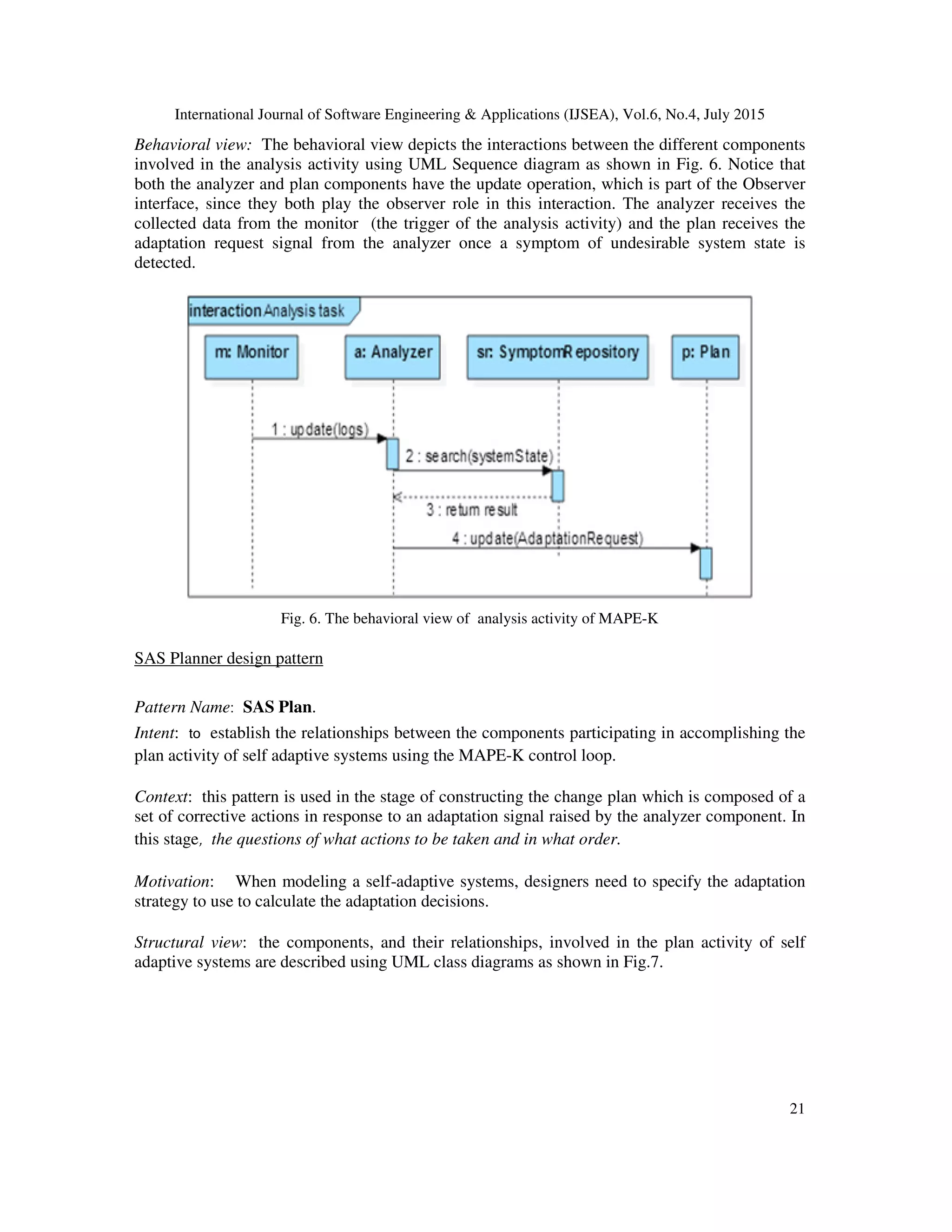
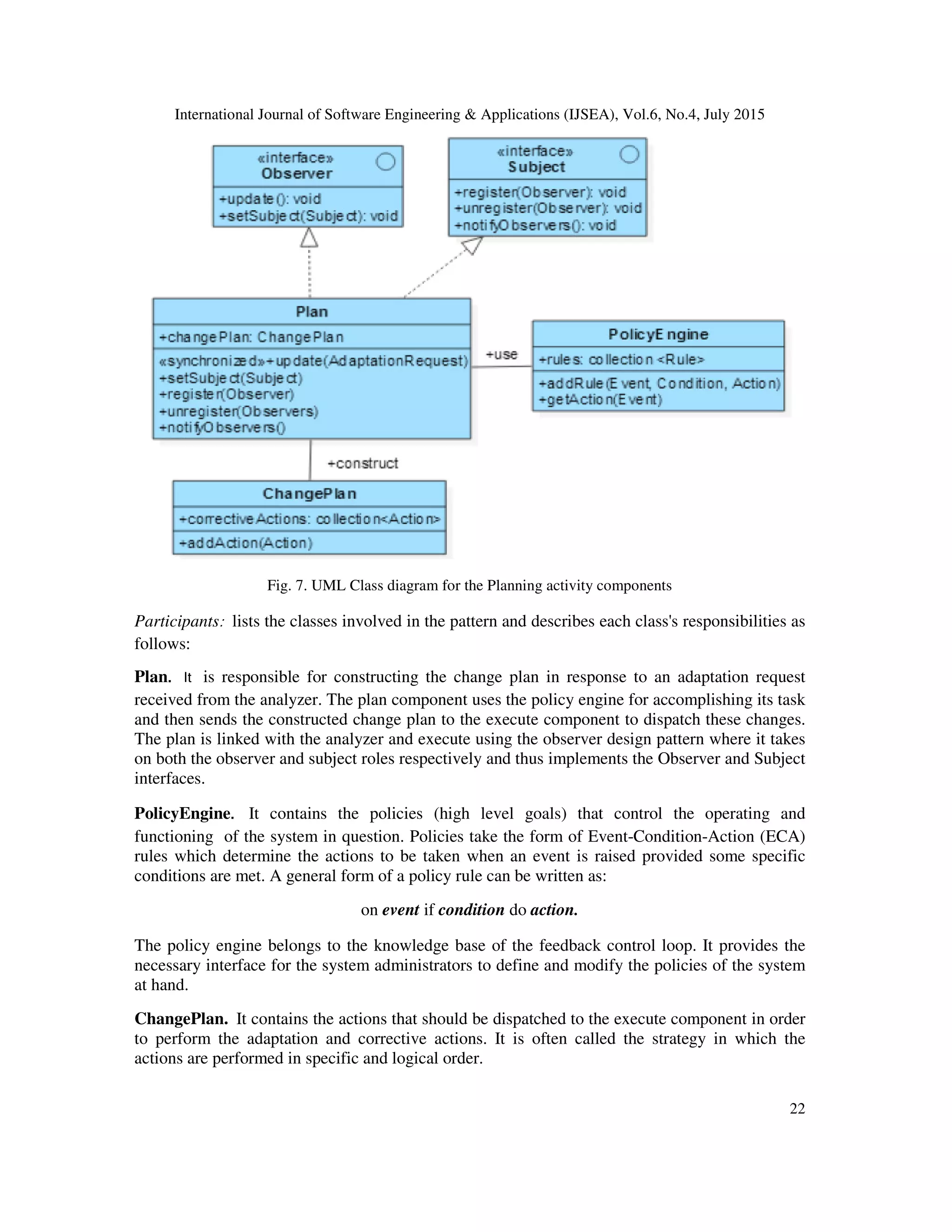
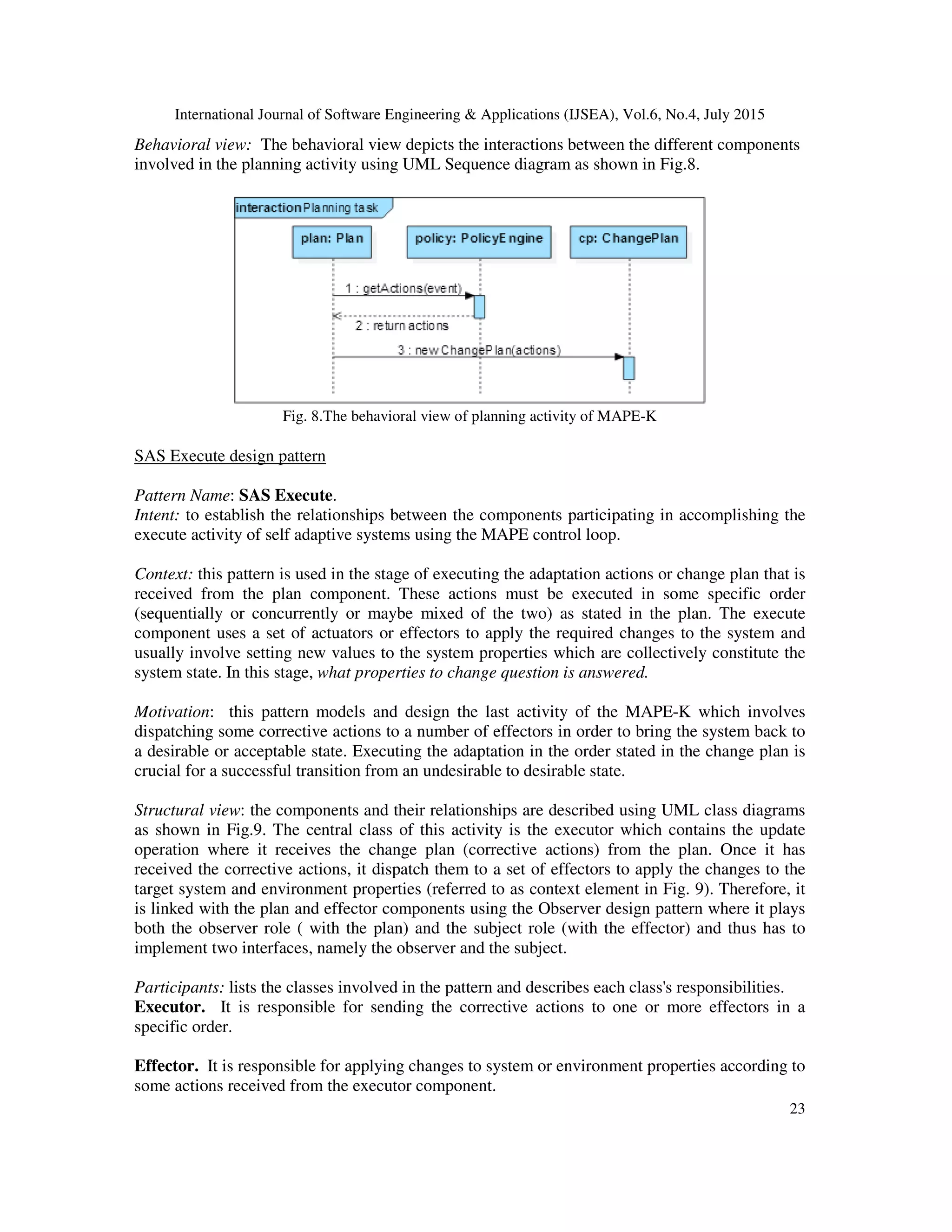
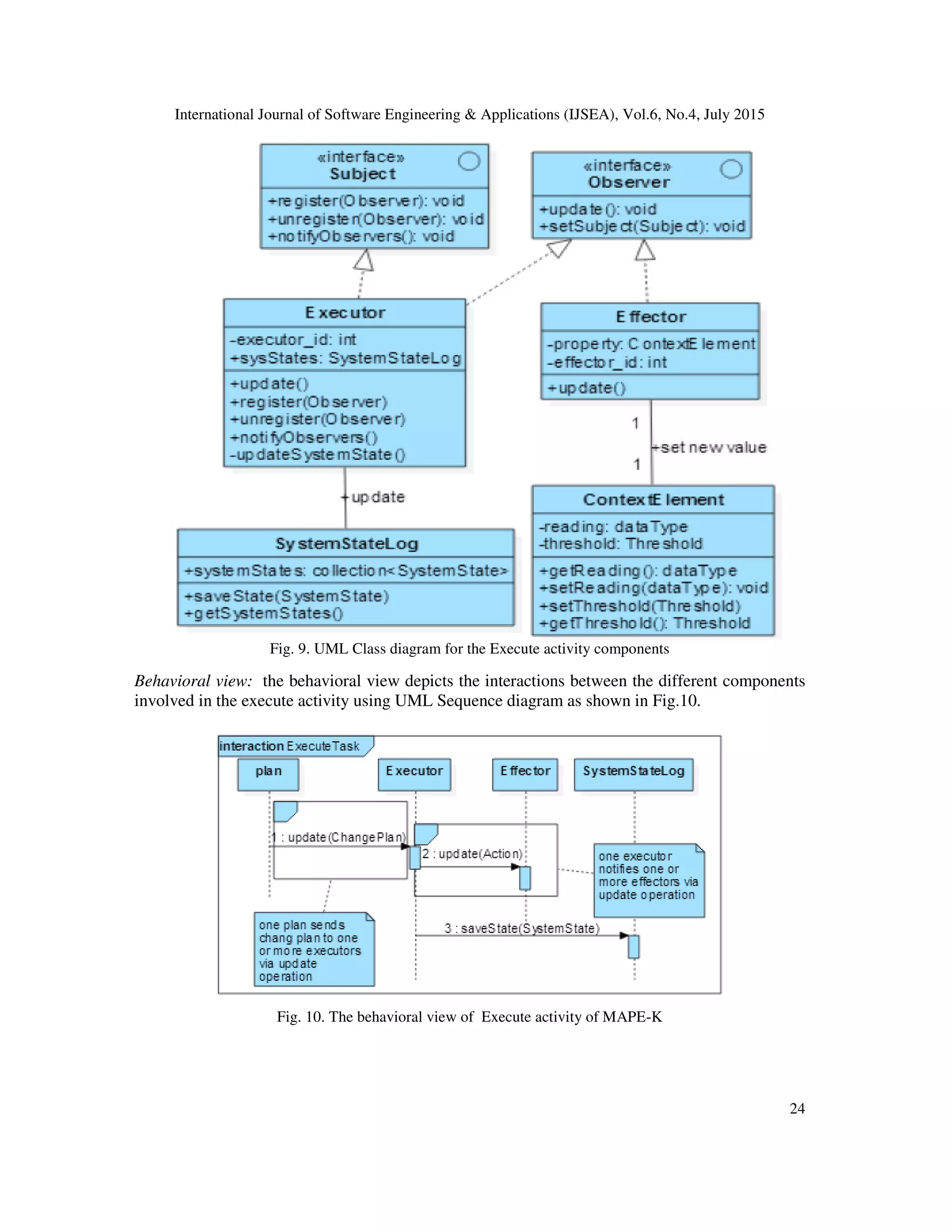
![International Journal of Software Engineering & Applications (IJSEA), Vol.6, No.4, July 2015
DOI : 10.5121/ijsea.2015.6402 11
DESIGN PATTERNS FOR SELF ADAPTIVE SYSTEMS
ENGINEERING
Yousef Abuseta and Khaled Swesi
Computer Science Department, Faculty of Science
Al-Jabal Al-Gharbi University, Libya
ABSTRACT
Self adaptation has been proposed to overcome the complexity of today's software systems which results
from the uncertainty issue. Aspects of uncertainty include changing systems goals, changing resource
availability and dynamic operating conditions. Feedback control loops have been recognized as vital
elements for engineering self-adaptive systems. However, despite their importance, there is still a lack of
systematic way of the design of the interactions between the different components comprising one
particular feedback control loop as well as the interactions between components from different control
loops . Most existing approaches are either domain specific or too abstract to be useful. In addition, the
issue of multiple control loops is often neglected and consequently self adaptive systems are often designed
around a single loop. In this paper we propose a set of design patterns for modeling and designing self
adaptive software systems based on MAPE-K. Control loop of IBM architecture blueprint which takes into
account the multiple control loops issue. A case study is presented to illustrate the applicability of the
proposed design patterns.
KEYWORDS
Self-adaptive, feedback control loop, Design Patterns
1. INTRODUCTION
The development of today's software systems has become a very difficult task to accomplish.
This is due to the dynamic and heterogeneous nature of these systems. It is rather difficult to
build a software system that meets all requirements and make it survive without the need for a
change either in response to new user requirements or to changing environmental conditions.
Furthermore, many of these systems cannot afford too long downtime while the source code is
being modified. Traditional top-down engineering approaches are insufficient to handle the
complexity and evolution problems inherent in decentralized, continually evolving software [19].
Therefore, there is an increasing need for the software systems to be able to self adapt to
accommodate new requirements not foreseen at design time or in response to changes on
contextual conditions.
A self-Self-adaptive system (SAS) is a software-intensive system augmented with the ability to
respond to a variety of changes that may take place in their environment, goals, or the system
itself by adapting its structure and behavior at run-time autonomously [5, 22]. This vision](https://image.slidesharecdn.com/designpatternsforselfadaptivesystems-150808051932-lva1-app6892/75/Design-patterns-for-self-adaptive-systems-1-2048.jpg)
![International Journal of Software Engineering & Applications (IJSEA), Vol.6, No.4, July 2015
12
requires shifting the human role from operational to strategic. Humans define high level policies
that state how a system should react to changes and the system then carries out corrective
changes (adaptations) autonomously at run-time [6].
Research in self-adaptive systems have been conducted within the different areas of software
engineering, including requirements engineering [2], software architecture [9, 10, 25],
middleware [18], and component-based development [23].
Feedback control loops [20] from the control theory area have been identified as vital elements
in engineering self-adaptive software systems. Such control loops are typically organized by
means of four components that are responsible for the fundamental functions of self-adaptation:
Monitor, Analyze, Plan, and Execute, often referred to as the MAPE loop as in the IBM
architecture blueprint [13]. In [7] these functions are referred to as collect, analyze, decide, and
act.
Despite the importance of feedback loops regarding the introduction of self adaptability to today's
software systems, there is still a lack of systematic way of the design of the interactions between
the different components comprising one particular feedback control loop. Existing approaches
are either too specific for some domains or highly abstract to be useful in modeling a wide range
of domains. Also, little attention has been given to modeling and designing multiple interacting
control loops since most approaches assume the existence of only one single control loop and
design their self adaptive systems accordingly. In addition, the responsibilities of each component
in the feedback control loop are not defined properly and consequently each SAS designer tends
to define them differently. The monitor responsibility, for instance, is often defined in a way that
overlaps with the analyzer's where the monitor accomplishes the data collection, aggregation and
reasoning tasks. This contradicts with the separation of concerns design principle. Such a design
principle contributes to a clean and flexible design of software systems in general and self
adaptive systems in particular.
In this paper we introduce a set of design patterns which serves as an assisting tool for software
designers of self adaptive systems. Such patterns support reuse of known solutions and evaluated
ideas and architectures taken from well designed and accepted approaches for the area of self
adaptive systems engineering. Our design patterns are based on the feedback control loop
proposed by the IBM architecture blueprint [13].
The rest of the paper is organized as follows. Section 2 reviews some background issues related
to our proposed design method of self adaptive systems. Section 3 introduces some related work
on the self adaptive software systems development. Section 4 presents our proposed set of design
patterns that depicts the well known solutions and ideas about the self adaptive systems
engineering. In section 5, an evaluation case study is employed to evaluate and show the
applicability of the proposed design patterns. The paper is concluded in section 6 with outlined
directions for future work.](https://image.slidesharecdn.com/designpatternsforselfadaptivesystems-150808051932-lva1-app6892/75/Design-patterns-for-self-adaptive-systems-2-2048.jpg)
![International Journal of Software Engineering & Applications (IJSEA), Vol.6, No.4, July 2015
13
2. BACKGROUND
2.1 Feedback Control Loop
Feedback loops provide the generic mechanism for self-adaptation [3]. A feedback loop is a
control loop where the output of the controlled system is fed back to the input. It allows therefore
to adjust operations according to differences between the actual output and the desired output. In
other words, feedback control loops are entities that observe the system and initiate adaption. A
feedback loop typically involves four key activities: collect, analyze, decide, and act [7]. Sensors
collect data from the running system and its environment which represents its current state. The
collected data are then aggregated and saved for future reference to construct a model of past and
current states. The data are then analyzed to infer trends and identify symptoms. The planning
activity then takes place and attempts to predict the future and prepare change plan to act on the
running system through a set of effectors or actuators [3].
2.2 Managed and Managing Systems
Self adaptation capabilities can be introduced to the software system either internally or
externally [26]. In the internal approach, the adaptation logic (managing system) is intertwined
with the core application (managed system) which may take the form of the exception handling.
In this case, the adaptation engine is system dependent and thus difficult to maintain, evolve, and
reuse. In contrast, in the external approach, the concerns of the adaptation logic are separated
from the core application. Most of the existing approaches adopt the external approach since it
enables the realization of some important software qualities such as the reusability and
modifiability. The IBM architecture blueprint [13] is an example of this approach which is shown
in Fig.1. As depicted in Fig.1, the managing system consists of four main activities: monitor,
analyze, plan and execute. These activities share a knowledge base component which contains
information about the system state as well as the policy engine that controls the system
functioning. A set of sensors is used to collect the important data to the adaptation process and
send them to the monitor for further processing while a set of effectors is used to apply the
corrective changes stated in the plan.
Fig. 1. Autonomic computing control loop [16]](https://image.slidesharecdn.com/designpatternsforselfadaptivesystems-150808051932-lva1-app6892/75/Design-patterns-for-self-adaptive-systems-3-2048.jpg)
![International Journal of Software Engineering & Applications (IJSEA), Vol.6, No.4, July 2015
14
2.3 Design Patterns
A Software design pattern is a repeatable solution to a usually occurring problem in software
designs. It is a template for how to solve a problem that can be used in many different situations
[8]. Design patterns [8,17] have fundamentally changed the way we approach the design of large
software systems. Applying design patterns not only helps system designers take advantage of the
software community’s collective experience as captured in the patterns, it also enables others
studying the system in question to gain a deeper understanding of how the system is structured,
and why it behaves in particular ways.
In [8], design patterns have been classified into three categories as follows:
• Creational patterns which are concerned with creating the appropriate objects for a given
case. This gives more flexibility to the program since choosing the right object to create
is postponed to the runtime.
• Structural patterns which are concerned with composing groups of objects into larger
structures.
• Behavioral patterns which define the communication between a set of objects in a
software system and how the flow is controlled in such a system.
A number of design patterns belonging to the categories listed above plays a crucial role in
designing self adaptive systems. The observer design pattern, for instance, can fit nicely when
establishing the relationship between the monitor component and the sensor. Also, the Strategy
design pattern can be used to design and implement the plan component which contains a set of
possible actions executed when some particular conditions hold. Sometimes it is desirable and
beneficial for the self adaptive systems to offer the option of reverting to previous system states
(prior to the application of the plan changes). In the latter, the command design pattern comes in
play and offers this feature. It is similar to the system restore option offered by Windows where
the system might encounter some problems and choosing a restore point might solve the issue.
3. RELATED WORK
Several approaches have been proposed to address the design of self adaptive software systems.
These approaches can be classified to requirements engineering , software architecture ,
middleware, and component-based development . Since our approach is related to the design
patterns and software architecture in general, this section is dedicated to previous works
conducted in these two specific areas. In [9, 11], Garlan et al proposed the Rainbow framework
which provides general, supporting mechanisms for self-adaptation which can be customized for
different classes of systems. It provides a language, called Stitch, to represent the adaptation
knowledge using high-level adaptation concepts of strategies, tactics, and operators. The
implementation of Rainbow is based on one large control loop that is in charge of all activities
related to the self adaptability issue for the whole system under consideration. Ramirez and
Cheng [24] describe a set of design patterns at the software design level to facilitate the
construction of a self-adaptive software system. Gomaa et al [12] proposed several patterns for
dynamically reconfiguring specific types of software architectures at run time [11]. In particular,
they extended the concepts of dynamic change management introduced by Kramer and Magee
[18] by introducing four design patterns to specify the behavior required to dynamically
reconfigure master/slave, centralized, server/client, and decentralized architectures. Iftikhar and](https://image.slidesharecdn.com/designpatternsforselfadaptivesystems-150808051932-lva1-app6892/75/Design-patterns-for-self-adaptive-systems-4-2048.jpg)
![International Journal of Software Engineering & Applications (IJSEA), Vol.6, No.4, July 2015
15
Weyns [14] propose ActiveFORMS, short for Active Formal Models, which contributes to the
self adaptive systems with an approach that guarantees the verified adaptation behavior at design
time and provides support for dealing with dynamic goals at runtime. Ben Said et al [1] proposed
a set of design patterns targeting the real time systems. Iglesia [15] in his PhD thesis proposed
and modeled the semantics for a set of MAPE-K formal templates for the design of self adaptive
systems. In [27], a set of design patterns is introduced by the authors to model the various
interactions between MAPE loops in decentralized control of self adaptive software systems.
4. PROPOSED DESIGN PATTERNS
Our proposed design patterns are built on some previous works carried out for addressing the
development of self adaptive software systems. In particular, we use the concepts proposed by
IBM architecture blueprint [13] for modeling the feedback control loops, namely the Monitor,
Analyze, Plan, and Execute. We also take advantage of the work presented in [3, 6] in which the
design space of self adaptive systems is presented as a set of dimensions whereas each dimension
is defined by a design question. We also studied the design patterns introduced in [27] to model
the various interactions between multiple MAPE loops of self adaptive software systems.
4.1 Metamodel of self adaptive systems
This section is dedicated to introduce the metamodel for the MAPE-K based self adaptive
systems. It shows, in a high level view, the concepts involved in the MAPE-K control loop as
well as the relationships and interactions between these concepts. This metamodel is an attempt
to accommodate the various possible interactions between MAPE-K components which might
emerge in many different situations or domains. In some situations, for example, a number of
sensors must notify a monitor of some specific system properties where in others one sensor is
linked to only one monitor. Likewise, it is sometimes necessary for the analyzer to accomplish its
task is to be notified by a set of monitors each responsible for monitoring one particular part of
the whole system. In addition, it might be necessary in some situations to have interactions
between two components of the same type (monitor-to-monitor, analyzer-to-analyzer, etc) and
therefore it is important to accommodate this interaction as well. Also, the notification process,
from the sensor to the monitor for instance, can be conducted either periodically or based on
some specific events. Regarding the adaptation application, a plan component might send the
change plan, called strategy in the metamodel, to a number of execute components and similarly,
an execute component could make use of a set of actuators to apply the change actions. Fig. 3
shows this metamodel using UML class diagrams. As it can be noticed from Fig. 3 the closed and
continuous control loop starts with the measurement conducted by the sensors and ends by
changes made through the actuators. The dotted arrow shows the process of the applying the
changes plan which should cause the runtime system state to be brought back to a desirable and
acceptable state according to some predefined goals and requirements.](https://image.slidesharecdn.com/designpatternsforselfadaptivesystems-150808051932-lva1-app6892/75/Design-patterns-for-self-adaptive-systems-5-2048.jpg)
![International Journal of Software Engineering & Applications (IJSEA), Vol.6, No.4, July 2015
16
Fig. 2. Metamodel of MAPE-K based Self Adaptive Systems
4.2 SAS Design Patterns
Below, we introduce the five design patterns: SAS Monitor, SAS Analyzer, SAS Plan, SAS
Execute and SAS Knowledge. Each design pattern proposed here is partially complied with the
Gamma [8] template structure. Each pattern is described by six fields, namely the pattern name,
intent, context, motivation, structural view and participants. UML diagrams are used here to
depict the structural and behavioural views of the design patterns.
SAS Monitor design pattern
Pattern Name: SAS Monitor.
Intent: to establish the relationships between the components participating in accomplishing the
monitoring activity of self adaptive systems using the MAPE control loop.
Context: this pattern is used in the first stage of the feedback control loop process aiming at
introducing self adaptability to software systems. In this stage, what properties to monitor
question is answered.
Motivation: the detection of a property threshold violation represents the trigger of the adaptation
process in self adaptive systems. Therefore, in order to accomplish the detection process, a
monitor component must be introduced.
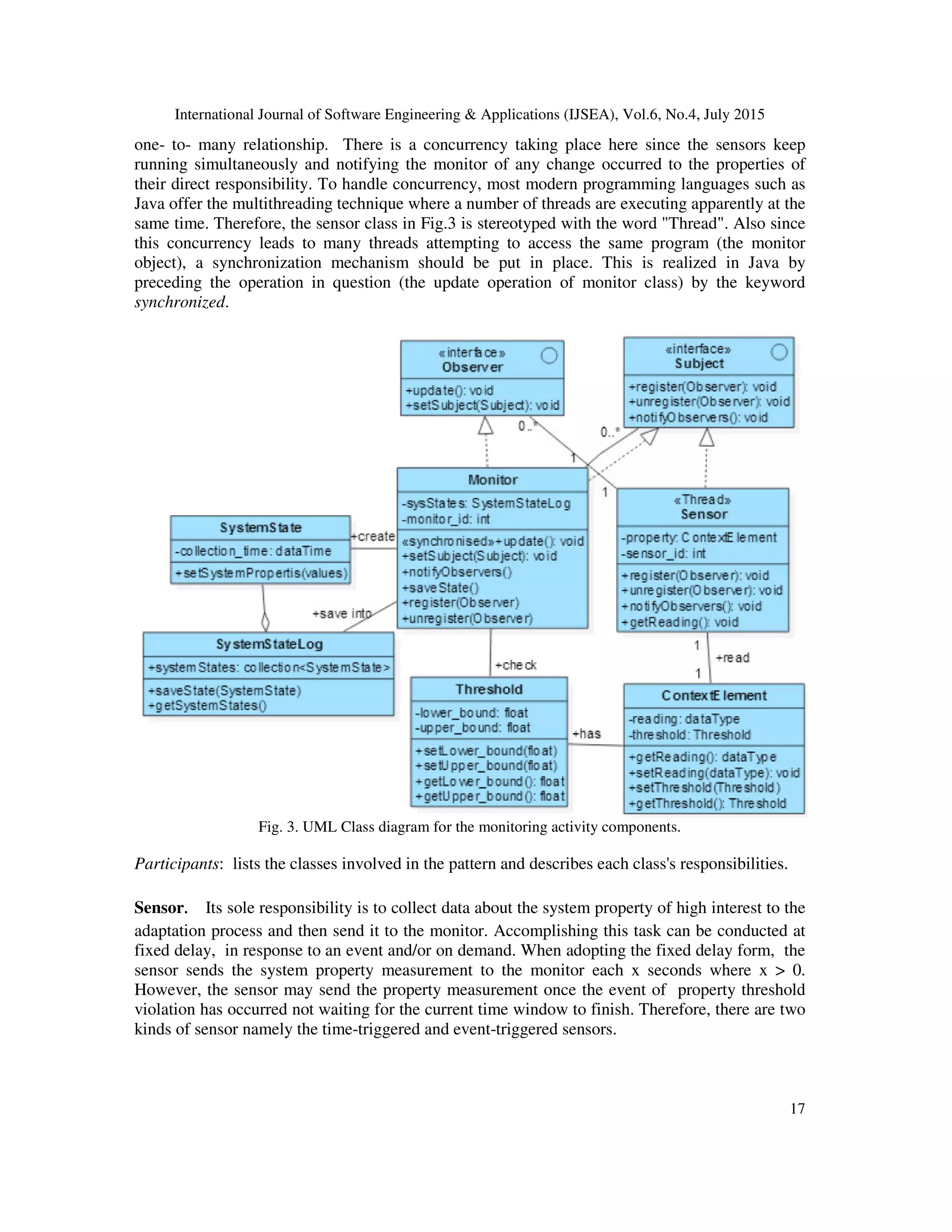
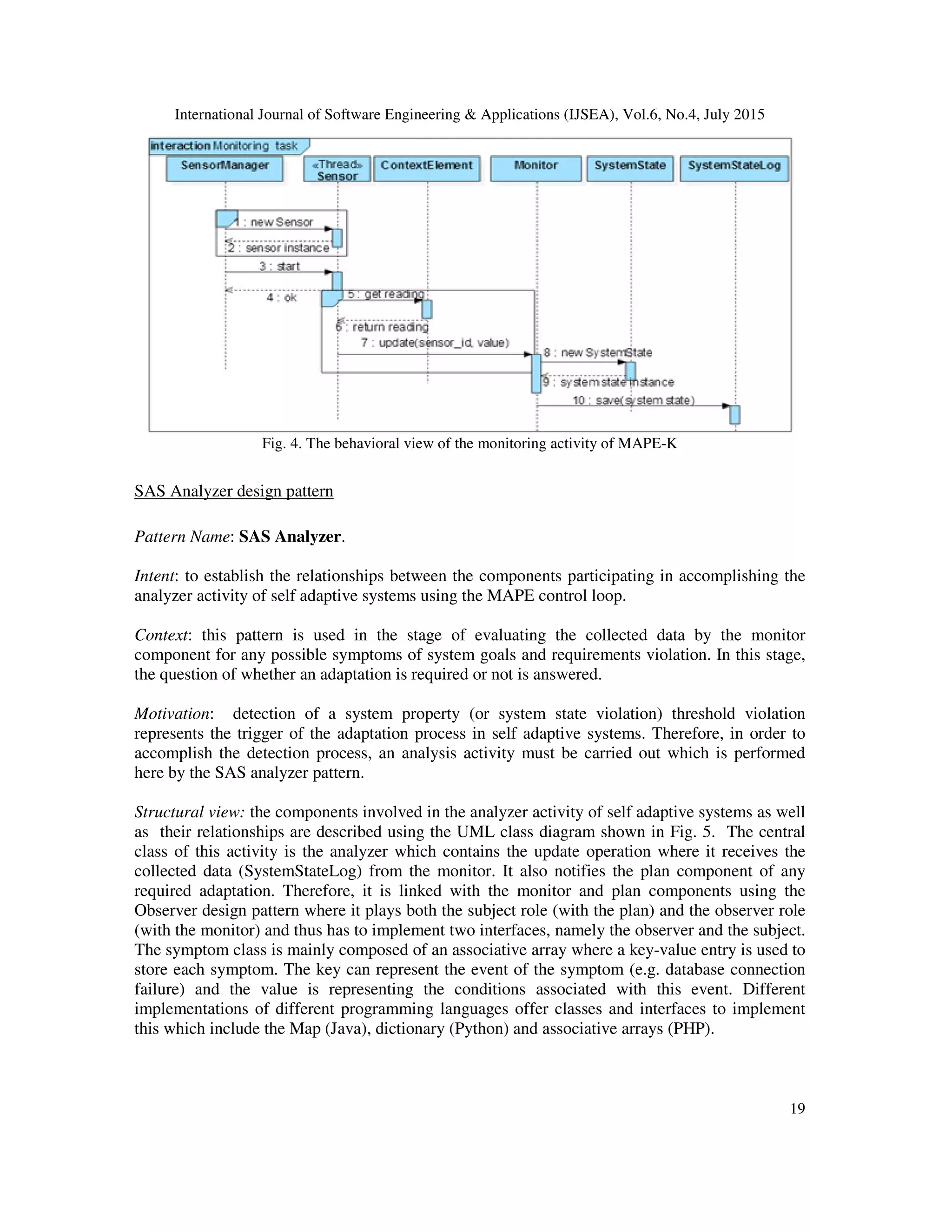
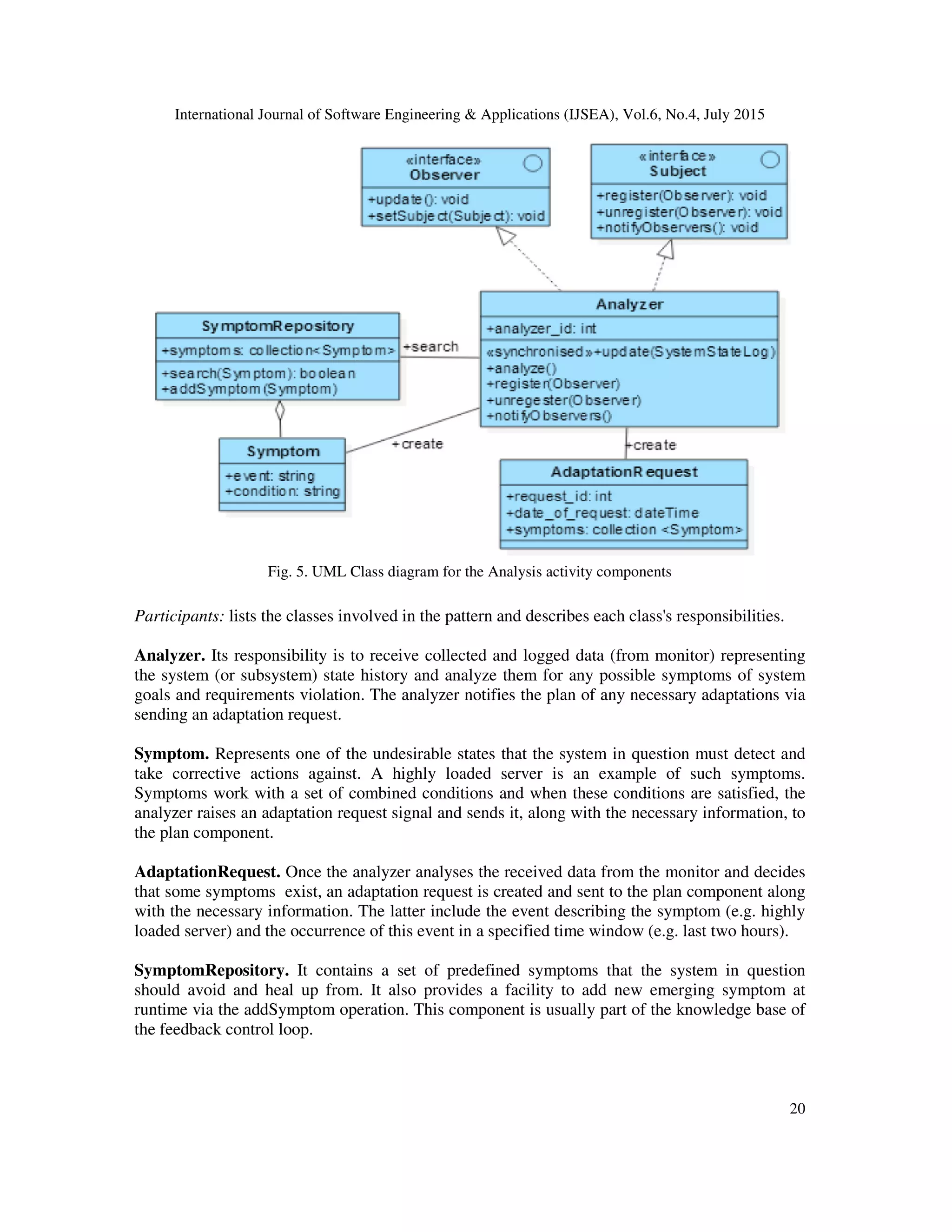
Structural view: the components involved in the monitoring activity as well as their relationships
are described using the UML class diagram shown in Fig. 3. As stated earlier, the relationship
between the monitor and sensor is established using the observer design pattern. The monitor is
interested in collecting data (property readings) from a set of sensors therefore it takes on the
observer role while the sensors play the subject role. However, in this case the monitor (the
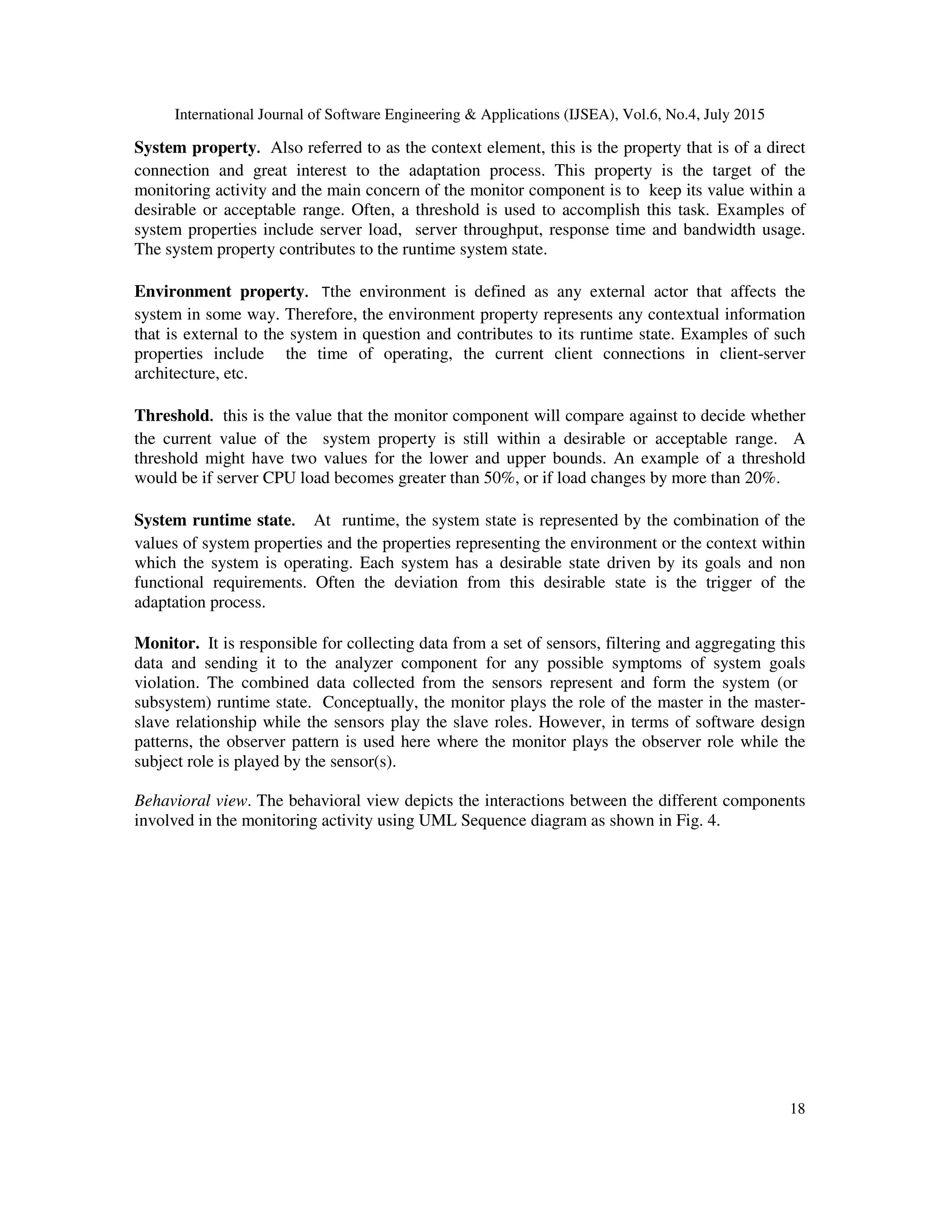
observer) registers its interest of change notifications with a number of sensors (subjects) in a](https://image.slidesharecdn.com/designpatternsforselfadaptivesystems-150808051932-lva1-app6892/75/Design-patterns-for-self-adaptive-systems-6-2048.jpg)
![International Journal of Software Engineering & Applications (IJSEA), Vol.6, No.4, July 2015
27
6. CONCLUSIONS
In this paper, we have introduced a set of design patterns to model the four main activities of the
MAPE-K control loop which are used to engineer self-adaptive systems (SAS). Accordingly,
such patterns are termed as SAS Monitor, SAS Analyzer, SAS Plan and SAS Execute. Also, the
interactions between the different MAPE-K components are modeled and designed. Such
interactions include Sensor-Monitor, Monitor-Analyzer, Analyzer-Plan, Plan-Execute and
Execute-Effector. We have applied the Observer design pattern for each interaction where all
components (except for the sensor and effector) play both the observer and subject roles and
thus implement two interfaces namely the observer and subject. This, besides the stated above
interactions, enables the establishment of the interaction between two component of the same
type (monitor for instance) which is needed in some situations. The E-learning system case study
was used to illustrate the applicability of part of these design patterns. As future work and
suggested research, the following issues need to be addressed:
• A more detailed case study to illustrate the application of our proposed deign
patterns.
• The application of our design patterns to introduce the self adaptation capability to
VLEs at the core services level. Such services include a self adaptive user interface
and self adaptive learning paths. In the case study presented here, we were interested
in providing the scalability at the hardware level (server farm). The server farm
represents the platform where theVLEs are executed.
• Modeling and programming the different states that each MAPE component goes
through during the management of the managed system.
• A complete lifecycle for the development of self adaptive systems.
• The impact of the architectural style of the system under development on the
feedback control loops organization (decentralized for instance).
REFERENCES
[1] M. Ben Said, Y. Kacem, M. Kerboeuf, N. Ben Amor, M. Abid. "Design patterns for self-adaptive
RTE systems specification". International Journal of Reconfigurable Computing, Vol. 2014 (2014).
[2] G. Brown, B. Cheng, H. Goldsby and J. Zhang. "Goal-oriented specification of adaptation
requirements engineering in adaptive systems". In: ACM 2006 International Workshop on Self-
Adaptation and Self-Managing Systems (SEAMS 2006), Shanghai, China, pp. 23–29 (2006).
[3] Y. Brun at el."Engineering Self-Adaptive System through Feedback Loops,” in Software Engineering
for Self Adaptive Systems", Springer-Verlag Berlin Heidelberg 2009, Cheng B. et al. (Eds), pp 48-70,
2009.
[4] F. Buschmann et al, Pattern-Oriented Software Architecture: System of Patterns, John Wiley, 1996.
[5] J. Camara, R. de Lemos, N. Laranjeiro, R. Ventura, M. Vieira. "Testing the robustness of controllers
for self-adaptive systems". Journal of the Brazilian Computer Society 2014.
[6] R. de Lemos et al., " Software Engineering for Self-Adaptive Systems: A Second Research Roadmap,
Springer-Verlag Berlin Heidelberg 2013 (Eds.): Self-Adaptive Systems, LNCS 7475, pp. 1–32, 2013.
[7] S. Dobson et al. "A survey of autonomic communications". ACM Transactions Autonomous
Adaptive Systems (TAAS) 1(2), 223–259 (2006).
[8] E. Gamma, R. Helm, R. Johnson, and J. Vlissides. Design Patterns: Elements of Reusable Object-
Oriented Software. Addison-Wesley Professional, 1995.
[9] D. Garlan, S. Cheng , A. Huang, B. Schmerl , P. Steenkiste (2004) Rainbow: architecture-based self-
adaptation with reusable infrastructure. IEEE Comput 37(10): 46–54](https://image.slidesharecdn.com/designpatternsforselfadaptivesystems-150808051932-lva1-app6892/75/Design-patterns-for-self-adaptive-systems-17-2048.jpg)
![International Journal of Software Engineering & Applications (IJSEA), Vol.6, No.4, July 2015
28
[10] D. Garlan, S. Cheng and B. Schmerl."Increasing system dependability through architecture-based
self-repair". In: de Lemos, R., Gacek, C., Romanovsky, A. (eds.) Architecting Dependable Systems.
LNCS, vol. 2677. Springer, Heidelberg (2003).
[11] D. Garlan, B. Schmerl, and S. Cheng, " Software Architecture-Based Self-Adaptation", Springer
Science+Business Media, LLC 2009.
[12] H. Gomma and M. Hussien, "Software Reconfiguration Patterns for Dynamic Evolution of Software
Architectures", IEEE Conference on Software Architecture (WICSA’04), 2004.
[13] IBM. "An architectural blueprint for autonomic computing. IBM", 2005.
[14] M. Iftikar and D. Weyns. "ActivFORMS: Active Formal Models for Self-Adaptation". The 9th
International Symposium on Software Engineering for Adaptive and Self-Managing Systems 2014
[15] D. Iglesia, A Formal Approach for Designing Distributed Self-Adaptive Systems, PhD Thesis, 2014.
[16] B. Jacob, R. Lanyon-Hogg, D. Nadgir and A. Yassin. "A Practical Guide to the IBM Autonomic
Computing Toolkit". IBM 2004.
[17] R. Johnson. "Components, frameworks, patterns". In Symposium on Software Reusability, 1997.
[18] J. Kramer and J. Magee."The Evolving Philosophers Problem: Dynamic Change Management", IEEE
Transactions on Softwr Eng, Vol. 16, No. 11, Nov 1990.
[19] H. Liu and M. Parashar. "Accord: a programming framework for autonomic applications". IEEE
Transactions on Systems, Man, and Cybernetics 36(3), 341–352 (2006).
[20] H. Muller, M. Pezze and M. Shaw. "Visibility of control in adaptive systems". In: Proceedings of
Second International Workshop on Ultra-Large-Scale Software- Intensive Systems (ULSSIS 2008),
pp. 23–27. ACM/IEEE (2008) .
[21] L. Northrop, P. Feiler, R. P. Gabriel, and et al. Ultra-Large-Scale systems - the software challenge of
the future. Technical report, Software Engineering Institute, Carnegie Mellon, June 2006.
[22] P. Oreizy, M. M. Gorlick, R. N. Taylor et al., “An architecture-based approach to self-adaptive
software”. IEEE Intelligent Systems and Their Applications, vol. 14, no. 3, pp. 54–62, 1999.
[23] C. Peper and D. Schneider."Component engineering for adaptive ad-hoc systems". In: ACM 2008
International Workshop on Software Engineering for Adaptive and Self-Managing Systems (SEAMS
2008), Leipzig, Germany, pp. 49–56 (2008)
[24] A. J. Ramirez and B. H. C. Cheng, “Design patterns for developing dynamically adaptive systems,” in
Proceedings of the ICSE Workshop on Software Engineering for Adaptive and Self-Managing
Systems (SEAMS '10), pp. 49–58, ACM, USA, 2010.
[25] U. Richter, M. Mnif, J. Branke, C. Muller-Schloer and H. Schmeck. "Towards a generic
observer/controller architecture for organic computing". In: Hochberger, C., Liskowsky, R. (eds.)
INFORMATIK 2006: Informatik f¨ur Menschen. GI-Edition – Lecture Notes in Informatics, vol. P-
93, pp. 112–119 (2006).
[26] M. Salehie and L. Tahvildari, “Self-adaptive software: landscape and research challenges,” ACM
Transactions on Autonomous and Adaptive Systems, vol. 4, no. 2, article 14, 2009.
[27] D. Weyns et al. "On patterns for decentralized control in self-adaptive systems". In R. de Lemos, H.
Giese, H. A. Muller, and M. Shaw, editors, ¨ Software Engineering for Self-Adaptive Systems,
volume 7475 of Lecture Notes in Computer Science, pages 76–107. Springer, 2012.
AUTHORS
Yousef Abuseta received an M.Sc in Computer Engineering in 2003 from University of Hertfordshire, UK. In 2009,
he received a PhD degree in Software Engineering (Autonomic systems) from Liverpool John Moores University, UK.
He has been lecturing at Al-Jabal Al-Gharbi University since 2011 where he is working as a Senior Lecturer. His
research interests include self adaptive systems, autonomic systems, design patterns, E-learning, Model Driven
Development (MDD) and Service Oriented Architecture (SOA).
Khaled Swesi received an M.Sc in Computer Science in 2003 from Newcastle University, UK. In 2010, he received
a PhD degree in Software Engineering from De Montfort University, UK. He joined Al-Jabal Al-Gharbi University in
2012 where he is working as a Senior Lecturer. His research interests include E-learning, AI and web-based
applications.](https://image.slidesharecdn.com/designpatternsforselfadaptivesystems-150808051932-lva1-app6892/75/Design-patterns-for-self-adaptive-systems-18-2048.jpg)

This paper proposes design patterns for self-adaptive software systems to address the complexity and uncertainties faced in modern software development. It emphasizes the importance of feedback control loops and provides a systematic approach to modeling interactions among multiple control loops using the MAPE-K model. A case study demonstrates the practicality of these design patterns in real-world applications.


![System Analysis & Designing : Elements of a System [In short]](https://cdn.slidesharecdn.com/ss_thumbnails/sadeoas-160410215155-thumbnail.jpg?width=640&height=640&fit=bounds)


