Gran Sasso Science Institute
Ivano Malavolta
Design patterns for mobile apps
Roadmap
Navigation
Forms
Search, sort & filter
Tools
Invitations
Feedback & Affordance
Anti-Patterns
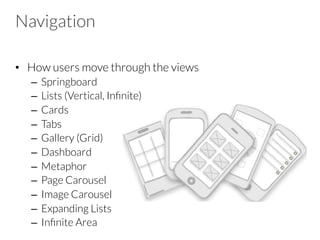
Navigation
•  How users move through the views
–  Springboard
–  Lists (Vertical, Infinite)
–  Cards
–  Tabs
–  Gallery (Grid)
–  Dashboard
–  Metaphor
–  Page Carousel
–  Image Carousel
–  Expanding Lists
–  Infinite Area
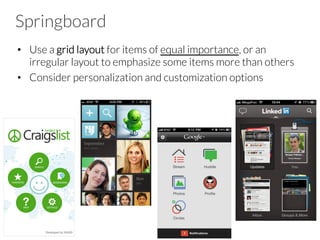
Springboard
•  Use a grid layout for items of equal importance, or an
irregular layout to emphasize some items more than others
•  Consider personalization and customization options
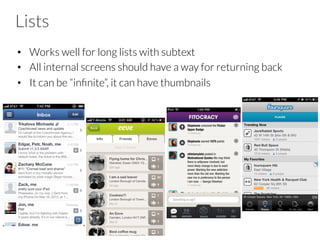
Lists
•  Works well for long lists with subtext
•  All internal screens should have a way for returning back
•  It can be “infinite”, it can have thumbnails
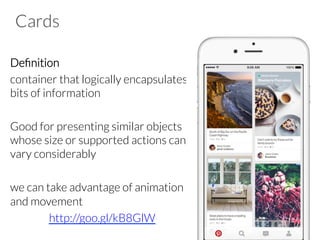
Cards
Definition
container that logically encapsulates
bits of information
Good for presenting similar objects
whose size or supported actions can
vary considerably
we can take advantage of animation
and movement
http://goo.gl/kB8GlW
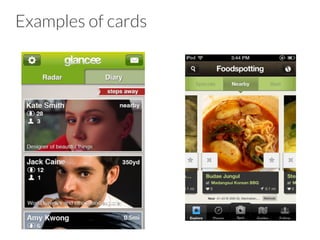
Examples of cards
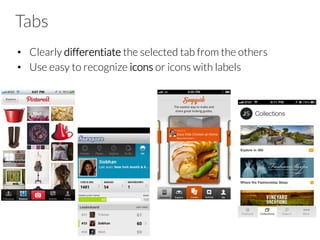
Tabs
•  Clearly differentiate the selected tab from the others
•  Use easy to recognize icons or icons with labels
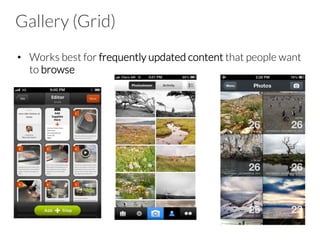
Gallery (Grid)
•  Works best for frequently updated content that people want
to browse
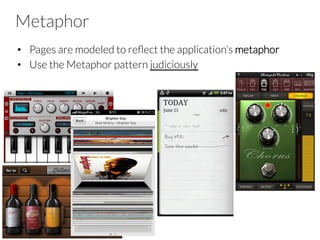
Metaphor
•  Pages are modeled to reflect the application’s metaphor
•  Use the Metaphor pattern judiciously
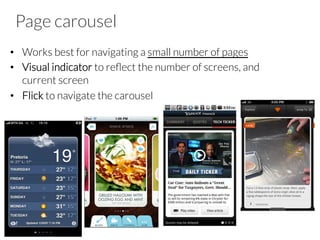
Page carousel
•  Works best for navigating a small number of pages
•  Visual indicator to reflect the number of screens, and
current screen
•  Flick to navigate the carousel
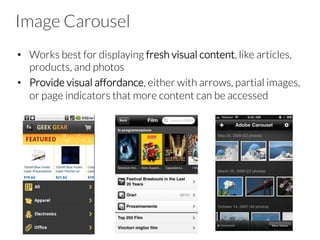
Image Carousel
•  Works best for displaying fresh visual content, like articles,
products, and photos
•  Provide visual affordance, either with arrows, partial images,
or page indicators that more content can be accessed
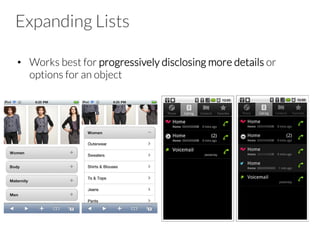
Expanding Lists
•  Works best for progressively disclosing more details or
options for an object
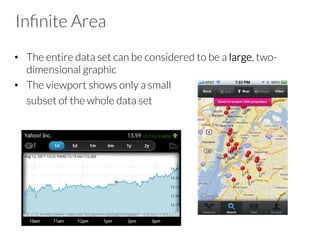
Infinite Area
•  The entire data set can be considered to be a large, two-
dimensional graphic
•  The viewport shows only a small
subset of the whole data set
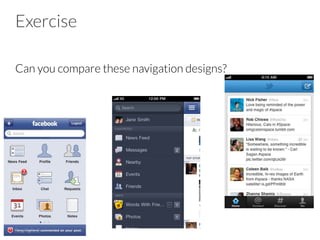
Can you compare these navigation designs?
Exercise
Roadmap
Navigation
Forms
Search, sort & filter
Tools
Invitations
Feedback & Affordance
Anti-Patterns
Forms
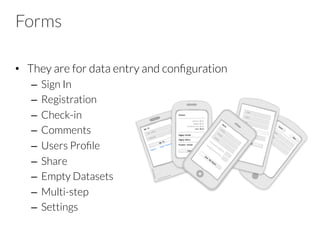
•  They are for data entry and configuration
–  Sign In
–  Registration
–  Check-in
–  Comments
–  Users Profile
–  Share
–  Empty Datasets
–  Multi-step
–  Settings
Sign In
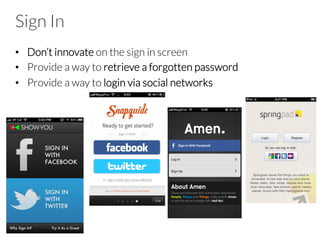
•  Don’t innovate on the sign in screen
•  Provide a way to retrieve a forgotten password
•  Provide a way to login via social networks
Registration
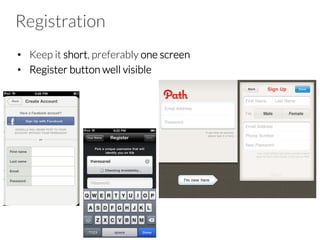
•  Keep it short, preferably one screen
•  Register button well visible
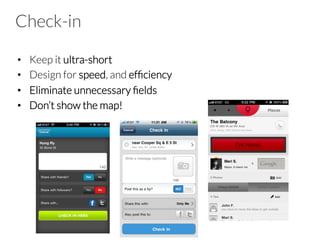
Check-in
•  Keep it ultra-short
•  Design for speed, and efficiency
•  Eliminate unnecessary fields
•  Don’t show the map!
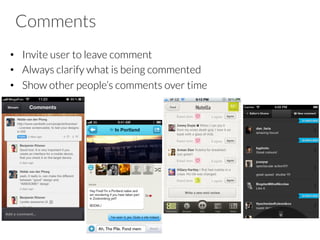
Comments
•  Invite user to leave comment
•  Always clarify what is being commented
•  Show other people’s comments over time
Timeline
•  Within the current hour, show as minutes ago
•  Within the current day, show the time as number of hours ago
•  Within the last two days, shown the day of the week, and the
time range, morning, afternoon, evening, night
•  Within the past week, show the day of the week
•  Within 12 months, show as mm/DD
•  Older than 12 months, show only the year
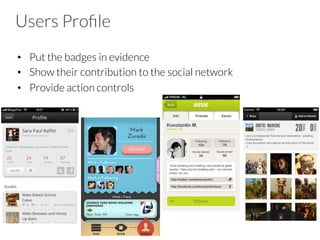
Users Profile
•  Put the badges in evidence
•  Show their contribution to the social network
•  Provide action controls
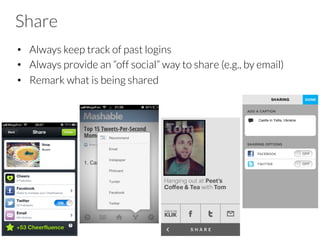
Share
•  Always keep track of past logins
•  Always provide an “off social” way to share (e.g., by email)
•  Remark what is being shared
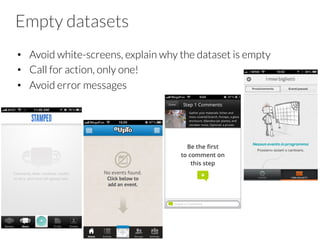
Empty datasets
•  Avoid white-screens, explain why the dataset is empty
•  Call for action, only one!
•  Avoid error messages
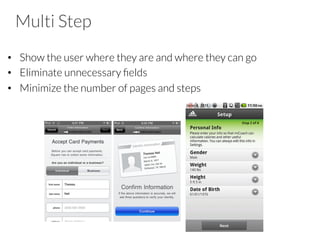
Multi Step
•  Show the user where they are and where they can go
•  Eliminate unnecessary fields
•  Minimize the number of pages and steps
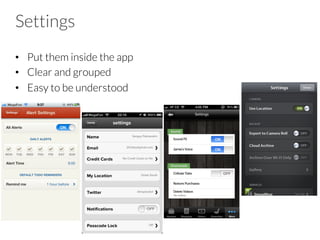
Settings
•  Put them inside the app
•  Clear and grouped
•  Easy to be understood
Roadmap
Navigation
Forms
Search, sort & filter
Tools
Invitations
Feedback & Affordance
Anti-Patterns
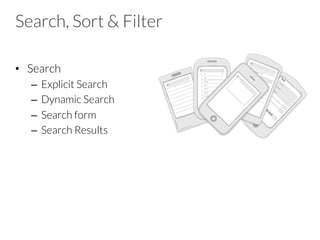
Search, Sort & Filter
•  Search
–  Explicit Search
–  Dynamic Search
–  Search form
–  Search Results
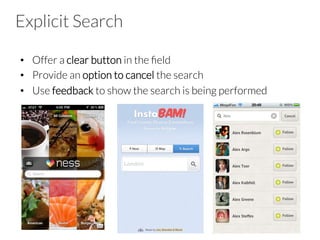
Explicit Search
•  Offer a clear button in the field
•  Provide an option to cancel the search
•  Use feedback to show the search is being performed
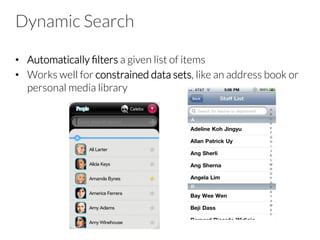
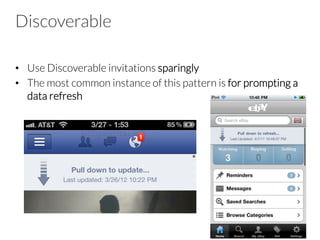
Dynamic Search
•  Automatically filters a given list of items
•  Works well for constrained data sets, like an address book or
personal media library
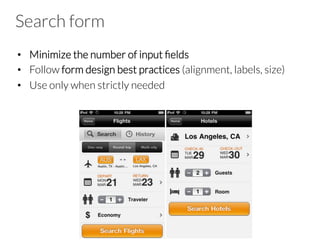
Search form
•  Minimize the number of input fields
•  Follow form design best practices (alignment, labels, size)
•  Use only when strictly needed
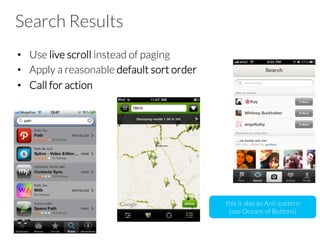
Search Results
•  Use live scroll instead of paging
•  Apply a reasonable default sort order
•  Call for action
Roadmap
Navigation
Forms
Search, sort & filter
Tools
Invitations
Feedback & Affordance
Anti-Patterns
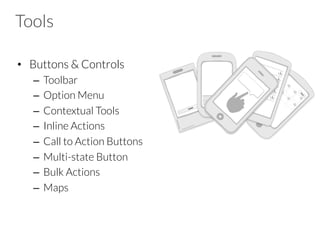
Tools
•  Buttons & Controls
–  Toolbar
–  Contextual Tools
–  Inline Actions
–  Call to Action Buttons
–  Multi-state Button
–  Maps
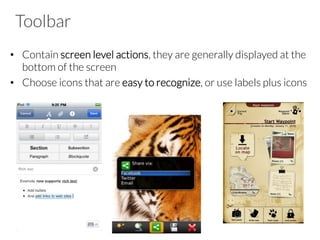
Toolbar
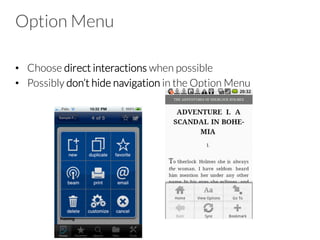
•  Contain screen level actions, they are generally displayed at the
bottom of the screen
•  Choose icons that are easy to recognize, or use labels plus icons
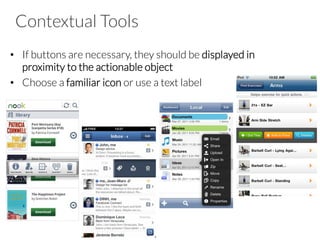
Contextual Tools
•  If buttons are necessary, they should be displayed in
proximity to the actionable object
•  Choose a familiar icon or use a text label
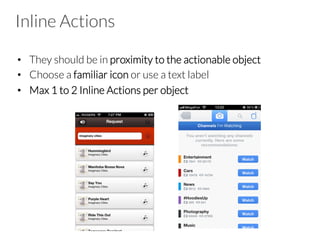
Inline Actions
•  They should be in proximity to the actionable object
•  Choose a familiar icon or use a text label
•  Max 1 to 2 Inline Actions per object
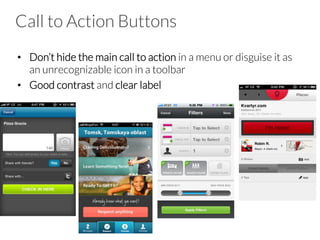
Call to Action Buttons
•  Don’t hide the main call to action in a menu or disguise it as
an unrecognizable icon in a toolbar
•  Good contrast and clear label
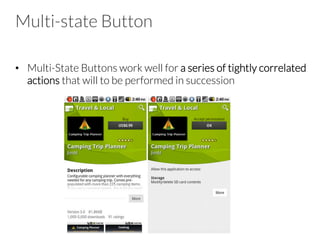
Multi-state Button
•  Multi-State Buttons work well for a series of tightly correlated
actions that will to be performed in succession
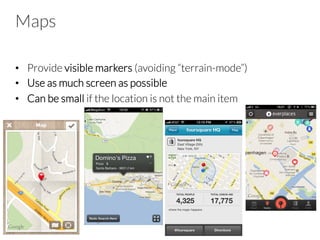
Maps
•  Provide visible markers (avoiding “terrain-mode”)
•  Use as much screen as possible
•  Can be small if the location is not the main item
Roadmap
Navigation
Forms
Search, sort & filter
Tools
Invitations
Feedback & Affordance
Anti-Patterns
Invitations
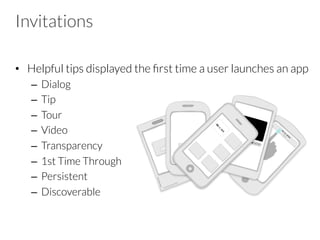
•  Helpful tips displayed the first time a user launches an app
–  Dialog
–  Tip
–  Tour
–  Video
–  Transparency
–  1st Time Through
–  Persistent
Dialog
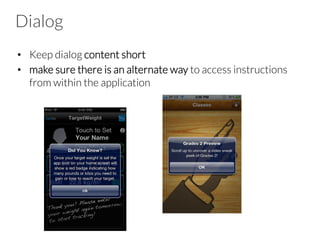
•  Keep dialog content short
•  make sure there is an alternate way to access instructions
from within the application
Tip
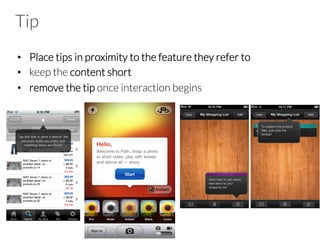
•  Place tips in proximity to the feature they refer to
•  keep the content short
•  remove the tip once interaction begins
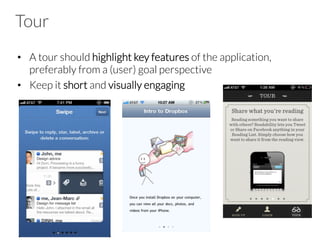
Tour
•  A tour should highlight key features of the application,
preferably from a (user) goal perspective
•  Keep it short and visually engaging
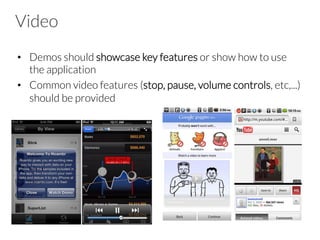
Video
•  Demos should showcase key features or show how to use
the application
•  Common video features (stop, pause, volume controls, etc,...)
should be provided
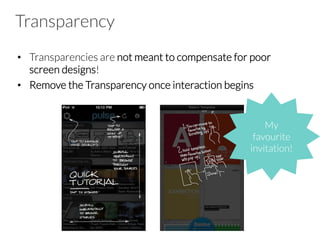
Transparency
•  Transparencies are not meant to compensate for poor
screen designs!
•  Remove the Transparency once interaction begins
My
favourite
invitation!
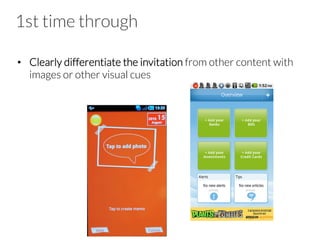
1st time through
•  Clearly differentiate the invitation from other content with
images or other visual cues
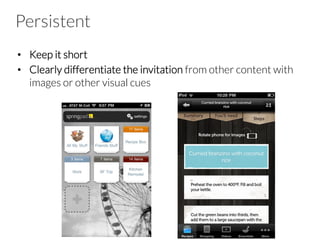
Persistent
•  Keep it short
•  Clearly differentiate the invitation from other content with
images or other visual cues
Roadmap
Navigation
Forms
Search, sort & filter
Tools
Invitations
Feedback & Affordance
Anti-Patterns
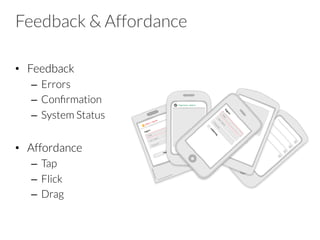
Feedback & Affordance
•  Feedback
–  Errors
–  Confirmation
–  System Status
•  Affordance
–  Tap
–  Flick
–  Drag
Feedback: Errors
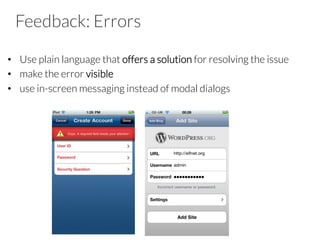
•  Use plain language that offers a solution for resolving the issue
•  make the error visible
•  use in-screen messaging instead of modal dialogs
Feedback: Confirmation
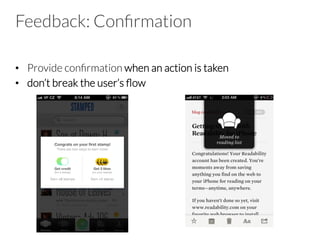
•  Provide confirmation when an action is taken
•  don’t break the user’s flow
Feedback: System Status
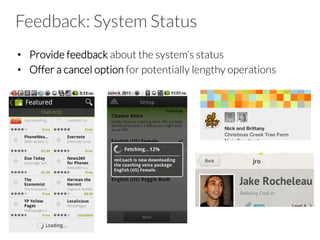
•  Provide feedback about the system’s status
•  Offer a cancel option for potentially lengthy operations
Affordance: Tap
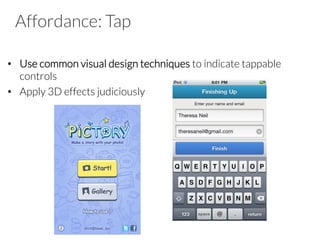
•  Use common visual design techniques to indicate tappable
controls
•  Apply 3D effects judiciously
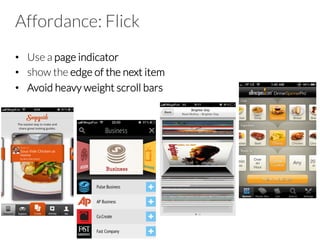
Affordance: Flick
•  Use a page indicator
•  show the edge of the next item
•  Avoid heavy weight scroll bars
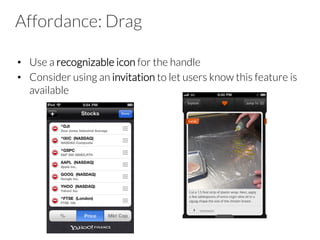
Affordance: Drag
•  Use a recognizable icon for the handle
•  Consider using an invitation to let users know this feature is
available
Roadmap
Navigation
Forms
Search, sort & filter
Tools
Invitations
Feedback & Affordance
Anti-Patterns
Anti-Patterns
•  Common pitfalls to avoid
–  Novel Notions
–  Metaphor Mismatch
–  Idiot Boxes
–  Chart Junk
–  Oceans of Buttons
Novel Notions
•  If you are looking for a way to innovate with your application,
focus on your core features and offerings, but rely on best
practices for the interface design
•  If you design a custom control, rigorously test it and refine it to
make sure it is usable
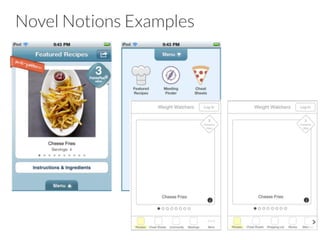
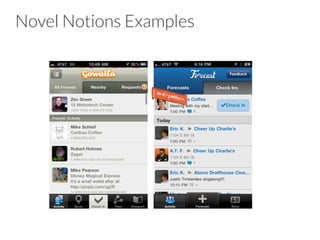
Novel Notions Examples
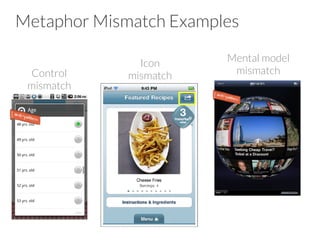
Metaphor Mismatch
•  Consists in picking the wrong metaphor for the interface:
–  Control mismatch
–  Icon mismatch
–  Mental model mismatch
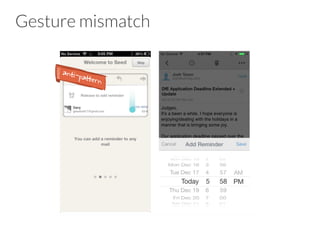
–  Gesture mismatch
Metaphor Mismatch Examples
Control
mismatch
Icon
mismatch
Mental model
mismatch
Gesture mismatch
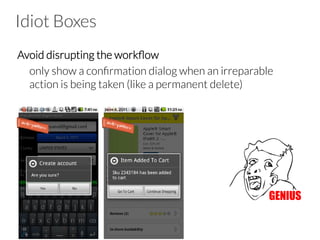
Idiot Boxes
Avoid disrupting the workflow
only show a confirmation dialog when an irreparable
action is being taken (like a permanent delete)
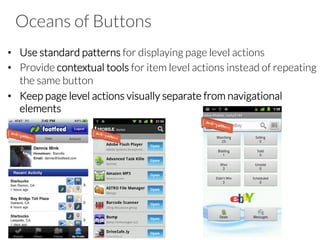
Oceans of Buttons
•  Use standard patterns for displaying page level actions
•  Provide contextual tools for item level actions instead of repeating
the same button
•  Keep page level actions visually separate from navigational
elements
References
•  Screenshots from:
–  www.mobiledesignpatterngallery.com
–  pttrns.com
–  inspired-ui.com
–  mobile-patterns.com
get
inspired!
References
Google material design guidelines
http://www.google.com/design/spec/material-design
Exercises
•  Sketch down the wireframe of two views of your app
•  List for each view the applied design patterns and the
applied design decisions

Design patterns for mobile apps

  • 1.
    Gran Sasso ScienceInstitute Ivano Malavolta Design patterns for mobile apps
  • 2.
    Roadmap Navigation Forms Search, sort &filter Tools Invitations Feedback & Affordance Anti-Patterns
  • 3.
    Navigation •  How usersmove through the views –  Springboard –  Lists (Vertical, Infinite) –  Cards –  Tabs –  Gallery (Grid) –  Dashboard –  Metaphor –  Page Carousel –  Image Carousel –  Expanding Lists –  Infinite Area
  • 4.
    Springboard •  Use agrid layout for items of equal importance, or an irregular layout to emphasize some items more than others •  Consider personalization and customization options
  • 5.
    Lists •  Works wellfor long lists with subtext •  All internal screens should have a way for returning back •  It can be “infinite”, it can have thumbnails
  • 6.
    Cards Definition container that logicallyencapsulates bits of information Good for presenting similar objects whose size or supported actions can vary considerably we can take advantage of animation and movement http://goo.gl/kB8GlW
  • 7.
  • 8.
    Tabs •  Clearly differentiatethe selected tab from the others •  Use easy to recognize icons or icons with labels
  • 9.
    Gallery (Grid) •  Worksbest for frequently updated content that people want to browse
  • 10.
    Metaphor •  Pages aremodeled to reflect the application’s metaphor •  Use the Metaphor pattern judiciously
  • 11.
    Page carousel •  Worksbest for navigating a small number of pages •  Visual indicator to reflect the number of screens, and current screen •  Flick to navigate the carousel
  • 12.
    Image Carousel •  Worksbest for displaying fresh visual content, like articles, products, and photos •  Provide visual affordance, either with arrows, partial images, or page indicators that more content can be accessed
  • 13.
    Expanding Lists •  Worksbest for progressively disclosing more details or options for an object
  • 14.
    Infinite Area •  Theentire data set can be considered to be a large, two- dimensional graphic •  The viewport shows only a small subset of the whole data set
  • 15.
    Can you comparethese navigation designs? Exercise
  • 16.
    Roadmap Navigation Forms Search, sort &filter Tools Invitations Feedback & Affordance Anti-Patterns
  • 17.
    Forms •  They arefor data entry and configuration –  Sign In –  Registration –  Check-in –  Comments –  Users Profile –  Share –  Empty Datasets –  Multi-step –  Settings
  • 18.
    Sign In •  Don’tinnovate on the sign in screen •  Provide a way to retrieve a forgotten password •  Provide a way to login via social networks
  • 19.
    Registration •  Keep itshort, preferably one screen •  Register button well visible
  • 20.
    Check-in •  Keep itultra-short •  Design for speed, and efficiency •  Eliminate unnecessary fields •  Don’t show the map!
  • 21.
    Comments •  Invite userto leave comment •  Always clarify what is being commented •  Show other people’s comments over time
  • 22.
    Timeline •  Within thecurrent hour, show as minutes ago •  Within the current day, show the time as number of hours ago •  Within the last two days, shown the day of the week, and the time range, morning, afternoon, evening, night •  Within the past week, show the day of the week •  Within 12 months, show as mm/DD •  Older than 12 months, show only the year
  • 23.
    Users Profile •  Putthe badges in evidence •  Show their contribution to the social network •  Provide action controls
  • 24.
    Share •  Always keeptrack of past logins •  Always provide an “off social” way to share (e.g., by email) •  Remark what is being shared
  • 25.
    Empty datasets •  Avoidwhite-screens, explain why the dataset is empty •  Call for action, only one! •  Avoid error messages
  • 26.
    Multi Step •  Showthe user where they are and where they can go •  Eliminate unnecessary fields •  Minimize the number of pages and steps
  • 27.
    Settings •  Put theminside the app •  Clear and grouped •  Easy to be understood
  • 28.
    Roadmap Navigation Forms Search, sort &filter Tools Invitations Feedback & Affordance Anti-Patterns
  • 29.
    Search, Sort &Filter •  Search –  Explicit Search –  Dynamic Search –  Search form –  Search Results
  • 30.
    Explicit Search •  Offera clear button in the field •  Provide an option to cancel the search •  Use feedback to show the search is being performed
  • 31.
    Dynamic Search •  Automaticallyfilters a given list of items •  Works well for constrained data sets, like an address book or personal media library
  • 32.
    Search form •  Minimizethe number of input fields •  Follow form design best practices (alignment, labels, size) •  Use only when strictly needed
  • 33.
    Search Results •  Uselive scroll instead of paging •  Apply a reasonable default sort order •  Call for action
  • 34.
    Roadmap Navigation Forms Search, sort &filter Tools Invitations Feedback & Affordance Anti-Patterns
  • 35.
    Tools •  Buttons &Controls –  Toolbar –  Contextual Tools –  Inline Actions –  Call to Action Buttons –  Multi-state Button –  Maps
  • 36.
    Toolbar •  Contain screenlevel actions, they are generally displayed at the bottom of the screen •  Choose icons that are easy to recognize, or use labels plus icons
  • 37.
    Contextual Tools •  Ifbuttons are necessary, they should be displayed in proximity to the actionable object •  Choose a familiar icon or use a text label
  • 38.
    Inline Actions •  Theyshould be in proximity to the actionable object •  Choose a familiar icon or use a text label •  Max 1 to 2 Inline Actions per object
  • 39.
    Call to ActionButtons •  Don’t hide the main call to action in a menu or disguise it as an unrecognizable icon in a toolbar •  Good contrast and clear label
  • 40.
    Multi-state Button •  Multi-StateButtons work well for a series of tightly correlated actions that will to be performed in succession
  • 41.
    Maps •  Provide visiblemarkers (avoiding “terrain-mode”) •  Use as much screen as possible •  Can be small if the location is not the main item
  • 42.
    Roadmap Navigation Forms Search, sort &filter Tools Invitations Feedback & Affordance Anti-Patterns
  • 43.
    Invitations •  Helpful tipsdisplayed the first time a user launches an app –  Dialog –  Tip –  Tour –  Video –  Transparency –  1st Time Through –  Persistent
  • 44.
    Dialog •  Keep dialogcontent short •  make sure there is an alternate way to access instructions from within the application
  • 45.
    Tip •  Place tipsin proximity to the feature they refer to •  keep the content short •  remove the tip once interaction begins
  • 46.
    Tour •  A tourshould highlight key features of the application, preferably from a (user) goal perspective •  Keep it short and visually engaging
  • 47.
    Video •  Demos shouldshowcase key features or show how to use the application •  Common video features (stop, pause, volume controls, etc,...) should be provided
  • 48.
    Transparency •  Transparencies arenot meant to compensate for poor screen designs! •  Remove the Transparency once interaction begins My favourite invitation!
  • 49.
    1st time through • Clearly differentiate the invitation from other content with images or other visual cues
  • 50.
    Persistent •  Keep itshort •  Clearly differentiate the invitation from other content with images or other visual cues
  • 51.
    Roadmap Navigation Forms Search, sort &filter Tools Invitations Feedback & Affordance Anti-Patterns
  • 52.
    Feedback & Affordance • Feedback –  Errors –  Confirmation –  System Status •  Affordance –  Tap –  Flick –  Drag
  • 53.
    Feedback: Errors •  Useplain language that offers a solution for resolving the issue •  make the error visible •  use in-screen messaging instead of modal dialogs
  • 54.
    Feedback: Confirmation •  Provideconfirmation when an action is taken •  don’t break the user’s flow
  • 55.
    Feedback: System Status • Provide feedback about the system’s status •  Offer a cancel option for potentially lengthy operations
  • 56.
    Affordance: Tap •  Usecommon visual design techniques to indicate tappable controls •  Apply 3D effects judiciously
  • 57.
    Affordance: Flick •  Usea page indicator •  show the edge of the next item •  Avoid heavy weight scroll bars
  • 58.
    Affordance: Drag •  Usea recognizable icon for the handle •  Consider using an invitation to let users know this feature is available
  • 59.
    Roadmap Navigation Forms Search, sort &filter Tools Invitations Feedback & Affordance Anti-Patterns
  • 60.
    Anti-Patterns •  Common pitfallsto avoid –  Novel Notions –  Metaphor Mismatch –  Idiot Boxes –  Chart Junk –  Oceans of Buttons
  • 61.
    Novel Notions •  Ifyou are looking for a way to innovate with your application, focus on your core features and offerings, but rely on best practices for the interface design •  If you design a custom control, rigorously test it and refine it to make sure it is usable
  • 62.
  • 63.
  • 64.
    Metaphor Mismatch •  Consistsin picking the wrong metaphor for the interface: –  Control mismatch –  Icon mismatch –  Mental model mismatch –  Gesture mismatch
  • 65.
  • 66.
  • 67.
    Idiot Boxes Avoid disruptingthe workflow only show a confirmation dialog when an irreparable action is being taken (like a permanent delete)
  • 68.
    Oceans of Buttons • Use standard patterns for displaying page level actions •  Provide contextual tools for item level actions instead of repeating the same button •  Keep page level actions visually separate from navigational elements
  • 69.
    References •  Screenshots from: – www.mobiledesignpatterngallery.com –  pttrns.com –  inspired-ui.com –  mobile-patterns.com get inspired!
  • 70.
    References Google material designguidelines http://www.google.com/design/spec/material-design
  • 71.
    Exercises •  Sketch downthe wireframe of two views of your app •  List for each view the applied design patterns and the applied design decisions