ST. MARTIN’S ENGINEERING COLLEGE
An Autonomous Institute
A Non Minority College | Approved by AICTE | Affiliated to JNTUH, Hyderabad | NAAC-
Accredited ‘A+’ Grade | 2(f) & 12(B) status (UGC) ISO 9001:2008 Certified | NBA Accredited |
SIRO (DSIR) | UGC-Paramarsh | Recognized Remote Center of IIT, Bombay
Dhulapally, Secunderabad – 500100
DEPARTMENT OF ELECTRONICS AND COMMUNICATION
PROJECT NAME: Design Of Wireless Sensor Network
For Building Management Systems
GUIDE NAME: Mr. G. Upender
M. Tech., (Ph.D)
By N. PREM KUMAR -16K81A0438
T. SRIYA SHARMA -16K81A0458
YOUNESH JAYARAMAN -16K81A0460
Abstract
The main goal of the project is to develop a wireless sensor network that collects
the information from a set of sensors and forwards information to the remote
server. The data on the server will be processed by the software, and display over
the android app. This work describes a method of creating a wireless sensor
network.
INDEX
• Introduction
• Existing and Proposed systems
• Block Diagram
• Hardware & Software Components
• Schematic Diagram
• Advantages
• Applications
• Result
• Conclusion
• Future Scope
Introduction
• Building management system (BMS) also known as building automation
system (BAS) refers to a computer-based control system that needs to be
installed within buildings.
• Monitors temperature, pressure, humidity occupancy and flow rates are
key functions of modern building control systems.
• The primary purpose of this system is to achieve an optimal level of
control of occupant comfort while minimizing energy use.
• A BMS has to be properly installed and commissioned for optimal
operation and to realize potential savings.
Existing and Proposed Systems
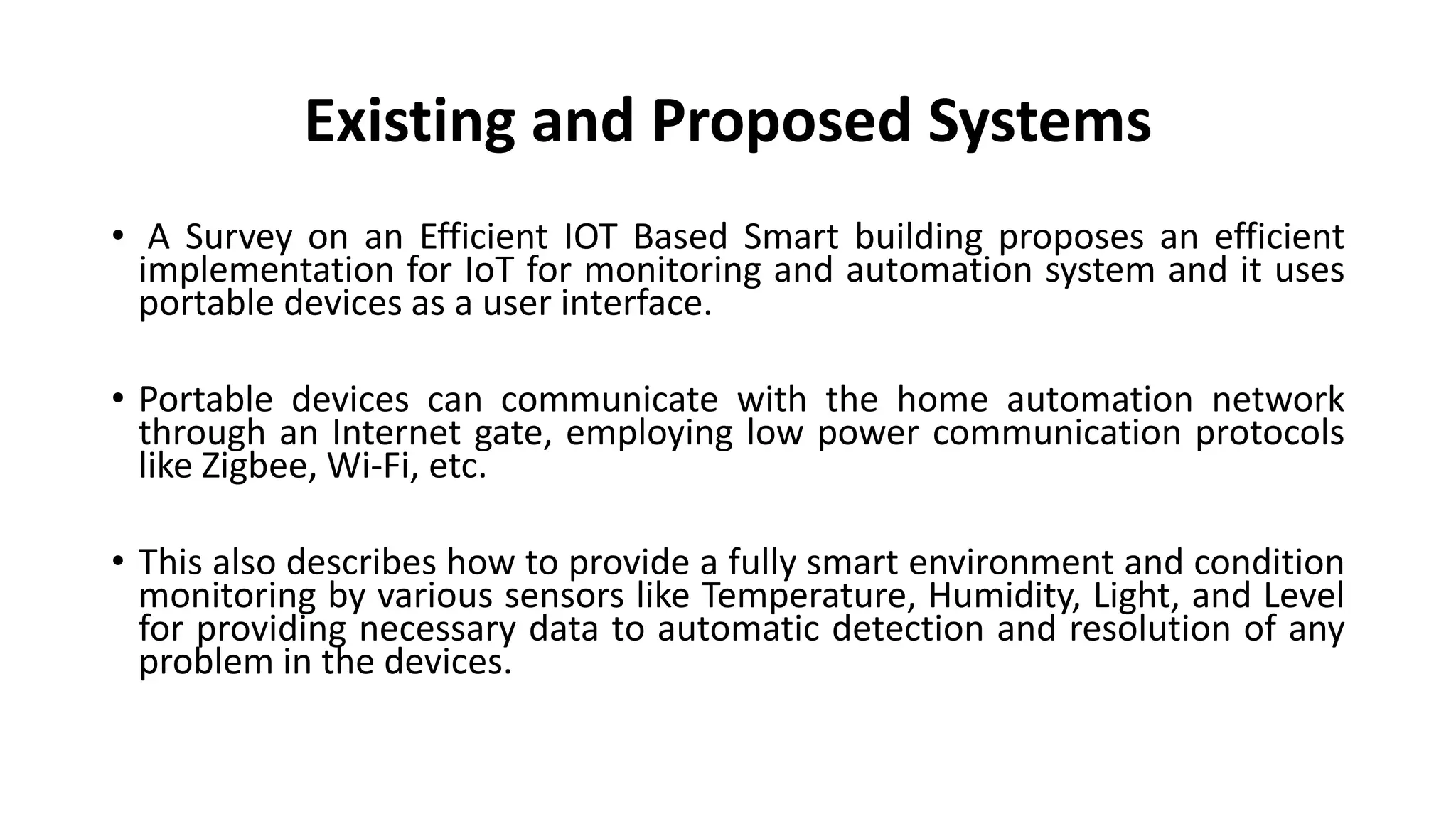
• A Survey on an Efficient IOT Based Smart building proposes an efficient
implementation for IoT for monitoring and automation system and it uses
portable devices as a user interface.
• Portable devices can communicate with the home automation network
through an Internet gate, employing low power communication protocols
like Zigbee, Wi-Fi, etc.
• This also describes how to provide a fully smart environment and condition
monitoring by various sensors like Temperature, Humidity, Light, and Level
for providing necessary data to automatic detection and resolution of any
problem in the devices.
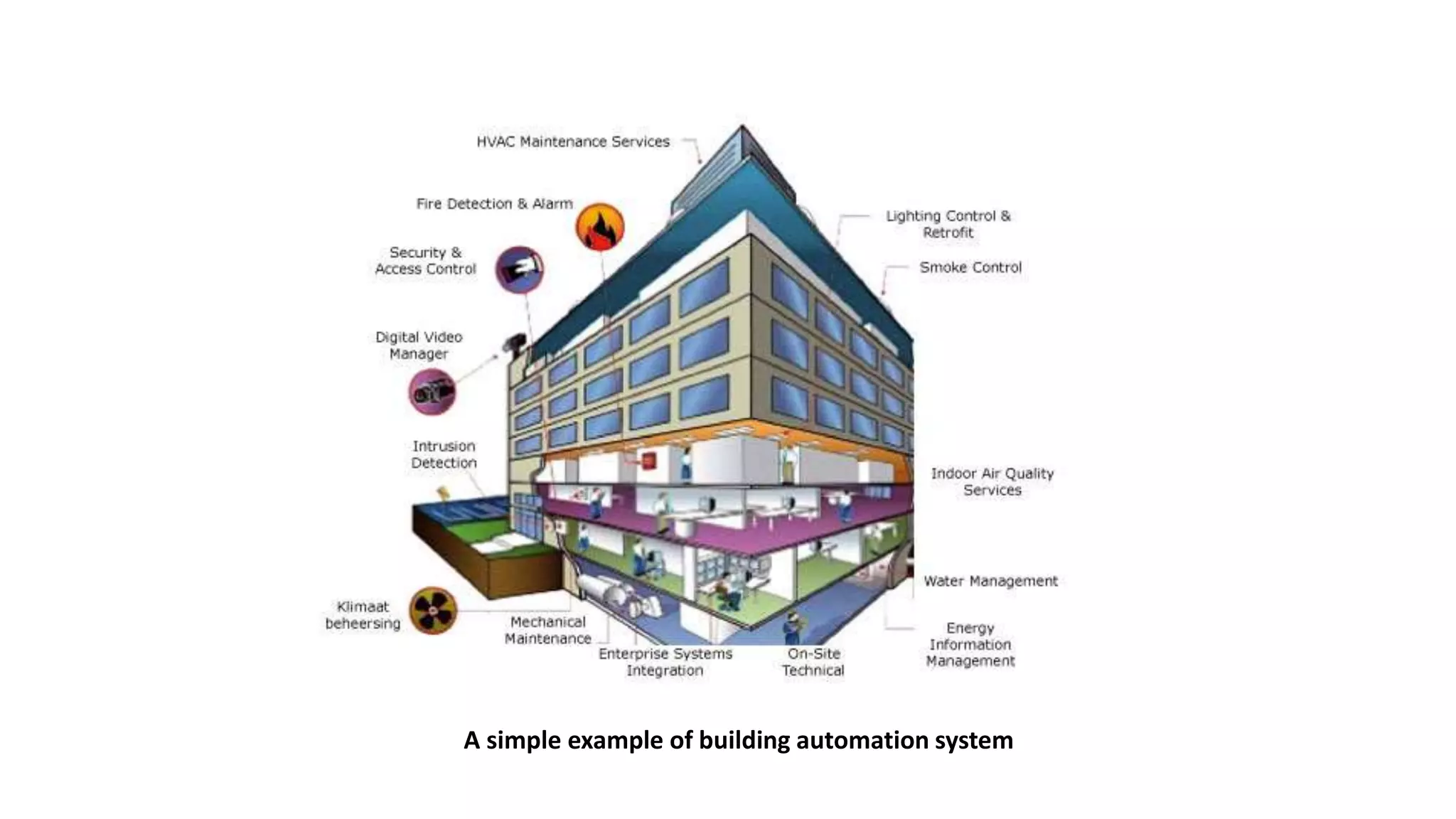
A simple example of building automation system
Block Diagram
• Main section
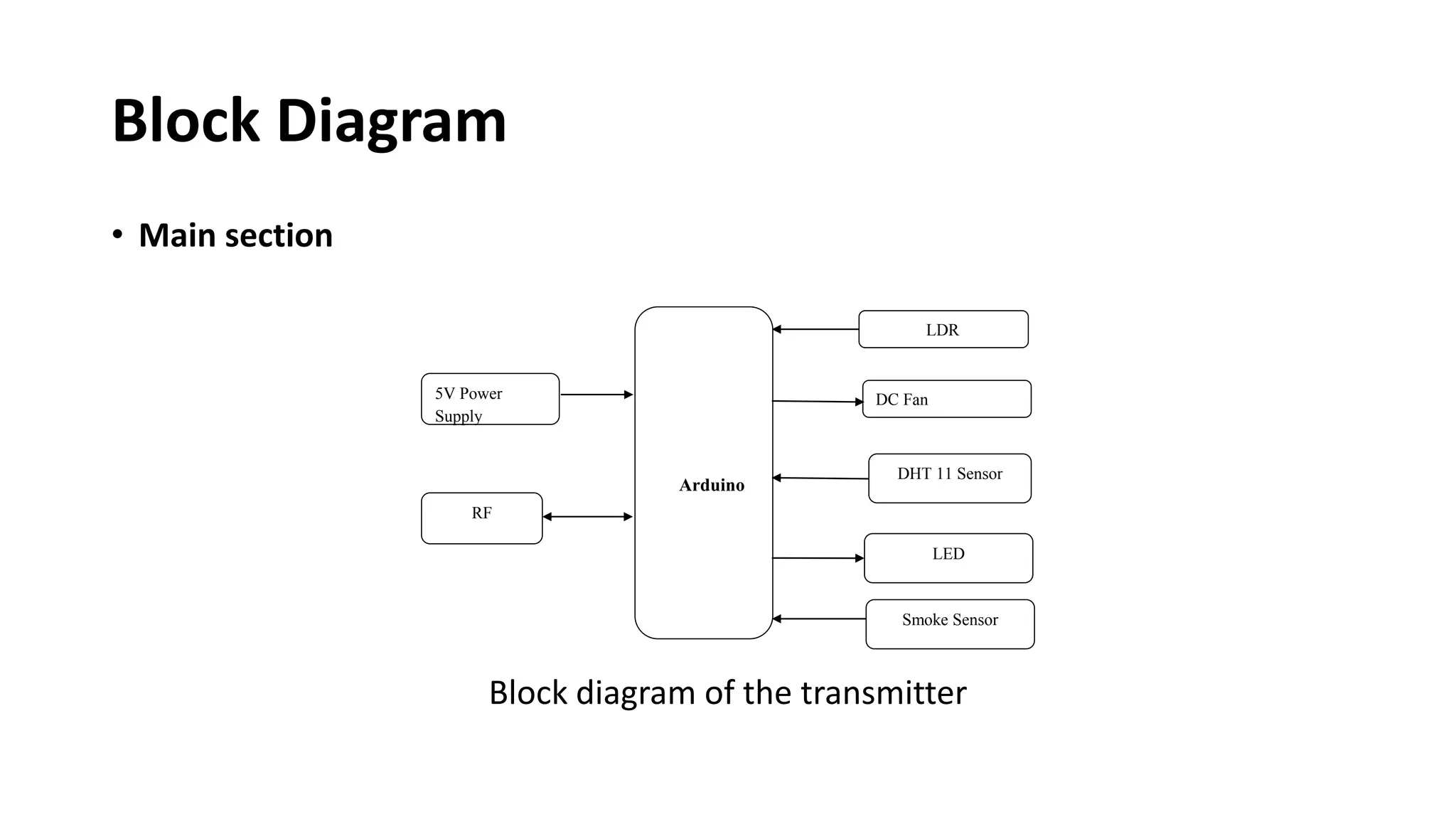
Block diagram of the transmitter
5V Power
Supply
RF
Arduino
DHT 11 Sensor
DC Fan
LED
LDR
Smoke Sensor
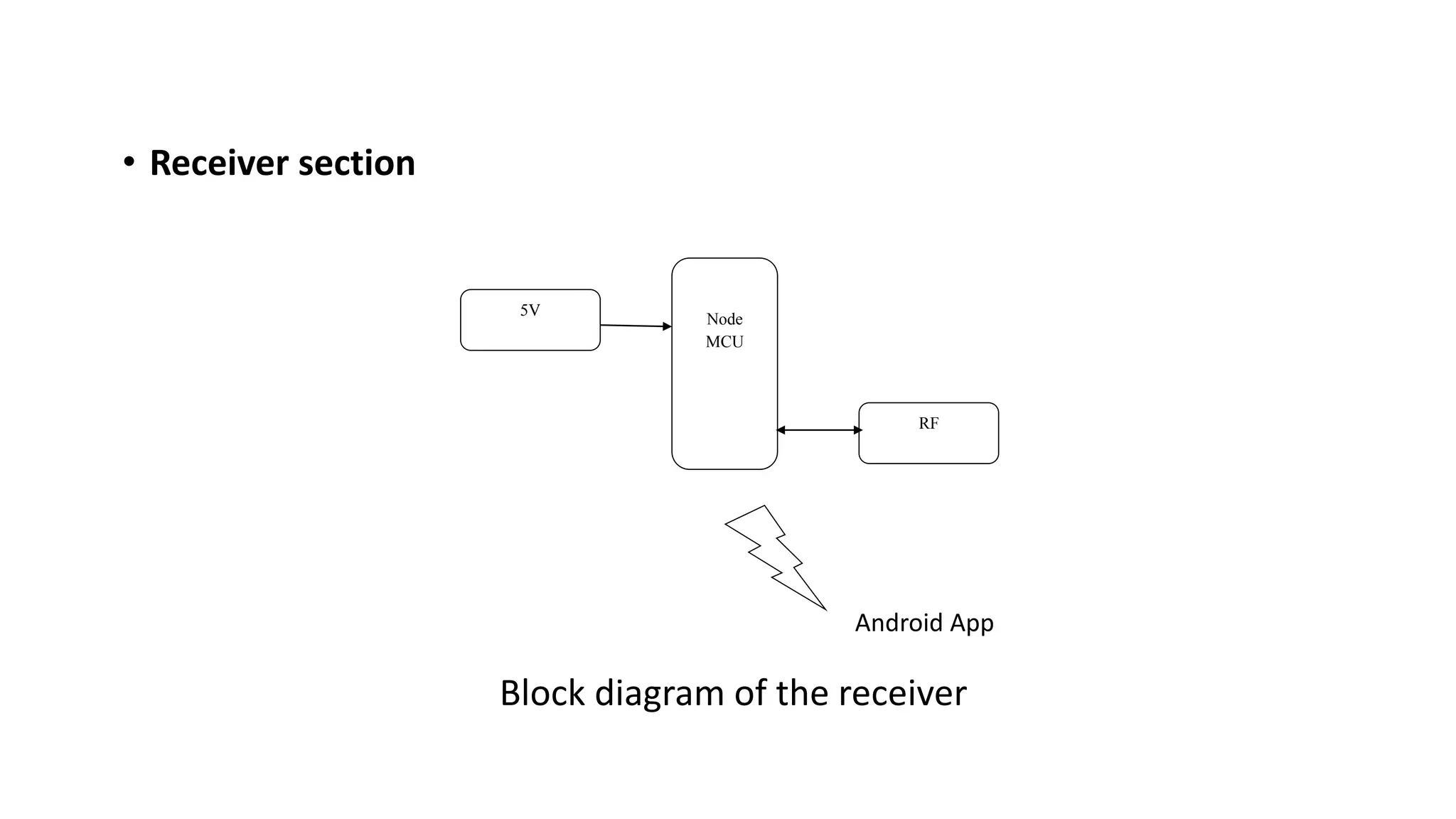
• Receiver section
Block diagram of the receiver
5V
Node
MCU
RF
Android App
Hardware Components
1. Arduino Nano
2. Power Supply
3. LDR
4. DC Fan
5. DHT 11 Sensor
6. LED
7. Smoke Sensor
8. Node MCU
9. RF Module
Software Components
1. Arduino IDE compiler
2. MIT app inventor
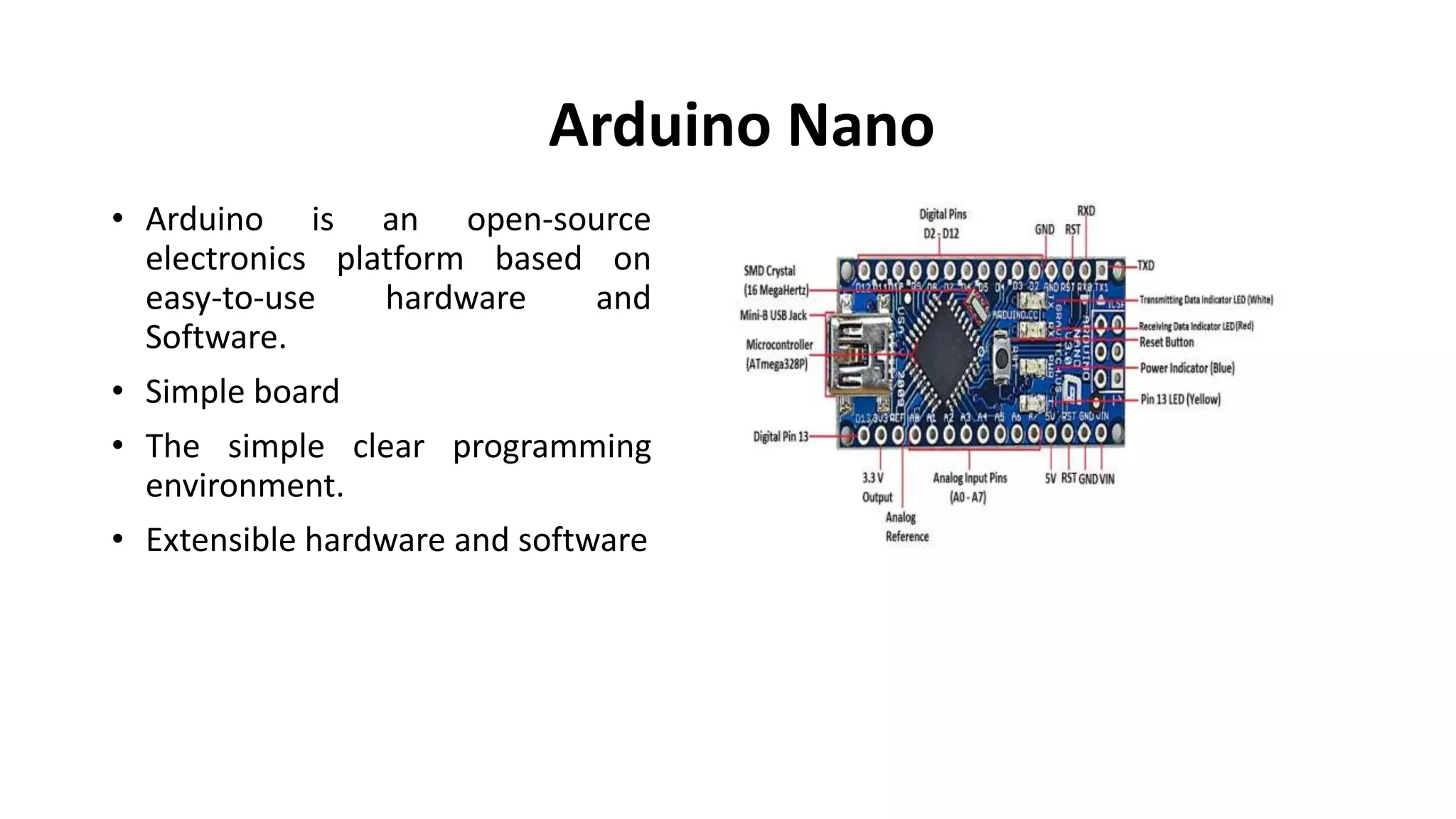
Arduino Nano
• Arduino is an open-source
electronics platform based on
easy-to-use hardware and
Software.
• Simple board
• The simple clear programming
environment.
• Extensible hardware and software
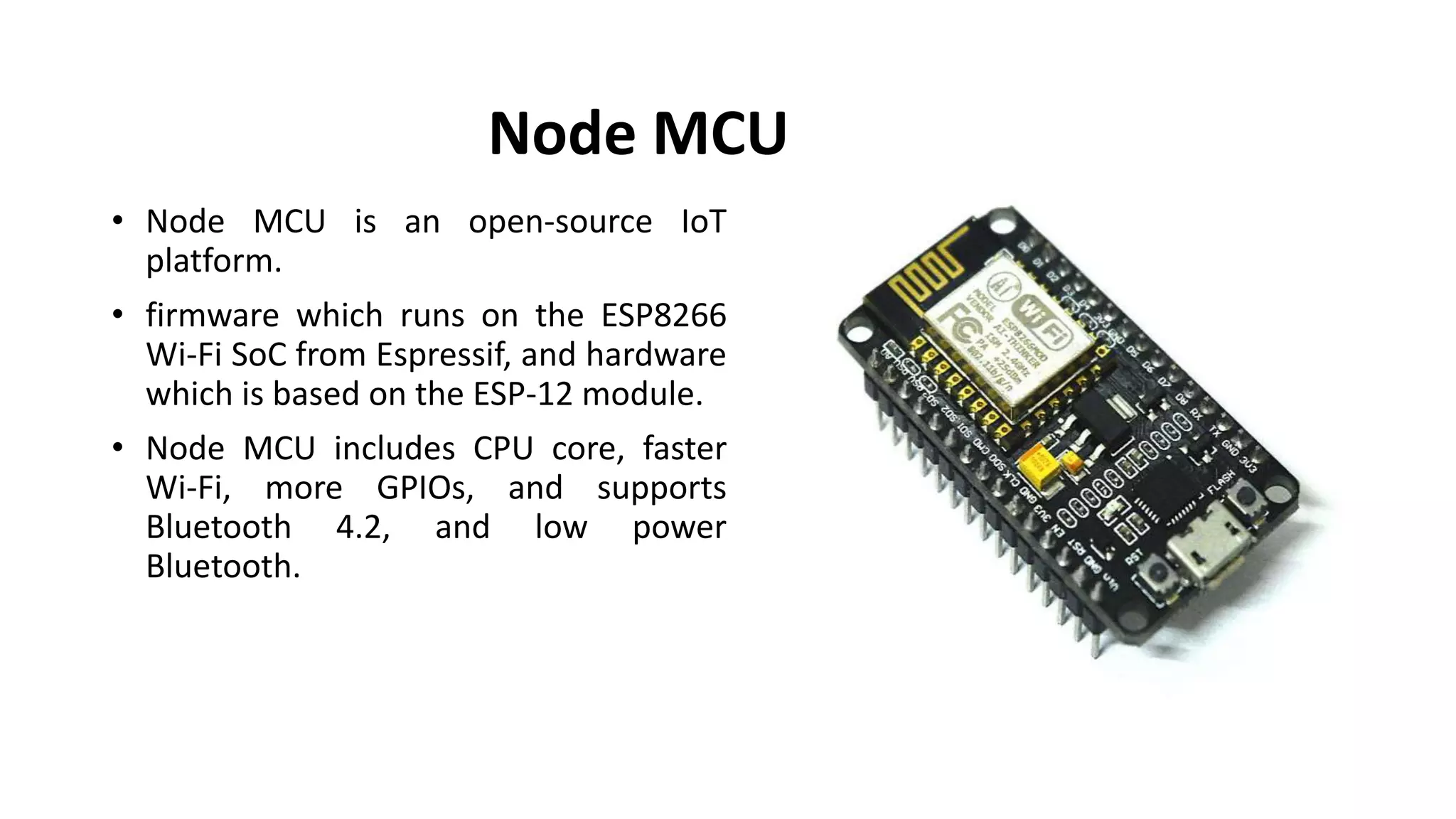
Node MCU
• Node MCU is an open-source IoT
platform.
• firmware which runs on the ESP8266
Wi-Fi SoC from Espressif, and hardware
which is based on the ESP-12 module.
• Node MCU includes CPU core, faster
Wi-Fi, more GPIOs, and supports
Bluetooth 4.2, and low power
Bluetooth.
Comparison of microcontrollers
RF Module
• An RF module is a small size
electronic device, that is used to
transmit or receive radio signals
between two devices.
• The main application of the RF
module is an embedded system to
communicate with another device
wirelessly.
• Main requirements for RF
communication are RF transmitter
and RF receiver
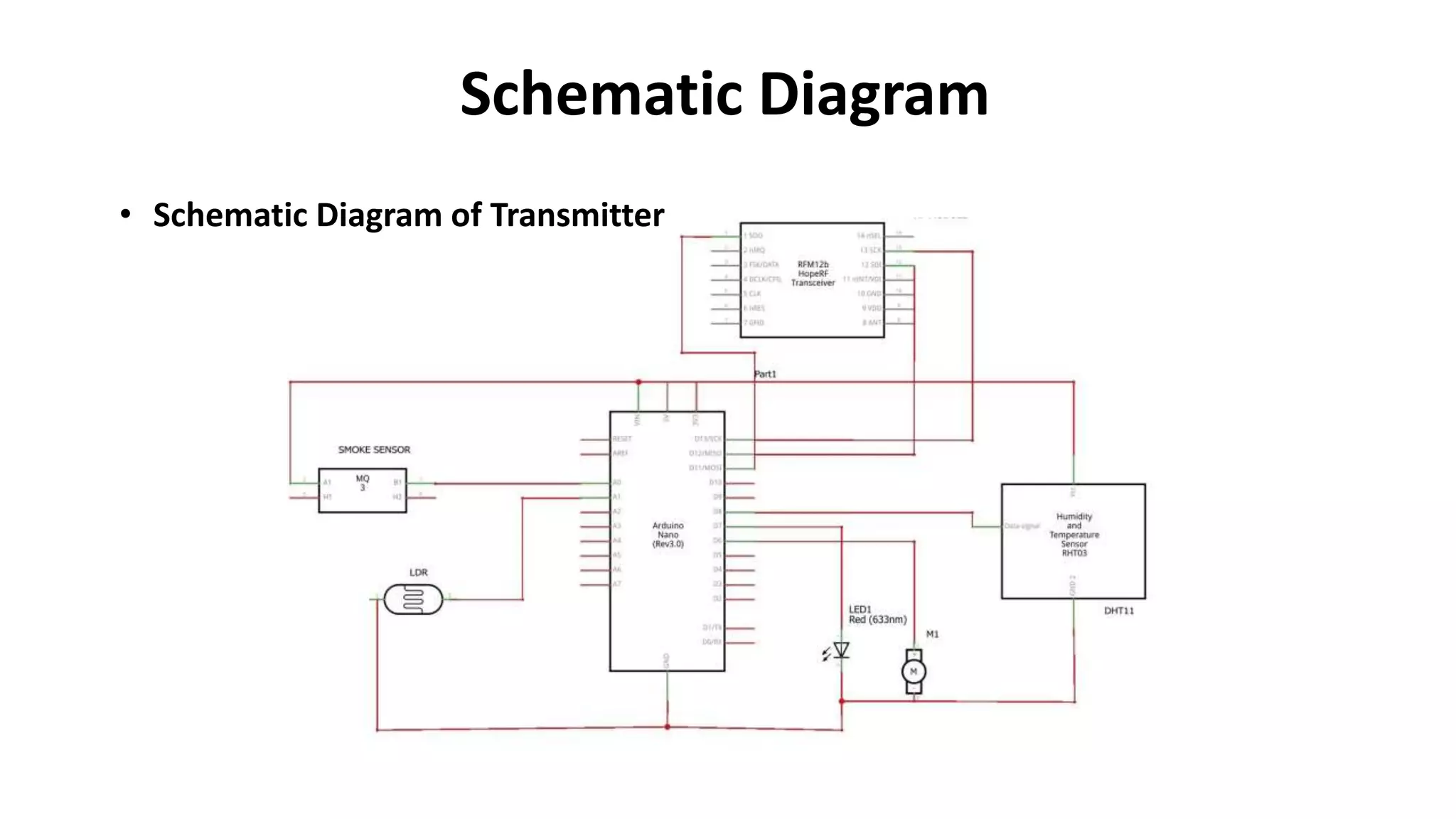
Schematic Diagram
• Schematic Diagram of Transmitter
• Schematic Diagram of Receiver
Advantages
• Fewer electricity bills:
As the amount of energy being consumed is reduced, the amount of electricity
associated with that energy consumed will also be decreased.
• Easy Installation:
Adding a WSN to an existing building can lead to a double-digit percentage
decrease in operating costs over a period of years. Not only do energy costs decline
significantly, but wiring costs and hassles become a thing of the past.
• Safety and Security:
Safety and security are the other benefits of a wireless sensor network. Wireless
sensor network systems are incredible in security, thereby ensuring the safety of
the people residing in the building.
• Comfort:
By more closely monitoring temperature, humidity, and ventilation, environmental
control helps improve comfort level depending on the number of people involved.
One study indicated a 3% increase in employee productivity when optimizing the
comfort level.
Applications
• Fire/Smoke Detection and Alarm:
In hazardous situations such as fires, deployment of wireless sensors could provide
more information about the conditions within and around a building for first
responders.
• Energy Information Management:
An energy management information system (EMIS) is a performance management
system that enables individuals and organizations to plan, make decisions and take
effective actions to manage energy use and costs.
• Flood Management Assistance:
Sensors collect data from multiple sources such as rain gutters, sewer systems and
pump stations, to monitor fluctuations in water levels and water quality. If an alert
triggers, having a network camera in proximity to visually verify the situation helps
responders determine the best course of action.
• Lighting systems:
Smart lighting is to cover the automation of lamp responses, such as dimming or
on/off control to enhance user comfort and save energy. An ambient light sensor
(ALS) can be used to detect the amount of natural light available, allowing
a lamp's output to be adjusted accordingly.
Result
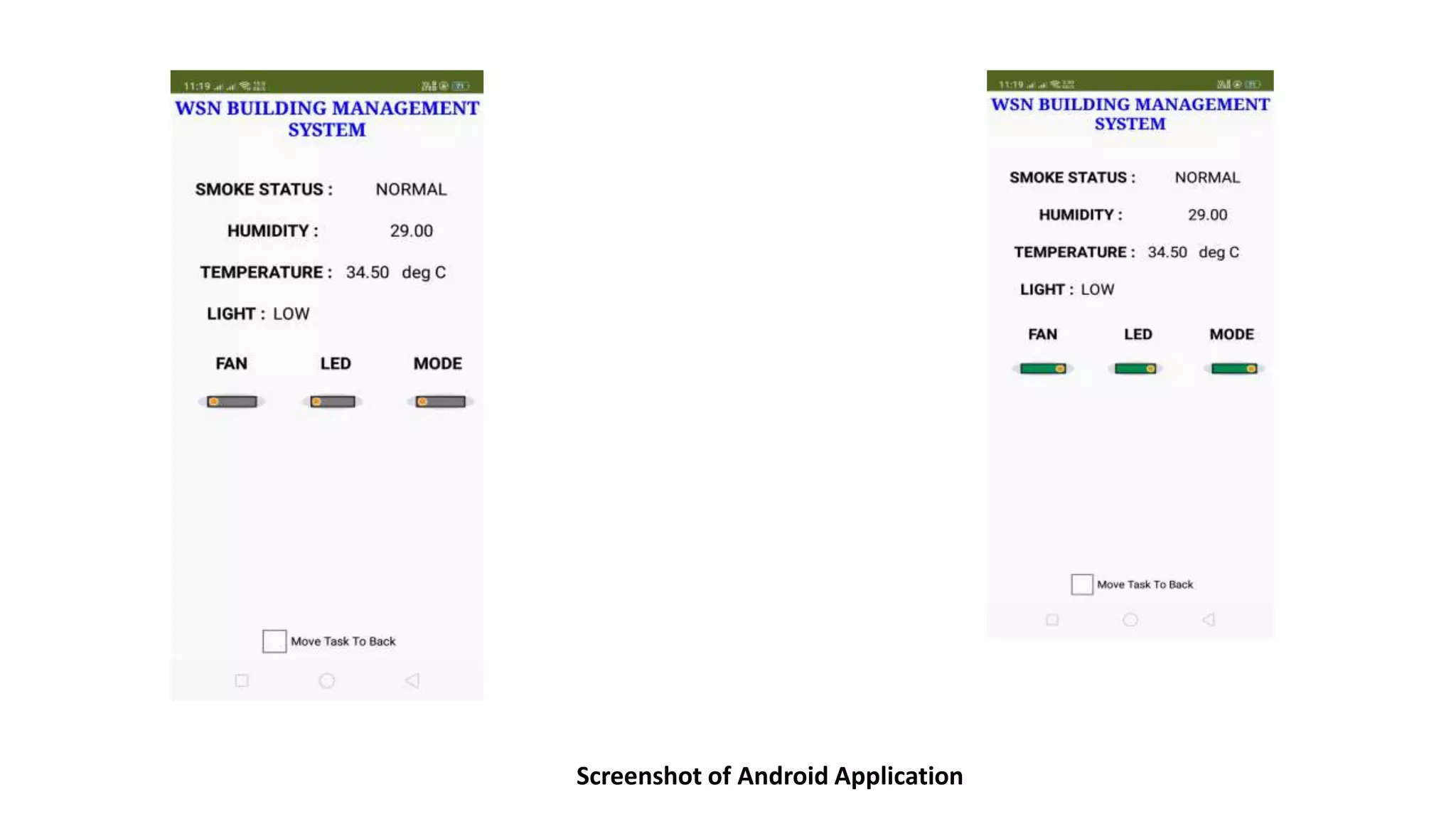
Change in the mode of Fan and Light
Screenshot of Android Application
Conclusion
• This project demonstrated how wireless sensors and actuators can be integrated
into the existing Building Management System framework. provided battery life
extended into multiple years, meaning that these networks will have to be
rigorously energy efficient.
• Our results are preliminary and further experimentation is required to
successfully validate our hypothesis of the benefit of using an ad hoc multiple
sensor architecture that provides a benefit of higher energy conservation and
added thermal comfort.
Future Scope
• It is important that any further work in developing the technology core in the
field of sensor networks is done keeping in mind the potential users of these
networks, and what their needs are. This project is based on Wi-Fi but can be
further continued by adding advanced technologies like Zigbee and GSM.

Thank You

Design of wireless sensor network for building management systems

  • 1.
    ST. MARTIN’S ENGINEERINGCOLLEGE An Autonomous Institute A Non Minority College | Approved by AICTE | Affiliated to JNTUH, Hyderabad | NAAC- Accredited ‘A+’ Grade | 2(f) & 12(B) status (UGC) ISO 9001:2008 Certified | NBA Accredited | SIRO (DSIR) | UGC-Paramarsh | Recognized Remote Center of IIT, Bombay Dhulapally, Secunderabad – 500100 DEPARTMENT OF ELECTRONICS AND COMMUNICATION PROJECT NAME: Design Of Wireless Sensor Network For Building Management Systems GUIDE NAME: Mr. G. Upender M. Tech., (Ph.D) By N. PREM KUMAR -16K81A0438 T. SRIYA SHARMA -16K81A0458 YOUNESH JAYARAMAN -16K81A0460
  • 2.
    Abstract The main goalof the project is to develop a wireless sensor network that collects the information from a set of sensors and forwards information to the remote server. The data on the server will be processed by the software, and display over the android app. This work describes a method of creating a wireless sensor network.
  • 3.
    INDEX • Introduction • Existingand Proposed systems • Block Diagram • Hardware & Software Components • Schematic Diagram • Advantages • Applications • Result • Conclusion • Future Scope
  • 4.
    Introduction • Building managementsystem (BMS) also known as building automation system (BAS) refers to a computer-based control system that needs to be installed within buildings. • Monitors temperature, pressure, humidity occupancy and flow rates are key functions of modern building control systems. • The primary purpose of this system is to achieve an optimal level of control of occupant comfort while minimizing energy use. • A BMS has to be properly installed and commissioned for optimal operation and to realize potential savings.
  • 5.
    Existing and ProposedSystems • A Survey on an Efficient IOT Based Smart building proposes an efficient implementation for IoT for monitoring and automation system and it uses portable devices as a user interface. • Portable devices can communicate with the home automation network through an Internet gate, employing low power communication protocols like Zigbee, Wi-Fi, etc. • This also describes how to provide a fully smart environment and condition monitoring by various sensors like Temperature, Humidity, Light, and Level for providing necessary data to automatic detection and resolution of any problem in the devices.
  • 6.
    A simple exampleof building automation system
  • 7.
    Block Diagram • Mainsection Block diagram of the transmitter 5V Power Supply RF Arduino DHT 11 Sensor DC Fan LED LDR Smoke Sensor
  • 8.
    • Receiver section Blockdiagram of the receiver 5V Node MCU RF Android App
  • 9.
    Hardware Components 1. ArduinoNano 2. Power Supply 3. LDR 4. DC Fan 5. DHT 11 Sensor 6. LED 7. Smoke Sensor 8. Node MCU 9. RF Module Software Components 1. Arduino IDE compiler 2. MIT app inventor
  • 10.
    Arduino Nano • Arduinois an open-source electronics platform based on easy-to-use hardware and Software. • Simple board • The simple clear programming environment. • Extensible hardware and software
  • 11.
    Node MCU • NodeMCU is an open-source IoT platform. • firmware which runs on the ESP8266 Wi-Fi SoC from Espressif, and hardware which is based on the ESP-12 module. • Node MCU includes CPU core, faster Wi-Fi, more GPIOs, and supports Bluetooth 4.2, and low power Bluetooth.
  • 12.
  • 13.
    RF Module • AnRF module is a small size electronic device, that is used to transmit or receive radio signals between two devices. • The main application of the RF module is an embedded system to communicate with another device wirelessly. • Main requirements for RF communication are RF transmitter and RF receiver
  • 14.
    Schematic Diagram • SchematicDiagram of Transmitter
  • 15.
  • 16.
    Advantages • Fewer electricitybills: As the amount of energy being consumed is reduced, the amount of electricity associated with that energy consumed will also be decreased. • Easy Installation: Adding a WSN to an existing building can lead to a double-digit percentage decrease in operating costs over a period of years. Not only do energy costs decline significantly, but wiring costs and hassles become a thing of the past.
  • 17.
    • Safety andSecurity: Safety and security are the other benefits of a wireless sensor network. Wireless sensor network systems are incredible in security, thereby ensuring the safety of the people residing in the building. • Comfort: By more closely monitoring temperature, humidity, and ventilation, environmental control helps improve comfort level depending on the number of people involved. One study indicated a 3% increase in employee productivity when optimizing the comfort level.
  • 18.
    Applications • Fire/Smoke Detectionand Alarm: In hazardous situations such as fires, deployment of wireless sensors could provide more information about the conditions within and around a building for first responders. • Energy Information Management: An energy management information system (EMIS) is a performance management system that enables individuals and organizations to plan, make decisions and take effective actions to manage energy use and costs.
  • 19.
    • Flood ManagementAssistance: Sensors collect data from multiple sources such as rain gutters, sewer systems and pump stations, to monitor fluctuations in water levels and water quality. If an alert triggers, having a network camera in proximity to visually verify the situation helps responders determine the best course of action. • Lighting systems: Smart lighting is to cover the automation of lamp responses, such as dimming or on/off control to enhance user comfort and save energy. An ambient light sensor (ALS) can be used to detect the amount of natural light available, allowing a lamp's output to be adjusted accordingly.
  • 20.
    Result Change in themode of Fan and Light
  • 21.
  • 22.
    Conclusion • This projectdemonstrated how wireless sensors and actuators can be integrated into the existing Building Management System framework. provided battery life extended into multiple years, meaning that these networks will have to be rigorously energy efficient. • Our results are preliminary and further experimentation is required to successfully validate our hypothesis of the benefit of using an ad hoc multiple sensor architecture that provides a benefit of higher energy conservation and added thermal comfort.
  • 23.
    Future Scope • Itis important that any further work in developing the technology core in the field of sensor networks is done keeping in mind the potential users of these networks, and what their needs are. This project is based on Wi-Fi but can be further continued by adding advanced technologies like Zigbee and GSM.

  • 24.