ASMARTHOME WITHENERGYCONSUMPTIONAND
FLOODALERTSECURITYSYSTEM
CONTENTS
• OBJECTIVE
• ABSTRACT
• INTRODUCTION
• BLOCK DIAGRAM
• EXISTING SYSTEM
• DISADVANTAGES
• LITERATURE SURVEY
• PROPOSED SYSTEM
• MATERIAL USED
• ADVANTAGES
• CONCLUSION
OBJECTIVE
• To develop a stochastic solar generation vehicle model
• To measure the charging station's utility as well as EVs'
charging requirements.
ABSTRACT
• Today, the security system field is a very important area in smart cities,
offices, and homes. Security of the house and the family is important for
everybody. Likewise, smart systems can provide Internet of Things (IoT).
The IoT can be applied in smart cities in order to give various benefits that
enhance citizens.
• The use of IoT will enhance some security level as well as it will help in
accessing and controlling the system remotely.
• Nowadays home and building automation systems are used more and more.
On the one hand, they provide increased comfort especially when employed
in a private home.
• Wireless based systems, used every day and everywhere, ranges from
wireless home networks and mobile phones to garage door openers.
INTRODUCTION
• The electric power systems have undergone significant changes in the
last few years, owing to the introduction of new business formats as
in the electrical power distribution system
• Smart lighting is used for energy saving which can be achieved by
adapting lighting to the ambient conditions and by switching on/off
or dimming of lights according to user needs thus reducing the
unnecessary use of energy.
• Saving energy also helps in reducing cost.
• Electric energy consumption is the form of energy consumption that
uses electric energy. Electric energy consumption is the actual energy
demand made on existing electricity supply.
EXISTING SYSTEM
 GSM based wireless home security system, which take a very less
power.
 The system can response rapidly as intruder detect and GSM module
will do alert home owner.
 This security system for alerting a house owner wherever he will. In
this system a relay and magnet installed at entry point to precedence
produce a signal through a public telecom network and sends a
message or redirect a call that that tells about your home update or
predefined message which is embedded in microcontroller.
 Suspected activities are conveyed to remote user through SMS or
Call using GSM technology.
DISADVANTAGES
• The disadvantage of this framework was that GSM has a
settled greatest cell site scope of 35km which is forced by
various cases.
• Moreover the rancher needs to be upgraded the whole complex
AT charges, lastly soil parameters in regards to manures and
plant ailments are not joined in the framework.
LITERATURE SURVEY
Major requirements for building Smart Homes in
Smart Cities based on Internet of Things
technologies
Method
• Smart Home is the major building block for Smart Cities
• Home Automation (HA) possible when personal computers
started invading home spaces
Advantages
• Smart Home adoption rate is still low
• Saving energy through smart home
Disadvantages
• Intelligent homes are critical in a Human-centric technology
Energy Harvesting for Wireless Sensor Networks
Review
Method
• Alternative energy sources has been demonstrated in order to
address the feasibility of their integration with wireless sensor
networks.
Advantages
• It increase the probability of having uninterruptible power
supply
• Some fluctuation of energy
Disadvantages
• Limited by the batteries Capacity
• Low energy levels.
Energy-efficient data collection in wireless
sensor networks with time constraints
Method
• Minimize the energy that the sensors use to transmit their
measurements.
Advantages
• Minimum energy consumption for the sensors.
• The energy consumption of a sensor is an increasing function
of the distance between this sensor and the sink.
Disadvantages
• Sensor has a noisy measurement
• The sink has a limited, predefined time windows
Wireless Sensor Networks With Energy
Harvesting
Method
• Wireless Sensor Networks have played a major role in the
research field of multi-hop wireless networks as enablers of
applications ranging from environmental and structural
monitoring
Advantages
• High Energy efficiency
• Slow down the depletion of battery energy, which include
power control
Disadvantages
• The replacement/recharging operation is slow and expensive,
and decreases network performance.
On the Design of a Solar-Panel Receiver for
Optical Wireless Communications With
Simultaneous Energy Harvesting
Method
• An optical wireless communications (OWC) receiver using a
solar panel as a photodetector.
Advantages
• High data transmission and energy harvesting.
• Maximize the receiver SNR.
Disadvantages
• Low performance
• Non linear distortion occurs.
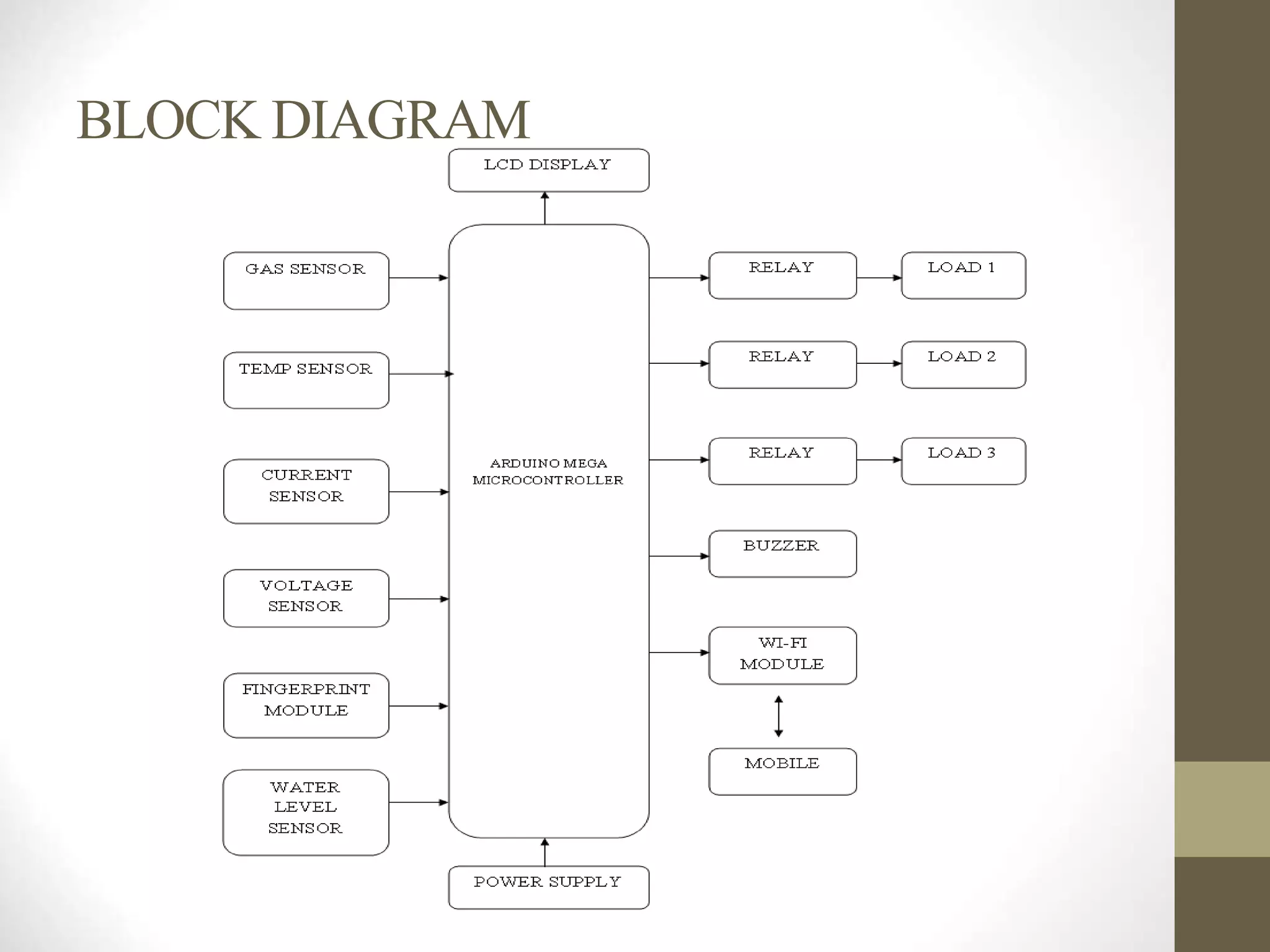
BLOCK DIAGRAM
BLOCK DIAGRAM DESCRIPTION
• In this we use Arduino microcontroller for controlling the whole process of
this project.
• Wi-Fi module is used for controlling the home appliances wirelessly.
Temperature sensor is used to find the Temperature of the indoor
environment.
• Gas sensor is used to sense any gas leakage in the home. Water level sensor
is used to detect flood level outdoor of the home. The power supply unit is
given to the circuit for supply input voltage of 12v.
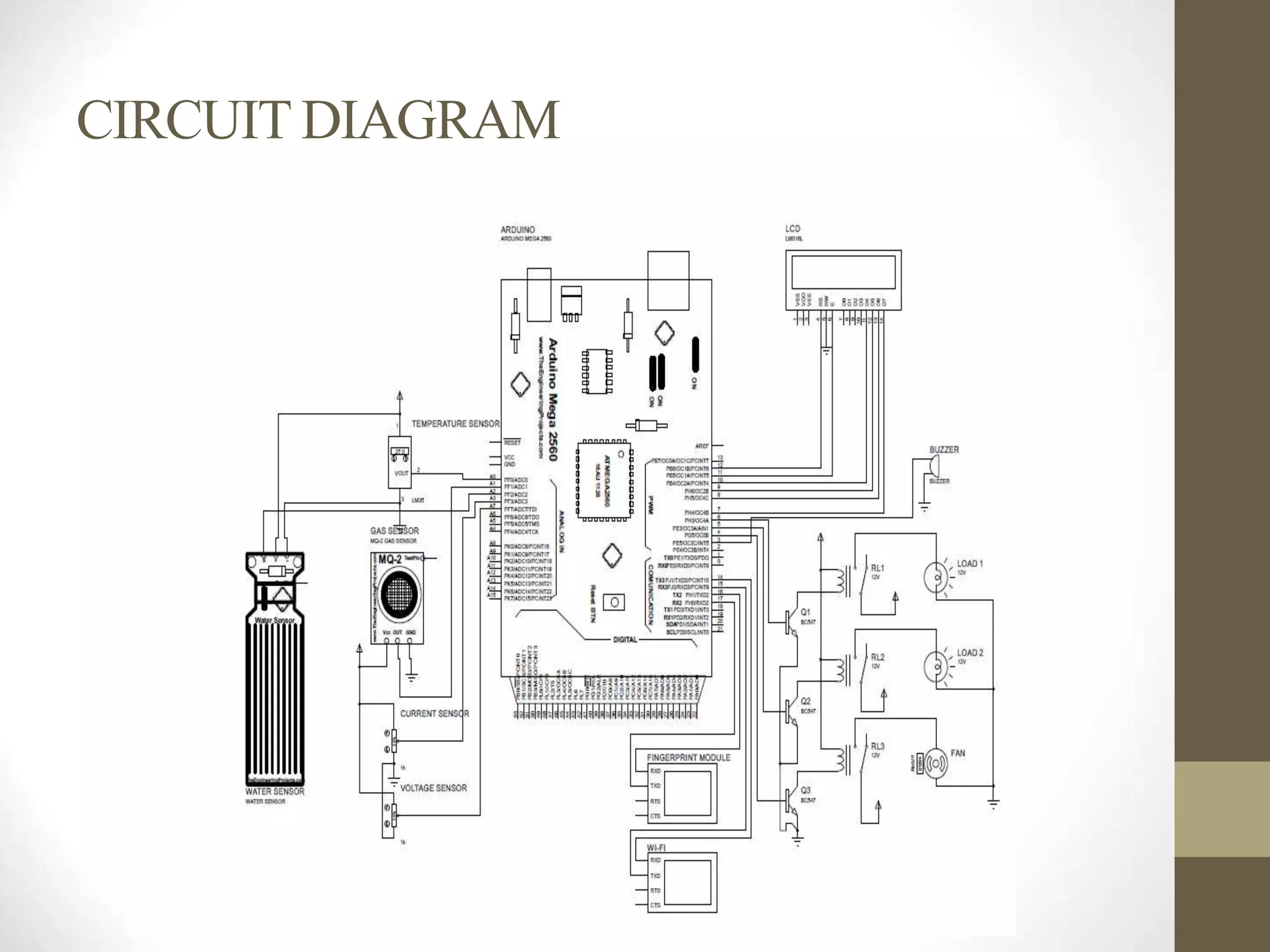
• Home automation system consists of Arduino microcontroller, Wi-Fi module,
Gas sensor, water level sensor, current sensor, voltage sensor, LCD-display,
lamp, power supply unit, Android mobile and temperature sensor.
Components are interfaced with Arduino microcontroller.
CIRCUIT DIAGRAM
PROPOSED SYSTEM
• In this home automation and security system implement with the help of
direct Wi-Fi (Wireless Federation), this is WLAN 802.11 standard. The
main advantage of this system is that it can be implemented with a wider
range of not more than 200 meters. It allows communicating with a brief
and small setup without wired connection.
• On the one hand, they provide increased comfort especially when employed
in a private home. On the other hand, automation systems installed in
commercial buildings do not only increase comfort, but also allow
centralized control of heating, ventilation, air condition and lighting.
• Hence, they contribute to an overall cost reduction and also to energy saving
which is certainly a main issue today.
• Employing a traditional wired automation system does not pose a problem
as long as the system is planned before and installed during the physical
ADVANTAGES
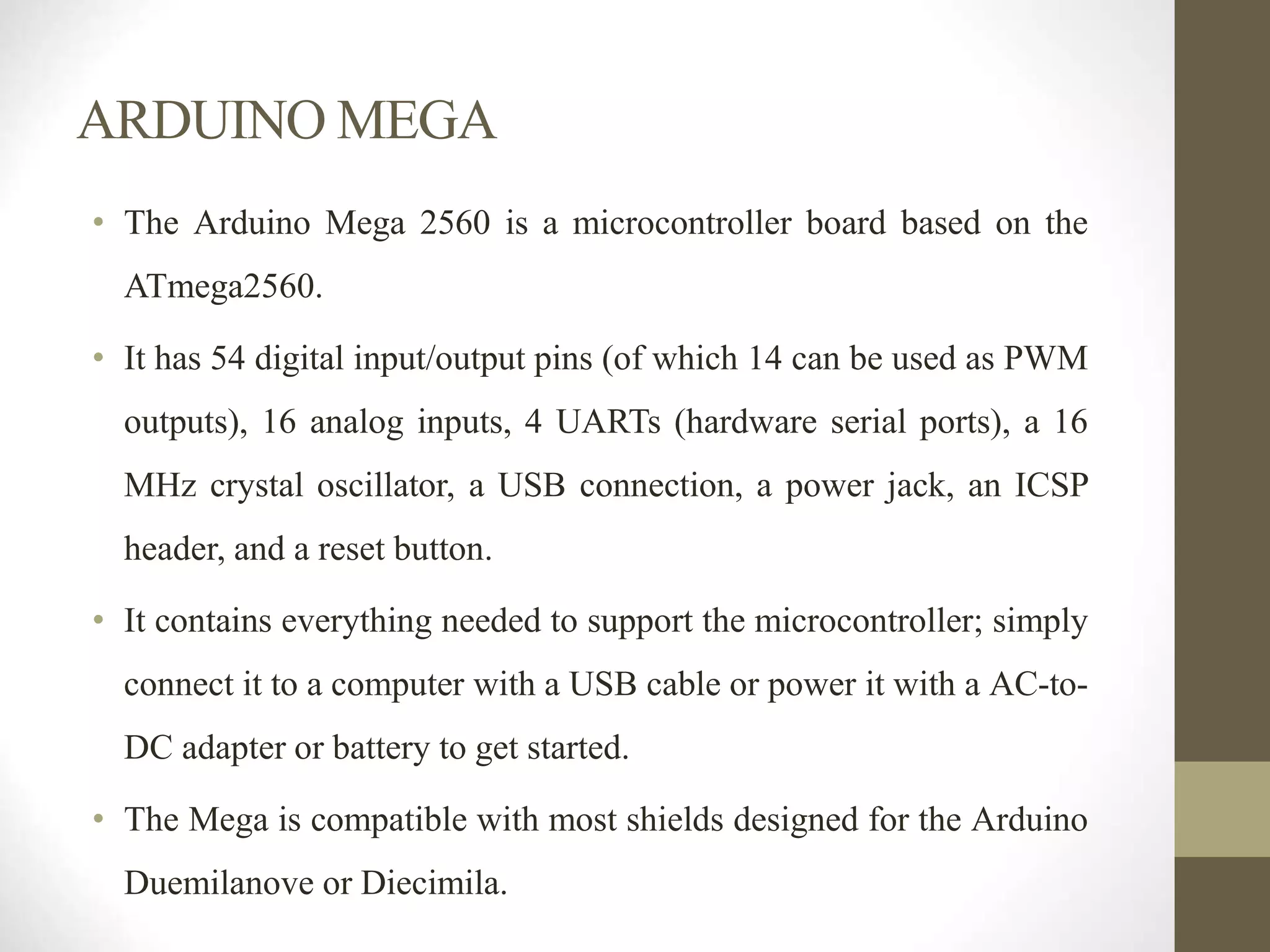
• Operating electricity costs are reduced.
• An improved wireless energy transfer system that reduces
energy losses.
• Easy to maintain and is less complicated in hardware
architecture
MATERIALUSED
ARDUINO MEGA
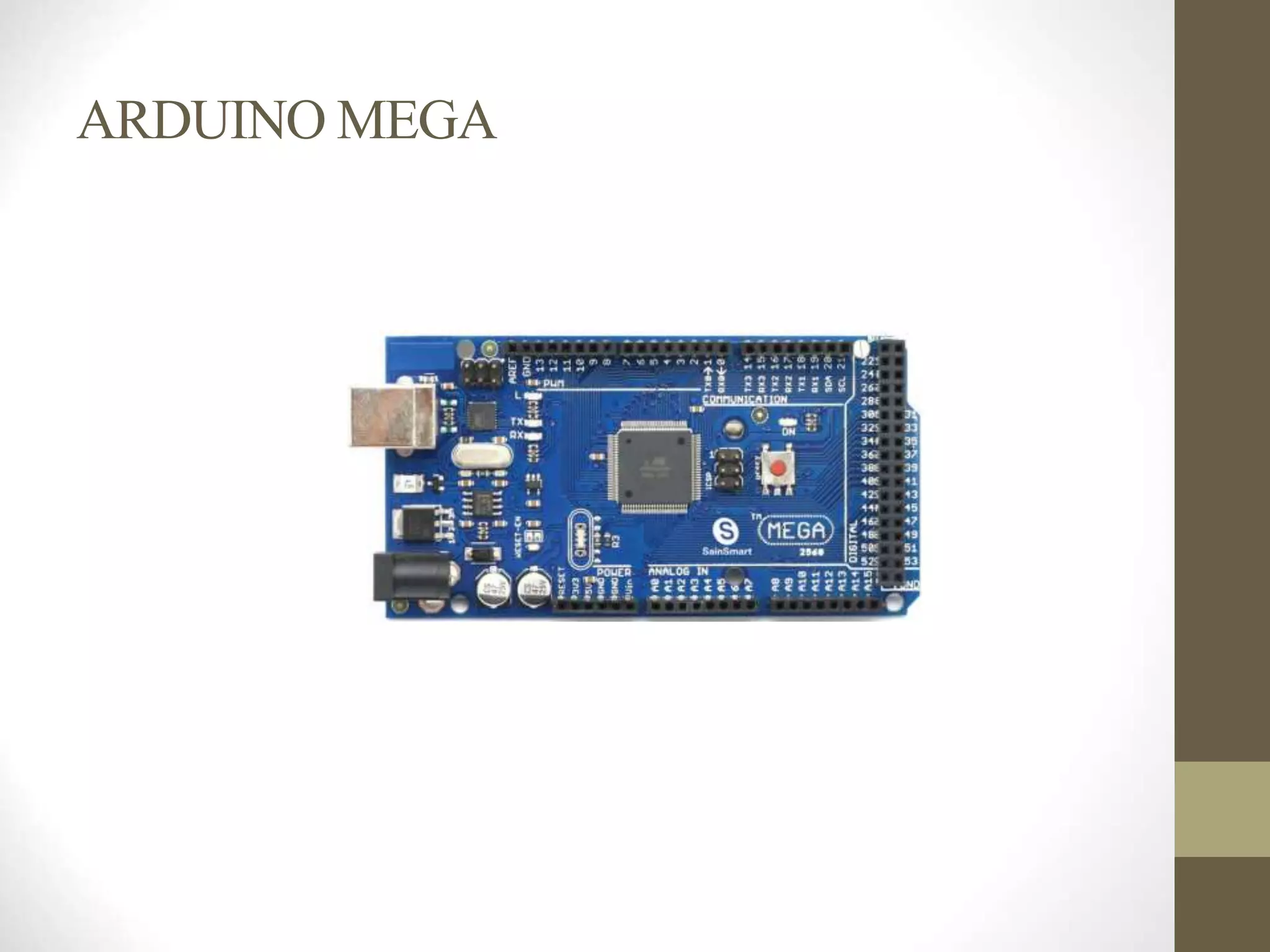
• The Arduino Mega 2560 is a microcontroller board based on the
ATmega2560.
• It has 54 digital input/output pins (of which 14 can be used as PWM
outputs), 16 analog inputs, 4 UARTs (hardware serial ports), a 16
MHz crystal oscillator, a USB connection, a power jack, an ICSP
header, and a reset button.
• It contains everything needed to support the microcontroller; simply
connect it to a computer with a USB cable or power it with a AC-to-
DC adapter or battery to get started.
• The Mega is compatible with most shields designed for the Arduino
Duemilanove or Diecimila.
ARDUINO MEGA
VOLTAGE SENSOR
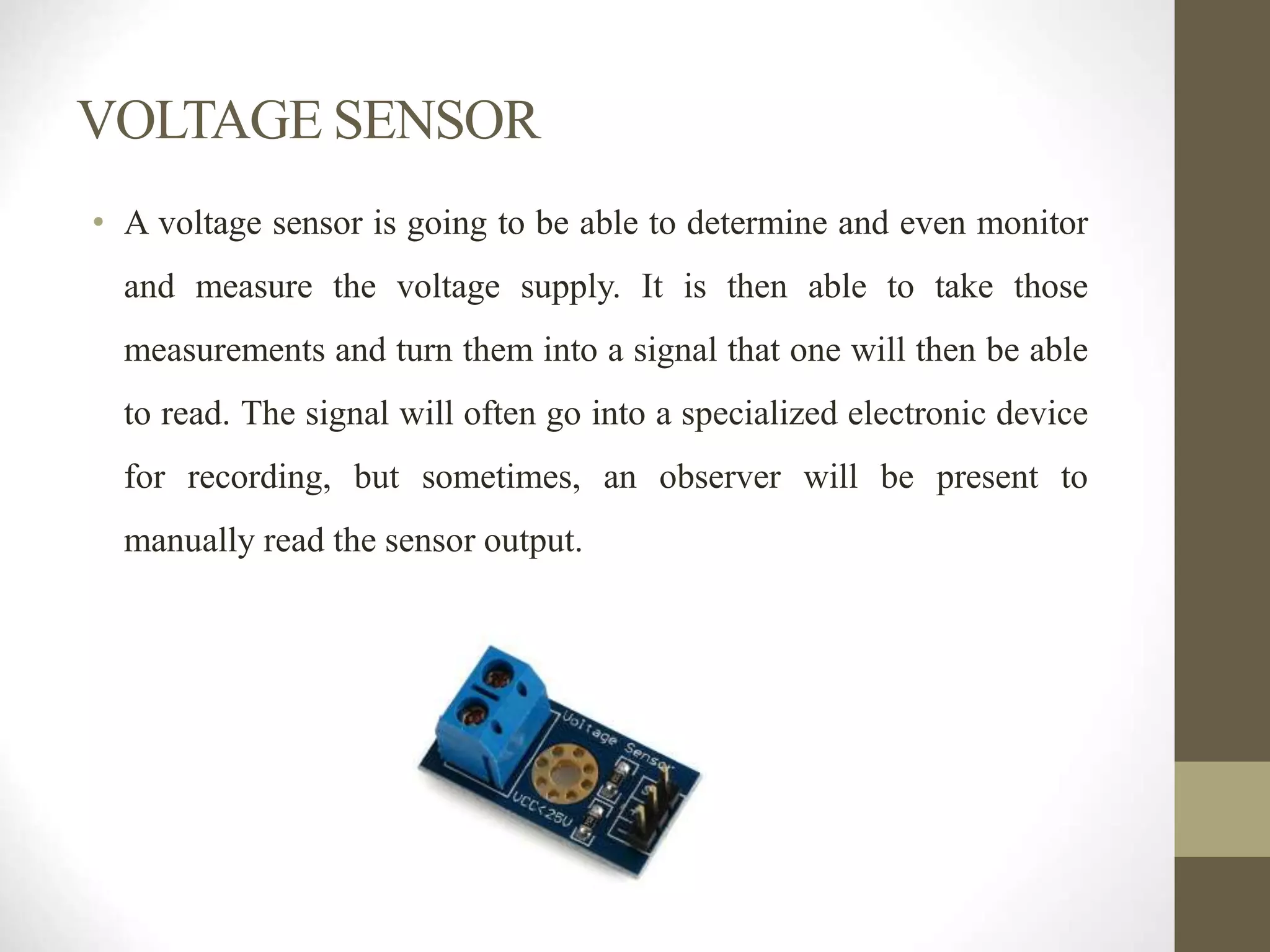
• A voltage sensor is going to be able to determine and even monitor
and measure the voltage supply. It is then able to take those
measurements and turn them into a signal that one will then be able
to read. The signal will often go into a specialized electronic device
for recording, but sometimes, an observer will be present to
manually read the sensor output.
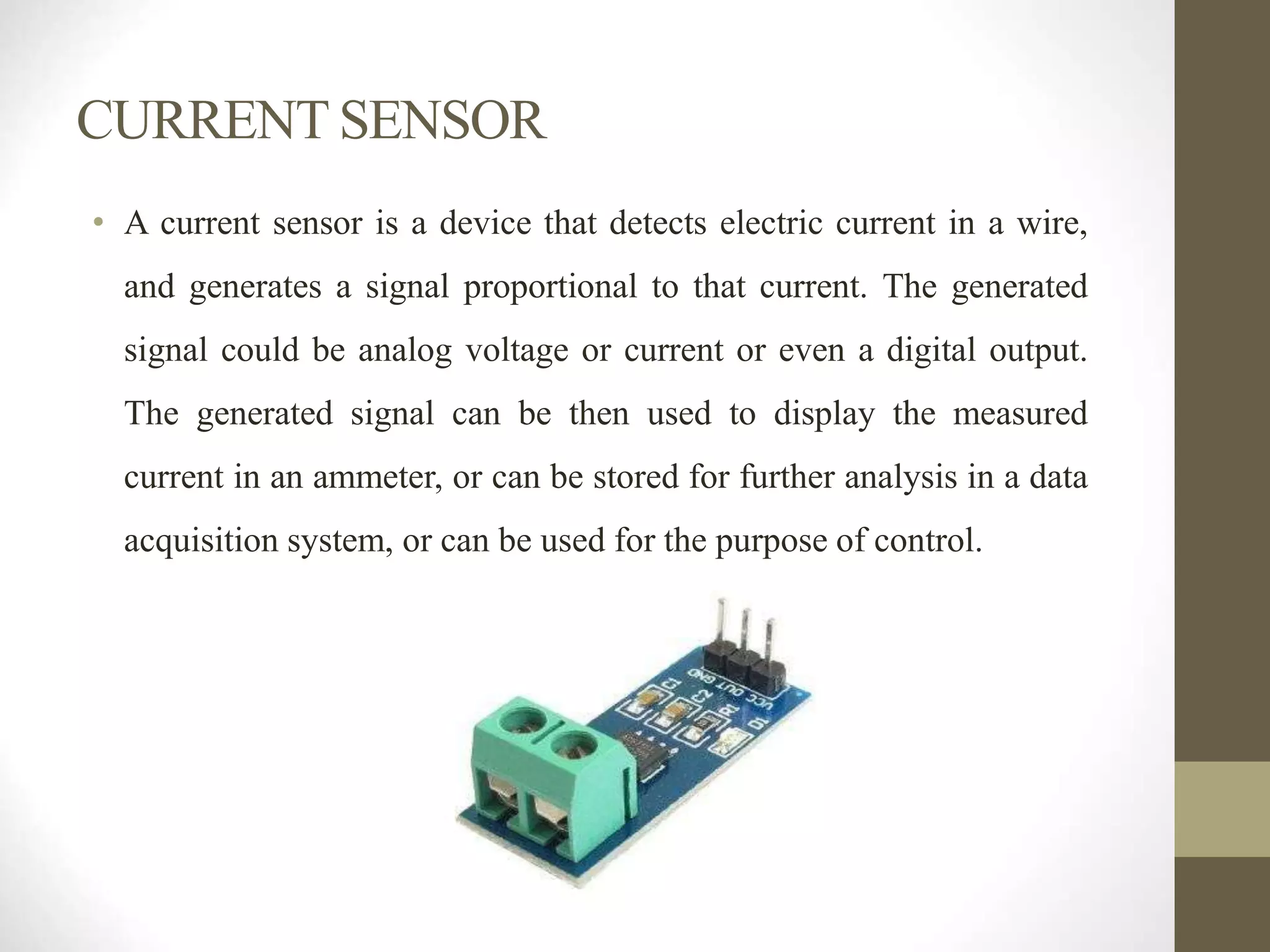
CURRENT SENSOR
• A current sensor is a device that detects electric current in a wire,
and generates a signal proportional to that current. The generated
signal could be analog voltage or current or even a digital output.
The generated signal can be then used to display the measured
current in an ammeter, or can be stored for further analysis in a data
acquisition system, or can be used for the purpose of control.
TEMPERATURE SENSOR
• The LM35 device has an advantage over linear temperature sensors
calibrated in Kelvin, as the user is not required to subtract a large constant
voltage from the output to obtain convenient Centigrade scaling.
• The LM35 device does not require any external calibration or trimming to
provide typical accuracies of ±¼°C at room temperature and ±¾°C over a
full −55°C to 150°C temperature range. Lower cost is assured by trimming
and calibration at the wafer level.
• The low-output impedance, linear output, and precise inherent calibration
of the LM35 device makes interfacing to readout or control circuitry
especially easy. The device is used with single power supplies, or with plus
and minus supplies.
Wi-Fi
• The ESP8266 is a low-cost Wi-Fi microchip with full TCP/IP stack and
microcontroller capability produced by Shanghai-based Chinese
manufacturer Espressif Systems.
• The chip first came to the attention of western makers in August 2014 with
the ESP-01 module, made by a third-party manufacturer Ai-Thinker. This
small module allows microcontrollers to connect to a Wi-Fi network and
make simple TCP/IP connections using Hayes-style commands.
• However, at the time there was almost no English-language documentation
on the chip and the commands it accepted. The very low price and the fact
that there were very few external components on the module, which
suggested that it could eventually be very inexpensive in volume, attracted
many hackers to explore the module, chip, and the software on it, as well as
to translate the Chinese documentation.
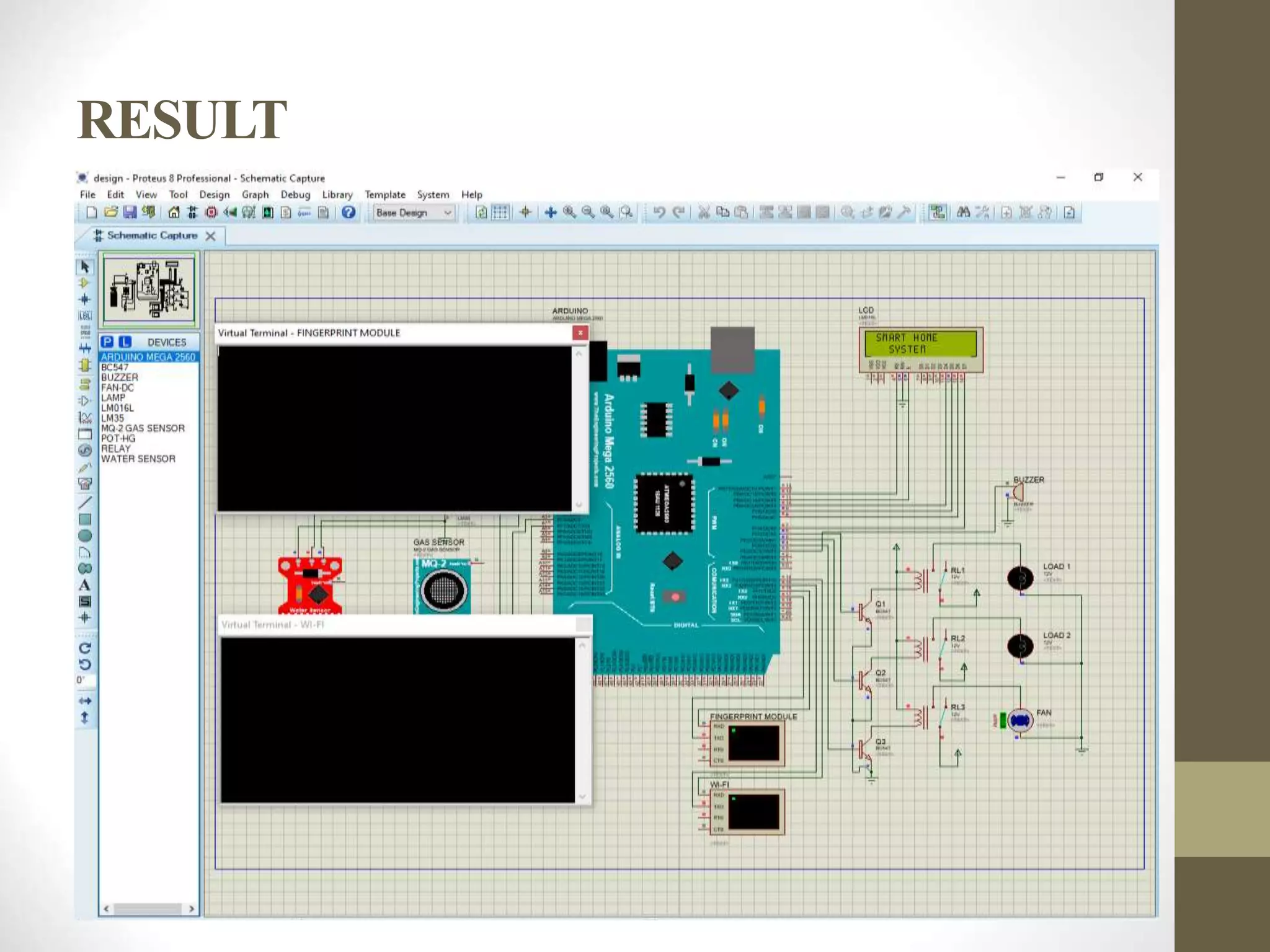
RESULT
CONCLUSION
• The goal of this method was to design a smart home system, which should be easy to
implement, and short ranged. The project is implemented through onboard Wi-Fi,
which is inbuilt in the mobile phones having an Android as its system. In this work a
remote control and monitoring system for Wi-Fi based smart home security and
automation system and the key components for the proposed system have been
developed. Using the wireless sensor network technology, Wi-Fi, helps organized a
flexible, low-power-consumption, low-cost, secure wireless network. The work detects
user actions at primary and secondary access points in a home using different sensors.
These detected user actions and behaviors are compared with normal user behavior at
various access points to identify intrusions or intrusion attempts. The alarm was
triggered when any sensor detects. The home appliance will be turn ON and OFF by
using mobile. Hence can conclude that the required goals and objectives of home
automation and security system have been achieved.
FUTURE SCOPE
• The home security system has a long way to go. As the technologies improving every
second, with time may have many ways for home security with more light protocol
and less delay in the output. With upcoming technologies there will be good
enhancement in the computer board as well as the communication protocols, which
will make it simpler as well as more light and secure.
REFERENCE
• [1] A. H. Sanoob, J. Roselin and P. Latha, "Smartphone Enabled
Intelligent Surveillance System," in IEEE Sensors Journal, vol. 16, no.
5, pp. 1361-1367, March 1, 2016.
• [2] D. Pavithra and R. Balakrishnan, "IoT based monitoring and control
system for home automation," 2015 Global Conference on
Communication Technologies (GCCT), Thuckalay, 2015, pp. 169-173.
• [3] G. V. Poonam, and R., Y., Kalshetty. "Bluetooth based smart
automation system using Android." International Journal of New
Innovations in Engineering and Technology 7.3 (2017): 24-29.
• [4] M. A. Mahler, Q., Li and A., Li, "SecureHouse: A home security
system based on smartphone sensors," 2017 IEEE International
Conference on Pervasive Computing and Communications (PerCom),
Kona, HI, 2017, pp. 11-20.
• [5] R. M. Green, N., J., Basil. “Mobile device controller application for
any security system”. US Patent 8,489,065, 2013.

final ppt.ppt

  • 1.
  • 2.
    CONTENTS • OBJECTIVE • ABSTRACT •INTRODUCTION • BLOCK DIAGRAM • EXISTING SYSTEM • DISADVANTAGES • LITERATURE SURVEY • PROPOSED SYSTEM • MATERIAL USED • ADVANTAGES • CONCLUSION
  • 3.
    OBJECTIVE • To developa stochastic solar generation vehicle model • To measure the charging station's utility as well as EVs' charging requirements.
  • 4.
    ABSTRACT • Today, thesecurity system field is a very important area in smart cities, offices, and homes. Security of the house and the family is important for everybody. Likewise, smart systems can provide Internet of Things (IoT). The IoT can be applied in smart cities in order to give various benefits that enhance citizens. • The use of IoT will enhance some security level as well as it will help in accessing and controlling the system remotely. • Nowadays home and building automation systems are used more and more. On the one hand, they provide increased comfort especially when employed in a private home. • Wireless based systems, used every day and everywhere, ranges from wireless home networks and mobile phones to garage door openers.
  • 5.
    INTRODUCTION • The electricpower systems have undergone significant changes in the last few years, owing to the introduction of new business formats as in the electrical power distribution system • Smart lighting is used for energy saving which can be achieved by adapting lighting to the ambient conditions and by switching on/off or dimming of lights according to user needs thus reducing the unnecessary use of energy. • Saving energy also helps in reducing cost. • Electric energy consumption is the form of energy consumption that uses electric energy. Electric energy consumption is the actual energy demand made on existing electricity supply.
  • 6.
    EXISTING SYSTEM  GSMbased wireless home security system, which take a very less power.  The system can response rapidly as intruder detect and GSM module will do alert home owner.  This security system for alerting a house owner wherever he will. In this system a relay and magnet installed at entry point to precedence produce a signal through a public telecom network and sends a message or redirect a call that that tells about your home update or predefined message which is embedded in microcontroller.  Suspected activities are conveyed to remote user through SMS or Call using GSM technology.
  • 7.
    DISADVANTAGES • The disadvantageof this framework was that GSM has a settled greatest cell site scope of 35km which is forced by various cases. • Moreover the rancher needs to be upgraded the whole complex AT charges, lastly soil parameters in regards to manures and plant ailments are not joined in the framework.
  • 8.
  • 9.
    Major requirements forbuilding Smart Homes in Smart Cities based on Internet of Things technologies Method • Smart Home is the major building block for Smart Cities • Home Automation (HA) possible when personal computers started invading home spaces Advantages • Smart Home adoption rate is still low • Saving energy through smart home Disadvantages • Intelligent homes are critical in a Human-centric technology
  • 10.
    Energy Harvesting forWireless Sensor Networks Review Method • Alternative energy sources has been demonstrated in order to address the feasibility of their integration with wireless sensor networks. Advantages • It increase the probability of having uninterruptible power supply • Some fluctuation of energy Disadvantages • Limited by the batteries Capacity • Low energy levels.
  • 11.
    Energy-efficient data collectionin wireless sensor networks with time constraints Method • Minimize the energy that the sensors use to transmit their measurements. Advantages • Minimum energy consumption for the sensors. • The energy consumption of a sensor is an increasing function of the distance between this sensor and the sink. Disadvantages • Sensor has a noisy measurement • The sink has a limited, predefined time windows
  • 12.
    Wireless Sensor NetworksWith Energy Harvesting Method • Wireless Sensor Networks have played a major role in the research field of multi-hop wireless networks as enablers of applications ranging from environmental and structural monitoring Advantages • High Energy efficiency • Slow down the depletion of battery energy, which include power control Disadvantages • The replacement/recharging operation is slow and expensive, and decreases network performance.
  • 13.
    On the Designof a Solar-Panel Receiver for Optical Wireless Communications With Simultaneous Energy Harvesting Method • An optical wireless communications (OWC) receiver using a solar panel as a photodetector. Advantages • High data transmission and energy harvesting. • Maximize the receiver SNR. Disadvantages • Low performance • Non linear distortion occurs.
  • 14.
  • 15.
    BLOCK DIAGRAM DESCRIPTION •In this we use Arduino microcontroller for controlling the whole process of this project. • Wi-Fi module is used for controlling the home appliances wirelessly. Temperature sensor is used to find the Temperature of the indoor environment. • Gas sensor is used to sense any gas leakage in the home. Water level sensor is used to detect flood level outdoor of the home. The power supply unit is given to the circuit for supply input voltage of 12v. • Home automation system consists of Arduino microcontroller, Wi-Fi module, Gas sensor, water level sensor, current sensor, voltage sensor, LCD-display, lamp, power supply unit, Android mobile and temperature sensor. Components are interfaced with Arduino microcontroller.
  • 16.
  • 17.
    PROPOSED SYSTEM • Inthis home automation and security system implement with the help of direct Wi-Fi (Wireless Federation), this is WLAN 802.11 standard. The main advantage of this system is that it can be implemented with a wider range of not more than 200 meters. It allows communicating with a brief and small setup without wired connection. • On the one hand, they provide increased comfort especially when employed in a private home. On the other hand, automation systems installed in commercial buildings do not only increase comfort, but also allow centralized control of heating, ventilation, air condition and lighting. • Hence, they contribute to an overall cost reduction and also to energy saving which is certainly a main issue today. • Employing a traditional wired automation system does not pose a problem as long as the system is planned before and installed during the physical
  • 18.
    ADVANTAGES • Operating electricitycosts are reduced. • An improved wireless energy transfer system that reduces energy losses. • Easy to maintain and is less complicated in hardware architecture
  • 19.
  • 20.
    ARDUINO MEGA • TheArduino Mega 2560 is a microcontroller board based on the ATmega2560. • It has 54 digital input/output pins (of which 14 can be used as PWM outputs), 16 analog inputs, 4 UARTs (hardware serial ports), a 16 MHz crystal oscillator, a USB connection, a power jack, an ICSP header, and a reset button. • It contains everything needed to support the microcontroller; simply connect it to a computer with a USB cable or power it with a AC-to- DC adapter or battery to get started. • The Mega is compatible with most shields designed for the Arduino Duemilanove or Diecimila.
  • 21.
  • 22.
    VOLTAGE SENSOR • Avoltage sensor is going to be able to determine and even monitor and measure the voltage supply. It is then able to take those measurements and turn them into a signal that one will then be able to read. The signal will often go into a specialized electronic device for recording, but sometimes, an observer will be present to manually read the sensor output.
  • 23.
    CURRENT SENSOR • Acurrent sensor is a device that detects electric current in a wire, and generates a signal proportional to that current. The generated signal could be analog voltage or current or even a digital output. The generated signal can be then used to display the measured current in an ammeter, or can be stored for further analysis in a data acquisition system, or can be used for the purpose of control.
  • 24.
    TEMPERATURE SENSOR • TheLM35 device has an advantage over linear temperature sensors calibrated in Kelvin, as the user is not required to subtract a large constant voltage from the output to obtain convenient Centigrade scaling. • The LM35 device does not require any external calibration or trimming to provide typical accuracies of ±¼°C at room temperature and ±¾°C over a full −55°C to 150°C temperature range. Lower cost is assured by trimming and calibration at the wafer level. • The low-output impedance, linear output, and precise inherent calibration of the LM35 device makes interfacing to readout or control circuitry especially easy. The device is used with single power supplies, or with plus and minus supplies.
  • 25.
    Wi-Fi • The ESP8266is a low-cost Wi-Fi microchip with full TCP/IP stack and microcontroller capability produced by Shanghai-based Chinese manufacturer Espressif Systems. • The chip first came to the attention of western makers in August 2014 with the ESP-01 module, made by a third-party manufacturer Ai-Thinker. This small module allows microcontrollers to connect to a Wi-Fi network and make simple TCP/IP connections using Hayes-style commands. • However, at the time there was almost no English-language documentation on the chip and the commands it accepted. The very low price and the fact that there were very few external components on the module, which suggested that it could eventually be very inexpensive in volume, attracted many hackers to explore the module, chip, and the software on it, as well as to translate the Chinese documentation.
  • 26.
  • 27.
    CONCLUSION • The goalof this method was to design a smart home system, which should be easy to implement, and short ranged. The project is implemented through onboard Wi-Fi, which is inbuilt in the mobile phones having an Android as its system. In this work a remote control and monitoring system for Wi-Fi based smart home security and automation system and the key components for the proposed system have been developed. Using the wireless sensor network technology, Wi-Fi, helps organized a flexible, low-power-consumption, low-cost, secure wireless network. The work detects user actions at primary and secondary access points in a home using different sensors. These detected user actions and behaviors are compared with normal user behavior at various access points to identify intrusions or intrusion attempts. The alarm was triggered when any sensor detects. The home appliance will be turn ON and OFF by using mobile. Hence can conclude that the required goals and objectives of home automation and security system have been achieved.
  • 28.
    FUTURE SCOPE • Thehome security system has a long way to go. As the technologies improving every second, with time may have many ways for home security with more light protocol and less delay in the output. With upcoming technologies there will be good enhancement in the computer board as well as the communication protocols, which will make it simpler as well as more light and secure.
  • 29.
    REFERENCE • [1] A.H. Sanoob, J. Roselin and P. Latha, "Smartphone Enabled Intelligent Surveillance System," in IEEE Sensors Journal, vol. 16, no. 5, pp. 1361-1367, March 1, 2016. • [2] D. Pavithra and R. Balakrishnan, "IoT based monitoring and control system for home automation," 2015 Global Conference on Communication Technologies (GCCT), Thuckalay, 2015, pp. 169-173. • [3] G. V. Poonam, and R., Y., Kalshetty. "Bluetooth based smart automation system using Android." International Journal of New Innovations in Engineering and Technology 7.3 (2017): 24-29. • [4] M. A. Mahler, Q., Li and A., Li, "SecureHouse: A home security system based on smartphone sensors," 2017 IEEE International Conference on Pervasive Computing and Communications (PerCom), Kona, HI, 2017, pp. 11-20. • [5] R. M. Green, N., J., Basil. “Mobile device controller application for any security system”. US Patent 8,489,065, 2013.