








SMART STREET-
LIGHTS
MANAGEMENT
SYSTEM
GROUP MEMBERS:
I14-1623, ZEESHAN ALI
I14-0302, SARMAD KAMAL
I14-0331, M. ASIF SHAFIQ
INTRODUCTION
• A smart road light is a public street light is an adaptive lighting that
dims when there no activity is detected, but brightens when movement
is detected. Smart Road Lights Management System would be an
information system designed to provide management and control of
the whole interconnected system, ensuring reliability, cost saving and
high efficiency.
PROCESSES THAT SHOULD BE
AUTOMATED:
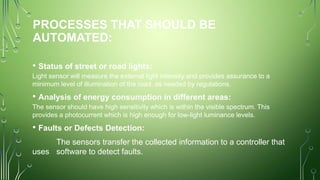
• Status of street or road lights:
Light sensor will measure the external light intensity and provides assurance to a
minimum level of illumination of the road, as needed by regulations.
• Analysis of energy consumption in different areas:
The sensor should have high sensitivity which is within the visible spectrum. This
provides a photocurrent which is high enough for low-light luminance levels.
• Faults or Defects Detection:
The sensors transfer the collected information to a controller that
uses software to detect faults.
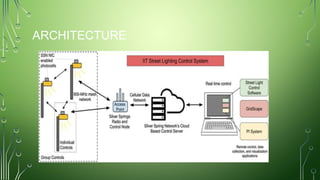
ARCHITECTURE
RECENT RESEARCH
• Smart Street Light Management System Using LoRa
Technology
• Abstract:
Increase in population and the corresponding increase in
number of street light, for the roads and people’s safety,
which rises investment and energy. This research gives
precise and the best control over energy efficient street
lighting system. It gives practical implementation using
Long Range (LoRa) and Arduino micro-controller using
sensors to gather information.
MIS REQUIREMENTS
• Current Condition of Street Light.
• Notify about failure of Street Light.
• Employee Management
• Security
• Reliability and Availability
• Performance
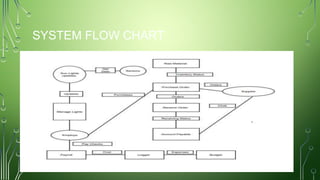
SYSTEM FLOW CHART
SECURITY FEATURES
• Advantages:
• Affordability:
With increased consumer confidence and demand for both security
integrations and smart home features, smart lighting provides customers with an
affordable way to add both to their home
• Accessibility:
Not only does smart lighting provide increased security measures while your
customers are home, it also gives them the opportunity to remotely access
their lighting anytime, anywhere through an app on their smartphone, if WIFI is
available
SECURITY FEATURES
• Disadvantages:
DDOS attacks can exploit vulnerabilities in poorly secured IOT
devises. Data security in IOT devices, including lighting fixtures, should
be treated as seriously as that of data centers, private wireless
networks and personal computers.
MODULES OF SYSTEM
• Smart Module
• Sensors
• Control Module (CM)
• Server
POTENTIAL RISKS
• Disruption and denial-of-service attacks
• Understanding the complexity of vulnerabilities
• IOT Vulnerabilities
• Collect Data
• Modular Components
• Rapid Demand in bandwidth requirement
ETHICAL ISSUES
• User personal data is not protected
• Incomplete information on the consequence of data disclosure
• Data disclosure
• Psychological biases
• Data protection solutions
IMPROVEMENTS
• Business related
• Marinating costs in reasonable range.
• Developing product in such a way so that it will be easier
to sell or attract customer.
• Technological issues
• Buying quality sensors which are durable in bad weathers.
• Affective connectivity system between sensors and control
system
• There is backup in case of automatic system failure.
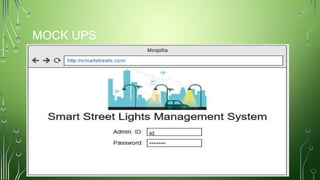
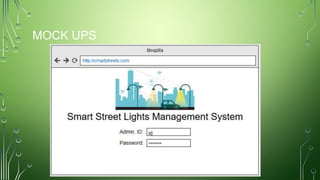
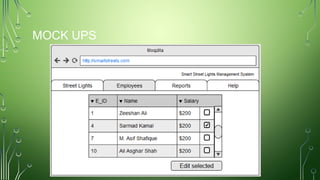
MOCK UPS
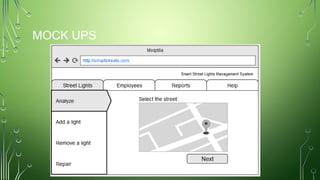
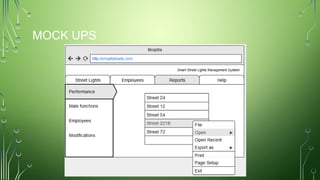
MOCK UPS
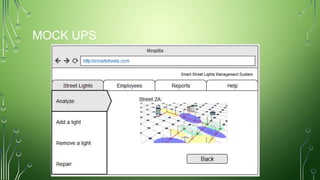
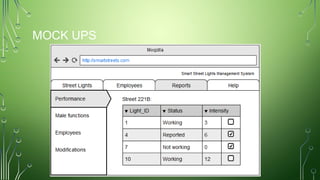
MOCK UPS
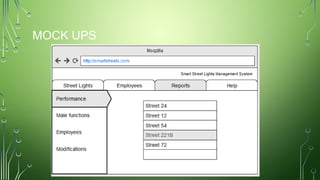
MOCK UPS
MOCK UPS
MOCK UPS
MOCK UPS
MOCK UPS
MOCK UPS
Thank You!

Smart light-management-system

  • 1.
    SMART STREET- LIGHTS MANAGEMENT SYSTEM GROUP MEMBERS: I14-1623,ZEESHAN ALI I14-0302, SARMAD KAMAL I14-0331, M. ASIF SHAFIQ
  • 2.
    INTRODUCTION • A smartroad light is a public street light is an adaptive lighting that dims when there no activity is detected, but brightens when movement is detected. Smart Road Lights Management System would be an information system designed to provide management and control of the whole interconnected system, ensuring reliability, cost saving and high efficiency.
  • 3.
    PROCESSES THAT SHOULDBE AUTOMATED: • Status of street or road lights: Light sensor will measure the external light intensity and provides assurance to a minimum level of illumination of the road, as needed by regulations. • Analysis of energy consumption in different areas: The sensor should have high sensitivity which is within the visible spectrum. This provides a photocurrent which is high enough for low-light luminance levels. • Faults or Defects Detection: The sensors transfer the collected information to a controller that uses software to detect faults.
  • 4.
  • 5.
    RECENT RESEARCH • SmartStreet Light Management System Using LoRa Technology • Abstract: Increase in population and the corresponding increase in number of street light, for the roads and people’s safety, which rises investment and energy. This research gives precise and the best control over energy efficient street lighting system. It gives practical implementation using Long Range (LoRa) and Arduino micro-controller using sensors to gather information.
  • 6.
    MIS REQUIREMENTS • CurrentCondition of Street Light. • Notify about failure of Street Light. • Employee Management • Security • Reliability and Availability • Performance
  • 7.
  • 8.
    SECURITY FEATURES • Advantages: •Affordability: With increased consumer confidence and demand for both security integrations and smart home features, smart lighting provides customers with an affordable way to add both to their home • Accessibility: Not only does smart lighting provide increased security measures while your customers are home, it also gives them the opportunity to remotely access their lighting anytime, anywhere through an app on their smartphone, if WIFI is available
  • 9.
    SECURITY FEATURES • Disadvantages: DDOSattacks can exploit vulnerabilities in poorly secured IOT devises. Data security in IOT devices, including lighting fixtures, should be treated as seriously as that of data centers, private wireless networks and personal computers.
  • 10.
    MODULES OF SYSTEM •Smart Module • Sensors • Control Module (CM) • Server
  • 11.
    POTENTIAL RISKS • Disruptionand denial-of-service attacks • Understanding the complexity of vulnerabilities • IOT Vulnerabilities • Collect Data • Modular Components • Rapid Demand in bandwidth requirement
  • 12.
    ETHICAL ISSUES • Userpersonal data is not protected • Incomplete information on the consequence of data disclosure • Data disclosure • Psychological biases • Data protection solutions
  • 13.
    IMPROVEMENTS • Business related •Marinating costs in reasonable range. • Developing product in such a way so that it will be easier to sell or attract customer. • Technological issues • Buying quality sensors which are durable in bad weathers. • Affective connectivity system between sensors and control system • There is backup in case of automatic system failure.
  • 14.
  • 15.
  • 16.
  • 17.
  • 18.
  • 19.
  • 20.
  • 21.
  • 22.
  • 23.