Working at the interface between design and construction  Peter Demian Lecturer in Construction Management Department of Civil and Building Engineering Loughborough University
Introduction to Myself Lecturer in Construction Management since 2005 Interested in Design and Knowledge Management PhD in Civil Engineering Undergraduate studies in Structural Engineering Disability: Poor eyesight
Outline First Principles “Design”? “Management”? “Design Management”? Why design management is difficult but important Tools we can use
First Principles: Design 1/2 “ The conception and planning of the artificial” (Buchanan 2000) “ The process of developing information about an object that has not previously existed.” (Ullman 1994) “ The most essential design activity is the production of a final description of the artefact.” (Cross 1989) (a description that would enable someone to build the artefact)
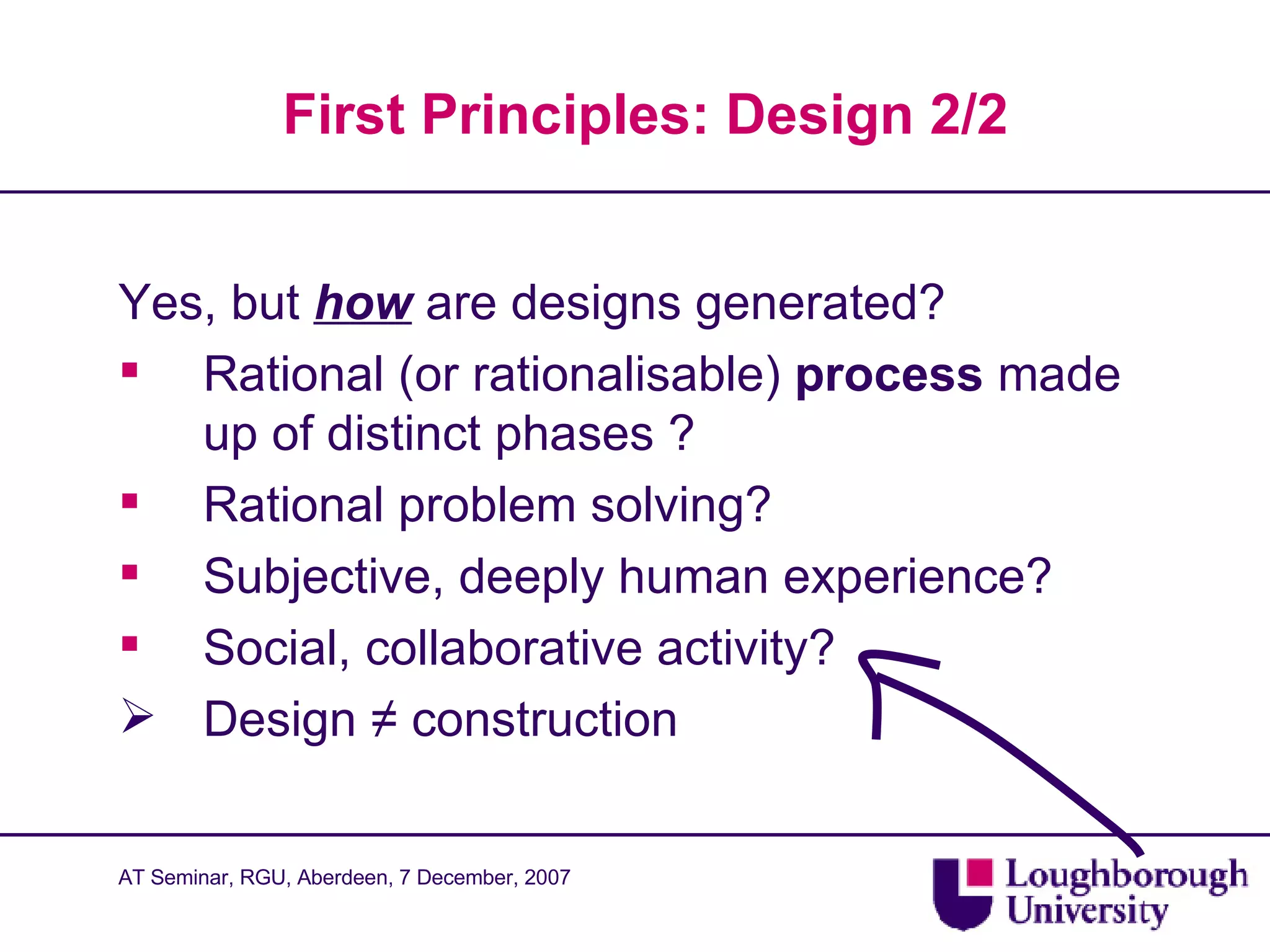
First Principles: Design 2/2 Yes, but  how  are designs generated? Rational (or rationalisable)  process  made up of distinct phases ? Rational problem solving? Subjective, deeply human experience? Social, collaborative activity? Design  ≠  construction
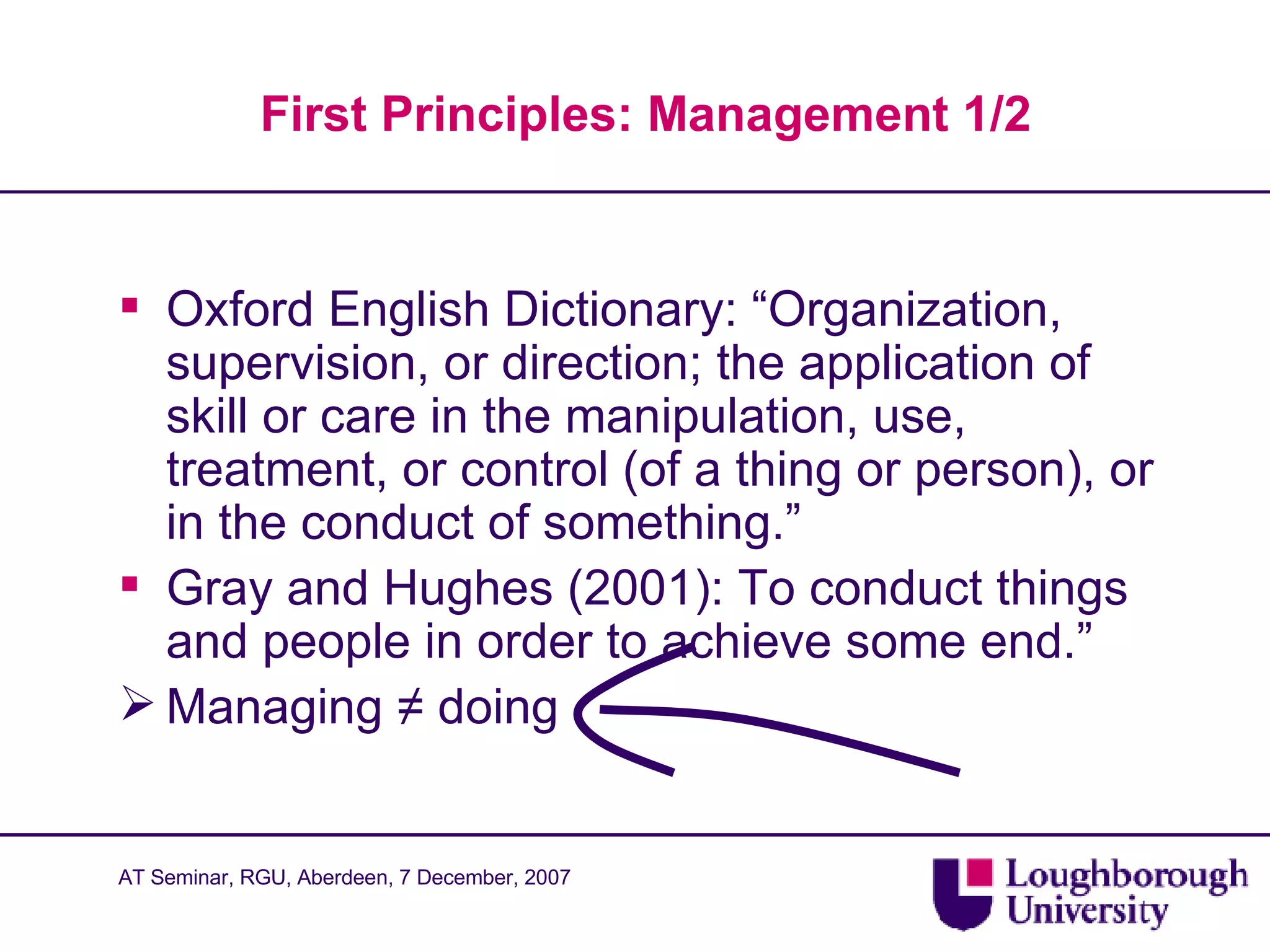
First Principles: Management 1/2 Oxford English Dictionary: “Organization, supervision, or direction; the application of skill or care in the manipulation, use, treatment, or control (of a thing or person), or in the conduct of something.”  Gray and Hughes (2001): To conduct things and people in order to achieve some end.” Managing  ≠  doing
First Principles: Management 2/2 Dictionary definition uses the word “ organisation”  –  from the notion of organs in the human body. To organise something is to arrange the elements into a coordinated whole. When it is difficult to deal with a whole, it is useful to split the whole into pieces, and deal with each piece in a separate but coordinated way. Disassembly must not destroy essence – reductionism  vs. holism.
First Principles: Design Management 1/5 Managing≠doing  Designing≠construction ? ? CONSTRUCTION ? ? DESIGN MANAGING DOING
First Principles: Design Management 2/5 A long time ago… Architect/ Masterbuilder Workmen or labourers CONSTRUCTION Architect/ Masterbuilder Architect/ Masterbuilder DESIGN MANAGING DOING
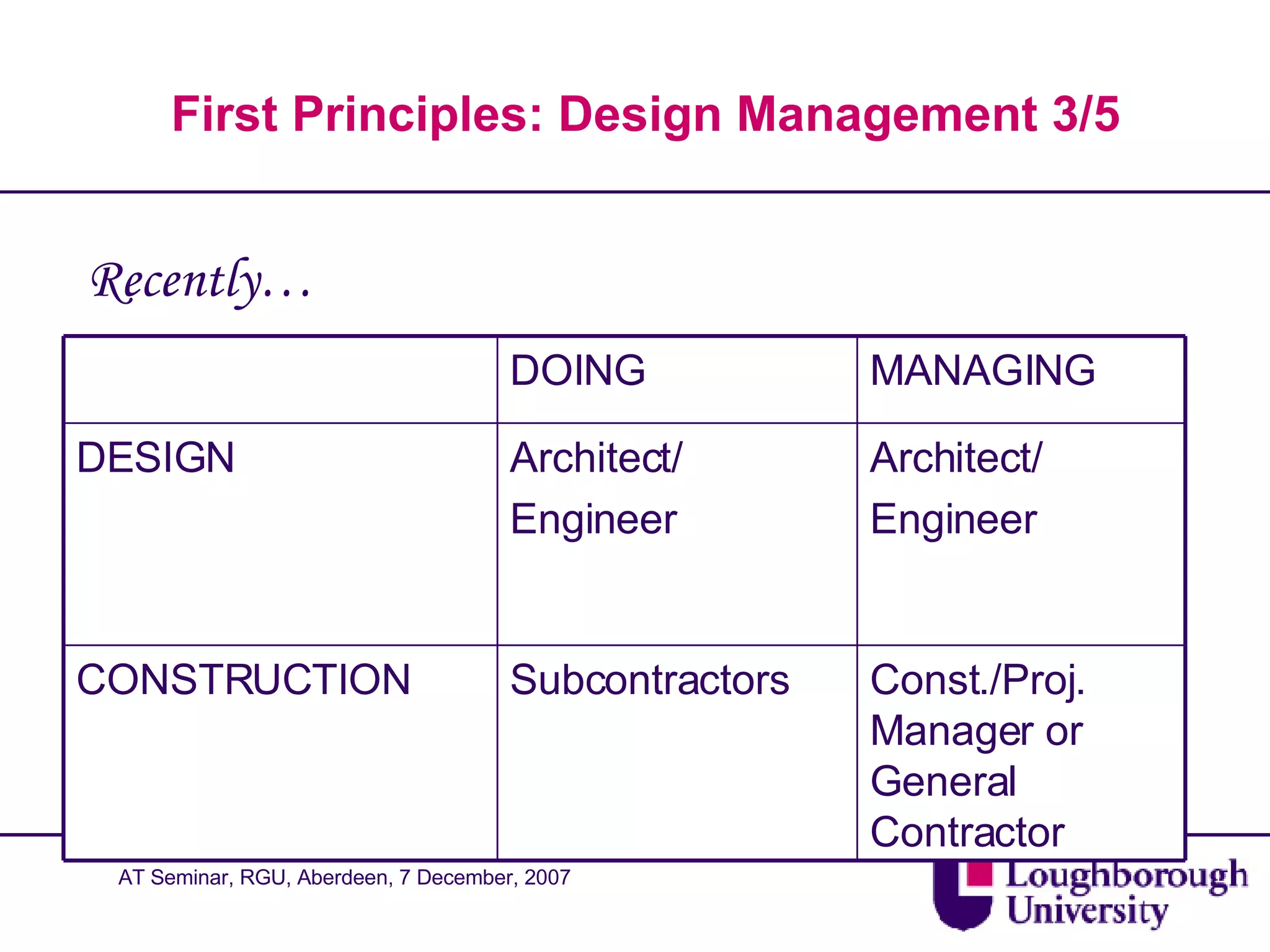
First Principles: Design Management 3/5 Recently… Const./Proj. Manager or General Contractor Subcontractors CONSTRUCTION Architect/ Engineer Architect/ Engineer DESIGN MANAGING DOING
First Principles: Design Management 4/5 The future… Const./Proj. Manager or General Contractor Subcontractors CONSTRUCTION The Design Manager Architect/ Engineer + Others DESIGN MANAGING DOING
First Principles: Design Management 5/5 “ A management framework for timely delivery of good, accurate and build-able designs that meet the stakeholder requirements.” – Design Management Handbook by Lee Bibby “ The management of people and resources in a multidisciplinary process, performed in a series of iterative steps, to conceive, describe and justify increasingly detailed solutions and costings to meet the needs of the stakeholders.” – Professor Simon Austin Module notes, CVP010 Design Process Management. Orchestra metaphor
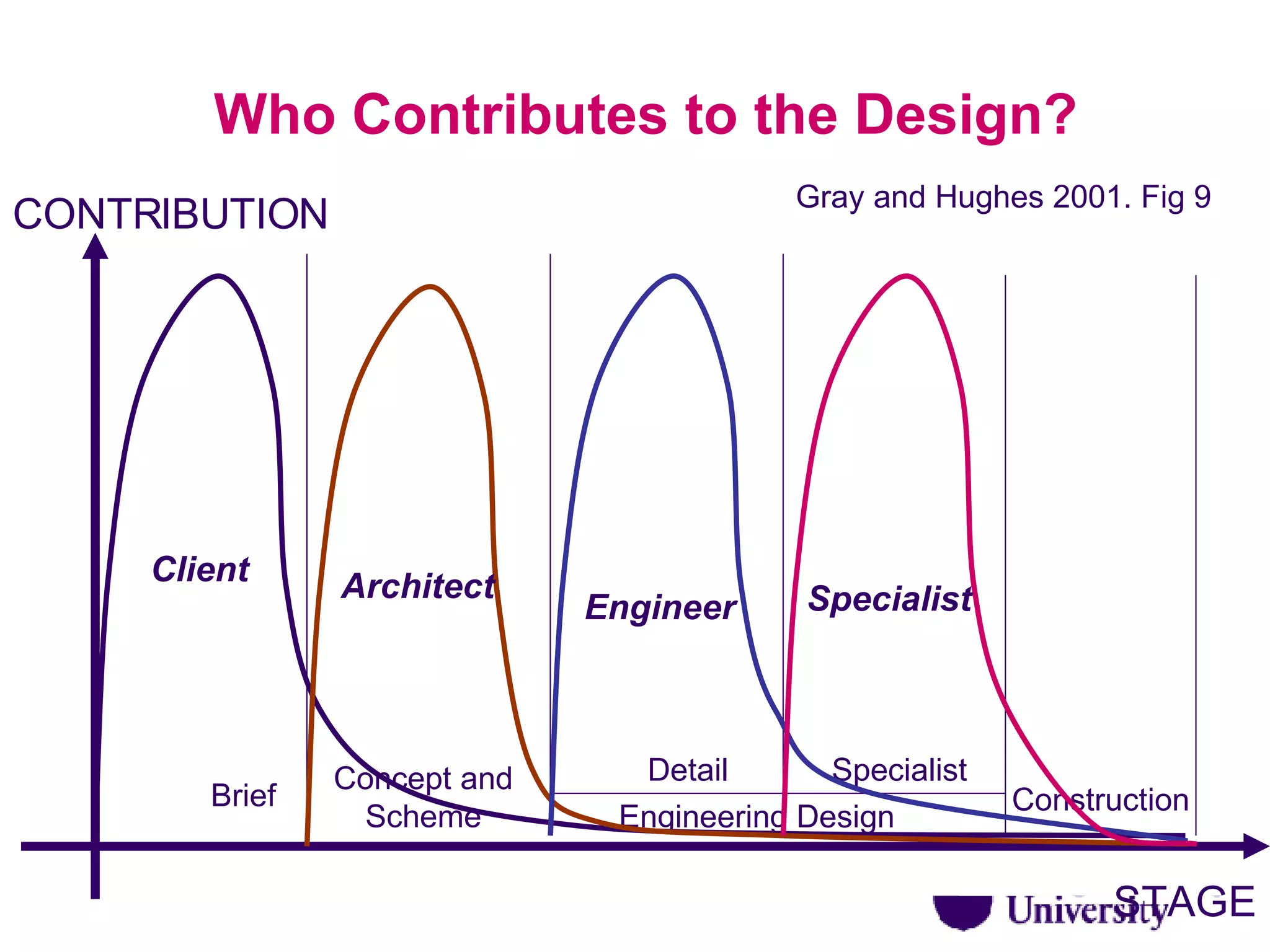
Changes in the Const. Industry One person/entity oversee the entire design and construction process    Co-ordination of multiple specialist designers and works contractors. Specialisation, fragmentation.  As work becomes more complex, so more skills are needed to accomplish it. Architect as project leader    Ambiguity:  Who’s the boss? Erosion of the role of architect. Complex financing, accounting before an architect is even hired. Leadership of project changes as project progresses (For more, see Table 1, Page 2 in Gray and Hughes 2001)
Who Contributes to the Design? CONTRIBUTION STAGE Brief Detail Concept and Scheme Specialist Engineering Design Construction Client Architect Engineer Specialist Gray and Hughes 2001. Fig 9
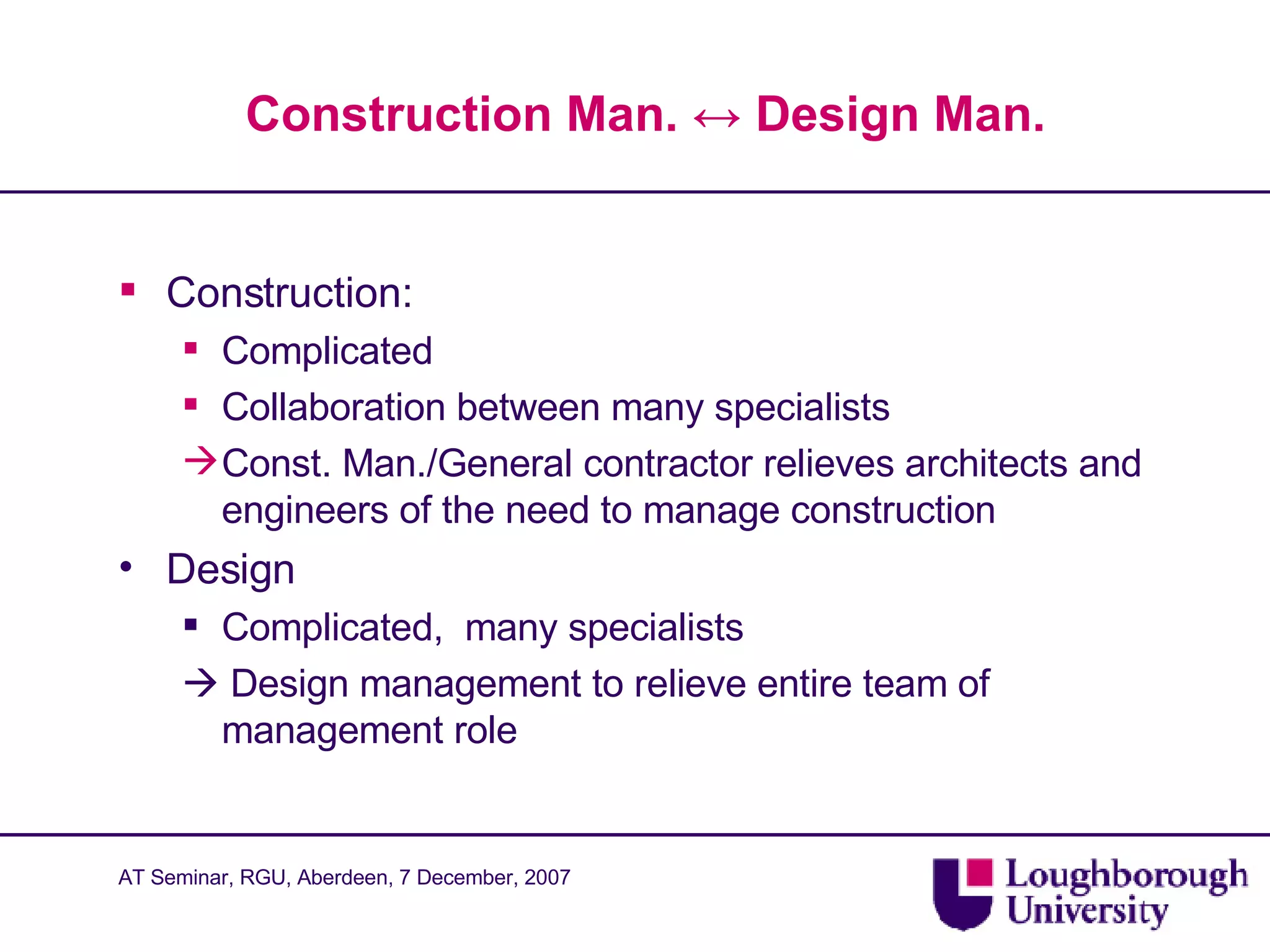
Construction Man.  ↔  Design Man. Construction: Complicated Collaboration between many specialists Const. Man./General contractor relieves architects and engineers of the need to manage construction Design Complicated,  many specialists    Design management to relieve entire team of management role
Characteristics of Design 1/2 Many stakeholders, disciplines Different disciplines because complexity    differentiation Different organisations because of transaction cost economics Each discipline has its own language and way of working We want this, but we need to provide integration and coordination
Characteristics of Design 2/2 Design is problem seeking (or problem definition) as well as problem solving Design is iterative.  No right answer first time.  No perfectly right answer at all? “Designer” is often not “builder”.   Contrast between design and construction.
Design versus Construction Design Management Handbook, Lee Bibby 2002
Design: greatest scope for change  During the design phase we have the greatest influence over the total final cost of the project  During the design phase we have the greatest influence over the total final cost of the project  During the design phase we have the greatest influence over the total final cost of the project
Level of Influence Feasibility  Brief  Design  Construction  Utilisation  Chapter 10 of “Professional Construction Management” by Barrie and Paulson (1992) Project Phase Level of Influence 0% 100% Decreasing Influence Increasing Expenditure Cumulative Cost of Project
Design Manager Imposes Freezes Feasibility  Brief  Design  Construction  Utilisation  Chapter 10 of “Professional Construction Management” by Barrie and Paulson (1992) Project Phase 0% 100% Decreasing Influence Increasing Expenditure Cumulative Cost of Project Cost of change BRIEF FREEZE DESIGN FREEZE
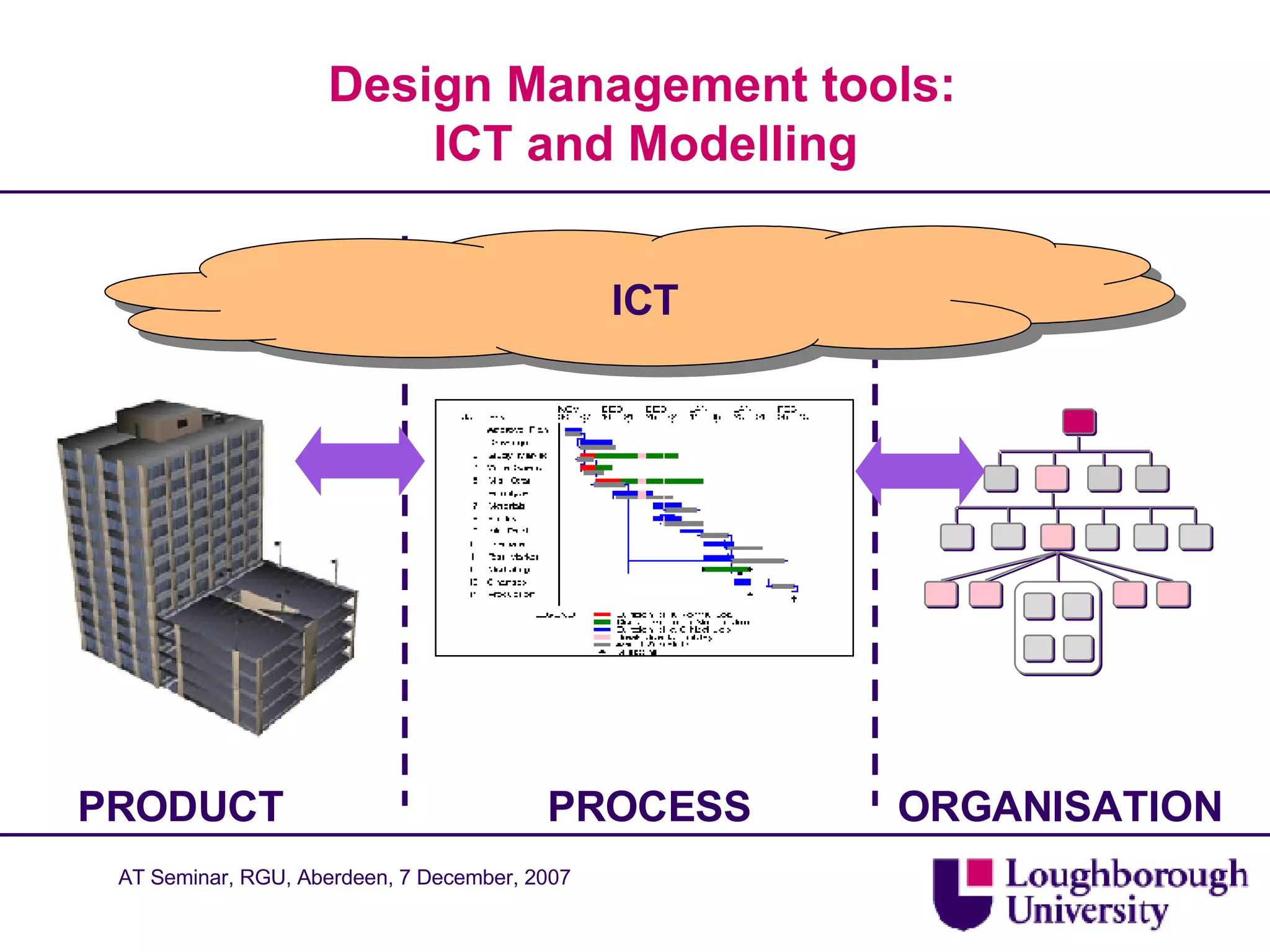
Design Management tools: ICT and Modelling PRODUCT PROCESS ORGANISATION ICT
Summary First Principles “ Managing ≠ doing Designing ≠ construction Difficult : Complicated, specialists,  iterative Important:  Design: greatest influence Tools Product modelling Process modelling Organisational modelling  ICT

Design ManagementSeminar

  • 1.
    Working at theinterface between design and construction Peter Demian Lecturer in Construction Management Department of Civil and Building Engineering Loughborough University
  • 2.
    Introduction to MyselfLecturer in Construction Management since 2005 Interested in Design and Knowledge Management PhD in Civil Engineering Undergraduate studies in Structural Engineering Disability: Poor eyesight
  • 3.
    Outline First Principles“Design”? “Management”? “Design Management”? Why design management is difficult but important Tools we can use
  • 4.
    First Principles: Design1/2 “ The conception and planning of the artificial” (Buchanan 2000) “ The process of developing information about an object that has not previously existed.” (Ullman 1994) “ The most essential design activity is the production of a final description of the artefact.” (Cross 1989) (a description that would enable someone to build the artefact)
  • 5.
    First Principles: Design2/2 Yes, but how are designs generated? Rational (or rationalisable) process made up of distinct phases ? Rational problem solving? Subjective, deeply human experience? Social, collaborative activity? Design ≠ construction
  • 6.
    First Principles: Management1/2 Oxford English Dictionary: “Organization, supervision, or direction; the application of skill or care in the manipulation, use, treatment, or control (of a thing or person), or in the conduct of something.” Gray and Hughes (2001): To conduct things and people in order to achieve some end.” Managing ≠ doing
  • 7.
    First Principles: Management2/2 Dictionary definition uses the word “ organisation” – from the notion of organs in the human body. To organise something is to arrange the elements into a coordinated whole. When it is difficult to deal with a whole, it is useful to split the whole into pieces, and deal with each piece in a separate but coordinated way. Disassembly must not destroy essence – reductionism vs. holism.
  • 8.
    First Principles: DesignManagement 1/5 Managing≠doing Designing≠construction ? ? CONSTRUCTION ? ? DESIGN MANAGING DOING
  • 9.
    First Principles: DesignManagement 2/5 A long time ago… Architect/ Masterbuilder Workmen or labourers CONSTRUCTION Architect/ Masterbuilder Architect/ Masterbuilder DESIGN MANAGING DOING
  • 10.
    First Principles: DesignManagement 3/5 Recently… Const./Proj. Manager or General Contractor Subcontractors CONSTRUCTION Architect/ Engineer Architect/ Engineer DESIGN MANAGING DOING
  • 11.
    First Principles: DesignManagement 4/5 The future… Const./Proj. Manager or General Contractor Subcontractors CONSTRUCTION The Design Manager Architect/ Engineer + Others DESIGN MANAGING DOING
  • 12.
    First Principles: DesignManagement 5/5 “ A management framework for timely delivery of good, accurate and build-able designs that meet the stakeholder requirements.” – Design Management Handbook by Lee Bibby “ The management of people and resources in a multidisciplinary process, performed in a series of iterative steps, to conceive, describe and justify increasingly detailed solutions and costings to meet the needs of the stakeholders.” – Professor Simon Austin Module notes, CVP010 Design Process Management. Orchestra metaphor
  • 13.
    Changes in theConst. Industry One person/entity oversee the entire design and construction process  Co-ordination of multiple specialist designers and works contractors. Specialisation, fragmentation. As work becomes more complex, so more skills are needed to accomplish it. Architect as project leader  Ambiguity: Who’s the boss? Erosion of the role of architect. Complex financing, accounting before an architect is even hired. Leadership of project changes as project progresses (For more, see Table 1, Page 2 in Gray and Hughes 2001)
  • 14.
    Who Contributes tothe Design? CONTRIBUTION STAGE Brief Detail Concept and Scheme Specialist Engineering Design Construction Client Architect Engineer Specialist Gray and Hughes 2001. Fig 9
  • 15.
    Construction Man. ↔ Design Man. Construction: Complicated Collaboration between many specialists Const. Man./General contractor relieves architects and engineers of the need to manage construction Design Complicated, many specialists  Design management to relieve entire team of management role
  • 16.
    Characteristics of Design1/2 Many stakeholders, disciplines Different disciplines because complexity  differentiation Different organisations because of transaction cost economics Each discipline has its own language and way of working We want this, but we need to provide integration and coordination
  • 17.
    Characteristics of Design2/2 Design is problem seeking (or problem definition) as well as problem solving Design is iterative. No right answer first time. No perfectly right answer at all? “Designer” is often not “builder”.  Contrast between design and construction.
  • 18.
    Design versus ConstructionDesign Management Handbook, Lee Bibby 2002
  • 19.
    Design: greatest scopefor change During the design phase we have the greatest influence over the total final cost of the project During the design phase we have the greatest influence over the total final cost of the project During the design phase we have the greatest influence over the total final cost of the project
  • 20.
    Level of InfluenceFeasibility Brief Design Construction Utilisation Chapter 10 of “Professional Construction Management” by Barrie and Paulson (1992) Project Phase Level of Influence 0% 100% Decreasing Influence Increasing Expenditure Cumulative Cost of Project
  • 21.
    Design Manager ImposesFreezes Feasibility Brief Design Construction Utilisation Chapter 10 of “Professional Construction Management” by Barrie and Paulson (1992) Project Phase 0% 100% Decreasing Influence Increasing Expenditure Cumulative Cost of Project Cost of change BRIEF FREEZE DESIGN FREEZE
  • 22.
    Design Management tools:ICT and Modelling PRODUCT PROCESS ORGANISATION ICT
  • 23.
    Summary First Principles“ Managing ≠ doing Designing ≠ construction Difficult : Complicated, specialists, iterative Important: Design: greatest influence Tools Product modelling Process modelling Organisational modelling ICT