Professional Practice & Ethics
Managing An Architectural Project
School of Architecture university of Lahore
Managing an Architectural Project
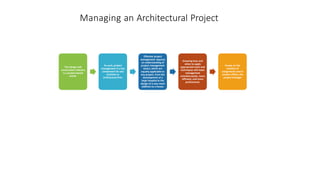
The design and
construction industry
is a project-based
world.
As such, project
management is a key
component for any
architect or
architecture firm.
Effective project
management requires
an understanding of
project management
basics, which are
equally applicable to
any project, from the
development of a
large hospital to the
design of a one-room
addition to a house.
Knowing how and
when to apply
appropriate tools and
techniques will make
management
activitieseasier, more
efficient, and more
professional.
Except on the
smallest of
assignments and in
smaller offices, the
project manager
Managing an
Architectural Project
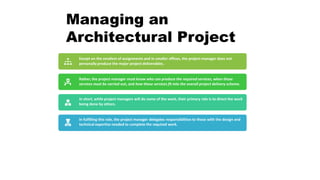
Except on the smallest of assignments and in smaller offices, the project manager does not
personally produce the major project deliverables.
Rather, the project manager must know who can produce the required services, when those
services must be carried out, and how those services fit into the overall project delivery scheme.
In short, while project managers will do some of the work, their primary role is to direct the work
being done by others.
In fulfilling this role, the project manager delegates responsibilities to those with the design and
technical expertise needed to complete the required work.
Managing an
Architectural Project
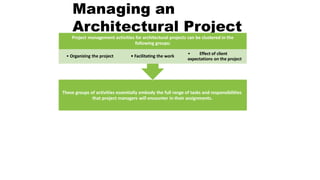
These groups of activities essentially embody the full range of tasks and responsibilities
that project managers will encounter in their assignments.
Project management activities for architectural projects can be clustered in the
following groups:
• Organizing the project • Facilitating the work
• Effect of client
expectations on the project
Managing Architectural
Project
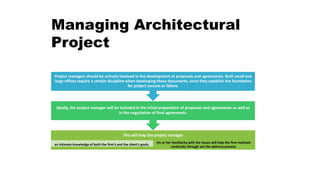
This will help the project manager
an intimate knowledge of both the firm’s and the client’s goals,
his or her familiarity with the issues will help the firm maintain
continuity through out the delivery process.
Ideally, the project manager will be included in the initial preparation of proposals and agreements as well as
in the negotiation of final agreements.
Project managers should be actively involved in the development of proposals and agreements. Both small and
large offices require a certain discipline when developing these documents, since they establish the foundation
for project success or failure.
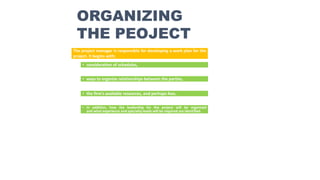
ORGANIZING
THE PEOJECT
The project manager is responsible for developing a work plan for the
project. It begins with;
• consideration of schedules,
• ways to organize relationships between the parties,
• the firm’s available resources, and perhaps fees.
• In addition, how the leadership for the project will be organized
and what experience and specialty levels will be required are identified.
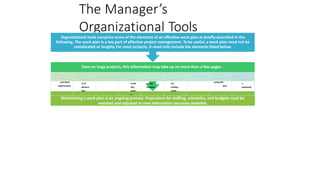
The Manager’s
Organizational Tools
Maintaining a work plan is an ongoing process. Projections for staffing, schedules, and budgets must be
revisited and adjusted as new information becomes available.
Even on large projects, this information may take up no more than a few pages.
1. Project
description
and client
requirements
2.
Stateme
nt of
delivera
bles
3. Team organization 4.
Resp
onsib
ility
matri
x
5.
Preliminary
project
schedule
6.
Prelimin
ary
staffing
needs
7. Project directory
8. Internal
project budget
and profit
plan
9. Code
informatio
n
(optional)
Organizational tools comprise some of the elements of an effective work plan as briefly described in the
following. The work plan is a key part of effective project management. To be useful, a work plan need not be
complicated or lengthy. For most projects, it need only include the elements listed below.
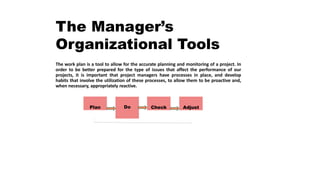
The Manager’s
Organizational Tools
The work plan is a tool to allow for the accurate planning and monitoring of a project. In
order to be better prepared for the type of issues that affect the performance of our
projects, it is important that project managers have processes in place, and develop
habits that involve the utilization of these processes, to allow them to be proactive and,
when necessary, appropriately reactive.
Plan Do Check Adjust
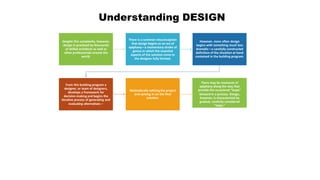
Understanding DESIGN
Despite this complexity, however,
design is practiced by thousands
of skilled architects as well as
other professionals around the
world.
There is a common misconception
that design begins as an act of
epiphany—a momentary stroke of
genius in which the essential
aspects of the solution come to
the designer fully formed.
However, more often design
begins with something much less
dramatic—a carefully constructed
definition of the situation at hand
contained in the building program.
From this building program a
designer, or team of designers,
develops a framework for
decision-making and begins the
iterative process of generating and
evaluating alternatives—
Methodically refining the project
and zeroing in on the final
solution.
There may be moments of
epiphany along the way that
provide the occasional “leaps”
forward in a process. Design,
however, is characterized by
gradual, carefully considered
“steps.”
DESIGN
PHASES
• Architectural design is the defining
and differentiating skill set of
architectural practice. It involves
translating the needs and aspirations
of the client into built form through
the creation of drawings and
specifications that define the work.
Understanding DESIGN
•While the best
solutions appear
simple, however,
the design
process is unique
and complex.
• Design is
simultaneously
intuitive—drawing
on personal
experience and
subjective artistic
judgment—as well
as rational,
drawing on
analysis and the
objective
integration of
functional and
technical
requirements.
Design, by its nature, is
multivalent. It involves
the integration of diverse,
often conflicting, project
requirements and
circumstances into a
gestalt—a whole greater
than the sum of its parts.
At its best, the result is a
solution that appears
simple, almost
inevitable—a functional,
cost-effective, and
beautiful resolution of
the client’s problem
appropriate to its place
and time.
Understanding DESIGN
Despite this complexity, however,
design is practiced by thousands
of skilled architects as well as
other professionals around the
world.
There is a common misconception
that design begins as an act of
epiphany—a momentary stroke of
genius in which the essential
aspects of the solution come to
the designer fully formed.
However, more often design
begins with something much less
dramatic—a carefully constructed
definition of the situation at hand
contained in the building program.
From this building program a
designer, or team of designers,
develops a framework for
decision-making and begins the
iterative process of generating and
evaluating alternatives—
Methodically refining the project
and zeroing in on the final
solution.
There may be moments of
epiphany along the way that
provide the occasional “leaps”
forward in a process. Design,
however, is characterized by
gradual, carefully considered
“steps.”
Understanding
DESIGN
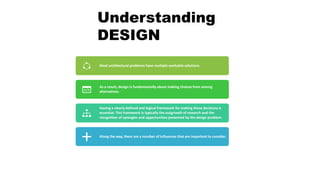
Most architectural problems have multiple workable solutions.
As a result, design is fundamentally about making choices from among
alternatives.
Having a clearly defined and logical framework for making these decisions is
essential. This framework is typically the outgrowth of research and the
recognition of synergies and opportunities presented by the design problem.
Along the way, there are a number of influences that are important to consider.
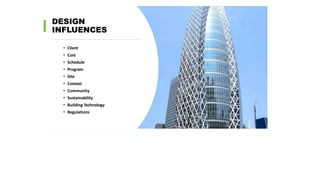
DESIGN
INFLUENCES
• Client
• Cost
• Schedule
• Program
• Site
• Context
• Community
• Sustainability
• Building Technology
• Regulations
THE DESIGN PROCESS
Design is a unique analytical
process that involves two
fundamental procedures:
• understanding a project’s
multiple parameters and
synthesizing these parameters
into a holistic strategy.
• While complex, the design
process is not impenetrable. It is
a rigorous, methodical process
of inquiry and invention.
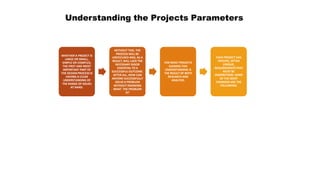
Understanding the Projects Parameters
WHETHER A PROJECT IS
LARGE OR SMALL,
SIMPLE OR COMPLEX,
THE FIRST AND MOST
IMPORTANT PART OF
THE DESIGN PROCESS IS
HAVING A CLEAR
UNDERSTANDING OF
THE RANGE OF ISSUES
AT HAND.
WITHOUT THIS, THE
PROCESS WILL BE
UNFOCUSED AND, AS A
RESULT, WILL LACK THE
NECESSARY RIGOR
ESSENTIAL TO A
SUCCESSFULOUTCOME.
AFTER ALL, HOW CAN
ANYONE SUCCESSFULLY
SOLVEA PROBLEM
WITHOUT KNOWING
WHAT THE PROBLEM
IS?
FOR MOST PROJECTS
GAINING THIS
UNDERSTANDING IS
THE RESULTOF BOTH
RESEARCH AND
ANALYSIS.
EACH PROJECT HAS
SPECIFIC, OFTEN
UNIQUE,
REQUIREMENTSTHAT
MUST BE
UNDERSTOOD. SOME
OF THE MOST
COMMON ARE THE
FOLLOWING;
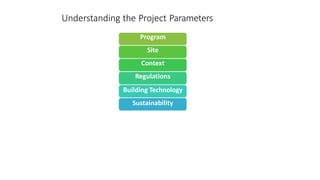
Understanding the Project Parameters
Program
Site
Context
Regulations
Building Technology
Sustainability
SYNTHESIS
The process of synthesis—drawing
together the analysis and
ultimately identifying the most
applicable resulting strategy for
exploration and refinement—is
what many, particularly the lay
public, consider design to be.
However, synthesis cannot take
place without a foundation of
careful analysis and
understanding.
Synthesis is a constituent process
of design that is increasingly a
collaborative endeavor. It often
involves a team of professionals
rather than a single architect.
To effectively marshal a team,
information and design values
must be commonly interpreted
and shared.
This is important to keep in mind
as we consider these following
steps.
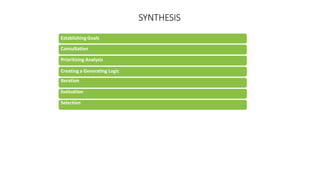
SYNTHESIS
Establishing Goals
Consultation
Prioritizing Analysis
Creating a Generating Logic
Iteration
Evaluation
Selection
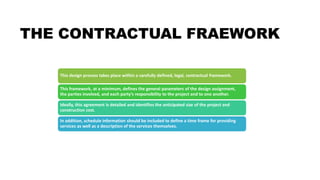
THE CONTRACTUAL FRAEWORK
This design process takes place within a carefully defined, legal, contractual framework.
This framework, at a minimum, defines the general parameters of the design assignment,
the parties involved, and each party’s responsibility to the project and to one another.
Ideally, this agreement is detailed and identifies the anticipated size of the project and
construction cost.
In addition, schedule information should be included to define a time frame for providing
services as well as a description of the services themselves.
THE CONTRACTUAL
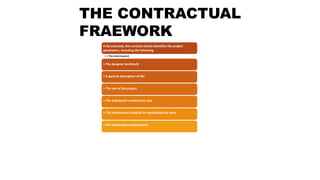
FRAEWORK
Fully executed, this contract clearly identifies the project
parameters, including the following:
• • The client (owner)
• The designer (architect)
• A general description of the
• The size of the project
• The anticipated construction cost
• The preliminary schedule for completing the work
• The anticipated compensation
THE CONTRACTUAL
FRAMEWORK
It legally describes a design process that moves through a series of
five established project phases in an orderly fashion, resulting in
greater and greater clarity and resolution of the design
solution. These phases are:
SCHEMATIC DESIGN
DESIGN DEVELOPMENT
CONSTRUCTIONDOCUMENTS
BIDDING AND NEGOTIATION
CONSTRUCTION CONTRACT ADMINISTRATION

all about starting your firm architecture

  • 1.
    Professional Practice &Ethics Managing An Architectural Project School of Architecture university of Lahore
  • 2.
    Managing an ArchitecturalProject The design and construction industry is a project-based world. As such, project management is a key component for any architect or architecture firm. Effective project management requires an understanding of project management basics, which are equally applicable to any project, from the development of a large hospital to the design of a one-room addition to a house. Knowing how and when to apply appropriate tools and techniques will make management activitieseasier, more efficient, and more professional. Except on the smallest of assignments and in smaller offices, the project manager
  • 3.
    Managing an Architectural Project Excepton the smallest of assignments and in smaller offices, the project manager does not personally produce the major project deliverables. Rather, the project manager must know who can produce the required services, when those services must be carried out, and how those services fit into the overall project delivery scheme. In short, while project managers will do some of the work, their primary role is to direct the work being done by others. In fulfilling this role, the project manager delegates responsibilities to those with the design and technical expertise needed to complete the required work.
  • 4.
    Managing an Architectural Project Thesegroups of activities essentially embody the full range of tasks and responsibilities that project managers will encounter in their assignments. Project management activities for architectural projects can be clustered in the following groups: • Organizing the project • Facilitating the work • Effect of client expectations on the project
  • 5.
    Managing Architectural Project This willhelp the project manager an intimate knowledge of both the firm’s and the client’s goals, his or her familiarity with the issues will help the firm maintain continuity through out the delivery process. Ideally, the project manager will be included in the initial preparation of proposals and agreements as well as in the negotiation of final agreements. Project managers should be actively involved in the development of proposals and agreements. Both small and large offices require a certain discipline when developing these documents, since they establish the foundation for project success or failure.
  • 6.
    ORGANIZING THE PEOJECT The projectmanager is responsible for developing a work plan for the project. It begins with; • consideration of schedules, • ways to organize relationships between the parties, • the firm’s available resources, and perhaps fees. • In addition, how the leadership for the project will be organized and what experience and specialty levels will be required are identified.
  • 7.
    The Manager’s Organizational Tools Maintaininga work plan is an ongoing process. Projections for staffing, schedules, and budgets must be revisited and adjusted as new information becomes available. Even on large projects, this information may take up no more than a few pages. 1. Project description and client requirements 2. Stateme nt of delivera bles 3. Team organization 4. Resp onsib ility matri x 5. Preliminary project schedule 6. Prelimin ary staffing needs 7. Project directory 8. Internal project budget and profit plan 9. Code informatio n (optional) Organizational tools comprise some of the elements of an effective work plan as briefly described in the following. The work plan is a key part of effective project management. To be useful, a work plan need not be complicated or lengthy. For most projects, it need only include the elements listed below.
  • 8.
    The Manager’s Organizational Tools Thework plan is a tool to allow for the accurate planning and monitoring of a project. In order to be better prepared for the type of issues that affect the performance of our projects, it is important that project managers have processes in place, and develop habits that involve the utilization of these processes, to allow them to be proactive and, when necessary, appropriately reactive. Plan Do Check Adjust
  • 9.
    Understanding DESIGN Despite thiscomplexity, however, design is practiced by thousands of skilled architects as well as other professionals around the world. There is a common misconception that design begins as an act of epiphany—a momentary stroke of genius in which the essential aspects of the solution come to the designer fully formed. However, more often design begins with something much less dramatic—a carefully constructed definition of the situation at hand contained in the building program. From this building program a designer, or team of designers, develops a framework for decision-making and begins the iterative process of generating and evaluating alternatives— Methodically refining the project and zeroing in on the final solution. There may be moments of epiphany along the way that provide the occasional “leaps” forward in a process. Design, however, is characterized by gradual, carefully considered “steps.”
  • 10.
    DESIGN PHASES • Architectural designis the defining and differentiating skill set of architectural practice. It involves translating the needs and aspirations of the client into built form through the creation of drawings and specifications that define the work.
  • 11.
    Understanding DESIGN •While thebest solutions appear simple, however, the design process is unique and complex. • Design is simultaneously intuitive—drawing on personal experience and subjective artistic judgment—as well as rational, drawing on analysis and the objective integration of functional and technical requirements. Design, by its nature, is multivalent. It involves the integration of diverse, often conflicting, project requirements and circumstances into a gestalt—a whole greater than the sum of its parts. At its best, the result is a solution that appears simple, almost inevitable—a functional, cost-effective, and beautiful resolution of the client’s problem appropriate to its place and time.
  • 12.
    Understanding DESIGN Despite thiscomplexity, however, design is practiced by thousands of skilled architects as well as other professionals around the world. There is a common misconception that design begins as an act of epiphany—a momentary stroke of genius in which the essential aspects of the solution come to the designer fully formed. However, more often design begins with something much less dramatic—a carefully constructed definition of the situation at hand contained in the building program. From this building program a designer, or team of designers, develops a framework for decision-making and begins the iterative process of generating and evaluating alternatives— Methodically refining the project and zeroing in on the final solution. There may be moments of epiphany along the way that provide the occasional “leaps” forward in a process. Design, however, is characterized by gradual, carefully considered “steps.”
  • 13.
    Understanding DESIGN Most architectural problemshave multiple workable solutions. As a result, design is fundamentally about making choices from among alternatives. Having a clearly defined and logical framework for making these decisions is essential. This framework is typically the outgrowth of research and the recognition of synergies and opportunities presented by the design problem. Along the way, there are a number of influences that are important to consider.
  • 14.
    DESIGN INFLUENCES • Client • Cost •Schedule • Program • Site • Context • Community • Sustainability • Building Technology • Regulations
  • 15.
    THE DESIGN PROCESS Designis a unique analytical process that involves two fundamental procedures: • understanding a project’s multiple parameters and synthesizing these parameters into a holistic strategy. • While complex, the design process is not impenetrable. It is a rigorous, methodical process of inquiry and invention.
  • 16.
    Understanding the ProjectsParameters WHETHER A PROJECT IS LARGE OR SMALL, SIMPLE OR COMPLEX, THE FIRST AND MOST IMPORTANT PART OF THE DESIGN PROCESS IS HAVING A CLEAR UNDERSTANDING OF THE RANGE OF ISSUES AT HAND. WITHOUT THIS, THE PROCESS WILL BE UNFOCUSED AND, AS A RESULT, WILL LACK THE NECESSARY RIGOR ESSENTIAL TO A SUCCESSFULOUTCOME. AFTER ALL, HOW CAN ANYONE SUCCESSFULLY SOLVEA PROBLEM WITHOUT KNOWING WHAT THE PROBLEM IS? FOR MOST PROJECTS GAINING THIS UNDERSTANDING IS THE RESULTOF BOTH RESEARCH AND ANALYSIS. EACH PROJECT HAS SPECIFIC, OFTEN UNIQUE, REQUIREMENTSTHAT MUST BE UNDERSTOOD. SOME OF THE MOST COMMON ARE THE FOLLOWING;
  • 17.
    Understanding the ProjectParameters Program Site Context Regulations Building Technology Sustainability
  • 18.
    SYNTHESIS The process ofsynthesis—drawing together the analysis and ultimately identifying the most applicable resulting strategy for exploration and refinement—is what many, particularly the lay public, consider design to be. However, synthesis cannot take place without a foundation of careful analysis and understanding. Synthesis is a constituent process of design that is increasingly a collaborative endeavor. It often involves a team of professionals rather than a single architect. To effectively marshal a team, information and design values must be commonly interpreted and shared. This is important to keep in mind as we consider these following steps.
  • 19.
    SYNTHESIS Establishing Goals Consultation Prioritizing Analysis Creatinga Generating Logic Iteration Evaluation Selection
  • 20.
    THE CONTRACTUAL FRAEWORK Thisdesign process takes place within a carefully defined, legal, contractual framework. This framework, at a minimum, defines the general parameters of the design assignment, the parties involved, and each party’s responsibility to the project and to one another. Ideally, this agreement is detailed and identifies the anticipated size of the project and construction cost. In addition, schedule information should be included to define a time frame for providing services as well as a description of the services themselves.
  • 21.
    THE CONTRACTUAL FRAEWORK Fully executed,this contract clearly identifies the project parameters, including the following: • • The client (owner) • The designer (architect) • A general description of the • The size of the project • The anticipated construction cost • The preliminary schedule for completing the work • The anticipated compensation
  • 22.
    THE CONTRACTUAL FRAMEWORK It legallydescribes a design process that moves through a series of five established project phases in an orderly fashion, resulting in greater and greater clarity and resolution of the design solution. These phases are: SCHEMATIC DESIGN DESIGN DEVELOPMENT CONSTRUCTIONDOCUMENTS BIDDING AND NEGOTIATION CONSTRUCTION CONTRACT ADMINISTRATION