3DIR: Three-dimensional
Information Retrieval from 3D
Building Information
Modelling Environments
Dr Peter Demian, Dr Kirti Ruikar, Prof Anne Morris
Presented by Peter Demian, BIM2015, Thursday 9-11 September 2015, UWE Bristol
Look for this presentation on SlideShare.net
Outline
• The Problem
• Literature
– BIM and CAD
– Information Retrieval
– Information Visualisation
– Human Cognition
• Method
• 3DIR Needs
• 3DIR Prototype
• Evaluation & Conclusions
The Problem: Information Overload
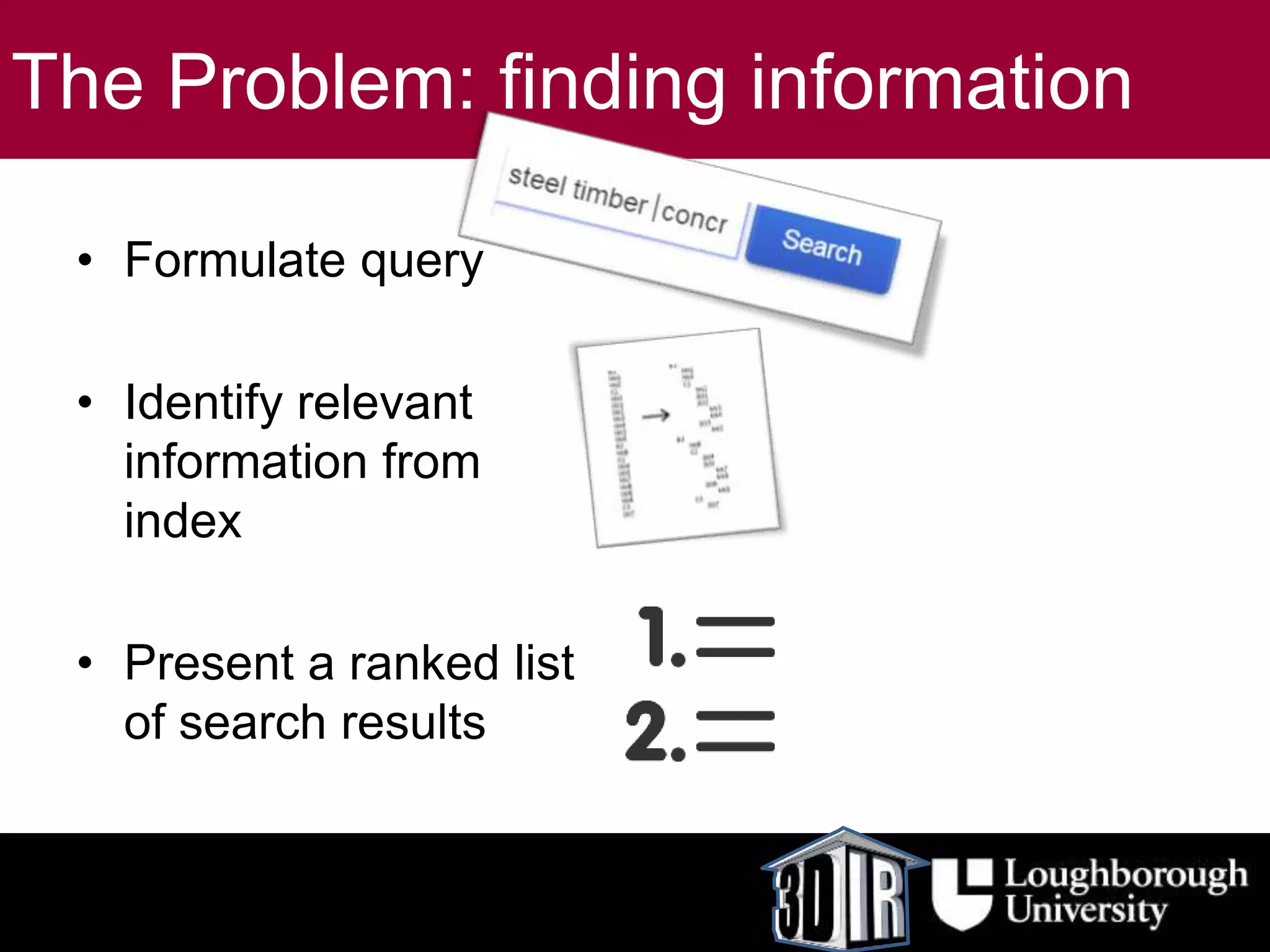
The Problem: finding information
• Formulate query
• Identify relevant
information from
index
• Present a ranked list
of search results
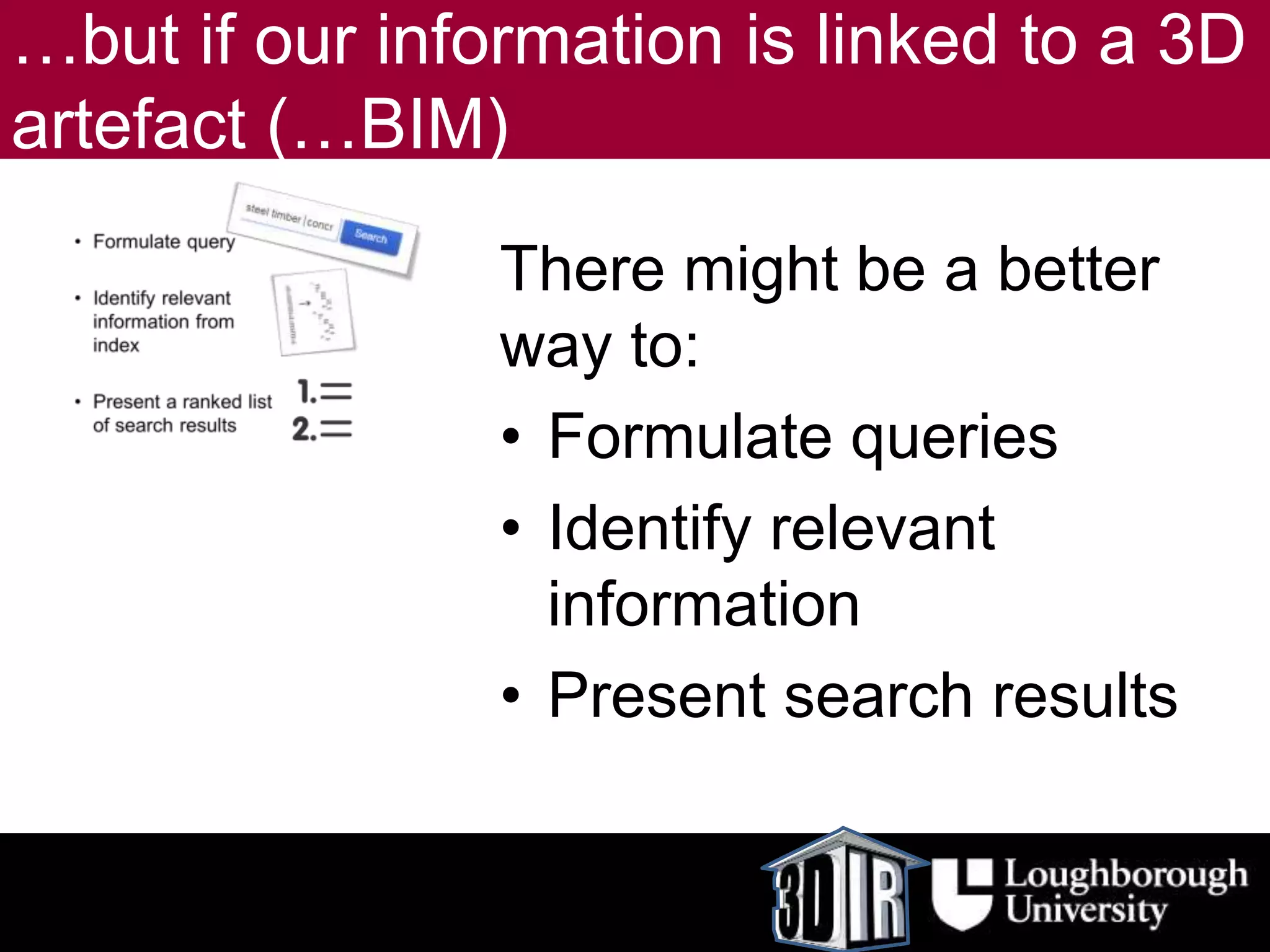
…but if our information is linked to a 3D
artefact (…BIM)
There might be a better
way to:
• Formulate queries
• Identify relevant
information
• Present search results
Literature: BIM and CAD
• CAD models: geometry
• BIM models can contain much more
information
– Attributes of 3D objects
– Nongeometric objects
• 3D model not fully exploited as a visual
index, no information scent (Pirolli &Card
1999)
Literature: Information Retrieval
• IR techniques usually applied to text
intensive situations
• Can also work for BIM, less text (Demian
&Fruchter 2005)
Literature: Information Visualisation
• “The use of visual representations to amplify
cognition” (Card et al. 1999)
• Visualisation data in 1D, 2D… nD
• Visualisation of documents: single docs,
small collections, the whole WWW
• No attention to doc collections about 3D
artefacts
• No integration between doc↔3D visualisation
Literature: Human Cognition
• Applying IV and IR to BIM exploits human
cognitive strengths
• Visual properties important in recall,
recognition, categorisation (Lansdale
1988)
• Systems have been developed to exploit
this
• Untapped potential for application in BIM
Research Method
• “Needs” workshops at “Architects” and
“Contractors”
• Scenario-Based Design (Rosson &Carroll
2001)
• Prototype development
• “Evaluation” workshops
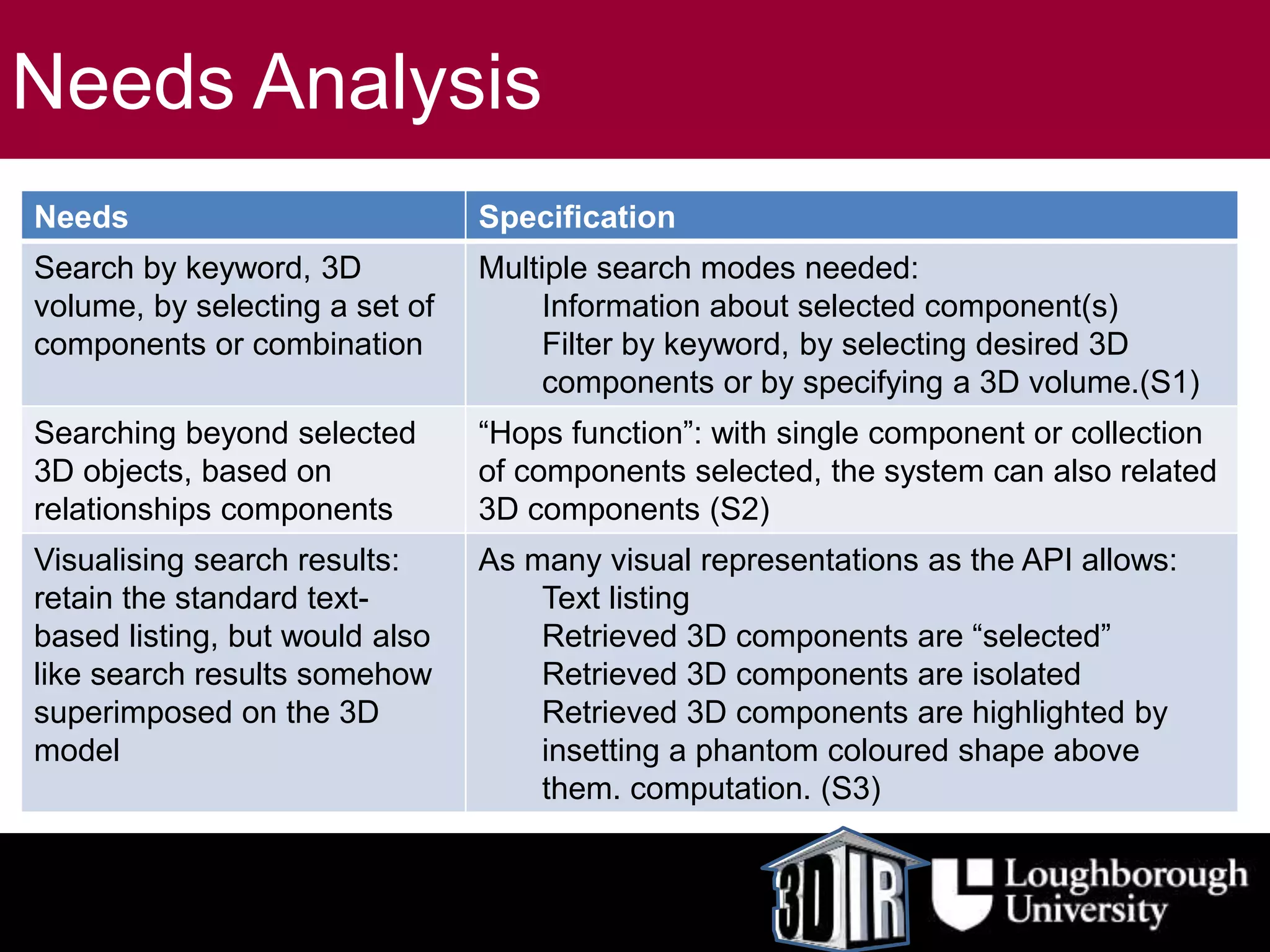
Needs Analysis
Needs Specification
Search by keyword, 3D
volume, by selecting a set of
components or combination
Multiple search modes needed:
Information about selected component(s)
Filter by keyword, by selecting desired 3D
components or by specifying a 3D volume.(S1)
Searching beyond selected
3D objects, based on
relationships components
“Hops function”: with single component or collection
of components selected, the system can also related
3D components (S2)
Visualising search results:
retain the standard text-
based listing, but would also
like search results somehow
superimposed on the 3D
model
As many visual representations as the API allows:
Text listing
Retrieved 3D components are “selected”
Retrieved 3D components are isolated
Retrieved 3D components are highlighted by
insetting a phantom coloured shape above
them. computation. (S3)
Prototype Development
• Autodesk Revit platform, good API,
technical support
• C# .NET API
• Apache Lucene open source library for IR
functions
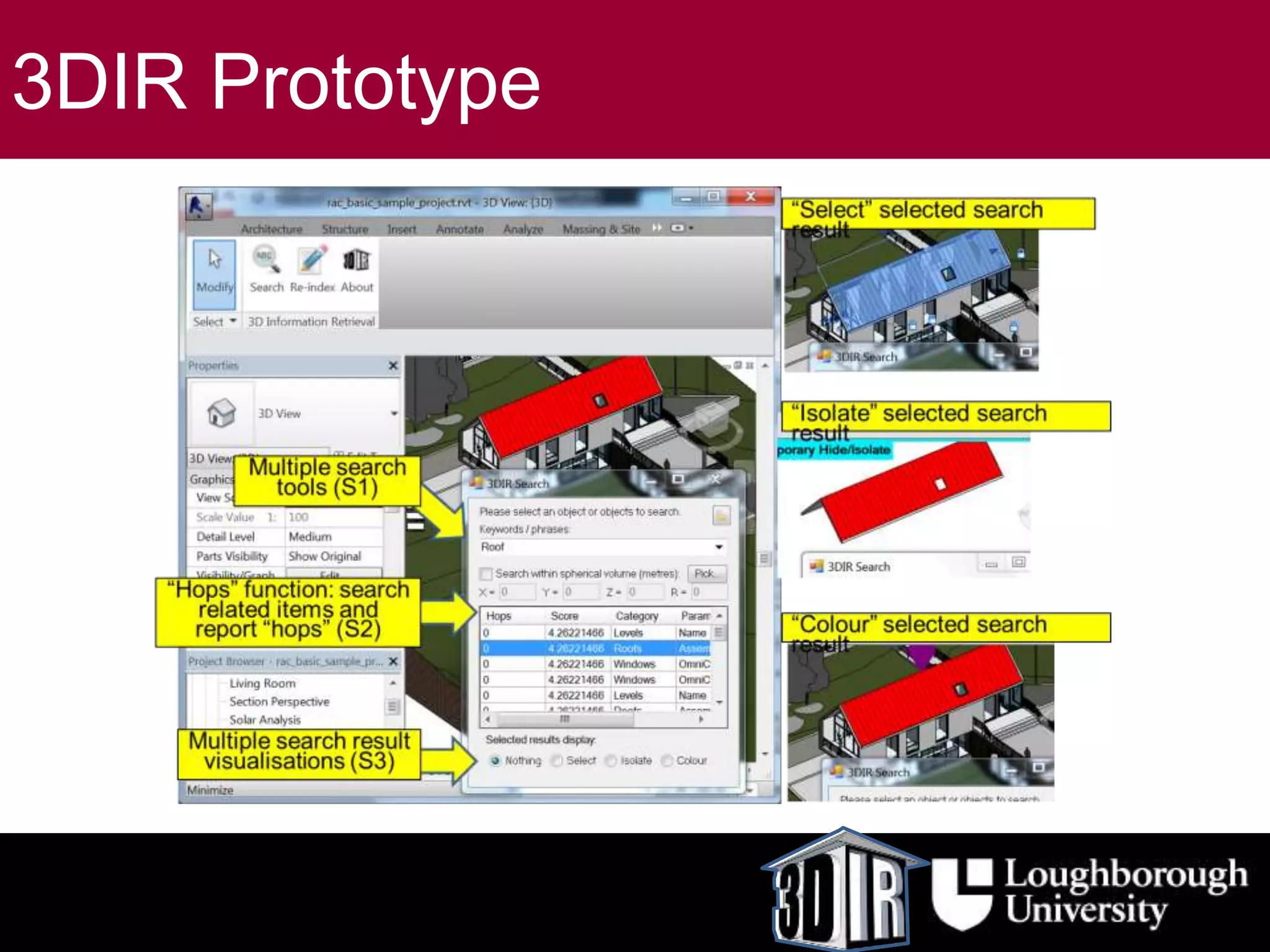
3DIR Prototype
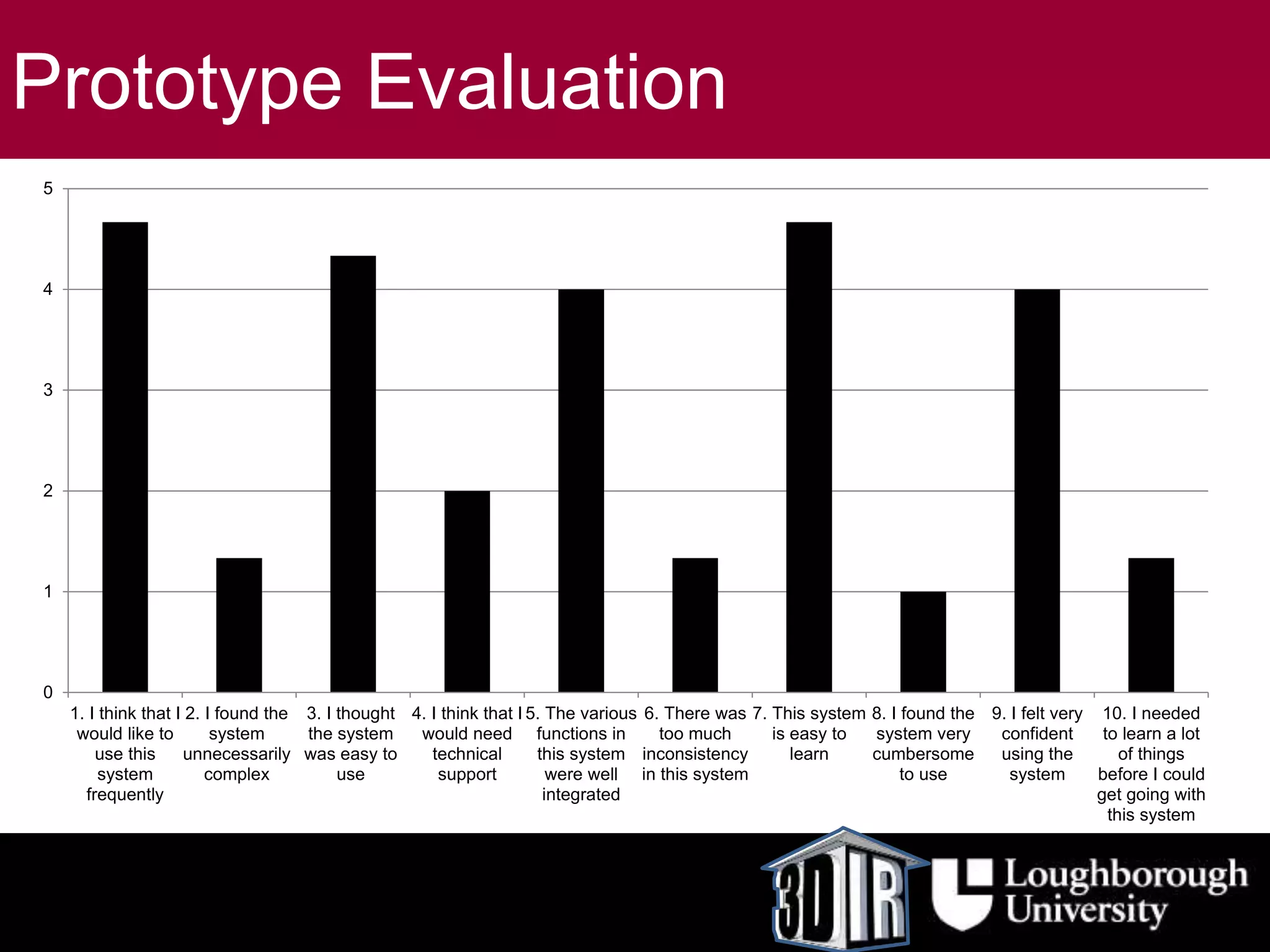
Prototype Evaluation
0
1
2
3
4
5
1. I think that I
would like to
use this
system
frequently
2. I found the
system
unnecessarily
complex
3. I thought
the system
was easy to
use
4. I think that I
would need
technical
support
5. The various
functions in
this system
were well
integrated
6. There was
too much
inconsistency
in this system
7. This system
is easy to
learn
8. I found the
system very
cumbersome
to use
9. I felt very
confident
using the
system
10. I needed
to learn a lot
of things
before I could
get going with
this system
Conclusions
• Links in BIMs to external information
(documents) can be exploited
• Links not yet common but growing
prevalence
• Relationships between 3D objects
exploited
• Tighter coupling between 3D model and
linked information
Thank you. Questions?
Acknowledgements
– Late Dr Ann O’Brien
– Royal Society, Brian Mercer Feasibility Award
– Enterprise Office at Loughborough University and Higher
Education Innovation Fund
– Autodesk Developer Network
– Software development by Neil Sutton at Adris, part of the
Graitec group.
– Tom Claridge, research support
•http://www.3dir.org/
References
• Card, S. K., Mackinlay, J. D., & Shneiderman, B. (Eds.).
(1999). Readings in information visualization: using vision to
think. Morgan Kaufmann.
• Demian, P., & Fruchter, R. (2005). Measuring relevance in
support of design reuse from archives of building product
models. Journal of computing in civil engineering, 19(2), 119-
136.
• Lansdale, M. W. (1988). The psychology of personal
information management. Applied ergonomics, 19(1), 55-66.
• Pirolli, P., & Card, S. (1999). Information foraging.
Psychological review, 106(4), 643.
• Rosson, M. B., & Carroll, J. M. (2001). Usability engineering:
scenario-based development of human-computer interaction.
Elsevier.

3DIR Presentation at BIM2015 Conference

  • 1.
    3DIR: Three-dimensional Information Retrievalfrom 3D Building Information Modelling Environments Dr Peter Demian, Dr Kirti Ruikar, Prof Anne Morris Presented by Peter Demian, BIM2015, Thursday 9-11 September 2015, UWE Bristol Look for this presentation on SlideShare.net
  • 2.
    Outline • The Problem •Literature – BIM and CAD – Information Retrieval – Information Visualisation – Human Cognition • Method • 3DIR Needs • 3DIR Prototype • Evaluation & Conclusions
  • 3.
  • 4.
    The Problem: findinginformation • Formulate query • Identify relevant information from index • Present a ranked list of search results
  • 5.
    …but if ourinformation is linked to a 3D artefact (…BIM) There might be a better way to: • Formulate queries • Identify relevant information • Present search results
  • 6.
    Literature: BIM andCAD • CAD models: geometry • BIM models can contain much more information – Attributes of 3D objects – Nongeometric objects • 3D model not fully exploited as a visual index, no information scent (Pirolli &Card 1999)
  • 7.
    Literature: Information Retrieval •IR techniques usually applied to text intensive situations • Can also work for BIM, less text (Demian &Fruchter 2005)
  • 8.
    Literature: Information Visualisation •“The use of visual representations to amplify cognition” (Card et al. 1999) • Visualisation data in 1D, 2D… nD • Visualisation of documents: single docs, small collections, the whole WWW • No attention to doc collections about 3D artefacts • No integration between doc↔3D visualisation
  • 9.
    Literature: Human Cognition •Applying IV and IR to BIM exploits human cognitive strengths • Visual properties important in recall, recognition, categorisation (Lansdale 1988) • Systems have been developed to exploit this • Untapped potential for application in BIM
  • 10.
    Research Method • “Needs”workshops at “Architects” and “Contractors” • Scenario-Based Design (Rosson &Carroll 2001) • Prototype development • “Evaluation” workshops
  • 11.
    Needs Analysis Needs Specification Searchby keyword, 3D volume, by selecting a set of components or combination Multiple search modes needed: Information about selected component(s) Filter by keyword, by selecting desired 3D components or by specifying a 3D volume.(S1) Searching beyond selected 3D objects, based on relationships components “Hops function”: with single component or collection of components selected, the system can also related 3D components (S2) Visualising search results: retain the standard text- based listing, but would also like search results somehow superimposed on the 3D model As many visual representations as the API allows: Text listing Retrieved 3D components are “selected” Retrieved 3D components are isolated Retrieved 3D components are highlighted by insetting a phantom coloured shape above them. computation. (S3)
  • 12.
    Prototype Development • AutodeskRevit platform, good API, technical support • C# .NET API • Apache Lucene open source library for IR functions
  • 13.
  • 14.
    Prototype Evaluation 0 1 2 3 4 5 1. Ithink that I would like to use this system frequently 2. I found the system unnecessarily complex 3. I thought the system was easy to use 4. I think that I would need technical support 5. The various functions in this system were well integrated 6. There was too much inconsistency in this system 7. This system is easy to learn 8. I found the system very cumbersome to use 9. I felt very confident using the system 10. I needed to learn a lot of things before I could get going with this system
  • 15.
    Conclusions • Links inBIMs to external information (documents) can be exploited • Links not yet common but growing prevalence • Relationships between 3D objects exploited • Tighter coupling between 3D model and linked information
  • 16.
    Thank you. Questions? Acknowledgements –Late Dr Ann O’Brien – Royal Society, Brian Mercer Feasibility Award – Enterprise Office at Loughborough University and Higher Education Innovation Fund – Autodesk Developer Network – Software development by Neil Sutton at Adris, part of the Graitec group. – Tom Claridge, research support •http://www.3dir.org/
  • 17.
    References • Card, S.K., Mackinlay, J. D., & Shneiderman, B. (Eds.). (1999). Readings in information visualization: using vision to think. Morgan Kaufmann. • Demian, P., & Fruchter, R. (2005). Measuring relevance in support of design reuse from archives of building product models. Journal of computing in civil engineering, 19(2), 119- 136. • Lansdale, M. W. (1988). The psychology of personal information management. Applied ergonomics, 19(1), 55-66. • Pirolli, P., & Card, S. (1999). Information foraging. Psychological review, 106(4), 643. • Rosson, M. B., & Carroll, J. M. (2001). Usability engineering: scenario-based development of human-computer interaction. Elsevier.