JAWAHARLAL NEHRU TECHNOLOGICAL UNIVERSITY KAKINADA
UNIVERSITY COLLEGE OF ENGINEERING KAKINADA(A)
Department of Petroleum and Petrochemical Engineering
First project review on
DESIGN AND SIMULATION OF DIVIDED WALL COLUMN FOR THE SEPARATION OF REFORMATE
By
T. HARI KIRAN
(15021A2529)
Under the guidance of
Prof. K. V. RAO
Programme Director
Petroleum courses
 CONTENTS
Introduction.
What is reformate?
Properties of BTX aromatics.
Uses of BTX aromatics.
Literature survey.
Future work.
References.
 INTRODUCTION
Distillation is the most important industrial separation technology.
It accounts for more than 50% of the operating costs of a Petrochemical plant.
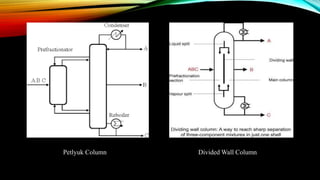
A Petlyuk column consists of a prefractionator with reflux and boil up from the downstream three- product column,
a setup with only one reboiler and one condenser.
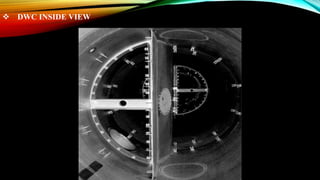
Dividing wall column (DWC) is a single shell, fully thermally coupled distillation column capable of separating
mixtures of three or more components into high purity products.
The Petlyuk column or a DWC can save between 20 to 40% of the reboiler duty.
In 2005, at the 7th World Congress of Chemical Engineering, BASF, a leader in DWC implementation, reported
more than 40 DWC in commercial service.
In 2006, ExxonMobil announced the successful revamp of a 380-cm/430-cm-diameter tower that removes xylene
from reformate.
There are now more than 100 columns installed worldwide.
Petlyuk Column Divided Wall Column
 DWC INSIDE VIEW
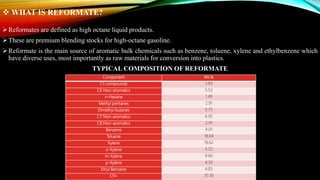
 WHAT IS REFORMATE?
Reformates are defined as high octane liquid products.
These are premium blending stocks for high-octane gasoline.
Reformate is the main source of aromatic bulk chemicals such as benzene, toluene, xylene and ethylbenzene which
have diverse uses, most importantly as raw materials for conversion into plastics.
TYPICAL COMPOSITION OF REFORMATE
Component Wt.%
C5 compounds 3.83
C6 Non-aromatics 5.52
n-Hexane 1.49
Methyl pentanes 2.91
Dimethyl butanes 0.75
C7 Non-aromatics 6.92
C8 Non-aromatics 2.91
Benzene 4.01
Toluene 18.04
Xylene 19.62
o-Xylene 5.72
m-Xylene 9.60
p-Xylene 4.30
Ethyl Benzene 4.05
C9+ 35.10
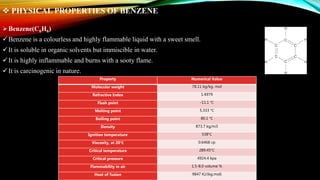
 PHYSICAL PROPERTIES OF BENZENE
Benzene(C6H6)
Benzene is a colourless and highly flammable liquid with a sweet smell.
It is soluble in organic solvents but immiscible in water.
It is highly inflammable and burns with a sooty flame.
It is carcinogenic in nature.
Property Numerical Value
Molecular weight 78.11 kg/kg. mol
Refractive Index 1.4979
Flash point -11.1 °C
Melting point 5.333 °C
Boiling point 80.1 °C
Density 873.7 kg/m3
Ignition temperature 538°C
Viscosity, at 20°C 0.6468 cp
Critical temperature 289.45°C
Critical pressure 4924.4 kpa
Flammability in air 1.5-8.0 volume %
Heat of fusion 9847 KJ/(kg.mol)
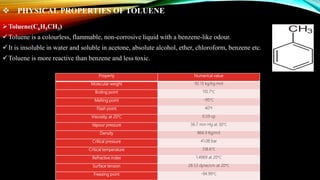
 PHYSICAL PROPERTIES OF TOLUENE
Toluene(C6H5CH3)
Toluene is a colourless, flammable, non-corrosive liquid with a benzene-like odour.
It is insoluble in water and soluble in acetone, absolute alcohol, ether, chloroform, benzene etc.
Toluene is more reactive than benzene and less toxic.
Property Numerical value
Molecular weight 92.13 kg/kg.mol
Boiling point 110.7°C
Melting point -95°C
Flash point 40°F
Viscosity, at 20°C 0.59 cp
Vapour pressure 36.7 mm Hg at 30°C
Density 866.9 Kg/m3
Critical pressure 41.08 bar
Critical temperature 318.6°C
Refractive index 1.4969 at 20°C
Surface tension 28.53 dyne/cm at 20°C
Freezing point -94.99°C
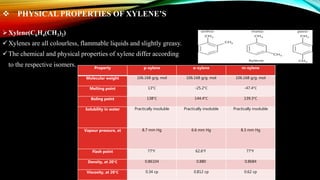
 PHYSICAL PROPERTIES OF XYLENE’S
Xylene(C6H4(CH3)2)
Xylenes are all colourless, flammable liquids and slightly greasy.
The chemical and physical properties of xylene differ according
to the respective isomers. Property p-xylene o-xylene m-xylene
Molecular weight 106.168 g/g. mol 106.168 g/g. mol 106.168 g/g. mol
Melting point 13°C -25.2°C -47.4°C
Boling point 138°C 144.4°C 139.3°C
Solubility in water Practically insoluble Practically insoluble Practically insoluble
Vapour pressure, at 8.7 mm Hg 6.6 mm Hg 8.3 mm Hg
Flash point 77°F 62.6°F 77°F
Density, at 20°C 0.86104 0.880 0.8684
Viscosity, at 20°C 0.34 cp 0.812 cp 0.62 cp
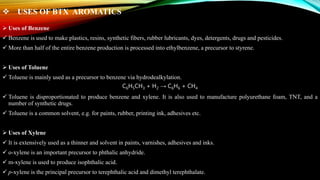
 USES OF BTX AROMATICS
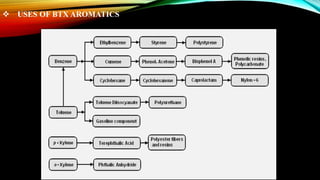
 Uses of Benzene
 Benzene is used to make plastics, resins, synthetic fibers, rubber lubricants, dyes, detergents, drugs and pesticides.
 More than half of the entire benzene production is processed into ethylbenzene, a precursor to styrene.
 Uses of Toluene
 Toluene is mainly used as a precursor to benzene via hydrodealkylation.
C6H5CH3 + H2 → C6H6 + CH4
 Toluene is disproportionated to produce benzene and xylene. It is also used to manufacture polyurethane foam, TNT, and a
number of synthetic drugs.
 Toluene is a common solvent, e.g. for paints, rubber, printing ink, adhesives etc.
 Uses of Xylene
 It is extensively used as a thinner and solvent in paints, varnishes, adhesives and inks.
 o-xylene is an important precursor to phthalic anhydride.
 m-xylene is used to produce isophthalic acid.
 p-xylene is the principal precursor to terephthalic acid and dimethyl terephthalate.
 USES OF BTX AROMATICS
 LITERATURE SURVEY
Concept of divided wall column
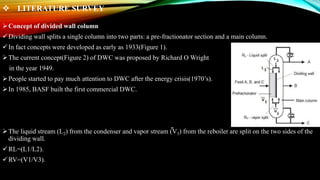
Dividing wall splits a single column into two parts: a pre-fractionator section and a main column.
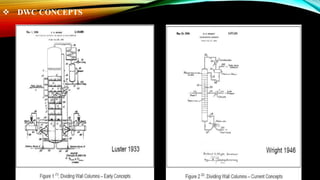
In fact concepts were developed as early as 1933(Figure 1).
The current concept(Figure 2) of DWC was proposed by Richard O Wright
in the year 1949.
People started to pay much attention to DWC after the energy crisis(1970’s).
In 1985, BASF built the first commercial DWC.
The liquid stream (L2) from the condenser and vapor stream (̅̅̅̅̅̅̅̅̅
V3) from the reboiler are split on the two sides of the
dividing wall.
RL=(L1/L2).
RV=(V1/V3).
 DWC CONCEPTS
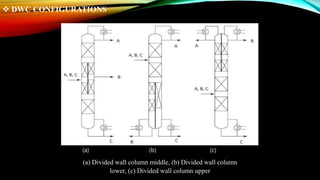
 DWC CONFIGURATIONS
(a) (b) (c)
(a) Divided wall column middle, (b) Divided wall column
lower, (c) Divided wall column upper
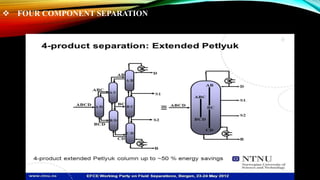
 FOUR COMPONENT SEPARATION
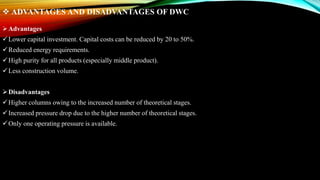
 ADVANTAGES AND DISADVANTAGES OF DWC
Advantages
Lower capital investment. Capital costs can be reduced by 20 to 50%.
Reduced energy requirements.
High purity for all products (especially middle product).
Less construction volume.
Disadvantages
Higher columns owing to the increased number of theoretical stages.
Increased pressure drop due to the higher number of theoretical stages.
Only one operating pressure is available.
 INDUSTRIAL APPLICATIONS OF DWC
Company System Constructor and year Features
BASF, diverse sites Undisclosed Majority of columns are
built by Montz Gmbh.
First commercial DWC in
1985
More than 70 DWCs
Diameter 0,6–4 m
Operating pressure 2 mbar
to 10 bar
Sasol, Johannesburg, South
Africa
Separation of hydrocarbons
from Fischer-Tropsch
synthesis unit
Linde AG in 1999 World largest DWC
Height 107 m
Diameter 5 m
Veba Oel Ag, Munchs
munster, Germany
Separation of benzene
pyrolysis gasoline
Uhde in 1999 170,000 mt/year feed
capacity
Saudi Chevron
Petrochemical, Al Jubail,
Saudi Arabia
Undisclosed Uhde in 2000 140,000 mt/year feed
capacity
Exxon mobil, Rotterdam,
Netherlands
Benezne-Toluene-Xylene
fractionation
Was planned for 2008 Undisclosed
 FUTURE WORK
Material balance.
Energy balance.
Equipment design.
Health, Safety and environmental aspects.
Instrumentation and process control.
Plant location & layout.
Cost estimation.
Conclusion.
Bibliography.
 REFERENCES
Asprion, N., Kaibel, G. (2010). Dividing wall columns: Fundamentals and recent advances. Chemical Engineering
and Processing: Process Intensidication.
Dejanović, I., Matijašević, L., & Olujić, Ž. (2010). Dividing wall column—a breakthrough towards sustainable
distilling. Chemical Engineering and Processing: Process Intensification.
Wright, R.O, 1946, Fractionation Apparatus, US patent No. 2471134, 1949.
Yildirim, Ö., Kiss, A. A., & Kenig, E. Y. (2011). Dividing wall columns in chemical process industry: A review on
current activities. Separation and Purification Technology.
Consider Dividing Wall Columns , by John G. Pendergast, David Vickery, Patrick Au-Yeung and Joe Anderson,
The Dow Chemical Company, Dec 19, 2008
http://seperationtechnology.com/dividing-wall-distillation/
https://en.wikipedia.org/wiki/Catalytic_reforming
https://en.wikipedia.org/wiki/BTX_(chemistry)
https://www.researchgate.net/publication/243803667_A_Method_for_the_Design_of_Divided_Wall_Columns
https://www.researchgate.net/publication/315787212_Simulation_and_Analysis_of_Divided_Wall_Column_for_En
ergy_Efficient_and_Intensified_Distillation

THANKYOU

Design and Simulation of Divided Wall Column

  • 1.
    JAWAHARLAL NEHRU TECHNOLOGICALUNIVERSITY KAKINADA UNIVERSITY COLLEGE OF ENGINEERING KAKINADA(A) Department of Petroleum and Petrochemical Engineering First project review on DESIGN AND SIMULATION OF DIVIDED WALL COLUMN FOR THE SEPARATION OF REFORMATE By T. HARI KIRAN (15021A2529) Under the guidance of Prof. K. V. RAO Programme Director Petroleum courses
  • 2.
     CONTENTS Introduction. What isreformate? Properties of BTX aromatics. Uses of BTX aromatics. Literature survey. Future work. References.
  • 3.
     INTRODUCTION Distillation isthe most important industrial separation technology. It accounts for more than 50% of the operating costs of a Petrochemical plant. A Petlyuk column consists of a prefractionator with reflux and boil up from the downstream three- product column, a setup with only one reboiler and one condenser. Dividing wall column (DWC) is a single shell, fully thermally coupled distillation column capable of separating mixtures of three or more components into high purity products. The Petlyuk column or a DWC can save between 20 to 40% of the reboiler duty. In 2005, at the 7th World Congress of Chemical Engineering, BASF, a leader in DWC implementation, reported more than 40 DWC in commercial service. In 2006, ExxonMobil announced the successful revamp of a 380-cm/430-cm-diameter tower that removes xylene from reformate. There are now more than 100 columns installed worldwide.
  • 4.
  • 5.
  • 6.
     WHAT ISREFORMATE? Reformates are defined as high octane liquid products. These are premium blending stocks for high-octane gasoline. Reformate is the main source of aromatic bulk chemicals such as benzene, toluene, xylene and ethylbenzene which have diverse uses, most importantly as raw materials for conversion into plastics. TYPICAL COMPOSITION OF REFORMATE Component Wt.% C5 compounds 3.83 C6 Non-aromatics 5.52 n-Hexane 1.49 Methyl pentanes 2.91 Dimethyl butanes 0.75 C7 Non-aromatics 6.92 C8 Non-aromatics 2.91 Benzene 4.01 Toluene 18.04 Xylene 19.62 o-Xylene 5.72 m-Xylene 9.60 p-Xylene 4.30 Ethyl Benzene 4.05 C9+ 35.10
  • 7.
     PHYSICAL PROPERTIESOF BENZENE Benzene(C6H6) Benzene is a colourless and highly flammable liquid with a sweet smell. It is soluble in organic solvents but immiscible in water. It is highly inflammable and burns with a sooty flame. It is carcinogenic in nature. Property Numerical Value Molecular weight 78.11 kg/kg. mol Refractive Index 1.4979 Flash point -11.1 °C Melting point 5.333 °C Boiling point 80.1 °C Density 873.7 kg/m3 Ignition temperature 538°C Viscosity, at 20°C 0.6468 cp Critical temperature 289.45°C Critical pressure 4924.4 kpa Flammability in air 1.5-8.0 volume % Heat of fusion 9847 KJ/(kg.mol)
  • 8.
     PHYSICAL PROPERTIESOF TOLUENE Toluene(C6H5CH3) Toluene is a colourless, flammable, non-corrosive liquid with a benzene-like odour. It is insoluble in water and soluble in acetone, absolute alcohol, ether, chloroform, benzene etc. Toluene is more reactive than benzene and less toxic. Property Numerical value Molecular weight 92.13 kg/kg.mol Boiling point 110.7°C Melting point -95°C Flash point 40°F Viscosity, at 20°C 0.59 cp Vapour pressure 36.7 mm Hg at 30°C Density 866.9 Kg/m3 Critical pressure 41.08 bar Critical temperature 318.6°C Refractive index 1.4969 at 20°C Surface tension 28.53 dyne/cm at 20°C Freezing point -94.99°C
  • 9.
     PHYSICAL PROPERTIESOF XYLENE’S Xylene(C6H4(CH3)2) Xylenes are all colourless, flammable liquids and slightly greasy. The chemical and physical properties of xylene differ according to the respective isomers. Property p-xylene o-xylene m-xylene Molecular weight 106.168 g/g. mol 106.168 g/g. mol 106.168 g/g. mol Melting point 13°C -25.2°C -47.4°C Boling point 138°C 144.4°C 139.3°C Solubility in water Practically insoluble Practically insoluble Practically insoluble Vapour pressure, at 8.7 mm Hg 6.6 mm Hg 8.3 mm Hg Flash point 77°F 62.6°F 77°F Density, at 20°C 0.86104 0.880 0.8684 Viscosity, at 20°C 0.34 cp 0.812 cp 0.62 cp
  • 10.
     USES OFBTX AROMATICS  Uses of Benzene  Benzene is used to make plastics, resins, synthetic fibers, rubber lubricants, dyes, detergents, drugs and pesticides.  More than half of the entire benzene production is processed into ethylbenzene, a precursor to styrene.  Uses of Toluene  Toluene is mainly used as a precursor to benzene via hydrodealkylation. C6H5CH3 + H2 → C6H6 + CH4  Toluene is disproportionated to produce benzene and xylene. It is also used to manufacture polyurethane foam, TNT, and a number of synthetic drugs.  Toluene is a common solvent, e.g. for paints, rubber, printing ink, adhesives etc.  Uses of Xylene  It is extensively used as a thinner and solvent in paints, varnishes, adhesives and inks.  o-xylene is an important precursor to phthalic anhydride.  m-xylene is used to produce isophthalic acid.  p-xylene is the principal precursor to terephthalic acid and dimethyl terephthalate.
  • 11.
     USES OFBTX AROMATICS
  • 12.
     LITERATURE SURVEY Conceptof divided wall column Dividing wall splits a single column into two parts: a pre-fractionator section and a main column. In fact concepts were developed as early as 1933(Figure 1). The current concept(Figure 2) of DWC was proposed by Richard O Wright in the year 1949. People started to pay much attention to DWC after the energy crisis(1970’s). In 1985, BASF built the first commercial DWC. The liquid stream (L2) from the condenser and vapor stream (̅̅̅̅̅̅̅̅̅ V3) from the reboiler are split on the two sides of the dividing wall. RL=(L1/L2). RV=(V1/V3).
  • 13.
  • 14.
     DWC CONFIGURATIONS (a)(b) (c) (a) Divided wall column middle, (b) Divided wall column lower, (c) Divided wall column upper
  • 15.
  • 16.
     ADVANTAGES ANDDISADVANTAGES OF DWC Advantages Lower capital investment. Capital costs can be reduced by 20 to 50%. Reduced energy requirements. High purity for all products (especially middle product). Less construction volume. Disadvantages Higher columns owing to the increased number of theoretical stages. Increased pressure drop due to the higher number of theoretical stages. Only one operating pressure is available.
  • 17.
     INDUSTRIAL APPLICATIONSOF DWC Company System Constructor and year Features BASF, diverse sites Undisclosed Majority of columns are built by Montz Gmbh. First commercial DWC in 1985 More than 70 DWCs Diameter 0,6–4 m Operating pressure 2 mbar to 10 bar Sasol, Johannesburg, South Africa Separation of hydrocarbons from Fischer-Tropsch synthesis unit Linde AG in 1999 World largest DWC Height 107 m Diameter 5 m Veba Oel Ag, Munchs munster, Germany Separation of benzene pyrolysis gasoline Uhde in 1999 170,000 mt/year feed capacity Saudi Chevron Petrochemical, Al Jubail, Saudi Arabia Undisclosed Uhde in 2000 140,000 mt/year feed capacity Exxon mobil, Rotterdam, Netherlands Benezne-Toluene-Xylene fractionation Was planned for 2008 Undisclosed
  • 18.
     FUTURE WORK Materialbalance. Energy balance. Equipment design. Health, Safety and environmental aspects. Instrumentation and process control. Plant location & layout. Cost estimation. Conclusion. Bibliography.
  • 19.
     REFERENCES Asprion, N.,Kaibel, G. (2010). Dividing wall columns: Fundamentals and recent advances. Chemical Engineering and Processing: Process Intensidication. Dejanović, I., Matijašević, L., & Olujić, Ž. (2010). Dividing wall column—a breakthrough towards sustainable distilling. Chemical Engineering and Processing: Process Intensification. Wright, R.O, 1946, Fractionation Apparatus, US patent No. 2471134, 1949. Yildirim, Ö., Kiss, A. A., & Kenig, E. Y. (2011). Dividing wall columns in chemical process industry: A review on current activities. Separation and Purification Technology. Consider Dividing Wall Columns , by John G. Pendergast, David Vickery, Patrick Au-Yeung and Joe Anderson, The Dow Chemical Company, Dec 19, 2008 http://seperationtechnology.com/dividing-wall-distillation/ https://en.wikipedia.org/wiki/Catalytic_reforming https://en.wikipedia.org/wiki/BTX_(chemistry) https://www.researchgate.net/publication/243803667_A_Method_for_the_Design_of_Divided_Wall_Columns https://www.researchgate.net/publication/315787212_Simulation_and_Analysis_of_Divided_Wall_Column_for_En ergy_Efficient_and_Intensified_Distillation 
  • 20.