java.util.concurrent.ConcurrentHashMap
Srinivasan Raghavan
Senior Member of Technical Staff
Java Platform Group
A Little bit of History Lesson
● Is all started with Hashtable.java in jdk1.0, which was reely slow and bad deisgn.
● Wonder what's worst of jdk 1.0 ?.
● Its the Stack which extends vector which is synchronized
● Stack was example of worst usage of inheritance
● As java moved on we had to deal with the Collection.synchronizedCollection
● After the dot com bubble most which survived were companies which handled massive data and massive traffic
● And processors weren't getting any fast cause there is a theoretical limit to processor clock speed . In came
multicore .
● Any they started with two , four and like octopus there were octa core processor even in mobile devices by the
turn of decade, and far more than that in server environments
The Dark Knight Begins
● Having multicore doesn't make your code run any faster . So parallel programming was the need of the hour
● So Dough leah went to his cave in new york and became the dark knight of java and released his concurrency
framework ..
● One of the major overhauls in java approach towards concurrency .It was released in September 2004
● java.util.concurrent.* was added which included Blocking Queue, Latches, Barriers , Executor and Concurrent Hash
Map
● We will take a deep look into the evolution of the concurrent hash map .
Concurrenthashmap V5
● Hashmap is divide into segments uses a concept of lock stripping
● Each segment has a Hash table within it
● Segment extends reentrant lock and the segment gives to volatile reads and guarded writes by locks
● As mentioned by Doug lea in the doc Segment is opportunistic subclass of the Reentrant Lock.
● Sub classing is pathetic ..
● But Doug lea can do it
● The most important to see here subclassing is recommended only if its the same package
● He has only one rule … ie not to break your code . he can break all others
● As concurrenthashmap matures in he will break more rules
v5 implementation V put(K,V)
● The segment gives to volatile reads and guarded writes by locks
● the segment has volatile count which is incremented in the put method guarded by locks
public V put(K key, V value) {
if (value == null)
throw new NullPointerException();
int hash = hash(key);
return segmentFor(hash).put(key, hash, value, false);
}
V put(K key, int hash, V value, boolean onlyIfAbsent) {
lock();
try {
int c = count;
if (c++ > threshold) // ensure capacity
rehash();
HashEntry[] tab = table;
int index = hash & (tab.length - 1);
HashEntry<K,V> first = (HashEntry<K,V>) tab[index];
HashEntry<K,V> e = first;
while (e != null && (e.hash != hash || !key.equals(e.key)))
e = e.next;
V oldValue;
if (e != null) {
oldValue = e.value;
if (!onlyIfAbsent)
e.value = value;
}
else {
oldValue = null;
tab[index] = new HashEntry<K,V>(key, hash, first, value);
count = c; // write-volatile
}
return oldValue;
} finally {
unlock(); }
}
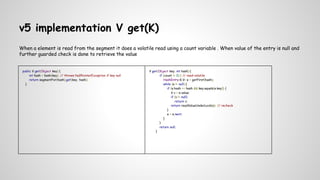
v5 implementation V get(K)
When a element is read from the segment it does a volatile read using a count variable . When value of the entry is null and
further guarded check is done to retrieve the value
public V get(Object key) {
int hash = hash(key); // throws NullPointerException if key null
return segmentFor(hash).get(key, hash);
}
V get(Object key, int hash) {
if (count != 0) { // read-volatile
HashEntry<K,V> e = getFirst(hash);
while (e != null) {
if (e.hash == hash && key.equals(e.key)) {
V v = e.value;
if (v != null)
return v;
return readValueUnderLock(e); // recheck
}
e = e.next;
}
}
return null;
}
v5 performance issues
● The v5 implementation is fairly simple but there are some performance issues
● There in v5 because the segments objects are created initially increases memory footprint
● Now with no objects the map there are minimum set of segment objects is created. When more maps are declared it
can result in serious performance blots
● While locking for put and in the case non volatile reads as it happens in special cases no spin locks are used .
Without spin locks throughput of the map decreases
In comes the v6 implementation
● It comes with the mysterious yet very powerful UNSAFE mechanics
● sun.misc.Unsafe is like the god particle of the java . It can do a lot native memory stuffs which is illegal in regular
java
● and it can be only used inside java libs and not for developers
● A lot of things can be done with sun.misc.Unsafe like volatile reads and contiguous memory allocation ,compare and
swap , park threads and unparking threads
● in v6 main change we can see is the Segment is allocated using UNSAFE.putOrderedObject() . This ensure volatile
reads of the segment and allocation of the segment memory on the fly ,thus removing the overhead of the v5
implementation
v6 implementation V get(K) and put(K,V)
● we will see how the segment is accessed ?
● Using the hash key supplied the segment hash is generated
● The segment is accessed using a non volatile UNSAFE.getObject () with the hash . If entry is found further put
operation is taken care
● If segment is not found ensuresegment() is called and using UNSAFE.compareAndSwapObject() the segment object
is created atomically
● As put operation should be guarded by locks .But instead of using a brute lock as used in the v5 . Spin locks are used
using try locks.
● The get operation is done by a volatile read of the segment UNSAFE.getObjectVolatile() and another volatile read
of the Hash Node to get the value
Spin locks
The below example is a generic example how a spin locks
int retries = -1;
while (!tryLock()) {
if (++retries > MAX_SCAN_RETRIES) {
lock();
break;
}
}
A spin lock can improve performance than the traditional lock chance for acquiring a lock without queueing is good
The Dark Knight rises
● After all the work with segment for many years, In Concurrenthashmap v8 the segments and reentrant locks are
thrown away
● This map usually acts as a binned (bucketed) hash table. Each key-value mapping is held in a Node. Most nodes
are instances of the basic Node class with hash, key, value, and next fields.
● However, various subclasses exist: Tree Nodes are arranged in balanced trees, not lists.
● Insertion (via put or its variants) of the first node in an empty bin is performed by just CASing it to the bin.
● This is by far the most common case for put operations under most key/hash distributions
● space required to associate a distinct lock object with each bin is not wasted , so instead use the first node of a
bin list itself as a lock. Locking support for these locks relies on built in "synchronized" monitors.
v8 implementation
● The main disadvantage of per-bin locks is that other update operations on other nodes in a bin list protected by
the same lock can stall, for example when user equals() or mapping functions take a long time.
● However, statistically, under random hash codes, this is not a common problem. Ideally, the frequency of
nodes in bins follows a Poisson distribution
● Lock contention probability for two threads accessing distinct elements is roughly 1 / (8 #elements) under
random hashes.
● For dumb or hostile usages in which multiple keys are designed to have identical hash codes or ones that differs
only in masked-out high bits
● when the number of nodes in a bin exceeds a threshold,TreeBins use a balanced tree to hold nodes (a specialized
form of red-black trees), bounding search time to O(log N)
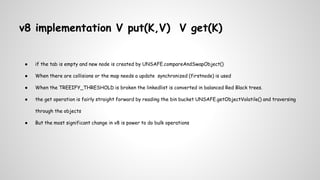
v8 implementation V put(K,V) V get(K)
● if the tab is empty and new node is created by UNSAFE.compareAndSwapObject()
● When there are collisions or the map needs a update synchronized (firstnode) is used
● When the TREEIFY_THRESHOLD is broken the linkedlist is converted in balanced Red Black trees.
● the get operation is fairly straight forward by reading the bin bucket UNSAFE.getObjectVolatile() and traversing
through the objects
● But the most significant change in v8 is power to do bulk operations
Bulk Operations
•suppose we want to find the first word that occurs more than 1,000 times. We need to search keys and values
String result = map.search(threshold, (k, v) -> v > 1000 ? k : null)
•Another usage in filter , consumer which one we saw in streams can be implemented
map.forEach(threshold, (k, v) -> v > 1000 ? k + " -> " + v : null, // Filter and transformer
System.out::println);
•reduce does a filter and accumulator . Like if we want to count how many entries have value > 1000
Long count = map.reduceValues(threshold, v -> v > 1000 ? 1L : null, Long::sum)

Java.util.concurrent.concurrent hashmap

  • 1.
  • 2.
    A Little bitof History Lesson ● Is all started with Hashtable.java in jdk1.0, which was reely slow and bad deisgn. ● Wonder what's worst of jdk 1.0 ?. ● Its the Stack which extends vector which is synchronized ● Stack was example of worst usage of inheritance ● As java moved on we had to deal with the Collection.synchronizedCollection ● After the dot com bubble most which survived were companies which handled massive data and massive traffic ● And processors weren't getting any fast cause there is a theoretical limit to processor clock speed . In came multicore . ● Any they started with two , four and like octopus there were octa core processor even in mobile devices by the turn of decade, and far more than that in server environments
  • 3.
    The Dark KnightBegins ● Having multicore doesn't make your code run any faster . So parallel programming was the need of the hour ● So Dough leah went to his cave in new york and became the dark knight of java and released his concurrency framework .. ● One of the major overhauls in java approach towards concurrency .It was released in September 2004 ● java.util.concurrent.* was added which included Blocking Queue, Latches, Barriers , Executor and Concurrent Hash Map ● We will take a deep look into the evolution of the concurrent hash map .
  • 4.
    Concurrenthashmap V5 ● Hashmapis divide into segments uses a concept of lock stripping ● Each segment has a Hash table within it ● Segment extends reentrant lock and the segment gives to volatile reads and guarded writes by locks ● As mentioned by Doug lea in the doc Segment is opportunistic subclass of the Reentrant Lock. ● Sub classing is pathetic .. ● But Doug lea can do it ● The most important to see here subclassing is recommended only if its the same package ● He has only one rule … ie not to break your code . he can break all others ● As concurrenthashmap matures in he will break more rules
  • 5.
    v5 implementation Vput(K,V) ● The segment gives to volatile reads and guarded writes by locks ● the segment has volatile count which is incremented in the put method guarded by locks public V put(K key, V value) { if (value == null) throw new NullPointerException(); int hash = hash(key); return segmentFor(hash).put(key, hash, value, false); } V put(K key, int hash, V value, boolean onlyIfAbsent) { lock(); try { int c = count; if (c++ > threshold) // ensure capacity rehash(); HashEntry[] tab = table; int index = hash & (tab.length - 1); HashEntry<K,V> first = (HashEntry<K,V>) tab[index]; HashEntry<K,V> e = first; while (e != null && (e.hash != hash || !key.equals(e.key))) e = e.next; V oldValue; if (e != null) { oldValue = e.value; if (!onlyIfAbsent) e.value = value; } else { oldValue = null; tab[index] = new HashEntry<K,V>(key, hash, first, value); count = c; // write-volatile } return oldValue; } finally { unlock(); } }
  • 6.
    v5 implementation Vget(K) When a element is read from the segment it does a volatile read using a count variable . When value of the entry is null and further guarded check is done to retrieve the value public V get(Object key) { int hash = hash(key); // throws NullPointerException if key null return segmentFor(hash).get(key, hash); } V get(Object key, int hash) { if (count != 0) { // read-volatile HashEntry<K,V> e = getFirst(hash); while (e != null) { if (e.hash == hash && key.equals(e.key)) { V v = e.value; if (v != null) return v; return readValueUnderLock(e); // recheck } e = e.next; } } return null; }
  • 7.
    v5 performance issues ●The v5 implementation is fairly simple but there are some performance issues ● There in v5 because the segments objects are created initially increases memory footprint ● Now with no objects the map there are minimum set of segment objects is created. When more maps are declared it can result in serious performance blots ● While locking for put and in the case non volatile reads as it happens in special cases no spin locks are used . Without spin locks throughput of the map decreases
  • 8.
    In comes thev6 implementation ● It comes with the mysterious yet very powerful UNSAFE mechanics ● sun.misc.Unsafe is like the god particle of the java . It can do a lot native memory stuffs which is illegal in regular java ● and it can be only used inside java libs and not for developers ● A lot of things can be done with sun.misc.Unsafe like volatile reads and contiguous memory allocation ,compare and swap , park threads and unparking threads ● in v6 main change we can see is the Segment is allocated using UNSAFE.putOrderedObject() . This ensure volatile reads of the segment and allocation of the segment memory on the fly ,thus removing the overhead of the v5 implementation
  • 9.
    v6 implementation Vget(K) and put(K,V) ● we will see how the segment is accessed ? ● Using the hash key supplied the segment hash is generated ● The segment is accessed using a non volatile UNSAFE.getObject () with the hash . If entry is found further put operation is taken care ● If segment is not found ensuresegment() is called and using UNSAFE.compareAndSwapObject() the segment object is created atomically ● As put operation should be guarded by locks .But instead of using a brute lock as used in the v5 . Spin locks are used using try locks. ● The get operation is done by a volatile read of the segment UNSAFE.getObjectVolatile() and another volatile read of the Hash Node to get the value
  • 10.
    Spin locks The belowexample is a generic example how a spin locks int retries = -1; while (!tryLock()) { if (++retries > MAX_SCAN_RETRIES) { lock(); break; } } A spin lock can improve performance than the traditional lock chance for acquiring a lock without queueing is good
  • 11.
    The Dark Knightrises ● After all the work with segment for many years, In Concurrenthashmap v8 the segments and reentrant locks are thrown away ● This map usually acts as a binned (bucketed) hash table. Each key-value mapping is held in a Node. Most nodes are instances of the basic Node class with hash, key, value, and next fields. ● However, various subclasses exist: Tree Nodes are arranged in balanced trees, not lists. ● Insertion (via put or its variants) of the first node in an empty bin is performed by just CASing it to the bin. ● This is by far the most common case for put operations under most key/hash distributions ● space required to associate a distinct lock object with each bin is not wasted , so instead use the first node of a bin list itself as a lock. Locking support for these locks relies on built in "synchronized" monitors.
  • 12.
    v8 implementation ● Themain disadvantage of per-bin locks is that other update operations on other nodes in a bin list protected by the same lock can stall, for example when user equals() or mapping functions take a long time. ● However, statistically, under random hash codes, this is not a common problem. Ideally, the frequency of nodes in bins follows a Poisson distribution ● Lock contention probability for two threads accessing distinct elements is roughly 1 / (8 #elements) under random hashes. ● For dumb or hostile usages in which multiple keys are designed to have identical hash codes or ones that differs only in masked-out high bits ● when the number of nodes in a bin exceeds a threshold,TreeBins use a balanced tree to hold nodes (a specialized form of red-black trees), bounding search time to O(log N)
  • 13.
    v8 implementation Vput(K,V) V get(K) ● if the tab is empty and new node is created by UNSAFE.compareAndSwapObject() ● When there are collisions or the map needs a update synchronized (firstnode) is used ● When the TREEIFY_THRESHOLD is broken the linkedlist is converted in balanced Red Black trees. ● the get operation is fairly straight forward by reading the bin bucket UNSAFE.getObjectVolatile() and traversing through the objects ● But the most significant change in v8 is power to do bulk operations
  • 14.
    Bulk Operations •suppose wewant to find the first word that occurs more than 1,000 times. We need to search keys and values String result = map.search(threshold, (k, v) -> v > 1000 ? k : null) •Another usage in filter , consumer which one we saw in streams can be implemented map.forEach(threshold, (k, v) -> v > 1000 ? k + " -> " + v : null, // Filter and transformer System.out::println); •reduce does a filter and accumulator . Like if we want to count how many entries have value > 1000 Long count = map.reduceValues(threshold, v -> v > 1000 ? 1L : null, Long::sum)