Diagnosing HotSpot JVM Memory Leaks
with JFR and JMC
Mushfekur Rahman
Software Engineer II
Today We’ll Talk About...
● Java Reference Types
● Understanding GC Reachability
● Memory Leak and java.lang.OutOfMemoryError
● Brief Introduction to JFR and JMC
● Few Classic Leak Scenarios
Java Reference Types
● What about it?
○ How do we create a reference to an object?
Car c = new Car();
● This is not the only way we can create references *newsflash*
● Java offers four types of references
1. Strong
2. Soft
3. Weak
4. Phantom
GC Reachability
● Let’s be a little hypothetical, what does GC do?
○ Simulate a finite memory space as infinite
● A common misunderstanding
○ GC collects unused/dead objects and reclaims memory space occupied by them
○ It’s actually the exact opposite
■ GC marks live objects
■ Reclaims everything else
GC Reachability (contd.)
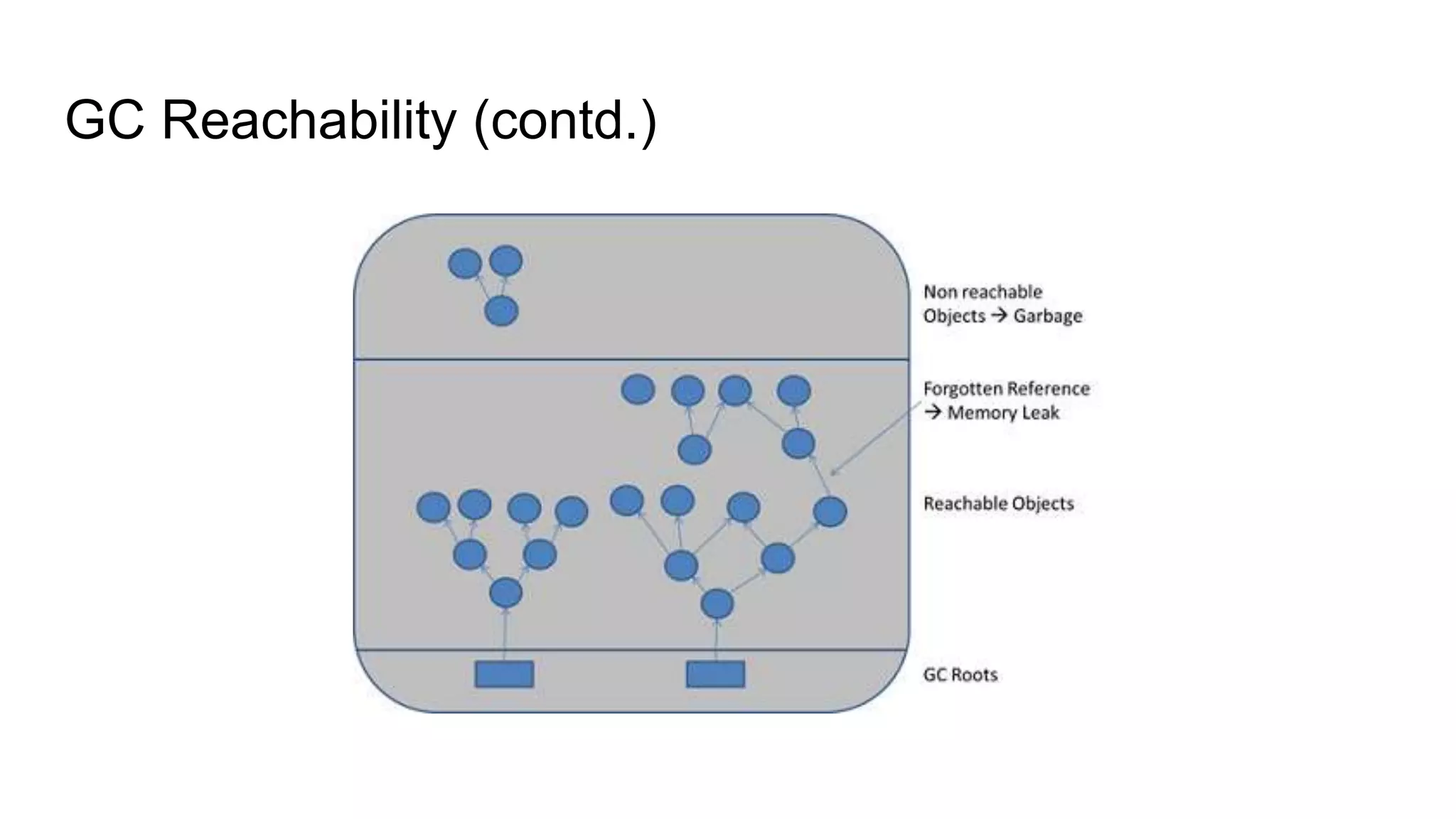
● Eligibility of an object to be GC’d depends on references
● GC algorithms traverse objects starting from GC root
○ GC roots
■ Source of Object trees
■ Possible candidates are active threads, and it's local variables, static variables
and JNI references
○ All the objects that are reachable from GC root are marked as alive (not eligible for GC)
● If there’s no strong reference to an object, it’s going to be collected
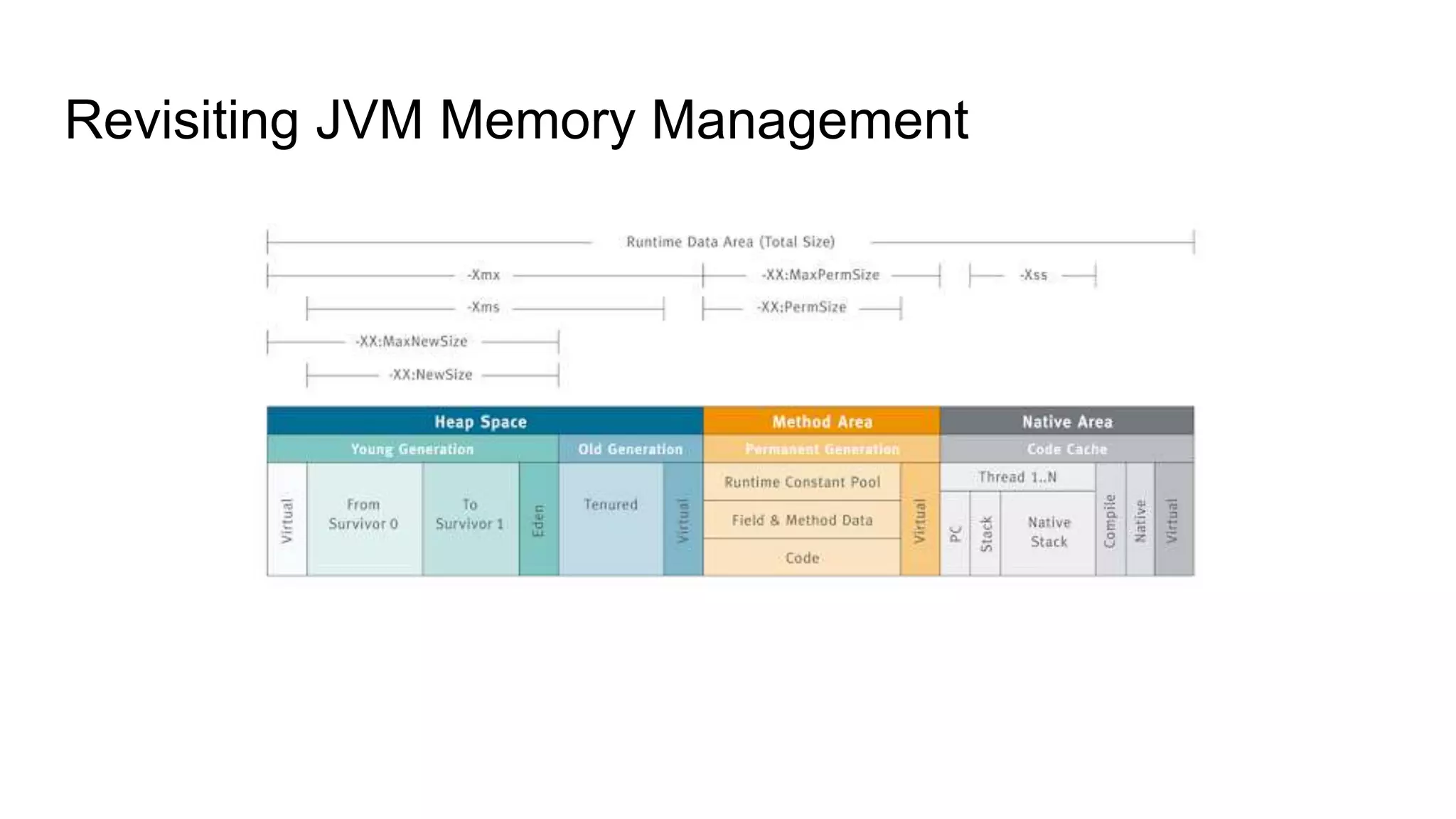
Revisiting JVM Memory Management
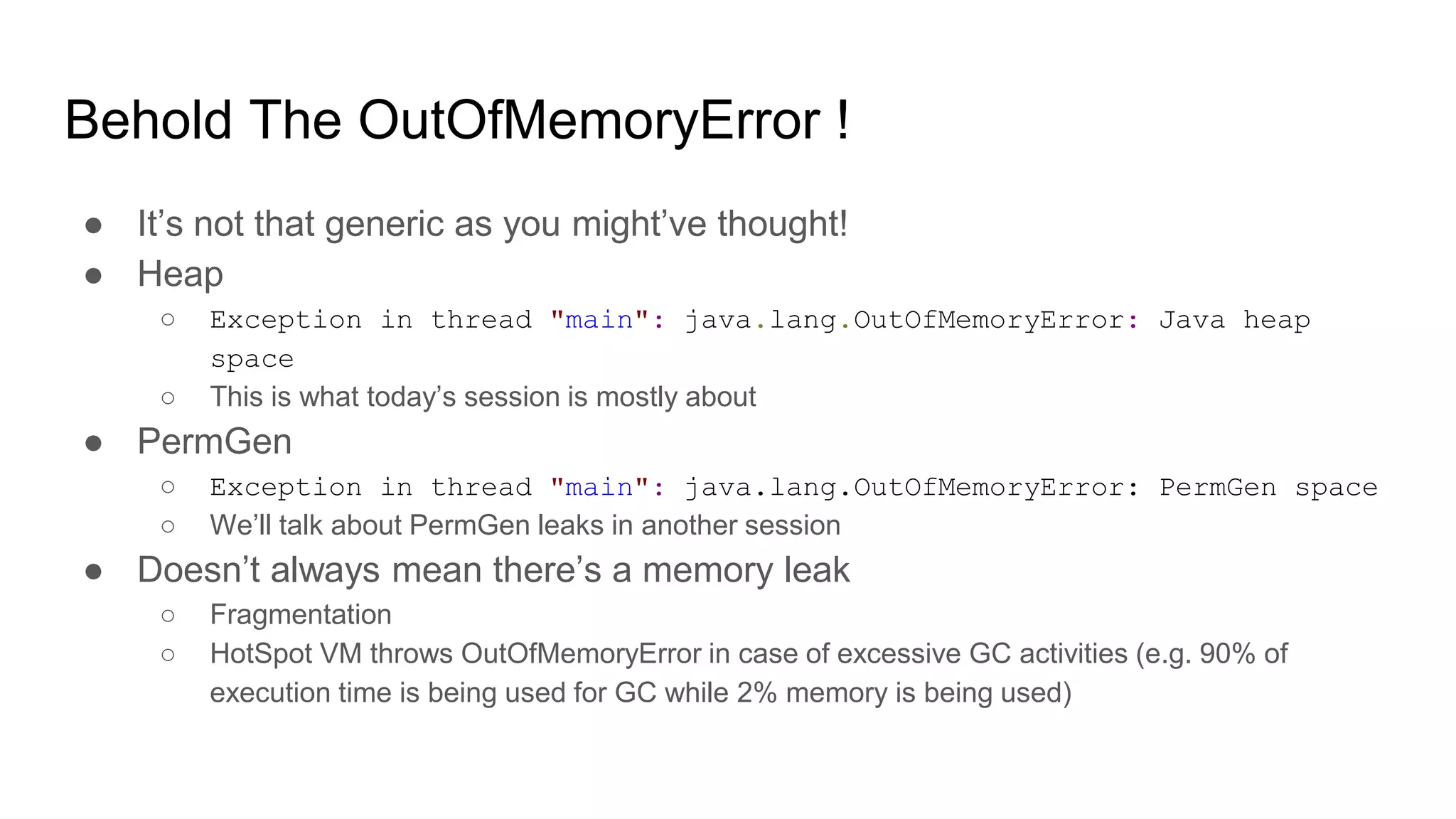
Behold The OutOfMemoryError !
● It’s not that generic as you might’ve thought!
● Heap
○ Exception in thread "main": java.lang.OutOfMemoryError: Java heap
space
○ This is what today’s session is mostly about
● PermGen
○ Exception in thread "main": java.lang.OutOfMemoryError: PermGen space
○ We’ll talk about PermGen leaks in another session
● Doesn’t always mean there’s a memory leak
○ Fragmentation
○ HotSpot VM throws OutOfMemoryError in case of excessive GC activities (e.g. 90% of
execution time is being used for GC while 2% memory is being used)
Wait a minute...
● So, we are fine as long as there’s no OutOfMemoryError?
○ Not really!
○ In fact, little unnoticed leaks are both decisive and vicious.
● What all these has to do with application performance?
○ GC is essential but expensive
○ GC is one of the biggest contributor to the overall latency in JVM applications
○ The less memory used, the less GC
Java Mission Control
● Set of powerful monitoring and diagnosis tools that comes with Oracle JDK
● Two main parts
○ JMX Console
■ For monitoring JVM in real time
○ Java Flight Recorder
■ For collecting data about JVM (profiling)
● Can monitor JVM instances both local and remote
○ Event triggers
○ Execute troubleshooting commands on target JVM
● Supports plugins
○ For additional functionalities (e.g. heap dump analysis, DTrace recording etc.)
● Free for development use
Java Flight Recorder
● Flight Recorder
“A flight recorder, commonly known as a black
box, although it is now orange-coloured, is an
electronic recording device placed in an aircraft
for the purpose of facilitating the investigation of
aviation accidents and incidents.” - Wikipedia
Fig. An actual aircraft Flight Recorder
Java Flight Recorder (contd.)
● High performance event recorder
○ Built into the runtime
● Recordings are stored as binary chunks
○ Very detailed (records everything according to settings)
○ Self contained and self describing
● Very low overhead (<=1% according to Oracle)
○ Can keep it running always
○ Dumps can be taken from time to time using JVM debugging commands (e.g. jcmd)
Java Flight Recorder (contd.)
● Recording Types
○ Continuous Recording
■ Have no end time
■ Must be explicitly dumped
○ Time Fixed Recordings (a.k.a Profiling Recordings)
■ Events will be captured within the specified timeframe
■ Will be automatically dumped in the specified location
JFR Setup
● Start JVM with the following flags
-XX:+UnlockCommercialFeatures -XX:+FlightRecorder
● For remote profiling add JMX related com.sun.management flags
● Additional parameters can be passed with -XX:StartFlightRecording
● Templates can be specified with a settings parameter
○ Templates can be created using JMC
○ Default template location $JAVA_HOME/jre/lib/jfr
○ Can only be used with JRockit or HotSpot (7u40 or later)
● *If there’s any* disable other profiling tool that does instrumentation (e.g.
XRebel)
Recording Events
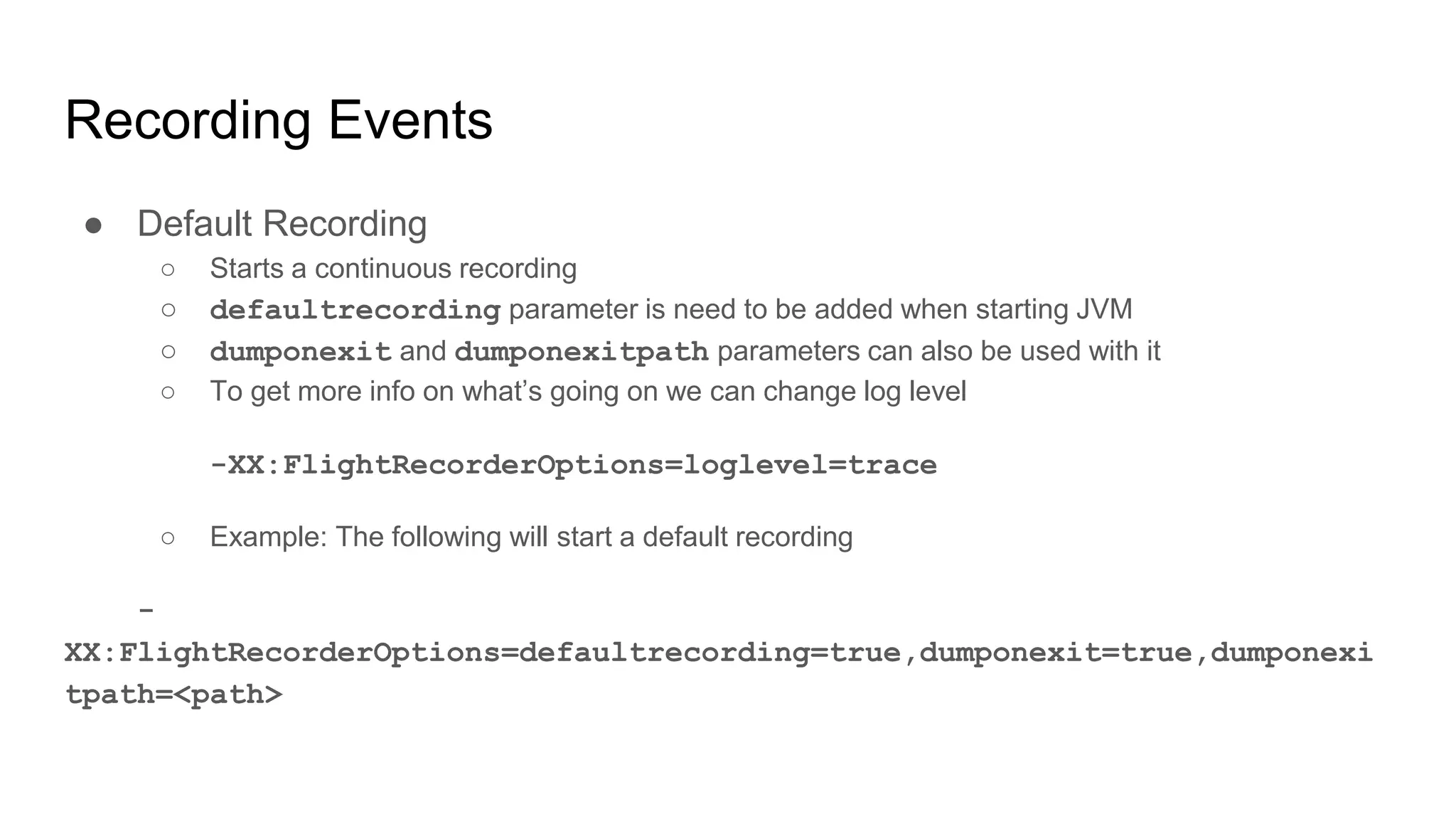
● Default Recording
○ Starts a continuous recording
○ defaultrecording parameter is need to be added when starting JVM
○ dumponexit and dumponexitpath parameters can also be used with it
○ To get more info on what’s going on we can change log level
-XX:FlightRecorderOptions=loglevel=trace
○ Example: The following will start a default recording
-
XX:FlightRecorderOptions=defaultrecording=true,dumponexit=true,dumponexi
tpath=<path>
Recording Events (contd.)
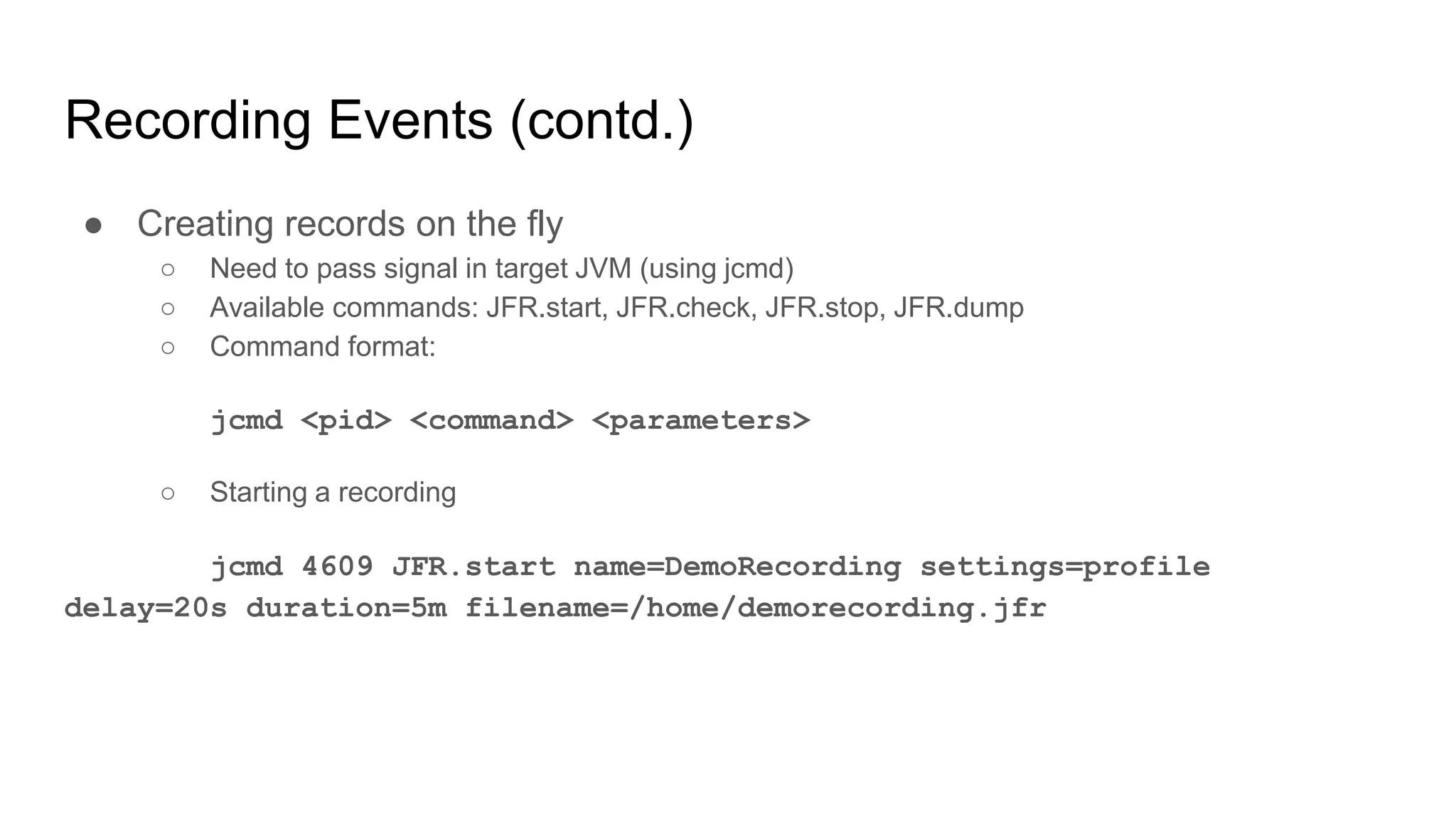
● Creating records on the fly
○ Need to pass signal in target JVM (using jcmd)
○ Available commands: JFR.start, JFR.check, JFR.stop, JFR.dump
○ Command format:
jcmd <pid> <command> <parameters>
○ Starting a recording
jcmd 4609 JFR.start name=DemoRecording settings=profile
delay=20s duration=5m filename=/home/demorecording.jfr
Back To Memory Leak!
Common Pitfalls
● Non-static Inner Classes
○ Inner class has an implicit reference to the containing class
○ Isn’t supposed to live longer than the container class
○ What if an outer context holds a reference to the inner class?
■ Due to the implicit strong reference outer class cannot be GC’d
public class OuterClass {
/**
* Outer class contents
*/
public class InnerClass {
/**
* Inner class contents
*/
}
}
Common Pitfalls (contd.)
● Flyweight Pattern
○ Structural design pattern aims to reduce cost of object creation
○ Reusing already existing objects by maintaining an object pool
○ Two states in every object
■ Intrinsic: Shareable values
■ Extrinsic: Non shareable values. Created and/or destroyed based on the client object
actions.
Common Pitfalls (contd.)
● JSP Tag Pooling
○ Servlet containers cache tag instances for performance reason
○ States goes back to the pool along with tag instances
○ Wait... it’s not just about heap leak
■ What if you have logic based on current state?
● Kaboom!
○ Should cleanup instance variable states after use
○ Example
Common Pitfalls (contd.)
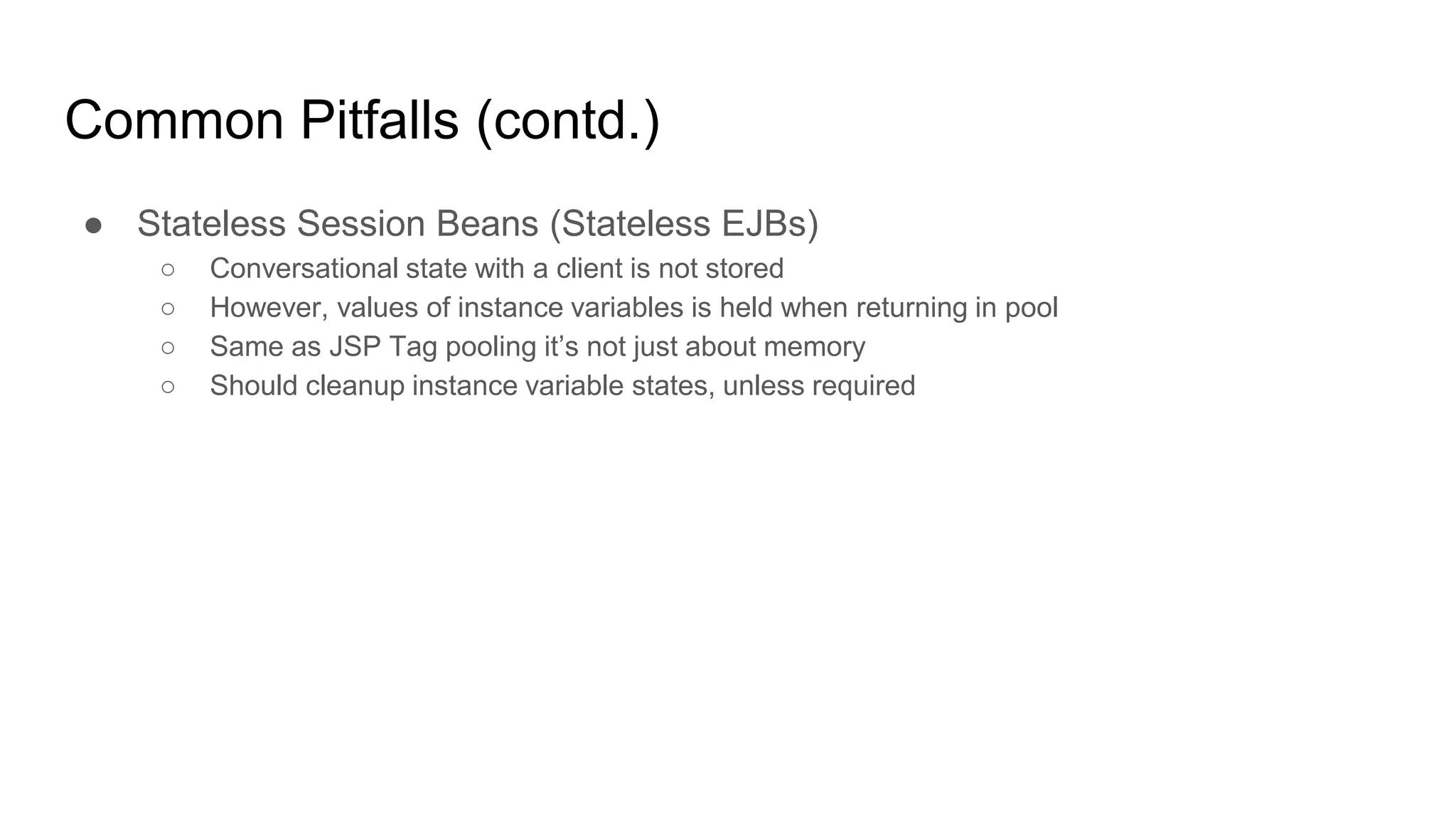
● Stateless Session Beans (Stateless EJBs)
○ Conversational state with a client is not stored
○ However, values of instance variables is held when returning in pool
○ Same as JSP Tag pooling it’s not just about memory
○ Should cleanup instance variable states, unless required
Common Pitfalls (contd.)
● ThreadLocal instances
○ Lifecycle bound to the owning thread
○ Typical multithreaded services use thread pools
■ Threads gets re-used
○ What if you forget to cleanup after the thread finishes it’s work?
● Implicit leaks
○ Autoboxing in a loop
○ Serializing/cloning/copying complex object graphs
Additional Resources
● Troubleshooting Guide for HotSpot VM (Chapter 3)
● Using Java Flight Recorder (JavaOne ‘15)
● Java Mission Control for Earthlings (Devoxx France ‘15)
● Running Java Flight Recorder

Diagnosing HotSpot JVM Memory Leaks with JFR and JMC

  • 1.
    Diagnosing HotSpot JVMMemory Leaks with JFR and JMC Mushfekur Rahman Software Engineer II
  • 2.
    Today We’ll TalkAbout... ● Java Reference Types ● Understanding GC Reachability ● Memory Leak and java.lang.OutOfMemoryError ● Brief Introduction to JFR and JMC ● Few Classic Leak Scenarios
  • 3.
    Java Reference Types ●What about it? ○ How do we create a reference to an object? Car c = new Car(); ● This is not the only way we can create references *newsflash* ● Java offers four types of references 1. Strong 2. Soft 3. Weak 4. Phantom
  • 4.
    GC Reachability ● Let’sbe a little hypothetical, what does GC do? ○ Simulate a finite memory space as infinite ● A common misunderstanding ○ GC collects unused/dead objects and reclaims memory space occupied by them ○ It’s actually the exact opposite ■ GC marks live objects ■ Reclaims everything else
  • 5.
  • 6.
    GC Reachability (contd.) ●Eligibility of an object to be GC’d depends on references ● GC algorithms traverse objects starting from GC root ○ GC roots ■ Source of Object trees ■ Possible candidates are active threads, and it's local variables, static variables and JNI references ○ All the objects that are reachable from GC root are marked as alive (not eligible for GC) ● If there’s no strong reference to an object, it’s going to be collected
  • 7.
  • 8.
    Behold The OutOfMemoryError! ● It’s not that generic as you might’ve thought! ● Heap ○ Exception in thread "main": java.lang.OutOfMemoryError: Java heap space ○ This is what today’s session is mostly about ● PermGen ○ Exception in thread "main": java.lang.OutOfMemoryError: PermGen space ○ We’ll talk about PermGen leaks in another session ● Doesn’t always mean there’s a memory leak ○ Fragmentation ○ HotSpot VM throws OutOfMemoryError in case of excessive GC activities (e.g. 90% of execution time is being used for GC while 2% memory is being used)
  • 9.
    Wait a minute... ●So, we are fine as long as there’s no OutOfMemoryError? ○ Not really! ○ In fact, little unnoticed leaks are both decisive and vicious. ● What all these has to do with application performance? ○ GC is essential but expensive ○ GC is one of the biggest contributor to the overall latency in JVM applications ○ The less memory used, the less GC
  • 10.
    Java Mission Control ●Set of powerful monitoring and diagnosis tools that comes with Oracle JDK ● Two main parts ○ JMX Console ■ For monitoring JVM in real time ○ Java Flight Recorder ■ For collecting data about JVM (profiling) ● Can monitor JVM instances both local and remote ○ Event triggers ○ Execute troubleshooting commands on target JVM ● Supports plugins ○ For additional functionalities (e.g. heap dump analysis, DTrace recording etc.) ● Free for development use
  • 11.
    Java Flight Recorder ●Flight Recorder “A flight recorder, commonly known as a black box, although it is now orange-coloured, is an electronic recording device placed in an aircraft for the purpose of facilitating the investigation of aviation accidents and incidents.” - Wikipedia Fig. An actual aircraft Flight Recorder
  • 12.
    Java Flight Recorder(contd.) ● High performance event recorder ○ Built into the runtime ● Recordings are stored as binary chunks ○ Very detailed (records everything according to settings) ○ Self contained and self describing ● Very low overhead (<=1% according to Oracle) ○ Can keep it running always ○ Dumps can be taken from time to time using JVM debugging commands (e.g. jcmd)
  • 13.
    Java Flight Recorder(contd.) ● Recording Types ○ Continuous Recording ■ Have no end time ■ Must be explicitly dumped ○ Time Fixed Recordings (a.k.a Profiling Recordings) ■ Events will be captured within the specified timeframe ■ Will be automatically dumped in the specified location
  • 14.
    JFR Setup ● StartJVM with the following flags -XX:+UnlockCommercialFeatures -XX:+FlightRecorder ● For remote profiling add JMX related com.sun.management flags ● Additional parameters can be passed with -XX:StartFlightRecording ● Templates can be specified with a settings parameter ○ Templates can be created using JMC ○ Default template location $JAVA_HOME/jre/lib/jfr ○ Can only be used with JRockit or HotSpot (7u40 or later) ● *If there’s any* disable other profiling tool that does instrumentation (e.g. XRebel)
  • 15.
    Recording Events ● DefaultRecording ○ Starts a continuous recording ○ defaultrecording parameter is need to be added when starting JVM ○ dumponexit and dumponexitpath parameters can also be used with it ○ To get more info on what’s going on we can change log level -XX:FlightRecorderOptions=loglevel=trace ○ Example: The following will start a default recording - XX:FlightRecorderOptions=defaultrecording=true,dumponexit=true,dumponexi tpath=<path>
  • 16.
    Recording Events (contd.) ●Creating records on the fly ○ Need to pass signal in target JVM (using jcmd) ○ Available commands: JFR.start, JFR.check, JFR.stop, JFR.dump ○ Command format: jcmd <pid> <command> <parameters> ○ Starting a recording jcmd 4609 JFR.start name=DemoRecording settings=profile delay=20s duration=5m filename=/home/demorecording.jfr
  • 17.
  • 18.
    Common Pitfalls ● Non-staticInner Classes ○ Inner class has an implicit reference to the containing class ○ Isn’t supposed to live longer than the container class ○ What if an outer context holds a reference to the inner class? ■ Due to the implicit strong reference outer class cannot be GC’d public class OuterClass { /** * Outer class contents */ public class InnerClass { /** * Inner class contents */ } }
  • 19.
    Common Pitfalls (contd.) ●Flyweight Pattern ○ Structural design pattern aims to reduce cost of object creation ○ Reusing already existing objects by maintaining an object pool ○ Two states in every object ■ Intrinsic: Shareable values ■ Extrinsic: Non shareable values. Created and/or destroyed based on the client object actions.
  • 20.
    Common Pitfalls (contd.) ●JSP Tag Pooling ○ Servlet containers cache tag instances for performance reason ○ States goes back to the pool along with tag instances ○ Wait... it’s not just about heap leak ■ What if you have logic based on current state? ● Kaboom! ○ Should cleanup instance variable states after use ○ Example
  • 21.
    Common Pitfalls (contd.) ●Stateless Session Beans (Stateless EJBs) ○ Conversational state with a client is not stored ○ However, values of instance variables is held when returning in pool ○ Same as JSP Tag pooling it’s not just about memory ○ Should cleanup instance variable states, unless required
  • 22.
    Common Pitfalls (contd.) ●ThreadLocal instances ○ Lifecycle bound to the owning thread ○ Typical multithreaded services use thread pools ■ Threads gets re-used ○ What if you forget to cleanup after the thread finishes it’s work? ● Implicit leaks ○ Autoboxing in a loop ○ Serializing/cloning/copying complex object graphs
  • 23.
    Additional Resources ● TroubleshootingGuide for HotSpot VM (Chapter 3) ● Using Java Flight Recorder (JavaOne ‘15) ● Java Mission Control for Earthlings (Devoxx France ‘15) ● Running Java Flight Recorder