Derivatives Market
Introduction
 Derivatives market is the market that
facilitate the trading of the financial or
commodity derivatives instruments.
 Derivatives are instruments used to
manage one's exposure to today's
volatile markets.
Introduction
 Derivatives instruments:
 Financial contracts where its values depend
on the values of other basic underlying
assets.
 such as commodity prices, interest rates,
indices, and share prices.
 It is settled at a future date.
 Objectives : speculation, reduce portfolio risk.
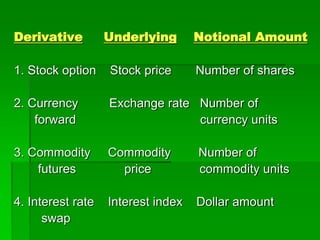
Derivative Underlying Notional Amount
1. Stock option Stock price Number of shares
2. Currency Exchange rate Number of
forward currency units
3. Commodity Commodity Number of
futures price commodity units
4. Interest rate Interest index Dollar amount
swap
1. Organized exchange
2. Over-the counter (O-T-C)
Operation:
1. Organized exchange
 Provide an organized market place where
futures contracts can be traded (e.g.
Standardized contracts).
 Establish and enforce rules for derivative
trading.
 E.g. Bursa Malaysia Derivative Bhd.
Operation:
2. Over-the counter (O-T-C)
 More complex.
 A financial intermediary (bank) finds a
counterparty or serves as the counterparty.
 Tailored to the counterparties’ requirements.
 E.g. non-standardized contracts and delivery months.
Operation:
 Futures Contracts
 Options Contracts
 Forward Contracts
 Swap Contracts.
Financial Derivatives:
Forward contracts
 An agreement between 2 counterparties that
fixed the terms of an exchange that will take
place between them at some future date.
 A contract for forward delivery.
 The contract specifies :
o what is being exchange,
o the price at which the exchange takes place,
o the date in the future at which the exchange takes
place.
 Forward contract is a tailor-made contract.
 Cannot be cancelled without the agreement of
both parties.
 Not liquid/marketable.
 No guarantee that one party will not default.
 Traded OTC.
Futures Contracts
 An agreement between two counterparties
to:
 buy or sell a specific amount of underlying
asset
 at a particular time in the future
 for a predetermined price.
Futures Contracts
 Standardized (quantity, quality and time of
delivery ) and legally binding agreement.
 Allow buyers to receive and seller to deliver an
underlying assets sometime in the future.
 Only negotiable for PRICE.
 Usually traded in an organized exchange.
 Different from forward.
 These futures contacts has specific settlement
dates which delivery would occur in March, June,
September and December.
 In Malaysia, the futures contracts are traded on
Bursa Malaysia.
 In US, they are traded on Chicago Board of
Trade or Chicago Mercantile Exchange.
Futures Contracts
Steps involved in trading futures:
 Open account at brokerage firms that
execute futures transactions.
 Establish a margin deposit before a
transaction can be executed (initial margin).
 As the future contract price changes on daily
basis, its value is ‘marked to market or
revised to reflect the prevailing conditions.
Steps involved in trading futures:
 When the value of a customer’s contract
moves in an unfavorable direction, that
customer may receive a margin call from the
broker, requiring additional funds to be
deposited in the margin account.
 The margin requirement reduce the risk that
customer will later default on their
obligations.
Types of order placed:
1) Market order: Orders placed for immediate
execution when trader wants to initiate or liquidate a
position. No price attached to order, can sell/ buy at
market price. The trade will automatically be
executed at the prevailing price of the futures
contract.
2) Limit order: the trade will be executed only if the
price is within the limit specified by the customer.
3) Stop order: used to stop loss, to protect profit or to
initiate strategies based on psychological price
levels.
Steps involved in trading futures:
 E.g. place a limit order to buy a particular
future contract if it is priced not higher
than a specified price, i.e. RM3.00.
 Place an order to sell a futures contract if
it is priced not lower than a specified
minimum price, i.e. RM5.50.
Settlement
1) Close-out a position by entering into an
opposite trade (off set).
2) Perform the contract by ‘final cash
settlement’ when the contract matures.
Settlement
1) Close-out a position by entering into an
opposite trade (off set).
 Any opened contract or position can be
closed out prior to maturity by taking an
offset position.
 Trader who has buying position can offset
his position by selling, and vice-versa.
Settlement
2) Perform the contract by ‘final cash
settlement’ when the contract matures.
 Any outstanding contract which has not been
closed-out, must be settled at maturity.
 Commodity can be settled through delivery or
cash settlement.
 Delivery the commodity at expiration means the
seller closes his position by delivering the
underlying commodity, and the buyer receiving the
commodity.
 Financial futures on the other hand, must be
settled by cash settlement.
For example,
 Today (September), a palm oil refiner expect to
use 1000 ton of crude palm oil (CPO) in three
months time (December).
 The CPO is traded at RM1200 per m/t now, he
is concerned of the price of CPO after three
months.
 How can he protects his factory from the high
cost of purchasing the CPO should the price
increases ?
If he expect price to increase in
December
 He can hedge his exposure by buying
December futures contract now.
 He will locked his price and amount today
(e.g. RM1250/ton), but the physical delivery
of the CPO will take place in December.
If he expect price to increase in
December
 If the price increase to RM1300/ton in
December, he is protected since he locked in
the price now at RM1250/ton.
 However, if the price drops to RM1150/ton,
he suffer losses (paper losss) as he has
already enter into contract to buy at
RM1250/ton.
Financial Futures Contract
1. Stock Index Futures Contract (FKLI)
2. Three-Month KLIBOR Futures
Contract
 Find information (tutorial)
Market participants
 Hedgers – protecting the value of their
portfolio.
 Speculators – profit.
 Arbitrageurs – profit .
1. Hedging or risk management tools
To minimise or mitigate risk on exposure
to market volatility.
To immunise from unfavourable price
movement in the underlying asset (u/a)-
protected from price increases, etc.
Used by corporation and investors to:
Example 1:
 An intended share seller will concern
about the falling share value in the future.
 Establish a selling or short hedge to
ensure their exposure of holding physical
shares is well protected.
Selling/ Short Hedge
 A fund manager anticipates BMSB is to experience
another downtrend between today (September) and
near future (December).
 Now: CI at BMSB is 1200 while December KLCI
Futures at 1110.
 The manager is managing a portfolio worth RM100 m
and decide to hedge 80% of the portfolio.
 As expected, cash index closes at 1160 and future
index at 1050.
Selling/ Short Hedge: Falling price
Month/Market Cash Market Futures Market
September
(Today)
•Managing RM100 m portfolio
and to hedge RM80m
(RM100m x 80%).
•Current index = 1200
•[Expect index to fall sell]
• Opening position:
• Sell 1657 September
FKLI Futures @1110
December r ber
(Later)
• Sell RM100m of portfolio at lower
price.
(Falling index as expected to 1160)
• Offsetting position:
• Buy 1657 September
FKLI Futures @1050
Example 2: A Selling Hedge
of KLIBOR Ft
 Uses by an intending borrower to set the
cost of future loan.
 Hedge against the risk of rising interest
rates.
 Attempt to make profit from price movements
in underlying assets.
 Hedgers take a future position to hedge their
risk, while speculators commonly take the
opposite position and serve as the
counterparty on many future transactions.
 They provide liquidity to the market.
2. Speculative trading
Speculators: Who are them?
 They are the trader who motivated and attracted to the
market in view of profit from volatility of the prices.
 If the market moves in their favour, they earn huge
profit, but if the market moves against their expectation,
they suffer losses.
 They are expose to high risk in view of their position as
long-term trader who normally hold derivatives contract
for more than a week  willing to take risk that hedger
seek to avoid with a compensation for higher return.
Speculators: Who are them?
 Speculators are traders who are not exposed to
price risks but accept risks motivated by profits.
 They do not wish to own any physical palm oil,
thus buying and selling only contracts and not the
physical commodity.
 They buy futures when they expect price to move
upward [buy low today and sell high later].
 They sell futures when they expect price to move
downward [sell higher today and buy at lower later].
 Day traders:
 Attempt to capitalized on price movements during a
single day.
 Usually close out their future positions on the same
day the positions were initiated.
 Position traders:
 Maintain their future positions for longer periods of
time (weeks or months).
 Attempt to capitalize on expected price movements
over a longer time horizon.
2. Speculative trading
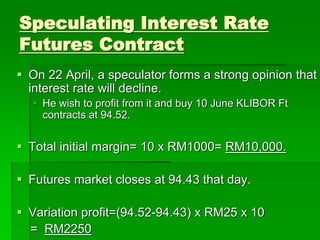
Speculating Interest Rate
Futures Contract
 On 22 April, a speculator forms a strong opinion that
interest rate will decline.
 He wish to profit from it and buy 10 June KLIBOR Ft
contracts at 94.52.
 Total initial margin= 10 x RM1000= RM10,000.
 Futures market closes at 94.43 that day.
 Variation profit=(94.52-94.43) x RM25 x 10
= RM2250
 Speculative trading position, where the trader ‘take a
view’ on the likely movement of futures prices, can
lead to large profits or losses depending on whether
the trader ‘gets it right”.
 From the example, speculation is risky, due to the
volatile prices in the futures market, combined with
leverage.
 Refers to case: The collapse of the Barings Bank
(1762-1995) –Nick Leeson.
Conclusion:
3. Arbitrage purposes
Take advantage by simultaneously selling
and buying underlying asset at different
markets.
I.e. buy from the market A with lower
price and sell it in market B with higher
price and get a positive return.
What is Options Contract?
 Contract that gives owner the right, but
not obligation
 to buy or sell a specified amount of an
underlying asset
 at a specified price
 on or before a specific day in the future.
 If holder/ option buyer chooses not to buy
or sell the underlying instrument or
commodity:
 Let the option to expire with a price called
premium.
Options Contract
 Owner of the option:
 Option purchaser or holder,
 Have long position in option.
 Can choose to exercise the contract if it would be
profitable based on current market situation.
 Seller of the option:
 Option writer
 Short position.
 Must fulfill requirement of option buyer.
Options Contract
 Options that can only be exercised at
maturity:
 European option.
 Options that can be exercised at any time
before maturity:
 American option.
Options Contract
 Call option
 Gives the holder the right but not the
obligation to buy the underlying asset at a
predetermined price, called the strike price, ,
on or before a specified date.
Options Contract
A June 2012 call option on 100 shares of MBB
stock at a strike price of 8.
- The option holder has the right to buy 100
shares of MBB for RM8 prior to the final
trading day (third Friday of June 2012).
Call option
 The holder has the right, but not obligation to buy
(option to buy) and he will do so only if buying is
beneficial to him.
 Whenever the price of the stock is above the strike
price of the call option, exercising the option is
profitable for the holder, and the option is said to be
in the money.
 The writer of the call option must fulfill the contract
by selling the shares if the holder chooses to
exercise the call option.
Call option
 Put option
 Gives the holder the right but not the
obligation to sell the underlying asset.
 The writer of the option is obliged to buy the
shares should the holder choose to exercise
the option.
Options Contract
Put option
A June 2012 put option on 100 shares of MBB
stock at a strike price of 8.
A right to sell 100 shares at RM8 per
share
Valuable when the market price of MBB
stock falls below RM8.
 Similarity:
 Both represent actions that occur in
future.
Future vs. Options Contracts
 Both seller and buyer
are obligated to
complete the
transaction.
 No premium is being
paid by the seller and
the buyer.
 Only writer (seller) is
obligated to the
agreement.
 The buyer pays the
writer (seller) the
premium.
Futures Contracts vs. Options Contracts
Participants
 Regulator : SC
 Clearing house : Bursa Malaysia
Derivatives Clearing Berhad
 Exchange : Bursa Malaysia Derivatives
Berhad
 Intermediaries : Brokers, fund managers,
trading advisors.
 Users/clients : Hedger, speculator,
arbitrageurs
Kuala Lumpur Commodity Exchange (KLCE)
 Introduced futures contract since 1980:
 Crude palm oil (1980)
 Rubber (1983)
 Palm kernal(1986)
 Tin (1987)
 Cocoa (1988) and
 Palm olein (1990).
 Activity was confined to trading of CPO
due to falling interest in other commodity
futures.
Malaysia Monetary Exchange (MME)
 Incorporated on 19 August 1992 (known as
KL Future Market Sdn Bhd).
 New opportunities for more effective
portfolio managements.
 Manage risk exposure: transfer financial risk in
cash market.
 Spreading & arbitraging activities.
 To provide a medium for the industry to
manage risk exposure to interest rate &
currency risks.
 Launched Three-month Kuala Lumpur
Interbank Offer Rate (KLIBOR) future.
(1996)
Development:
Development:
 Kuala Lumpur Options and Financial
Futures Exchange (KLOFFE)
 Commenced operations on 15 Dec 1995.
 Instruments: stock options and stock index futures .
 To manage equity risk exposure.
 Traded stock index future based on BM Composite
index(FKLI).
 Previously traded at
 Kuala Lumpur Options and Financial Futures
Exchange (KLOFFE)
 Malaysia Monetary Exchange (MME).
 Combination of KLCE and MME to form
Commodity and Monetary Exchange of
Malaysia (COMMEX) in 1998.
Development : The Exchanges
 In 2001, the Malaysia Derivatives
Exchange (MDEX) was formed as a
merger between KLOFFE and COMMEX.
 Now known as the exchanges.
Development : The Exchanges
Bursa Malaysia Derivatives
 The derivatives exchange.
 Self regulated exchanges : establish rules
and regulations governing:
 Membership
 Exchange administration
 Member-customer relationship
 Trading practices.
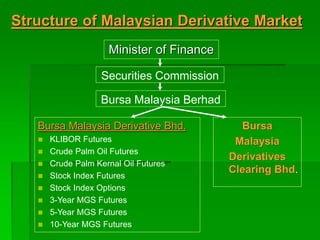
Structure of Malaysian Derivative Market
Minister of Finance
Bursa
Malaysia
Derivatives
Clearing Bhd.
Bursa Malaysia Derivative Bhd.
 KLIBOR Futures
 Crude Palm Oil Futures
 Crude Palm Kernal Oil Futures
 Stock Index Futures
 Stock Index Options
 3-Year MGS Futures
 5-Year MGS Futures
 10-Year MGS Futures
Bursa Malaysia Berhad
Securities Commission
More Recent Products traded:
 Single Stock Futures (SSFs)
 Ethylene OTC Futures Contract .
Bursa Malaysia Derivatives Clearing Bhd
 Previously known as Malaysian Derivatives Clearing
House Bhd( MDCH).
 Acts as counterparty to all contracts traded.
 Assumes role of ‘buyer’ to the seller .
 Assumes role of ‘seller’ to the buyer.
 Provide financial stability by guaranteeing the
performance of all contracts.
 Guarantee is supported by collection of margin
payment from buyer and seller.
Bursa Malaysia Derivatives
Berhad (BMDB)
 75%-owned subsidiary of Bursa Malaysia
Berhad.
 Provides, operates and maintains a
futures and options exchange.
 BMDB operates the most liquid and
successful crude palm oil futures (FCPO)
contract in the world.
Jurisdiction:
 It operates under the supervision of the
Securities Commission and is governed by
the Capital Market and Services Act 2007.
 BMDB also falls under the jurisdiction of the
Ministry of Finance of Malaysia
 Offering investors the security of trading on a
regulated Exchange with infrastructure and
regulations comparable to that of established
markets worldwide.
Strategic partnership:
 With Chicago Mercantile Exchange
(CME) on September 17, 2009
 To improve accessibility to its derivatives
offerings globally.
 licensing of the settlement prices of the FCPO to
position Malaysia as the global price benchmark
for the commodity as well as global distribution of
Bursa Malaysia's products through the Globex
electronic trading platform.
Strategic partnership:
 CME now holds 25% of the equity stake
in Bursa Malaysia Derivatives Berhad,
while the remaining 75% interest is held
by Bursa Malaysia Berhad.
Examples of Financial
Futures Contract
1. Stock Index Futures Contract (FKLI)
2. Three-Month KLIBOR Futures
1. Stock Index Futures Contract (FKLI)
 An agreement between two parties to
buy or sell a basket of stocks that make
up an index at a specific time in the
future for a specific price determined
today.
 Settled in cash rather than physical
delivery of the underlying index of stocks.
Product Specification (FKLI)
 Contract months and maturity
 Four contracts: spot month, next month, next
two quarterly calendar months (March, June,
September & December).
 Contract value
 Price of the future times RM100
 E.g.: price of July futures contract is 1020.5,
contract value is 1020.5 x RM100
=RM102,050.
Margin requirements
 Deposit initial margin with brokers.
 May pay higher amount of deposit
according to their risk assessment of
client.
 Broker issues margin call when deposit is
insufficient to cover the clearing house’s
margin requirement.
2. Three-Month KLIBOR Future
 An interest rate futures contract.
 Hedging instrument in Ringgit interest rate.
 Underlying asset: 3-month Ringgit Interbank
money market deposit
 Contract value
 Price of the future times RM100.
Product specification
 Contract size
 A Ringgit interbank time deposit of
RM1,000,000 with a 3-month maturity on a
360 day year.
 Delivery months
 March, June, September & December up to 3
years ahead.
 Minimum price movement for future
 Called a tick.
 A tick or 0.01% = RM25 per contract.
 E.g. RM1 mil x (3/12month) x 0.01% =
Regulatory Framework:
 Governed by Futures Industry Act 1993/
Futures Industry (Amendment) Act 2003
under the purview of Securities
Commissions.
 FIA: ensure protection of investors &
establishment of minimum standards.
 SC: licensing of futures brokers, trading
advisers, fund managers.
Derivatives market & Capital
market:
 It provides hedging and asset allocation
facilities.
 Allow investors to hold larger debt and equity
positions.
 An active derivatives market that
complements the capital market will enable
investors to hedge or adjust their positions.

Derivative Markets.ppt-lecture.ppt

  • 1.
  • 2.
    Introduction  Derivatives marketis the market that facilitate the trading of the financial or commodity derivatives instruments.  Derivatives are instruments used to manage one's exposure to today's volatile markets.
  • 3.
    Introduction  Derivatives instruments: Financial contracts where its values depend on the values of other basic underlying assets.  such as commodity prices, interest rates, indices, and share prices.  It is settled at a future date.  Objectives : speculation, reduce portfolio risk.
  • 4.
    Derivative Underlying NotionalAmount 1. Stock option Stock price Number of shares 2. Currency Exchange rate Number of forward currency units 3. Commodity Commodity Number of futures price commodity units 4. Interest rate Interest index Dollar amount swap
  • 5.
    1. Organized exchange 2.Over-the counter (O-T-C) Operation:
  • 6.
    1. Organized exchange Provide an organized market place where futures contracts can be traded (e.g. Standardized contracts).  Establish and enforce rules for derivative trading.  E.g. Bursa Malaysia Derivative Bhd. Operation:
  • 7.
    2. Over-the counter(O-T-C)  More complex.  A financial intermediary (bank) finds a counterparty or serves as the counterparty.  Tailored to the counterparties’ requirements.  E.g. non-standardized contracts and delivery months. Operation:
  • 8.
     Futures Contracts Options Contracts  Forward Contracts  Swap Contracts. Financial Derivatives:
  • 9.
    Forward contracts  Anagreement between 2 counterparties that fixed the terms of an exchange that will take place between them at some future date.  A contract for forward delivery.  The contract specifies : o what is being exchange, o the price at which the exchange takes place, o the date in the future at which the exchange takes place.
  • 10.
     Forward contractis a tailor-made contract.  Cannot be cancelled without the agreement of both parties.  Not liquid/marketable.  No guarantee that one party will not default.  Traded OTC.
  • 11.
    Futures Contracts  Anagreement between two counterparties to:  buy or sell a specific amount of underlying asset  at a particular time in the future  for a predetermined price.
  • 12.
    Futures Contracts  Standardized(quantity, quality and time of delivery ) and legally binding agreement.  Allow buyers to receive and seller to deliver an underlying assets sometime in the future.  Only negotiable for PRICE.  Usually traded in an organized exchange.  Different from forward.
  • 13.
     These futurescontacts has specific settlement dates which delivery would occur in March, June, September and December.  In Malaysia, the futures contracts are traded on Bursa Malaysia.  In US, they are traded on Chicago Board of Trade or Chicago Mercantile Exchange. Futures Contracts
  • 14.
    Steps involved intrading futures:  Open account at brokerage firms that execute futures transactions.  Establish a margin deposit before a transaction can be executed (initial margin).  As the future contract price changes on daily basis, its value is ‘marked to market or revised to reflect the prevailing conditions.
  • 15.
    Steps involved intrading futures:  When the value of a customer’s contract moves in an unfavorable direction, that customer may receive a margin call from the broker, requiring additional funds to be deposited in the margin account.  The margin requirement reduce the risk that customer will later default on their obligations.
  • 16.
    Types of orderplaced: 1) Market order: Orders placed for immediate execution when trader wants to initiate or liquidate a position. No price attached to order, can sell/ buy at market price. The trade will automatically be executed at the prevailing price of the futures contract. 2) Limit order: the trade will be executed only if the price is within the limit specified by the customer. 3) Stop order: used to stop loss, to protect profit or to initiate strategies based on psychological price levels.
  • 17.
    Steps involved intrading futures:  E.g. place a limit order to buy a particular future contract if it is priced not higher than a specified price, i.e. RM3.00.  Place an order to sell a futures contract if it is priced not lower than a specified minimum price, i.e. RM5.50.
  • 18.
    Settlement 1) Close-out aposition by entering into an opposite trade (off set). 2) Perform the contract by ‘final cash settlement’ when the contract matures.
  • 19.
    Settlement 1) Close-out aposition by entering into an opposite trade (off set).  Any opened contract or position can be closed out prior to maturity by taking an offset position.  Trader who has buying position can offset his position by selling, and vice-versa.
  • 20.
    Settlement 2) Perform thecontract by ‘final cash settlement’ when the contract matures.  Any outstanding contract which has not been closed-out, must be settled at maturity.  Commodity can be settled through delivery or cash settlement.  Delivery the commodity at expiration means the seller closes his position by delivering the underlying commodity, and the buyer receiving the commodity.  Financial futures on the other hand, must be settled by cash settlement.
  • 21.
    For example,  Today(September), a palm oil refiner expect to use 1000 ton of crude palm oil (CPO) in three months time (December).  The CPO is traded at RM1200 per m/t now, he is concerned of the price of CPO after three months.  How can he protects his factory from the high cost of purchasing the CPO should the price increases ?
  • 22.
    If he expectprice to increase in December  He can hedge his exposure by buying December futures contract now.  He will locked his price and amount today (e.g. RM1250/ton), but the physical delivery of the CPO will take place in December.
  • 23.
    If he expectprice to increase in December  If the price increase to RM1300/ton in December, he is protected since he locked in the price now at RM1250/ton.  However, if the price drops to RM1150/ton, he suffer losses (paper losss) as he has already enter into contract to buy at RM1250/ton.
  • 24.
    Financial Futures Contract 1.Stock Index Futures Contract (FKLI) 2. Three-Month KLIBOR Futures Contract  Find information (tutorial)
  • 25.
    Market participants  Hedgers– protecting the value of their portfolio.  Speculators – profit.  Arbitrageurs – profit .
  • 26.
    1. Hedging orrisk management tools To minimise or mitigate risk on exposure to market volatility. To immunise from unfavourable price movement in the underlying asset (u/a)- protected from price increases, etc. Used by corporation and investors to:
  • 27.
    Example 1:  Anintended share seller will concern about the falling share value in the future.  Establish a selling or short hedge to ensure their exposure of holding physical shares is well protected.
  • 28.
    Selling/ Short Hedge A fund manager anticipates BMSB is to experience another downtrend between today (September) and near future (December).  Now: CI at BMSB is 1200 while December KLCI Futures at 1110.  The manager is managing a portfolio worth RM100 m and decide to hedge 80% of the portfolio.  As expected, cash index closes at 1160 and future index at 1050.
  • 29.
    Selling/ Short Hedge:Falling price Month/Market Cash Market Futures Market September (Today) •Managing RM100 m portfolio and to hedge RM80m (RM100m x 80%). •Current index = 1200 •[Expect index to fall sell] • Opening position: • Sell 1657 September FKLI Futures @1110 December r ber (Later) • Sell RM100m of portfolio at lower price. (Falling index as expected to 1160) • Offsetting position: • Buy 1657 September FKLI Futures @1050
  • 30.
    Example 2: ASelling Hedge of KLIBOR Ft  Uses by an intending borrower to set the cost of future loan.  Hedge against the risk of rising interest rates.
  • 31.
     Attempt tomake profit from price movements in underlying assets.  Hedgers take a future position to hedge their risk, while speculators commonly take the opposite position and serve as the counterparty on many future transactions.  They provide liquidity to the market. 2. Speculative trading
  • 32.
    Speculators: Who arethem?  They are the trader who motivated and attracted to the market in view of profit from volatility of the prices.  If the market moves in their favour, they earn huge profit, but if the market moves against their expectation, they suffer losses.  They are expose to high risk in view of their position as long-term trader who normally hold derivatives contract for more than a week  willing to take risk that hedger seek to avoid with a compensation for higher return.
  • 33.
    Speculators: Who arethem?  Speculators are traders who are not exposed to price risks but accept risks motivated by profits.  They do not wish to own any physical palm oil, thus buying and selling only contracts and not the physical commodity.  They buy futures when they expect price to move upward [buy low today and sell high later].  They sell futures when they expect price to move downward [sell higher today and buy at lower later].
  • 34.
     Day traders: Attempt to capitalized on price movements during a single day.  Usually close out their future positions on the same day the positions were initiated.  Position traders:  Maintain their future positions for longer periods of time (weeks or months).  Attempt to capitalize on expected price movements over a longer time horizon. 2. Speculative trading
  • 35.
    Speculating Interest Rate FuturesContract  On 22 April, a speculator forms a strong opinion that interest rate will decline.  He wish to profit from it and buy 10 June KLIBOR Ft contracts at 94.52.  Total initial margin= 10 x RM1000= RM10,000.  Futures market closes at 94.43 that day.  Variation profit=(94.52-94.43) x RM25 x 10 = RM2250
  • 36.
     Speculative tradingposition, where the trader ‘take a view’ on the likely movement of futures prices, can lead to large profits or losses depending on whether the trader ‘gets it right”.  From the example, speculation is risky, due to the volatile prices in the futures market, combined with leverage.  Refers to case: The collapse of the Barings Bank (1762-1995) –Nick Leeson. Conclusion:
  • 37.
    3. Arbitrage purposes Takeadvantage by simultaneously selling and buying underlying asset at different markets. I.e. buy from the market A with lower price and sell it in market B with higher price and get a positive return.
  • 38.
    What is OptionsContract?  Contract that gives owner the right, but not obligation  to buy or sell a specified amount of an underlying asset  at a specified price  on or before a specific day in the future.
  • 39.
     If holder/option buyer chooses not to buy or sell the underlying instrument or commodity:  Let the option to expire with a price called premium. Options Contract
  • 40.
     Owner ofthe option:  Option purchaser or holder,  Have long position in option.  Can choose to exercise the contract if it would be profitable based on current market situation.  Seller of the option:  Option writer  Short position.  Must fulfill requirement of option buyer. Options Contract
  • 41.
     Options thatcan only be exercised at maturity:  European option.  Options that can be exercised at any time before maturity:  American option. Options Contract
  • 42.
     Call option Gives the holder the right but not the obligation to buy the underlying asset at a predetermined price, called the strike price, , on or before a specified date. Options Contract
  • 43.
    A June 2012call option on 100 shares of MBB stock at a strike price of 8. - The option holder has the right to buy 100 shares of MBB for RM8 prior to the final trading day (third Friday of June 2012). Call option
  • 44.
     The holderhas the right, but not obligation to buy (option to buy) and he will do so only if buying is beneficial to him.  Whenever the price of the stock is above the strike price of the call option, exercising the option is profitable for the holder, and the option is said to be in the money.  The writer of the call option must fulfill the contract by selling the shares if the holder chooses to exercise the call option. Call option
  • 45.
     Put option Gives the holder the right but not the obligation to sell the underlying asset.  The writer of the option is obliged to buy the shares should the holder choose to exercise the option. Options Contract
  • 46.
    Put option A June2012 put option on 100 shares of MBB stock at a strike price of 8. A right to sell 100 shares at RM8 per share Valuable when the market price of MBB stock falls below RM8.
  • 47.
     Similarity:  Bothrepresent actions that occur in future. Future vs. Options Contracts
  • 48.
     Both sellerand buyer are obligated to complete the transaction.  No premium is being paid by the seller and the buyer.  Only writer (seller) is obligated to the agreement.  The buyer pays the writer (seller) the premium. Futures Contracts vs. Options Contracts
  • 49.
    Participants  Regulator :SC  Clearing house : Bursa Malaysia Derivatives Clearing Berhad  Exchange : Bursa Malaysia Derivatives Berhad  Intermediaries : Brokers, fund managers, trading advisors.  Users/clients : Hedger, speculator, arbitrageurs
  • 50.
    Kuala Lumpur CommodityExchange (KLCE)  Introduced futures contract since 1980:  Crude palm oil (1980)  Rubber (1983)  Palm kernal(1986)  Tin (1987)  Cocoa (1988) and  Palm olein (1990).  Activity was confined to trading of CPO due to falling interest in other commodity futures.
  • 51.
    Malaysia Monetary Exchange(MME)  Incorporated on 19 August 1992 (known as KL Future Market Sdn Bhd).  New opportunities for more effective portfolio managements.  Manage risk exposure: transfer financial risk in cash market.  Spreading & arbitraging activities.
  • 52.
     To providea medium for the industry to manage risk exposure to interest rate & currency risks.  Launched Three-month Kuala Lumpur Interbank Offer Rate (KLIBOR) future. (1996) Development:
  • 53.
    Development:  Kuala LumpurOptions and Financial Futures Exchange (KLOFFE)  Commenced operations on 15 Dec 1995.  Instruments: stock options and stock index futures .  To manage equity risk exposure.  Traded stock index future based on BM Composite index(FKLI).
  • 54.
     Previously tradedat  Kuala Lumpur Options and Financial Futures Exchange (KLOFFE)  Malaysia Monetary Exchange (MME).  Combination of KLCE and MME to form Commodity and Monetary Exchange of Malaysia (COMMEX) in 1998. Development : The Exchanges
  • 55.
     In 2001,the Malaysia Derivatives Exchange (MDEX) was formed as a merger between KLOFFE and COMMEX.  Now known as the exchanges. Development : The Exchanges
  • 56.
    Bursa Malaysia Derivatives The derivatives exchange.  Self regulated exchanges : establish rules and regulations governing:  Membership  Exchange administration  Member-customer relationship  Trading practices.
  • 57.
    Structure of MalaysianDerivative Market Minister of Finance Bursa Malaysia Derivatives Clearing Bhd. Bursa Malaysia Derivative Bhd.  KLIBOR Futures  Crude Palm Oil Futures  Crude Palm Kernal Oil Futures  Stock Index Futures  Stock Index Options  3-Year MGS Futures  5-Year MGS Futures  10-Year MGS Futures Bursa Malaysia Berhad Securities Commission
  • 58.
    More Recent Productstraded:  Single Stock Futures (SSFs)  Ethylene OTC Futures Contract .
  • 59.
    Bursa Malaysia DerivativesClearing Bhd  Previously known as Malaysian Derivatives Clearing House Bhd( MDCH).  Acts as counterparty to all contracts traded.  Assumes role of ‘buyer’ to the seller .  Assumes role of ‘seller’ to the buyer.  Provide financial stability by guaranteeing the performance of all contracts.  Guarantee is supported by collection of margin payment from buyer and seller.
  • 60.
    Bursa Malaysia Derivatives Berhad(BMDB)  75%-owned subsidiary of Bursa Malaysia Berhad.  Provides, operates and maintains a futures and options exchange.  BMDB operates the most liquid and successful crude palm oil futures (FCPO) contract in the world.
  • 61.
    Jurisdiction:  It operatesunder the supervision of the Securities Commission and is governed by the Capital Market and Services Act 2007.  BMDB also falls under the jurisdiction of the Ministry of Finance of Malaysia  Offering investors the security of trading on a regulated Exchange with infrastructure and regulations comparable to that of established markets worldwide.
  • 62.
    Strategic partnership:  WithChicago Mercantile Exchange (CME) on September 17, 2009  To improve accessibility to its derivatives offerings globally.  licensing of the settlement prices of the FCPO to position Malaysia as the global price benchmark for the commodity as well as global distribution of Bursa Malaysia's products through the Globex electronic trading platform.
  • 63.
    Strategic partnership:  CMEnow holds 25% of the equity stake in Bursa Malaysia Derivatives Berhad, while the remaining 75% interest is held by Bursa Malaysia Berhad.
  • 64.
    Examples of Financial FuturesContract 1. Stock Index Futures Contract (FKLI) 2. Three-Month KLIBOR Futures
  • 65.
    1. Stock IndexFutures Contract (FKLI)  An agreement between two parties to buy or sell a basket of stocks that make up an index at a specific time in the future for a specific price determined today.  Settled in cash rather than physical delivery of the underlying index of stocks.
  • 66.
    Product Specification (FKLI) Contract months and maturity  Four contracts: spot month, next month, next two quarterly calendar months (March, June, September & December).  Contract value  Price of the future times RM100  E.g.: price of July futures contract is 1020.5, contract value is 1020.5 x RM100 =RM102,050.
  • 67.
    Margin requirements  Depositinitial margin with brokers.  May pay higher amount of deposit according to their risk assessment of client.  Broker issues margin call when deposit is insufficient to cover the clearing house’s margin requirement.
  • 68.
    2. Three-Month KLIBORFuture  An interest rate futures contract.  Hedging instrument in Ringgit interest rate.  Underlying asset: 3-month Ringgit Interbank money market deposit  Contract value  Price of the future times RM100.
  • 69.
    Product specification  Contractsize  A Ringgit interbank time deposit of RM1,000,000 with a 3-month maturity on a 360 day year.  Delivery months  March, June, September & December up to 3 years ahead.  Minimum price movement for future  Called a tick.  A tick or 0.01% = RM25 per contract.  E.g. RM1 mil x (3/12month) x 0.01% =
  • 70.
    Regulatory Framework:  Governedby Futures Industry Act 1993/ Futures Industry (Amendment) Act 2003 under the purview of Securities Commissions.  FIA: ensure protection of investors & establishment of minimum standards.  SC: licensing of futures brokers, trading advisers, fund managers.
  • 71.
    Derivatives market &Capital market:  It provides hedging and asset allocation facilities.  Allow investors to hold larger debt and equity positions.  An active derivatives market that complements the capital market will enable investors to hedge or adjust their positions.