Derivative Instruments- Future, Forward
.MBA (3rd
) semester
Contents
 Introduction
 What is Derivatives
 Features of Derivative Instruments
 Participants in Derivative market
 Reasons to use Derivatives
 Concepts to understand
 Future contract, Features
 Forward contract, Features
 Payoff, Offsetting,
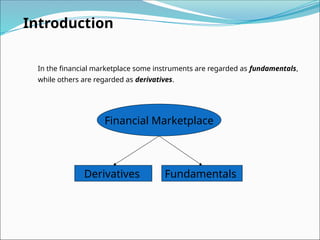
Introduction
In the financial marketplace some instruments are regarded as fundamentals,
while others are regarded as derivatives.
Financial Marketplace
Derivatives Fundamentals
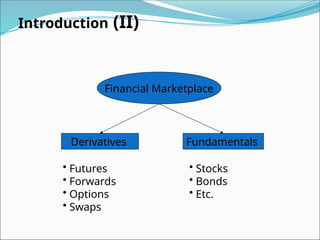
Financial Marketplace
Derivatives Fundamentals
• Stocks
• Bonds
• Etc.
• Futures
• Forwards
• Options
• Swaps
Introduction (II)
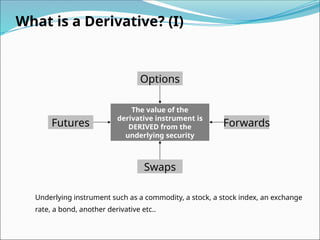
What is a Derivative? (I)
Options
Swaps
Forwards
Futures
The value of the
derivative instrument is
DERIVED from the
underlying security
Underlying instrument such as a commodity, a stock, a stock index, an exchange
rate, a bond, another derivative etc..
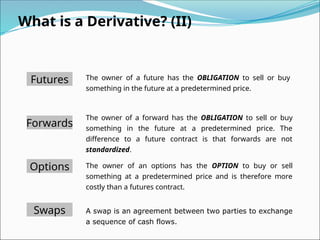
Options
Swaps
Forwards
Futures
The owner of an options has the OPTION to buy or sell
something at a predetermined price and is therefore more
costly than a futures contract.
The owner of a forward has the OBLIGATION to sell or buy
something in the future at a predetermined price. The
difference to a future contract is that forwards are not
standardized.
The owner of a future has the OBLIGATION to sell or buy
something in the future at a predetermined price.
What is a Derivative? (II)
A swap is an agreement between two parties to exchange
a sequence of cash flows.
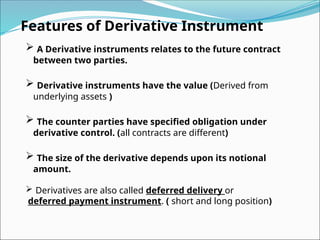
Features of Derivative Instrument
 A Derivative instruments relates to the future contract
between two parties.
 Derivative instruments have the value (Derived from
underlying assets )
 The counter parties have specified obligation under
derivative control. (all contracts are different)
 The size of the derivative depends upon its notional
amount.
 Derivatives are also called deferred delivery or
deferred payment instrument. ( short and long position)
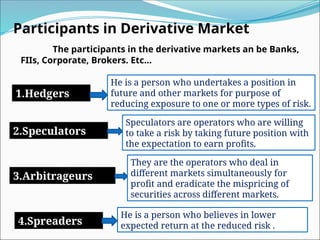
Participants in Derivative Market
The participants in the derivative markets an be Banks,
FIIs, Corporate, Brokers. Etc…
1.Hedgers
2.Speculators
3.Arbitrageurs
4.Spreaders
He is a person who undertakes a position in
future and other markets for purpose of
reducing exposure to one or more types of risk.
Speculators are operators who are willing
to take a risk by taking future position with
the expectation to earn profits.
They are the operators who deal in
different markets simultaneously for
profit and eradicate the mispricing of
securities across different markets.
He is a person who believes in lower
expected return at the reduced risk .
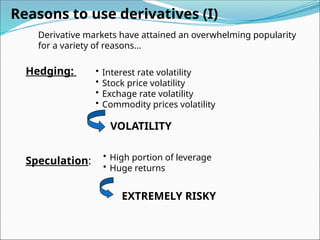
Reasons to use derivatives (I)
Hedging:
Speculation:
• Interest rate volatility
• Stock price volatility
• Exchage rate volatility
• Commodity prices volatility
VOLATILITY
• High portion of leverage
• Huge returns
EXTREMELY RISKY
Derivative markets have attained an overwhelming popularity
for a variety of reasons...
Reasons to use Derivatives (II)
Also derivatives create...
• a complete market, defined as a market in which all
identifiable payoffs can be obtained by trading the securities
available in the market.
• and market efficiency, characterized by low transaction costs
and greater liquidity.
Concepts to Understand
Short Selling: • Short selling is the selling of a security
that the seller does not own.
• Short sellers assume the risk that they will
be able to buy the stock at a more
favorable price than the price at which
they sold short.
Holding Long Position:
• Investors are legally owning a security.
• Investors are the legal owners of a security.
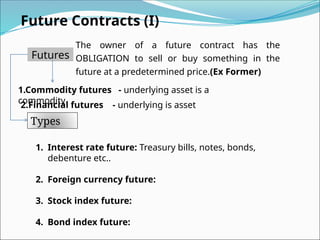
Future Contracts (I)
Futures
The owner of a future contract has the
OBLIGATION to sell or buy something in the
future at a predetermined price.(Ex Former)
1.Commodity futures - underlying asset is a
commodity
2.Financial futures - underlying is asset
Types
1. Interest rate future: Treasury bills, notes, bonds,
debenture etc..
2. Foreign currency future:
3. Stock index future:
4. Bond index future:
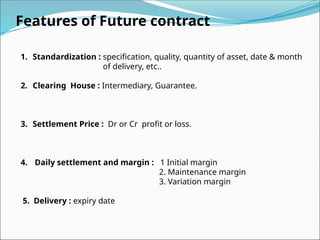
Features of Future contract
1. Standardization : specification, quality, quantity of asset, date & month
of delivery, etc..
2. Clearing House : Intermediary, Guarantee.
3. Settlement Price : Dr or Cr profit or loss.
4. Daily settlement and margin : 1 Initial margin
2. Maintenance margin
3. Variation margin
5. Delivery : expiry date
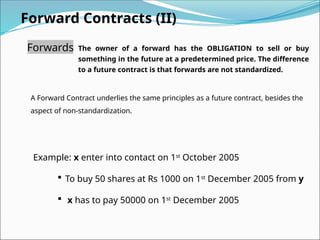
Forward Contracts (II)
Forwards The owner of a forward has the OBLIGATION to sell or buy
something in the future at a predetermined price. The difference
to a future contract is that forwards are not standardized.
A Forward Contract underlies the same principles as a future contract, besides the
aspect of non-standardization.
Example: x enter into contact on 1st
October 2005
 To buy 50 shares at Rs 1000 on 1st
December 2005 from y
 x has to pay 50000 on 1st
December 2005
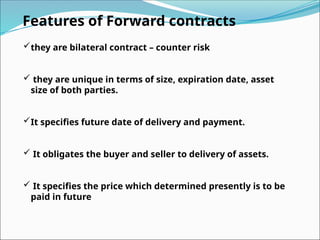
Features of Forward contracts
they are bilateral contract – counter risk
 they are unique in terms of size, expiration date, asset
size of both parties.
It specifies future date of delivery and payment.
 It obligates the buyer and seller to delivery of assets.
 It specifies the price which determined presently is to be
paid in future
Payoff from forward contract
To explain profit and loss (payoff) on a forward
contract
What is Offsetting the Forward contract?
In forward contract the party bears the risk until the
contracts expire because profit to be incurred will depend
upon the future spot price of the underlying assets
THANK YOU ALL

derivatives.pptx share market derivatives

  • 1.
    Derivative Instruments- Future,Forward .MBA (3rd ) semester
  • 2.
    Contents  Introduction  Whatis Derivatives  Features of Derivative Instruments  Participants in Derivative market  Reasons to use Derivatives  Concepts to understand  Future contract, Features  Forward contract, Features  Payoff, Offsetting,
  • 3.
    Introduction In the financialmarketplace some instruments are regarded as fundamentals, while others are regarded as derivatives. Financial Marketplace Derivatives Fundamentals
  • 4.
    Financial Marketplace Derivatives Fundamentals •Stocks • Bonds • Etc. • Futures • Forwards • Options • Swaps Introduction (II)
  • 5.
    What is aDerivative? (I) Options Swaps Forwards Futures The value of the derivative instrument is DERIVED from the underlying security Underlying instrument such as a commodity, a stock, a stock index, an exchange rate, a bond, another derivative etc..
  • 6.
    Options Swaps Forwards Futures The owner ofan options has the OPTION to buy or sell something at a predetermined price and is therefore more costly than a futures contract. The owner of a forward has the OBLIGATION to sell or buy something in the future at a predetermined price. The difference to a future contract is that forwards are not standardized. The owner of a future has the OBLIGATION to sell or buy something in the future at a predetermined price. What is a Derivative? (II) A swap is an agreement between two parties to exchange a sequence of cash flows.
  • 7.
    Features of DerivativeInstrument  A Derivative instruments relates to the future contract between two parties.  Derivative instruments have the value (Derived from underlying assets )  The counter parties have specified obligation under derivative control. (all contracts are different)  The size of the derivative depends upon its notional amount.  Derivatives are also called deferred delivery or deferred payment instrument. ( short and long position)
  • 8.
    Participants in DerivativeMarket The participants in the derivative markets an be Banks, FIIs, Corporate, Brokers. Etc… 1.Hedgers 2.Speculators 3.Arbitrageurs 4.Spreaders He is a person who undertakes a position in future and other markets for purpose of reducing exposure to one or more types of risk. Speculators are operators who are willing to take a risk by taking future position with the expectation to earn profits. They are the operators who deal in different markets simultaneously for profit and eradicate the mispricing of securities across different markets. He is a person who believes in lower expected return at the reduced risk .
  • 9.
    Reasons to usederivatives (I) Hedging: Speculation: • Interest rate volatility • Stock price volatility • Exchage rate volatility • Commodity prices volatility VOLATILITY • High portion of leverage • Huge returns EXTREMELY RISKY Derivative markets have attained an overwhelming popularity for a variety of reasons...
  • 10.
    Reasons to useDerivatives (II) Also derivatives create... • a complete market, defined as a market in which all identifiable payoffs can be obtained by trading the securities available in the market. • and market efficiency, characterized by low transaction costs and greater liquidity.
  • 11.
    Concepts to Understand ShortSelling: • Short selling is the selling of a security that the seller does not own. • Short sellers assume the risk that they will be able to buy the stock at a more favorable price than the price at which they sold short. Holding Long Position: • Investors are legally owning a security. • Investors are the legal owners of a security.
  • 12.
    Future Contracts (I) Futures Theowner of a future contract has the OBLIGATION to sell or buy something in the future at a predetermined price.(Ex Former) 1.Commodity futures - underlying asset is a commodity 2.Financial futures - underlying is asset Types 1. Interest rate future: Treasury bills, notes, bonds, debenture etc.. 2. Foreign currency future: 3. Stock index future: 4. Bond index future:
  • 13.
    Features of Futurecontract 1. Standardization : specification, quality, quantity of asset, date & month of delivery, etc.. 2. Clearing House : Intermediary, Guarantee. 3. Settlement Price : Dr or Cr profit or loss. 4. Daily settlement and margin : 1 Initial margin 2. Maintenance margin 3. Variation margin 5. Delivery : expiry date
  • 14.
    Forward Contracts (II) ForwardsThe owner of a forward has the OBLIGATION to sell or buy something in the future at a predetermined price. The difference to a future contract is that forwards are not standardized. A Forward Contract underlies the same principles as a future contract, besides the aspect of non-standardization. Example: x enter into contact on 1st October 2005  To buy 50 shares at Rs 1000 on 1st December 2005 from y  x has to pay 50000 on 1st December 2005
  • 15.
    Features of Forwardcontracts they are bilateral contract – counter risk  they are unique in terms of size, expiration date, asset size of both parties. It specifies future date of delivery and payment.  It obligates the buyer and seller to delivery of assets.  It specifies the price which determined presently is to be paid in future
  • 16.
    Payoff from forwardcontract To explain profit and loss (payoff) on a forward contract What is Offsetting the Forward contract? In forward contract the party bears the risk until the contracts expire because profit to be incurred will depend upon the future spot price of the underlying assets
  • 17.

Editor's Notes

  • #4 You could also mention here why there is securitization in asian regions: This Ă­s to promote home ownership to finance infrastructure growth and to develop the domestic capital markets.
  • #16 ×