Getting it Right for People with Learning Disabilities Genevieve Smyth College of Occupational Therapists 6 th  November 2008
Introduction Background Current project work Future work Challenging Behaviour update
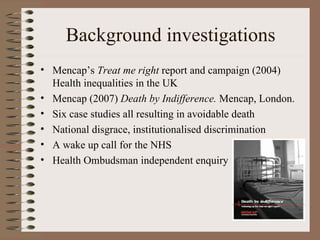
Background investigations Mencap’s  Treat me right  report and campaign (2004) Health inequalities in the UK Mencap (2007)  Death by Indifference.  Mencap, London. Six case studies all resulting in avoidable death National disgrace, institutionalised discrimination A wake up call for the NHS Health Ombudsman independent enquiry
Background investigations Disability Rights Commission (2006)  Equal Treatment: Closing the Gap . Disability rights commission, London. Health inequalities for people with learning disabilities and/or mental health problems in the UK People with learning disabilities die younger Higher rates of obesity and respiratory disease Fewer health screenings Diagnostic overshadowing Information not collated
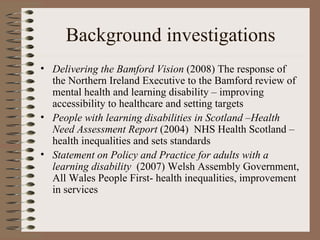
Background investigations Delivering the Bamford Vision  (2008) The response of the Northern Ireland Executive to the Bamford review of mental health and learning disability – improving accessibility to healthcare and setting targets People with learning disabilities in Scotland –Health Need Assessment Report  (2004)  NHS Health Scotland –health inequalities and sets standards Statement on Policy and Practice for adults with a learning disability   (2007) Welsh Assembly Government, All Wales People First- health inequalities, improvement in services
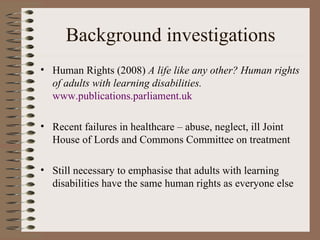
Background investigations Human Rights (2008)  A life like any other? Human rights of adults with learning disabilities.   www.publications.parliament. uk Recent failures in healthcare – abuse, neglect, ill Joint House of Lords and Commons Committee on treatment Still necessary to emphasise that adults with learning disabilities have the same human rights as everyone else
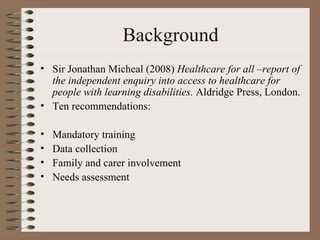
Background Sir Jonathan Micheal (2008)  Healthcare for all –report of the independent enquiry into access to healthcare for people with learning disabilities.  Aldridge Press, London. Ten recommendations: Mandatory training Data collection  Family and carer involvement Needs assessment
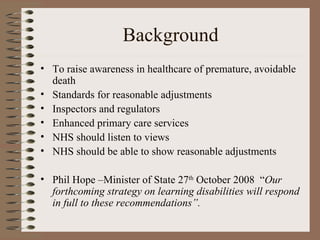
Background To raise awareness in healthcare of premature, avoidable death Standards for reasonable adjustments Inspectors and regulators Enhanced primary care services NHS should listen to views NHS should be able to show reasonable adjustments Phil Hope –Minister of State 27 th  October 2008  “ Our forthcoming strategy on learning disabilities will respond in full to these recommendations”.
AHP Bulletin October 2008 www.dh. gov . uk / ahpbulletin Vital role for AHPs in improving access to healthcare for people with learning disabilities “ This is a great opportunity for AHPs to use their wide range of skills to help transform healthcare for people with learning disabilities” “ I’m fed up with enquiry after enquiry making no difference whatsoever”
Start of Getting it Right 15 th  November 2007, Jim Blair – President of the Royal Society of Medicine’s Intellectual Disabilities Forum, Senior Lecturer in Learning Disabilities, Kingston University. Launch of a cross-agency, cross-college  working group to tackle disturbing inadequacies in NHS treatment Addressing the issues of accountability, training and responsibility
Getting it Right Meetings once a month Product to improve generic healthcare staff’s ability to work with people with learning disabilities Endorsed leaflet in paper and electronic format Insert into OTN  Each professional group responsible for dissemination
Group members Mencap  The College of Occupational Therapists Royal Society of Medicine Royal College of General Practitioners Royal College of Nursing  The Commission for Carers Nursing and Midwifery Council  Royal College of Speech and Language Therapists Royal College of Psychiatrists
Who we are Getting it right is a group of organisations working to wards better healthcare, well being and quality of life for people with a learning disability. People with a learning disability experience poorer health and healthcare than the general population. We aim to provide healthcare professionals with information on best practice and where to go for information and support so all people with a learning disability get the best health treatment possible.
See the person –not the disability Find time to Listen to the person Listen to the family Find the best way to communicate Pay attention to facial expressions Notice gestures and body language Try pointing to pictures Try signing Keep info simple and brief Avoid using jargon
Don’t make assumptions about the person’s quality of life People with a learning disability feel pain too People with a learning disability get ill too Don’t confuse a learning disability with illness Be suspicious about serious illness- act quickly! Get to know some of the health conditions that are more common for people with a learning disability
The Law and you You must make reasonable adjustments to ensure that each person has the same opportunity for health whether they have a learning disability or not. Disability Discrimination Act 2005
The Law and you You must be able to establish the person’s capacity and make decisions that are in their best interest if they cannot decide for themselves. Mental Capacity Act 2005
The Law and you Everyone has a right to expect and receive appropriate healthcare. Human Rights Act 1998
Where to find help and more information Call your local learning disability team Go to  www. mencap .org. uk Or  www. intellectualdisability .info Or  www. easyhealth .org. uk
Dissemination OTN Specialist Sections Higher Education Institutes COT Conference Brighton 2009 June 23 rd -26 th You!
Challenging Behaviour update Royal College of Psychiatrists, British Psychological Society, Royal College of Speech and Language Therapists (2007)  Challenging Behaviour; a unified approach.  www. rcpsych .ac. uk Challenging Behaviour National Strategy Group – the Challenging Behaviour Foundation Collate all the strands of work currently being undertaken in the field of LD and challenging behaviour Identify gaps in provision and where to target work for the greatest impact
Conclusion Getting it Right  from inception to dissemination Challenging Behaviour update [email_address] uk 0207 450 5220

Getting it right for people with Learning Disabilities

  • 1.
    Getting it Rightfor People with Learning Disabilities Genevieve Smyth College of Occupational Therapists 6 th November 2008
  • 2.
    Introduction Background Currentproject work Future work Challenging Behaviour update
  • 3.
    Background investigations Mencap’s Treat me right report and campaign (2004) Health inequalities in the UK Mencap (2007) Death by Indifference. Mencap, London. Six case studies all resulting in avoidable death National disgrace, institutionalised discrimination A wake up call for the NHS Health Ombudsman independent enquiry
  • 4.
    Background investigations DisabilityRights Commission (2006) Equal Treatment: Closing the Gap . Disability rights commission, London. Health inequalities for people with learning disabilities and/or mental health problems in the UK People with learning disabilities die younger Higher rates of obesity and respiratory disease Fewer health screenings Diagnostic overshadowing Information not collated
  • 5.
    Background investigations Deliveringthe Bamford Vision (2008) The response of the Northern Ireland Executive to the Bamford review of mental health and learning disability – improving accessibility to healthcare and setting targets People with learning disabilities in Scotland –Health Need Assessment Report (2004) NHS Health Scotland –health inequalities and sets standards Statement on Policy and Practice for adults with a learning disability (2007) Welsh Assembly Government, All Wales People First- health inequalities, improvement in services
  • 6.
    Background investigations HumanRights (2008) A life like any other? Human rights of adults with learning disabilities. www.publications.parliament. uk Recent failures in healthcare – abuse, neglect, ill Joint House of Lords and Commons Committee on treatment Still necessary to emphasise that adults with learning disabilities have the same human rights as everyone else
  • 7.
    Background Sir JonathanMicheal (2008) Healthcare for all –report of the independent enquiry into access to healthcare for people with learning disabilities. Aldridge Press, London. Ten recommendations: Mandatory training Data collection Family and carer involvement Needs assessment
  • 8.
    Background To raiseawareness in healthcare of premature, avoidable death Standards for reasonable adjustments Inspectors and regulators Enhanced primary care services NHS should listen to views NHS should be able to show reasonable adjustments Phil Hope –Minister of State 27 th October 2008 “ Our forthcoming strategy on learning disabilities will respond in full to these recommendations”.
  • 9.
    AHP Bulletin October2008 www.dh. gov . uk / ahpbulletin Vital role for AHPs in improving access to healthcare for people with learning disabilities “ This is a great opportunity for AHPs to use their wide range of skills to help transform healthcare for people with learning disabilities” “ I’m fed up with enquiry after enquiry making no difference whatsoever”
  • 10.
    Start of Gettingit Right 15 th November 2007, Jim Blair – President of the Royal Society of Medicine’s Intellectual Disabilities Forum, Senior Lecturer in Learning Disabilities, Kingston University. Launch of a cross-agency, cross-college working group to tackle disturbing inadequacies in NHS treatment Addressing the issues of accountability, training and responsibility
  • 11.
    Getting it RightMeetings once a month Product to improve generic healthcare staff’s ability to work with people with learning disabilities Endorsed leaflet in paper and electronic format Insert into OTN Each professional group responsible for dissemination
  • 12.
    Group members Mencap The College of Occupational Therapists Royal Society of Medicine Royal College of General Practitioners Royal College of Nursing The Commission for Carers Nursing and Midwifery Council Royal College of Speech and Language Therapists Royal College of Psychiatrists
  • 13.
    Who we areGetting it right is a group of organisations working to wards better healthcare, well being and quality of life for people with a learning disability. People with a learning disability experience poorer health and healthcare than the general population. We aim to provide healthcare professionals with information on best practice and where to go for information and support so all people with a learning disability get the best health treatment possible.
  • 14.
    See the person–not the disability Find time to Listen to the person Listen to the family Find the best way to communicate Pay attention to facial expressions Notice gestures and body language Try pointing to pictures Try signing Keep info simple and brief Avoid using jargon
  • 15.
    Don’t make assumptionsabout the person’s quality of life People with a learning disability feel pain too People with a learning disability get ill too Don’t confuse a learning disability with illness Be suspicious about serious illness- act quickly! Get to know some of the health conditions that are more common for people with a learning disability
  • 16.
    The Law andyou You must make reasonable adjustments to ensure that each person has the same opportunity for health whether they have a learning disability or not. Disability Discrimination Act 2005
  • 17.
    The Law andyou You must be able to establish the person’s capacity and make decisions that are in their best interest if they cannot decide for themselves. Mental Capacity Act 2005
  • 18.
    The Law andyou Everyone has a right to expect and receive appropriate healthcare. Human Rights Act 1998
  • 19.
    Where to findhelp and more information Call your local learning disability team Go to www. mencap .org. uk Or www. intellectualdisability .info Or www. easyhealth .org. uk
  • 20.
    Dissemination OTN SpecialistSections Higher Education Institutes COT Conference Brighton 2009 June 23 rd -26 th You!
  • 21.
    Challenging Behaviour updateRoyal College of Psychiatrists, British Psychological Society, Royal College of Speech and Language Therapists (2007) Challenging Behaviour; a unified approach. www. rcpsych .ac. uk Challenging Behaviour National Strategy Group – the Challenging Behaviour Foundation Collate all the strands of work currently being undertaken in the field of LD and challenging behaviour Identify gaps in provision and where to target work for the greatest impact
  • 22.
    Conclusion Getting itRight from inception to dissemination Challenging Behaviour update [email_address] uk 0207 450 5220