Chapter 9 Property Acquisition and Cost Recovery  Copyright   © 2010 by The McGraw-Hill Companies, Inc. All rights reserved. McGraw-Hill/Irwin
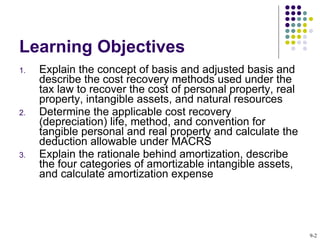
Learning Objectives Explain the concept of basis and adjusted basis and describe the cost recovery methods used under the tax law to recover the cost of personal property, real property, intangible assets, and natural resources Determine the applicable cost recovery (depreciation) life, method, and convention for tangible personal and real property and calculate the deduction allowable under MACRS Explain the rationale behind amortization, describe the four categories of amortizable intangible assets, and calculate amortization expense 9-
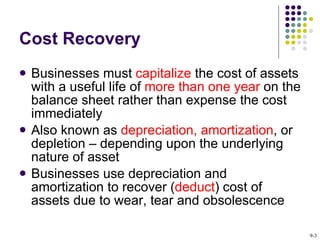
Cost Recovery Businesses must  capitalize  the cost of assets with a useful life of  more than one year  on the balance sheet rather than expense the cost immediately Also known as  depreciation, amortization , or depletion – depending upon the underlying nature of asset Businesses use depreciation and amortization to recover ( deduct ) cost of assets due to wear, tear and obsolescence 9-
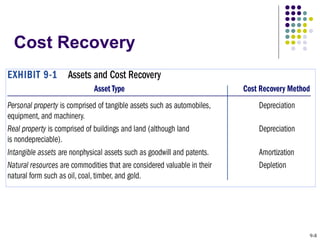
Different methods to recover (deduct) the costs of assets   Depreciation  - Deducting the cost of tangible personal and real property (other than land) over a specific period of time  Amortization  - Deducting the cost of intangible personal and real property (other than land) over a specific period of time  Depletion  - Deducting the cost of natural resources over time  Cost Recovery 9-
Cost Recovery Basis for Cost Recovery  –  When the asset is  placed in service , cost recovery deductions start Cost  basis goes down  as cost is recovered through depreciation deductions  (reduced basis is called  Adjusted Basis  or Tax Basis) Assets  Adjusted Basis  = Assets  Initial Cost  or Historical basis  minus Accumulated Depreciation  (Amortization or Depletion) 9-
Basis Example Scrap-Happy Inc., a scrapbooking retail  chain, purchased an old office building for $175,000 for use in expanding its current operations. An additional $15,000 was spent painting and carpeting the building in preparation for its opening.  Two years later, a Scrap-Happy employee discovered that several leaks in the roof were causing serious water damage to the store’s inventory; the company spent $50,000 to re-roof the building. Every six months, Scrap-Happy pays $500 to have the carpet professionally cleaned.  9-
Basis Example (cont.) What is the  original basis  of the building? $175,000 initial cost  +  $15,000  painting and carpeting $ 190,000  Original Basis What  effect s do the other two transactions have  on  the  original basis ? $50,000  re-roofing expense :  Added to basis  (extends the useful life of the building)  $500 biannual  carpet cleaning :  No effect on basis  (Expensed (deducted) immediately    routine maintenance) 9-
Cost Recovery 9-
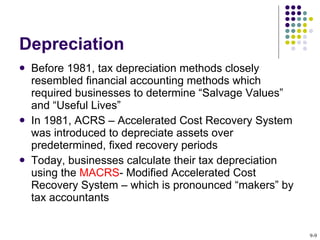
Depreciation  Before 1981, tax depreciation methods closely resembled financial accounting methods which required businesses to determine “Salvage Values” and “Useful Lives”  In 1981, ACRS – Accelerated Cost Recovery System was introduced to depreciate assets over predetermined, fixed recovery periods Today, businesses calculate their tax depreciation using the  MACRS - Modified Accelerated Cost Recovery System – which is pronounced “makers” by tax accountants  9-
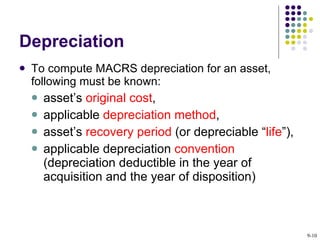
Depreciation To compute MACRS depreciation for an asset, following must be known: asset’s  original cost ,  applicable  depreciation method ,  asset’s  recovery period  (or depreciable “ life ”),  applicable depreciation  convention  (depreciation deductible in the year of acquisition and the year of disposition) 9-
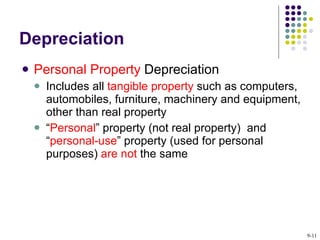
Depreciation Personal Property  Depreciation Includes all  tangible property  such as computers, automobiles, furniture, machinery and equipment, other than real property  “ Personal ” property (not real property)  and “ personal-use ” property (used for personal purposes)  are not  the same  9-
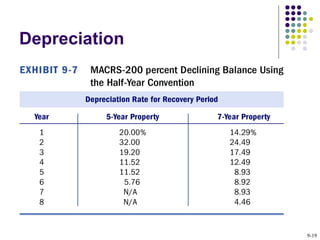
Depreciation Depreciation Method Three acceptable methods for depreciating personal property 200 percent (double) declining balance ( most common ) 150 percent declining balance straight-line   9-
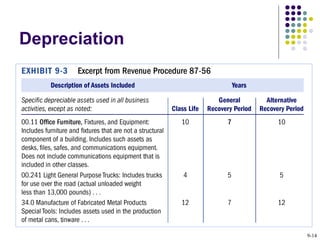
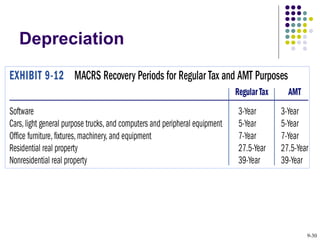
Depreciation Depreciation Recovery Period For  financial statement purposes  an assets recovery period (depreciable life) is based on its  taxpayer-determined estimated useful life  For tax purposes, an assets  recovery period is predetermined  by IRS in the Rev. Proc. 87-56 which helps taxpayers to categorize each of their assets based upon the property’s description 9-
Depreciation 9-
Depreciation 9-
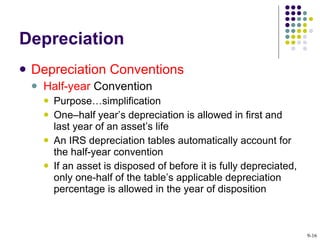
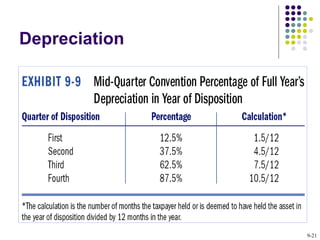
Depreciation Depreciation Conventions Half-year  Convention Purpose…simplification One–half year’s depreciation is allowed in first and last year of an asset’s life  An IRS depreciation tables automatically account for the half-year convention If an asset is disposed of before it is fully depreciated, only one-half of the table’s applicable depreciation percentage is allowed in the year of disposition  9-
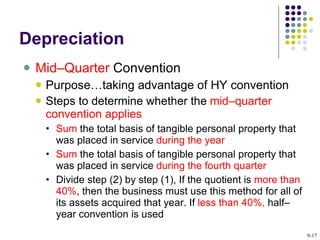
Depreciation Mid–Quarter  Convention Purpose…taking advantage of HY convention Steps to determine whether the  mid–quarter convention applies   Sum  the total basis of tangible personal property that was placed in service  during the year Sum  the total basis of tangible personal property that was placed in service  during the fourth quarter Divide step (2) by step (1), If the quotient is  more than 40% , then the business must use this method for all of its assets acquired that year. If  less than 40%,  half–year convention is used 9-
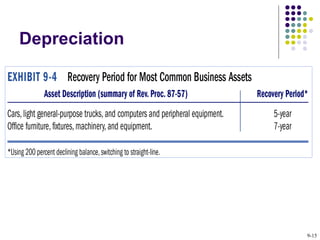
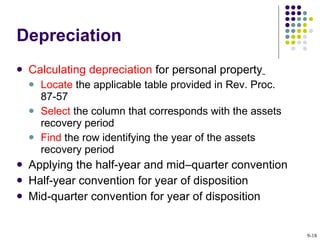
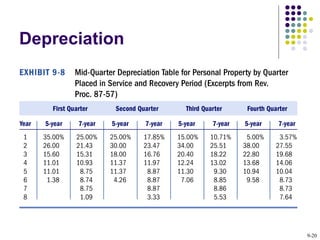
Depreciation Calculating depreciation  for personal property   Locate  the applicable table provided in Rev. Proc. 87-57 Select  the column that corresponds with the assets recovery period  Find  the row identifying the year of the assets recovery period Applying the half-year and mid–quarter convention Half-year convention for year of disposition Mid-quarter convention for year of disposition 9-
Depreciation  9-
Depreciation 9-
Depreciation 9-
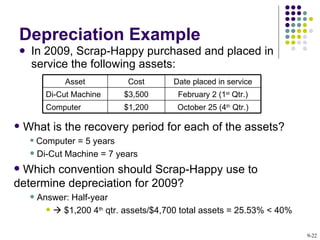
Depreciation Example In 2009, Scrap-Happy purchased and placed in service the following assets: What is the recovery period for each of the assets? Computer = 5 years Di-Cut Machine = 7 years Which convention should Scrap-Happy use to determine depreciation for 2009? Answer: Half-year    $1,200 4 th  qtr. assets/$4,700 total assets = 25.53% < 40% 9- Asset Cost Date placed in service Di-Cut Machine $3,500 February 2 (1 st  Qtr.) Computer $1,200 October 25 (4 th  Qtr.)
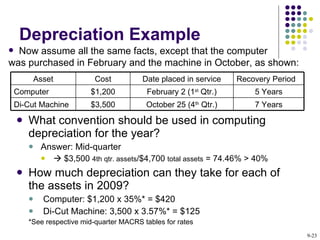
Depreciation Example What convention should be used in computing depreciation for the year? Answer: Mid-quarter    $3,500  4th qtr. assets /$4,700  total assets  = 74.46% > 40% How much depreciation can they take for each of the assets in 2009? Computer: $1,200 x 35%* = $420 Di-Cut Machine: 3,500 x 3.57%* = $125 *See respective mid-quarter MACRS tables for rates  Now assume all the same facts, except that the computer  was purchased in February and the machine in October, as shown: 9- Asset Cost Date placed in service Recovery Period Computer $1,200 February 2 (1 st  Qtr.) 5 Years Di-Cut Machine $3,500 October 25 (4 th  Qtr.) 7 Years
Problems  (see solutions manual) Problem 46 on p167.
Depreciation Immediate  Expensing This incentive is commonly referred as  §179  expense or immediate expensing election Limits  on immediate expensing (see p.136) Choosing  the assets to immediately expense (see p.138) Bonus  Depreciation To stimulate the economy, policy makers occasionally implement bonus depreciation 9-
Problems  (see solutions manual) Problem 50 on p168.
Depreciation Listed Property  (p.140) Property that is commonly used for both business and personal purposes. Must reduce depreciation deduction by personal use percentage See text discussion and examples Luxury Automobiles  (p.143) IRS allows depreciation deduction for business use of autos, however, it draws a line at extravagance. See limitations in text examples 9-

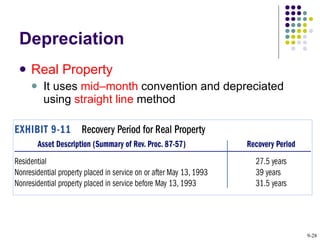
Depreciation Real Property It uses  mid–month  convention   and depreciated using  straight line  method 9-
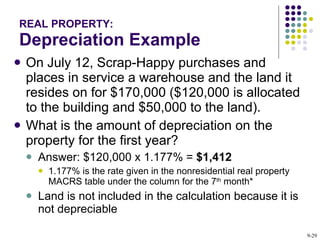
REAL PROPERTY: Depreciation Example On July 12, Scrap-Happy purchases and places in service a warehouse and the land it resides on for $170,000 ($120,000 is allocated to the building and $50,000 to the land).  What is the amount of depreciation on the property for the first year? Answer: $120,000 x 1.177% =  $1,412 1.177% is the rate given in the nonresidential real property  MACRS table under the column for the 7 th  month* Land is not included in the calculation because it is not depreciable 9-
Depreciation 9-
Problems  (see solutions manual) Problem 56 on p170.
Amortization For  intangible assets , businesses recover cost of the asset through  amortization Intangible assets fall into one of the following characteristics: Section 197 Intangibles Start-up expenditures and organizational costs Research and experimentation costs Patents and Copyrights  9-
Amortization Section 197  intangibles Includes almost all intangible asset types Acquired when a  business buys another business These assets have a recovery period of 180 months ( 15 years ), regardless of their actual life Uses  full month  convention allows taxpayers to deduct an entire month’s worth of amortization for the month of purchase and all subsequent months in the year 9-
Amortization Organizational Expenditures and Start-up Costs Organizational expenditures  include expenditures to  form and organize  a business and are incurred  prior to starting  the   business (one-time expenses) Start-up costs  are normal business expenses incurred before business officially begins (wages, rent, etc.)   9-
Amortization Patents and Copyrights Business  directly purchases  patents or copyrights (not part of business acquisition…See §197) amortize the cost over the remaining life of the patents or copyrights. Business  receives “self-created”  patents or copyrights amortize the cost or basis of the self-created intangible assets over their legal lives - up to a maximum of 17 years for patents and 28 years for copyrights 9-
To Do… In-Class Problems:  39,40,42,49,51,54,59 Homework (due Sunday @ 11:59pm): 7,17,25,32,47,52,61,64 Ch 9 Quiz (due Sunday @ 11:59pm) Chapter 10 Pre-Class Questions 5,6,7,11,24

Chap009

  • 1.
    Chapter 9 PropertyAcquisition and Cost Recovery Copyright © 2010 by The McGraw-Hill Companies, Inc. All rights reserved. McGraw-Hill/Irwin
  • 2.
    Learning Objectives Explainthe concept of basis and adjusted basis and describe the cost recovery methods used under the tax law to recover the cost of personal property, real property, intangible assets, and natural resources Determine the applicable cost recovery (depreciation) life, method, and convention for tangible personal and real property and calculate the deduction allowable under MACRS Explain the rationale behind amortization, describe the four categories of amortizable intangible assets, and calculate amortization expense 9-
  • 3.
    Cost Recovery Businessesmust capitalize the cost of assets with a useful life of more than one year on the balance sheet rather than expense the cost immediately Also known as depreciation, amortization , or depletion – depending upon the underlying nature of asset Businesses use depreciation and amortization to recover ( deduct ) cost of assets due to wear, tear and obsolescence 9-
  • 4.
    Different methods torecover (deduct) the costs of assets Depreciation - Deducting the cost of tangible personal and real property (other than land) over a specific period of time Amortization - Deducting the cost of intangible personal and real property (other than land) over a specific period of time Depletion - Deducting the cost of natural resources over time Cost Recovery 9-
  • 5.
    Cost Recovery Basisfor Cost Recovery – When the asset is placed in service , cost recovery deductions start Cost basis goes down as cost is recovered through depreciation deductions (reduced basis is called Adjusted Basis or Tax Basis) Assets Adjusted Basis = Assets Initial Cost or Historical basis minus Accumulated Depreciation (Amortization or Depletion) 9-
  • 6.
    Basis Example Scrap-HappyInc., a scrapbooking retail chain, purchased an old office building for $175,000 for use in expanding its current operations. An additional $15,000 was spent painting and carpeting the building in preparation for its opening. Two years later, a Scrap-Happy employee discovered that several leaks in the roof were causing serious water damage to the store’s inventory; the company spent $50,000 to re-roof the building. Every six months, Scrap-Happy pays $500 to have the carpet professionally cleaned. 9-
  • 7.
    Basis Example (cont.)What is the original basis of the building? $175,000 initial cost + $15,000 painting and carpeting $ 190,000 Original Basis What effect s do the other two transactions have on the original basis ? $50,000 re-roofing expense : Added to basis (extends the useful life of the building) $500 biannual carpet cleaning : No effect on basis (Expensed (deducted) immediately  routine maintenance) 9-
  • 8.
  • 9.
    Depreciation Before1981, tax depreciation methods closely resembled financial accounting methods which required businesses to determine “Salvage Values” and “Useful Lives” In 1981, ACRS – Accelerated Cost Recovery System was introduced to depreciate assets over predetermined, fixed recovery periods Today, businesses calculate their tax depreciation using the MACRS - Modified Accelerated Cost Recovery System – which is pronounced “makers” by tax accountants 9-
  • 10.
    Depreciation To computeMACRS depreciation for an asset, following must be known: asset’s original cost , applicable depreciation method , asset’s recovery period (or depreciable “ life ”), applicable depreciation convention (depreciation deductible in the year of acquisition and the year of disposition) 9-
  • 11.
    Depreciation Personal Property Depreciation Includes all tangible property such as computers, automobiles, furniture, machinery and equipment, other than real property “ Personal ” property (not real property) and “ personal-use ” property (used for personal purposes) are not the same 9-
  • 12.
    Depreciation Depreciation MethodThree acceptable methods for depreciating personal property 200 percent (double) declining balance ( most common ) 150 percent declining balance straight-line 9-
  • 13.
    Depreciation Depreciation RecoveryPeriod For financial statement purposes an assets recovery period (depreciable life) is based on its taxpayer-determined estimated useful life For tax purposes, an assets recovery period is predetermined by IRS in the Rev. Proc. 87-56 which helps taxpayers to categorize each of their assets based upon the property’s description 9-
  • 14.
  • 15.
  • 16.
    Depreciation Depreciation ConventionsHalf-year Convention Purpose…simplification One–half year’s depreciation is allowed in first and last year of an asset’s life An IRS depreciation tables automatically account for the half-year convention If an asset is disposed of before it is fully depreciated, only one-half of the table’s applicable depreciation percentage is allowed in the year of disposition 9-
  • 17.
    Depreciation Mid–Quarter Convention Purpose…taking advantage of HY convention Steps to determine whether the mid–quarter convention applies Sum the total basis of tangible personal property that was placed in service during the year Sum the total basis of tangible personal property that was placed in service during the fourth quarter Divide step (2) by step (1), If the quotient is more than 40% , then the business must use this method for all of its assets acquired that year. If less than 40%, half–year convention is used 9-
  • 18.
    Depreciation Calculating depreciation for personal property Locate the applicable table provided in Rev. Proc. 87-57 Select the column that corresponds with the assets recovery period Find the row identifying the year of the assets recovery period Applying the half-year and mid–quarter convention Half-year convention for year of disposition Mid-quarter convention for year of disposition 9-
  • 19.
  • 20.
  • 21.
  • 22.
    Depreciation Example In2009, Scrap-Happy purchased and placed in service the following assets: What is the recovery period for each of the assets? Computer = 5 years Di-Cut Machine = 7 years Which convention should Scrap-Happy use to determine depreciation for 2009? Answer: Half-year  $1,200 4 th qtr. assets/$4,700 total assets = 25.53% < 40% 9- Asset Cost Date placed in service Di-Cut Machine $3,500 February 2 (1 st Qtr.) Computer $1,200 October 25 (4 th Qtr.)
  • 23.
    Depreciation Example Whatconvention should be used in computing depreciation for the year? Answer: Mid-quarter  $3,500 4th qtr. assets /$4,700 total assets = 74.46% > 40% How much depreciation can they take for each of the assets in 2009? Computer: $1,200 x 35%* = $420 Di-Cut Machine: 3,500 x 3.57%* = $125 *See respective mid-quarter MACRS tables for rates Now assume all the same facts, except that the computer was purchased in February and the machine in October, as shown: 9- Asset Cost Date placed in service Recovery Period Computer $1,200 February 2 (1 st Qtr.) 5 Years Di-Cut Machine $3,500 October 25 (4 th Qtr.) 7 Years
  • 24.
    Problems (seesolutions manual) Problem 46 on p167.
  • 25.
    Depreciation Immediate Expensing This incentive is commonly referred as §179 expense or immediate expensing election Limits on immediate expensing (see p.136) Choosing the assets to immediately expense (see p.138) Bonus Depreciation To stimulate the economy, policy makers occasionally implement bonus depreciation 9-
  • 26.
    Problems (seesolutions manual) Problem 50 on p168.
  • 27.
    Depreciation Listed Property (p.140) Property that is commonly used for both business and personal purposes. Must reduce depreciation deduction by personal use percentage See text discussion and examples Luxury Automobiles (p.143) IRS allows depreciation deduction for business use of autos, however, it draws a line at extravagance. See limitations in text examples 9-
  • 28.
    Depreciation Real PropertyIt uses mid–month convention and depreciated using straight line method 9-
  • 29.
    REAL PROPERTY: DepreciationExample On July 12, Scrap-Happy purchases and places in service a warehouse and the land it resides on for $170,000 ($120,000 is allocated to the building and $50,000 to the land). What is the amount of depreciation on the property for the first year? Answer: $120,000 x 1.177% = $1,412 1.177% is the rate given in the nonresidential real property MACRS table under the column for the 7 th month* Land is not included in the calculation because it is not depreciable 9-
  • 30.
  • 31.
    Problems (seesolutions manual) Problem 56 on p170.
  • 32.
    Amortization For intangible assets , businesses recover cost of the asset through amortization Intangible assets fall into one of the following characteristics: Section 197 Intangibles Start-up expenditures and organizational costs Research and experimentation costs Patents and Copyrights 9-
  • 33.
    Amortization Section 197 intangibles Includes almost all intangible asset types Acquired when a business buys another business These assets have a recovery period of 180 months ( 15 years ), regardless of their actual life Uses full month convention allows taxpayers to deduct an entire month’s worth of amortization for the month of purchase and all subsequent months in the year 9-
  • 34.
    Amortization Organizational Expendituresand Start-up Costs Organizational expenditures include expenditures to form and organize a business and are incurred prior to starting the business (one-time expenses) Start-up costs are normal business expenses incurred before business officially begins (wages, rent, etc.) 9-
  • 35.
    Amortization Patents andCopyrights Business directly purchases patents or copyrights (not part of business acquisition…See §197) amortize the cost over the remaining life of the patents or copyrights. Business receives “self-created” patents or copyrights amortize the cost or basis of the self-created intangible assets over their legal lives - up to a maximum of 17 years for patents and 28 years for copyrights 9-
  • 36.
    To Do… In-ClassProblems: 39,40,42,49,51,54,59 Homework (due Sunday @ 11:59pm): 7,17,25,32,47,52,61,64 Ch 9 Quiz (due Sunday @ 11:59pm) Chapter 10 Pre-Class Questions 5,6,7,11,24