E-FILING OF RETURNS
TOPIC:- TDS & PROVISIONS
PREPARED BY:-
SANKALP NAUTIYAL 2273
WHAT IS TDS?
Tax Deducted at Source (TDS) is a system introduced by Income Tax
Department, where person responsible for making specified
payments such as salary, commission, professional fees, interest,
rent, etc. is liable to deduct a certain percentage of tax before making
payment in full to the receiver of the payment. As the name suggests,
the concept of TDS is to deduct tax at its source.
The concept of TDS was introduced with an aim to collect tax from the
very source of income. As per this concept, a person (deductor) who is
liable to make payment of specified nature to any other person (deductee)
shall deduct tax at source and remit the same into the account of the
Central Government.
The deductee from whose income tax has been deducted at source would
be entitled to get credit of the amount so deducted on the basis of Form
26AS or TDS certificate issued by the deductor.
CONCEPT
WHAT IS TAN AND
HOW TO APPLY FOR
TAN?
TAN stands for Tax Deduction
Account Number. It is 10 digit alpha
numeric number required to be
obtained by all persons who are
responsible for deducting or collecting
tax. Under Section 203A of the
Income Tax Act, 1961, it is mandatory
to quote Tax Deduction Account
Number (TAN) allotted by the Income
Tax Department (ITD) on all TDS
returns.
The procedure for application of TAN
is very simple and can be done online
by filling up Form 49B. Please refer to
NSDL Site in order to Apply For TAN.
WHEN TDS SHOULD
BE DEDUCTED?
The concept of TDS is based on a simple
principle i.e. tax is to be deducted at the
time of payment getting due or actual
payment whichever is earlier.
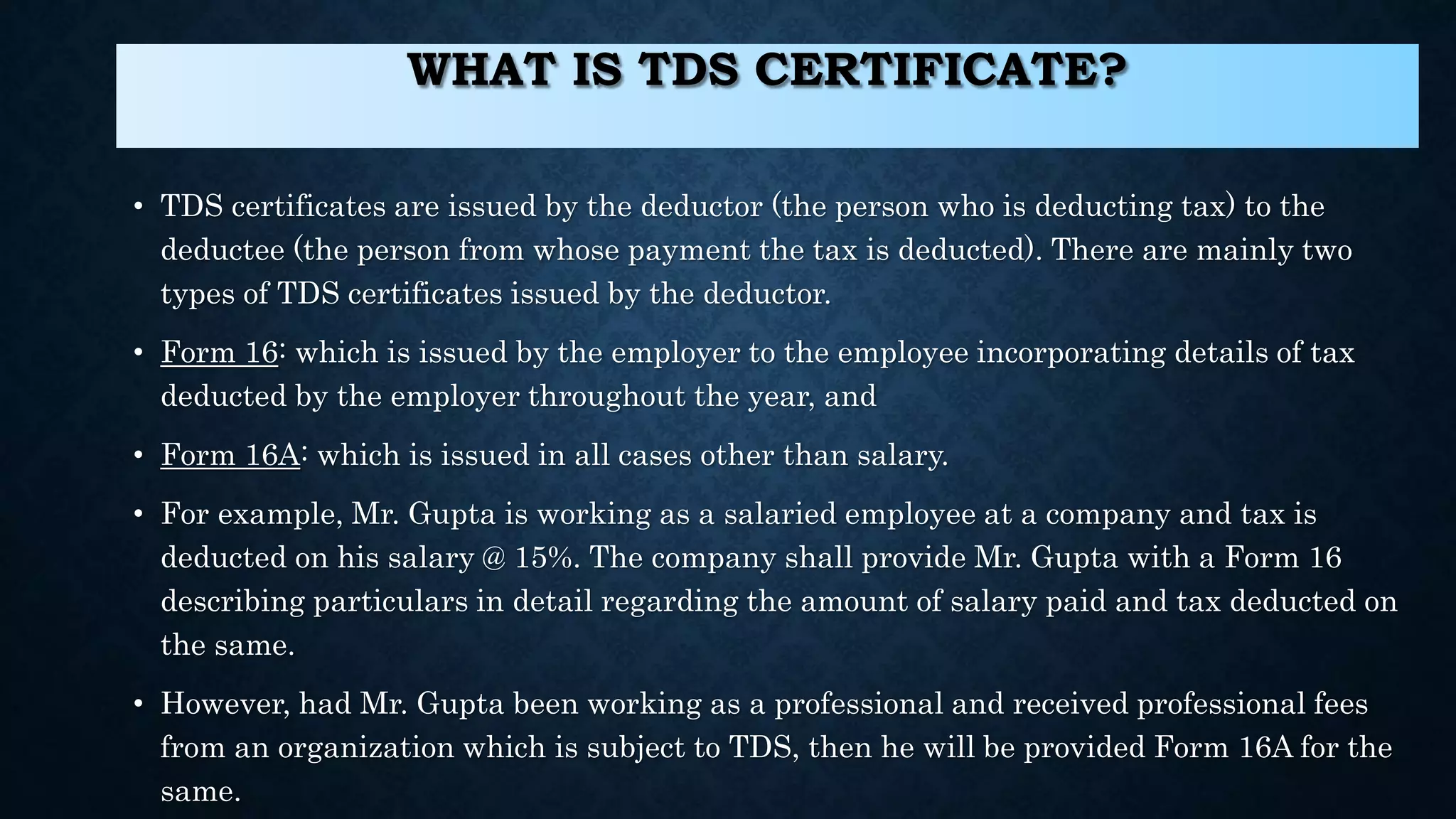
WHAT IS TDS CERTIFICATE?
• TDS certificates are issued by the deductor (the person who is deducting tax) to the
deductee (the person from whose payment the tax is deducted). There are mainly two
types of TDS certificates issued by the deductor.
• Form 16: which is issued by the employer to the employee incorporating details of tax
deducted by the employer throughout the year, and
• Form 16A: which is issued in all cases other than salary.
• For example, Mr. Gupta is working as a salaried employee at a company and tax is
deducted on his salary @ 15%. The company shall provide Mr. Gupta with a Form 16
describing particulars in detail regarding the amount of salary paid and tax deducted on
the same.
• However, had Mr. Gupta been working as a professional and received professional fees
from an organization which is subject to TDS, then he will be provided Form 16A for the
same.
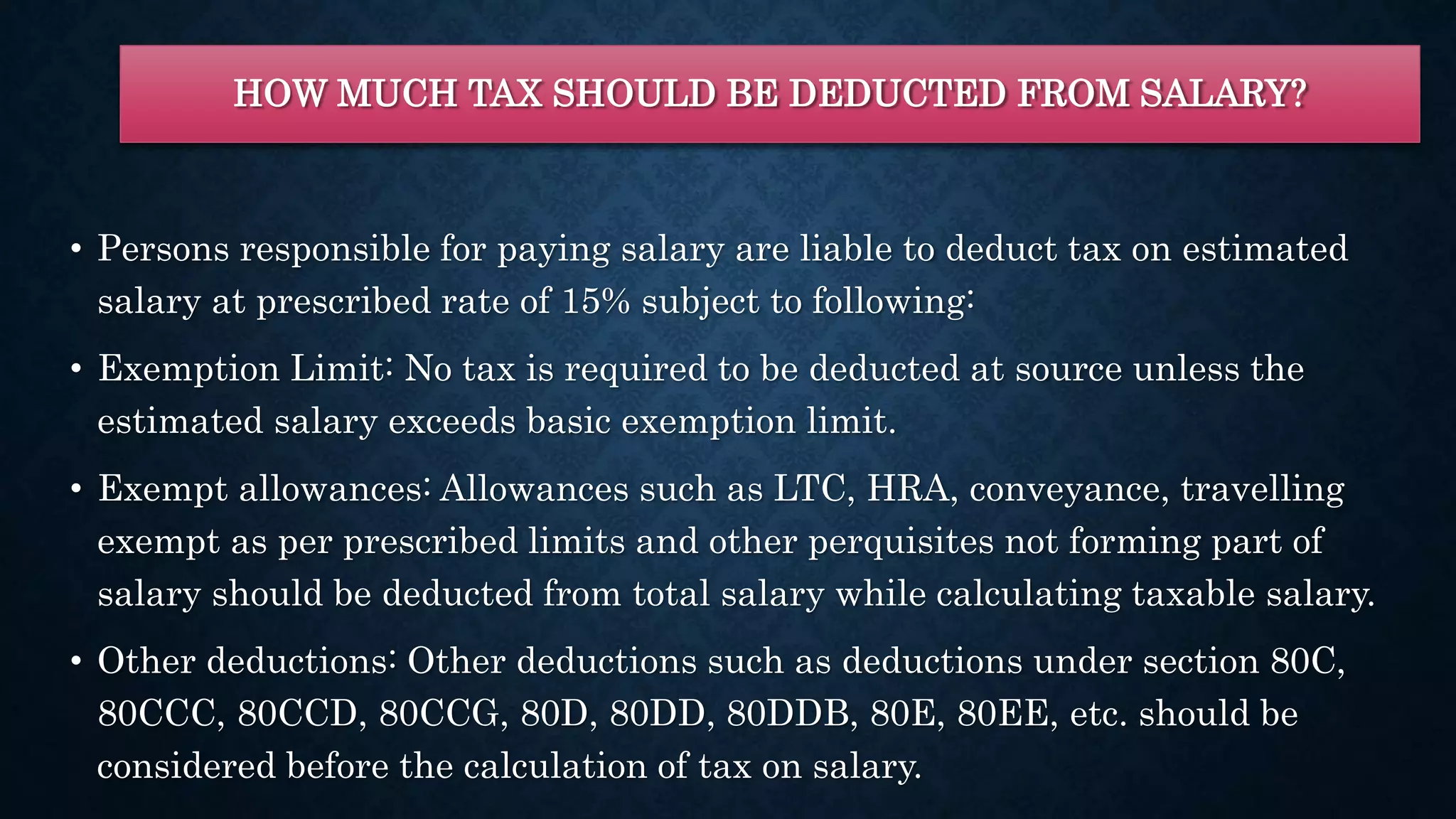
HOW MUCH TAX SHOULD BE DEDUCTED FROM SALARY?
• Persons responsible for paying salary are liable to deduct tax on estimated
salary at prescribed rate of 15% subject to following:
• Exemption Limit: No tax is required to be deducted at source unless the
estimated salary exceeds basic exemption limit.
• Exempt allowances: Allowances such as LTC, HRA, conveyance, travelling
exempt as per prescribed limits and other perquisites not forming part of
salary should be deducted from total salary while calculating taxable salary.
• Other deductions: Other deductions such as deductions under section 80C,
80CCC, 80CCD, 80CCG, 80D, 80DD, 80DDB, 80E, 80EE, etc. should be
considered before the calculation of tax on salary.
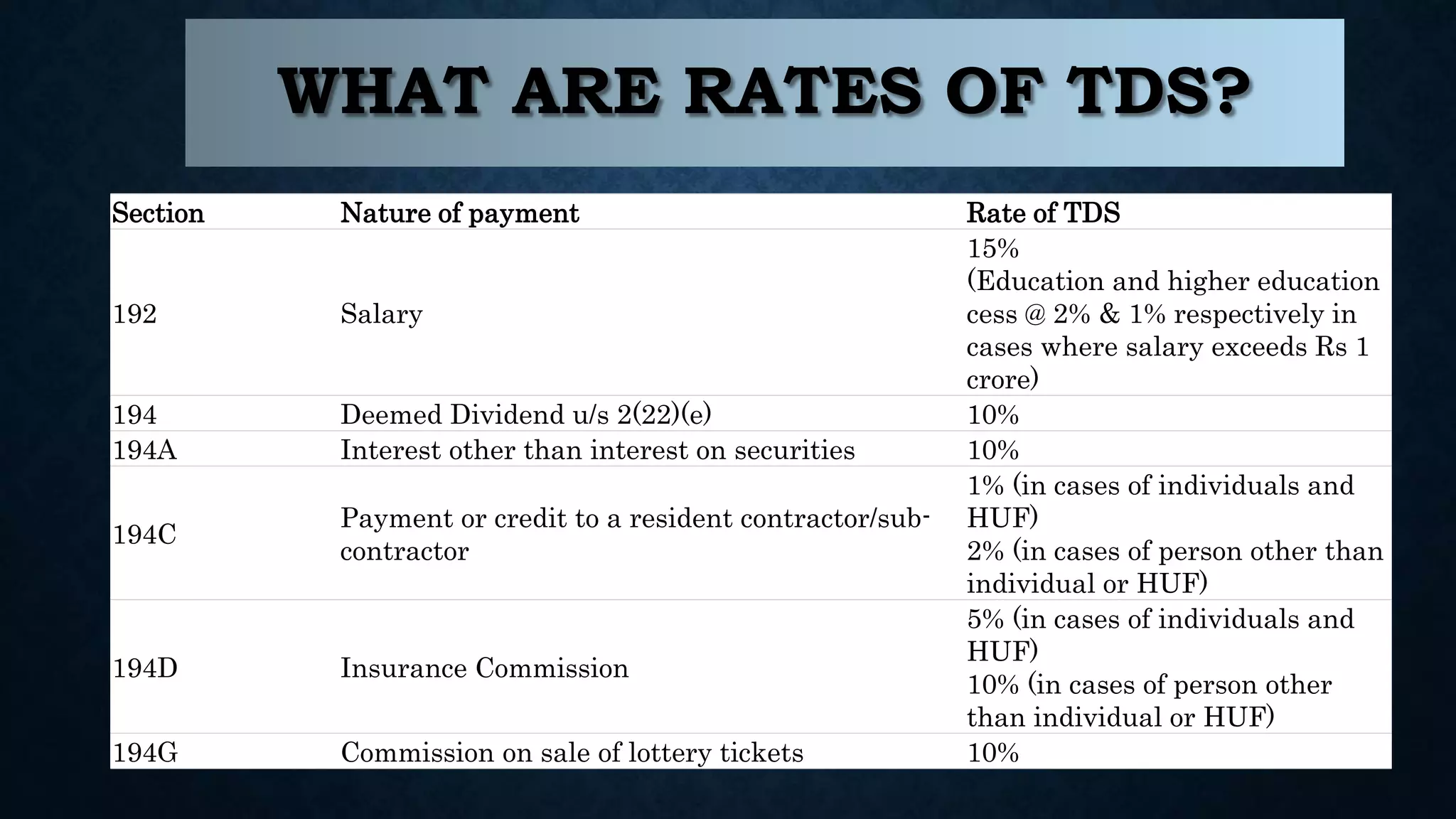
WHAT ARE RATES OF TDS?
Section Nature of payment Rate of TDS
192 Salary
15%
(Education and higher education
cess @ 2% & 1% respectively in
cases where salary exceeds Rs 1
crore)
194 Deemed Dividend u/s 2(22)(e) 10%
194A Interest other than interest on securities 10%
194C
Payment or credit to a resident contractor/sub-
contractor
1% (in cases of individuals and
HUF)
2% (in cases of person other than
individual or HUF)
194D Insurance Commission
5% (in cases of individuals and
HUF)
10% (in cases of person other
than individual or HUF)
194G Commission on sale of lottery tickets 10%
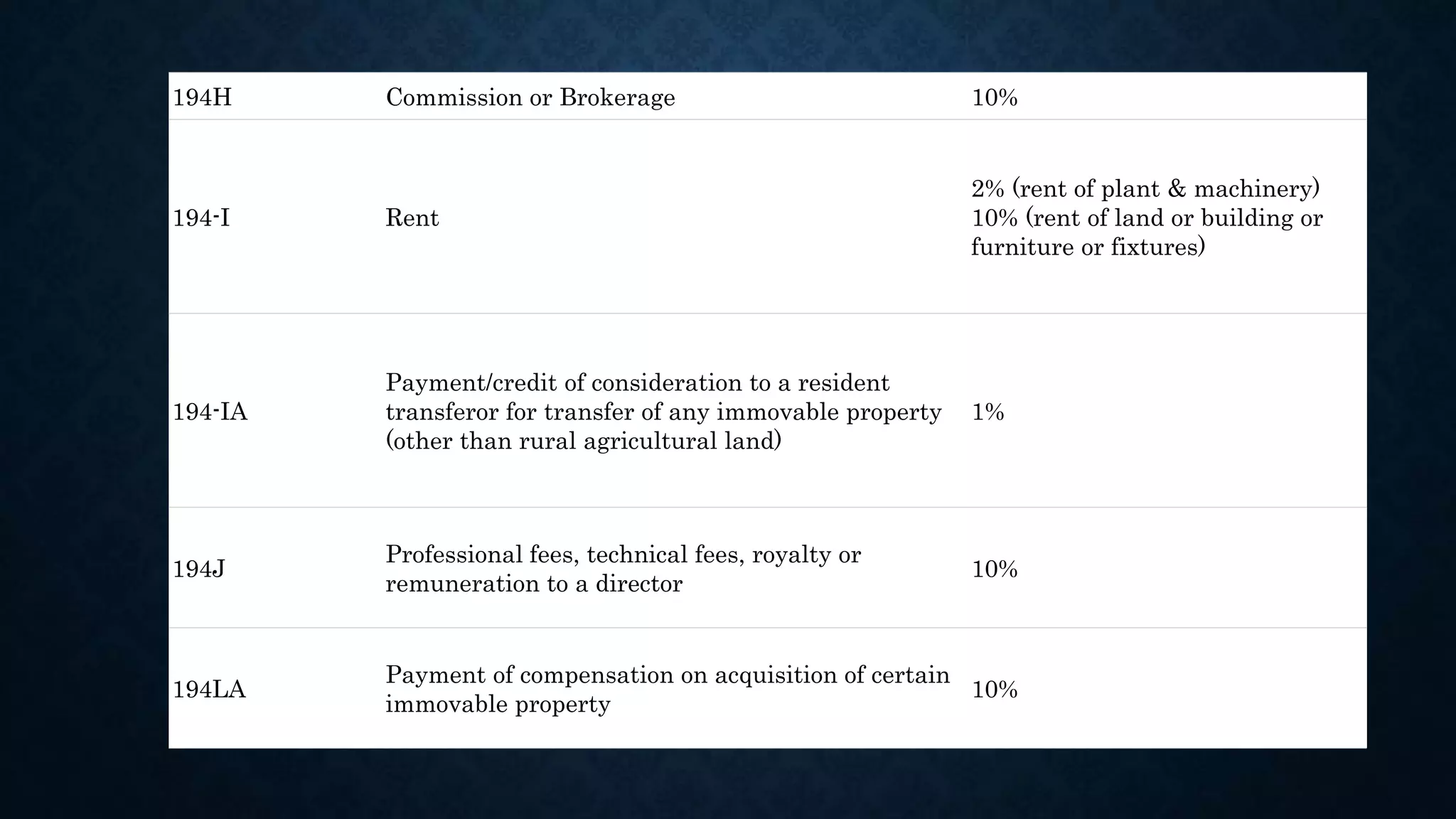
194H Commission or Brokerage 10%
194-I Rent
2% (rent of plant & machinery)
10% (rent of land or building or
furniture or fixtures)
194-IA
Payment/credit of consideration to a resident
transferor for transfer of any immovable property
(other than rural agricultural land)
1%
194J
Professional fees, technical fees, royalty or
remuneration to a director
10%
194LA
Payment of compensation on acquisition of certain
immovable property
10%
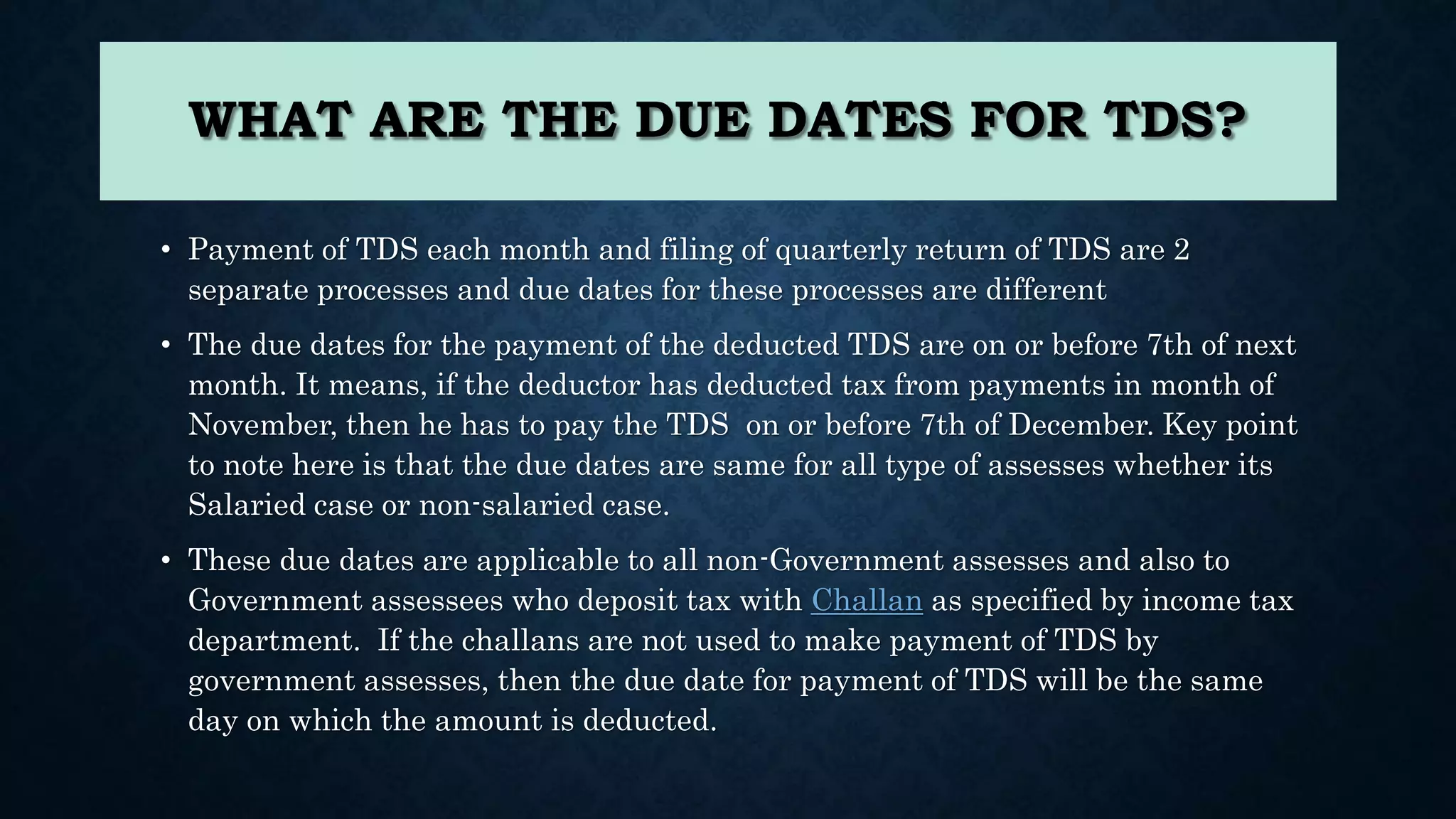
WHAT ARE THE DUE DATES FOR TDS?
• Payment of TDS each month and filing of quarterly return of TDS are 2
separate processes and due dates for these processes are different
• The due dates for the payment of the deducted TDS are on or before 7th of next
month. It means, if the deductor has deducted tax from payments in month of
November, then he has to pay the TDS on or before 7th of December. Key point
to note here is that the due dates are same for all type of assesses whether its
Salaried case or non-salaried case.
• These due dates are applicable to all non-Government assesses and also to
Government assessees who deposit tax with Challan as specified by income tax
department. If the challans are not used to make payment of TDS by
government assesses, then the due date for payment of TDS will be the same
day on which the amount is deducted.
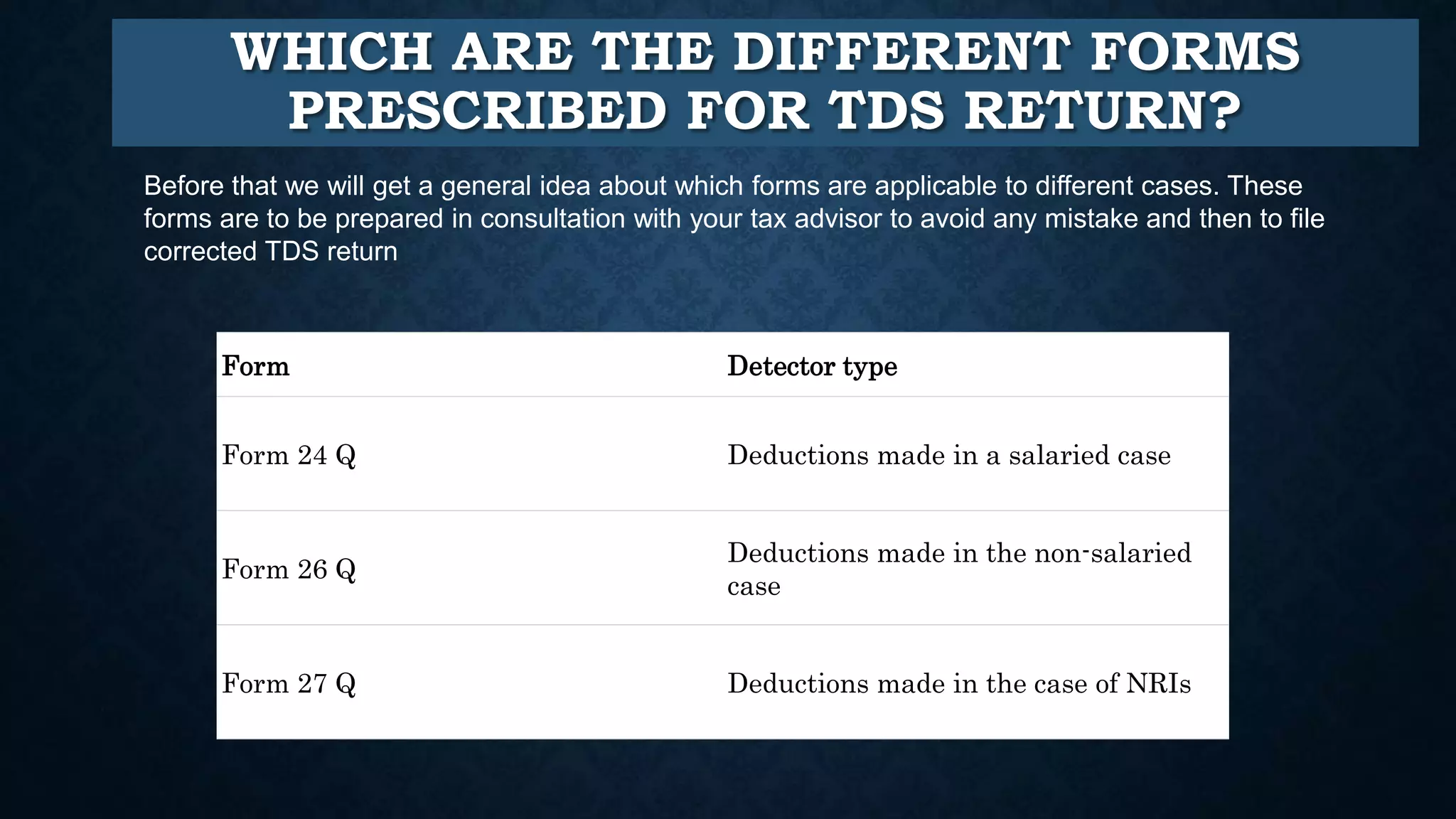
WHICH ARE THE DIFFERENT FORMS
PRESCRIBED FOR TDS RETURN?
Form Detector type
Form 24 Q Deductions made in a salaried case
Form 26 Q
Deductions made in the non-salaried
case
Form 27 Q Deductions made in the case of NRIs
Before that we will get a general idea about which forms are applicable to different cases. These
forms are to be prepared in consultation with your tax advisor to avoid any mistake and then to file
corrected TDS return
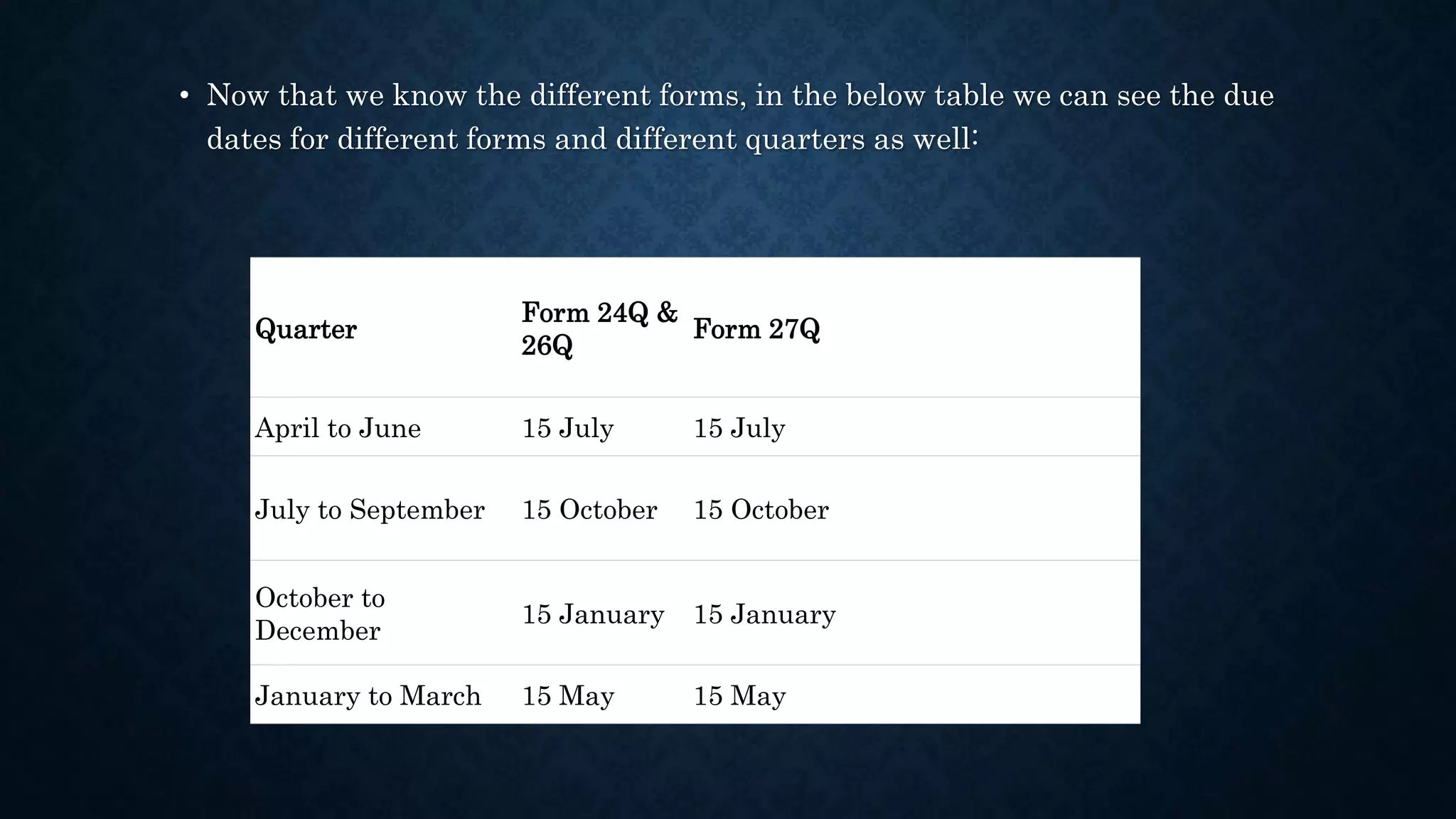
• Now that we know the different forms, in the below table we can see the due
dates for different forms and different quarters as well:
Quarter
Form 24Q &
26Q
Form 27Q
April to June 15 July 15 July
July to September 15 October 15 October
October to
December
15 January 15 January
January to March 15 May 15 May
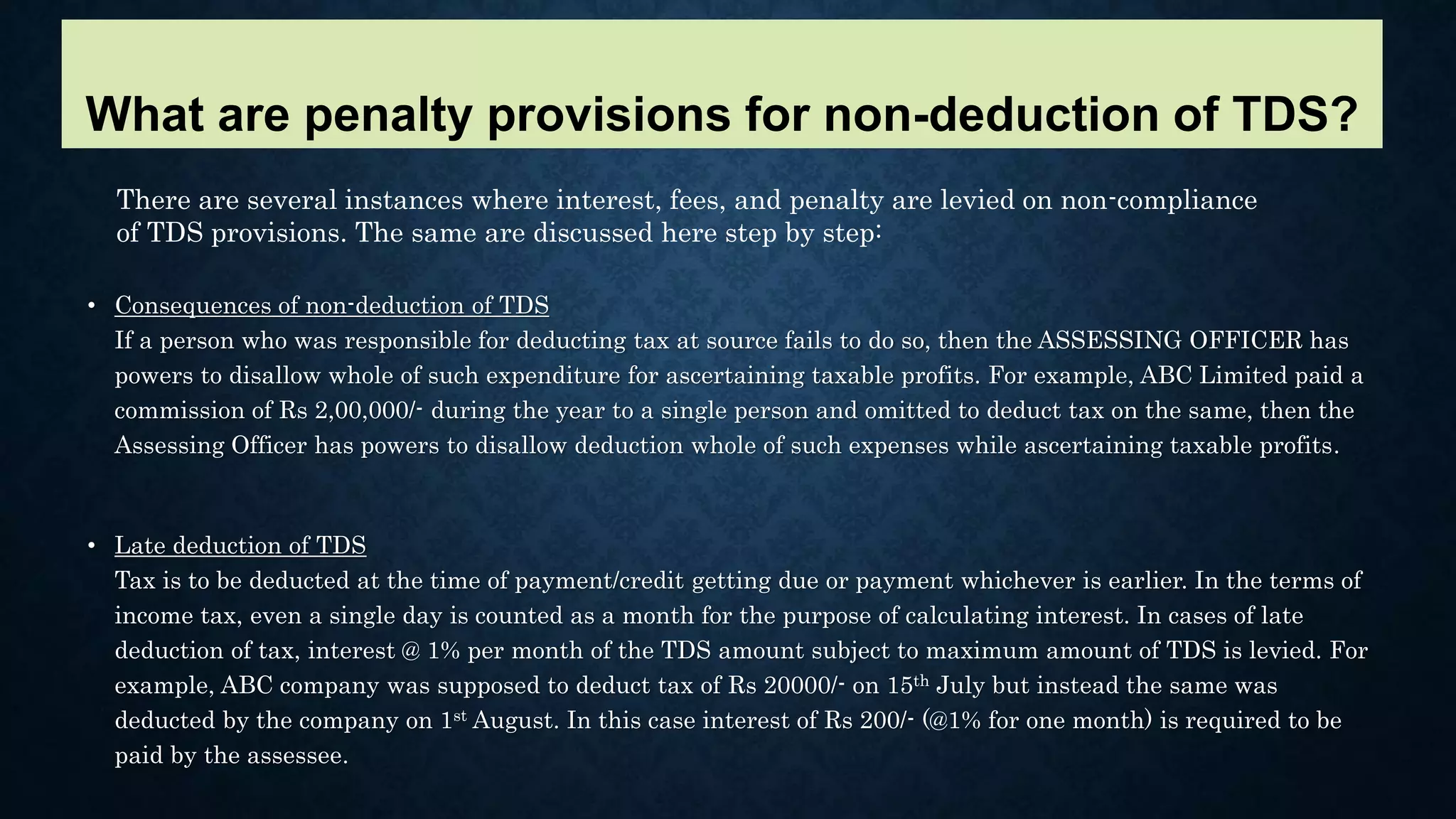
• Consequences of non-deduction of TDS
If a person who was responsible for deducting tax at source fails to do so, then the ASSESSING OFFICER has
powers to disallow whole of such expenditure for ascertaining taxable profits. For example, ABC Limited paid a
commission of Rs 2,00,000/- during the year to a single person and omitted to deduct tax on the same, then the
Assessing Officer has powers to disallow deduction whole of such expenses while ascertaining taxable profits.
• Late deduction of TDS
Tax is to be deducted at the time of payment/credit getting due or payment whichever is earlier. In the terms of
income tax, even a single day is counted as a month for the purpose of calculating interest. In cases of late
deduction of tax, interest @ 1% per month of the TDS amount subject to maximum amount of TDS is levied. For
example, ABC company was supposed to deduct tax of Rs 20000/- on 15th July but instead the same was
deducted by the company on 1st August. In this case interest of Rs 200/- (@1% for one month) is required to be
paid by the assessee.
There are several instances where interest, fees, and penalty are levied on non-compliance
of TDS provisions. The same are discussed here step by step:
What are penalty provisions for non-deduction of TDS?
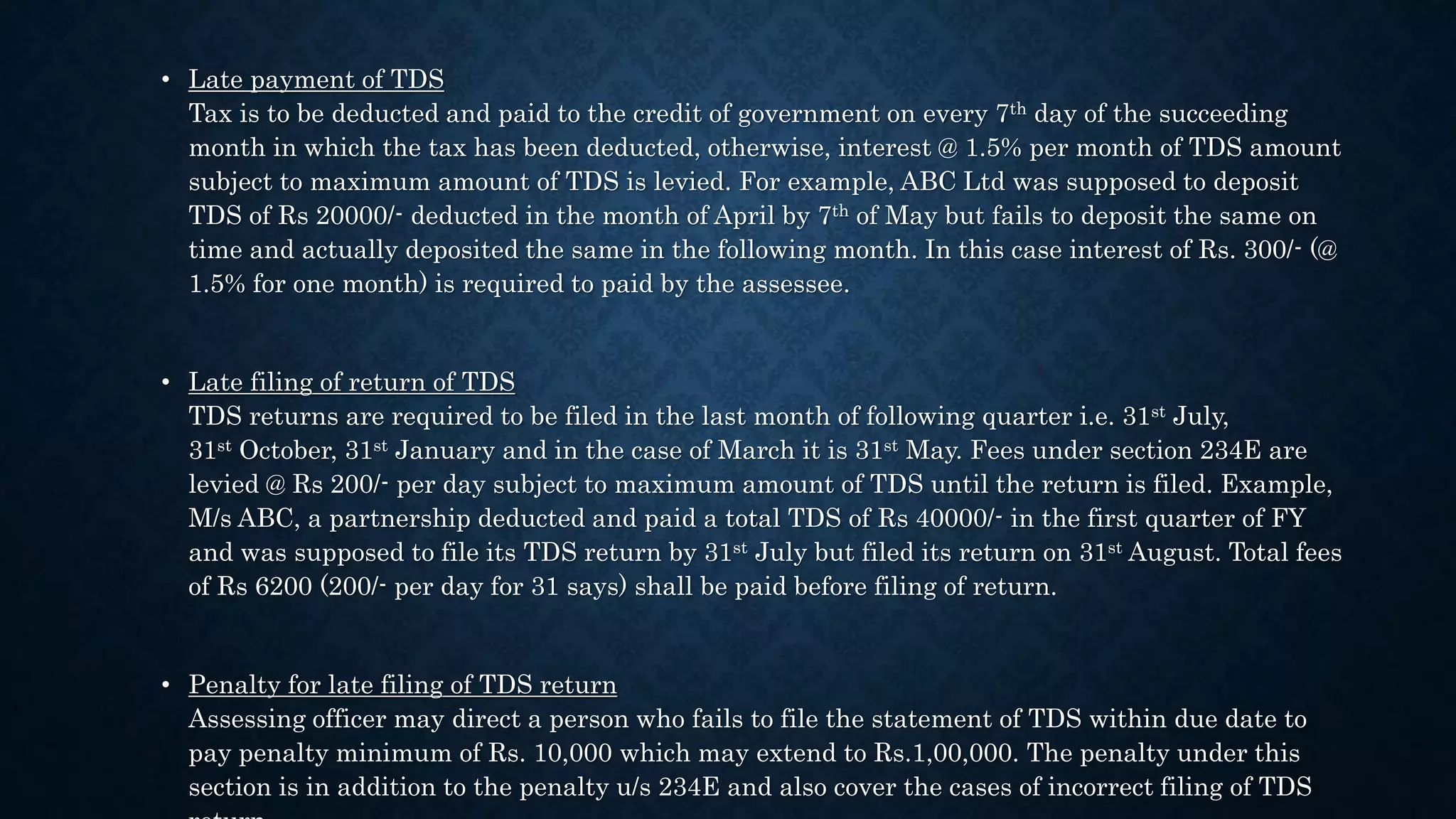
• Late payment of TDS
Tax is to be deducted and paid to the credit of government on every 7th day of the succeeding
month in which the tax has been deducted, otherwise, interest @ 1.5% per month of TDS amount
subject to maximum amount of TDS is levied. For example, ABC Ltd was supposed to deposit
TDS of Rs 20000/- deducted in the month of April by 7th of May but fails to deposit the same on
time and actually deposited the same in the following month. In this case interest of Rs. 300/- (@
1.5% for one month) is required to paid by the assessee.
• Late filing of return of TDS
TDS returns are required to be filed in the last month of following quarter i.e. 31st July,
31st October, 31st January and in the case of March it is 31st May. Fees under section 234E are
levied @ Rs 200/- per day subject to maximum amount of TDS until the return is filed. Example,
M/s ABC, a partnership deducted and paid a total TDS of Rs 40000/- in the first quarter of FY
and was supposed to file its TDS return by 31st July but filed its return on 31st August. Total fees
of Rs 6200 (200/- per day for 31 says) shall be paid before filing of return.
• Penalty for late filing of TDS return
Assessing officer may direct a person who fails to file the statement of TDS within due date to
pay penalty minimum of Rs. 10,000 which may extend to Rs.1,00,000. The penalty under this
section is in addition to the penalty u/s 234E and also cover the cases of incorrect filing of TDS
• It is very simple to know how much TDS has been deducted and whether it is credited to you or
not. Follow these simple process to find it out:
• Step 1: Log on to Income Tax India eFiling website and click on the link “Register Yourself”
• Step 2: Enter your details as per PAN and generate a password
• Step 3: Once you have logged into the portal, click on the option “View Tax Credit Statement (26
AS)”
• Step 4: After clicking on this link you will be directed to another website called TRACES (TDS
Reconciliation Analysis and Correction Enabling System) where you can know about complete
details of your tax deducted at source, advance tax paid and other important details.
26AS is a tax credit statement and covers all the amounts of TDS deducted by others. This might
happen that someone has deducted your tax but the same isn’t appearing in your tax credit
statements, which may be simply due to non-filing of TDS return by the deductor. In such cases,
please make sure to obtain a TDS certificate as this will be an ultimate proof that your tax has been
How do I know how much TDS has been deducted and whether it has been credited to me?
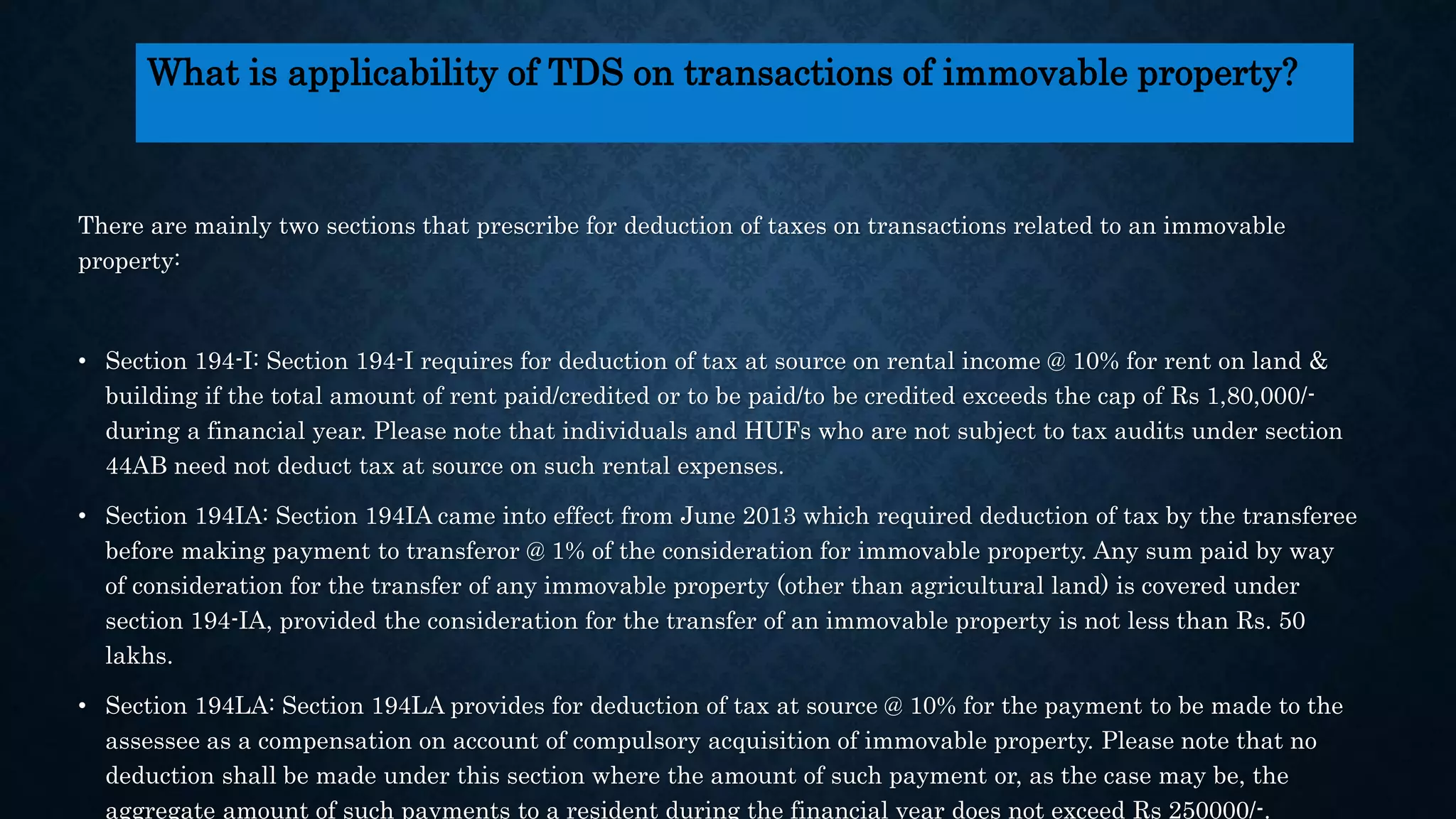
There are mainly two sections that prescribe for deduction of taxes on transactions related to an immovable
property:
• Section 194-I: Section 194-I requires for deduction of tax at source on rental income @ 10% for rent on land &
building if the total amount of rent paid/credited or to be paid/to be credited exceeds the cap of Rs 1,80,000/-
during a financial year. Please note that individuals and HUFs who are not subject to tax audits under section
44AB need not deduct tax at source on such rental expenses.
• Section 194IA: Section 194IA came into effect from June 2013 which required deduction of tax by the transferee
before making payment to transferor @ 1% of the consideration for immovable property. Any sum paid by way
of consideration for the transfer of any immovable property (other than agricultural land) is covered under
section 194-IA, provided the consideration for the transfer of an immovable property is not less than Rs. 50
lakhs.
• Section 194LA: Section 194LA provides for deduction of tax at source @ 10% for the payment to be made to the
assessee as a compensation on account of compulsory acquisition of immovable property. Please note that no
deduction shall be made under this section where the amount of such payment or, as the case may be, the
aggregate amount of such payments to a resident during the financial year does not exceed Rs 250000/-.
What is applicability of TDS on transactions of immovable property?
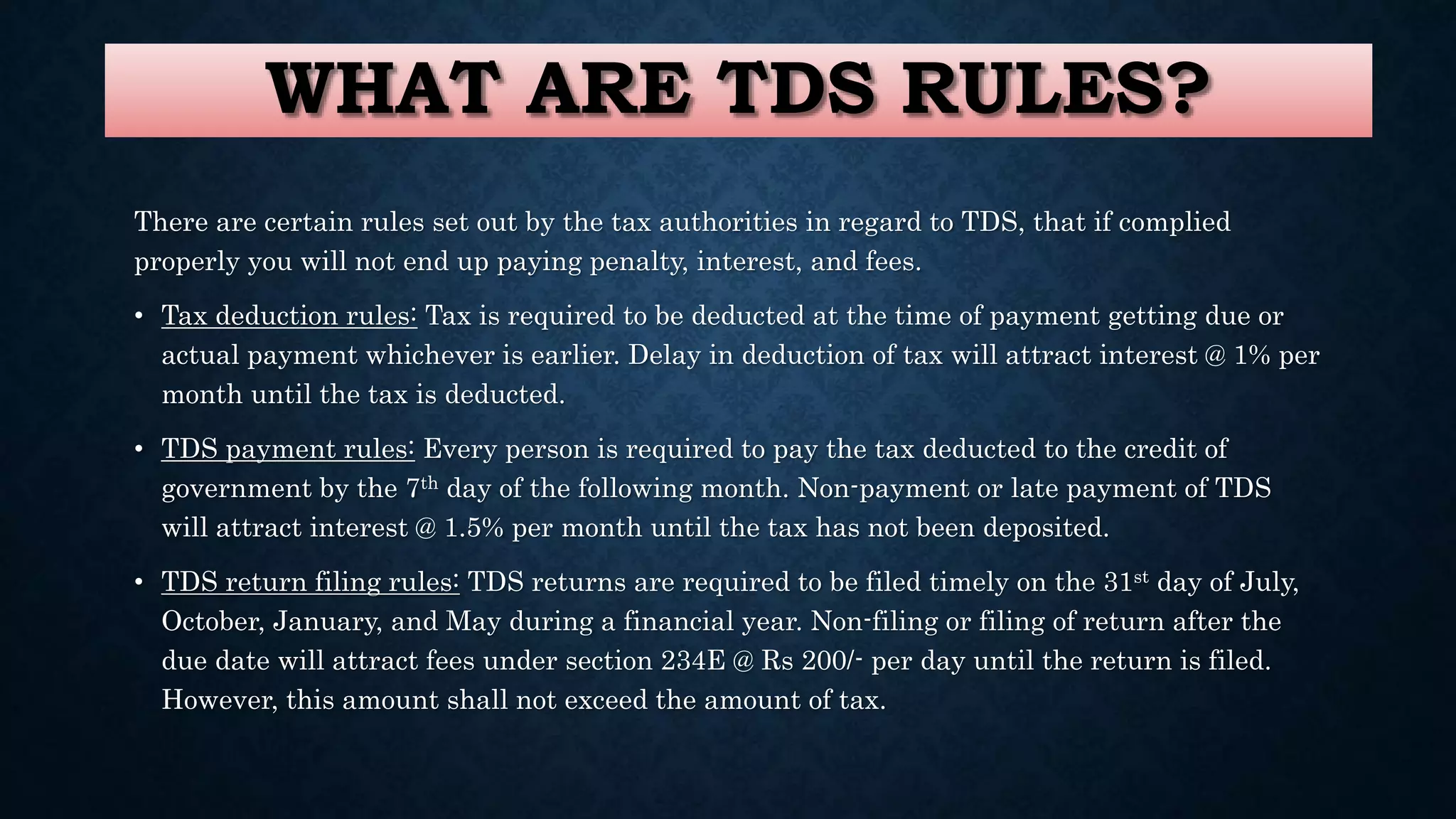
WHAT ARE TDS RULES?
There are certain rules set out by the tax authorities in regard to TDS, that if complied
properly you will not end up paying penalty, interest, and fees.
• Tax deduction rules: Tax is required to be deducted at the time of payment getting due or
actual payment whichever is earlier. Delay in deduction of tax will attract interest @ 1% per
month until the tax is deducted.
• TDS payment rules: Every person is required to pay the tax deducted to the credit of
government by the 7th day of the following month. Non-payment or late payment of TDS
will attract interest @ 1.5% per month until the tax has not been deposited.
• TDS return filing rules: TDS returns are required to be filed timely on the 31st day of July,
October, January, and May during a financial year. Non-filing or filing of return after the
due date will attract fees under section 234E @ Rs 200/- per day until the return is filed.
However, this amount shall not exceed the amount of tax.
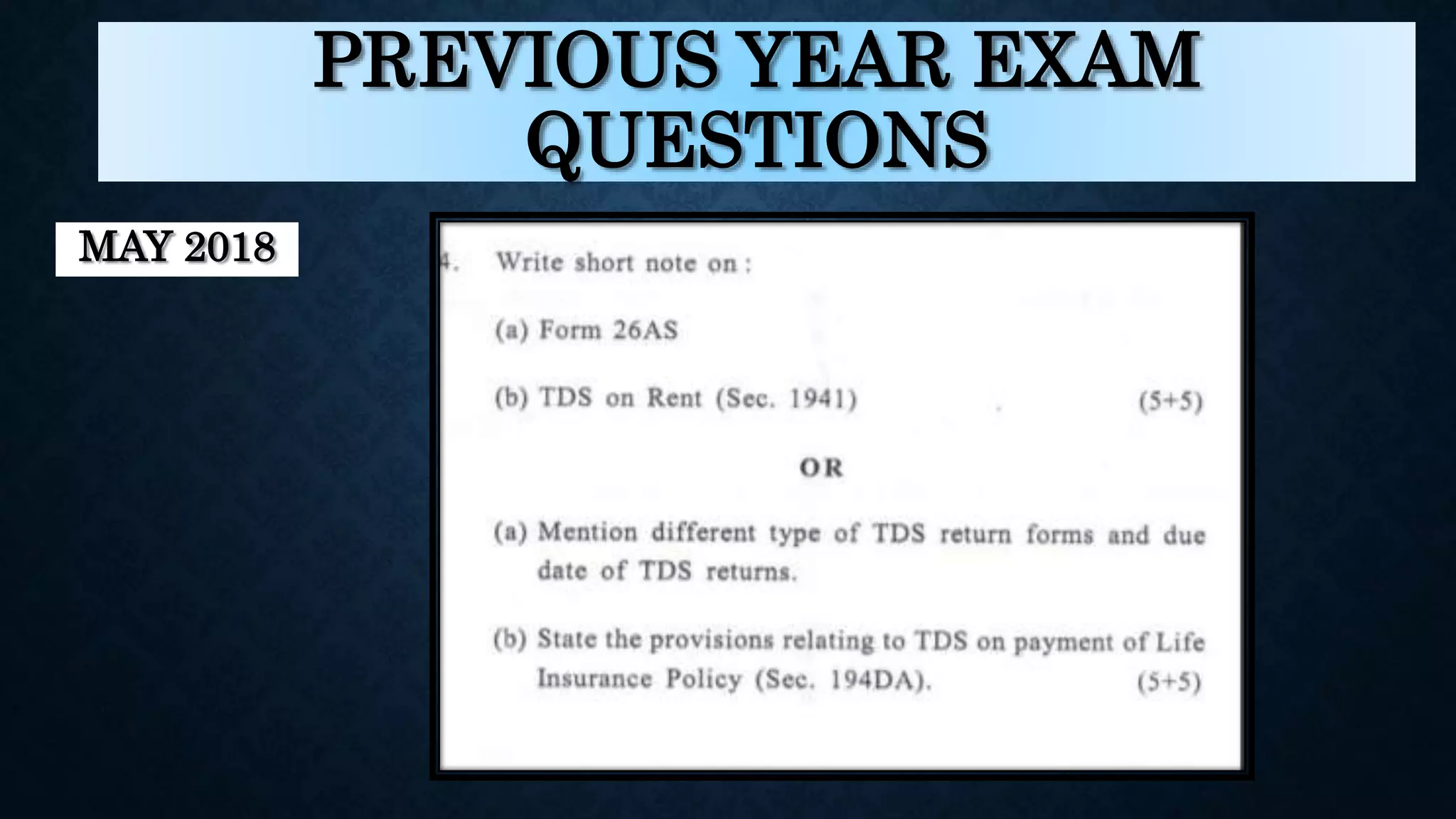
PREVIOUS YEAR EXAM
QUESTIONS
MAY 2018
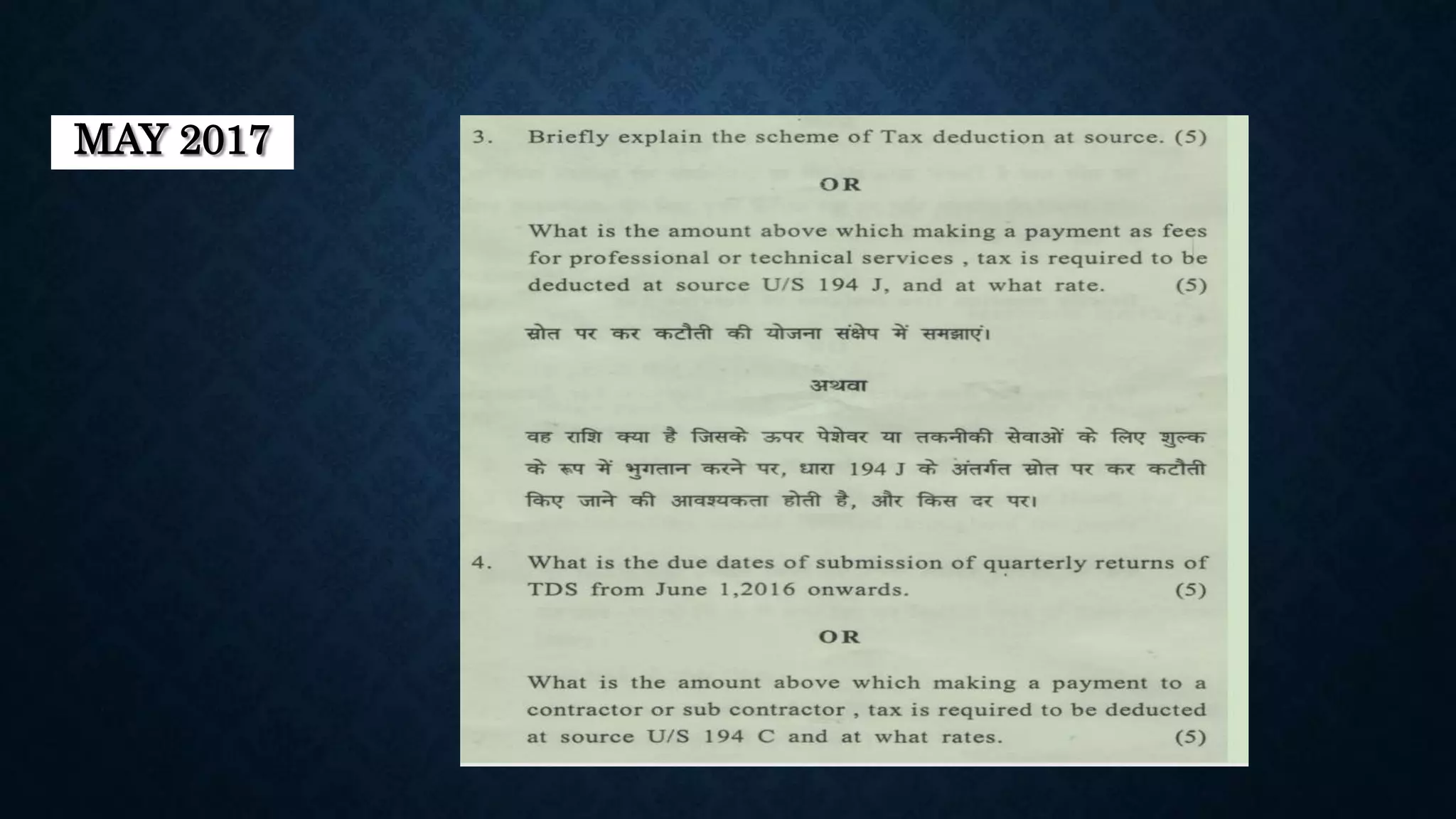
MAY 2017
TDS filing, E-filling of returns

TDS filing, E-filling of returns

  • 1.
    E-FILING OF RETURNS TOPIC:-TDS & PROVISIONS PREPARED BY:- SANKALP NAUTIYAL 2273
  • 2.
    WHAT IS TDS? TaxDeducted at Source (TDS) is a system introduced by Income Tax Department, where person responsible for making specified payments such as salary, commission, professional fees, interest, rent, etc. is liable to deduct a certain percentage of tax before making payment in full to the receiver of the payment. As the name suggests, the concept of TDS is to deduct tax at its source.
  • 3.
    The concept ofTDS was introduced with an aim to collect tax from the very source of income. As per this concept, a person (deductor) who is liable to make payment of specified nature to any other person (deductee) shall deduct tax at source and remit the same into the account of the Central Government. The deductee from whose income tax has been deducted at source would be entitled to get credit of the amount so deducted on the basis of Form 26AS or TDS certificate issued by the deductor. CONCEPT
  • 4.
    WHAT IS TANAND HOW TO APPLY FOR TAN? TAN stands for Tax Deduction Account Number. It is 10 digit alpha numeric number required to be obtained by all persons who are responsible for deducting or collecting tax. Under Section 203A of the Income Tax Act, 1961, it is mandatory to quote Tax Deduction Account Number (TAN) allotted by the Income Tax Department (ITD) on all TDS returns. The procedure for application of TAN is very simple and can be done online by filling up Form 49B. Please refer to NSDL Site in order to Apply For TAN. WHEN TDS SHOULD BE DEDUCTED? The concept of TDS is based on a simple principle i.e. tax is to be deducted at the time of payment getting due or actual payment whichever is earlier.
  • 5.
    WHAT IS TDSCERTIFICATE? • TDS certificates are issued by the deductor (the person who is deducting tax) to the deductee (the person from whose payment the tax is deducted). There are mainly two types of TDS certificates issued by the deductor. • Form 16: which is issued by the employer to the employee incorporating details of tax deducted by the employer throughout the year, and • Form 16A: which is issued in all cases other than salary. • For example, Mr. Gupta is working as a salaried employee at a company and tax is deducted on his salary @ 15%. The company shall provide Mr. Gupta with a Form 16 describing particulars in detail regarding the amount of salary paid and tax deducted on the same. • However, had Mr. Gupta been working as a professional and received professional fees from an organization which is subject to TDS, then he will be provided Form 16A for the same.
  • 6.
    HOW MUCH TAXSHOULD BE DEDUCTED FROM SALARY? • Persons responsible for paying salary are liable to deduct tax on estimated salary at prescribed rate of 15% subject to following: • Exemption Limit: No tax is required to be deducted at source unless the estimated salary exceeds basic exemption limit. • Exempt allowances: Allowances such as LTC, HRA, conveyance, travelling exempt as per prescribed limits and other perquisites not forming part of salary should be deducted from total salary while calculating taxable salary. • Other deductions: Other deductions such as deductions under section 80C, 80CCC, 80CCD, 80CCG, 80D, 80DD, 80DDB, 80E, 80EE, etc. should be considered before the calculation of tax on salary.
  • 7.
    WHAT ARE RATESOF TDS? Section Nature of payment Rate of TDS 192 Salary 15% (Education and higher education cess @ 2% & 1% respectively in cases where salary exceeds Rs 1 crore) 194 Deemed Dividend u/s 2(22)(e) 10% 194A Interest other than interest on securities 10% 194C Payment or credit to a resident contractor/sub- contractor 1% (in cases of individuals and HUF) 2% (in cases of person other than individual or HUF) 194D Insurance Commission 5% (in cases of individuals and HUF) 10% (in cases of person other than individual or HUF) 194G Commission on sale of lottery tickets 10%
  • 8.
    194H Commission orBrokerage 10% 194-I Rent 2% (rent of plant & machinery) 10% (rent of land or building or furniture or fixtures) 194-IA Payment/credit of consideration to a resident transferor for transfer of any immovable property (other than rural agricultural land) 1% 194J Professional fees, technical fees, royalty or remuneration to a director 10% 194LA Payment of compensation on acquisition of certain immovable property 10%
  • 9.
    WHAT ARE THEDUE DATES FOR TDS? • Payment of TDS each month and filing of quarterly return of TDS are 2 separate processes and due dates for these processes are different • The due dates for the payment of the deducted TDS are on or before 7th of next month. It means, if the deductor has deducted tax from payments in month of November, then he has to pay the TDS on or before 7th of December. Key point to note here is that the due dates are same for all type of assesses whether its Salaried case or non-salaried case. • These due dates are applicable to all non-Government assesses and also to Government assessees who deposit tax with Challan as specified by income tax department. If the challans are not used to make payment of TDS by government assesses, then the due date for payment of TDS will be the same day on which the amount is deducted.
  • 10.
    WHICH ARE THEDIFFERENT FORMS PRESCRIBED FOR TDS RETURN? Form Detector type Form 24 Q Deductions made in a salaried case Form 26 Q Deductions made in the non-salaried case Form 27 Q Deductions made in the case of NRIs Before that we will get a general idea about which forms are applicable to different cases. These forms are to be prepared in consultation with your tax advisor to avoid any mistake and then to file corrected TDS return
  • 11.
    • Now thatwe know the different forms, in the below table we can see the due dates for different forms and different quarters as well: Quarter Form 24Q & 26Q Form 27Q April to June 15 July 15 July July to September 15 October 15 October October to December 15 January 15 January January to March 15 May 15 May
  • 12.
    • Consequences ofnon-deduction of TDS If a person who was responsible for deducting tax at source fails to do so, then the ASSESSING OFFICER has powers to disallow whole of such expenditure for ascertaining taxable profits. For example, ABC Limited paid a commission of Rs 2,00,000/- during the year to a single person and omitted to deduct tax on the same, then the Assessing Officer has powers to disallow deduction whole of such expenses while ascertaining taxable profits. • Late deduction of TDS Tax is to be deducted at the time of payment/credit getting due or payment whichever is earlier. In the terms of income tax, even a single day is counted as a month for the purpose of calculating interest. In cases of late deduction of tax, interest @ 1% per month of the TDS amount subject to maximum amount of TDS is levied. For example, ABC company was supposed to deduct tax of Rs 20000/- on 15th July but instead the same was deducted by the company on 1st August. In this case interest of Rs 200/- (@1% for one month) is required to be paid by the assessee. There are several instances where interest, fees, and penalty are levied on non-compliance of TDS provisions. The same are discussed here step by step: What are penalty provisions for non-deduction of TDS?
  • 13.
    • Late paymentof TDS Tax is to be deducted and paid to the credit of government on every 7th day of the succeeding month in which the tax has been deducted, otherwise, interest @ 1.5% per month of TDS amount subject to maximum amount of TDS is levied. For example, ABC Ltd was supposed to deposit TDS of Rs 20000/- deducted in the month of April by 7th of May but fails to deposit the same on time and actually deposited the same in the following month. In this case interest of Rs. 300/- (@ 1.5% for one month) is required to paid by the assessee. • Late filing of return of TDS TDS returns are required to be filed in the last month of following quarter i.e. 31st July, 31st October, 31st January and in the case of March it is 31st May. Fees under section 234E are levied @ Rs 200/- per day subject to maximum amount of TDS until the return is filed. Example, M/s ABC, a partnership deducted and paid a total TDS of Rs 40000/- in the first quarter of FY and was supposed to file its TDS return by 31st July but filed its return on 31st August. Total fees of Rs 6200 (200/- per day for 31 says) shall be paid before filing of return. • Penalty for late filing of TDS return Assessing officer may direct a person who fails to file the statement of TDS within due date to pay penalty minimum of Rs. 10,000 which may extend to Rs.1,00,000. The penalty under this section is in addition to the penalty u/s 234E and also cover the cases of incorrect filing of TDS
  • 14.
    • It isvery simple to know how much TDS has been deducted and whether it is credited to you or not. Follow these simple process to find it out: • Step 1: Log on to Income Tax India eFiling website and click on the link “Register Yourself” • Step 2: Enter your details as per PAN and generate a password • Step 3: Once you have logged into the portal, click on the option “View Tax Credit Statement (26 AS)” • Step 4: After clicking on this link you will be directed to another website called TRACES (TDS Reconciliation Analysis and Correction Enabling System) where you can know about complete details of your tax deducted at source, advance tax paid and other important details. 26AS is a tax credit statement and covers all the amounts of TDS deducted by others. This might happen that someone has deducted your tax but the same isn’t appearing in your tax credit statements, which may be simply due to non-filing of TDS return by the deductor. In such cases, please make sure to obtain a TDS certificate as this will be an ultimate proof that your tax has been How do I know how much TDS has been deducted and whether it has been credited to me?
  • 15.
    There are mainlytwo sections that prescribe for deduction of taxes on transactions related to an immovable property: • Section 194-I: Section 194-I requires for deduction of tax at source on rental income @ 10% for rent on land & building if the total amount of rent paid/credited or to be paid/to be credited exceeds the cap of Rs 1,80,000/- during a financial year. Please note that individuals and HUFs who are not subject to tax audits under section 44AB need not deduct tax at source on such rental expenses. • Section 194IA: Section 194IA came into effect from June 2013 which required deduction of tax by the transferee before making payment to transferor @ 1% of the consideration for immovable property. Any sum paid by way of consideration for the transfer of any immovable property (other than agricultural land) is covered under section 194-IA, provided the consideration for the transfer of an immovable property is not less than Rs. 50 lakhs. • Section 194LA: Section 194LA provides for deduction of tax at source @ 10% for the payment to be made to the assessee as a compensation on account of compulsory acquisition of immovable property. Please note that no deduction shall be made under this section where the amount of such payment or, as the case may be, the aggregate amount of such payments to a resident during the financial year does not exceed Rs 250000/-. What is applicability of TDS on transactions of immovable property?
  • 16.
    WHAT ARE TDSRULES? There are certain rules set out by the tax authorities in regard to TDS, that if complied properly you will not end up paying penalty, interest, and fees. • Tax deduction rules: Tax is required to be deducted at the time of payment getting due or actual payment whichever is earlier. Delay in deduction of tax will attract interest @ 1% per month until the tax is deducted. • TDS payment rules: Every person is required to pay the tax deducted to the credit of government by the 7th day of the following month. Non-payment or late payment of TDS will attract interest @ 1.5% per month until the tax has not been deposited. • TDS return filing rules: TDS returns are required to be filed timely on the 31st day of July, October, January, and May during a financial year. Non-filing or filing of return after the due date will attract fees under section 234E @ Rs 200/- per day until the return is filed. However, this amount shall not exceed the amount of tax.
  • 17.
  • 18.