Depository Receipts (Outline)
Arun Kumar T
meArunkumar@live.com
7799499701
by
SBS Hyderabad
2
 Definitions
 ADRs Overview
 Sponsored Vs Unsponsored
 Types of ADRs
 Regulatory Framework
 Within India
 Outside India
 Parties involved in Issue of ADRs
 Approvals Required
 Documents involved
 Process of Issue.
Topics
3
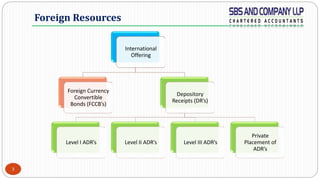
Foreign Resources
International
Offering
Foreign Currency
Convertible
Bonds (FCCB’s)
Depository
Receipts (DR’s)
Level I ADR’s Level II ADR’s Level III ADR’s
Private
Placement of
ADR’s
4
 “Custodian”: is a Bank or any Financial Institution that is responsible for ensuring the safety of
assets (stocks, bonds, certificate of deposits and gold, diamonds, jewelry).
 “Depository”: Along with the above responsibilities, a Depository has legal ownership over
these assets and responsible for controlling those assets according to the established rules,
laws, regulations, and guidelines. Ex- NSDL and CDSL.
 “Depository Receipt” (DR) – is a type of transferable financial security that is traded on a local
Stock Exchange representing a security (usually Equity shares as underlying asset) that is issued
by foreign publicly listed company.
Definitions
5
 ADRs are introduced in 1927.
 ADRs are one of the most convenient and popular way for U.S investors to buy stocks of non U.S
company.
 ADRs are listed on US stock exchanges (NYSE, AMEX or Nasdaq), GDRs are listed on London,
Luxembourg (Europe).
 Holder of DR is entitled to all benefits such as dividends and rights issues from underlying
shares.
 Issue of ADRs are regulated by Securities Exchange Commission (SEC) in U.S, and GDRs are
regulated by European Union Directives (EU).
 At present active DRs issued by Infosys, ITC, Dr. Reddys, L&T etc.
ADRs Overview
6
 U.S banks (acting as Depository) purchases a bulk lot of shares from the issuing foreign
company.
 This bulk lot is then bundled into groups and re-issued by setting the “ADR Ratio”.
 10 shares of a foreign company may be equal to 1 ADR. Here the ratio is pegged at 10:1.
 1 ADR may be fraction of a share or multiple shares.
 ADRs are priced in such a way that price is high enough to show substantial value, yet
low enough to make it affordable for investors.
 Once an ADR is priced and sold, its subsequent price is determined by supply and
demand factor, like any ordinary share.
How ADRs are created
7
 “Sponsored ADRs”:
 It is a process of disinvestment by the Indian shareholders of their holding in overseas market.
 Issuing company sponsor an issue of ADRs/GDRs with overseas Depository against shares held by its
shareholders.
 The proceeds of the issue shall be repatriated to India within a period of 1 month and are distributed to
the shareholders in proportion to the shares sold by them.
 “Unsponsored ADRs”:
 This type of DRs are issued by one or more depositories in response to market demand.
 There is no involvement and control of the issuing company.
 the Broker/Dealer in U.S Creates the ADRs by purchasing and depositing the shares of issuing company
with bank.
 The Depository issues ADRs to the Broker/Dealer or to his clients against these shares.
Sponsored Vs Unsponsored
8
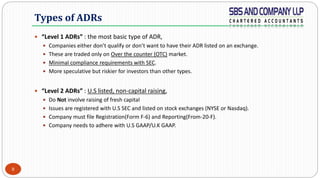
 “Level 1 ADRs” : the most basic type of ADR,
 Companies either don’t qualify or don’t want to have their ADR listed on an exchange.
 These are traded only on Over the counter (OTC) market.
 Minimal compliance requirements with SEC.
 More speculative but riskier for investors than other types.
 “Level 2 ADRs” : U.S listed, non-capital raising,
 Do Not involve raising of fresh capital
 Issues are registered with U.S SEC and listed on stock exchanges (NYSE or Nasdaq).
 Company must file Registration(Form F-6) and Reporting(From-20-F).
 Company needs to adhere with U.S GAAP/U.K GAAP.
Types of ADRs
9
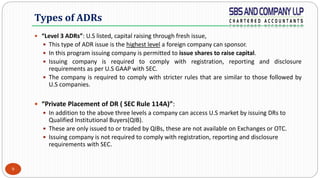
 “Level 3 ADRs”: U.S listed, capital raising through fresh issue,
 This type of ADR issue is the highest level a foreign company can sponsor.
 In this program issuing company is permitted to issue shares to raise capital.
 Issuing company is required to comply with registration, reporting and disclosure
requirements as per U.S GAAP with SEC.
 The company is required to comply with stricter rules that are similar to those followed by
U.S companies.
 “Private Placement of DR ( SEC Rule 114A)”:
 In addition to the above three levels a company can access U.S market by issuing DRs to
Qualified Institutional Buyers(QIB).
 These are only issued to or traded by QIBs, these are not available on Exchanges or OTC.
 Issuing company is not required to comply with registration, reporting and disclosure
requirements with SEC.
Types of ADRs
10
 Within India:
 The Depositories Receipts Scheme, 2014.
 The Companies Act, 2013 read with the Company (Issue of Global Depository Receipts) Rules,
2014.
 SEBI (Listing obligations and disclosure requirements) Regulations, 2015 (LODR).
 SEBI (Issue of Capital and Disclosure Requirement) Regulations, 2009 (ICDR).
 SEBI (Substantial Acquisitions of Shares and Takeover) Regulations, 2011(SAST), wherever
they applicable.
Regulatory Framework
11
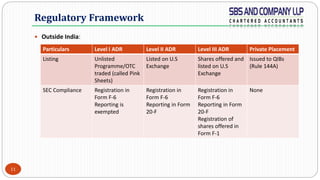
 Outside India:
Regulatory Framework
Particulars Level I ADR Level II ADR Level III ADR Private Placement
Listing Unlisted
Programme/OTC
traded (called Pink
Sheets)
Listed on U.S
Exchange
Shares offered and
listed on U.S
Exchange
Issued to QIBs
(Rule 144A)
SEC Compliance Registration in
Form F-6
Reporting is
exempted
Registration in
Form F-6
Reporting in Form
20-F
Registration in
Form F-6
Reporting in Form
20-F
Registration of
shares offered in
Form F-1
None
12
 Lead Manager:- to structure the issue and arrange for the marketing.
 Co-Lead/Co-Manager:- to co-ordinate with the issuing company and Lead Manager.
 Overseas Depository Bank:- it is the bank which is authorised by the issuing company to issue
DRs against issue of ordinary shares.
 Domestic Custodian Bank:- which acts as custodian for the ordinary shares issued by the
company. It functions in co-ordination with the Depository bank.
 When the shares are issued by the company, they are registered in the name of the Overseas
Depository Bank and Physical possession is handed over to the Domestic Custodian Bank.
• Listing Agent, Legal Advisors, Printers, Auditors, Underwriters.
Parties Involved
13
 Approval of Board of Directors
 Approvals of Shareholders by Special Resolution.
 Post facto Approval of Reserve Bank of India.
 In-principle consent of Stock Exchanges for listing of shares.
 In-principle consent of Financial Institutions, if there exists any term loan.
 Approval of FIPB when the limits provided under FDI policy are exceeded.
Approvals Required
14
 Subscription Agreement:- relating to lead manager/co-lead manager and subscriptions
of DRs at the offering price set forth.
 Depository Agreement:- contains the detailed arrangements entered into by the
Company with Depository, along with the forms and terms of DRs.
 Custodian Agreement:- the custodian is solely responsible to the depository, need to
observe all obligations imposed on it including those mentioned in Depository
Agreement.
 Listing Agreement:- with the concerned Stock Exchange in which the proposed DRs are
going to be listed.
 SEC Registration /Exemption
Documents Involved
15
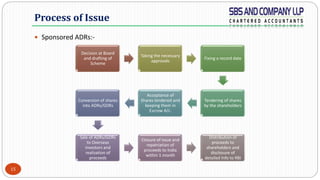
 Sponsored ADRs:-
Process of Issue
Decision at Board
and drafting of
Scheme
Taking the necessary
approvals
Fixing a record date
Tendering of shares
by the shareholders
Acceptance of
Shares tendered and
keeping them in
Escrow A/c.
Conversion of shares
into ADRs/GDRs
Sale of ADRs/GDRs
to Overseas
Investors and
realization of
proceeds
Closure of issue and
repatriation of
proceeds to India
within 1 month
Distribution of
proceeds to
shareholders and
disclosure of
detailed Info to RBI
16
 Factors to be considered while investing in ADRs
 Political Risk:- research if the government in the home country is stable, and if there are any
sanctions from its home country would cut the banks indirect access to international capital
markets.
 Exchange rate risk:- as the ADR shares track the shares in its home country, if countries
currency is devaluated value of the shares get effected.
 Tax treatment of ADRs:- as far as the IRS is concerned, ADRs are generally treated same as
domestic investment, and investors are subject to same capital gains and dividend taxes at
the same rates.
What’s important is tax treatment in other country, one has to pay U.S income tax on
dividends and can claim a deduction of foreign tax paid to avoid Double taxation, and the claim
depends on the double taxation agreement between the countries.
Choice of Decision
www.sbsandco.com/wiki
www.sbsandco.com/digest
Read our monthly SBS e-Journals
Our Presence: Hyderabad, Kurnool, Nellore, TADA, Vizag & Bengaluru: info@sbsandco.com; 040-40183366
17
Arun Kumar T
meArunkumar@live.com
7799499701
SBS Hyderabad
At
Disclaimer: Please logon to: http://www.sbsandco.com/disclaimer/

Depository reciepts

  • 1.
    Depository Receipts (Outline) ArunKumar T meArunkumar@live.com 7799499701 by SBS Hyderabad
  • 2.
    2  Definitions  ADRsOverview  Sponsored Vs Unsponsored  Types of ADRs  Regulatory Framework  Within India  Outside India  Parties involved in Issue of ADRs  Approvals Required  Documents involved  Process of Issue. Topics
  • 3.
    3 Foreign Resources International Offering Foreign Currency Convertible Bonds(FCCB’s) Depository Receipts (DR’s) Level I ADR’s Level II ADR’s Level III ADR’s Private Placement of ADR’s
  • 4.
    4  “Custodian”: isa Bank or any Financial Institution that is responsible for ensuring the safety of assets (stocks, bonds, certificate of deposits and gold, diamonds, jewelry).  “Depository”: Along with the above responsibilities, a Depository has legal ownership over these assets and responsible for controlling those assets according to the established rules, laws, regulations, and guidelines. Ex- NSDL and CDSL.  “Depository Receipt” (DR) – is a type of transferable financial security that is traded on a local Stock Exchange representing a security (usually Equity shares as underlying asset) that is issued by foreign publicly listed company. Definitions
  • 5.
    5  ADRs areintroduced in 1927.  ADRs are one of the most convenient and popular way for U.S investors to buy stocks of non U.S company.  ADRs are listed on US stock exchanges (NYSE, AMEX or Nasdaq), GDRs are listed on London, Luxembourg (Europe).  Holder of DR is entitled to all benefits such as dividends and rights issues from underlying shares.  Issue of ADRs are regulated by Securities Exchange Commission (SEC) in U.S, and GDRs are regulated by European Union Directives (EU).  At present active DRs issued by Infosys, ITC, Dr. Reddys, L&T etc. ADRs Overview
  • 6.
    6  U.S banks(acting as Depository) purchases a bulk lot of shares from the issuing foreign company.  This bulk lot is then bundled into groups and re-issued by setting the “ADR Ratio”.  10 shares of a foreign company may be equal to 1 ADR. Here the ratio is pegged at 10:1.  1 ADR may be fraction of a share or multiple shares.  ADRs are priced in such a way that price is high enough to show substantial value, yet low enough to make it affordable for investors.  Once an ADR is priced and sold, its subsequent price is determined by supply and demand factor, like any ordinary share. How ADRs are created
  • 7.
    7  “Sponsored ADRs”: It is a process of disinvestment by the Indian shareholders of their holding in overseas market.  Issuing company sponsor an issue of ADRs/GDRs with overseas Depository against shares held by its shareholders.  The proceeds of the issue shall be repatriated to India within a period of 1 month and are distributed to the shareholders in proportion to the shares sold by them.  “Unsponsored ADRs”:  This type of DRs are issued by one or more depositories in response to market demand.  There is no involvement and control of the issuing company.  the Broker/Dealer in U.S Creates the ADRs by purchasing and depositing the shares of issuing company with bank.  The Depository issues ADRs to the Broker/Dealer or to his clients against these shares. Sponsored Vs Unsponsored
  • 8.
    8  “Level 1ADRs” : the most basic type of ADR,  Companies either don’t qualify or don’t want to have their ADR listed on an exchange.  These are traded only on Over the counter (OTC) market.  Minimal compliance requirements with SEC.  More speculative but riskier for investors than other types.  “Level 2 ADRs” : U.S listed, non-capital raising,  Do Not involve raising of fresh capital  Issues are registered with U.S SEC and listed on stock exchanges (NYSE or Nasdaq).  Company must file Registration(Form F-6) and Reporting(From-20-F).  Company needs to adhere with U.S GAAP/U.K GAAP. Types of ADRs
  • 9.
    9  “Level 3ADRs”: U.S listed, capital raising through fresh issue,  This type of ADR issue is the highest level a foreign company can sponsor.  In this program issuing company is permitted to issue shares to raise capital.  Issuing company is required to comply with registration, reporting and disclosure requirements as per U.S GAAP with SEC.  The company is required to comply with stricter rules that are similar to those followed by U.S companies.  “Private Placement of DR ( SEC Rule 114A)”:  In addition to the above three levels a company can access U.S market by issuing DRs to Qualified Institutional Buyers(QIB).  These are only issued to or traded by QIBs, these are not available on Exchanges or OTC.  Issuing company is not required to comply with registration, reporting and disclosure requirements with SEC. Types of ADRs
  • 10.
    10  Within India: The Depositories Receipts Scheme, 2014.  The Companies Act, 2013 read with the Company (Issue of Global Depository Receipts) Rules, 2014.  SEBI (Listing obligations and disclosure requirements) Regulations, 2015 (LODR).  SEBI (Issue of Capital and Disclosure Requirement) Regulations, 2009 (ICDR).  SEBI (Substantial Acquisitions of Shares and Takeover) Regulations, 2011(SAST), wherever they applicable. Regulatory Framework
  • 11.
    11  Outside India: RegulatoryFramework Particulars Level I ADR Level II ADR Level III ADR Private Placement Listing Unlisted Programme/OTC traded (called Pink Sheets) Listed on U.S Exchange Shares offered and listed on U.S Exchange Issued to QIBs (Rule 144A) SEC Compliance Registration in Form F-6 Reporting is exempted Registration in Form F-6 Reporting in Form 20-F Registration in Form F-6 Reporting in Form 20-F Registration of shares offered in Form F-1 None
  • 12.
    12  Lead Manager:-to structure the issue and arrange for the marketing.  Co-Lead/Co-Manager:- to co-ordinate with the issuing company and Lead Manager.  Overseas Depository Bank:- it is the bank which is authorised by the issuing company to issue DRs against issue of ordinary shares.  Domestic Custodian Bank:- which acts as custodian for the ordinary shares issued by the company. It functions in co-ordination with the Depository bank.  When the shares are issued by the company, they are registered in the name of the Overseas Depository Bank and Physical possession is handed over to the Domestic Custodian Bank. • Listing Agent, Legal Advisors, Printers, Auditors, Underwriters. Parties Involved
  • 13.
    13  Approval ofBoard of Directors  Approvals of Shareholders by Special Resolution.  Post facto Approval of Reserve Bank of India.  In-principle consent of Stock Exchanges for listing of shares.  In-principle consent of Financial Institutions, if there exists any term loan.  Approval of FIPB when the limits provided under FDI policy are exceeded. Approvals Required
  • 14.
    14  Subscription Agreement:-relating to lead manager/co-lead manager and subscriptions of DRs at the offering price set forth.  Depository Agreement:- contains the detailed arrangements entered into by the Company with Depository, along with the forms and terms of DRs.  Custodian Agreement:- the custodian is solely responsible to the depository, need to observe all obligations imposed on it including those mentioned in Depository Agreement.  Listing Agreement:- with the concerned Stock Exchange in which the proposed DRs are going to be listed.  SEC Registration /Exemption Documents Involved
  • 15.
    15  Sponsored ADRs:- Processof Issue Decision at Board and drafting of Scheme Taking the necessary approvals Fixing a record date Tendering of shares by the shareholders Acceptance of Shares tendered and keeping them in Escrow A/c. Conversion of shares into ADRs/GDRs Sale of ADRs/GDRs to Overseas Investors and realization of proceeds Closure of issue and repatriation of proceeds to India within 1 month Distribution of proceeds to shareholders and disclosure of detailed Info to RBI
  • 16.
    16  Factors tobe considered while investing in ADRs  Political Risk:- research if the government in the home country is stable, and if there are any sanctions from its home country would cut the banks indirect access to international capital markets.  Exchange rate risk:- as the ADR shares track the shares in its home country, if countries currency is devaluated value of the shares get effected.  Tax treatment of ADRs:- as far as the IRS is concerned, ADRs are generally treated same as domestic investment, and investors are subject to same capital gains and dividend taxes at the same rates. What’s important is tax treatment in other country, one has to pay U.S income tax on dividends and can claim a deduction of foreign tax paid to avoid Double taxation, and the claim depends on the double taxation agreement between the countries. Choice of Decision
  • 17.
    www.sbsandco.com/wiki www.sbsandco.com/digest Read our monthlySBS e-Journals Our Presence: Hyderabad, Kurnool, Nellore, TADA, Vizag & Bengaluru: info@sbsandco.com; 040-40183366 17 Arun Kumar T meArunkumar@live.com 7799499701 SBS Hyderabad At Disclaimer: Please logon to: http://www.sbsandco.com/disclaimer/