Dentistry
Jameel Abdul-Mateen
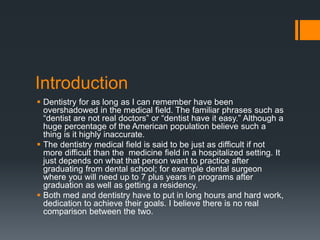
Introduction
 Dentistry for as long as I can remember have been
overshadowed in the medical field. The familiar phrases such as
“dentist are not real doctors” or “dentist have it easy.” Although a
huge percentage of the American population believe such a
thing is it highly inaccurate.
 The dentistry medical field is said to be just as difficult if not
more difficult than the medicine field in a hospitalized setting. It
just depends on what that person want to practice after
graduating from dental school; for example dental surgeon
where you will need up to 7 plus years in programs after
graduation as well as getting a residency.
 Both med and dentistry have to put in long hours and hard work,
dedication to achieve their goals. I believe there is no real
comparison between the two.
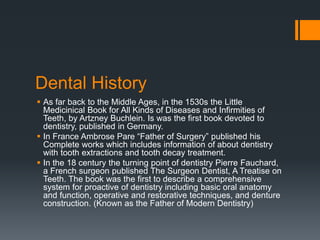
Dental History
 As far back to the Middle Ages, in the 1530s the Little
Medicinical Book for All Kinds of Diseases and Infirmities of
Teeth, by Artzney Buchlein. Is was the first book devoted to
dentistry, published in Germany.
 In France Ambrose Pare “Father of Surgery” published his
Complete works which includes information of about dentistry
with tooth extractions and tooth decay treatment.
 In the 18 century the turning point of dentistry Pierre Fauchard,
a French surgeon published The Surgeon Dentist, A Treatise on
Teeth. The book was the first to describe a comprehensive
system for proactive of dentistry including basic oral anatomy
and function, operative and restorative techniques, and denture
construction. (Known as the Father of Modern Dentistry)
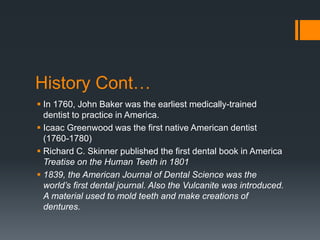
History Cont…
 In 1760, John Baker was the earliest medically-trained
dentist to practice in America.
 Icaac Greenwood was the first native American dentist
(1760-1780)
 Richard C. Skinner published the first dental book in America
Treatise on the Human Teeth in 1801
 1839, the American Journal of Dental Science was the
world’s first dental journal. Also the Vulcanite was introduced.
A material used to mold teeth and make creations of
dentures.
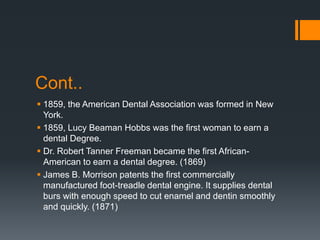
Cont..
 1859, the American Dental Association was formed in New
York.
 1859, Lucy Beaman Hobbs was the first woman to earn a
dental Degree.
 Dr. Robert Tanner Freeman became the first African-
American to earn a dental degree. (1869)
 James B. Morrison patents the first commercially
manufactured foot-treadle dental engine. It supplies dental
burs with enough speed to cut enamel and dentin smoothly
and quickly. (1871)
Cont..
 1945, the water fluoridation begun when sodium fluoride are
added to public water system.
 1950, when floristic toothpaste first marketed
Growth Potential and Salary
 Between 2014-2024 employment of dentist are projected to
grow up to 18% putting itself above average for all
occupations. As the population ages and insurance more
available dental practices are going to be more demanded.
 In addition, this generation are more likely to have teeth as
they age so more work will be needed because more risk for
cancers and other diseases. Also other hard complications in
order to maintain healthy teeth.
 Salary averages to be about 152,700 for general dentist
Other important criteria
 There are many branches of dentistry one can take. Some
are:
 Orthodontist whom uses braces to align teeth and make your
mouth healthy.
 An Oral-Maxillofacial surgeon can replace teeth using dental
implants, have your jaw aligned, and have facial cyst or
diagnosed , removed and reconstructed, even have facial bones
realigned after facial trauma.
 Prosthodontists are dentist that perform procedures such as:
crowns, bridges, veneers, inlays/outlays, and complete and
partial dentures. Dental implants that support the teeth and
gums.
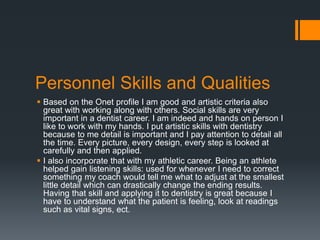
Personnel Skills and Qualities
 Based on the Onet profile I am good and artistic criteria also
great with working along with others. Social skills are very
important in a dentist career. I am indeed and hands on person I
like to work with my hands. I put artistic skills with dentistry
because to me detail is important and I pay attention to detail all
the time. Every picture, every design, every step is looked at
carefully and then applied.
 I also incorporate that with my athletic career. Being an athlete
helped gain listening skills: used for whenever I need to correct
something my coach would tell me what to adjust at the smallest
little detail which can drastically change the ending results.
Having that skill and applying it to dentistry is great because I
have to understand what the patient is feeling, look at readings
such as vital signs, ect.
Cont..
 Another plus from having an high athletic career is stress
maintenance. In the dental field stress is all around from both
you can the patient. As an athlete it is vital to maintain and calm
mind and perform at which you know you can perform, at the
very highest of your ability. During a procedure anything can
happen where stress levels can rise and cause panic or
incidence, but having the ability to maintain composure and
level head gives me an edge over a plethora of individuals.
 Which brings the next skill set is the ability to perform
algorithms. Being in the dental field is nothing but algorithms.
How do I go about problem? What is the problem? What is the
best way to solve this problem with little risks and the best
results for that individual patient. Developing this skill takes
years of practices and trials and I am already on the path.
Cont..
 I have taking some classes dealing with management. I do
plan to own my own practice so it is important to known how
to run a business and understand what can help you and
what can hurt you. Also knowing the laws and regulations
and staying up to date with it to avoid and type of problems is
key as well.
 It is very important to get as much experience as you can.
The more practice the better you will become. I have already
started to shadow dentists and have been recommended by
some as well. Getting a just start before heading in your
career gives you a better outcome and become more
successful while you are actually in the career.
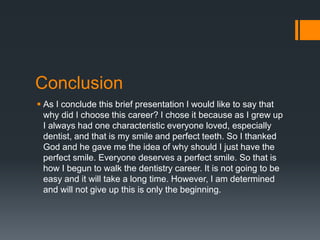
Conclusion
 As I conclude this brief presentation I would like to say that
why did I choose this career? I chose it because as I grew up
I always had one characteristic everyone loved, especially
dentist, and that is my smile and perfect teeth. So I thanked
God and he gave me the idea of why should I just have the
perfect smile. Everyone deserves a perfect smile. So that is
how I begun to walk the dentistry career. It is not going to be
easy and it will take a long time. However, I am determined
and will not give up this is only the beginning.
References
 http://www.ada.org/en/about-the-ada/ada-history-and-
presidents-of-the-ada/ada-history-of-dentistry-timeline
 http://classroom.synonym.com/differences-between-dental-
medical-schools-3772.html
 http://www.bls.gov/ooh/healthcare/dentists.htm#tab-5

Dentistry career ppt

  • 1.
  • 2.
    Introduction  Dentistry foras long as I can remember have been overshadowed in the medical field. The familiar phrases such as “dentist are not real doctors” or “dentist have it easy.” Although a huge percentage of the American population believe such a thing is it highly inaccurate.  The dentistry medical field is said to be just as difficult if not more difficult than the medicine field in a hospitalized setting. It just depends on what that person want to practice after graduating from dental school; for example dental surgeon where you will need up to 7 plus years in programs after graduation as well as getting a residency.  Both med and dentistry have to put in long hours and hard work, dedication to achieve their goals. I believe there is no real comparison between the two.
  • 3.
    Dental History  Asfar back to the Middle Ages, in the 1530s the Little Medicinical Book for All Kinds of Diseases and Infirmities of Teeth, by Artzney Buchlein. Is was the first book devoted to dentistry, published in Germany.  In France Ambrose Pare “Father of Surgery” published his Complete works which includes information of about dentistry with tooth extractions and tooth decay treatment.  In the 18 century the turning point of dentistry Pierre Fauchard, a French surgeon published The Surgeon Dentist, A Treatise on Teeth. The book was the first to describe a comprehensive system for proactive of dentistry including basic oral anatomy and function, operative and restorative techniques, and denture construction. (Known as the Father of Modern Dentistry)
  • 4.
    History Cont…  In1760, John Baker was the earliest medically-trained dentist to practice in America.  Icaac Greenwood was the first native American dentist (1760-1780)  Richard C. Skinner published the first dental book in America Treatise on the Human Teeth in 1801  1839, the American Journal of Dental Science was the world’s first dental journal. Also the Vulcanite was introduced. A material used to mold teeth and make creations of dentures.
  • 5.
    Cont..  1859, theAmerican Dental Association was formed in New York.  1859, Lucy Beaman Hobbs was the first woman to earn a dental Degree.  Dr. Robert Tanner Freeman became the first African- American to earn a dental degree. (1869)  James B. Morrison patents the first commercially manufactured foot-treadle dental engine. It supplies dental burs with enough speed to cut enamel and dentin smoothly and quickly. (1871)
  • 6.
    Cont..  1945, thewater fluoridation begun when sodium fluoride are added to public water system.  1950, when floristic toothpaste first marketed
  • 7.
    Growth Potential andSalary  Between 2014-2024 employment of dentist are projected to grow up to 18% putting itself above average for all occupations. As the population ages and insurance more available dental practices are going to be more demanded.  In addition, this generation are more likely to have teeth as they age so more work will be needed because more risk for cancers and other diseases. Also other hard complications in order to maintain healthy teeth.  Salary averages to be about 152,700 for general dentist
  • 8.
    Other important criteria There are many branches of dentistry one can take. Some are:  Orthodontist whom uses braces to align teeth and make your mouth healthy.  An Oral-Maxillofacial surgeon can replace teeth using dental implants, have your jaw aligned, and have facial cyst or diagnosed , removed and reconstructed, even have facial bones realigned after facial trauma.  Prosthodontists are dentist that perform procedures such as: crowns, bridges, veneers, inlays/outlays, and complete and partial dentures. Dental implants that support the teeth and gums.
  • 9.
    Personnel Skills andQualities  Based on the Onet profile I am good and artistic criteria also great with working along with others. Social skills are very important in a dentist career. I am indeed and hands on person I like to work with my hands. I put artistic skills with dentistry because to me detail is important and I pay attention to detail all the time. Every picture, every design, every step is looked at carefully and then applied.  I also incorporate that with my athletic career. Being an athlete helped gain listening skills: used for whenever I need to correct something my coach would tell me what to adjust at the smallest little detail which can drastically change the ending results. Having that skill and applying it to dentistry is great because I have to understand what the patient is feeling, look at readings such as vital signs, ect.
  • 10.
    Cont..  Another plusfrom having an high athletic career is stress maintenance. In the dental field stress is all around from both you can the patient. As an athlete it is vital to maintain and calm mind and perform at which you know you can perform, at the very highest of your ability. During a procedure anything can happen where stress levels can rise and cause panic or incidence, but having the ability to maintain composure and level head gives me an edge over a plethora of individuals.  Which brings the next skill set is the ability to perform algorithms. Being in the dental field is nothing but algorithms. How do I go about problem? What is the problem? What is the best way to solve this problem with little risks and the best results for that individual patient. Developing this skill takes years of practices and trials and I am already on the path.
  • 11.
    Cont..  I havetaking some classes dealing with management. I do plan to own my own practice so it is important to known how to run a business and understand what can help you and what can hurt you. Also knowing the laws and regulations and staying up to date with it to avoid and type of problems is key as well.  It is very important to get as much experience as you can. The more practice the better you will become. I have already started to shadow dentists and have been recommended by some as well. Getting a just start before heading in your career gives you a better outcome and become more successful while you are actually in the career.
  • 12.
    Conclusion  As Iconclude this brief presentation I would like to say that why did I choose this career? I chose it because as I grew up I always had one characteristic everyone loved, especially dentist, and that is my smile and perfect teeth. So I thanked God and he gave me the idea of why should I just have the perfect smile. Everyone deserves a perfect smile. So that is how I begun to walk the dentistry career. It is not going to be easy and it will take a long time. However, I am determined and will not give up this is only the beginning.
  • 13.