CHINA
I. Critical Historical Junctures
II. Governance and Policy-Making
III. Representation and
   Participation
IV. Political Economy
V. Political Culture
VI. Chinese Politics in
   Transition
I. Critical Historical Junctures
Technological and organizational
superiority of the ‘Middle Kingdom’
Isolation from outside world
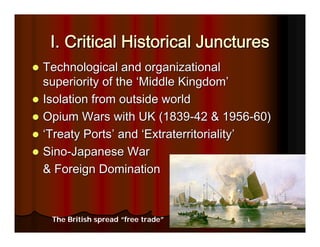
Opium Wars with UK (1839-42 & 1956-60)
‘Treaty Ports’ and ‘Extraterritoriality’
Sino-Japanese War
& Foreign Domination


 The British spread “free trade”
Revolution, Invasion and Civil War
Sun Yat-sen and Chinese Nationalist Party (or
Kuomintang -- KMT)
  Overthrow of Emperor and chaos
  Replaced by Chiang Kai-shek in 1925
  Creation of Chinese Communist Party (CCP)
KMT war against the CCP
The ‘Long March’ (1934)
War against Japanese
People’s Republic of China
(PRC – 1949)
  Nationalists flee to Taiwan
                                          Chiang Kai-Shek
Maoist China
First Five Year Plan (1953)
Sino-Soviet Split (starting 1956)
Great Leap Forward (1957)
Mao’s reduced influence
Cultural Revolution
(1966-76)
  ‘Red Guards’ and
  the ‘Gang of Four’
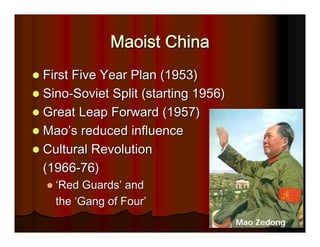
                                    Mao Zedong
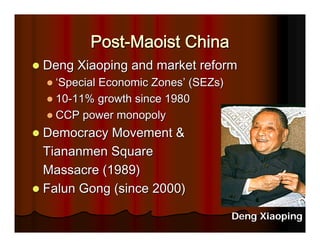
Post-Maoist China
Deng Xiaoping and market reform
  ‘Special Economic Zones’ (SEZs)
  10-11% growth since 1980
  CCP power monopoly
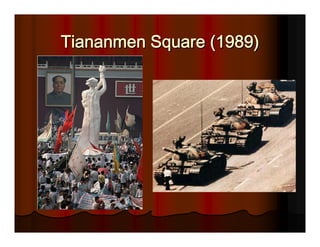
Democracy Movement &
Tiananmen Square
Massacre (1989)
Falun Gong (since 2000)

                                    Deng Xiaoping
Tiananmen Square (1989)
II. Governance and Policy-Making
Government:
  National Peoples Congress (2,989 delegates)
  President: Hu Jintao
  Premier: Wen Jiabao
Party:
  Central Committee
  Politburo
  Standing Committee
Army (People’s Liberation Army-PLA)
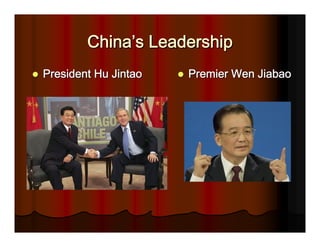
China’s Leadership
President Hu Jintao   Premier Wen Jiabao
III. Representation and Participation
                             President
                           Vice President
Premier, Vice-
                                                     Central Military
  Premiers
                                                      Commission

                         National People’s             Supreme
State Council
                             Congress                People’s Court

  Ministries,                                          Supreme
 Commissions,                                          People’s
 Bureaus, etc.                                       Procuratorate

                  Provincial,         Provincial,
                  City, Local,        City, Local,
                   People’s            People’s
                 Governments          Congress
IV. Political Economy
Deng Xiaoping’s Economic Reforms
  “Black cat, white cat, who care as long as it
  catches mice.”
Agriculture ‘De-Collectivization, Private
Enterprise, Special Economic Zones
Foreign Direct Investment (FDI)
Spectacular growth and a rising standard of
living
Problems:
  State-owned enterprises (SOEs)
  Unemployment and Inequality
  Environmental Degradation
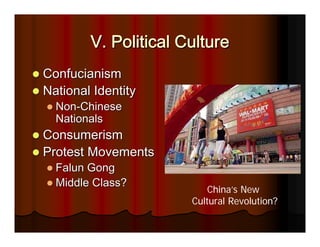
V. Political Culture
Confucianism
National Identity
  Non-Chinese
  Nationals
Consumerism
Protest Movements
  Falun Gong
  Middle Class?
                          China’s New
                      Cultural Revolution?
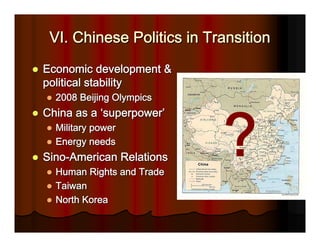
VI. Chinese Politics in Transition
Economic development &
political stability
  2008 Beijing Olympics
China as a ‘superpower’
  Military power
  Energy needs
Sino-American Relations
  Human Rights and Trade
  Taiwan
  North Korea

China Ppt 1205823081999732 2

  • 1.
    CHINA I. Critical HistoricalJunctures II. Governance and Policy-Making III. Representation and Participation IV. Political Economy V. Political Culture VI. Chinese Politics in Transition
  • 2.
    I. Critical HistoricalJunctures Technological and organizational superiority of the ‘Middle Kingdom’ Isolation from outside world Opium Wars with UK (1839-42 & 1956-60) ‘Treaty Ports’ and ‘Extraterritoriality’ Sino-Japanese War & Foreign Domination The British spread “free trade”
  • 3.
    Revolution, Invasion andCivil War Sun Yat-sen and Chinese Nationalist Party (or Kuomintang -- KMT) Overthrow of Emperor and chaos Replaced by Chiang Kai-shek in 1925 Creation of Chinese Communist Party (CCP) KMT war against the CCP The ‘Long March’ (1934) War against Japanese People’s Republic of China (PRC – 1949) Nationalists flee to Taiwan Chiang Kai-Shek
  • 4.
    Maoist China First FiveYear Plan (1953) Sino-Soviet Split (starting 1956) Great Leap Forward (1957) Mao’s reduced influence Cultural Revolution (1966-76) ‘Red Guards’ and the ‘Gang of Four’ Mao Zedong
  • 5.
    Post-Maoist China Deng Xiaopingand market reform ‘Special Economic Zones’ (SEZs) 10-11% growth since 1980 CCP power monopoly Democracy Movement & Tiananmen Square Massacre (1989) Falun Gong (since 2000) Deng Xiaoping
  • 6.
  • 7.
    II. Governance andPolicy-Making Government: National Peoples Congress (2,989 delegates) President: Hu Jintao Premier: Wen Jiabao Party: Central Committee Politburo Standing Committee Army (People’s Liberation Army-PLA)
  • 8.
    China’s Leadership President HuJintao Premier Wen Jiabao
  • 9.
    III. Representation andParticipation President Vice President Premier, Vice- Central Military Premiers Commission National People’s Supreme State Council Congress People’s Court Ministries, Supreme Commissions, People’s Bureaus, etc. Procuratorate Provincial, Provincial, City, Local, City, Local, People’s People’s Governments Congress
  • 10.
    IV. Political Economy DengXiaoping’s Economic Reforms “Black cat, white cat, who care as long as it catches mice.” Agriculture ‘De-Collectivization, Private Enterprise, Special Economic Zones Foreign Direct Investment (FDI) Spectacular growth and a rising standard of living Problems: State-owned enterprises (SOEs) Unemployment and Inequality Environmental Degradation
  • 11.
    V. Political Culture Confucianism NationalIdentity Non-Chinese Nationals Consumerism Protest Movements Falun Gong Middle Class? China’s New Cultural Revolution?
  • 12.
    VI. Chinese Politicsin Transition Economic development & political stability 2008 Beijing Olympics China as a ‘superpower’ Military power Energy needs Sino-American Relations Human Rights and Trade Taiwan North Korea