



Demonstrating digital
transformation: a
framework for Higher
Education
Sarah Knight and Simon Birkett
Jisc
Digital transformation
2
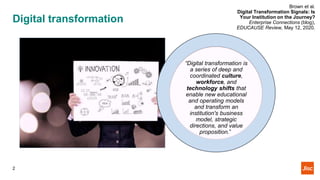
“Digital transformation is
a series of deep and
coordinated culture,
workforce, and
technology shifts that
enable new educational
and operating models
and transform an
institution's business
model, strategic
directions, and value
proposition.”
Brown et al.
Digital Transformation Signals: Is
Your Institution on the Journey?
Enterprise Connections (blog),
EDUCAUSE Review, May 12, 2020.
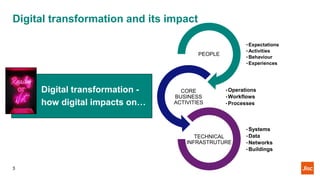
Digital transformation and its impact
3
• Expectations
• Activities
• Behaviour
• Experiences
PEOPLE
• Operations
• Workflows
• Processes
CORE
BUSINESS
ACTIVITIES
• Systems
• Data
• Networks
• Buildings
TECHNICAL
INFRASTRUTURE
Digital transformation -
how digital impacts on…
Digital strategies in UK higher education:
making digital mainstream
How UK universities are developing and implementing
their digital strategies (January 2023)
Interview with senior leaders
Exemplar strategies
Available from http://bit.ly/3JVHciT
4
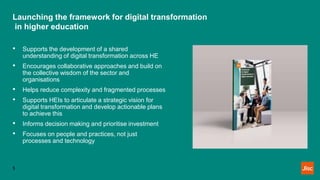
Launching the framework for digital transformation
in higher education
• Supports the development of a shared
understanding of digital transformation across HE
• Encourages collaborative approaches and build on
the collective wisdom of the sector and
organisations
• Helps reduce complexity and fragmented processes
• Supports HEIs to articulate a strategic vision for
digital transformation and develop actionable plans
to achieve this
• Informs decision making and prioritise investment
• Focuses on people and practices, not just
processes and technology
5
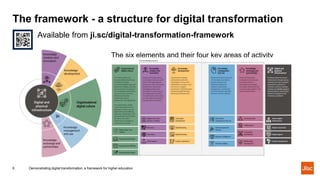
The framework - a structure for digital transformation
Available from ji.sc/digital-transformation-framework
The six elements and their four key areas of activity
6 Demonstrating digital transformation: a framework for higher education
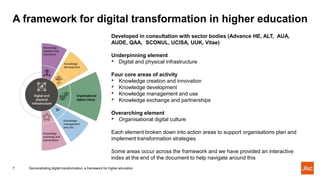
A framework for digital transformation in higher education
Developed in consultation with sector bodies (Advance HE, ALT, AUA,
AUDE, QAA, SCONUL, UCISA, UUK, Vitae)
Underpinning element
• Digital and physical infrastructure
Four core areas of activity
• Knowledge creation and innovation
• Knowledge development
• Knowledge management and use
• Knowledge exchange and partnerships
Overarching element
• Organisational digital culture
Each element broken down into action areas to support organisations plan and
implement transformation strategies
Some areas occur across the framework and we have provided an interactive
index at the end of the document to help navigate around this​
7 Demonstrating digital transformation: a framework for higher education
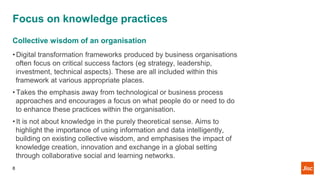
Focus on knowledge practices
Collective wisdom of an organisation
• Digital transformation frameworks produced by business organisations
often focus on critical success factors (eg strategy, leadership,
investment, technical aspects). These are all included within this
framework at various appropriate places.
• Takes the emphasis away from technological or business process
approaches and encourages a focus on what people do or need to do
to enhance these practices within the organisation.
• It is not about knowledge in the purely theoretical sense. Aims to
highlight the importance of using information and data intelligently,
building on existing collective wisdom, and emphasises the impact of
knowledge creation, innovation and exchange in a global setting
through collaborative social and learning networks.
8
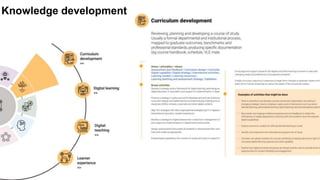
Knowledge development
9
Developing a digital maturity model
Working group
Co-creation of sector-wide mature model for digital
transformation
• We have had over 150 expressions of interest to join the
group from senior leaders in a range of roles across UK HE
as well as international interest
• We will be working collaboratively on shared google
documents to gather your input
• Establishment of a Teams site to communicate and share
documents
• Running a webinar on the 12th June to gather feedback on
the maturity model
• Join our working group https://ji.sc/working-group
11
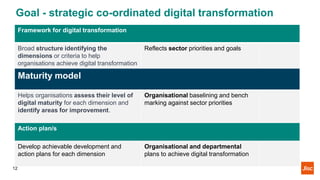
Goal - strategic co-ordinated digital transformation
12
Framework for digital transformation
Broad structure identifying the
dimensions or criteria to help
organisations achieve digital transformation
Reflects sector priorities and goals
Maturity model
Helps organisations assess their level of
digital maturity for each dimension and
identify areas for improvement.
Organisational baselining and bench
marking against sector priorities
Action plan/s
Develop achievable development and
action plans for each dimension
Organisational and departmental
plans to achieve digital transformation
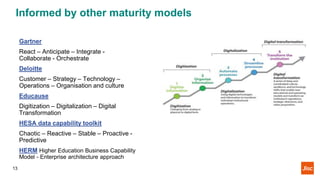
Informed by other maturity models
Gartner
React – Anticipate – Integrate -
Collaborate - Orchestrate
Deloitte
Customer – Strategy – Technology –
Operations – Organisation and culture
Educause
Digitization – Digitalization – Digital
Transformation
HESA data capability toolkit
Chaotic – Reactive – Stable – Proactive -
Predictive
HERM Higher Education Business Capability
Model - Enterprise architecture approach
13
Assessing levels of digital maturity
14
Evaluating organisational digital maturity against an agreed sector wide model
• Identify how we currently use digital across the organisation - benchmarking
and baselining
• Highlight the possibilities that digital presents
• Identify strengths, gaps and prioritise investment and digital initiatives
accordingly
• Assess and prioritise digital capabilities of all stakeholders
• Identify pathways to further transform and elevate performance and outcomes
Spark conversations across different business functions – library and learning resources,
IT, senior leadership, teaching/training leads, support teams,, researchers/research
managers, range of professional services (eg HR, administrators, marketing/comms
teams)
Progressing to digital maturity
• Leaders making strategic digital vision a reality
• Co-ordinated and collaborative approaches
• Long term investment, planning and changing practice
• Transitioning from legacy systems to new digital
approaches
• Mitigating risk and protecting systems, stakeholder
information and data
• Engagement and building digital capability of all
stakeholders
15
16
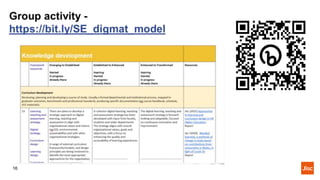
Group activity -
https://bit.ly/SE_digmat_model
Consider and discuss on your tables the following questions:
1. Describing maturity levels- If you could describe 3 levels of
digital maturity for all aspects of university business/activities
what terms would you use.
2. Identifying maturity levels - What do you think of the notion
of using a sliding scale of maturity reached for each level
3. What is the best way to present the maturity model to
enable its use?
4. How would you use this in your own organisation? How
could you encourage a cross-organisation approach?
5. Use the padlet to record your discussions and prepare to
feedback key points
https://padlet.com/sarah_knight7/SE_digmat_model
17
Join us at our
Demonstrating digital
transformation events
Hosted in partnership with
universities, designed to
inspire new thinking and
share good practice, to
support you with your
transformation journey.
10 May
Innovating physical and virtual spaces for
digital learning in health care
hosted by Staffordshire University
https://ji.sc/DTE-Staffordshire
5 June
Reimagining assessment and feedback
hosted by University College London
https://ji.sc/DTE-UCL
6 July
Rethinking learning and curriculum design
hosted by University of Northampton
https://ji.sc/ DTE-Northampton
18 July
Developing and implementing a digital strategy
hosted by University of Greenwich
https://ji.sc/ DTE-Greenwich
Sarah Knight
sarah.knight@jisc.ac.uk
@sarahknight
Lou McGill
lou.mcgill@jisc.ac.uk
@loumcgill
Simon Birkett
simon.Birkett@jisc.ac.uk
@simonbirkett
Elizabeth Newall
Elizabeth.newall@jisc.ac.uk
Except where otherwise noted,
this work is licensed under CC-BY

Demonstrating digital transformation: a framework for Higher Education​

  • 1.
    Demonstrating digital transformation: a frameworkfor Higher Education Sarah Knight and Simon Birkett Jisc
  • 2.
    Digital transformation 2 “Digital transformationis a series of deep and coordinated culture, workforce, and technology shifts that enable new educational and operating models and transform an institution's business model, strategic directions, and value proposition.” Brown et al. Digital Transformation Signals: Is Your Institution on the Journey? Enterprise Connections (blog), EDUCAUSE Review, May 12, 2020.
  • 3.
    Digital transformation andits impact 3 • Expectations • Activities • Behaviour • Experiences PEOPLE • Operations • Workflows • Processes CORE BUSINESS ACTIVITIES • Systems • Data • Networks • Buildings TECHNICAL INFRASTRUTURE Digital transformation - how digital impacts on…
  • 4.
    Digital strategies inUK higher education: making digital mainstream How UK universities are developing and implementing their digital strategies (January 2023) Interview with senior leaders Exemplar strategies Available from http://bit.ly/3JVHciT 4
  • 5.
    Launching the frameworkfor digital transformation in higher education • Supports the development of a shared understanding of digital transformation across HE • Encourages collaborative approaches and build on the collective wisdom of the sector and organisations • Helps reduce complexity and fragmented processes • Supports HEIs to articulate a strategic vision for digital transformation and develop actionable plans to achieve this • Informs decision making and prioritise investment • Focuses on people and practices, not just processes and technology 5
  • 6.
    The framework -a structure for digital transformation Available from ji.sc/digital-transformation-framework The six elements and their four key areas of activity 6 Demonstrating digital transformation: a framework for higher education
  • 7.
    A framework fordigital transformation in higher education Developed in consultation with sector bodies (Advance HE, ALT, AUA, AUDE, QAA, SCONUL, UCISA, UUK, Vitae) Underpinning element • Digital and physical infrastructure Four core areas of activity • Knowledge creation and innovation • Knowledge development • Knowledge management and use • Knowledge exchange and partnerships Overarching element • Organisational digital culture Each element broken down into action areas to support organisations plan and implement transformation strategies Some areas occur across the framework and we have provided an interactive index at the end of the document to help navigate around this​ 7 Demonstrating digital transformation: a framework for higher education
  • 8.
    Focus on knowledgepractices Collective wisdom of an organisation • Digital transformation frameworks produced by business organisations often focus on critical success factors (eg strategy, leadership, investment, technical aspects). These are all included within this framework at various appropriate places. • Takes the emphasis away from technological or business process approaches and encourages a focus on what people do or need to do to enhance these practices within the organisation. • It is not about knowledge in the purely theoretical sense. Aims to highlight the importance of using information and data intelligently, building on existing collective wisdom, and emphasises the impact of knowledge creation, innovation and exchange in a global setting through collaborative social and learning networks. 8
  • 9.
  • 10.
    Developing a digitalmaturity model
  • 11.
    Working group Co-creation ofsector-wide mature model for digital transformation • We have had over 150 expressions of interest to join the group from senior leaders in a range of roles across UK HE as well as international interest • We will be working collaboratively on shared google documents to gather your input • Establishment of a Teams site to communicate and share documents • Running a webinar on the 12th June to gather feedback on the maturity model • Join our working group https://ji.sc/working-group 11
  • 12.
    Goal - strategicco-ordinated digital transformation 12 Framework for digital transformation Broad structure identifying the dimensions or criteria to help organisations achieve digital transformation Reflects sector priorities and goals Maturity model Helps organisations assess their level of digital maturity for each dimension and identify areas for improvement. Organisational baselining and bench marking against sector priorities Action plan/s Develop achievable development and action plans for each dimension Organisational and departmental plans to achieve digital transformation
  • 13.
    Informed by othermaturity models Gartner React – Anticipate – Integrate - Collaborate - Orchestrate Deloitte Customer – Strategy – Technology – Operations – Organisation and culture Educause Digitization – Digitalization – Digital Transformation HESA data capability toolkit Chaotic – Reactive – Stable – Proactive - Predictive HERM Higher Education Business Capability Model - Enterprise architecture approach 13
  • 14.
    Assessing levels ofdigital maturity 14 Evaluating organisational digital maturity against an agreed sector wide model • Identify how we currently use digital across the organisation - benchmarking and baselining • Highlight the possibilities that digital presents • Identify strengths, gaps and prioritise investment and digital initiatives accordingly • Assess and prioritise digital capabilities of all stakeholders • Identify pathways to further transform and elevate performance and outcomes Spark conversations across different business functions – library and learning resources, IT, senior leadership, teaching/training leads, support teams,, researchers/research managers, range of professional services (eg HR, administrators, marketing/comms teams)
  • 15.
    Progressing to digitalmaturity • Leaders making strategic digital vision a reality • Co-ordinated and collaborative approaches • Long term investment, planning and changing practice • Transitioning from legacy systems to new digital approaches • Mitigating risk and protecting systems, stakeholder information and data • Engagement and building digital capability of all stakeholders 15
  • 16.
  • 17.
    Group activity - https://bit.ly/SE_digmat_model Considerand discuss on your tables the following questions: 1. Describing maturity levels- If you could describe 3 levels of digital maturity for all aspects of university business/activities what terms would you use. 2. Identifying maturity levels - What do you think of the notion of using a sliding scale of maturity reached for each level 3. What is the best way to present the maturity model to enable its use? 4. How would you use this in your own organisation? How could you encourage a cross-organisation approach? 5. Use the padlet to record your discussions and prepare to feedback key points https://padlet.com/sarah_knight7/SE_digmat_model 17
  • 18.
    Join us atour Demonstrating digital transformation events Hosted in partnership with universities, designed to inspire new thinking and share good practice, to support you with your transformation journey. 10 May Innovating physical and virtual spaces for digital learning in health care hosted by Staffordshire University https://ji.sc/DTE-Staffordshire 5 June Reimagining assessment and feedback hosted by University College London https://ji.sc/DTE-UCL 6 July Rethinking learning and curriculum design hosted by University of Northampton https://ji.sc/ DTE-Northampton 18 July Developing and implementing a digital strategy hosted by University of Greenwich https://ji.sc/ DTE-Greenwich
  • 19.
    Sarah Knight sarah.knight@jisc.ac.uk @sarahknight Lou McGill lou.mcgill@jisc.ac.uk @loumcgill SimonBirkett simon.Birkett@jisc.ac.uk @simonbirkett Elizabeth Newall Elizabeth.newall@jisc.ac.uk Except where otherwise noted, this work is licensed under CC-BY