TTOOPP 1100 CCiitteedd CCoommppuutteerr SScciieennccee &&
IInnffoorrmmaattiioonn TTeecchhnnoollooggyy
RReesseeaarrcchh AArrttiicclleess FFrroomm 22000099 IIssssuuee
http://airccse.org/journal/ijcsitcurr.html
International Journal of Computer Science and
Information Technology (IJCSIT)
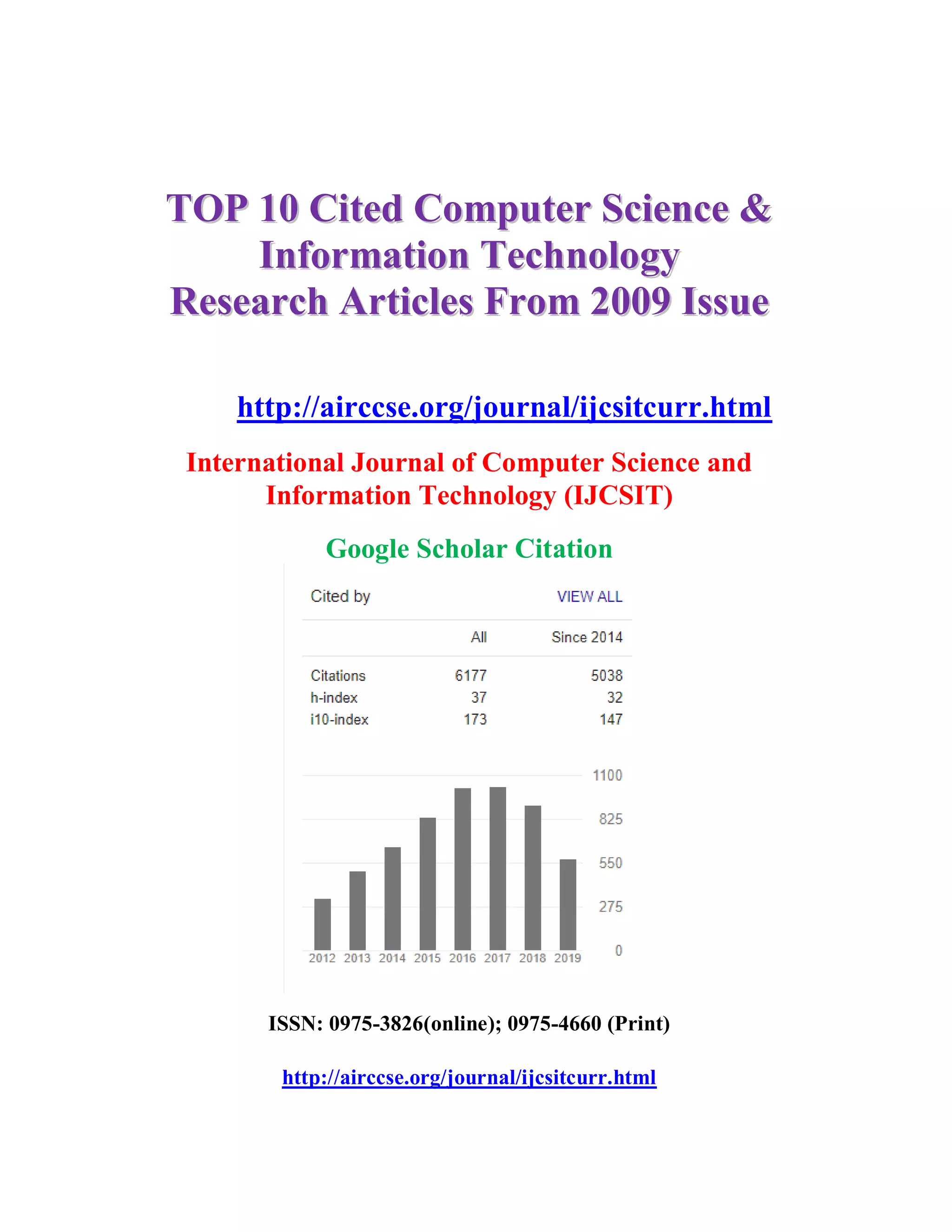
Google Scholar Citation
ISSN: 0975-3826(online); 0975-4660 (Print)
http://airccse.org/journal/ijcsitcurr.html
Citation Count – 54
THESAURUS AND QUERY EXPANSION
Hazra Imran1
and Aditi Sharan2
1
Department of Computer Science, Jamia Hamdard , New Delhi ,India
2
School of Computers and System Sciences, Jawaharlal Nehru University, New
Delhi, India
ABSTRACT
The explosive growth of the World Wide Web is making it difficult for a user to locate
information that is relevant to his/her interest. Though existing search engines work well
to a certain extent but they still face problems like word mismatch which arises because
the majority of information retrieval systems compare query and document terms on
lexical level rather than on semantic level and short query: the average length of queries
by the user is less than two words. Short queries and the incompatibility between the
terms in user queries and documents strongly affect the retrieval of relevant document.
Query expansion has long been suggested as a technique to increase the effectiveness of
the information retrieval. Query expansion is the process of supplementing additional
terms or phrases to the original query to improve the retrieval performance. The central
problem of query expansion is the selection of the expansion terms based on which user’s
original query is expanded. Thesaurus helps to solve this problem. Thesaurus have
frequently been incorporated in information retrieval system for identifying the
synonymous expressions and linguistic entities that are semantically similar. Thesaurus
has been widely used in many applications, including information retrieval and natural
language processing.
KEYWORDS
Network Protocols, Wireless Network, Mobile Network, Virus, Worms &Trojon
Thesaurus, Automatic query expansion, Local context analysis, Information retrieval
For More Details : http://airccse.org/journal/jcsit/1109s8.pdf
Volume Link: http://airccse.org/journal/ijcsitcurr.html
REFERENCES
[1] Jinxi Xu., “Solving the word mismatch problem through automatic text analysis.”,
Ph.D. Thesis,Department of Computer Science, University of Massachusetts,
Amherst, MA, USA, May 1997.
[2] J.R.Wen, J.Y.Nie and H.J. Zhang, “Clustering User Queries of a Search Engine”,. In
Proc. Of WWW10, pp. 587-596, 2001
[3] Spink,A and Saracevic,T., “Interaction in information retrieval:selection and
effectiveness of search terms” , Journal of the American Society for Information
Science 48 ,No 8,p.741-761,1997
[4] Harter, Stephen P, “Online Information Retrieval: Concepts, Principles, and
Techniques”,Orlando: Academic Press, 1986.
[5] H. Fowkes and M. Beaulieu., “Interactive searching behavior: Okapi experiment for
TREC-8.”, Proceedings of 22nd BCS-IRSG European Colloquium on IR Research,
Electronic Workshops in Computing. Cambridge. 2000.
[6] Callan J, “Passage level evidence in document retrieval”, In Proceedings of the
Seventeeth Annual International ACM SIGIR Conference on Research and
Development in Information retrieval,pages 302-310,1994 .
[7] Minker, J., Wilson, G.A., Zimmerman, B.H., “An evaluation of query expansion by
the addition of clustered terms for a document retrieval system. Information Storage
and Retrieval, 8:329--348, 1972
[8] Grossman, D.A. and Frieder, O., “Information Retrieval: Algorithms and
Heuristics.”,Kluwer,1998
[9] Ruge, G.,“Experiments on linguistically-based term associations”, Information
Processing & Management, 28(3): 317-32, 1992.
[10] Y. Qiu and H.P. Frei, “Concept-based query expansion”, in SIGIR ,1993.
[11] C. J. Crouch and Bokyung Yang , “Experiments in automatic statistical thesaurus
construction”, SIGIR 92,77-88,1992.
[12] Baeza-Yates, R. and Berthier Ribiero—Neto,“Modern Information Retrieval.”,
Addison Wesley,1999
[13] Jinxi Xu and W. Bruce Croft., “Query expansion using local and global document
analysis.”, In Proceedings of the 19th Annual International ACM SIGIR Conference
on Research and Development in Information Retrieval, pages 4--11, 1996.
[14] J. Xu, W. B. Croft, Improving the effectiveness of information retrieval with local
context analysis, ACM Transactions on Information Systems,2000.
[15] Blocks, D., Binding, C., Cunliffe, D., Tudhope, D., "Qualitative evaluation of
thesaurus-based retrieval", in Agosti, M., Thanos, C. (Eds),Proceedings of 6th
European Conference on Research and Advanced Technology for Digital Libraries,
Springer, Berlin, Rome, 16-18 September (Lecture Notes in Computer Science),
pp.346-61,2002.
[16] Sihvonen, A., Vakkari, P., "Subject knowledge improves interactive query expansion
assisted by a thesaurus", Journal of Documentation, Vol. 60 No.6, pp.673-90., 2004
[17] Shiri, A.A., Revie, C., "Query expansion behaviour within a thesaurus-enhanced
search environment: a user-centred evaluation", Journal of the American Society for
Information Science, Vol. 57 No.2,2006
[18] G. Salton, Automatic Information Organization and Retrieval, McGraw-Hill Book
Company, 1968.
[19] Wang,Y.,Vandendorpe,J.,and Evens ,M., “Relational thesauri in information
retrieval”, Journal of the American Society for Information Science,36(1):15-
27,1985.
[20] E.M. Voorhees., “Query expansion using lexical-semantic relations”, In Proceedings
of the 17th
ACM-SIGIR Conference, pp. 61-69, 1994
[21] Jing .Y and Croft,w.Bruce, “ The association thesaurus for information retrieval”,
RIAO’94,Intelligent Multimedia Information Retrieval Systems and
Managemnet,146-160,Paris France,CID,1994.
[22] D. Hindle.,“Noun classification from predicate-argument structures.”, In
Proceedings of 28th
Annual Meeting of the ACL, pp. 268-275, 1990.
[23] Miller, G.A., Beckwith, R.T., Fellbaum, C.D., Gross, D., and Miller, K.“ WordNet:
An On-line Lexical Database”, International Journal of Lexicography, 3(4):235-
244,1990
[24] Francisco Joao Pinto et al, “Joining automatic query expansion based on thesaurus
and word sense disambiguation using WordNet”, International Journal of Computer
Applications in Technology, Volume 33, Pages 271-279 ,2009
[25] Y. Qiu and H.P. Frei, “Concept-based query expansion”, in SIGIR ,1993.
[26] Ding,Y.,Ghowdhury,G.G. and Foo,S., “ Incorporating the results of co-word analyses
to increase search variety for information retrieval”,Journal of Information
Science,26,429-451,2000 .
[27] C.J. Rijsbergen, D. J. Harper, and , M. F. Porter , “The selection of good search
terms.”, Information Processing and Management 17: 77 – 91 , 1981
Authors
Hazra Imran is a Ph.D. scholar at the School of Computer and
Systems Sciences (SC & SS), Jawaharlal Nehru University (JNU),
New Delhi, India, and also working as lecturer in Department of
Computer Science, JamiaHamdard, New Delhi, India
(email:hazrabano@gmail.com).
Aditi Sharan is an assistant professor at the School of Computer and
Systems Sciences (SC & SS), Jawaharlal Nehru University (JNU),
New Delhi, India. Her research areas include information retrieval,
text mining, Web mining; email:aditisharan@mail.jnu.ac.in).
Citation Count – 35
Text Independent Speaker Recognition and Speaker Independent Speech
Recognition Using Iterative Clustering Approach
A.Revathi1
, R.Ganapathy2
and Y.Venkataramani3
1
Department of ECE, Saranathan college of Engg., Trichy
2
Department of MCA, Saranathan college of Engg., Trichy
3
Principal, Saranathan college of Engg., Trichy
ABSTRACT
This paper presents the effectiveness of perceptual features and iterative clustering
approach for performing both speech and speaker recognition. Procedure used for
formation of training speech is different for developing training models for speaker
independent speech and text independent speaker recognition. So, this work mainly
emphasizes the utilization of clustering models developed for the training data to obtain
better accuracy as 91%, 91% and 99.5% for mel frequency perceptual linear predictive
cepstrum with respect to three categories such as speaker identification, isolated digit
recognition and continuous speech recognition. This feature also produces 9% as low
equal error rate which is used as a performance measure for speaker verification. The
work is experimentally evaluated on the set of isolated digits and continuous speeches
from TI digits_1 and TI digits_2 database for speech recognition and on speeches of 50
speakers randomly chosen from TIMIT database for speaker recognition. The noteworthy
feature of speaker recognition algorithm is to evaluate the testing procedure on identical
messages of all the 50 speakers, theoretical validation of results using F-ratio and
validation of results by statistical analysis using 2χ distribution.
Keywords:
Clustering methods, Speech recognition, Speaker recognition, Spectral analysis, Speech
analysis, Speech processing, Vector quantization.
For More Details : http://airccse.org/journal/jcsit/1109s3.pdf
Volume Link: http://airccse.org/journal/ijcsitcurr.html
REFERENCES
[1]. A.Revathi, R.Chinnadurai & Y.Venkataramani, “T-LPCC and T-LSF in twins
identification based on speaker clustering” , Proceedings of IEEE INDICON, IEEE
Bangalore section, pp.25-26.September 2007.
[2]. Hynek Hermansky, Kazuhiro Tsuga, Shozo Makino and Hisashi Wakita,
“Perceptually based processing in automatic speech recognition”, Proceedings of
IEEE International Conference on Acoustics, Speech And Signal Processing, Vol.11,
pp.1971-1974, April 1986, Tokyo.
[3]. Hynek Hermansky, Nelson Margon, Aruna Bayya and Phil Kohn, “The challenge of
Inverse E: The RASTA PLP method”, Proceedings of Twenty Fifth IEEE Asilomar
Conference on Signals, Systems And Computers, Vol.2, pp.800-804, November
1991, pacific Grove, CA, USA.
[4]. Hynek Hermansky and Nelson Morgan, “RASTA processing of speech”, IEEE
Transactions on Speech And Audio Processing, Vol.2, No.4, pp.578-589, October
1994.
[5]. A.Revathi and Y.Venkataramani, :”Text independent speaker
identification/verification using multiple features”, Proceedings of IEEE
International Conference on Computer Science And Information Engineering, April
2009, Los Angeles, USA.
[6]. A.Revathi and Y.Venkataramani, “Iterative clustering approach for text independent
speaker identification using multiple features”, Proceedings of IEEE International
Conference on Signal Processing And Communication Systems, December 2008,
Gold coast, Australia.
[7]. A.Revathi and Y.Venkataramani, “Use of perceptual features in iterative clustering
based twins identification system”, Proceedings of IEEE International Conference on
Computing, Communication and Networking, December 2008, India.
[8] A.Revathi, R.Chinnadurai and Y.Venkataramani, “Effectiveness of LP derived
features and DCTC in twins identification-Iterative speaker clustering approach”,
Proceedings of IEEE ICCIMA, Vol.1, pp.535- 539, December 2007.
[9]. Rabiner.L.& Juang B.H., “Fundamentals of speech recognition”, Prentice Hall, NJ
1993.
[10].A.Revathi, R.Chinnadurai and Y.Venkataramani. “Use of wavelets in end point
detection and denoising under low SNR constraints”. International Journal of
Systemic, Cybernetics And Informatics, vol.2, pp. 19- 25, April 2007.
[11].S.R.Das, W.S. Mohn, “A scheme for speech processing in automatic speaker
verification”, IEEE Transactions on Audio And Electroacoustics, Vol.AU-19, pp.32-
43, March 1971.
[12].Aaron. E. Rosenberg, “New techniques for automatic speaker verification”, IEEE
Transactions on Acoustics, Speech and Signal Processing, Vol.ASSP-23, No.2,
pp.169-176, April 1975.
[13].Guruprasad S., Dhananjaya,. N, and B. Yegnanarayana, “AANN models for speaker
recognition based on difference cepstrals”, Proceedings of IEEE International Joint
Conference on Neural Networks, Vol.1, pp.692-697, July 2003.
[14].Tanveer A.Faruquie, Abhik Majmudar, Nitendra Rajput and L.V.Subramanian,
“Large vocabulary audio-visual speech recognition using active shape models”,
Proceedings of 15th IEEE International Conference on Pattern recognition, Vol.3,
pp.106-109, July 2000.
[15] Chulhee Lee, Donghoon Hyun, Euisun Choi, Jinwook Go and Chungyong Lee,
“Optimizing feature extraction for speech recognition”, IEEE Transactions on
Speech and Audio Processing, Vol.11, No.1, January 2009.
[16].P.C.Woodland, J.J.Odell, V.Vatchev and S.J.Young, “large vocabulary continuous
speech recognition using HTK”, Proceedings of IEEE International Conference on
Acoustics, Speech and signal processing, Vol.2, pp.125-128, April 1994.
[17].Hui Jiang, Xinwei Li and Chaojun Liu, “Large margin hidden markov models for
speech recognition”, IEEE Transactions on Audio, Speech and Language Processing,
Vol.14, No.5, pp. 1584-1595,September 2006.
[18].James Mc Auley, Ji Ming, Daryl Stewart and Philip Hanna, “Sub band correlation
and robust speech recognition”, IEEE Transactions on Speech and Audio Processing,
Vol.13, No.6, pp.956-964, September 2005.
[19].E.Avci and D.Avci, “The speaker identification by using genetic wavelet adaptive
network based fuzzy inference system”, International Journal on Expert Systems
with Applications, Vol. 36, No.6, pp. 9928-9940, August 2009.
[20].Prateek Agarwal, Anupam Shukla and Ritu Tiwari, “Multilingual speaker
recognition using artificial neural network”, Advances in Computational
Intelligence, pp.1-9, 2009.
[21].Waleed H.Abdulla, “Robust speaker modeling using perceptually motivated
feature”, Pattern Recognition letters, pp.1333-1342, August 2007.
[22].Chunyan Xu, Xianbao Wang and Shoujue wang, “Research on Chinese digit speech
recognition based on multi weighted neural network”, Proceedings of IEEE Pacific-
Asia workshop on Computational Intelligence and Industrial Applications, pp.400-
403, 2008.
[23].Anastasis Kounoudes, Antonakoudi, Vasili Ketatos and Phillippos Peleties,
“Combined speech recognition and speaker verification over the fixed and mobile
telephone networks”, Proceedings of 24th
IASTED International Conference on
Signal Processing, Pattern Recognition and Applications, pp.228-233, 2006.
Citation Count – 23
IDENTIFICATION OF TELUGU, DEVANAGARI AND ENGLISH
SCRIPTS USING DISCRIMINATING FEATURES
M C Padma1
and P A Vijaya2
1
Department of Computer Science Engineering, PES College of Engineering,
Mandya, India
2
Department of Electronics and Communication Engineering, Malnad College of
Engineering, Hassan, India
ABSTRACT
In a multi-script multi-lingual environment, a document may contain text lines in more
than one script/language forms. It is necessary to identify different script regions of the
document in order to feed the document to the OCRs of individual language. With this
context, this paper proposes to develop a model to identify and separate text lines of
Telugu, Devanagari and English scripts from a printed trilingual document. The proposed
method uses the distinct features extracted from the top and bottom profiles of the printed
text lines. Experimentation conducted involved 1500 text lines for learning and 900 text
lines for testing. The performance has turned out to be 99.67%.
KEYWORDS
Multi-script multi-lingual document, Script Identification, Feature extraction.
For More Details : http://airccse.org/journal/jcsit/1109s6.pdf
Volume Link: http://airccse.org/journal/ijcsitcurr.html
REFERENCES
[1] U.Pal, B.B.Choudhuri, : Script Line Separation From Indian Multi-Script
Documents, 5th Int. Conference on Document Analysis and Recognition(IEEE
Comput. Soc. Press), 406-409, (1999).
[2] T.N.Tan,: Rotation Invariant Texture Features and their use in Automatic Script
Identification, IEEE Trans. Pattern Analysis and Machine Intelligence, vol. 20, no. 7,
pp. 751-756, (1998).
[3] U. Pal, S. Sinha and B. B. Chaudhuri : Multi-Script Line identification from Indian
Documents, In Proceedings of the Seventh International Conference on Document
Analysis and Recognition (ICDAR 2003) 0-7695-1960-1/03 © 2003 IEEE, vol.2,
pp.880-884, (2003).
[4] Santanu Choudhury, Gaurav Harit, Shekar Madnani, R.B. Shet, : Identification of
Scripts of Indian Languages by Combining Trainable Classifiers, ICVGIP, Dec.20-
22, Bangalore, India, (2000).
[5] S. Chaudhury, R. Sheth, “Trainable script identification strategies for Indian
languages”, In Proc. 5th Int. Conf. on Document Analysis and Recognition (IEEE
Comput. Soc. Press), pp. 657–660, 1999.
[6] Gopal Datt Joshi, Saurabh Garg and Jayanthi Sivaswamy, :Script Identification from
Indian Documents, LNCS 3872, pp. 255-267, DAS (2006).
[7] S.Basavaraj Patil and N V Subbareddy,: Neural network based system for script
identification in Indian documents”, Sadhana Vol. 27, Part 1, pp. 83–97. © Printed in
India, (2002).
[8] B.V. Dhandra, Mallikarjun Hangarge, Ravindra Hegadi and V.S. Malemath,: Word
Level Script Identification in Bilingual Documents through Discriminating Features,
IEEE - ICSCN 2007, MIT Campus, Anna University, Chennai, India. pp.630-635.
(2007).
[9] U. Pal and B. B. Chaudhuri, “Automatic separation of Roman, Devnagari and
Telugu script lines”, Advances in Pattern Recognition and Digital techniques, pp.
447-451, 1999.
[10] Lijun Zhou, Yue Lu and Chew Lim Tan,: Bangla/English Script Identification Based
on Analysis of Connected Component Profiles, in proc. 7th DAS, pp. 243-254,
(2006).
[11] M. C. Padma and P.Nagabhushan,: Identification and separation of text words of
Karnataka, Hindi and English languages through discriminating features, in proc. of
Second National Conference on Document Analysis and Recognition, Karnataka,
India, pp. 252-260, (2003).
[12]M. C. Padma and P.A.Vijaya,: Language Identification of Kannada, Hindi and
English Text Words Through Visual Discriminating Features, International Journal
of Computational Intelligence Systems (IJCIS), Volume 1, Issue 2, pp. 116-126,
(2008).
[13] Rafael C. Gonzalez, Richard E. Woods and Steven L. Eddins,: Digital Image
Processing using MATLAB, Pearson Education, (2004).
[14] Vipin Gupta, G.N. Rathna, K.R. Ramakrishnan,: A Novel Approach to Automatic
Identification of Kannada, English and Hindi Words from a Trilingual Document,
Int. conf. on Signal and Image Processing, Hubli, pp. 561-566, (2006).
[15] Brunzell H. and Eriksson J., “Feature Reduction for Classification of
Multidimensional Data”, Pattern Recognition, 33, pp. 1741-1748, 2000.
[16] Sutcliffe, J. P., “On the logical necessity and priority of a monothetic conception of
class, and on the consequent inadequacy of polythetic accounts of category and
categorization”, http://www.db.dk/bh/lifeboat_ko/CONCEPTS/monothetic.html
[17]Shivakumar, Nagabhushan, Hemanthkumar, Manjunath, 2006, “Skew Estimation by
Improved Boundary Growing for Text Documents in South Indian Languages”,
VIVEK- International Journal of Artificial Intelligence, Vol. 16, No. 2, pp 15-21.
[18]Andrew Busch, Wageeh W. Boles and Sridha Sridharan, “Texture for Script
Identification”, IEEE Transactions on Pattern Analysis and Machine Intelligence,
Vol. 27, No. 11, pp. 1720- 1732, Nov. 2005.
[19]Murali, Vasudev, Hemanthkumar, Nagabhushan, 2006, “Language Independent
Skew Detection and Correction of Printed Text Document Images: A Non-rotational
Approach”, VIVEKInternational Journal of Artificial Intelligence, Vol. 16, No. 2, pp
08-15.
[20]A. L. Spitz, “Determination of script and language content of document images”,
IEEE Trans. On Pattern Analysis and Machine Intelligence, Vol. 19, No.3, pp. 235–
245, 1997.
[21]S. L. Wood, X. Yao, K. Krishnamurthy and L. Dang, “Language identification for
printed text independent of segmentation”, Proc. Int. Conf. on Image Processing, pp.
428–431, 0-8186-7310- 9/95, 1995 IEEE.
[22] J. Hochberg, L. Kerns, P. Kelly and T. Thomas, “Automatic script identification
from images using cluster based templates”, IEEE Trans. Pattern Anal. Machine
Intell. Vol. 19, No. 2, pp. 176–181, 1997.
[23] G. S. Peake and T. N. Tan, “Script and Language Identification from Document
Images”, Proc. Workshop Document Image Analysis, vol. 1, pp. 10-17, 1997.
[24]A. K. Jain and Y. Zhong, “Page Segmentation using Texture Analysis”, Pattern
Recognition 29, pp743-770, 1996
Citation Count – 18
ANALYSIS ON DEPLOYMENT COST AND NETWORK
PERFORMANCE FOR HETEROGENEOUS WIRELESS
SENSOR NETWORKS
Dilip Kumar1
, Trilok. C Aseri2
, R.B Patel3
1
Design Engineer, Centre for Development of Advanced Computing (C-DAC), A
Scientific Society of the Ministry of Communication & Information Technology,
Government of India, A-34, Phase-8, Industrial Area, Mohali -160071 (India)
2
Sr. Lecturer, Department of Computer Science & Engineering, Punjab
Engineering College (PEC), Deemed University, Sector-12, Chandigarh-160012
(India)
3
Prof. & Head, Department of Computer Science & Engineering, Maharishi
Markandeshwar University (MMU), Mullana, Ambala-133203 (India)
ABSTRACT
A wireless sensor network is an autonomous system of sensor connected by wireless
devices without any fixed infrastructure support. One of the major issues in wireless
sensor network is developing a cost effective routing protocol which has a significant
impact on the overall network performance in the sensor network. In this paper, we have
considered three types of nodes with different battery energy. The key role of the
proposed protocol is to maximize the network performance without increasing the
network deployment cost. We have compared the quantitative analysis of different
protocols in terms of their network deployment cost. Our analysis and simulation results
demonstrate that the proposed scheme can achieve higher network performance and
lower network deployment cost as compared to the existing protocols.
KEYWORDS
Heterogeneous, Clustering, Cost, Lifetime, Sensor Networks
For More Details : http://airccse.org/journal/jcsit/1109s10.pdf
Volume Link: http://airccse.org/journal/ijcsitcurr.html
REFERENCES
[1] Römer Kay and Mattern F. (2004). The Design Space of Wireless Sensor Networks,
IEEE Wireless Communications.
[2] Xue Q and Ganz A. (2004). Maximizing Sensor Network Lifetime: Analysis and
Design Guides Proceedings of MILCOM.
[3] Mhatre V and Rosenberg C. (2004). Homogeneous vs. Heterogeneous Clustered
Sensor Networks: A Comparative Study. Proceedings of IEEE International
Conference on Communications (ICC).
[4] Soro S., HenizelmanW B., (2005). Prolonging the lifetime of Wireless Sensor
Networks Via Unequal Clustering. Proceedings for 5th IEEE International
Workshop on Algorithms for Wireless Mobile Ad Hoc and Sensor Networks,
Denver, Colorado.
[5] Yuan L, and Gui C. (2004). Applications and Design of Heterogeneous and Broadb
and Advanced Sensor Networks (Basenets).
[6] Intanagonwiwat C, Govindan R and Estrin.(2000). Directed diffusion: A Scalable
and Robust Communication Paradigm for Sensor Networks, Proceedings of the 6th
Annual International Conference on Mobile Computing and Networking. 56–67.
[7] Heinzelman W.R.(2000). Application - Specific Protocol Architectures for Wireless
Networks. Ph.D. Thesis, Massachusetts Institute of Technology.
[8] Duarte-Melo EJ and Liu M., (2002) Analysis of energy consumption and lifetime of
heterogeneous wireless sensor networks. Proceedings of Global Telecommunications
Conference (GLOBECOM 2002) IEEE. 21–25.
[9] Wei D., Kaplan S., and Chan H A.,(2008). Energy Efficient Clustering Algorithms
for Wireless Sensor Networks. Proceedings of IEEE Communications Society (ICC
2008 ).236-240.
[10] Smaragdakis G., Matta I., and Bestavros A.,(2004). SEP: A Stable Election Protocol
For Clustered Heterogeneous Wireless Sensor Networks. Proceedings of Second
International Workshop on Sensor and Actor Network Protocols and Applications
(SANPA 2004), Boston, MA.
[11] Pan J, Cai L., Hou Y.T, Shi Y and Shen S.X., Optimal Base-station Locations in
Two-Tiered Wireless Sensor Networks, IEEE Transactions on Mobile Computing
(TMC); 2005; 458–473.
[12]Bandyopadhyay S., and Coyle EJ.,(2003).An Energy Efficient Hierarchical
Clustering Algorithm for Wireless Sensor Networks. Proceedings of the IEEE
Conference on Computer Communications (INFOCOM). International Journal of
Computer science & Information Technology (IJCSIT), Vol 1, No 2, November
2009 118
[13]Intanagonwiwat C., Govindan R., Estrin D., Heidemann J., and Silva F., (2003).
Directed Diffusion for Wireless Sensor Networking; IEEE/ACM Transactions on
Networking, Vol. 11, No. 1, 2–16.
[14]Park S. H., Cho J. S., Han YJ., and Chung TM. (2007). Architecture of Context
Aware Integrated Security Management Systems for Smart Home Environments.
APNOMS2007, LNCS 4773, 543- 546.
[15]Kim JM., Park S. H., Han Y. J., and Chung TM.,(2008). CHEF: Cluster Head
Election Mechanism using Fuzzy Logic in Wireless Sensor Networks. Proceedings
of ICACT, 654-659.
[16]Heinzelman W, Chandrakasan A and Balakrishnan H, Energy-Efficient
Communication Protocols for Wireless Microsensor Networks (LEACH).
Proceedings of the 33rd Hawaii International Conference on Systems Science, Vol.
8, 3005-3014
Citation Count –14
Analysis of Telecommunication Management Technologies
Khalil ur rehman Laghari, Imen Grida ben Yahia, and Noel Crespi
Institut Telecom, Telecom SudParis Mobile Networks and Multimedia Services
Department 9
Rue Charles Fourier, 91011 Evry Cedex France.
ABSTRACT
The phenomenal success of IT and Telecommunication would not have been possible
without any effective management framework. The management technologies have also
been maturing with evolution of IT & Telecom. In this paper, we trace out some
important traditional and current telecommunications management technologies in terms
of their strengths and limitations. We analyze them in order to draw lessons and
guidelines for emerging research in this field.
KEYWORDS
Network Management Technologies, Distributed Object Technologies, Web based
Technologies, Autonomic services and network management vision.
For More Details : http://airccse.org/journal/jcsit/1109s12.pdf
Volume Link: http://airccse.org/journal/ijcsitcurr.html
REFERENCES
[1] Online Tutorial of Simple network management protocol (snmp), mibs and smi DOI=
http://www.mplstutorial.com/simple-network-management-protocol-snmp-mibs-and-s
[2] Lens-Peter Redlich, Masaaki Suzuki, and Stephen Weinstein 1998 Distributed Object
Technology for Networking IEEE Communication Magazine.
DOI=http://ieeexplore.ieee.org/stamp/stamp.jsp?tp=&arnumber=722144.
[3] Charles J. Byrne 1998, Extensions of the TMN Functional Architecture for Operations
Systems. IEEE Transaction, DOI=
http://ieeexplore.ieee.org/stamp/stamp.jsp?arnumber=00654896
[4] Lakshmi G. Raman March 1999, Fundamentals of Telecommunications Network
Management WileyIEEE Press ISBN: 978-0-7803-3466-3
[5] J. Kirk Shrewsbury March 1995, an Introduction to TMN Journal of Network and Systems
Management, vol. 3, No. 1. DOI=http://www.cs.stevens.edu/~sghosh/courses/cs669/old-
classnotes/Tmn-intr.pdf International Journal of Computer science & Information
Technology (IJCSIT), Vol 1, No 2, November 2009 164
[6] P.Saravanan, Emmanuel Reuter, Sekhar Venna 2008, Enhancing Enterprise Network
Management using SMART (Secured Mobile Agents for heteRogeneous environmenT),
IEEE Transaction.
[7] Andreas Binzenh¨ofer, Kurt Tutschku, Bj¨orn auf dem Graben and Markus Fiedler, Patrik
Carlsson 2005 A P2P-based Framework for Distributed Network Management, Research
Report Series University W¨urzburg Institute of Computer Science http://www-
info3.informatik.uni-wuerzburg.de/TR/tr351.(pdf)
[8] Kurt Wallnau, Nelson Weiderman, Linda Northrop June 1997, Distributed Object
Technology with CORBA and JAVA: key concepts and implications, Technical Report by
Software Engineering Institute Carnegie Mellon University Pittsburgh, Pennsylvania.
DOI=http://www.sei.cmu.edu/pub/documents/97.reports/pdf/97tr004.pdf
[9] Object Management Group’s Online Technology Update: History of CORBA Technology
DOI= http://www.omg.org/gettingstarted/history_of_corba.htm
[10] Maozhen Li, Mark Baker 2005, The Grid: Core Technologies John Wiley & Sons; ISBN 0-
470-09417-6
[11] Adhikari, Richard 1995, Adopting OO Languages? Check Your Mindset at the Door,
Software Magazine (November 1995), pp. 49-59
[12] George Pavlou 2000, Using Distributed Object Technologies in Telecommunication
Network Management, IEEE Journal on Selected Areas in Communications, VOL. 18, NO.
5, MAY 2000.
[13] Markus Horstmann and Mary Kirtland 1997, DCOM Architecture, Microsoft Developer
Network online Tutorial about DCOM. DOI=http://msdn.microsoft.com/en-
us/library/ms809311.aspx
[14] Dionisis X. Adamopoulos, George Pavlou, Constantine A. Papandreou and Emmanuel
Manolessos 1999, Distributed Object Platforms in Telecommunications: A Comparison
Between DCOM and CORBA: Proceedings of Federation of Telecommunications Engineers
of the European Community (FITCE '99) - the 38th European Telecommunications
Congress 'Networking the Future ', Utrecht, The Netherlands, also in British
Telecommunications Engineering Journal, Vol. 18, Part 2, pp. 43-49, ISSN 0262-401X,
August 1999.DOI=
http://personal.ee.surrey.ac.uk/Personal/G.Pavlou/Publications/Conference-papers/Adam-
99d.pdf
[15] Rajesh P,Ranjhiit S,Soumya PR,Karthik V,Datthathreya S 2006, Network Management
System using web services and service oriented architecture-A Case Study, IEEE
transaction.
[16] J.Patrick Thompson 1998,Web-based Enterprise Management architecture, IEEE
Transaction.
[17] DMTF organisation’s CIM concepts white paper 2003,
DOI=http://www.dmtf.org/standards/documents/CIM/DSP0110.pdf
[18]Microsoft Online tutorial, WMI Architecture.DOI=
http://technet.microsoft.com/enus/library/cc180678.aspx
[19] Sun WBEM SDK Developer's Guide DOI=http://docs.sun.com/app/docs/doc/806-
6831/6jfoe2of4?a=view
[20] Andreas Wallstrom 2000, Evaulation and Implementation of protocols for configuration data
export from IMA, Master thesis report Civilngenjorsprogrammer Datateknik Institutionen
for systemteknik avdelningen Programvaruteknik 28 November 2000.
DOI=http://epubl.luth.se/1402- 1617/2000/284/LTU-EX-00284-SE.pdf
[21] Konstantinos Kotsopoulos, Pouwan Lei, Yim Fun Hu 2008 A SOA-based Information
Management Model for Next-Generation Network Proceedings of the International
Conference on Computer and Communication Engineering 2008 (May 13-15, 2008 )Kuala
Lumpur, Malaysia
[22] Swanand Sahasrabuddhe 2008 Insights into Implementing Genetic Algorithm based
Production Schedulers. (Dec 2008) DOI= http://www.infosys.com/supply-chain/white-
papers/genetic-algorithmproduction-schedulers.pdf
[23] Yu Chang et al 2006, A Generic Architecture for autonomic services and .., computer
communications (2006), DOI =10.1016/j.comcom.2006.06.017
[24] Autonomic Network Architecture (ANA) Project update, 2009. DOI=http://www.ana-
project.org/web/
[25] CASCADAS project update. DOI= http://www.cascadas-project.org/docs/D8.4.pdf [26]
Autonomic Communication Forum project work updates. DOI= http://www.autonomic-
communicationforum.org/ International Journal of Computer science & Information
Technology (IJCSIT), Vol 1, No 2, November 2009 165
[27] Seventh Framework Programme (FP7) projects and their online updates. DOI=
http://cordis.europa.eu/fetch?CALLER=FP7_PROJ_EN&ACTION=D&DOC=408&CAT=P
ROJ&QUE RY=011aa1a07160:26fc:0a638c91&RCN=85451
[28] HAGGLE: A European Union funded project in Situated and Autonomic Communications
(2006-2010). DOI=http://www.haggleproject.org/index.php/Main_Page
[29] Emanics: European Network of Excellence for the Management of Internet Technologies
and Complex Services. DOI=http://www.emanics.org/
[30] John C. Strassner, Nazim Agoulmine, Elyes Lehtihet, 2006, FOCALE – A Novel Autonomic
Networking Architecture, Latin American Autonomic Computing Symposium (LAACS),
2006, Campo Grande, MS, Brazil.
DOI=http://eprints.wit.ie/189/1/2006_LAACS_Strassner_et_al_final.pdf [31] IETF
Document: Policy Core Information Model -Version 1 Specification Feb 2001.
DOI=http://tools.ietf.org/html/rfc3060
[32] DMTF,Inc online Tutorial : Web-Based Enterprise Management (WBEM) FAQs
http://www.dmtf.org/about/faq/wbem/
[33] Nigel Sheridan-Smith 2003, A Distributed Policy-based Network Management (PBNM)
system for Enriched Experience Networks™ (EENs).Doctoral Thesis presented in
University of Technology, Sydney Faculty of Engineering Information and Communication
Group 5 Nov 2003.
[34] Gianni A. Di Caro, Frederick Ducatelle, Luca M. Gambardella 2005 BISON: Biology-
Inspired techniques for Self-Organization in dynamic Networks. DOI=
http://www.cs.unibo.it/bison/publications/KIbison.pdf
[35] S. Dobson et al, ACM Transactions on Autonomous and Adaptive Systems, Vol. 1, No. 2,
December 2006, Pages 223–259. DOI=http://www.perada.eu/documents/articles-
perspectives/survey-onautonomic-communication.pdf
[36] Elke Michlmayr 2006, Ant Algorithms for Search in Unstructured Peer-to-Peer
Networks,published in IEEE proceedings.
DOI=ieeexplore.ieee.org/iel5/10810/34089/01623938.pdf
[37] Ken Binmore and Nir Vulkan 1997 Applying Game Theory to Automated Negotiation,
(April, 1997), at Rutgers DIMACS Workshop on Economics Game Theory and the Internet
University, New Brunswick, NJ.DOI= http://www.econ.iastate.edu/tesfatsi/binmore1.pdf
[38] R. Boutaba, J. Xiao, "Network Management: State of the Art," in Proceedings of the 2002
World Computer Congress, pp. 127-146
[39] WTCS online tutorial on SNMP DOI=http://www.wtcs.org/snmp4tpc/snmp.html
[40] Aiko Pras, Bert-Jan van Beijnum, Ron Sprenkels 1999 Introduction to TMN CTIT Technical
Report 99-09 University of Twente Netherlands.
DOI=http://www.simpleweb.org/tutorials/tmn/tmn.pdf
[41] Kotsopoulos, K. Pouwan Lei, Yim Fun Hu 2008 A SOA-based information management
model for Next-Generation Network presented in International conference ICCCE 2008
May 13-15, 2008 Kuala Lumpur, Malaysia.
[42] Ben Yahia, I.G.; Bertin, E.; Crespi, N, 2007 Ontology-based Management Systems for the
Next Generation Services: State-of-the-Art, presented in Networking and Services, 2007.
ICNS Third International Conference and published in IEEE Transaction 2007.
[43] W3C Recommendation OWL Web Ontology Language DOI= http://www.w3.org/TR/owl-
features/
Citation Count – 14
DESIGN AND IMPLEMENTATION OF 32-BIT CONTROLLER FOR
INTERACTIVE INTERFACING WITH RECONFIGURABLE
COMPUTING SYSTEMS
Ashutosh Gupta and Kota Solomon Raju
Digital System Group, Central Electronics Engineering Research Institute (CEERI)
Council of Scientific and Industrial Research (CSIR), Pilani-333031 (Raj.), India
ABSTRACT
Partial reconfiguration allows time-sharing of physical resources for the execution of
multiple functional modules by swapping in or out at run-time without incurring any
system downtime. This results in dramatically increase in speed and functionality of
FPGA based system. This paper presents the designing an interface controller through
UART for execution & implementation of reconfigurable modules (RM) on Xilinx
Virtex-4(XC4VFX12), (XC4VFX20) and (XC4VFX60) devices. To verify partial
reconfiguration execution at run-time an interface has been designed to make user
interaction with the system at run-time. Interface design includes the controllers for
controlling the flow of data to and from the reconfigurable modules to the external world
(host environment) through busmacros. The controller is designed as static module. All
the static as well as dynamic modules are designed and simulated to verify the
functionality with supporting simulation tool using ModelSim-6.0d and synthesized with
Xilinx 9.1.02i_PR10 (ISE).
KEYWORDS
Reconfigurable computing systems, Partial reconfiguration, FPGA, Reconfigurable
modules, Busmacros
For More Details : http://airccse.org/journal/jcsit/1109s7.pdf
Volume Link: http://airccse.org/journal/ijcsitcurr.html
REFERENCES
[1] Christophe Bobda “Introduction to Reconfigurable Computing: Architectures,
Algorithms and Applications” Springer 2007.
[2] Two Flows for Partial Reconfiguration: Module Based or Difference Based, Xilinx
website
http://www.xilinx.com/support/documentation/application_notes/xapp290.pdf
[3] Sedcole, P. Blodget, B. Anderson, J. Lysaghi, P. Becker, T. " Modular partial
reconfigurable in Virtex FPGAs," International Conference on Field Programmable
Logic and Applications, 24-26 Aug. 2005 p.p.: 211- 216, ISBN: 0-7803-9362-7
[4] Emi Eto, “Difference-Based Partial Reconfiguration”, XAPP290 (v2.0) December 3,
2007.
[5] Early Access Partial reconfiguration User Guide, UG208, Xilinx website,
http://www.xilinx.com
Authors
Ashutosh Gupta
Received B.E. (ECE) and M.Tech. in Vlsi Design & Embedded systems
from Guru Jambheshwar University of Science & Technology, Hisar in
2006 and 2008, respectively. Presently working as a Project Assistant in
Digital Systems Group, Central Electronic Engineering Research
Institute, Pilani, India. His field of interest is FPGA based
Reconfigurable computing systems.
Dr. Kota Solomon Raju
Received B.E. (ECE) from SRKR Engineering College Bhimavaram,
M.E. from Birla Institute of Technology & Science Pilani and Ph.D.
from Department of Electronics and Computer Engineering, Indian
Institute of Technology, Roorkee. Presently, he is working as senior
scientist in Digital Systems Group, Central Electronic Engineering
Research Institute, Pilani, India. He is working in the field of
reconfigurable computing systems for communication, image
processing and intelligent smart sensor systems.
Citation Count – 10
ENSEMBLE DESIGN FOR INTRUSION DETECTION SYSTEMS
T. Subbulakshmi1, A. Ramamoorthi2, and Dr. S. Mercy Shalinie3
1
Department of Computer Science and Engineering, Thiagarajar College of
Engineering, Madurai
2
IVCSE, Computer Science Department, Sethu Institute of technology, Madurai,
3
HODCSE, Department of Computer Science and Engineering, Thiagarajar College
of Engineering, Madurai
ABSTRACT
Intrusion Detection problem is one of the most promising research issues of Information
Security. The problem provides excellent opportunities in terms of providing host and
network security. Intrusion detection is divided into two categories with respect to the
type of detection. Misuse detection and Anomaly detection. Intrusion detection is done
using rule based, Statistical, and Soft computing techniques. The rule based measures
provides better results but the extensibility of the approach is still a question. The
statistical measures are lagging in identifying the new types of attacks. Soft Computing
Techniques offers good results since learning is done using the training, and during
testing the newpattern of attacks was also recognized appreciably. This paper aims at
detecting Intruders using both Misuse and Anomaly detection by applying Ensemble of
soft Computing Techniques. Neural networks, Support Vector Machines and Naïve
Bayes Classifiers are trained and tested individually and the classification rates for
different classes are observed. Then threshold values are set for all the classes. Based on
this threshold value the ensemble approach produces result for various classes. The
standard kddcup’99 dataset is used in this research for Misuse detection. Shonlau dataset
of truncated UNIX commands is used for Anomaly detection. The detection rate and false
alarm rates are notified. Multilayer Perceptrons,
KEYWORDS
Intrusion Detection Systems, Anomaly Detection Systems, Misuse Detection Systems,
Support Vector Machines, Naïve Bayes Classifiers, Multilayer Perceptrons, Ensemble
approach
For More Details : http://airccse.org/journal/nsa/0809s01.pdf
Volume Link: http://airccse.org/journal/ijcsitcurr.html
REFERENCES
[1] Dong Seong Kim and Jong Son Park, “ Network Based Intrusion Detection with
Support Vector Machines”, ICOIN 2003, LNCS 2662
[2] Nahla Ben Amor, Salem Benferhat, Zied Elouedi “Naive Bayes vs. Decision trees in
intrusion detection systems”, Sas’04, March14-17, 2004, Nicosia,Cyprus
[3] Wilson Naik Bhukya, Suresh Kumar G , Atul Negi “ A Study of Effectiveness in
Masquerade Detection”, 2006 IEEE.
[4] Yingbing Yu, James H. Graham, Member, IEEE “Anomaly Instruction Detection of
Masqueraders and Threat Evaluation Using Fuzzy Logic”, 2006 IEEE
[5] Wun-Hwa Chen, Sheng-Hsun Hsu* , Hwang-Pin Shen “Application of SVM and
ANN intrusion detection” , 2004 Elseiver
[6] Kanchan Thadani, Aahutosh, V.K.jayaraman and V.Sundarajan “Evolutionary
Selection of Kernels in Support Vector Machines”, 2006 IEEE
[7] Animwsh Patcha, Jun “An overview of anomaly detection techniques: Existing
solution and latest technological trends” , 2007 Elsevier B.V
[8] Roy A.Maxion, Tahlia N.Townsend “ Masquerade Detection Augmented With
Error Analysis” ,2004 IEEE
[9] Taeshik Shon , Jongsub Moon “ A hybrid machine learning approach to network
anomaly detection “ 2007 Elsevier Inc.
[10] Min Yang, Huang Zhang , H.J. Cai “Masquerade Detection Using String Kernels “ ,
2007 IEEE.
[11] Kunlun Li ,Guifa Teng “ Unsupervised SVM Based on p-kernels for Anomaly
Detection” 2006 IEEE
[12] Dorothy E. Denning, “An intrusion - detection model”, IEEE Transactions on
Software Engineering, 13(2):222-232, 1987
[13] http://www.schonlau.net/
[14] http://www.sigkdd.org/kddcup/index.php?section=1999&method=data
[15] Matthias Schonlau, William Du Mouchel, Wen-Hua. Ju, Alan F. Karr, Martin, Theus
and Yehuda vardi, “Computer Intrusion: Detecting Masqueraders”, Statistical
Science Journal, 2001
[16] Kwong H Yung, “Using Self- Consistent Naïve Bayes classifiers to detect
masqueraders”, Standard EC Journal, 2004
[17] Mizuki Oka, Yoshihiro Oyama, Hirotake abe, Kazuhiko kato, “Anomaly Detection
using layered Networks based on Eigen Co-occurance Matrix”, Recent Advances in
Intrusion Detection 2004, 2004
[18] Alen peacock, Xian KE, Mattiiew, Wilkerson, “Typing patterns: A key to User
Identification”, IEEE Security and Privacy, 2004.
[19] Robert Birkely, 2003, “A Neural Network based Intelligent Intrusion Detection
System”, M. S. Thesis, Griffith University, Gold coast campus, 2003
[20] Zhuowei Li , Amitabha Das and Jianying Zhou “Theoretical Basis for Intrusion
Detection”, 2005 IEEE
Authors
T. Subbulakshmi is working as a Senior Grade Lecturer in department
of Computer Science and Engineering, Thiagarajar College of
Engineering, Madurai, Tamilnadu. She has completed her B. E from
Raja College of Engineering and Technology, TamilNadu and M.E
from Arulmigu kalasalingam College of Engineering, TamilNadu She
has published papers in conferences and Journals. She is currently
pursuing Ph. D in the area of Information Security. Her research
interests includes information Security and Machine learning algorithms
Ramamoorthi is the B.E Computer Science Student. Pursu ing his
BE degree in Sethu Institute of Technology, AnnaUniversity,
TamilNadu. He has published papers in conferences. His research
interests includes Soft Computing Techniques, Network Security and
Intrusion Detection Systems
Dr. S. Mercy Shalinie, is currently heading the Department of
Computer Science and
Engineering, Thiagarajar College of Engineering, Madurai,
Tamilnadu. She has has published 50 papers in International
Journals. Her research interests in cludes Application of Neuro
Fuzzy systems to various research problems.
Citation Count – 06
Optimal Curve Fitting of Speech Signal for Disabled Children
Anandthirtha. B. GUDI1
, and H. C. Nagaraj2
1
Department of Electronics and Communication Engineering, Sri Bhagawan
Mahaveer Jain College of Engineering, Bangalore-562112, Karnataka, India
2
Department of Electronics and Communication Engineering, Nitte Meenakshi
Institute of Technology, Yelahanka, Bangalore-560064, Karnataka, India.
ABSTRACT
In this work, the amplitude profile of sampled speech data were fitted by employing sum
of sine functions with a confidence level more than 90%. Furthermore, amplitude
correlation technique is applied between original speech signal samples of normal and
pathological subjects and correlation technique is also applied between the curve fit
constant values for normal and pathological subjects. Results obtained in both the
techniques were compared to determine the varying degrees of speech disability severity.
KEYWORDS
Correlation, Curve fitting, Discrete time signal, Linear filter, Speech disability
For More Details : http://airccse.org/journal/jcsit/1109s9.pdf
Volume Link: http://airccse.org/journal/ijcsitcurr.html
REFERENCES
[1]. http://www.disabilityworld.org/06-08-03/children/unicef.shtml
[2]. Lawrence Rabiner and Biling-Hwang Juang, “Fundamentals of Speech Recognition”,
second Impression, published by Dorling Kindersley (India) Pvt. Ltd., licensees of Pearson
Education in South Asia.2007.
[3]. Ben Gold and Nelson Morgan, “Speech and Audio Signal Processing (Processing and
Perception of Speech and Music)”, John Wiley & Sons, Inc.2006.
[4]. J. B. Allen, ”How do humans process and recognize speech“, IEEE Transactions on Speech
and Audio Processing vol. 2, No 4, October 1994, pp. 567-577.
[5]. Harry Levitt,” Speech Processing Aids for the Deaf an Overview” IEEE Transactions on
Audio and Electroacoustics, Vol. Au-21, No.3, June 1973, pp. 269- 273.
[6]. Ronald W. Schlffer, Member, IEEE, “A Surveyof Digital Speech Processing
Techniques”IEEE Transaction on Audio and Electro acoustics Vol. Au-20, No. 1,
March,1972, pp. 28-35.
[7]. B. Garcia, J. Vicente, I. Ruiz, A. Alonso, “Multiplatform Interface Adapted To Pathological
Voices”, IEEE Symposium on Signal Processing and Information Technology, 2005, pp.
912-917.
[8]. CHERIF Adnbne-Botiafif Lamia-Mhamdi mounir, “Analysis of Pathological Voices by
Speech Processing”, IEEE, 2003, pp. 365-367.
[9]. Y. Ephraim, D. Malah, and B. H. Juang, “On the application of hidden Markov models for
enhancing noisy speech”, IEEE Transactions on Speech and Audio Processing vol. 37,
October 1989, pp.. 1846-1856.
[10]. J. Picone “Continuous speech recognition using Hidden Markov Models“, IEEE, ASAP
Magazine, July 1990, pp. 26-41.
[11]. T. Kobayashi, J. Furuyama, K. Masumitsu, “PartlyHidden Markov Model and its
application to speech recognition”, IEEE, 1991, pp. 121-124.
[12]. N. Ratnayake, M. Savic, J. Sorensen, “Use of Semi- Markov Models for speaker-
independent phoneme recognition”, IEEE, 1992, pp. 565-568
[13]. J. Kabudian, M. M. Homayounpour, S. Mohammad Ahadi, “Time-Inhomogeneous hidden
Bernoulli Model:An Alternative to Hidden Markov Model for Automatic Speech
recognition”, Proceedings of ICASSP, 2008, pp. 4101-4104.
[14]. M. Robert ITO, R. W. Donaldson, “Zero-crossing measurements for analysis and
recognition of speech sounds”, IEEE Transactions on Audio and Electroacoustics, Vol. 19,
No.3, 1971, pp. 235-242.
[15]. B. S. Atal and Suzanee L. Hanauer, “Speech Analysis and Synthesis by Linear Prediction of
the Speech Wave”, the Journal of the Acoustical Society of America, April 1971, pp. 637-
655.
[16]. Susanna Varho and Paavo Alku, “Regressive Linear Prediction with Triplets-An Effective
All-Pole Modeling Technique for Speech Processing”, IEEE, 1998, pp. IV- 194 – IV-197.
[17].R. Kumrisan and C.S.Ramalingam, “On separating voiced-speech into its components”,
IEEE, 1993, pp.1041-1046.
[18].Yuanning Liu, Senmiao Yuan and Xiaodong Zhu, “A Time-frequency Field Fingerprint
Enhancement Technology and Three-order Spline Curve Fitting Matching Algorithm
Research”, IMTC 2003- Instrumentation and Measurement Technology Conference, Vail,
Co, USA, 20-22 May 2003, pp.1067- 1069.
[19].K.Steiglitz, G. Winham and J.Petzinger, “Pitch Extraction by Trigonometric Curve
Fitting”,IEEE Transactions on acoustics, speech and signal processing, June 1975,pp.321-
323.
[20]. http://www.hindu.com (dated 1st Nov 2008)
[21]. http://www.goldwave.com/
Authors
Anandthirtha B. Gudi obtained Bachelor of Engineering from
S.J.M.Institute of Technology, Chitradurga, Mysore University. Master of
Engineering from U. V. C. E.Bangalore, Bangalore University. Professor
in the Department o f Electronics and Communication Engineering, Sri
Bhagawan Mahaveer Jain College of Engineering, Bangalore. Karnataka,
India.
Dr. H. C. Nagaraj obtained Bachelor of Engineering from Mysore
University, Master of Engineering from P. S. G. College of Technology,
Coimbatore. PhD from I.I.T., Madras. Principal, Nitte Meenakshi
Institute of Technology, Bangalore, Karnataka, India.
Citation Count – 1
INVESTIGATING THE PERFORMANCE OF VARIOUS VOCODERS
FOR A FAIR SCHEDULING ALGORITHM IN WIMAX
B. Kaarthick Member IEEE1
, V. J.Yeshwenth2
, P.M.Sudarsan3
, N.Nagarajan4
and
Rajeev Senior Member IEEE5
1
Network System Design Center, Sri Krishna College of Engineering & Technology,
Coimbatore, India.
2,3
University Of Texas at Dallas, USA.
4
Coimbatore Institute of Eng. and Information Technology, Coimbatore.
5
Wipro Technologies,India
ABSTRACT
An appealing feature of blockchain technology is smart contracts. A smart contract is
executable code that runs on top of the blockchain to facilitate, execute and enforce an
agreement between untrusted parties without the involvement of a trusted third party. In
this paper, we conduct a systematic mapping study to collect all research that is relevant
to smart contracts from a technical perspective. The aim of doing so is to identify current
research topics and open challenges for future studies in smart contract research. We
extract 24 papers from different scientific databases. The results show that about two
thirds of the papers focus on identifying and tackling smart contract issues. Four key
issues are identified, namely, codifying, security, privacy and performance issues. The
rest of the papers focuses on smart contract applications or other smart contract related
topics. Research gaps that need to be addressed in future studies are provided.
KEYWORDS
Blockchain, Smart contracts, Systematic mapping study, Survey
For More Details : http://airccse.org/journal/jcsit/1109s4.pdf
Volume Link: http://airccse.org/journal/ijcsitcurr.html
REFERENCES
[1] IEEE Std 802.16-2004, IEEE Standard for Local and Metropolitan Area Networks,
Part 16: Air interface for Fixed Broadband Access Systems, October, 2004.
[2] IEEE Standard for Local and Metropolitan Area Networks - Part 16: Air Interface
for Fixed and Mobile Broadband Wireless Access Systems Amendment 2,” Feb. 28.
[3] Jeffrey G.Andrews, Arunabha Ghosh, Rias Muhammed “Fundamentals of WiMAX
Understanding Broadband Wireless Networks” Prentice Hall Inc, 2007.
[4] Belghith, A. Nuaymi, L. ENST Bretagne and Rennes, “Comparison of WiMAX
scheduling algorithms and proposals for the rtPS QoS class,” This paper appears in:
Wireless Conference, 2008. EW 2008. 14th European, Publication Date: 22-25 June
2008, pp 1-6
[5] LEE Howon, KWON Taesoo, CHO Dong-Ho, “An efficient uplink scheduling
algorithm for VoIP services in IEEE 802.16 BWA systems,” Vehicular Technology
Conference, 2004. VTC2004-Fall. 2004 IEEE 60th , vol. 5, pp. 3070-3074.
[6] Jin-Cherng Lin, Chun-Lun Chou and Cheng-Hsiung Liu, “Performance Evaluation
for Scheduling Algorithms in WiMAX Network,” Advanced Information
Networking and Applications - Workshops, 2008. AINAW 2008. 22nd International
Conference vol., Issue , 25-28 March 2008, pp. 68 – 74 M.
[7] http://en.wikipedia.org/wiki/list_of_codecs.
[8] Micheal Y.Appial, Raimonda Marrickalite, Milda Gusaite, Sasikanth
Managala,”Robust Voice Activity Detection and Noise Reduction Mechanism using
higher order stastistics”,June-05.
[9] S. Sengupta, M. Chatterjee, S. Ganguly, “Improving Quality of VoIP Streams over
WiMAX“, IEEE Transactions on Computers, Vol. 57, No.2, February.
[10] Hung-Hui Juan; Hsiang-Chun Huang , “Cross-layer System Designs for Scalable
Video Streaming over Mobile WiMAX”, IEEE Wireless Communications and
Networking Conference , Page(s) 1860-1864, 11-15 March.

TOP 10 Cited Computer Science & Information Technology Research Articles From 2009 Issue

  • 1.
    TTOOPP 1100 CCiitteeddCCoommppuutteerr SScciieennccee && IInnffoorrmmaattiioonn TTeecchhnnoollooggyy RReesseeaarrcchh AArrttiicclleess FFrroomm 22000099 IIssssuuee http://airccse.org/journal/ijcsitcurr.html International Journal of Computer Science and Information Technology (IJCSIT) Google Scholar Citation ISSN: 0975-3826(online); 0975-4660 (Print) http://airccse.org/journal/ijcsitcurr.html
  • 2.
    Citation Count –54 THESAURUS AND QUERY EXPANSION Hazra Imran1 and Aditi Sharan2 1 Department of Computer Science, Jamia Hamdard , New Delhi ,India 2 School of Computers and System Sciences, Jawaharlal Nehru University, New Delhi, India ABSTRACT The explosive growth of the World Wide Web is making it difficult for a user to locate information that is relevant to his/her interest. Though existing search engines work well to a certain extent but they still face problems like word mismatch which arises because the majority of information retrieval systems compare query and document terms on lexical level rather than on semantic level and short query: the average length of queries by the user is less than two words. Short queries and the incompatibility between the terms in user queries and documents strongly affect the retrieval of relevant document. Query expansion has long been suggested as a technique to increase the effectiveness of the information retrieval. Query expansion is the process of supplementing additional terms or phrases to the original query to improve the retrieval performance. The central problem of query expansion is the selection of the expansion terms based on which user’s original query is expanded. Thesaurus helps to solve this problem. Thesaurus have frequently been incorporated in information retrieval system for identifying the synonymous expressions and linguistic entities that are semantically similar. Thesaurus has been widely used in many applications, including information retrieval and natural language processing. KEYWORDS Network Protocols, Wireless Network, Mobile Network, Virus, Worms &Trojon Thesaurus, Automatic query expansion, Local context analysis, Information retrieval For More Details : http://airccse.org/journal/jcsit/1109s8.pdf Volume Link: http://airccse.org/journal/ijcsitcurr.html
  • 3.
    REFERENCES [1] Jinxi Xu.,“Solving the word mismatch problem through automatic text analysis.”, Ph.D. Thesis,Department of Computer Science, University of Massachusetts, Amherst, MA, USA, May 1997. [2] J.R.Wen, J.Y.Nie and H.J. Zhang, “Clustering User Queries of a Search Engine”,. In Proc. Of WWW10, pp. 587-596, 2001 [3] Spink,A and Saracevic,T., “Interaction in information retrieval:selection and effectiveness of search terms” , Journal of the American Society for Information Science 48 ,No 8,p.741-761,1997 [4] Harter, Stephen P, “Online Information Retrieval: Concepts, Principles, and Techniques”,Orlando: Academic Press, 1986. [5] H. Fowkes and M. Beaulieu., “Interactive searching behavior: Okapi experiment for TREC-8.”, Proceedings of 22nd BCS-IRSG European Colloquium on IR Research, Electronic Workshops in Computing. Cambridge. 2000. [6] Callan J, “Passage level evidence in document retrieval”, In Proceedings of the Seventeeth Annual International ACM SIGIR Conference on Research and Development in Information retrieval,pages 302-310,1994 . [7] Minker, J., Wilson, G.A., Zimmerman, B.H., “An evaluation of query expansion by the addition of clustered terms for a document retrieval system. Information Storage and Retrieval, 8:329--348, 1972 [8] Grossman, D.A. and Frieder, O., “Information Retrieval: Algorithms and Heuristics.”,Kluwer,1998 [9] Ruge, G.,“Experiments on linguistically-based term associations”, Information Processing & Management, 28(3): 317-32, 1992. [10] Y. Qiu and H.P. Frei, “Concept-based query expansion”, in SIGIR ,1993. [11] C. J. Crouch and Bokyung Yang , “Experiments in automatic statistical thesaurus construction”, SIGIR 92,77-88,1992. [12] Baeza-Yates, R. and Berthier Ribiero—Neto,“Modern Information Retrieval.”, Addison Wesley,1999
  • 4.
    [13] Jinxi Xuand W. Bruce Croft., “Query expansion using local and global document analysis.”, In Proceedings of the 19th Annual International ACM SIGIR Conference on Research and Development in Information Retrieval, pages 4--11, 1996. [14] J. Xu, W. B. Croft, Improving the effectiveness of information retrieval with local context analysis, ACM Transactions on Information Systems,2000. [15] Blocks, D., Binding, C., Cunliffe, D., Tudhope, D., "Qualitative evaluation of thesaurus-based retrieval", in Agosti, M., Thanos, C. (Eds),Proceedings of 6th European Conference on Research and Advanced Technology for Digital Libraries, Springer, Berlin, Rome, 16-18 September (Lecture Notes in Computer Science), pp.346-61,2002. [16] Sihvonen, A., Vakkari, P., "Subject knowledge improves interactive query expansion assisted by a thesaurus", Journal of Documentation, Vol. 60 No.6, pp.673-90., 2004 [17] Shiri, A.A., Revie, C., "Query expansion behaviour within a thesaurus-enhanced search environment: a user-centred evaluation", Journal of the American Society for Information Science, Vol. 57 No.2,2006 [18] G. Salton, Automatic Information Organization and Retrieval, McGraw-Hill Book Company, 1968. [19] Wang,Y.,Vandendorpe,J.,and Evens ,M., “Relational thesauri in information retrieval”, Journal of the American Society for Information Science,36(1):15- 27,1985. [20] E.M. Voorhees., “Query expansion using lexical-semantic relations”, In Proceedings of the 17th ACM-SIGIR Conference, pp. 61-69, 1994 [21] Jing .Y and Croft,w.Bruce, “ The association thesaurus for information retrieval”, RIAO’94,Intelligent Multimedia Information Retrieval Systems and Managemnet,146-160,Paris France,CID,1994. [22] D. Hindle.,“Noun classification from predicate-argument structures.”, In Proceedings of 28th Annual Meeting of the ACL, pp. 268-275, 1990. [23] Miller, G.A., Beckwith, R.T., Fellbaum, C.D., Gross, D., and Miller, K.“ WordNet: An On-line Lexical Database”, International Journal of Lexicography, 3(4):235- 244,1990 [24] Francisco Joao Pinto et al, “Joining automatic query expansion based on thesaurus and word sense disambiguation using WordNet”, International Journal of Computer Applications in Technology, Volume 33, Pages 271-279 ,2009
  • 5.
    [25] Y. Qiuand H.P. Frei, “Concept-based query expansion”, in SIGIR ,1993. [26] Ding,Y.,Ghowdhury,G.G. and Foo,S., “ Incorporating the results of co-word analyses to increase search variety for information retrieval”,Journal of Information Science,26,429-451,2000 . [27] C.J. Rijsbergen, D. J. Harper, and , M. F. Porter , “The selection of good search terms.”, Information Processing and Management 17: 77 – 91 , 1981 Authors Hazra Imran is a Ph.D. scholar at the School of Computer and Systems Sciences (SC & SS), Jawaharlal Nehru University (JNU), New Delhi, India, and also working as lecturer in Department of Computer Science, JamiaHamdard, New Delhi, India (email:hazrabano@gmail.com). Aditi Sharan is an assistant professor at the School of Computer and Systems Sciences (SC & SS), Jawaharlal Nehru University (JNU), New Delhi, India. Her research areas include information retrieval, text mining, Web mining; email:aditisharan@mail.jnu.ac.in).
  • 6.
    Citation Count –35 Text Independent Speaker Recognition and Speaker Independent Speech Recognition Using Iterative Clustering Approach A.Revathi1 , R.Ganapathy2 and Y.Venkataramani3 1 Department of ECE, Saranathan college of Engg., Trichy 2 Department of MCA, Saranathan college of Engg., Trichy 3 Principal, Saranathan college of Engg., Trichy ABSTRACT This paper presents the effectiveness of perceptual features and iterative clustering approach for performing both speech and speaker recognition. Procedure used for formation of training speech is different for developing training models for speaker independent speech and text independent speaker recognition. So, this work mainly emphasizes the utilization of clustering models developed for the training data to obtain better accuracy as 91%, 91% and 99.5% for mel frequency perceptual linear predictive cepstrum with respect to three categories such as speaker identification, isolated digit recognition and continuous speech recognition. This feature also produces 9% as low equal error rate which is used as a performance measure for speaker verification. The work is experimentally evaluated on the set of isolated digits and continuous speeches from TI digits_1 and TI digits_2 database for speech recognition and on speeches of 50 speakers randomly chosen from TIMIT database for speaker recognition. The noteworthy feature of speaker recognition algorithm is to evaluate the testing procedure on identical messages of all the 50 speakers, theoretical validation of results using F-ratio and validation of results by statistical analysis using 2χ distribution. Keywords: Clustering methods, Speech recognition, Speaker recognition, Spectral analysis, Speech analysis, Speech processing, Vector quantization. For More Details : http://airccse.org/journal/jcsit/1109s3.pdf Volume Link: http://airccse.org/journal/ijcsitcurr.html
  • 7.
    REFERENCES [1]. A.Revathi, R.Chinnadurai& Y.Venkataramani, “T-LPCC and T-LSF in twins identification based on speaker clustering” , Proceedings of IEEE INDICON, IEEE Bangalore section, pp.25-26.September 2007. [2]. Hynek Hermansky, Kazuhiro Tsuga, Shozo Makino and Hisashi Wakita, “Perceptually based processing in automatic speech recognition”, Proceedings of IEEE International Conference on Acoustics, Speech And Signal Processing, Vol.11, pp.1971-1974, April 1986, Tokyo. [3]. Hynek Hermansky, Nelson Margon, Aruna Bayya and Phil Kohn, “The challenge of Inverse E: The RASTA PLP method”, Proceedings of Twenty Fifth IEEE Asilomar Conference on Signals, Systems And Computers, Vol.2, pp.800-804, November 1991, pacific Grove, CA, USA. [4]. Hynek Hermansky and Nelson Morgan, “RASTA processing of speech”, IEEE Transactions on Speech And Audio Processing, Vol.2, No.4, pp.578-589, October 1994. [5]. A.Revathi and Y.Venkataramani, :”Text independent speaker identification/verification using multiple features”, Proceedings of IEEE International Conference on Computer Science And Information Engineering, April 2009, Los Angeles, USA. [6]. A.Revathi and Y.Venkataramani, “Iterative clustering approach for text independent speaker identification using multiple features”, Proceedings of IEEE International Conference on Signal Processing And Communication Systems, December 2008, Gold coast, Australia. [7]. A.Revathi and Y.Venkataramani, “Use of perceptual features in iterative clustering based twins identification system”, Proceedings of IEEE International Conference on Computing, Communication and Networking, December 2008, India. [8] A.Revathi, R.Chinnadurai and Y.Venkataramani, “Effectiveness of LP derived features and DCTC in twins identification-Iterative speaker clustering approach”, Proceedings of IEEE ICCIMA, Vol.1, pp.535- 539, December 2007. [9]. Rabiner.L.& Juang B.H., “Fundamentals of speech recognition”, Prentice Hall, NJ 1993.
  • 8.
    [10].A.Revathi, R.Chinnadurai andY.Venkataramani. “Use of wavelets in end point detection and denoising under low SNR constraints”. International Journal of Systemic, Cybernetics And Informatics, vol.2, pp. 19- 25, April 2007. [11].S.R.Das, W.S. Mohn, “A scheme for speech processing in automatic speaker verification”, IEEE Transactions on Audio And Electroacoustics, Vol.AU-19, pp.32- 43, March 1971. [12].Aaron. E. Rosenberg, “New techniques for automatic speaker verification”, IEEE Transactions on Acoustics, Speech and Signal Processing, Vol.ASSP-23, No.2, pp.169-176, April 1975. [13].Guruprasad S., Dhananjaya,. N, and B. Yegnanarayana, “AANN models for speaker recognition based on difference cepstrals”, Proceedings of IEEE International Joint Conference on Neural Networks, Vol.1, pp.692-697, July 2003. [14].Tanveer A.Faruquie, Abhik Majmudar, Nitendra Rajput and L.V.Subramanian, “Large vocabulary audio-visual speech recognition using active shape models”, Proceedings of 15th IEEE International Conference on Pattern recognition, Vol.3, pp.106-109, July 2000. [15] Chulhee Lee, Donghoon Hyun, Euisun Choi, Jinwook Go and Chungyong Lee, “Optimizing feature extraction for speech recognition”, IEEE Transactions on Speech and Audio Processing, Vol.11, No.1, January 2009. [16].P.C.Woodland, J.J.Odell, V.Vatchev and S.J.Young, “large vocabulary continuous speech recognition using HTK”, Proceedings of IEEE International Conference on Acoustics, Speech and signal processing, Vol.2, pp.125-128, April 1994. [17].Hui Jiang, Xinwei Li and Chaojun Liu, “Large margin hidden markov models for speech recognition”, IEEE Transactions on Audio, Speech and Language Processing, Vol.14, No.5, pp. 1584-1595,September 2006. [18].James Mc Auley, Ji Ming, Daryl Stewart and Philip Hanna, “Sub band correlation and robust speech recognition”, IEEE Transactions on Speech and Audio Processing, Vol.13, No.6, pp.956-964, September 2005. [19].E.Avci and D.Avci, “The speaker identification by using genetic wavelet adaptive network based fuzzy inference system”, International Journal on Expert Systems with Applications, Vol. 36, No.6, pp. 9928-9940, August 2009. [20].Prateek Agarwal, Anupam Shukla and Ritu Tiwari, “Multilingual speaker recognition using artificial neural network”, Advances in Computational Intelligence, pp.1-9, 2009.
  • 9.
    [21].Waleed H.Abdulla, “Robustspeaker modeling using perceptually motivated feature”, Pattern Recognition letters, pp.1333-1342, August 2007. [22].Chunyan Xu, Xianbao Wang and Shoujue wang, “Research on Chinese digit speech recognition based on multi weighted neural network”, Proceedings of IEEE Pacific- Asia workshop on Computational Intelligence and Industrial Applications, pp.400- 403, 2008. [23].Anastasis Kounoudes, Antonakoudi, Vasili Ketatos and Phillippos Peleties, “Combined speech recognition and speaker verification over the fixed and mobile telephone networks”, Proceedings of 24th IASTED International Conference on Signal Processing, Pattern Recognition and Applications, pp.228-233, 2006.
  • 10.
    Citation Count –23 IDENTIFICATION OF TELUGU, DEVANAGARI AND ENGLISH SCRIPTS USING DISCRIMINATING FEATURES M C Padma1 and P A Vijaya2 1 Department of Computer Science Engineering, PES College of Engineering, Mandya, India 2 Department of Electronics and Communication Engineering, Malnad College of Engineering, Hassan, India ABSTRACT In a multi-script multi-lingual environment, a document may contain text lines in more than one script/language forms. It is necessary to identify different script regions of the document in order to feed the document to the OCRs of individual language. With this context, this paper proposes to develop a model to identify and separate text lines of Telugu, Devanagari and English scripts from a printed trilingual document. The proposed method uses the distinct features extracted from the top and bottom profiles of the printed text lines. Experimentation conducted involved 1500 text lines for learning and 900 text lines for testing. The performance has turned out to be 99.67%. KEYWORDS Multi-script multi-lingual document, Script Identification, Feature extraction. For More Details : http://airccse.org/journal/jcsit/1109s6.pdf Volume Link: http://airccse.org/journal/ijcsitcurr.html
  • 11.
    REFERENCES [1] U.Pal, B.B.Choudhuri,: Script Line Separation From Indian Multi-Script Documents, 5th Int. Conference on Document Analysis and Recognition(IEEE Comput. Soc. Press), 406-409, (1999). [2] T.N.Tan,: Rotation Invariant Texture Features and their use in Automatic Script Identification, IEEE Trans. Pattern Analysis and Machine Intelligence, vol. 20, no. 7, pp. 751-756, (1998). [3] U. Pal, S. Sinha and B. B. Chaudhuri : Multi-Script Line identification from Indian Documents, In Proceedings of the Seventh International Conference on Document Analysis and Recognition (ICDAR 2003) 0-7695-1960-1/03 © 2003 IEEE, vol.2, pp.880-884, (2003). [4] Santanu Choudhury, Gaurav Harit, Shekar Madnani, R.B. Shet, : Identification of Scripts of Indian Languages by Combining Trainable Classifiers, ICVGIP, Dec.20- 22, Bangalore, India, (2000). [5] S. Chaudhury, R. Sheth, “Trainable script identification strategies for Indian languages”, In Proc. 5th Int. Conf. on Document Analysis and Recognition (IEEE Comput. Soc. Press), pp. 657–660, 1999. [6] Gopal Datt Joshi, Saurabh Garg and Jayanthi Sivaswamy, :Script Identification from Indian Documents, LNCS 3872, pp. 255-267, DAS (2006). [7] S.Basavaraj Patil and N V Subbareddy,: Neural network based system for script identification in Indian documents”, Sadhana Vol. 27, Part 1, pp. 83–97. © Printed in India, (2002). [8] B.V. Dhandra, Mallikarjun Hangarge, Ravindra Hegadi and V.S. Malemath,: Word Level Script Identification in Bilingual Documents through Discriminating Features, IEEE - ICSCN 2007, MIT Campus, Anna University, Chennai, India. pp.630-635. (2007). [9] U. Pal and B. B. Chaudhuri, “Automatic separation of Roman, Devnagari and Telugu script lines”, Advances in Pattern Recognition and Digital techniques, pp. 447-451, 1999. [10] Lijun Zhou, Yue Lu and Chew Lim Tan,: Bangla/English Script Identification Based on Analysis of Connected Component Profiles, in proc. 7th DAS, pp. 243-254, (2006).
  • 12.
    [11] M. C.Padma and P.Nagabhushan,: Identification and separation of text words of Karnataka, Hindi and English languages through discriminating features, in proc. of Second National Conference on Document Analysis and Recognition, Karnataka, India, pp. 252-260, (2003). [12]M. C. Padma and P.A.Vijaya,: Language Identification of Kannada, Hindi and English Text Words Through Visual Discriminating Features, International Journal of Computational Intelligence Systems (IJCIS), Volume 1, Issue 2, pp. 116-126, (2008). [13] Rafael C. Gonzalez, Richard E. Woods and Steven L. Eddins,: Digital Image Processing using MATLAB, Pearson Education, (2004). [14] Vipin Gupta, G.N. Rathna, K.R. Ramakrishnan,: A Novel Approach to Automatic Identification of Kannada, English and Hindi Words from a Trilingual Document, Int. conf. on Signal and Image Processing, Hubli, pp. 561-566, (2006). [15] Brunzell H. and Eriksson J., “Feature Reduction for Classification of Multidimensional Data”, Pattern Recognition, 33, pp. 1741-1748, 2000. [16] Sutcliffe, J. P., “On the logical necessity and priority of a monothetic conception of class, and on the consequent inadequacy of polythetic accounts of category and categorization”, http://www.db.dk/bh/lifeboat_ko/CONCEPTS/monothetic.html [17]Shivakumar, Nagabhushan, Hemanthkumar, Manjunath, 2006, “Skew Estimation by Improved Boundary Growing for Text Documents in South Indian Languages”, VIVEK- International Journal of Artificial Intelligence, Vol. 16, No. 2, pp 15-21. [18]Andrew Busch, Wageeh W. Boles and Sridha Sridharan, “Texture for Script Identification”, IEEE Transactions on Pattern Analysis and Machine Intelligence, Vol. 27, No. 11, pp. 1720- 1732, Nov. 2005. [19]Murali, Vasudev, Hemanthkumar, Nagabhushan, 2006, “Language Independent Skew Detection and Correction of Printed Text Document Images: A Non-rotational Approach”, VIVEKInternational Journal of Artificial Intelligence, Vol. 16, No. 2, pp 08-15. [20]A. L. Spitz, “Determination of script and language content of document images”, IEEE Trans. On Pattern Analysis and Machine Intelligence, Vol. 19, No.3, pp. 235– 245, 1997. [21]S. L. Wood, X. Yao, K. Krishnamurthy and L. Dang, “Language identification for printed text independent of segmentation”, Proc. Int. Conf. on Image Processing, pp. 428–431, 0-8186-7310- 9/95, 1995 IEEE.
  • 13.
    [22] J. Hochberg,L. Kerns, P. Kelly and T. Thomas, “Automatic script identification from images using cluster based templates”, IEEE Trans. Pattern Anal. Machine Intell. Vol. 19, No. 2, pp. 176–181, 1997. [23] G. S. Peake and T. N. Tan, “Script and Language Identification from Document Images”, Proc. Workshop Document Image Analysis, vol. 1, pp. 10-17, 1997. [24]A. K. Jain and Y. Zhong, “Page Segmentation using Texture Analysis”, Pattern Recognition 29, pp743-770, 1996
  • 14.
    Citation Count –18 ANALYSIS ON DEPLOYMENT COST AND NETWORK PERFORMANCE FOR HETEROGENEOUS WIRELESS SENSOR NETWORKS Dilip Kumar1 , Trilok. C Aseri2 , R.B Patel3 1 Design Engineer, Centre for Development of Advanced Computing (C-DAC), A Scientific Society of the Ministry of Communication & Information Technology, Government of India, A-34, Phase-8, Industrial Area, Mohali -160071 (India) 2 Sr. Lecturer, Department of Computer Science & Engineering, Punjab Engineering College (PEC), Deemed University, Sector-12, Chandigarh-160012 (India) 3 Prof. & Head, Department of Computer Science & Engineering, Maharishi Markandeshwar University (MMU), Mullana, Ambala-133203 (India) ABSTRACT A wireless sensor network is an autonomous system of sensor connected by wireless devices without any fixed infrastructure support. One of the major issues in wireless sensor network is developing a cost effective routing protocol which has a significant impact on the overall network performance in the sensor network. In this paper, we have considered three types of nodes with different battery energy. The key role of the proposed protocol is to maximize the network performance without increasing the network deployment cost. We have compared the quantitative analysis of different protocols in terms of their network deployment cost. Our analysis and simulation results demonstrate that the proposed scheme can achieve higher network performance and lower network deployment cost as compared to the existing protocols. KEYWORDS Heterogeneous, Clustering, Cost, Lifetime, Sensor Networks For More Details : http://airccse.org/journal/jcsit/1109s10.pdf Volume Link: http://airccse.org/journal/ijcsitcurr.html
  • 15.
    REFERENCES [1] Römer Kayand Mattern F. (2004). The Design Space of Wireless Sensor Networks, IEEE Wireless Communications. [2] Xue Q and Ganz A. (2004). Maximizing Sensor Network Lifetime: Analysis and Design Guides Proceedings of MILCOM. [3] Mhatre V and Rosenberg C. (2004). Homogeneous vs. Heterogeneous Clustered Sensor Networks: A Comparative Study. Proceedings of IEEE International Conference on Communications (ICC). [4] Soro S., HenizelmanW B., (2005). Prolonging the lifetime of Wireless Sensor Networks Via Unequal Clustering. Proceedings for 5th IEEE International Workshop on Algorithms for Wireless Mobile Ad Hoc and Sensor Networks, Denver, Colorado. [5] Yuan L, and Gui C. (2004). Applications and Design of Heterogeneous and Broadb and Advanced Sensor Networks (Basenets). [6] Intanagonwiwat C, Govindan R and Estrin.(2000). Directed diffusion: A Scalable and Robust Communication Paradigm for Sensor Networks, Proceedings of the 6th Annual International Conference on Mobile Computing and Networking. 56–67. [7] Heinzelman W.R.(2000). Application - Specific Protocol Architectures for Wireless Networks. Ph.D. Thesis, Massachusetts Institute of Technology. [8] Duarte-Melo EJ and Liu M., (2002) Analysis of energy consumption and lifetime of heterogeneous wireless sensor networks. Proceedings of Global Telecommunications Conference (GLOBECOM 2002) IEEE. 21–25. [9] Wei D., Kaplan S., and Chan H A.,(2008). Energy Efficient Clustering Algorithms for Wireless Sensor Networks. Proceedings of IEEE Communications Society (ICC 2008 ).236-240. [10] Smaragdakis G., Matta I., and Bestavros A.,(2004). SEP: A Stable Election Protocol For Clustered Heterogeneous Wireless Sensor Networks. Proceedings of Second International Workshop on Sensor and Actor Network Protocols and Applications (SANPA 2004), Boston, MA. [11] Pan J, Cai L., Hou Y.T, Shi Y and Shen S.X., Optimal Base-station Locations in Two-Tiered Wireless Sensor Networks, IEEE Transactions on Mobile Computing (TMC); 2005; 458–473.
  • 16.
    [12]Bandyopadhyay S., andCoyle EJ.,(2003).An Energy Efficient Hierarchical Clustering Algorithm for Wireless Sensor Networks. Proceedings of the IEEE Conference on Computer Communications (INFOCOM). International Journal of Computer science & Information Technology (IJCSIT), Vol 1, No 2, November 2009 118 [13]Intanagonwiwat C., Govindan R., Estrin D., Heidemann J., and Silva F., (2003). Directed Diffusion for Wireless Sensor Networking; IEEE/ACM Transactions on Networking, Vol. 11, No. 1, 2–16. [14]Park S. H., Cho J. S., Han YJ., and Chung TM. (2007). Architecture of Context Aware Integrated Security Management Systems for Smart Home Environments. APNOMS2007, LNCS 4773, 543- 546. [15]Kim JM., Park S. H., Han Y. J., and Chung TM.,(2008). CHEF: Cluster Head Election Mechanism using Fuzzy Logic in Wireless Sensor Networks. Proceedings of ICACT, 654-659. [16]Heinzelman W, Chandrakasan A and Balakrishnan H, Energy-Efficient Communication Protocols for Wireless Microsensor Networks (LEACH). Proceedings of the 33rd Hawaii International Conference on Systems Science, Vol. 8, 3005-3014
  • 17.
    Citation Count –14 Analysisof Telecommunication Management Technologies Khalil ur rehman Laghari, Imen Grida ben Yahia, and Noel Crespi Institut Telecom, Telecom SudParis Mobile Networks and Multimedia Services Department 9 Rue Charles Fourier, 91011 Evry Cedex France. ABSTRACT The phenomenal success of IT and Telecommunication would not have been possible without any effective management framework. The management technologies have also been maturing with evolution of IT & Telecom. In this paper, we trace out some important traditional and current telecommunications management technologies in terms of their strengths and limitations. We analyze them in order to draw lessons and guidelines for emerging research in this field. KEYWORDS Network Management Technologies, Distributed Object Technologies, Web based Technologies, Autonomic services and network management vision. For More Details : http://airccse.org/journal/jcsit/1109s12.pdf Volume Link: http://airccse.org/journal/ijcsitcurr.html
  • 18.
    REFERENCES [1] Online Tutorialof Simple network management protocol (snmp), mibs and smi DOI= http://www.mplstutorial.com/simple-network-management-protocol-snmp-mibs-and-s [2] Lens-Peter Redlich, Masaaki Suzuki, and Stephen Weinstein 1998 Distributed Object Technology for Networking IEEE Communication Magazine. DOI=http://ieeexplore.ieee.org/stamp/stamp.jsp?tp=&arnumber=722144. [3] Charles J. Byrne 1998, Extensions of the TMN Functional Architecture for Operations Systems. IEEE Transaction, DOI= http://ieeexplore.ieee.org/stamp/stamp.jsp?arnumber=00654896 [4] Lakshmi G. Raman March 1999, Fundamentals of Telecommunications Network Management WileyIEEE Press ISBN: 978-0-7803-3466-3 [5] J. Kirk Shrewsbury March 1995, an Introduction to TMN Journal of Network and Systems Management, vol. 3, No. 1. DOI=http://www.cs.stevens.edu/~sghosh/courses/cs669/old- classnotes/Tmn-intr.pdf International Journal of Computer science & Information Technology (IJCSIT), Vol 1, No 2, November 2009 164 [6] P.Saravanan, Emmanuel Reuter, Sekhar Venna 2008, Enhancing Enterprise Network Management using SMART (Secured Mobile Agents for heteRogeneous environmenT), IEEE Transaction. [7] Andreas Binzenh¨ofer, Kurt Tutschku, Bj¨orn auf dem Graben and Markus Fiedler, Patrik Carlsson 2005 A P2P-based Framework for Distributed Network Management, Research Report Series University W¨urzburg Institute of Computer Science http://www- info3.informatik.uni-wuerzburg.de/TR/tr351.(pdf) [8] Kurt Wallnau, Nelson Weiderman, Linda Northrop June 1997, Distributed Object Technology with CORBA and JAVA: key concepts and implications, Technical Report by Software Engineering Institute Carnegie Mellon University Pittsburgh, Pennsylvania. DOI=http://www.sei.cmu.edu/pub/documents/97.reports/pdf/97tr004.pdf [9] Object Management Group’s Online Technology Update: History of CORBA Technology DOI= http://www.omg.org/gettingstarted/history_of_corba.htm [10] Maozhen Li, Mark Baker 2005, The Grid: Core Technologies John Wiley & Sons; ISBN 0- 470-09417-6 [11] Adhikari, Richard 1995, Adopting OO Languages? Check Your Mindset at the Door, Software Magazine (November 1995), pp. 49-59 [12] George Pavlou 2000, Using Distributed Object Technologies in Telecommunication Network Management, IEEE Journal on Selected Areas in Communications, VOL. 18, NO. 5, MAY 2000.
  • 19.
    [13] Markus Horstmannand Mary Kirtland 1997, DCOM Architecture, Microsoft Developer Network online Tutorial about DCOM. DOI=http://msdn.microsoft.com/en- us/library/ms809311.aspx [14] Dionisis X. Adamopoulos, George Pavlou, Constantine A. Papandreou and Emmanuel Manolessos 1999, Distributed Object Platforms in Telecommunications: A Comparison Between DCOM and CORBA: Proceedings of Federation of Telecommunications Engineers of the European Community (FITCE '99) - the 38th European Telecommunications Congress 'Networking the Future ', Utrecht, The Netherlands, also in British Telecommunications Engineering Journal, Vol. 18, Part 2, pp. 43-49, ISSN 0262-401X, August 1999.DOI= http://personal.ee.surrey.ac.uk/Personal/G.Pavlou/Publications/Conference-papers/Adam- 99d.pdf [15] Rajesh P,Ranjhiit S,Soumya PR,Karthik V,Datthathreya S 2006, Network Management System using web services and service oriented architecture-A Case Study, IEEE transaction. [16] J.Patrick Thompson 1998,Web-based Enterprise Management architecture, IEEE Transaction. [17] DMTF organisation’s CIM concepts white paper 2003, DOI=http://www.dmtf.org/standards/documents/CIM/DSP0110.pdf [18]Microsoft Online tutorial, WMI Architecture.DOI= http://technet.microsoft.com/enus/library/cc180678.aspx [19] Sun WBEM SDK Developer's Guide DOI=http://docs.sun.com/app/docs/doc/806- 6831/6jfoe2of4?a=view [20] Andreas Wallstrom 2000, Evaulation and Implementation of protocols for configuration data export from IMA, Master thesis report Civilngenjorsprogrammer Datateknik Institutionen for systemteknik avdelningen Programvaruteknik 28 November 2000. DOI=http://epubl.luth.se/1402- 1617/2000/284/LTU-EX-00284-SE.pdf [21] Konstantinos Kotsopoulos, Pouwan Lei, Yim Fun Hu 2008 A SOA-based Information Management Model for Next-Generation Network Proceedings of the International Conference on Computer and Communication Engineering 2008 (May 13-15, 2008 )Kuala Lumpur, Malaysia [22] Swanand Sahasrabuddhe 2008 Insights into Implementing Genetic Algorithm based Production Schedulers. (Dec 2008) DOI= http://www.infosys.com/supply-chain/white- papers/genetic-algorithmproduction-schedulers.pdf [23] Yu Chang et al 2006, A Generic Architecture for autonomic services and .., computer communications (2006), DOI =10.1016/j.comcom.2006.06.017
  • 20.
    [24] Autonomic NetworkArchitecture (ANA) Project update, 2009. DOI=http://www.ana- project.org/web/ [25] CASCADAS project update. DOI= http://www.cascadas-project.org/docs/D8.4.pdf [26] Autonomic Communication Forum project work updates. DOI= http://www.autonomic- communicationforum.org/ International Journal of Computer science & Information Technology (IJCSIT), Vol 1, No 2, November 2009 165 [27] Seventh Framework Programme (FP7) projects and their online updates. DOI= http://cordis.europa.eu/fetch?CALLER=FP7_PROJ_EN&ACTION=D&DOC=408&CAT=P ROJ&QUE RY=011aa1a07160:26fc:0a638c91&RCN=85451 [28] HAGGLE: A European Union funded project in Situated and Autonomic Communications (2006-2010). DOI=http://www.haggleproject.org/index.php/Main_Page [29] Emanics: European Network of Excellence for the Management of Internet Technologies and Complex Services. DOI=http://www.emanics.org/ [30] John C. Strassner, Nazim Agoulmine, Elyes Lehtihet, 2006, FOCALE – A Novel Autonomic Networking Architecture, Latin American Autonomic Computing Symposium (LAACS), 2006, Campo Grande, MS, Brazil. DOI=http://eprints.wit.ie/189/1/2006_LAACS_Strassner_et_al_final.pdf [31] IETF Document: Policy Core Information Model -Version 1 Specification Feb 2001. DOI=http://tools.ietf.org/html/rfc3060 [32] DMTF,Inc online Tutorial : Web-Based Enterprise Management (WBEM) FAQs http://www.dmtf.org/about/faq/wbem/ [33] Nigel Sheridan-Smith 2003, A Distributed Policy-based Network Management (PBNM) system for Enriched Experience Networks™ (EENs).Doctoral Thesis presented in University of Technology, Sydney Faculty of Engineering Information and Communication Group 5 Nov 2003. [34] Gianni A. Di Caro, Frederick Ducatelle, Luca M. Gambardella 2005 BISON: Biology- Inspired techniques for Self-Organization in dynamic Networks. DOI= http://www.cs.unibo.it/bison/publications/KIbison.pdf [35] S. Dobson et al, ACM Transactions on Autonomous and Adaptive Systems, Vol. 1, No. 2, December 2006, Pages 223–259. DOI=http://www.perada.eu/documents/articles- perspectives/survey-onautonomic-communication.pdf [36] Elke Michlmayr 2006, Ant Algorithms for Search in Unstructured Peer-to-Peer Networks,published in IEEE proceedings. DOI=ieeexplore.ieee.org/iel5/10810/34089/01623938.pdf
  • 21.
    [37] Ken Binmoreand Nir Vulkan 1997 Applying Game Theory to Automated Negotiation, (April, 1997), at Rutgers DIMACS Workshop on Economics Game Theory and the Internet University, New Brunswick, NJ.DOI= http://www.econ.iastate.edu/tesfatsi/binmore1.pdf [38] R. Boutaba, J. Xiao, "Network Management: State of the Art," in Proceedings of the 2002 World Computer Congress, pp. 127-146 [39] WTCS online tutorial on SNMP DOI=http://www.wtcs.org/snmp4tpc/snmp.html [40] Aiko Pras, Bert-Jan van Beijnum, Ron Sprenkels 1999 Introduction to TMN CTIT Technical Report 99-09 University of Twente Netherlands. DOI=http://www.simpleweb.org/tutorials/tmn/tmn.pdf [41] Kotsopoulos, K. Pouwan Lei, Yim Fun Hu 2008 A SOA-based information management model for Next-Generation Network presented in International conference ICCCE 2008 May 13-15, 2008 Kuala Lumpur, Malaysia. [42] Ben Yahia, I.G.; Bertin, E.; Crespi, N, 2007 Ontology-based Management Systems for the Next Generation Services: State-of-the-Art, presented in Networking and Services, 2007. ICNS Third International Conference and published in IEEE Transaction 2007. [43] W3C Recommendation OWL Web Ontology Language DOI= http://www.w3.org/TR/owl- features/
  • 22.
    Citation Count –14 DESIGN AND IMPLEMENTATION OF 32-BIT CONTROLLER FOR INTERACTIVE INTERFACING WITH RECONFIGURABLE COMPUTING SYSTEMS Ashutosh Gupta and Kota Solomon Raju Digital System Group, Central Electronics Engineering Research Institute (CEERI) Council of Scientific and Industrial Research (CSIR), Pilani-333031 (Raj.), India ABSTRACT Partial reconfiguration allows time-sharing of physical resources for the execution of multiple functional modules by swapping in or out at run-time without incurring any system downtime. This results in dramatically increase in speed and functionality of FPGA based system. This paper presents the designing an interface controller through UART for execution & implementation of reconfigurable modules (RM) on Xilinx Virtex-4(XC4VFX12), (XC4VFX20) and (XC4VFX60) devices. To verify partial reconfiguration execution at run-time an interface has been designed to make user interaction with the system at run-time. Interface design includes the controllers for controlling the flow of data to and from the reconfigurable modules to the external world (host environment) through busmacros. The controller is designed as static module. All the static as well as dynamic modules are designed and simulated to verify the functionality with supporting simulation tool using ModelSim-6.0d and synthesized with Xilinx 9.1.02i_PR10 (ISE). KEYWORDS Reconfigurable computing systems, Partial reconfiguration, FPGA, Reconfigurable modules, Busmacros For More Details : http://airccse.org/journal/jcsit/1109s7.pdf Volume Link: http://airccse.org/journal/ijcsitcurr.html
  • 23.
    REFERENCES [1] Christophe Bobda“Introduction to Reconfigurable Computing: Architectures, Algorithms and Applications” Springer 2007. [2] Two Flows for Partial Reconfiguration: Module Based or Difference Based, Xilinx website http://www.xilinx.com/support/documentation/application_notes/xapp290.pdf [3] Sedcole, P. Blodget, B. Anderson, J. Lysaghi, P. Becker, T. " Modular partial reconfigurable in Virtex FPGAs," International Conference on Field Programmable Logic and Applications, 24-26 Aug. 2005 p.p.: 211- 216, ISBN: 0-7803-9362-7 [4] Emi Eto, “Difference-Based Partial Reconfiguration”, XAPP290 (v2.0) December 3, 2007. [5] Early Access Partial reconfiguration User Guide, UG208, Xilinx website, http://www.xilinx.com Authors Ashutosh Gupta Received B.E. (ECE) and M.Tech. in Vlsi Design & Embedded systems from Guru Jambheshwar University of Science & Technology, Hisar in 2006 and 2008, respectively. Presently working as a Project Assistant in Digital Systems Group, Central Electronic Engineering Research Institute, Pilani, India. His field of interest is FPGA based Reconfigurable computing systems. Dr. Kota Solomon Raju Received B.E. (ECE) from SRKR Engineering College Bhimavaram, M.E. from Birla Institute of Technology & Science Pilani and Ph.D. from Department of Electronics and Computer Engineering, Indian Institute of Technology, Roorkee. Presently, he is working as senior scientist in Digital Systems Group, Central Electronic Engineering Research Institute, Pilani, India. He is working in the field of reconfigurable computing systems for communication, image processing and intelligent smart sensor systems.
  • 24.
    Citation Count –10 ENSEMBLE DESIGN FOR INTRUSION DETECTION SYSTEMS T. Subbulakshmi1, A. Ramamoorthi2, and Dr. S. Mercy Shalinie3 1 Department of Computer Science and Engineering, Thiagarajar College of Engineering, Madurai 2 IVCSE, Computer Science Department, Sethu Institute of technology, Madurai, 3 HODCSE, Department of Computer Science and Engineering, Thiagarajar College of Engineering, Madurai ABSTRACT Intrusion Detection problem is one of the most promising research issues of Information Security. The problem provides excellent opportunities in terms of providing host and network security. Intrusion detection is divided into two categories with respect to the type of detection. Misuse detection and Anomaly detection. Intrusion detection is done using rule based, Statistical, and Soft computing techniques. The rule based measures provides better results but the extensibility of the approach is still a question. The statistical measures are lagging in identifying the new types of attacks. Soft Computing Techniques offers good results since learning is done using the training, and during testing the newpattern of attacks was also recognized appreciably. This paper aims at detecting Intruders using both Misuse and Anomaly detection by applying Ensemble of soft Computing Techniques. Neural networks, Support Vector Machines and Naïve Bayes Classifiers are trained and tested individually and the classification rates for different classes are observed. Then threshold values are set for all the classes. Based on this threshold value the ensemble approach produces result for various classes. The standard kddcup’99 dataset is used in this research for Misuse detection. Shonlau dataset of truncated UNIX commands is used for Anomaly detection. The detection rate and false alarm rates are notified. Multilayer Perceptrons, KEYWORDS Intrusion Detection Systems, Anomaly Detection Systems, Misuse Detection Systems, Support Vector Machines, Naïve Bayes Classifiers, Multilayer Perceptrons, Ensemble approach For More Details : http://airccse.org/journal/nsa/0809s01.pdf Volume Link: http://airccse.org/journal/ijcsitcurr.html
  • 25.
    REFERENCES [1] Dong SeongKim and Jong Son Park, “ Network Based Intrusion Detection with Support Vector Machines”, ICOIN 2003, LNCS 2662 [2] Nahla Ben Amor, Salem Benferhat, Zied Elouedi “Naive Bayes vs. Decision trees in intrusion detection systems”, Sas’04, March14-17, 2004, Nicosia,Cyprus [3] Wilson Naik Bhukya, Suresh Kumar G , Atul Negi “ A Study of Effectiveness in Masquerade Detection”, 2006 IEEE. [4] Yingbing Yu, James H. Graham, Member, IEEE “Anomaly Instruction Detection of Masqueraders and Threat Evaluation Using Fuzzy Logic”, 2006 IEEE [5] Wun-Hwa Chen, Sheng-Hsun Hsu* , Hwang-Pin Shen “Application of SVM and ANN intrusion detection” , 2004 Elseiver [6] Kanchan Thadani, Aahutosh, V.K.jayaraman and V.Sundarajan “Evolutionary Selection of Kernels in Support Vector Machines”, 2006 IEEE [7] Animwsh Patcha, Jun “An overview of anomaly detection techniques: Existing solution and latest technological trends” , 2007 Elsevier B.V [8] Roy A.Maxion, Tahlia N.Townsend “ Masquerade Detection Augmented With Error Analysis” ,2004 IEEE [9] Taeshik Shon , Jongsub Moon “ A hybrid machine learning approach to network anomaly detection “ 2007 Elsevier Inc. [10] Min Yang, Huang Zhang , H.J. Cai “Masquerade Detection Using String Kernels “ , 2007 IEEE. [11] Kunlun Li ,Guifa Teng “ Unsupervised SVM Based on p-kernels for Anomaly Detection” 2006 IEEE [12] Dorothy E. Denning, “An intrusion - detection model”, IEEE Transactions on Software Engineering, 13(2):222-232, 1987 [13] http://www.schonlau.net/ [14] http://www.sigkdd.org/kddcup/index.php?section=1999&method=data
  • 26.
    [15] Matthias Schonlau,William Du Mouchel, Wen-Hua. Ju, Alan F. Karr, Martin, Theus and Yehuda vardi, “Computer Intrusion: Detecting Masqueraders”, Statistical Science Journal, 2001 [16] Kwong H Yung, “Using Self- Consistent Naïve Bayes classifiers to detect masqueraders”, Standard EC Journal, 2004 [17] Mizuki Oka, Yoshihiro Oyama, Hirotake abe, Kazuhiko kato, “Anomaly Detection using layered Networks based on Eigen Co-occurance Matrix”, Recent Advances in Intrusion Detection 2004, 2004 [18] Alen peacock, Xian KE, Mattiiew, Wilkerson, “Typing patterns: A key to User Identification”, IEEE Security and Privacy, 2004. [19] Robert Birkely, 2003, “A Neural Network based Intelligent Intrusion Detection System”, M. S. Thesis, Griffith University, Gold coast campus, 2003 [20] Zhuowei Li , Amitabha Das and Jianying Zhou “Theoretical Basis for Intrusion Detection”, 2005 IEEE Authors T. Subbulakshmi is working as a Senior Grade Lecturer in department of Computer Science and Engineering, Thiagarajar College of Engineering, Madurai, Tamilnadu. She has completed her B. E from Raja College of Engineering and Technology, TamilNadu and M.E from Arulmigu kalasalingam College of Engineering, TamilNadu She has published papers in conferences and Journals. She is currently pursuing Ph. D in the area of Information Security. Her research interests includes information Security and Machine learning algorithms Ramamoorthi is the B.E Computer Science Student. Pursu ing his BE degree in Sethu Institute of Technology, AnnaUniversity, TamilNadu. He has published papers in conferences. His research interests includes Soft Computing Techniques, Network Security and Intrusion Detection Systems Dr. S. Mercy Shalinie, is currently heading the Department of Computer Science and Engineering, Thiagarajar College of Engineering, Madurai, Tamilnadu. She has has published 50 papers in International Journals. Her research interests in cludes Application of Neuro Fuzzy systems to various research problems.
  • 27.
    Citation Count –06 Optimal Curve Fitting of Speech Signal for Disabled Children Anandthirtha. B. GUDI1 , and H. C. Nagaraj2 1 Department of Electronics and Communication Engineering, Sri Bhagawan Mahaveer Jain College of Engineering, Bangalore-562112, Karnataka, India 2 Department of Electronics and Communication Engineering, Nitte Meenakshi Institute of Technology, Yelahanka, Bangalore-560064, Karnataka, India. ABSTRACT In this work, the amplitude profile of sampled speech data were fitted by employing sum of sine functions with a confidence level more than 90%. Furthermore, amplitude correlation technique is applied between original speech signal samples of normal and pathological subjects and correlation technique is also applied between the curve fit constant values for normal and pathological subjects. Results obtained in both the techniques were compared to determine the varying degrees of speech disability severity. KEYWORDS Correlation, Curve fitting, Discrete time signal, Linear filter, Speech disability For More Details : http://airccse.org/journal/jcsit/1109s9.pdf Volume Link: http://airccse.org/journal/ijcsitcurr.html
  • 28.
    REFERENCES [1]. http://www.disabilityworld.org/06-08-03/children/unicef.shtml [2]. LawrenceRabiner and Biling-Hwang Juang, “Fundamentals of Speech Recognition”, second Impression, published by Dorling Kindersley (India) Pvt. Ltd., licensees of Pearson Education in South Asia.2007. [3]. Ben Gold and Nelson Morgan, “Speech and Audio Signal Processing (Processing and Perception of Speech and Music)”, John Wiley & Sons, Inc.2006. [4]. J. B. Allen, ”How do humans process and recognize speech“, IEEE Transactions on Speech and Audio Processing vol. 2, No 4, October 1994, pp. 567-577. [5]. Harry Levitt,” Speech Processing Aids for the Deaf an Overview” IEEE Transactions on Audio and Electroacoustics, Vol. Au-21, No.3, June 1973, pp. 269- 273. [6]. Ronald W. Schlffer, Member, IEEE, “A Surveyof Digital Speech Processing Techniques”IEEE Transaction on Audio and Electro acoustics Vol. Au-20, No. 1, March,1972, pp. 28-35. [7]. B. Garcia, J. Vicente, I. Ruiz, A. Alonso, “Multiplatform Interface Adapted To Pathological Voices”, IEEE Symposium on Signal Processing and Information Technology, 2005, pp. 912-917. [8]. CHERIF Adnbne-Botiafif Lamia-Mhamdi mounir, “Analysis of Pathological Voices by Speech Processing”, IEEE, 2003, pp. 365-367. [9]. Y. Ephraim, D. Malah, and B. H. Juang, “On the application of hidden Markov models for enhancing noisy speech”, IEEE Transactions on Speech and Audio Processing vol. 37, October 1989, pp.. 1846-1856. [10]. J. Picone “Continuous speech recognition using Hidden Markov Models“, IEEE, ASAP Magazine, July 1990, pp. 26-41. [11]. T. Kobayashi, J. Furuyama, K. Masumitsu, “PartlyHidden Markov Model and its application to speech recognition”, IEEE, 1991, pp. 121-124. [12]. N. Ratnayake, M. Savic, J. Sorensen, “Use of Semi- Markov Models for speaker- independent phoneme recognition”, IEEE, 1992, pp. 565-568 [13]. J. Kabudian, M. M. Homayounpour, S. Mohammad Ahadi, “Time-Inhomogeneous hidden Bernoulli Model:An Alternative to Hidden Markov Model for Automatic Speech recognition”, Proceedings of ICASSP, 2008, pp. 4101-4104. [14]. M. Robert ITO, R. W. Donaldson, “Zero-crossing measurements for analysis and recognition of speech sounds”, IEEE Transactions on Audio and Electroacoustics, Vol. 19, No.3, 1971, pp. 235-242.
  • 29.
    [15]. B. S.Atal and Suzanee L. Hanauer, “Speech Analysis and Synthesis by Linear Prediction of the Speech Wave”, the Journal of the Acoustical Society of America, April 1971, pp. 637- 655. [16]. Susanna Varho and Paavo Alku, “Regressive Linear Prediction with Triplets-An Effective All-Pole Modeling Technique for Speech Processing”, IEEE, 1998, pp. IV- 194 – IV-197. [17].R. Kumrisan and C.S.Ramalingam, “On separating voiced-speech into its components”, IEEE, 1993, pp.1041-1046. [18].Yuanning Liu, Senmiao Yuan and Xiaodong Zhu, “A Time-frequency Field Fingerprint Enhancement Technology and Three-order Spline Curve Fitting Matching Algorithm Research”, IMTC 2003- Instrumentation and Measurement Technology Conference, Vail, Co, USA, 20-22 May 2003, pp.1067- 1069. [19].K.Steiglitz, G. Winham and J.Petzinger, “Pitch Extraction by Trigonometric Curve Fitting”,IEEE Transactions on acoustics, speech and signal processing, June 1975,pp.321- 323. [20]. http://www.hindu.com (dated 1st Nov 2008) [21]. http://www.goldwave.com/ Authors Anandthirtha B. Gudi obtained Bachelor of Engineering from S.J.M.Institute of Technology, Chitradurga, Mysore University. Master of Engineering from U. V. C. E.Bangalore, Bangalore University. Professor in the Department o f Electronics and Communication Engineering, Sri Bhagawan Mahaveer Jain College of Engineering, Bangalore. Karnataka, India. Dr. H. C. Nagaraj obtained Bachelor of Engineering from Mysore University, Master of Engineering from P. S. G. College of Technology, Coimbatore. PhD from I.I.T., Madras. Principal, Nitte Meenakshi Institute of Technology, Bangalore, Karnataka, India.
  • 30.
    Citation Count –1 INVESTIGATING THE PERFORMANCE OF VARIOUS VOCODERS FOR A FAIR SCHEDULING ALGORITHM IN WIMAX B. Kaarthick Member IEEE1 , V. J.Yeshwenth2 , P.M.Sudarsan3 , N.Nagarajan4 and Rajeev Senior Member IEEE5 1 Network System Design Center, Sri Krishna College of Engineering & Technology, Coimbatore, India. 2,3 University Of Texas at Dallas, USA. 4 Coimbatore Institute of Eng. and Information Technology, Coimbatore. 5 Wipro Technologies,India ABSTRACT An appealing feature of blockchain technology is smart contracts. A smart contract is executable code that runs on top of the blockchain to facilitate, execute and enforce an agreement between untrusted parties without the involvement of a trusted third party. In this paper, we conduct a systematic mapping study to collect all research that is relevant to smart contracts from a technical perspective. The aim of doing so is to identify current research topics and open challenges for future studies in smart contract research. We extract 24 papers from different scientific databases. The results show that about two thirds of the papers focus on identifying and tackling smart contract issues. Four key issues are identified, namely, codifying, security, privacy and performance issues. The rest of the papers focuses on smart contract applications or other smart contract related topics. Research gaps that need to be addressed in future studies are provided. KEYWORDS Blockchain, Smart contracts, Systematic mapping study, Survey For More Details : http://airccse.org/journal/jcsit/1109s4.pdf Volume Link: http://airccse.org/journal/ijcsitcurr.html
  • 31.
    REFERENCES [1] IEEE Std802.16-2004, IEEE Standard for Local and Metropolitan Area Networks, Part 16: Air interface for Fixed Broadband Access Systems, October, 2004. [2] IEEE Standard for Local and Metropolitan Area Networks - Part 16: Air Interface for Fixed and Mobile Broadband Wireless Access Systems Amendment 2,” Feb. 28. [3] Jeffrey G.Andrews, Arunabha Ghosh, Rias Muhammed “Fundamentals of WiMAX Understanding Broadband Wireless Networks” Prentice Hall Inc, 2007. [4] Belghith, A. Nuaymi, L. ENST Bretagne and Rennes, “Comparison of WiMAX scheduling algorithms and proposals for the rtPS QoS class,” This paper appears in: Wireless Conference, 2008. EW 2008. 14th European, Publication Date: 22-25 June 2008, pp 1-6 [5] LEE Howon, KWON Taesoo, CHO Dong-Ho, “An efficient uplink scheduling algorithm for VoIP services in IEEE 802.16 BWA systems,” Vehicular Technology Conference, 2004. VTC2004-Fall. 2004 IEEE 60th , vol. 5, pp. 3070-3074. [6] Jin-Cherng Lin, Chun-Lun Chou and Cheng-Hsiung Liu, “Performance Evaluation for Scheduling Algorithms in WiMAX Network,” Advanced Information Networking and Applications - Workshops, 2008. AINAW 2008. 22nd International Conference vol., Issue , 25-28 March 2008, pp. 68 – 74 M. [7] http://en.wikipedia.org/wiki/list_of_codecs. [8] Micheal Y.Appial, Raimonda Marrickalite, Milda Gusaite, Sasikanth Managala,”Robust Voice Activity Detection and Noise Reduction Mechanism using higher order stastistics”,June-05. [9] S. Sengupta, M. Chatterjee, S. Ganguly, “Improving Quality of VoIP Streams over WiMAX“, IEEE Transactions on Computers, Vol. 57, No.2, February. [10] Hung-Hui Juan; Hsiang-Chun Huang , “Cross-layer System Designs for Scalable Video Streaming over Mobile WiMAX”, IEEE Wireless Communications and Networking Conference , Page(s) 1860-1864, 11-15 March.