Pennants for Descriptors
Howard D. White, Philipp Mayr
philipp.mayr@gesis.org
NKOS workshop, Valletta, Malta
2013-09-26
Introduction
• Online searching and browsing of large databases
need much more meaningful visualization and
possibilities to better understand the
underlying data and structures
• Especially in KOS-enhanced systems
• This presentation outlines the main ideas and
mechanisms of pennant diagrams applied on
descriptor distributions in literatures
2
Background
• Pennant diagrams is an idea of Howard
White (Drexel University)
• A combination of bibliometrics, information
retrieval and relevance theory
• Pennants have been implemented first in the
system Authorweb for co-cited authors at
Drexel
• This approach is working on typical
bibliographic and bibliometric data
3
Motivation
• Apply this new technique for displaying the descriptors related to
a descriptor across literatures
• Background: “Bibliometric distributions are densely populated power
law distributions of core and scatter” ( see Schneider et al. 2007)
– e.g. Bradford distributions
• Co-occurrence distributions behave similar to bibliometric
distributions
• We try to utilize these typical distributions to visualize co-occurring
descriptors
– Pennants can be a starting point for a dialogue between system and
user
– Pennants can be a different way of showing the database-centric
usage of KOS in a collection
4
Requirements
• Data gathering (this example) in the Dialog search system
due to its RANK command
1. Everything what the users needs is a good seed term to
initiate retrieval and display
2. Non-zero co-occurrence counts of every term with the seed
3. Total frequency counts for each of these co-occurring terms
in the database.
• Counts in (2) and (3) are the basic input to the well-known
tf*idf term-weighting
5
Calculation
• The counts in (2) are converted to a tf
(term frequency) weight as log(count) + 1,
• and the counts in (3) are converted to an
idf (inverse document frequency) weight
as log(N/count), where N is the total
number of documents in the database
(estimated if not known).
6
Relevance effect
• Relevance of a message in a particular
context depends on two factors that
operate simultaneously (see Sperber &
Wilson, 1995)
– Cognitive effects on a reader: the greater the
cognitive effects it produces, the greater its
relevance
– Processing effort the message costs the reader:
the easier it is to process, the greater its
relevance
• These two factors underlie the positioning of
terms on the pennant
7
How it works
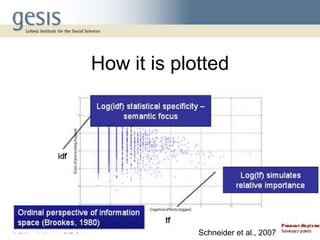
• Seed term is always at the tip, and the other
terms are placed (as a scatterplot) on two
logarithmic axes with respect to the seed
• Horizontal axis represents cognitive
effects (from low at left to high at right) and
predicts that the user will experience
greater cognitive effects the closer a term
is to the seed
8
How it works
• Vertical axis represents the predicted ease
of processing a term (from low at bottom to
high at top)
• Placement on it represents a term’s total
count in the database
• Terms with counts lower than the seed’s
tend to be very specifically related to the
seed and hence are easy to interpret.
9
How it is plotted
10
Schneider et al., 2007
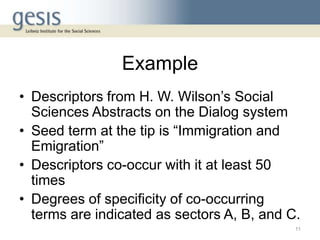
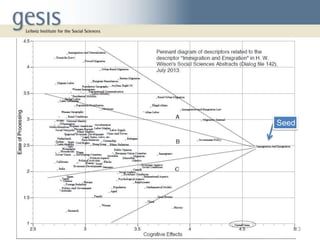
Example
• Descriptors from H. W. Wilson’s Social
Sciences Abstracts on the Dialog system
• Seed term at the tip is “Immigration and
Emigration”
• Descriptors co-occur with it at least 50
times
• Degrees of specificity of co-occurring
terms are indicated as sectors A, B, and C.
11
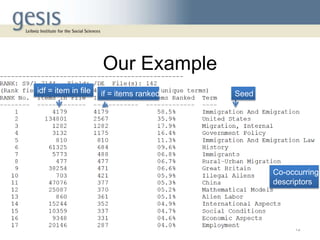
Our Example
12
idf = item in file if = items ranked
Co-occurring
descriptors
Seed
Example
13
Seed
Results
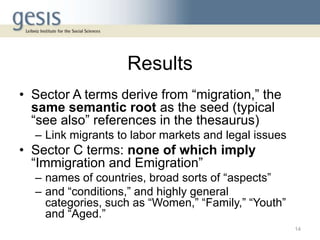
• Sector A terms derive from “migration,” the
same semantic root as the seed (typical
“see also” references in the thesaurus)
– Link migrants to labor markets and legal issues
• Sector C terms: none of which imply
“Immigration and Emigration”
– names of countries, broad sorts of “aspects”
– and “conditions,” and highly general
categories, such as “Women,” “Family,” “Youth”
and “Aged.”
14
Results
• Pennant is showing the structure of
existing literatures in this database
• Descriptors in the context of this seed
term
– E.g. “Government Policy,” “Migration,
Internal,” “Immigration and Emigration Law,”
and “History“
15
Summary
• Pennants are comparable easy to
compute
• Pennants could be good starting points
for indexer and searcher to retrieve
alternative descriptors
• Future: We are planing to implement a
Pennants visualization in sowiport
16
Questions
Are Pennants
• meaningful?
• beautiful?
• useful?
17
Further reading
• White, H. (2007a) Combining bibliometrics, information
retrieval, and relevance theory, part 1: First examples
of a synthesis. JASIST 58(4), p. 536-559
• White, H. (2007a) Combining bibliometrics, information
retrieval, and relevance theory, part 2: Some
implications for information science. JASIST 58(4), p.
583-605
• Schneider, Jesper W., Birger Larsen, Peter Ingwersen.
(2007). Pennant Diagrams: What Is It [sic], What Are
the Possibilities, and Are They Useful? Presentation at
the 12th Nordic Workshop on Bibliometrics and
Research Policy. Copenhagen, Denmark
18

Pennants for Descriptors

  • 1.
    Pennants for Descriptors HowardD. White, Philipp Mayr philipp.mayr@gesis.org NKOS workshop, Valletta, Malta 2013-09-26
  • 2.
    Introduction • Online searchingand browsing of large databases need much more meaningful visualization and possibilities to better understand the underlying data and structures • Especially in KOS-enhanced systems • This presentation outlines the main ideas and mechanisms of pennant diagrams applied on descriptor distributions in literatures 2
  • 3.
    Background • Pennant diagramsis an idea of Howard White (Drexel University) • A combination of bibliometrics, information retrieval and relevance theory • Pennants have been implemented first in the system Authorweb for co-cited authors at Drexel • This approach is working on typical bibliographic and bibliometric data 3
  • 4.
    Motivation • Apply thisnew technique for displaying the descriptors related to a descriptor across literatures • Background: “Bibliometric distributions are densely populated power law distributions of core and scatter” ( see Schneider et al. 2007) – e.g. Bradford distributions • Co-occurrence distributions behave similar to bibliometric distributions • We try to utilize these typical distributions to visualize co-occurring descriptors – Pennants can be a starting point for a dialogue between system and user – Pennants can be a different way of showing the database-centric usage of KOS in a collection 4
  • 5.
    Requirements • Data gathering(this example) in the Dialog search system due to its RANK command 1. Everything what the users needs is a good seed term to initiate retrieval and display 2. Non-zero co-occurrence counts of every term with the seed 3. Total frequency counts for each of these co-occurring terms in the database. • Counts in (2) and (3) are the basic input to the well-known tf*idf term-weighting 5
  • 6.
    Calculation • The countsin (2) are converted to a tf (term frequency) weight as log(count) + 1, • and the counts in (3) are converted to an idf (inverse document frequency) weight as log(N/count), where N is the total number of documents in the database (estimated if not known). 6
  • 7.
    Relevance effect • Relevanceof a message in a particular context depends on two factors that operate simultaneously (see Sperber & Wilson, 1995) – Cognitive effects on a reader: the greater the cognitive effects it produces, the greater its relevance – Processing effort the message costs the reader: the easier it is to process, the greater its relevance • These two factors underlie the positioning of terms on the pennant 7
  • 8.
    How it works •Seed term is always at the tip, and the other terms are placed (as a scatterplot) on two logarithmic axes with respect to the seed • Horizontal axis represents cognitive effects (from low at left to high at right) and predicts that the user will experience greater cognitive effects the closer a term is to the seed 8
  • 9.
    How it works •Vertical axis represents the predicted ease of processing a term (from low at bottom to high at top) • Placement on it represents a term’s total count in the database • Terms with counts lower than the seed’s tend to be very specifically related to the seed and hence are easy to interpret. 9
  • 10.
    How it isplotted 10 Schneider et al., 2007
  • 11.
    Example • Descriptors fromH. W. Wilson’s Social Sciences Abstracts on the Dialog system • Seed term at the tip is “Immigration and Emigration” • Descriptors co-occur with it at least 50 times • Degrees of specificity of co-occurring terms are indicated as sectors A, B, and C. 11
  • 12.
    Our Example 12 idf =item in file if = items ranked Co-occurring descriptors Seed
  • 13.
  • 14.
    Results • Sector Aterms derive from “migration,” the same semantic root as the seed (typical “see also” references in the thesaurus) – Link migrants to labor markets and legal issues • Sector C terms: none of which imply “Immigration and Emigration” – names of countries, broad sorts of “aspects” – and “conditions,” and highly general categories, such as “Women,” “Family,” “Youth” and “Aged.” 14
  • 15.
    Results • Pennant isshowing the structure of existing literatures in this database • Descriptors in the context of this seed term – E.g. “Government Policy,” “Migration, Internal,” “Immigration and Emigration Law,” and “History“ 15
  • 16.
    Summary • Pennants arecomparable easy to compute • Pennants could be good starting points for indexer and searcher to retrieve alternative descriptors • Future: We are planing to implement a Pennants visualization in sowiport 16
  • 17.
  • 18.
    Further reading • White,H. (2007a) Combining bibliometrics, information retrieval, and relevance theory, part 1: First examples of a synthesis. JASIST 58(4), p. 536-559 • White, H. (2007a) Combining bibliometrics, information retrieval, and relevance theory, part 2: Some implications for information science. JASIST 58(4), p. 583-605 • Schneider, Jesper W., Birger Larsen, Peter Ingwersen. (2007). Pennant Diagrams: What Is It [sic], What Are the Possibilities, and Are They Useful? Presentation at the 12th Nordic Workshop on Bibliometrics and Research Policy. Copenhagen, Denmark 18